If you’ve been searching for the best free budgeting apps for students, you’ve probably noticed most lists either recommend apps that no longer exist or ones that aren’t actually free. This guide fixes that, with picks that are still around and genuinely free to use in 2026
. Your financial aid hits your account. It feels like a lot of money.
Two weeks later, it’s gone.
You didn’t buy anything wild. Just coffee, a few late-night food orders, and a subscription you forgot to cancel. Maybe one “just this once” purchase that turned into three.
Sound familiar? You’re not bad with money. You just don’t have a system yet.
That’s what this post is for.
Quick answer, if you’re short on time: Goodbudget is the best free pick if you want something simple with no bank linking. YNAB is the strongest app overall, and it’s free for a full year if you’re a verified student. Splitwise is worth adding if you split rent or groceries with roommates. Details on all six apps are below, along with the mistakes that quietly wreck most student budgets.
This list is based on what’s actually available right now, not recycled from older “best of” roundups. Several of those still recommend Mint, which shut down in January 2024. If you see it listed anywhere in 2026, that article hasn’t been updated in a while.
lets go through Best Free Budgeting Apps for Students in 2026 (Tested Picks, No Fluff)
Most budgeting advice assumes one thing: a steady paycheck, same amount, every month.
That’s not most students’ reality.
You might get a big lump of financial aid in September, a small paycheck in October, and nothing in December, since you’re on break and not working.
A budget built around a fixed salary doesn’t bend for that. It breaks.
There’s more going on too:
Splitting rent, groceries, or a Netflix account with roommates
A lot of small purchases that add up fast without feeling like much at the time
Little to no credit history yet
Hesitation about linking a bank account to a new app, which is a fair concern, not a paranoid one
Spotty campus Wi-Fi, which matters if an app needs a constant connection just to log a $4 coffee
Any app worth using has to work with these realities, not against them.
What “Free” Actually Means (Read This First)
Quick reality check before you download anything.
A lot of apps advertise “free” when they mean “free trial.” Seven days, sometimes a month, then a paywall. That’s not the same as an actual free plan.
So for each app below, it’s clear which ones you can use indefinitely for free and which ones are trials in disguise. Pricing changes often, so confirm current terms on the app’s own site before committing to one.
1. Goodbudget — Best If You Want Something Simple
Goodbudget runs on the envelope method.
Instead of one big pool of money, you split your income into digital “envelopes”: groceries, textbooks, fun money, transport, whatever fits your life. You spend from an envelope until it’s empty. Once it’s empty, that’s it.
Simple, and that’s the point. It sets a limit before you spend, instead of you finding out you overspent a week later.
What’s good:
Free plan includes up to 20 envelopes, enough for most student budgets
No bank account linking required; you enter transactions yourself
You can share the budget across two devices for free, useful if you’re splitting costs with a partner
The envelope view in Goodbudget’s free plan — each category has its own spending limit.
What to know:
Manual entry only on the free plan. Skip logging for a week and the budget stops reflecting reality.
Bank syncing is a paid upgrade.
If you’ve never budgeted before, Goodbudget is a solid place to start.
2. YNAB (You Need A Budget) — Free for Verified Students
YNAB normally costs money, and not just a few dollars. But verified college students get a full free year with a valid .edu email, no catch. Check current terms directly on YNAB’s website.
The method behind it is zero-based budgeting. Every dollar gets a job before you spend it. Instead of looking back at where your money went, you decide ahead of time where it’s going.
This is what “giving every dollar a job” looks like inside YNAB.
[IMAGE 2: YNAB budget screen showing categories assigned, “$0 left to assign”] Alt text: “YNAB zero-based budget screen with every dollar assigned to a category”Suggested caption: “This is what ‘giving every dollar a job’ actually looks like inside YNAB.”
What’s good:
Full access, not a stripped-down version
Automatic bank syncing
Solid educational content if budgeting concepts are new to you
Encourages planning ahead instead of reacting after the fact
What to know:
There’s a real learning curve. Setting up your first budget can take 20 to 30 minutes.
Once you graduate, or if you’re not eligible for the student offer, it becomes a paid subscription.
Not built for people who want a passive app running quietly in the background. It expects your attention.
If you’re willing to put in some setup time, this is probably the most complete system on the list, and a free year as a student is a good deal.
3. PocketGuard — Good for a Fast “Can I Spend This?” Check
PocketGuard centers on one number: how much you actually have left to spend after bills and savings are accounted for. It stops you from spending money that’s already spoken for.
PocketGuard boils everything down to one number: what’s actually safe to spend.
What’s good:
Simple, visual, easy to check at a glance
Syncs with a large number of banks
Useful if you tend to overspend without noticing until it’s too late
What to know:
Reports on PocketGuard’s free plan are mixed right now. Some sources say a free basic tier still exists; others say it’s shifted to a short trial before pushing you to a paid plan. Check PocketGuard’s own pricing page before counting on it as free.
4. EveryDollar — Simple Zero-Based Budgeting
EveryDollar, from Dave Ramsey’s company, is another zero-based budgeting app, built lighter and less detailed than YNAB. If YNAB sounds like a lot, this is an easier entry point.
What’s good:
Clean interface, not overwhelming
Good structure without a steep learning curve
What to know:
Manual entry on the free version
Bank syncing costs extra
Works best if you already have a rough sense of your monthly income, which can be tricky with irregular student income
5. Splitwise — For Roommate and Group Expenses
Splitwise isn’t a budgeting app in the traditional sense. It solves one specific, common student problem: figuring out who owes who.
Rent, a group grocery run, a shared Netflix account, splitting a pizza three ways. If you’ve ever tracked that with screenshots and mental math, you know how fast it falls apart.
What’s good:
Free for its core features
Automatically calculates who owes what after a group expense
Removes the awkward “hey, you still owe me for…” conversation
What to know:
Use it alongside a real budgeting app, not instead of one. It’s a sidekick, not the main tool.
6. Empower (formerly Personal Capital) — For the Bigger Picture
Empower leans toward tracking net worth rather than day-to-day spending. Its free tier is worth knowing about once you have some savings, a student loan, or a small investment account.
What’s good:
Free net worth and account overview tools
Useful for seeing the bigger financial picture, not just this month’s spending
Handy for freelancers juggling income from multiple sources
What to know:
Less detailed on category-by-category budgeting compared to Goodbudget or YNAB
Some features nudge you toward Empower’s paid advisory services, which most students can ignore
Quick Comparison Table
App
Free Plan?
Bank Sync
Best For
Goodbudget
Yes, up to 20 envelopes
Paid only
Beginners who want simplicity
YNAB
Free 1 year (verified students)
Yes
Serious, structured budgeting
PocketGuard
Unclear as of 2026 — verify
Yes
Quick spendable-amount check
EveryDollar
Yes, manual entry
Paid only
Lighter zero-based budgeting
Splitwise
Yes
No
Splitting costs with roommates
Empower
Yes
Yes
Net worth and bigger-picture view
Not sure which one to pick? Follow the flowchart.
Common Mistakes Students Make With Budgeting Apps
Downloading five apps and using none of them properly. Pick one. Give it three real weeks before judging it.
Waiting until the weekend to log expenses. By then, half of it’s forgotten. Log it the same day; it takes 30 seconds.
Forcing a monthly budget onto irregular income. If your money comes in lump sums, plan around the lump sums instead of pretending it’s a steady paycheck.
Linking a bank account out of habit, not choice. If that makes you uneasy, don’t. Manual-entry apps exist for exactly this reason.
Never revisiting the budget. Exam season spending looks nothing like a normal month. Adjust it instead of setting it once and forgetting it.
A Quick Disclaimer This article is for general educational purposes and isn’t financial advice. I’m not a financial advisor or CPA. App features, free-plan limits, and pricing change often, so confirm current details on each app’s official website before relying on them. For general, unbiased budgeting guidance, the Consumer Financial Protection Bureau is a solid, non-promotional place to check.
FAQ
Is there a completely free budgeting app for college students in 2026? Yes. Goodbudget’s free plan covers up to 20 envelopes with no time limit. YNAB is also fully free for a year if you verify as a student with a .edu email.
Do budgeting apps require linking my bank account? No. Goodbudget relies on manual entry, so you never have to connect a bank account. YNAB and PocketGuard offer bank syncing, but it’s usually optional.
What’s the best budgeting app for irregular student income? Envelope-based apps like Goodbudget tend to handle irregular income better than apps built around a fixed monthly paycheck, since you’re planning around categories instead of a strict monthly total.
Is Mint still a good budgeting app for students? No. Mint shut down in January 2024. Any article still recommending it hasn’t been updated.
What’s the best app for splitting expenses with roommates? Splitwise. It’s not a full budgeting app, but it’s the easiest way to track shared costs and settle up without awkward reminders.
Final Thoughts
Budgeting as a student isn’t about being perfect with money. It’s about not getting blindsided two weeks before the semester ends.
Each app on this list solves a slightly different problem. The best one is whichever one you’ll actually open tomorrow.
Start free, use it for a few weeks, and only consider paying for extra features if you hit a real limitation. Most students never do.
If this helped, the natural next step is learning how to build your first budget, not just picking the app for it. That’s worth its own post.
By a 19-year-old creator, learning in public | For educational purposes only — not professional financial advice
🌍 Global Context Note: Banking products, loan terms, credit scores, taxes, and financial regulations vary by country. This guide includes examples from India and the US, but always verify local rules and rates before acting on anything here.
Nobody taught me this stuff.
Not at school. Not at home. Not anywhere.
I sat through years of lessons — history, science, math, English. But nobody ever explained how a bank account actually works. Nobody told me what happens when you ignore your spending. Nobody mentioned that the habits you build at 18 quietly shape the next twenty years of your life.
And then suddenly I had some money — a small allowance, a little from part-time work — and it disappeared. Every month. Without explanation.
I’d open my bank app and just stare at the number. Where did it go?
That confusion is what eventually pushed me to start learning about personal finance. And the first thing I realized? Almost nobody teaches this to students. Many students receive little or no formal personal finance education before graduating high school, according to research from the National Endowment for Financial Education (NEFE). That means most of us are figuring this out alone, usually after making a few expensive mistakes first.
This personal finance for studentsguide is my attempt to put everything I’ve learned in one place. Plain English. No confusing terms. No lectures. Just the real basics — explained the way I wish someone had explained them to me.
⚠️ Quick heads-up: I’m a 19-year-old writing this based on research and personal learning. Nothing here is professional financial advice. For important money decisions, please speak with a certified financial advisor or your bank directly.
🚀 New Here? Start With These Three Things Right Now
Before you read anything else, do these. They take under ten minutes total.
Open your bank app and look at your last 30 days of transactions. Not what you think you spent — what you actually spent.
Count every active subscription on your phone. Write down the monthly cost of each one.
Pick one small, fixed amount — ₹200, ₹500, whatever won’t hurt — and commit to moving it to savings the moment money arrives next month.
That’s your starting point. Everything else in this guide builds from there.
Personal finance just means how you manage your own money. That’s the whole thing. How much comes in. How much goes out. What you keep. What you owe. How you think about the future.
Nobody is born understanding this. It’s a skill. And like any skill, you get better by actually doing it — not by reading about it endlessly.
Here’s why it matters especially for students.
Right now, most of us don’t earn a lot. But we also don’t have a lot of obligations. No mortgage. No family to feed. No massive fixed bills. That combination — low income, low obligations — is actually a really useful window.
It’s the easiest time to build good habits from scratch.
Because here’s what I’ve learned: money habits stick. The ones you build at 18 or 19 tend to follow you. They either quietly work for you over time, or quietly work against you. And most people don’t realize which one is happening until years later.
I’m not saying this to scare you. I’m saying it because starting early — even with very little — genuinely matters.
You don’t need to be rich to start. You just need to pay attention.
Terms That Confused Me (And What They Actually Mean)
I want to be honest about something.
The first time I started reading about personal finance, I got confused and nervous almost immediately. Words like “CIBIL score,” “credit utilization,” “fixed deposit,” “SIP,” “compound interest” — they all sounded important. But nobody explained them in plain English.
I’d read one sentence and hit three unfamiliar terms. I’d Google one term and find two more I didn’t understand. It was exhausting.
So before we get into the actual guide, here are the terms that kept tripping me up — explained the way I wish someone had explained them when I first started.
Personal Finance Just how you manage your own money. Income, spending, saving, borrowing. That’s it. Nothing mysterious.
Budget A plan for where your money goes each month. Not a restriction — a decision. You decide in advance instead of wondering afterward.
Emergency Fund Money you keep set aside specifically for unexpected things. Broken phone. Sudden medical expense. A job gap. You don’t touch it for anything else. It’s your financial safety net.
Savings Account A basic bank account where your money earns a small amount of interest (usually 2.5–4% per year in India, though rates vary by bank and can change). Easy to access anytime.
Fixed Deposit (FD) You lock a sum of money with a bank for a fixed period — say, 6 months or 1 year. In return, the bank pays you a higher interest rate than a regular savings account (rates vary depending on the bank and deposit period). The catch: you can’t easily take the money out early without a penalty.
Compound Interest Interest on your interest. When you save money, you earn interest. Then next month, you earn interest on the original amount plus the interest from last month. Over years, this grows your money faster than simple interest. It’s one of the most important concepts in personal finance.
Credit Score A number that tells banks how trustworthy you are as a borrower. In India, it’s called a CIBIL score (300–900). In the US, it’s a FICO score (300–850). Higher is better. It affects whether you can get loans, credit cards, or even rent an apartment.
Credit Utilization The percentage of your credit limit you’re currently using. If your credit card limit is ₹20,000 and you’ve spent ₹6,000, your utilization is 30%. Many financial educators recommend keeping this below 30%, though lower is generally better.
SIP (Systematic Investment Plan) A way of investing a fixed small amount — say ₹500 — every month into a mutual fund, automatically. You don’t need to time the market. You just set it and let it run. Popular in India as a beginner investing method.
Mutual Fund A pool of money from many investors, managed by a professional. Instead of buying one stock, your money is spread across many — which reduces risk. Index funds are a common low-cost type.
Hard Inquiry When a bank or lender checks your credit history because you applied for a card or loan. Too many of these in a short time can slightly lower your credit score.
Moratorium Period For education loans in India — the gap between taking the loan and when repayments start. Usually 6–12 months after graduating or 1 year after getting a job, depending on the bank.
UPI (Unified Payments Interface) India’s digital payment system. When you pay someone using PhonePe, Google Pay, or Paytm — that’s UPI. Instant, free, and works 24/7.
Once I actually understood these terms, everything else made more sense. The guide below uses all of them — but now you already know what they mean.
How to Track Your Expenses as a Student
Before budgets, before savings, before any plan at all — you need to know where your money is actually going.
Most students have no idea. I didn’t.
I thought I was spending reasonably. Then I actually tracked one month. Food delivery I’d forgotten about. Subscriptions I hadn’t used in three weeks. Small random purchases that each felt harmless but together added up to a number I wasn’t proud of.
Tracking doesn’t fix anything on its own. But it makes everything visible. And you genuinely cannot manage what you cannot see.
I’ve been using the Expense Manager app by Bishinews to track my spending, and it’s been surprisingly helpful. It’s free, easy to use, and makes it simple to see exactly where my money goes each month. If you’re just getting started with budgeting, it’s a great option because you can log expenses quickly without dealing with complicated features.
Note: This is a personal recommendation based on my experience. I’m not affiliated with or sponsored by the developer.
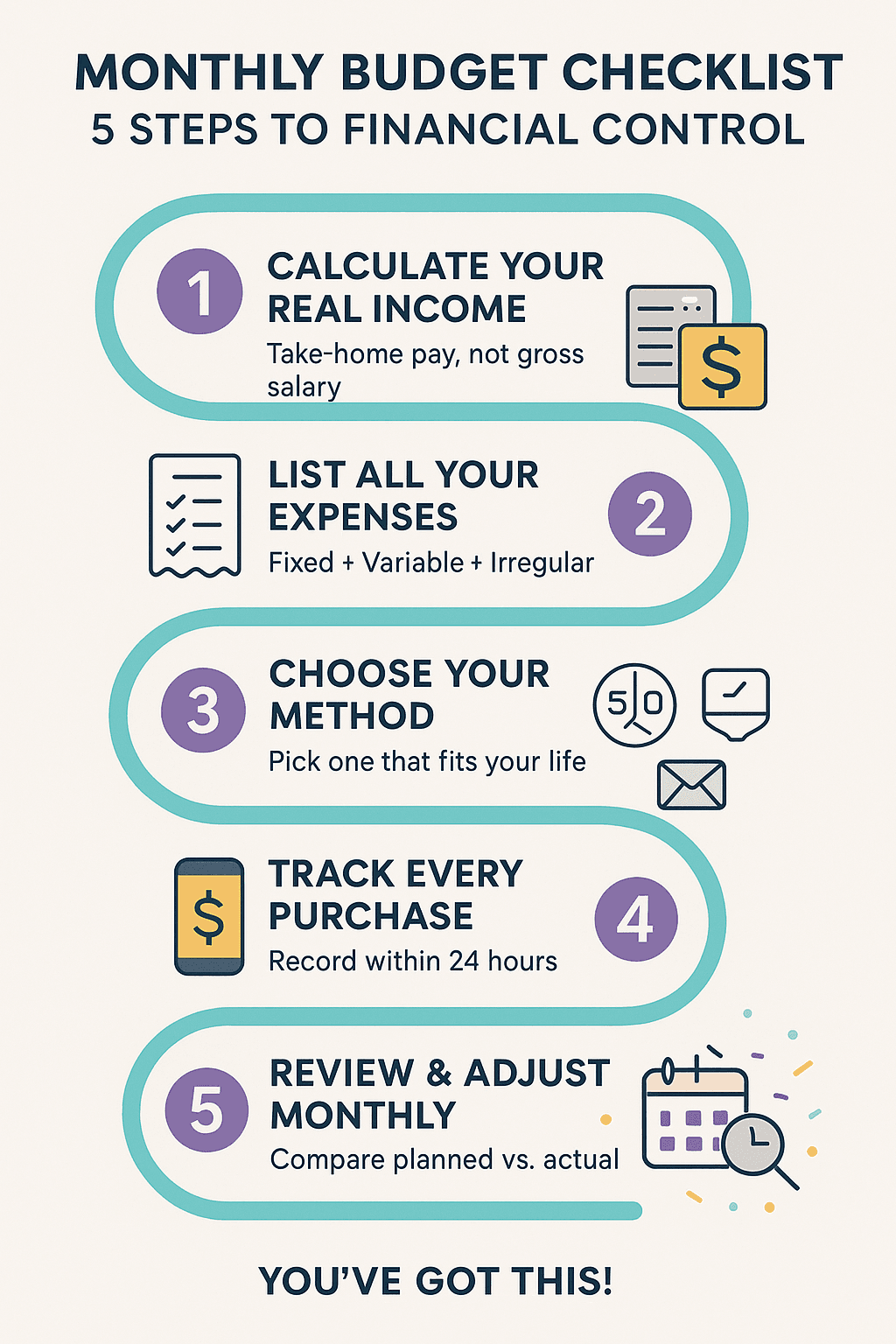
Here’s How to Start
Step 1 — Pick a method you’ll actually use.
No fancy app required. A notebook works. A Google Sheet works. If you want an app, Walnut is decent for India. Your own bank’s statement page works fine too. Whatever you’ll actually open every day — use that.
Step 2 — Record every purchase for 30 days.
Every coffee. Every ride. Every time you tap your card or use UPI. No skipping, no rounding, no “I’ll add it later.” Just record it honestly.
Step 3 — Sort it into categories.
At the end of the month, group everything:
Category
Examples
Essentials
Food, rent, transport, phone recharge
Education
Books, stationery, course fees, printing
Lifestyle
Eating out, movies, clothes, online shopping
Subscriptions
Netflix, Spotify, apps, cloud storage
Savings
Amount you actually moved aside
Random / Other
One-off purchases, unexpected costs
Step 4 — Look at the totals honestly.
Where did most of your money go? What surprised you? No judgment here. Just awareness.
Step 5 — Make one small change next month.
Not ten. One. Cancel one unused subscription. Cook at home twice a week instead of ordering. Swap one expensive habit for a cheaper one. Small, sustainable shifts.
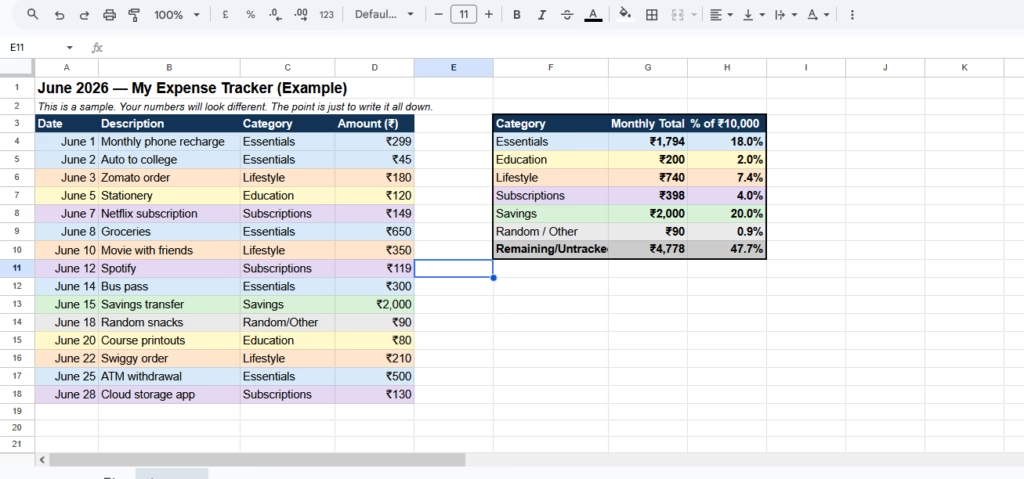
This is roughly how I categorize my spending each month. Nothing fancy—just consistent tracking.
A Sample Monthly Student Budget (Example Only)
This is a rough example for a student in an Indian city with ₹10,000/month. Your numbers will be different — this is just to show what tracking might look like:
Category
Example Amount
% of Income
Food & Groceries
₹3,000
30%
Transport
₹800
8%
Phone / Internet
₹500
5%
Education Costs
₹600
6%
Subscriptions
₹500
5%
Eating Out / Fun
₹1,600
16%
Savings
₹2,000
20%
Random / Buffer
₹1,000
10%
Total
₹10,000
100%
This is a hypothetical example. Costs vary significantly by city, lifestyle, and personal situation.
Five minutes a day. That’s all tracking takes. But most people never do it — and then wonder why they’re always running out of money before the month ends.
How to Budget When You’re a Student
Budgeting sounds like punishment. I know.
Like you’re going to be miserable, saying no to everything fun, staring at spreadsheets on a Friday night.
It’s not like that. A budget is just a plan. You’re deciding in advance where your money goes instead of being confused about it afterward. That’s it.
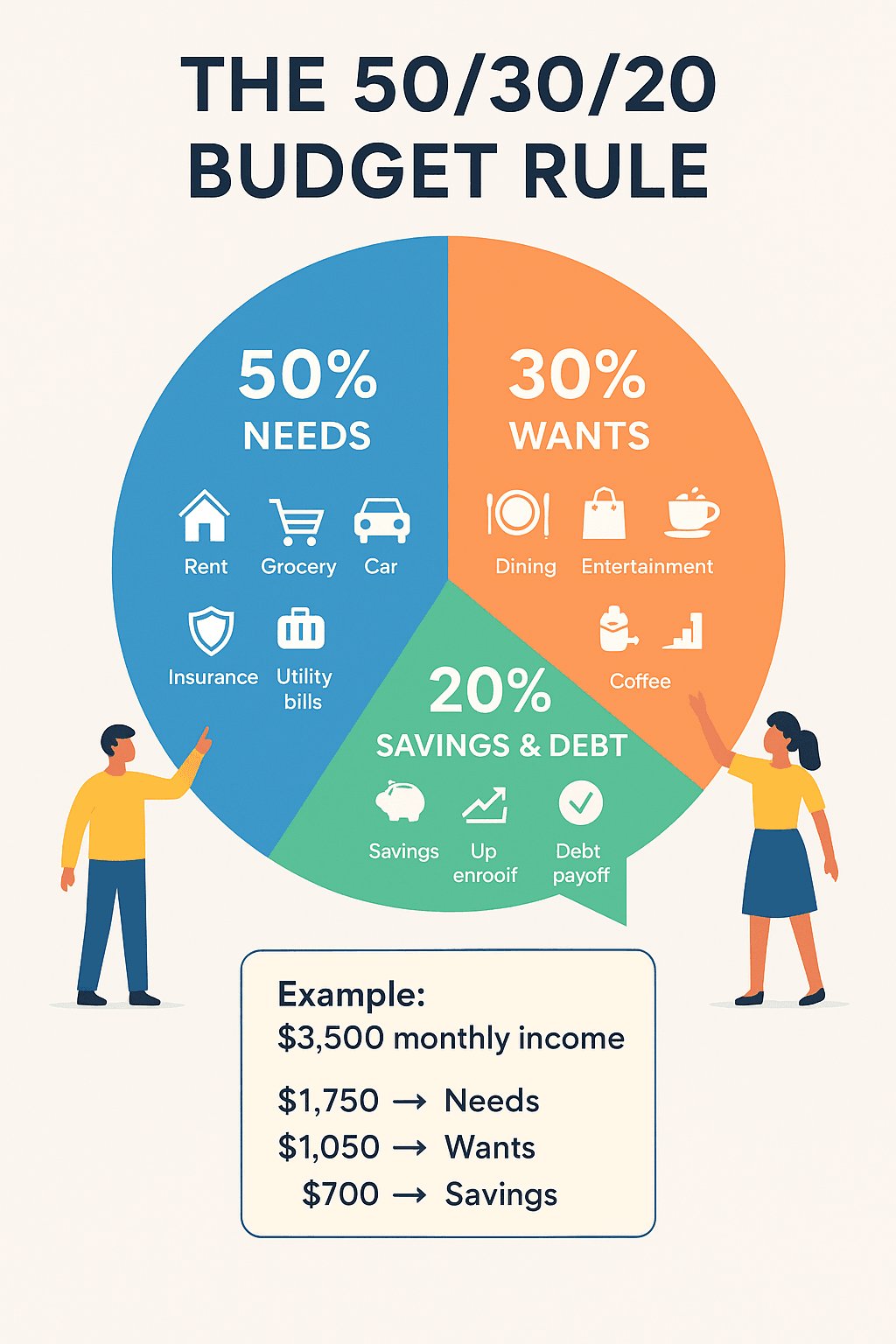
The 50/30/20 Method
This is the most beginner-friendly starting point I’ve found. Flexible, simple, and easy to remember.
Take your monthly income and split it roughly like this:
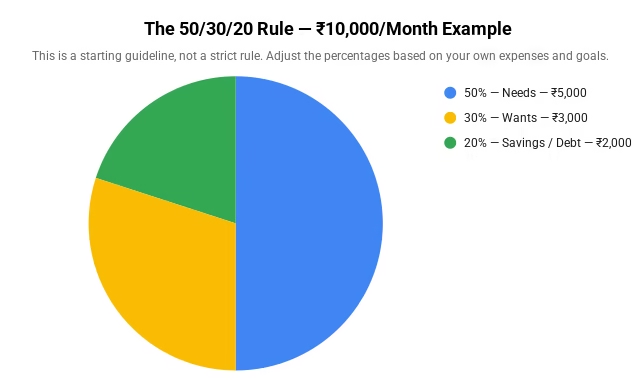
The 50/30/20 rule visualized. The green slice — savings — is the one most students skip first. Don’t.
Example with ₹10,000/month:
₹5,000 → Needs
₹3,000 → Wants
₹2,000 → Savings
This isn’t a rigid rule. If you’re living in Mumbai or Delhi and rent takes 60% of your income, that’s your reality — adjust from there. The point is to have some structure.
Zero-Based Budgeting (For When You Want More Control)
The idea here: every single rupee gets a specific job. Income minus all your assigned amounts = zero. Nothing floats around unaccounted for.
It’s more work than 50/30/20. But it gives you total clarity. No surprises at the end of the month. Apps like YNAB are built around this approach if you want to try it.
My honest suggestion: start with 50/30/20. If you want more precision after a month or two, try zero-based. The worst budget is the one sitting in a tab you never open.
Work toward financial independence — not relying on anyone
Build enough savings to take a risk (quit a bad job, start something)
You don’t need goals in all three categories right now. Just having one short-term goal makes a real difference. Write it down. Give it a number. Put it somewhere you see regularly.
“Save ₹8,000 for a new laptop by December” is more motivating than “save money.” Specific goals work. Vague ones don’t.
How to Save Money as a Student on a Low Income
“I don’t earn enough to save.”
I’ve said this. Most students have said this. And I’m not going to pretend it’s never true — survival mode is real, and some students are genuinely stretched thin.
But a lot of the time, the real issue isn’t the amount. It’s the absence of a system.
Start Ridiculously Small
Don’t try to save 20% right away. Start with an amount so small it barely registers.
₹200 a week. ₹100. Whatever doesn’t feel like a sacrifice.
Set up an automatic transfer — the moment money comes in, a tiny amount moves to a separate savings account before you can spend it. Out of sight, genuinely out of mind.
The habit matters more than the amount right now. Build the habit first, then increase it later.
Build Your Emergency Fund Before Anything Else
Before investing, before any big financial move — build a small buffer.
Students often start with a small emergency fund equal to one or two months of essential expenses and gradually build toward a larger amount over time. For many students, that starting target might be ₹5,000–15,000 depending on your city and lifestyle.
Why? Because without it, every surprise — broken phone, unexpected medical visit, sudden travel — becomes debt. And debt has a way of growing.
This is the concept that changed how I think about saving. I’ll keep it short.
When you save money, you earn interest. Next period, you earn interest on the original amount plus the interest from before. That process keeps repeating. Over years, it grows your savings significantly without you doing anything extra.
Here’s a rough example with clear assumptions:
Hypothetical example only — not a guarantee of returns: Monthly investment: ₹1,000 Assumed annual return: 7% Starting at age 18, investing for 22 years (to age 40): Approximate total invested: ₹2,64,000 Approximate value at 40: ~₹6,00,000+
Starting at age 28 instead, for 12 years: Approximate total invested: ₹1,44,000 Approximate value at 40: ~₹2,10,000+
Returns are hypothetical and not guaranteed. Actual results depend on the investment vehicle, market conditions, fees, and timing. Always research before investing.
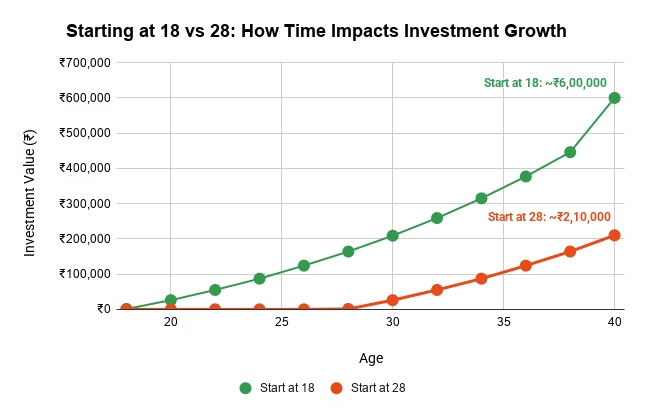
Starting early matters more than investing larger amounts later. Even with the same monthly contribution, time gives compound growth more opportunities to work.
Disclaimer:Hypothetical example only. Returns are not guaranteed. Actual results depend on the investment vehicle, market conditions, and fees. Always research before investing.
The gap isn’t because the second person is worse with money. It’s just time. That’s compound interest doing its thing.
Once you have even a small emergency fund, it’s worth knowing investing exists — even if you’re not ready to start.
SIPs (Systematic Investment Plans) let you invest a fixed amount every month into a mutual fund automatically. You can start with ₹500/month on platforms like Groww or Zerodha Coin. You don’t need to time the market. You just set a monthly amount and let it run.
Index funds are a common beginner choice — they track a broad market index, costs are usually low, and risk is spread across many companies.
But — and this matters — investing carries real risk. You can lose money. Never invest an amount you’d urgently need back. And do your own research before putting any money in. The Securities and Exchange Board of India (SEBI) has a free investor education portal worth checking before you start.
→ Related: Saving vs Investing: Which Should You Do First?(coming soon)
Banking Basics Every Student Should Know
I assumed everyone just… knew how banking worked. Then I realized I had gaps in my own understanding that I’d never admitted to anyone.
So here’s the straightforward version.
Savings Account vs Current Account
A savings account is what most students use. It earns modest interest on your balance (rates vary by bank). Easy to open, easy to use for day-to-day transactions.
A current account is mainly for businesses. It handles higher transaction volumes but typically earns no interest. As a student, you almost certainly want a savings account — not a current account.
A debit card spends your own money. A credit card borrows the bank’s money — which you must pay back. This distinction matters more than most people realize.
UPI and Online Banking
In India, UPI (Unified Payments Interface) has made digital payments effortless. PhonePe, Google Pay, Paytm — all use UPI. It’s instant, free, and works 24/7.
Most banks now have solid mobile apps. Set yours up if you haven’t. Being able to check your balance, track transactions, and transfer money instantly makes staying on top of finances much easier.
Avoiding Unnecessary Bank Fees
A few things to watch:
Minimum balance fees — Some accounts charge you if your balance drops below a certain level. Check your account type. Many student or zero-balance accounts don’t have this.
ATM charges — Most banks allow a fixed number of free ATM withdrawals per month. Exceeding that incurs small fees that add up.
SMS alert charges — Some banks charge a small fee for transaction alerts. Check whether yours does.
These are small amounts individually. But noticing them is part of paying attention to your money.
Student Loans: What You Should Know Before You Borrow
Taking a loan for education isn’t automatically a bad decision. For many students, it’s the only realistic path to getting the qualification they want.
But going in without understanding the terms? That’s where things go wrong.
Interest Doesn’t Wait for You to Graduate
Depending on the loan, interest may start building from day one — before you’ve finished studying, before you’ve found a job. By the time your course ends, your balance could be higher than when you started.
Not all loans work this way. Some have a moratorium period — a gap where you don’t have to repay yet. But interest might still be running. Read the terms before signing. All of them.
Not All Debt Is the Same
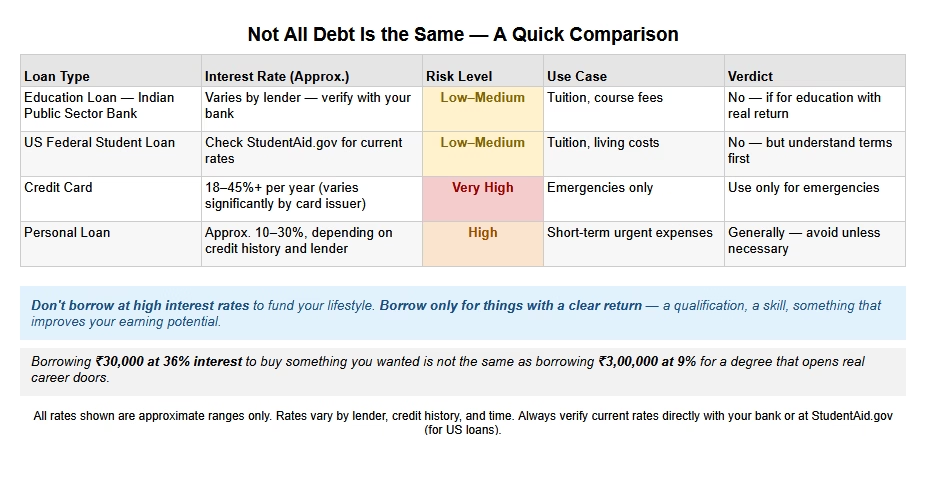
These are the most common types of debt students encounter. The interest rate gap between them can be significant.
For US students, StudentAid.gov has clear, up-to-date information on loan types, repayment options, and interest rates directly from the federal government.
Don’t borrow at high interest rates to fund your lifestyle. Borrow for things with a clear return — a qualification, a skill, something that improves your earning potential.
Borrowing ₹30,000 at 36% interest to buy something you wanted is not the same as borrowing ₹3,00,000 at 9% for a degree that opens real career doors.
All rates shown are approximate ranges. Always confirm current rates directly with your lender.
How to Build Credit as a Student Responsibly
Credit felt like an adult concept to me for a long time. Then I realized it starts much earlier than I thought — and that ignoring it early can create headaches later.
Your credit score is a number that tells banks how reliably you pay back borrowed money.
In India: CIBIL score, range 300–900. In the US: FICO score, range 300–850. Higher = better.
This score affects real things: whether you can rent an apartment, qualify for a loan, or get a better interest rate. It’s built slowly, over time, through consistent behavior.
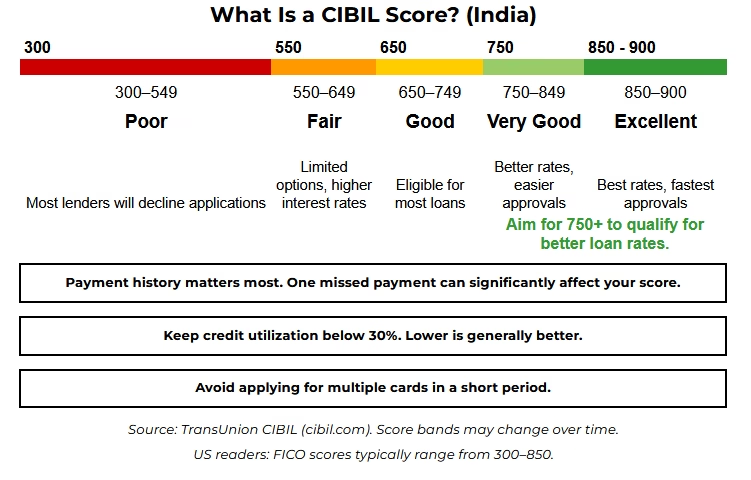
A higher CIBIL score can improve your chances of qualifying for loans and better interest rates.
Payment history — Do you pay on time? This is the biggest factor.
Credit utilization — What percentage of your available credit are you using? Many financial educators recommend keeping this below 30%, though lower is generally better.
Length of credit history — How long have your accounts been open?
New applications — Have you been applying for credit frequently?
One missed payment can hurt more than months of good behavior helps. Payment history really is that important.
How to Start Building Credit (Without Messing It Up)
1. Get a student or secured credit card. These exist for people with little or no credit history. A secured card is backed by a fixed deposit — the bank’s risk is low, so they’re easier to get.
2. Use it for one small predictable expense. A phone bill. A streaming subscription. Something you’d pay for anyway. Charge it, then pay it immediately.
3. Pay the full balance every single month. Not the minimum — everything. This is non-negotiable. Paying only the minimum triggers interest charges that compound fast. The CFPB has a clear explanation of how credit card interest works if you want to understand the math.
4. Keep utilization low. If your limit is ₹20,000, try to stay below ₹6,000 used at any time.
5. Don’t apply for multiple cards at once. Each application creates a hard inquiry on your record. Multiple hard inquiries in a short window signals financial stress to lenders and can slightly lower your score.
Build it slowly. There’s no shortcut. A clean, consistent track record is the entire goal.
→ Related: What Is a CIBIL Score and How Does It Work?(coming soon)
Common Personal Finance Mistakes Students Should Avoid
These aren’t judgments. They’re just patterns. Almost every student — including me — falls into at least one.
Mistake 1: Treating a Credit Card Like Free Money
It isn’t free. It’s borrowed money with interest attached. If you don’t pay the full balance, that interest compounds fast — often at 18–45% annually, varying by card issuer.
A lot of students build card debt buying things they couldn’t otherwise afford, then spend years slowly paying it off.
Fix: Only spend on a credit card what you already have in your bank account.
Mistake 2: Ignoring Subscriptions
₹149 here. ₹199 there. ₹299 for something you signed up for once and forgot.
Individually harmless. Together, they drain quietly. Six to eight subscriptions can add up to ₹1,200–2,000 a month — money that disappears without you noticing.
Fix: Audit every three months. If you haven’t used something in 30 days, cancel it.
Mistake 3: Having No Emergency Buffer
Something unexpected will happen. Phone screen. Medical visit. Travel emergency. Without a buffer, every surprise becomes debt.
Fix: Build a small emergency fund before anything else. Even ₹3,000–5,000 makes a difference. Students often start small and build it gradually — the goal isn’t perfection, it’s having something.
Mistake 4: Spending to Match Friends
You go places you can’t afford because everyone’s going. You buy things you don’t need because they have them. It’s quiet pressure and it’s real.
Fix: Know your own numbers. Decisions based on your budget, not on how someone else’s life looks on the surface.
Mistake 5: Waiting Until You Earn More
“I’ll start saving when I get a real job.” “I’ll budget once I have a proper income.”
It rarely happens that way. Spending grows with income. The habits you build now follow you forward.
Fix: Start with whatever you have. A small habit built now beats a perfect plan that never starts.
→ Related: Best Side Hustles for Students to Increase Income in 2026(coming soon)
📋 Disclaimer
Please read this before acting on anything in this article.
This guide is written by a 19-year-old beginner creator for educational and informational purposes only. It is not professional financial, legal, or investment advice.
Interest rates, loan terms, credit rules, and tax laws change regularly and differ by country, bank, and individual situation. All figures and rates mentioned here are approximate and may be outdated by the time you read this.
Always verify current information directly with your bank, a certified financial advisor, or an official government financial resource before making important decisions.
External links are included for reference only. Inclusion of a link does not imply endorsement of the content.
FAQ
What is the best budgeting method for students?
There’s no single best method — it depends on your personality. If you want something simple and flexible, start with the 50/30/20 rule: 50% needs, 30% wants, 20% savings. If you want total control and zero mystery, try zero-based budgeting where every rupee gets assigned a specific purpose. The best method is whichever one you’ll actually stick to.
How much money should students keep in an emergency fund?
Start small. Students often begin with a target equal to one or two months of essential expenses — just enough to handle a broken phone, a medical visit, or a sudden travel need without going into debt. For many students in India, that might be ₹5,000–20,000 depending on their city and lifestyle. Build it gradually. Having something is far better than having nothing.
What’s the difference between a debit card and a credit card?
A debit card spends your own money directly from your bank account. You can only spend what’s there. A credit card borrows money from the bank up to your credit limit — you then have to repay it. If you don’t pay the full balance, interest charges apply, often at high rates. A debit card can’t build your credit score; a credit card can, if used responsibly.
What is the best budgeting method for students with no income?
If you have no income yet, focus on tracking rather than formal budgeting. Note where money comes from and where it goes — even if it’s an allowance from family. Understanding your spending patterns before you earn independently is genuinely useful preparation. Once income starts, even the simplest budget (set aside a fixed percentage first, spend the rest) will put you ahead of most people.
Should students invest before paying off debt?
Generally, no — if the debt carries high interest. Paying off a credit card charging 36% interest gives you a guaranteed 36% return. No investment reliably matches that. The common guidance: clear high-interest debt first, then build an emergency fund, then begin investing. For low-interest debt like an education loan, the calculation is less clear — some people invest and repay simultaneously. But high-interest debt almost always gets paid first.
How much should a student save every month?
There’s no magic number. The common suggestion is 10–20% of income. But if that’s not realistic right now, start with ₹200 or ₹500 — whatever you can move consistently. Consistency matters far more than the amount when you’re building the habit from scratch.
Is it worth getting a credit card as a student in India?
It can be, if you’re disciplined. Student credit cards and secured cards are low-risk ways to begin building a CIBIL score. The one rule that matters: pay the full balance every month, not just the minimum. If you’re not sure you can commit to that, hold off until you are.
Final Thoughts + What To Do This Week
Personal finance for students doesn’t require a finance degree. It doesn’t require a lot of money. It doesn’t require being exceptionally disciplined or organized.
It mostly just requires paying attention.
Knowing where your money goes. Making a rough plan. Saving something, even small. Avoiding high-interest debt. Building credit slowly and cleanly. Setting a goal that makes saving feel like it has a point.
None of that is exciting. None of it goes viral. But it compounds quietly over years — into more options, less financial stress, and more freedom to make choices based on what you actually want rather than what you can currently afford.
Start now. Start small. Stay consistent.
That’s genuinely all there is to it.
✅ What To Do This Week
If you finish reading this and do nothing, you’ll forget most of it by next week. Personal finance for students isn’t about knowing more—it’s about taking small actions consistently. Here are four things you can do in under an hour before the week ends.
Look at your last 30 days of transactions. Open your bank app right now. Not what you think you spent — what actually happened.
List every active subscription and its monthly cost. Add them up. You might be surprised.
Pick one financial goal. Write it down with a number and a date. “Save ₹8,000 by December” beats “save more money.”
Move a small amount to savings before your next spend. Set up an automatic transfer if possible. Even ₹200 counts.
That’s your starting point. Everything else builds from there.
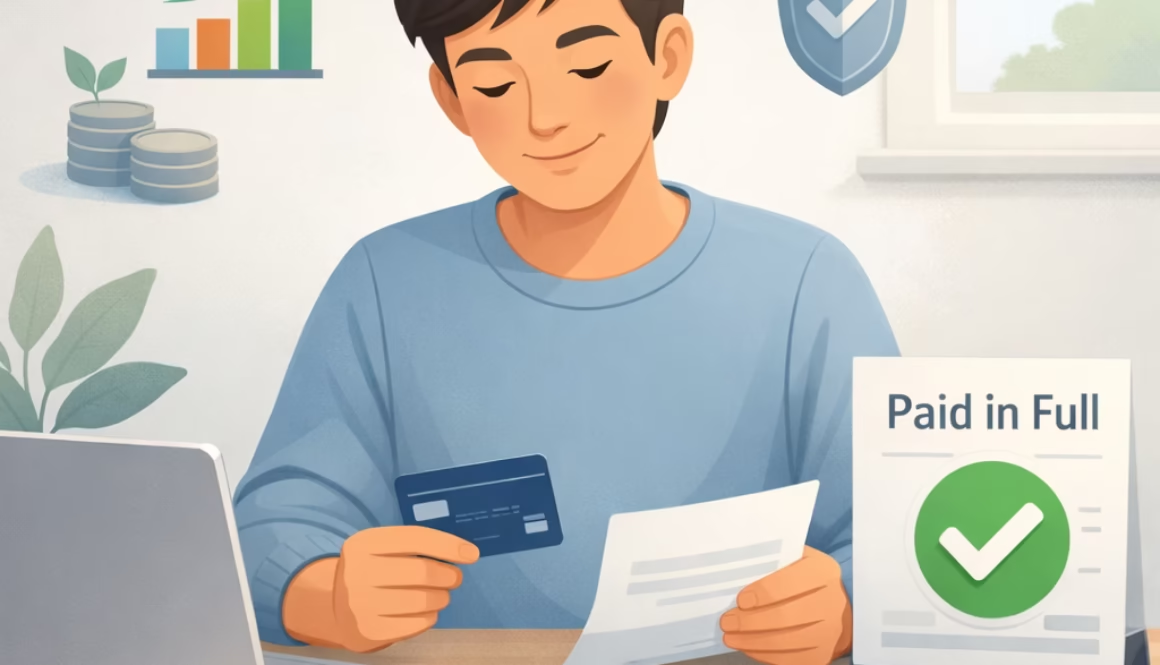
I used to think I had this whole credit card thing figured out. Made my minimum payments. Never missed a due date. Used my card for groceries, gas, the usual stuff. Felt pretty responsible, actually.
Then I checked my balance one random Tuesday afternoon.
$4,500.
I stared at that number for a good five minutes. How did this happen? More importantly—why was I only paying down like $30 of actual debt each month while the rest went straight to interest? That’s when it hit me. I wasn’t managing my credit. It was managing me.
Here’s something wild: Americans now owe over $1.2 trillion in credit card debt. The average person carries around $6,500. But here’s the thing nobody tells you—using credit cards responsibly isn’t about avoiding them entirely. It’s about understanding how they work and making them work for you.
Using credit cards responsibly means treating them like a payment tool instead of free money. Pay your full balance every month. Keep your spending way below your limit. Only buy what you can actually afford right now. Do this, and credit cards become one of the best financial tools you’ll ever have.
Do it wrong? Well. You end up like I did. Staring at a balance that grew while I thought I was being smart.
TL;DR: The Core Rules (For the Impatient)
If you only read one section, make it this:
Pay your full statement balance every month before the due date
Keep your balance under 30% of your limit (10% is even better)
Only charge what you can afford to pay off immediately
Set up autopay for at least the minimum as a safety net
Check your statement monthly for errors and fraud
Never carry a balance thinking it helps your credit score (it doesn’t)
Everything else in this post just explains why these rules matter and how to actually stick to them.
What Does Using Credit Cards Responsibly Actually Mean?
Okay. Let’s start here.
Responsible credit card use sounds like something your parents would say. Or a bank commercial. It’s one of those phrases that everyone uses but nobody really explains.
So here’s my take after years of getting it wrong, then finally getting it right.
Managing credit cards wisely means treating your credit card like it’s a debit card that gives you rewards.
That’s it. That’s the whole thing.
You wouldn’t spend $500 on your debit card if you only had $300 in your checking account, right? Same rules apply to credit cards. The only difference is credit cards let you borrow money for a few weeks. And if you pay it back before they start charging interest, you get to keep any rewards you earned.
Consumer finance data shows that cardholders who pay in full each month save an average of over $1,000 annually in interest charges compared to those who carry balances. It’s actually a pretty sweet deal. If—and this is a massive if—you play by the rules.
What It Looks Like in Real Life
Someone practicing smart credit card habits:
Pays off the entire balance before the due date every single month
Keeps their balance under 30% of their credit limit (even better if it’s under 10%)
Only buys stuff they already budgeted for
Checks their statement regularly for weird charges
Never, ever spends money they don’t actually have
Someone heading for trouble:
Makes minimum payments and carries the balance month after month
Uses credit to afford a lifestyle their income doesn’t support
Maxes out their cards or keeps balances super high
Forgets about due dates or just pays whenever
Opens multiple cards in a short period without any real plan
Here’s a Real Example That Changed How I Think
I have two friends. Alex and Jordan. Both make about $3,000 a month.
Alex puts $800 on a credit card every month. Groceries, gas, utilities. Normal stuff. Pays the full $800 off every single month. Gets 2% cash back, which comes out to about $16 monthly. Built an excellent credit score doing this. Total interest paid per year? Zero dollars.
Jordan does the exact same thing. $800 monthly charges. But Jordan only pays the $25 minimum each month. And with credit card interest rates hovering around 25% these days, Jordan’s balance keeps growing. By the end of the year, Jordan owes $8,600 and has paid over $1,800 just in interest.
Same income. Same purchases. Completely different outcomes.
That’s what responsible use looks like. It’s not about how much you make. It’s about the system you follow.
Which of these mistakes sounds familiar to you? Most people I know have been Jordan at some point. Including me.
How Credit Cards Really Work (The Parts They Don’t Advertise)
I’m going to be real with you. I used credit cards for three years before I actually understood how they worked.
Nobody explains this stuff. They just hand you a card and assume you’ll figure it out. Or maybe they’re hoping you won’t. Because the less you understand, the more money they make off interest charges.
So let me break it down the way I wish someone had for me.
Billing Cycles vs. Due Dates (They’re Not the Same Thing)
Your billing cycle is usually about 30 days. During this time, everything you buy gets added to your balance.
At the end of the cycle, your credit card company sends you a statement that says “you owe this much.”
Your due date comes about 3-4 weeks after that statement.
The time between these two dates? That’s your grace period. And it’s basically free money—if you use it right.
Here’s how it works:
March 1-31: You charge $600 in purchases
April 1: Your statement closes and says you owe $600
April 25: Payment is due
If you pay that $600 before April 25, you pay zero interest
If you pay less, interest starts piling up on what’s left
I didn’t understand this for the longest time. I thought as long as I made some payment, I was good.
Nope.
Any amount you don’t pay in full starts collecting interest immediately.
Interest Rates Are Designed to Confuse You
APR stands for Annual Percentage Rate. Sounds simple enough, right?
But here’s what they don’t tell you in the commercials. That annual rate gets divided up and charged every month.
So if your APR is 24% (pretty common these days), you’re actually paying about 2% per month on whatever balance you carry.
Doesn’t sound like much?
Let me show you what happened to me. I once carried a $3,000 balance thinking I’d pay it off “eventually.”
At 23% APR, I was getting hit with roughly $57 in interest charges every single month. So even when I paid $100, only $43 actually went toward my debt.
The rest lined the bank’s pockets.
It took me eight months to figure out why my balance barely moved.
The Grace Period Disappears If You Carry a Balance
This one shocked me.
Most people think the grace period is always there. It’s not.
If you carry a balance from the previous month, many credit cards stop giving you a grace period on new purchases. Which means the second you swipe your card, interest starts accumulating.
So you end up paying interest on stuff you just bought. Even if you pay it off next month.
It’s like a penalty for having a balance. Nobody tells you this upfront, of course.
The Minimum Payment Trap (This Almost Ruined Me)
Credit card companies require a minimum payment. Usually 1-3% of your balance, or $25-$35, whichever is higher.
Sounds reasonable, right?
It’s literally designed to keep you in debt as long as possible.
According to data from the Consumer Financial Protection Bureau, the share of cardholders making only minimum payments has reached its highest level in years. And I was one of them for way too long.
I did the math once. If you owe $6,000 at 22% APR and you only make minimum payments (let’s say 2%, so $120 a month), you’ll be paying that debt for over 14 years.
Fourteen. Years.
And you’ll pay about $6,500 in interest alone.
Which means that $6,000 in purchases ends up costing you $12,500 total.
Minimum payments keep your account in good standing. That’s all they do. They don’t help you financially. At all.
Key takeaway: Paying only the minimum is the single biggest credit card mistake you can make. Resources like Bankrate have entire calculators dedicated to showing people how much minimum payments actually cost them over time.
The Psychology Behind Credit Card Spending (Why Your Brain Works Against You)
Here’s something they don’t teach in school: credit cards literally rewire how your brain processes spending.
I’m not exaggerating. There’s actual research on this.
Why Credit Cards Disconnect Pain from Spending
When you hand over cash for something, your brain registers a loss. You see the money leave your hand. You feel lighter. There’s a genuine psychological response that says “I just spent money.”
With credit cards?
Nothing. Just a quick tap or swipe. No emotional feedback. No sense of loss. Your brain doesn’t register that you spent anything because nothing physical changed hands.
Studies consistently show people spend 12-18% more when using credit cards versus cash for identical purchases. It’s not because credit card users are less disciplined. It’s because the payment method itself removes the psychological pain of spending.
How Banks Design Experiences to Make You Spend More
Ever noticed how credit card apps are really smooth and easy to use? How paying is literally one tap?
That’s intentional.
Banks and card companies spend millions designing user experiences that remove friction from spending. They want it to feel effortless. Painless. Almost invisible.
Compare that to checking your balance or reading your statement. Usually buried in menus. Multiple clicks. Harder to find.
Again—intentional.
The easier it is to spend and the harder it is to track, the more likely you are to overspend. This isn’t conspiracy theory stuff. It’s basic behavioral economics applied to card design.
Why Debit Cards Feel Different (Even Though They Shouldn’t)
Debit cards work almost identically to credit cards from a user experience perspective. Tap, swipe, done.
But psychologically? They feel totally different.
With debit cards, the money leaves your account immediately. You can’t spend more than you have. There’s a hard limit that your brain recognizes.
With credit cards, that limit is artificial. It’s your credit limit, not your actual money. So your brain treats it differently—more like potential money than real money.
This is why the “treat your credit card like a debit card” advice actually works. You’re forcing your brain to reimpose that psychological barrier.
Building Your Credit Score the Smart Way (Without the Guru BS)
Okay, let’s talk about how to build credit with credit cards.
I used to think credit scores were this mysterious thing that only financial wizards understood. Turns out, it’s actually pretty straightforward. The credit card companies just benefit from you not understanding it.
Payment History Is Everything (35% of Your Score)
About 35% of your credit score comes from payment history. That’s the biggest chunk. Nothing else even comes close.
Every on-time payment helps you. Every late payment hurts you. It’s that simple.
Or it should be.
Here’s what surprised me though. A payment that’s just 30 days late can drop your score by anywhere from 17 to 83 points. If you’re 90 days late? You could see your score tank by over 130 points.
I missed a payment once by four days. Four days. And while it didn’t show up on my credit report (because it wasn’t 30 days late yet), I got slammed with a $35 late fee and my interest rate jumped to 29.99%.
Four. Days.
So yeah. Payment history matters. A lot.
My system now:
I set up autopay for at least the minimum payment (just as a safety net)
I have calendar reminders set for 5 days before my due date
I pay everything early instead of waiting until the last day
I keep about one month’s worth of expenses in checking as a buffer
Has this system failed me yet? Nope. And I sleep better at night not worrying about missing a payment.
Credit Utilization Best Practices: The 30% Rule (Actually, Aim for 10%)
Credit utilization is how much of your available credit you’re using. You calculate it by dividing your total balance by your total credit limit.
Everyone says keep it under 30%. That’s the standard advice you’ll hear everywhere.
But here’s what I learned: people with excellent credit scores usually keep their utilization in the single digits. Like under 10%. Sometimes under 5%.
According to credit scoring research, your utilization ratio impacts about 30% of your credit score. That makes it the second-most important factor after payment history.
Example:
Your credit limit: $5,000
Your current balance: $1,200
Your utilization: 24%
That’s technically “good” by the 30% rule. But if you want an excellent score? You’d want that balance under $500.
Now, I’m not saying you can’t spend more than 10% during the month. I spend way more than that sometimes.
The trick is to pay it down before your statement closing date.
See, credit card companies report your balance to the credit bureaus when your statement closes, not when you make purchases. So if you charge $2,000 during the month but pay it down to $300 before your statement closes, only the $300 gets reported.
I didn’t know this for years. Wish I had.
How Credit Cards Affect Your Credit Score (The Other Factors)
Beyond payment history and utilization, credit cards affect your score through:
Length of credit history (15% of your score): How long you’ve had your accounts. This is why closing old cards can hurt you.
Credit mix (10% of your score): Having different types of credit (cards, loans, etc.). But don’t open accounts just for this reason.
New credit inquiries (10% of your score): Too many applications in a short time hurts. Each hard inquiry can drop your score temporarily.
Why Your Income Doesn’t Matter (Shocking, I Know)
Here’s something that blew my mind when I first learned it.
Your income doesn’t appear on your credit report. At all.
Someone making $35,000 a year who pays on time and keeps balances low will have a better credit score than someone making $150,000 who carries high balances and occasionally misses payments.
Which is actually kind of encouraging when you think about it. You don’t need a high income to build excellent credit. You just need discipline and consistency.
Daily Habits That Keep You Out of Debt (No Willpower Required)
I’m not a fan of advice that depends on you being perfect all the time. Because nobody is. I’m certainly not.
The habits that actually work are the ones you can stick to even when you’re tired, stressed, or just not thinking about money.
Here’s what actually helps me maintain healthy credit card usage.
Weekly Check-Ins (5 Minutes, That’s It)
Every Sunday evening, I spend about 5 minutes looking at my credit card accounts.
Here’s what I do:
Open the app on my phone
Scroll through recent transactions
Make sure everything looks legit
Check my current balance
Look for any weird charges
This habit has saved me multiple times. I’ve caught forgotten subscriptions, duplicate charges, even fraud once.
Monthly Reviews (The Important Part)
When my statement comes in, I actually read it.
My monthly routine:
Go through it line by line (10-15 minutes)
Compare the total to my budget
Schedule payment right then—not later
Check utilization percentage
Look for any fees
I used to skip this step. Big mistake. In 2024, cardholders disputed nearly $10 billion in charges. Many could have been caught earlier with regular reviews.
Automation Done Right
I’ve tried full autopay. Where it just takes the full balance every month automatically.
It works great—until it doesn’t. I had one month where I forgot about a large purchase, autopay kicked in, and I didn’t have enough in my checking account. Got hit with an overdraft fee from my bank and still didn’t pay the credit card on time because the payment bounced.
Now I do it differently:
Autopay covers the minimum as a safety net. That’s it. Then I manually pay the full balance each month. This way, if I somehow forget or something goes wrong, at least the minimum gets paid and I don’t trash my payment history.
I also have alerts set up for:
Every transaction over $50
When my balance hits 50% of my limit
7 days before my due date
3 days before my due date
1 day before my due date
Overkill? Maybe. But I’d rather get too many notifications than miss a payment.
The “Virtual Debit Card” Method
This is the trick that changed everything for me.
When I buy something with my credit card, I immediately move that exact amount from my checking account to my savings account. Immediately. Like, standing in line at the grocery store, I’ll pull out my phone and transfer the money.
So if I spend $73 at the store, I transfer $73 to savings right after.
Then when my statement comes, I just transfer the full balance from savings back to checking and pay it off. The money’s already been “spent” in my head, so there’s no temptation to use it for something else.
Is this necessary if you’re disciplined? Probably not. But I’m not always disciplined. So this system keeps me honest.
Quick Checklist: Responsible Credit Card Rules
Copy this. Print it. Put it on your fridge:
[ ] Pay full balance before due date every month
[ ] Keep utilization under 30% (aim for 10%)
[ ] Review statement weekly for 5 minutes
[ ] Check for fraudulent charges monthly
[ ] Set up autopay for minimum payment
[ ] Only charge budgeted expenses
[ ] Transfer “spent” money immediately to separate account
[ ] Never carry a balance thinking it helps credit
[ ] Use calendar reminders for due dates
[ ] Treat credit card like a debit card with rewards
Credit Card Mistakes to Avoid (I Made Every Single One)
Let me save you from the stupid things I’ve done with credit cards.
Myth: Should You Carry a Balance to Build Credit?
About 22% of Americans think you need to carry a balance to build credit. It’s completely wrong.
The truth: Your credit score cares about on-time payments, utilization ratio, account age, and credit mix. Carrying a balance just makes you pay interest. It doesn’t help your score at all.
I gave credit card companies hundreds in unnecessary interest thinking I was “building credit.” I wasn’t. I was just being financially illiterate.
Using All Your Available Credit
Maxing out your cards tanks your score even if you pay on time. People with excellent scores keep utilization super low—usually under 10%.
Using 90% of your limit signals financial desperation to lenders.
Only Making Minimum Payments
I had a $5,000 balance once. Minimum payment was $100 monthly at 24% APR. After three months of “progress,” my balance had dropped by $80. Eighty dollars. After paying $300 total.
The rest went to interest. If I’d continued, I’d have paid over $11,000 total for $5,000 in purchases.
Minimum payments maximize the bank’s profits, not your financial health.
Ignoring Statements
For almost a year, I had autopay set up and never looked at statements. Turned out I was paying for a cancelled gym membership, forgotten subscriptions, and duplicate charges.
By the time I looked, I’d overpaid by hundreds. Now I read every statement. Takes 10 minutes. Has caught multiple errors.
Closing Paid-Off Cards
I closed a card after paying it off. Felt good. My credit score dropped 40 points.
Closing cards reduces available credit (increases utilization ratio) and eventually shortens credit history. Unless it has an unjustifiable annual fee, keep it open with one small recurring charge on autopay.
Emotional Spending
Bad day? I’m browsing online stores.
Stressed? Suddenly I’ve ordered $150 in unnecessary stuff.
Credit cards make this easy because there’s no immediate pain. With cash, you feel it. With credit? Just tap and go.
My 24-hour rule: anything over $50 that’s not budgeted goes in the cart, I close the browser, wait a full day.
Usually I forget about it or realize I don’t need it.
This has saved thousands.
When You Should Just Put the Card Away
Real talk for a minute.
There are times when using a credit card is just a bad idea. Even if you have perfect discipline. Even if you always pay on time.
I wish someone had told me this earlier. Would’ve saved me a lot of stress.
Real Emergencies vs. Shopping “Emergencies”
I’ve had both. And they’re very different.
Actual emergencies where a credit card makes sense:
Medical bills you need to pay now
Car repairs that you need to get to work
Emergency home repairs (broken heater in winter, burst pipe, etc.)
Last-minute travel for family emergencies
Things that feel like emergencies but aren’t:
Sales that are “ending soon”
Concert tickets because “everyone’s going”
Vacation deals that seem too good to pass up
Upgrading your phone when your current one works fine
The difference? Real emergencies are unexpected, unavoidable, and affect your safety or livelihood. Everything else is just good marketing making you feel FOMO.
I’ve fallen for the fake emergencies so many times. “This sale ends tonight!” Okay, but the sale ending doesn’t create a genuine need. It just creates urgency.
Learning to tell the difference has been huge for me.
If You Can’t Answer These Three Questions, Don’t Swipe
Before I use my credit card for anything unplanned, I ask myself:
1. When exactly will I pay this off? Not “soon” or “eventually.” An actual date.
2. Where will that money come from? Specific income source. Not just “I’ll figure it out.”
3. What will this actually cost me? Including interest if I need to carry it for a bit.
If I can’t answer all three clearly, I don’t buy it. Period.
This rule has stopped me from making so many impulsive purchases. Because when you actually think through the logistics, a lot of purchases don’t make sense.
When You’re Already Carrying Balances
If you’re already carrying a balance on one or more cards, stop using them for new purchases.
I know that sounds obvious. But I didn’t follow this advice for way too long.
I’d have a $2,000 balance on one card, still carrying it month to month, and I’d keep using that same card for new purchases. “I’m already paying it off,” I’d think. “What’s another $50?”
That $50 adds up. Fast. And it makes getting out of debt so much harder.
If you’re in debt, stop digging. Focus on paying down what you owe before adding more charges.
Warning Signs You Need to Stop Using Credit
These are the red flags that mean you need to cut up your cards (or at least freeze them in a block of ice):
You’re making minimum payments on multiple cards
You’re using one credit card to pay another
You’re borrowing money from friends or family to cover card payments
You feel anxious or avoid checking your balances
You hide purchases from your partner or yourself
If any of these are happening, it’s time to stop using credit entirely and focus on recovery.
I’ve been there. Not fun. But it’s better to acknowledge the problem early than let it spiral.
Credit Cards vs. Debit Cards: What’s the Difference?
People ask me this all the time. “Should I just use my debit card instead?”
It’s not a simple yes or no. Both have their place. Here’s how they actually compare:
My personal approach: I use credit cards for everything I’ve budgeted, then pay them off in full. This gets me rewards and builds credit without any interest charges. But I treat them exactly like debit cards in terms of what I allow myself to spend.
If you struggle with overspending, start with a debit card until you build the discipline. Then transition to credit cards once you’ve proven to yourself that you can stick to a budget.
There’s no shame in knowing your limits.
Picking a Credit Card That Won’t Screw You Over
I’ve had seven different credit cards over the years. Here’s what I’ve learned about choosing cards that work for you instead of against you.
What Actually Matters for Beginners
When you’re learning responsible credit card use for beginners, focus on basics:
Must-haves: No annual fee, decent grace period, simple flat-rate rewards, free credit score tracking, good mobile app
Choose low APR if: You’re not confident you’ll pay in full monthly, want a safety net, or are still building discipline.
Choose rewards if: You’re certain you’ll never carry a balance and already pay cards in full monthly.
If you carry balances, interest charges always exceed rewards earned. A 2% cash back card charging 24% interest means a 22% net loss.
Secured Cards Work
When I had no credit history, I started with a secured card. Put down a $300 deposit, used it responsibly for 8 months, then graduated to an unsecured card with my deposit refunded.
If you’re starting from scratch or rebuilding, secured cards are your best bet.
How to Compare Cards
Focus on these in order:
Annual fee – can you justify it?
Interest rate – what if you carry a balance once?
Rewards structure – earn on what you already buy?
Redemption options – can you actually use rewards?
Sign-up bonus – nice but not the main factor
I made a simple spreadsheet to compare three cards. Helped visualize which matched my actual spending patterns.
Global Context
If you’re outside the United States, the core principles still apply—pay in full, keep utilization low, track spending. But interest rates, grace periods, and credit reporting vary by country. Always check your local regulations and card terms.
Already in Credit Card Debt? Your Recovery Path
If you’re already carrying significant credit card debt, this section is for you. No judgment. I’ve been there. About 47% of American credit cardholders carry balances month to month. You’re not alone.
Step 1: Stop Using the Cards
First thing: stop using the cards you’re trying to pay off. Remove them from your wallet, freeze them in ice, or cut them up if needed. Make using them require deliberate effort.
Step 2: List Everything You Owe
Write down: card name, balance, interest rate, minimum payment, due date. Seeing it all in one place hurts. But you need to know what you’re dealing with.
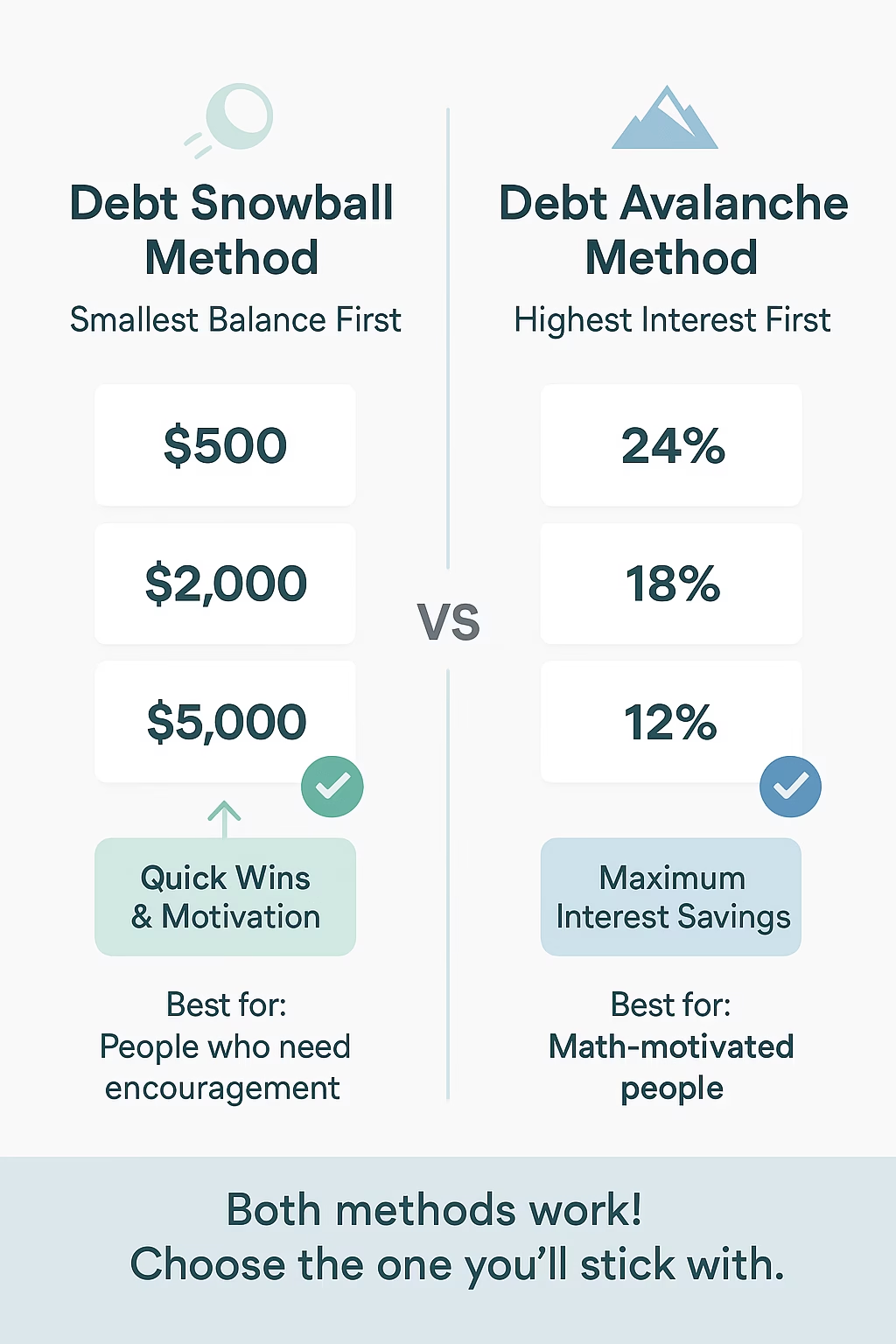
Step 3: Choose Your Payoff Strategy
Debt Avalanche: Pay minimums on everything, throw extra money at highest interest rate first. Saves the most money.
Debt Snowball: Pay minimums on everything, throw extra money at smallest balance first. Feels better psychologically.
I used the snowball method because I needed those small wins. Pick whichever you’ll actually stick to.
Step 4: Find Extra Money
Even $50-100 extra per month makes a huge difference.
What worked for me:
Cancelled unused subscriptions (saved $75/month)
Meal prepped instead of eating out (saved ~$150/month)
Picked up occasional freelance work (added $200-400/month)
Step 5: Consider Balance Transfers (Carefully)
0% balance transfer cards can save hundreds in interest if you pay off the debt during the promotional period. But watch out for transfer fees (3-5%) and don’t keep spending on the old card.
Step 6: Don’t Shame Yourself
You made some mistakes. So did I. So have millions of people. Shame doesn’t help you pay down debt faster. Focus on the system, make progress, celebrate small wins.
Common Questions About Using Credit Cards Responsibly
1.Is it bad to use my credit card every month?
Not even a little bit. In fact, using your credit card monthly is exactly what you should do—as long as you pay the full balance before the due date.
Monthly use shows active credit management, helps build payment history, and can earn you rewards. The only time it’s bad is if you’re carrying balances and paying interest.
2.How much of my credit limit should I actually use?
Everyone says 30%. But if you want excellent credit, aim for 10% or less.
You can spend more than 10% during the month—just pay it down before your statement closes. For example, with a $3,000 limit, you could spend $1,500 but pay it down to $300 before the statement date. Only the $300 gets reported to credit bureaus.
Financial education platforms like NerdWallet have extensively covered utilization ratios and their impact on credit scores.
3.Do I need to carry a balance to build credit?
No. No no no.
You do NOT need to carry a balance to build credit. You can pay in full every month and build an excellent score. Carrying a balance doesn’t help your credit—it only helps the credit card company’s profits.
Pay in full every month, build great credit, save money on interest.
4.What happens if I miss one payment?
Less than 30 days late: Late fee ($25-$40), possible penalty APR, no credit report impact
30+ days late: Everything above plus reported to credit bureaus, score drops 17-83 points, stays on report 7 years
90+ days late: Score drops 100+ points, might go to collections
What to do: Call your card company immediately (they’ll often waive first-time late fees), pay ASAP, then set up autopay.
One missed payment is recoverable. Don’t make it a habit.
5.Should I close a credit card after I pay it off?
Usually no. Closing cards reduces available credit (increases utilization ratio) and eventually shortens credit history.
Close it if: Annual fee you can’t justify, serious self-control issues, or you’re paying for unused benefits.
Better alternative: Keep it open, remove from wallet, set up one small recurring charge with autopay.
6.How long does it take to build good credit?
With responsible use, expect noticeable improvements in 6-12 months. I started with a 620 score and reached 740 after 18 months of consistent on-time payments and low utilization.
The key is consistency. Twelve consecutive on-time payments matter way more than one perfect month.
Final Thoughts (The Stuff That Actually Matters)
Using credit cards responsibly isn’t rocket science. It’s discipline, consistency, and honesty with yourself about your habits.
About 47% of American credit cardholders carry balances month to month. You don’t have to be in that group. I’m not anymore. And I don’t make a ton of money. I just follow a system.
The core principles:
Spend only what you’ve budgeted
Pay the full balance every month
Keep utilization under 30% (ideally under 10%)
Check statements regularly
Choose cards matching your actual spending
You don’t need to be perfect. I still make impulse purchases sometimes. But I pay it off and stay aware.
The real game-changer: Your credit score measures behavior, not income. Someone making $35,000 who pays on time will always outscore someone making $150,000 who’s chaotic with credit.
You don’t need to be rich to build excellent credit. You just need discipline.
What to Do This Week
Pick one thing from this post. Just one.
Maybe it’s setting up autopay, scheduling weekly reviews, adding calendar reminders, or checking your utilization ratio.
Do that one thing. Master it. Then add another.
Small, consistent changes beat massive overhauls you abandon after two weeks.
Bookmark This. Share It. Come Back.
If this helped, bookmark it for later reference. Share it with someone struggling with credit card debt or just starting out.
Come back after your next statement. Read the habits section again. See which ones you’re actually doing.
You’ve got this.
Important Disclaimer
This content is for educational purposes only. I’m sharing my personal experiences and what I’ve learned about credit card management. This is not professional financial advice.
Credit card terms, interest rates, and regulations vary by location and change over time. What I’ve described reflects general principles and my personal experience, but your situation may be different.
Before making major financial decisions:
Check your specific credit card terms and conditions
Verify current interest rates and fees
Consider consulting with licensed financial advisors or credit counselors
Research your local consumer protection regulations
Your circumstances are unique. Your income, existing debt, financial goals, and credit history all affect what strategy makes sense for you. This post provides general education, not personalized recommendations.
Different countries and regions have different credit systems, regulations, and consumer protections. If you’re outside the United States, verify how credit reporting and card regulations work in your area.
The disclaimers are boring but necessary. Take this information, apply what’s useful to your situation, and make informed decisions that work for you.
Thanks for reading this incredibly long guide to using credit cards responsibly. If you made it this far, you’re already ahead of most people—you care enough to educate yourself. That’s huge.
Now stop reading and go implement something. Literally anything from this post. Just start.
Go to Next Lesson: The Truth About Good Debt vs Bad Debt in 2026 (Most People Get This Completely Wrong)
Learning to use credit cards responsibly is a huge step toward building healthy financial habits. But credit cards are just one piece of a bigger financial puzzle: debt.
Not all debt is created equal. Some types can help you build opportunities—like education or starting a business—while others quietly drain your finances through high interest and endless payments.
In the next guide, we take a deeper look at what good debt vs bad debt really means in 2026, why the traditional advice is often misleading, and how to tell whether a debt decision is actually helping your financial future.
You just got your first paycheck. Exciting, right?
But then reality hits. Where do you actually put this money?
Carrying cash feels risky. Keeping it at home seems outdated. And everyone keeps telling you to “open a bank account” like it’s the simplest thing in the world.
Except… it’s not that simple when you’re doing it for the first time.
Here’s something most people won’t tell you: nearly 40% of first-time account holders choose the wrong type of account initially. They end up paying unnecessary fees, earning zero interest on their savings, or struggling with minimum balance requirements they didn’t even know existed.
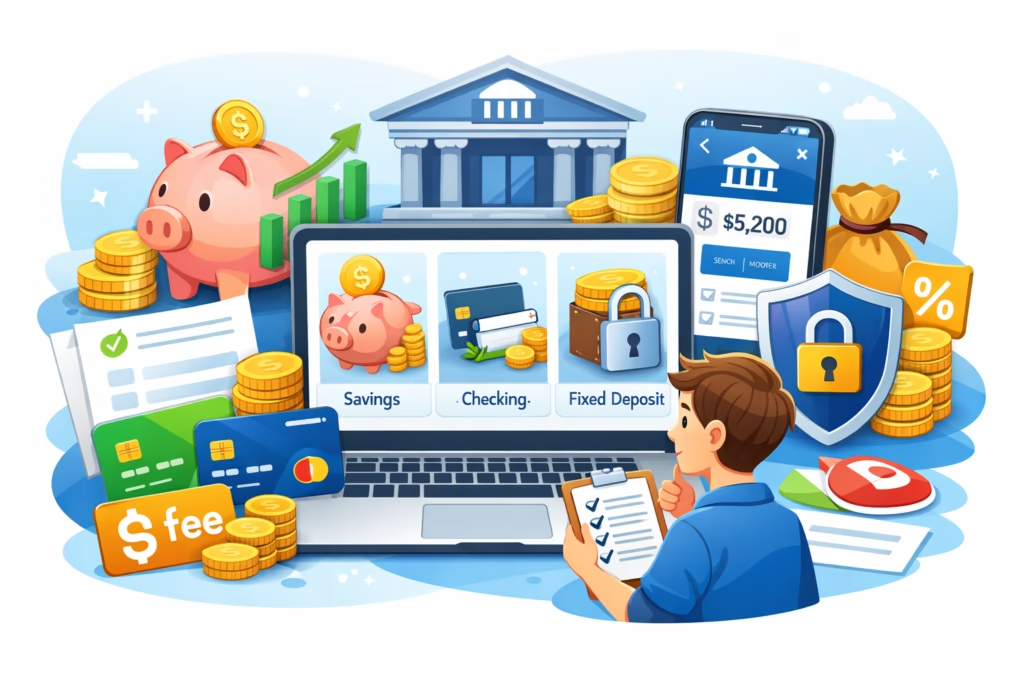
Visual guide to understanding different bank account types and features in 2026.
This guide will walk you through everything about bank accounts in plain English. You’ll learn what different accounts actually do, how to pick one that fits your life, and the mistakes that cost beginners real money. By the end, you’ll feel confident making banking decisions instead of guessing or just picking whatever your friend recommended.
I’ve spent years helping people understand personal finance. This guide combines current banking practices, real beginner experiences, and straightforward advice that actually helps.
What Beginners Should Expect from a Modern Bank Account in 2026
Banking has changed a lot in the past few years.
If you’re opening your first account now, certain features should be standard. Not “premium perks”—just normal expectations.
Real-time notifications
You should get instant alerts when:
Money goes in or out
Your card is used anywhere
Your balance hits certain levels
Someone tries accessing your account
If a bank can’t do this, that’s a red flag.
Instant transfers
Moving money between your accounts should happen immediately. Not “1-3 business days.”
Services like Zelle (US), UPI (India), and Faster Payments (UK) make instant transfers normal now.
Smart spending insights
Good banking apps now automatically categorize your spending. You can see how much you spent on food, transport, entertainment without manually tracking.
Not every bank does this well. But it’s becoming standard.
Virtual debit cards
Many apps let you create temporary card numbers for online purchases. Use them once and disable them.
This protects your real card number from sketchy websites.
Easy card controls
You should be able to:
Freeze your card instantly from your phone
Set spending limits
Block certain transaction types
Enable/disable international use
All without calling anyone or visiting a branch.
Account aggregation
Some banking apps let you see accounts from multiple banks in one place.
Not essential for beginners. But useful if you have accounts at different banks.
You’re keeping small amounts for spending (not saving)
The Confusion That Costs Money
Some people keep thousands of dollars in digital wallets because it’s convenient.
Problems with this:
No interest earnings (money sits there doing nothing)
Less regulatory protection if something goes wrong
Not designed for long-term money storage
Risk if the service has issues
The smart approach:
Keep your main money in a proper bank account. Use digital wallets for convenience with smaller amounts.
Think of it this way: Your bank account is your home. Your digital wallet is your pocket. You don’t store everything you own in your pocket.
One Important Exception
Some digital wallet companies are now becoming actual banks (called “neobanks”).
Examples: Chime, Dave, MoneyLion
When they offer “bank accounts,” they’re partnering with or becoming licensed banks. Your money gets proper FDIC insurance.
Always check: Is this wallet just a payment service, or is it actually offering a real bank account?
Look for mentions of FDIC insurance (US), DICGC (India), or equivalent in your country.
Bank Accounts for Different Countries: What Changes Globally
Banking fundamentals work similarly everywhere. But specific details change based on where you live.
Let me highlight what varies across different regions.
Account Number Systems Differ
US and India: Use routing numbers + account numbers
Europe and many other countries: Use IBAN (International Bank Account Number)
IBAN is longer and includes country code, bank identifier, and account number all in one string.
Both systems work fine. Just know which one your country uses when setting up payments.
Not All Countries Use Checks
In many countries, checks are basically extinct.
Europe, much of Asia, and parts of Latin America rarely use them. Everything happens through electronic transfers.
If you’re in one of these countries, ignore the “check-writing” features banks advertise. You won’t need them.
Minimum Balance Culture Varies
Countries with strict requirements: India, Philippines, some African nations
Banks often require substantial minimum balances (₹10,000, ₱15,000, etc.) and charge significant fees if you drop below.
Countries with relaxed requirements: US, UK, much of Europe
Many banks offer zero-minimum accounts, especially for students.
Why this matters:
If you’re in a country with strict balance rules, choosing the right account type becomes even more critical. You can’t afford to ignore minimum balance requirements.
Government Banks Play Different Roles
In some countries: Government-owned banks dominate and offer the safest, most accessible options for beginners.
Examples: Post Office accounts in India, state banks in various countries.
In other countries: Private banks dominate and government banks are less common.
For beginners: In countries with strong government banking systems, these often provide the most beginner-friendly accounts with lowest fees.
Online Banking Matters More in Some Regions
Developed markets: Online banks compete with traditional banks as equals.
Emerging markets: Online banks and digital wallets are actually leapfrogging traditional banking.
In countries where physical bank access is limited, mobile banking becomes the primary way people manage money.
If you’re in one of these markets, prioritizing a bank with an excellent mobile app matters even more than in developed markets.
Cash Deposits Are Handled Differently
Some countries: Cash deposits at any bank branch or ATM are normal.
Other countries: You can only deposit at your specific bank’s locations.
Increasingly common: Digital-only banks partner with retail stores for cash deposits (deposit at a convenience store, not a bank).
Check how your bank handles cash deposits if you regularly deal with physical money.
International Money Transfers
If you’re an expat, migrant, or frequently send money across borders:
Look for banks that integrate with international transfer services like Wise, Western Union, or local remittance providers.
Traditional bank wire transfers are expensive ($25-50 per transfer).
Modern alternatives cost $3-10 for the same service.
The Universal Truth
Despite these differences, the core principles remain the same everywhere:
Separate accounts for spending vs saving
Avoid unnecessary fees
Understand minimum balance requirements
Choose accounts that match your actual usage
Monitor for fraud regularly
Location changes the specifics. Not the fundamentals.
What Exactly Is a Bank Account? A Beginner’s Guide Explanation
Think of a bank account as a secure digital wallet.
Instead of stuffing cash under your mattress or in your drawer, you hand it to a licensed bank. They store it electronically, keep it safe, and let you access it whenever you need.
Simple concept. But here’s what makes it powerful.
What Happens Behind the Scenes
Let me walk you through real scenarios.
When you put money in:
You deposit cash at a branch or ATM. Or someone transfers money to you digitally.
The bank immediately updates your balance. That money is now protected by government insurance. In most countries, even if the bank somehow fails, your deposits are safe up to certain limits.
In the US, that’s $250,000 per account through FDIC insurance. In India, it’s ₹5 lakh through DICGC coverage.
The bank doesn’t just sit on your money, though. They lend it to other people and businesses. That’s how they make profit. And they share a tiny portion of that profit with you through interest.
When you take money out or spend it:
You swipe your debit card at a store. Or withdraw cash from an ATM. Maybe you send money to a friend online.
Your account balance drops instantly (or within a day for checks).
Everything gets recorded. You can see exactly where your money went.
Why This Matters More Than You Think
Here’s the thing about keeping cash at home.
It doesn’t grow. It just sits there losing value to inflation. A $100 bill today buys less than it did last year.
But money in a savings account? It earns interest. Not much sometimes, but it’s something.
Plus, you can’t lose your entire savings to a fire, theft, or simple forgetfulness. Banks provide security that cash in a drawer never will.
The Catch Nobody Mentions Upfront
Banks aren’t running a charity.
They make money from your account in several ways:
They keep the difference between what they pay you in interest (maybe 0.5%) and what they charge borrowers (around 7-10%)
Monthly fees if you don’t meet certain requirements
Charges when you overdraw your account
Fees for using ATMs outside their network
Penalties for dropping below minimum balance requirements
The good news? Most of these fees are completely avoidable once you know the rules.
That’s what we’ll cover next.
Breaking Down Types of Bank Accounts for Beginners
Different accounts exist because people use money differently.
A student paying rent once a month has different needs than a freelancer receiving twenty small payments each week.
Let me break down each type in a way that actually makes sense.
1.Checking Account (Also Called Current Account in Some Countries)
What it’s designed for: Money you’re actively using
This is your everyday spending account. Your salary gets deposited here. You pay bills from here. You buy groceries and gas with the debit card linked to this account.
Key features:
Unlimited transactions without penalties
Comes with a debit card
Often includes check-writing privileges
Usually earns little to no interest
Easy access through ATMs and online banking
Here’s who needs this:
Anyone receiving regular income and paying regular expenses. Which is probably you.
Real example:
Sarah gets paid $2,500 every two weeks. Her checking account receives the deposit. She pays $900 rent, $150 utilities, $400 groceries, and other daily expenses. Her balance goes up and down constantly throughout the month.
That’s exactly what checking accounts are built for.
Common minimum balance: $0 to $1,500
Many banks now offer no-minimum checking accounts, especially for students or if you set up direct deposit.
2.Regular Savings Account
What it’s designed for: Money you want to keep safe and grow slowly
This isn’t for money you’re spending next week. It’s for money you’re setting aside.
Key features:
Earns interest on your balance (currently 0.40% to 1.20% at traditional banks)
Limited withdrawals (some banks restrict you to 3-6 per month)
Usually no debit card
Interest compounds over time
Protected by the same insurance as checking
Here’s who needs this:
Anyone building an emergency fund or saving for something specific.
Real example:
Marcus wants $6,000 saved for emergencies. He automatically transfers $250 from checking to savings every payday. The savings account keeps that money separate from his daily spending. Plus it earns a small amount of interest.
After a year, he has $3,000 saved plus about $15 in interest earnings. Not huge, but better than nothing.
Common minimum balance: $0 to $500
3.High-Yield Savings Account
What it’s designed for: Maximizing interest while keeping money accessible
This is like a regular savings account that actually pays you decent interest.
Key features:
Much higher interest rates (3.80% to 4.50% currently)
Usually offered by online-only banks
Same safety protections as traditional accounts
May require higher minimum deposits
All transactions happen electronically
The numbers that matter:
Let’s compare two scenarios with $10,000 saved:
Regular savings at 0.40%: Earns $40 per year High-yield savings at 4.00%: Earns $400 per year
That’s $360 extra for literally zero additional effort.
Here’s who needs this:
Anyone with money sitting in a regular savings account earning basically nothing.
Common minimum balance: $0 to $2,500
4.Certificate of Deposit (CD)
What it’s designed for: Higher guaranteed returns when you won’t need money for a while
A CD is a time-locked savings tool. You agree not to touch your money for a specific period. In exchange, the bank pays you higher interest.
Key features:
Terms range from 3 months to 5 years
Higher interest than regular savings (2.50% to 5.00% currently)
Your money is locked until the term ends
Early withdrawal triggers penalties
Rate is guaranteed for the entire term
When this makes sense:
You’ve saved $5,000 for a car you’re definitely buying in 18 months. Put it in an 18-month CD at 4.50% instead of checking at 0%. You’ll earn extra interest while the money sits there anyway.
When this doesn’t make sense:
You might need the money earlier. Or interest rates are rising and you’ll get better rates in a few months.
5.Money Market Account
What it’s designed for: Better interest with some flexibility
Think of this as a hybrid between checking and savings.
Key features:
Interest rates similar to high-yield savings
Usually comes with limited check-writing or debit card access
Higher minimum balance requirements ($1,000 to $10,000)
Transactions typically limited to 6-10 per month
Best for larger emergency funds
The confusion factor:
Many beginners see “debit card included” and treat this like a checking account. Then they get hit with fees for making too many transactions.
Don’t do that.
Use a money market account like a savings account that has an emergency escape hatch.
Common minimum balance: $1,000 to $10,000
6. Joint Bank Account
What it’s designed for: Shared finances between two or more people
Joint accounts let multiple people access and manage the same account equally.
Key features:
Two or more account holders with equal access
Both people can deposit, withdraw, and see all transactions
Both are responsible for overdrafts and fees
Available for both checking and savings accounts
Useful for couples, families, or roommates sharing expenses
Real-life example:
Alex and Jordan get married. They open a joint checking account for shared expenses: rent, groceries, utilities. They both deposit money monthly and both can pay bills from it.
When this makes sense:
Married couples managing household expenses together. Parents and adult children managing family finances. Roommates splitting rent and utilities fairly.
When this can cause problems:
Early in relationships (if things go wrong, both people have full access to all money). When one person is irresponsible with money. With anyone you don’t completely trust.
Important warning:
In a joint account, both people have 100% access to 100% of the money. One person can withdraw everything without the other’s permission. There’s no “my half, your half” protection.
Only open joint accounts with people you deeply trust with your finances.
Common minimum balance: Same as individual accounts of the same type
Savings Account vs Current Account: Which One Do You Need?
This confuses a lot of people, especially in countries where both terms are commonly used.
Let me clear it up with a simple comparison.
Feature
Savings Account
Current Account
Main purpose
Storing money safely
Managing frequent transactions
Who needs it
Individuals, students, employees
Businesses, merchants, freelancers with many transactions
Transaction limits
Usually 3-6 per month without fees
Unlimited transactions
Interest earned
Yes (0.40% to 4.50% depending on type)
Usually no
Minimum balance
Lower ($0 to $500)
Higher ($1,000 to $5,000)
Overdraft option
Rarely available
Often available for businesses
Best for
Building savings, emergency funds
Running a business with many daily transactions
When You Actually Need a Savings Account
You’re receiving a monthly salary or regular income. You want that money to grow through interest. You’re not running a business with constant transactions.
That’s most people reading this guide.
When You Actually Need a Current Account
You run a small business receiving payments from many customers. You’re writing checks frequently. You need overdraft protection for business cash flow.
If you’re just starting your first job or managing personal finances, you probably don’t need a current account at all.
Here’s What Confuses Beginners
Banks sometimes push current accounts because they’re more profitable. They have higher fees and minimum balances.
Don’t get talked into something you don’t need.
If you’re managing personal finances—even if you’re a freelancer—a regular checking account or savings account combination works perfectly fine.
Beginner’s Guide: How to Choose the Right Bank Account for Your Situation
Stop trying to find the “perfect” account.
Instead, answer these five questions honestly. Your answers will tell you exactly what you need.
Question 1: What Will You Actually Use This Account For?
Be specific here.
“Receiving my paycheck and paying monthly bills” → You need a basic checking account
“Storing money I’m not planning to spend soon” → You need a savings account
“Building an emergency fund that earns decent interest” → You need a high-yield savings account
“Saving for a specific purchase happening in 2 years” → You need a CD or high-yield savings
Question 2: How Often Will You Touch This Money?
This matters more than you think.
Several times per week: Get a checking account with a large ATM network near you
A few times per month: Regular savings works fine
Once per quarter or less: High-yield savings or money market account
Not at all for 6 months to 3 years: Consider a CD
Question 3: Can You Honestly Maintain a Minimum Balance?
Be realistic about your financial situation right now.
You can keep $1,500+ consistently: More account options available, including ones with better perks
You can keep $500-1,000: Mid-tier accounts with moderate requirements work
Your balance often drops below $500: Prioritize no-minimum accounts (many online banks offer these)
You’re starting with less than $100: Look for student accounts or beginner checking with zero minimums
Don’t pick an account with requirements you can’t meet. Those monthly fees add up fast.
Question 4: Do You Need In-Person Banking?
This is a personal preference thing.
Yes, I want to deposit cash and get face-to-face help: Choose a traditional bank with local branches
No, I’m fine doing everything online: Online banks usually offer better interest rates and lower fees
Sometimes, but rarely: Get a traditional bank for checking (frequent use) and an online bank for savings (better rates)
Question 5: What’s Your Income Situation Right Now?
Your income pattern matters for choosing the right account.
Regular monthly salary: Traditional checking plus savings combination
Irregular income from freelancing or gig work: Checking with no minimum balance plus automatic savings transfers when money comes in
Very low or no income (student, between jobs): Student checking or no-fee checking, skip savings until income stabilizes
Multiple income streams: Consider multiple savings accounts for different purposes
Quick Decision Guide
Let me make this even simpler:
First job, paying rent and bills: Checking + basic savings
Student with part-time work: Student checking + high-yield savings for anything extra
Building emergency fund: Checking for bills + high-yield savings for the fund
Saving for something specific 2+ years away: Checking + CD matching your timeline
Freelancer with unpredictable income: No-minimum checking + multiple savings accounts (one for taxes, one for emergencies)
Pick the scenario closest to your situation. Start there.
You can always add or change accounts later as your needs evolve.
Quick Decision Table for Beginners
Not sure which account type fits your situation? This table gives you a starting point:
Use this as a starting point, not a rigid rule. Your specific situation might need adjustments.
Which Bank Account Is Best for Students and First-Time Users?
Students and first-job earners face unique challenges.
Lower balances. Irregular income. Zero experience managing accounts.
Here’s what actually works when you’re just starting out.
Features That Actually Matter
1. Zero monthly fees (or fees waived until age 25)
Without consistent income, even a $10 monthly fee can drain your account quickly.
Many banks specifically waive fees for students enrolled in college or high school. Take advantage of this while you can.
2. No minimum balance requirement
Your balance will go up and down a lot while you’re learning. You need an account that won’t punish you for dropping to $50 during a tough week.
3. Overdraft protection without huge fees
Beginners often miscalculate their balance. An account that simply declines the transaction is much better than one that charges $35 in fees.
Some banks let you link checking to savings for automatic overdraft protection. Others just decline purchases when you’re out of money.
Both are better than surprise fees.
4. Good mobile app
You won’t visit branches often. You need to check balances, deposit checks by photo, and transfer money from your phone easily.
A clunky app makes everything harder.
5. Free ATM access near you
Getting charged $3 every time you need $20 cash adds up insanely fast.
Look for banks with ATMs near your campus, apartment, or job. Or choose one that reimburses ATM fees.
The Smart Two-Account Setup for Students
Here’s what I recommend:
Account 1: Student Checking
This is where your job deposits paychecks. This is what you use for daily spending. It’s linked to your debit card.
Zero balance requirements. Zero monthly fees.
Examples: Chase College Checking, Bank of America Advantage SafeBalance, Wells Fargo Clear Access
Account 2: High-Yield Online Savings
This is where you transfer $50-100 monthly if you can manage it. Emergency money only.
Why online? Because it earns 4% instead of 0.40% at traditional banks.
Examples: Ally Online Savings, Marcus by Goldman Sachs, Discover Online Savings
Common Student Mistakes (And How to Avoid Them)
1. Mistake: Opening an account just because your parents use that bank
Your parents probably have mortgages, investment accounts, and much higher balances. Their banking needs are completely different from yours.
What works for them might cost you money in fees.
Better approach: Research student-specific accounts based on your actual needs.
2. Mistake: Ignoring the account terms because “it’s free”
“Free” almost always has conditions attached. Maintain $500 minimum. Set up direct deposit. Stay under age 25.
Miss one condition and suddenly you’re paying $12-15 monthly.
Better approach: Read the summary. If there’s a minimum balance, ask yourself honestly: “Can I actually keep this much in my account every month?”
3. Mistake: Getting a debit card and treating it like unlimited money
Unlike credit cards, debit cards spend money you actually have right now.
Many students overdraft in the first month because they don’t check their balance before swiping.
Better approach: Check your balance before making purchases over $20. Set up low-balance alerts that text you when you drop below $50.
4. Mistake: Using out-of-network ATMs constantly
Your bank charges $3. The ATM owner charges $3. That’s $6 per withdrawal.
Withdraw $40 weekly and you’re throwing away $312 per year.
Better approach: Find a bank with ATMs near campus. Or get cash back at grocery stores instead of using ATMs.
Common Mistakes That Cost Beginners Money
Let’s talk about the expensive errors that actually happen to real people.
These aren’t theoretical. They’re what costs beginners hundreds (sometimes thousands) of dollars in the first year.
Mistake 1: Keeping Everything in One Checking Account
Here’s what happens:
You have $3,500 in checking. That includes your $3,000 emergency fund, $300 for rent, and $200 for groceries.
You see “$3,500 available” and think you can afford that $400 purchase.
Two weeks later, rent is due and you’re suddenly $200 short.
Why this costs money:
You accidentally spend money that was supposed to go elsewhere. Plus that emergency fund earns 0% interest in checking when it could earn 4% in savings.
That’s $120 per year lost just from keeping money in the wrong type of account.
The fix:
Use at least two accounts. Checking for spending and bills. Savings for money you shouldn’t touch.
Even better: separate savings accounts for different goals.
Mistake 2: Paying Monthly Fees You Could Easily Avoid
Here’s the scenario:
Your account charges $12 monthly. You could avoid this by maintaining a $500 balance or setting up direct deposit.
But you don’t do either. You don’t even notice for months.
The math:
$12 × 8 months = $96 gone For many students, that’s groceries for two weeks.
The fix:
Ask explicitly when opening any account: “What fees does this have and exactly how do I avoid them?”
Set a monthly phone reminder to verify you’re meeting the requirements.
Mistake 3: Ignoring Your Balance and Overdrawing
This one hurts.
You buy coffee ($5), lunch ($12), and gas ($35) in one day.
You thought you had $200. You actually had $150.
Your rent check for $800 bounces. The bank charges $35 for overdraft. Your landlord charges $50 for the bounced check.
Total damage: $85 in fees you didn’t need to pay
Some landlords also report late payments, which can hurt your rental history.
The fix:
Check your balance through the mobile app before purchases over $20.
Set up alerts that text you when balance drops below $100.
Mistake 4: Not Reading Fine Print on “High Interest” Accounts
The marketing says: “Earn up to 4.50% interest!”
You deposit $2,000. After one year, you’ve earned only $8.
What happened:
The fine print said you need $10,000 minimum to get 4.50%. Under that, you get 0.40%.
You saw the big advertised number. You missed the actual requirement.
The fix:
Ask three specific questions before opening any account:
What’s the ACTUAL interest rate with my expected balance?
What minimum balance is required to earn that rate?
What happens if I drop below that minimum?
Mistake 5: Linking Everything to Autopay and Forgetting
You sign up for a gym ($30/month) and two streaming services ($15 each).
Six months later, you stopped going to the gym. You barely watch one streaming service. But you forgot to cancel.
Set a calendar reminder every 3 months: “Review all automatic payments.”
Ask yourself: “Am I actually using this?”
Cancel anything you’re not actively using that day.
Mistake 6: Using Out-of-Network ATMs Without Thinking
Your bank charges $3 per withdrawal. The ATM owner charges $3.
That’s $6 every time you need cash.
Do this twice per week: $6 × 8 times monthly × 12 months = $576 per year
You’re literally paying $576 for the convenience of using the wrong ATM.
The fix:
Choose a bank with ATMs near where you actually spend time.
Or get cash back at grocery stores (usually free).
Or switch to an account that reimburses ATM fees.
Mistake 7: Mixing Personal and Side Hustle Money
You start freelancing. Clients pay you through your personal checking. You pay business expenses from the same account.
Tax time comes. You have absolutely no idea what was business income versus personal money.
You either overpay taxes or risk an audit trying to guess.
The fix:
The moment you start receiving money from clients (not an employer), open a second checking account.
Doesn’t have to be a “business account” yet. A second personal checking works fine initially.
Keep all business transactions separate from day one.
Banking Terms Explained Without the Jargon
Banks love complicated language. Let me translate.
APY (Annual Percentage Yield)
The interest rate your account earns, including compounding.
If you see “4.00% APY,” your money grows about 4% over a year.
Higher numbers are better for savings accounts.
Overdraft
Spending more money than you have in your account.
Example: You have $100. You buy something for $120. You’re overdrawn by $20.
Your balance is now negative.
Overdraft Fee
The penalty banks charge when you overdraft.
Usually $30-35 per transaction that causes an overdraft.
Overdraw three times in one day? That’s $90-105 in fees on top of the money you didn’t have.
Overdraft Protection
A service that links your checking to savings.
When you overspend, the bank automatically moves money from savings to cover it.
Sometimes free. Sometimes has a small fee ($10-12 per transfer).
Still way cheaper than overdraft fees.
Minimum Balance
The lowest amount you must keep in your account to avoid fees or earn interest.
Some accounts require $0. Others require $500-1,500.
Drop below this amount and you typically pay monthly fees.
Direct Deposit
Your employer sending your paycheck electronically straight to your bank.
No paper check. No delays. No trips to the bank.
Many accounts waive fees if you set this up.
ACH Transfer
Electronic money movement between accounts.
When you transfer $100 from savings to checking online, that’s an ACH transfer.
Usually takes 1-3 business days.
Free at most banks.
Wire Transfer
Faster electronic money movement for larger amounts.
Usually costs $15-30 per transfer.
Gets money there same day.
Used when speed really matters.
Routing Number
A 9-digit code identifying your bank.
You need this to set up direct deposit or receive money from other banks.
Find it at the bottom of checks or in your online account.
Account Number
Your specific account’s ID number at that bank.
Combined with the routing number, it tells the system exactly where money should go.
Compound Interest
Interest earned on both your original deposit and previous interest earned.
Example: $1,000 at 4% earns $40 year one.
Year two, you earn 4% on $1,040 (not just the original $1,000).
It grows faster over time.
FDIC Insured (DICGC in India)
Government protection on your deposits.
US: Up to $250,000 per account type per bank India: Up to ₹5 lakh
Even if the bank fails, you get your money back up to these limits.
Debit Card vs Credit Card
Debit card: Spends money already in your account. Balance drops immediately.
Credit card: Borrows money from the bank. You pay it back later. You get a monthly bill.
Mobile Check Deposit
Taking a photo of a paper check with your phone to deposit it.
No branch visit needed.
Money usually available in 1-2 business days.
Statement
A monthly summary of all transactions, fees, and interest.
Shows everything that happened in your account that month.
Hold on Deposit
When you deposit a check, the bank might not give you the money immediately.
They “hold” it for 1-5 business days to verify the check is real and the money exists.
Large checks or new accounts often face longer holds.
How to Keep Your Bank Account Safe
Security isn’t just about hackers.
It’s about practical habits that protect your money from common threats.
Protecting Against Fraud
Never share account details with anyone claiming to be your bank
Real banks will NEVER call, text, or email asking for:
Your account number
Your routing number
Your debit card PIN
Your online banking password
If someone contacts you asking for these, it’s a scam.
Hang up. Look up your bank’s real phone number. Call them directly.
Set up account alerts immediately
Free text notifications when:
Your balance drops below $50
A purchase over $200 processes
Your debit card gets used online
Someone tries logging in from a new device
These catch problems in minutes instead of weeks.
Use strong, unique passwords
Your banking password should be different from your email, social media, and everything else.
If you can’t remember multiple passwords, use a password manager.
Turn on two-factor authentication
Requires a code sent to your phone when logging in.
Even if someone steals your password, they can’t access your account without your phone.
Check your account at least twice per week
Log in. Look for transactions you don’t recognize.
Thieves often test with small charges ($3-10) before making big ones.
Report unauthorized charges immediately
You usually have 60 days to report fraud and get your money back.
After that, you might be out of luck.
Don’t wait.
Protecting Yourself From Your Own Mistakes
Use credit cards for online shopping when possible
If a website charges you wrong or gets hacked, disputing with a credit card is much easier than getting cash back to your checking account.
Your debit card connects directly to your cash. Credit cards create a protective barrier.
Don’t save debit card info on retail websites
Every saved card is another potential target for hackers.
Re-entering your card number each time is a small inconvenience compared to dealing with fraud.
Check ATMs for skimmers before using them
Wiggle the card reader. Does it feel loose? Look different than usual?
Criminals install “skimmers” that steal your card information.
If something feels off, use a different ATM.
Use well-lit ATMs in high-traffic areas
Gas station ATMs at 2 AM are targets for both skimmers and physical theft.
Bank branch ATMs during daytime are much safer.
Don’t write your PIN on your debit card
I know someone who actually did this. Don’t be that person.
Memorize it.
What to Do When Something Goes Wrong
If you spot an unauthorized transaction:
Call your bank immediately (number on your card)
Report the specific transaction
Request a new debit card
File a fraud report
Watch your account closely for 30 days
If your debit card is lost or stolen:
Use your banking app to lock the card instantly
Call the bank to report it
Request a replacement
Review recent transactions for fraud
If you overdraft unexpectedly:
Deposit money to cover the negative balance ASAP
Call the bank and politely explain what happened
Ask if they’ll waive the fee as a one-time courtesy (many will for first incidents)
Set up low-balance alerts to prevent it from happening again
Digital Banks vs Traditional Banks: What’s the Difference?
This is a newer question that didn’t exist 10 years ago.
Digital banks (also called online banks or neobanks) are changing how banking works.
Let me explain the real differences.
Traditional Banks
What they are:
Physical banks with branches you can walk into. Think Chase, Bank of America, Wells Fargo, HDFC, ICICI.
Pros:
Face-to-face customer service when you need help
Can deposit cash easily
ATMs often nearby and fee-free
Some people just feel more comfortable with physical locations
Established trust and reputation
Cons:
Lower interest rates on savings (usually 0.40% vs 4.00% at online banks)
Higher monthly fees
More minimum balance requirements
Limited hours (branches close at night and on weekends)
Best for:
People who deposit cash regularly. Those who want in-person help. Anyone uncomfortable with all-online banking.
Digital Banks (Online Banks)
What they are:
Banks that exist entirely online. No physical branches. Everything happens through apps and websites.
Examples: Ally, Marcus by Goldman Sachs, Chime, Discover Bank
Pros:
Much higher interest rates (3.80%-4.50% on savings)
Usually no monthly fees
No or very low minimum balances
24/7 access through apps
Lower overhead costs mean better rates for customers
Cons:
Can’t deposit cash (you’d need to use money orders or transfer from another bank)
No face-to-face help (customer service is phone/chat only)
Some people feel nervous without physical locations
Slightly slower for some transactions
Best for:
People who rarely use cash. Those comfortable with technology. Anyone building savings who wants better interest rates.
The Hybrid Approach (What I Recommend)
Use both types for different purposes.
Traditional bank for checking: Your daily spending account. Easy cash deposits. Local ATM access.
Digital bank for savings: Your emergency fund and savings goals. Way better interest rates. Money you rarely need to touch.
This gives you convenience where you need it and better returns where it matters.
As mentioned earlier, modern bank accounts in 2026 should include features like real-time notifications, instant transfers, smart spending insights, and AI fraud monitoring as standard offerings, not premium add-ons.
What About Neobanks? (Chime, Cash App, Venmo)
These are even newer than online banks.
They’re app-based financial services that partner with traditional banks for insurance coverage.
Pros:
Super easy to set up
No fees for most things
Great apps
Quick money transfers
Early direct deposit (get paid 2 days early)
Cons:
Sometimes limited features
Customer service can be frustrating
Not always FDIC insured (check carefully)
May have transaction limits
Best for:
Tech-savvy younger users. Side hustles and gig work. People who want simple, no-hassle banking.
Not ideal for:
Large savings you want to grow. Complex banking needs. Anyone who wants comprehensive financial services.
How to Decide
Ask yourself:
Do you deposit cash regularly? → Traditional bank Do you want maximum interest on savings? → Digital bank Do you need both? → Use one of each
There’s no single right answer. Pick what fits your actual lifestyle.
Important Disclaimers (The Boring But Necessary Stuff)
Let me be clear about what this guide is and isn’t.
What this guide does:
Explains general banking concepts and principles
Helps you understand different account types and how to choose
Shows you how to avoid common beginner mistakes
Provides educational information based on current banking practices
What this guide doesn’t do:
Give you personalized financial advice for your specific situation
Recommend exact banks or specific products to open
Guarantee any financial outcomes or account performance
Replace professional guidance for complex financial situations
Important things to know:
Banking products, interest rates, and fees change constantly. Information here reflects conditions in early 2025. Always verify current details directly with banks before making decisions.
Regulations vary significantly by country and region. This guide provides international principles with some US and Indian examples. Your country may have different rules, insurance limits, and account types.
Every person’s financial situation is unique. What works well for one individual may not suit another. Consider consulting a qualified financial advisor for personalized guidance.
Before opening any account:
Research multiple options in your area
Read all terms and disclosures carefully
Ask questions when anything is unclear
Verify the bank is properly licensed and insured
Banking can feel overwhelming at first. But millions of people successfully manage accounts every day. Start with the basics. Ask questions. Learn as you go.
Questions Beginners Actually Ask
1. Before You Open Your First Bank Account, Have This Ready
Opening an account is straightforward when you’re prepared. Here’s exactly what you need:
Required documents:
Government-issued ID (driver’s license, passport, or national ID card)
Proof of address (utility bill, lease agreement, or official mail from the last 3 months)
Tax ID number (Social Security number in the US, PAN card in India, or equivalent in your country)
Phone number that you actually use
Email address you check regularly
Financial requirements:
Minimum opening deposit (varies by account, often $0-$100)
Funding source for that deposit (cash, transfer from another account, or check)
Optional but helpful:
Backup bank account details (if opening online, some banks verify identity by making small test deposits)
Employment information (some banks ask, though not always required)
Existing bank statements (if you have a banking history)
Pro tip: Call the bank before visiting or starting an online application. Ask: “What exactly do I need to open a [specific account type]?” This prevents wasted trips or incomplete applications.
2.How much money do I need to open my first bank account?
Honestly? It depends on the account.
Some student checking accounts and basic savings accounts let you start with $0. You can open the account and add money later.
Other accounts want $25 to $100 upfront.
Premium accounts with higher interest might require $500 to $1,000 initially.
Here’s what you need to ask before opening anything:
“What’s the minimum deposit to open this account?”
And also: “Is there a minimum balance I have to keep after opening it?”
These are two different things. Many beginners get confused here.
You might only need $25 to open an account. But you might need to maintain $500 to avoid fees. Big difference.
3.Can I have multiple bank accounts?
Yes. Absolutely yes.
There’s no limit on how many accounts you can have.
Most people should actually have at least two accounts:
One for spending (checking) One for saving (savings)
Some people have even more. Separate savings for emergencies, vacations, car fund, whatever.
The only warning: don’t open more accounts than you can actually monitor.
Every account needs occasional attention. Check for fraud. Watch for fees. Keep track of balances.
Three to four accounts is manageable for most people. Ten accounts might be overkill unless you have a specific system.
4.What’s the difference between a bank and a credit union?
Banks are for-profit companies owned by shareholders.
They tend to have:
More locations and ATMs
Better technology and apps
Higher fees
Lower interest rates on savings
They exist to make profit for shareholders.
Credit unions are non-profit cooperatives owned by members (that’s you if you have an account there).
They tend to have:
Better interest rates
Lower fees
Fewer branches
Sometimes less fancy technology
They exist to serve members, not make profit.
Both are equally safe if properly insured. FDIC for banks, NCUA for credit unions in the US.
Choose based on which offers better terms for your specific needs. Not based on the bank vs credit union label.
5.How long does it take to open a bank account?
Online applications: 10-20 minutes to fill out the form.
You’ll need:
Government ID (driver’s license or passport)
Social Security number or tax ID
Your address and phone number
Employment information
The bank then verifies everything. This can take anywhere from a few minutes to 3 business days.
Once approved, you can often start using the account immediately for transfers.
Your physical debit card arrives by mail in 7-10 business days.
In-person at a branch: Can be faster if you bring all required documents.
You might walk out with a temporary debit card the same day. The permanent one still arrives by mail.
6.What if I move to a different state or country?
Moving within your country:
Most national banks work across all states. Your account continues normally.
Just update your address in the bank’s system (online or by calling them).
Request a new debit card with your new address if needed.
Everything else stays the same. Same account number. Same routing number. Same features.
Moving to a different country:
This gets more complicated.
Some banks let you keep your account open from abroad. Others don’t.
You’ll almost certainly need to open a local account in your new country for daily transactions.
If you’re moving internationally, research banks in your destination country that work with expats. They usually make account opening easier for foreigners.
Also check: Can you keep your home country account open? Will it cost extra? How will you access it?
7.What if I can’t maintain the minimum balance?
First, check your account terms. Understand exactly what happens if you drop below the minimum.
Usually: You get charged a monthly fee ($5-15 typically).
Then you have options:
Option 1: Switch account types
Many banks offer basic accounts with $0 minimum requirements. Ask if you can switch to one of those.
Option 2: Move to a different bank
Online banks frequently have no minimums and no fees. Worth exploring.
Option 3: Link accounts
Some banks waive fees if your combined checking and savings balance meets the minimum. Even if checking alone doesn’t.
Option 4: Set up direct deposit
Many accounts waive minimum balance requirements if you have direct deposit active. Even small deposits count.
Don’t just ignore the problem.
Those monthly fees drain an already low account even faster. Deal with it proactively.
8.Is online banking safe?
Yes, when you take basic precautions.
Online banks use the same security measures as traditional banks:
Encryption for data transmission
Multi-factor authentication
FDIC insurance on deposits
Fraud monitoring systems
The safety issues come from user behavior, not the technology.
What makes it safe:
Using strong passwords
Enabling two-factor authentication
Not clicking suspicious links
Checking accounts regularly
Using secure WiFi (not public networks for banking)
What makes it risky:
Reusing passwords across sites
Clicking links in texts/emails claiming to be your bank
Sharing login information
Never checking your account
Using public WiFi for financial transactions
The bank’s security is solid. Your habits determine actual safety.
9.Can I open a bank account with bad credit?
Yes, usually.
Here’s what confuses people:
Opening a bank account doesn’t require a credit check in most cases. Credit scores matter for loans and credit cards, not checking or savings accounts.
What banks do check: ChexSystems
This is a database tracking banking history. It shows:
Bounced checks
Overdrafts you didn’t pay back
Accounts closed for fraud
Unpaid bank fees
If you have serious banking problems in ChexSystems, some banks might deny you.
What to do if you’re denied:
Ask why specifically
Get your ChexSystems report (free once yearly at ChexSystems.com)
Dispute errors if any exist
Look for “second chance” checking accounts designed for people with banking problems
Consider prepaid cards temporarily until you rebuild banking history
Bad credit doesn’t automatically mean no bank account. Unpaid banking debts might.
10.What happens if I don’t use my bank account for a long time?
This is called account inactivity or dormancy. It’s more serious than many beginners realize.
What counts as inactive:
Most banks consider an account dormant if there’s no activity for 12-24 months. “Activity” usually means:
Deposits or withdrawals
Transfers in or out
Using your debit card
Even logging into online banking sometimes counts
Simply having money sitting there doesn’t count as activity.
What happens to dormant accounts:
Different banks and countries have different rules, but common consequences include:
In many Asian countries (especially India):
Account gets frozen after 12-24 months of inactivity
You can’t access money until you visit the branch
May require re-verification of identity (re-KYC)
Sometimes stops earning interest
May start charging maintenance fees even if previously waived
In the US and many Western countries:
Account may be flagged as dormant
May incur dormancy fees
After several years, money might be turned over to the state as “unclaimed property”
You can still claim it, but it’s a hassle
How to avoid this problem:
Set a calendar reminder every 6 months to make at least one transaction. Even tiny actions work:
Transfer $1 from savings to checking
Use your debit card to buy something small
Log in and move money between your own accounts
If you know you won’t use an account for a long time, consider:
Setting up automatic monthly transfers (even $5)
Closing the account properly instead of abandoning it
Combining accounts to reduce the number you need to maintain
If your account is already dormant:
Visit the bank branch with your ID. They’ll reactivate it, though they might ask you to:
Verify your identity
Update your contact information
Explain why the account was inactive
Don’t just ignore a dormant account. It can create problems when you actually need the money.
Your Next Steps
You’ve made it through everything you need to know about bank accounts as a beginner.
Let me summarize what matters most.
The fundamentals:
Bank accounts keep your money safe and help it grow. Different types serve different purposes. Choose based on how you’ll actually use the account, not marketing promises.
Avoid fees aggressively.
Banking shouldn’t cost you money when you’re starting out. Plenty of no-fee accounts exist. Find them.
Understand the terms before opening anything.
What’s the minimum balance? How do you avoid monthly fees? What’s the actual interest rate? Where are free ATMs?
Get clear answers first.
Monitor regularly but don’t stress.
Check your balance twice a week. Review transactions. Set up alerts.
This becomes automatic within a month.
Start simple and build gradually.
Begin with one checking account. Add a savings account when comfortable. Explore higher-interest options once you have money to save.
You don’t need everything perfect on day one.
Your immediate action:
Open or review one account this week. Just one.
If you don’t have a bank account: Decide whether you need checking (daily use) or savings (storing money). Research three options that fit your requirements. Pick one and open it.
If you already have an account: Review whether it still works for your situation. Are you paying avoidable fees? Could you earn better interest elsewhere? Would adding a second account help?
Banking confidence comes from action, not perfection.
You don’t need the absolute best account to start. You need an account that works reasonably well and doesn’t drain your money through fees.
Start there. Learn by doing. Adjust as needed.
Remember this:
Banking is a tool. Nothing more.
Choose the right tool for your needs. Use it correctly. It’ll support your financial life quietly without drama.
You’re not guessing anymore. You understand how this works now.
Take the first step this week.
Go to Next Lesson: Credit Score 101: What It Is, Why It Matters, and How to Improve It
Opening a bank account is one of the first steps toward building a healthy financial life. But simply having a bank account isn’t enough—you also need to understand how your financial behavior affects your credit profile.
In the next guide, you’ll learn what a credit score is, why lenders care about it, and the simple habits that can help you build and improve your score over time.
Maya’s car broke down on a Tuesday morning. The repair? $847. She didn’t have it. So she put it on a credit card at 24% interest, turned down a freelance project because she couldn’t get to the client meeting, and spent the next three months paying off that one unexpected expense while the interest piled on.
Here’s what gets me: Maya earns decent money. She’s not irresponsible. She just didn’t have an emergency fund—and that single gap turned a fixable problem into a financial spiral.
An emergency fund is money you set aside specifically for unexpected expenses or income loss—separate from your regular savings. It’s not about being pessimistic; it’s about being realistic. Life doesn’t send you a calendar invite before things break, jobs end, or emergencies hit. And without this buffer, one bad week can derail months of progress.
According to the Federal Reserve, nearly 40% of Americans couldn’t cover a $400 emergency expense without borrowing or selling something. That’s not a personal failing—it’s a system that doesn’t teach people to build financial cushions.
This guide will show you how to build an emergency fund, even if you’re living paycheck to paycheck, freelancing with unpredictable income, or just starting out as a complete beginner. Whether you’re earning minimum wage or navigating irregular income, you’re about to learn exactly how to build emergency savings that actually protect you.
An emergency fund is basically your financial safety net—cash you keep accessible for when life throws you a curveball. And life loves throwing curveballs.
It’s not money for that amazing sale you spotted. Not for your best friend’s destination wedding. Not for “I’ve had a rough week and deserve a treat.” This is your “oh crap” money, pure and simple.
Think about it like insurance you create for yourself. Your regular savings? Those might be earmarked for fun stuff—maybe a down payment on a house, that trip you’ve been dreaming about, or just building wealth over time.
Your emergency fund sits in the corner, quiet and boring, waiting for the moments when everything goes sideways.
It’s not an investment account where you’re trying to get rich
It’s not a backup budget for things you forgot to plan for
It’s not your “treat yourself” fund when you’re feeling impulsive
Money stress doesn’t come from emergencies—it comes from being unprepared for them.
When you don’t have emergency savings, every little surprise becomes a full-blown crisis. Your brain goes into panic mode. You start borrowing from sketchy places. You make decisions you wouldn’t normally make because you’re desperate.
But flip that scenario. When you’ve got money sitting there specifically for emergencies? You handle problems like someone who’s got their act together.
Your car needs a new battery? Annoying, sure, but not earth-shattering. You pay it, move on with your life, and maybe complain about it over dinner. That’s it.
Something I noticed while digging into financial research: people without emergency funds basically pay a “broke tax” on everything. They end up at payday loan places paying 400% interest. They carry credit card balances month after month, hemorrhaging money on interest.
They can’t wait for better deals because they need solutions right this second. An emergency fund doesn’t just save you from disaster—it saves you from making expensive desperate choices every time something goes wrong.
Quick reality check: If your income disappeared tomorrow, how long would you last?
(Most people don’t know—and that’s exactly why emergency funds matter.)
The peace of mind alone is worth it. There’s something about knowing you could handle most common problems without your world falling apart. It changes how you sleep at night.
How Much Emergency Fund Do You Really Need?
You’ve probably heard “save three to six months of expenses” thrown around like it’s gospel. And yeah, that’s the eventual goal. But if you’re sitting there thinking “I can barely save $50 a month,” hearing “save $15,000” feels like someone telling you to climb Mount Everest in flip-flops.
Let’s make this actually achievable. We’re breaking it down into stages that won’t make you want to give up before you start.
Phase 1: The $1,000 Starter Emergency Fund
Your first finish line is one thousand dollars. That’s it. Will it cover every possible emergency? Nope. But it’ll handle the most common ones: car trouble, a surprise dental bill, your phone dying, minor medical expenses.
Getting to $1,000 means you’re no longer one bad day away from financial chaos.
If you’re living paycheck to paycheck, saving $1,000 might take you six months, a year, maybe longer. And you know what? That’s completely fine. We’re not racing anyone here. What matters is building the habit and creating that initial cushion.
Phase 2: One Month of Essential Expenses
Once you hit that first $1,000, your next target is one month of bare-bones living costs. I’m talking rent or mortgage, utilities, basic groceries, getting to work, insurance premiums.
Not your current spending—just what you’d need to survive for 30 days if everything went wrong.
This is your “I lost my job” buffer. Research from the Bureau of Labor Statistics shows the average job search takes about 3-5 months, but having even one month saved buys you crucial time to breathe, file for unemployment, polish up that resume, and start your search without immediate panic setting in.
Phase 3: Three to Six Months of Full Expenses
Now we’re talking about the gold standard everyone mentions. Here’s how to figure out your number: three months if you’ve got a stable job, dual income household, or strong family support nearby.
Shoot for six months if you’re self-employed, working in an unstable industry, your income bounces around, or you’re the only earner keeping your household afloat.
Let me show you what this looks like for real people:
Sarah works in healthcare—pretty solid job security, decent insurance coverage. Three months gives her enough breathing room for most scenarios without going overboard.
James’s income is all over the place. Some months he pulls in $6,000, other months barely $1,500. According to recent data on freelance workers, nearly 63% experience significant income volatility month-to-month. Six months protects him during those inevitable dry spells without forcing him to take terrible projects out of desperation.
Situation 3: The Martinez Family, Two Incomes, Two Kids
Both parents work, which provides some security, but they’ve got kids depending on them and higher fixed costs. Four months splits the difference—realistic but still protective.
Emergency Fund for Beginners on Low Income: Let’s Keep It Real
If you’re making minimum wage or trying to survive in an expensive city on entry-level pay, building six months of expenses might take years. Literal years. And I need you to hear this: start anyway.
Even putting away $25 a month adds up to $300 by year’s end. That’s a broken phone covered. That’s a small medical copay. That’s not nothing. Progress beats perfection every single time, especially when it comes to building an emergency fund for beginners.
Some folks push their emergency fund targets to nine or twelve months. That makes sense if you work in a super specialized field where finding new work takes forever, if you’ve got chronic health stuff going on, or if you live somewhere without many job options.
But don’t let perfect be the enemy of good. A $500 emergency fund beats zero by about $500.
The important thing about figuring out how much emergency fund you need isn’t hitting some magic number next month—it’s understanding your target and taking consistent steps toward it.
Step-by-Step: How to Build an Emergency Fund on Low Income.
Building an emergency fund when money’s tight isn’t about following some finance guru’s aggressive savings challenge. It’s about being smart, being honest with yourself, and showing up consistently.
Grab a notebook or open your phone and write down your monthly essential expenses. I mean really essential—not what you typically spend, but what you’d need if you were in survival mode:
Housing (rent or mortgage payment)
Utilities (electric, water, internet, phone)
Food (realistic grocery budget, not fantasy diet budget)
Transportation (car payment, insurance, gas, or transit pass)
Insurance (health, car, renter’s or homeowner’s)
Minimum debt payments you legally have to make
Add those up. Now multiply by 1, 3, or 6 depending on your situation we talked about earlier. That’s your target. Don’t freak out if it seems huge—you’re not saving it all by Tuesday.
Step 2: Open a Separate Account
This part is non-negotiable, and I mean it. Your emergency fund cannot live in your checking account where it mingles with your taco money and impulse purchases. Just can’t.
Open a high-yield savings account. Online banks usually offer the best interest rates—we’re talking around 4-5% APY as of early 2025, which beats the pathetic 0.01% your traditional bank probably offers.
Here’s a pro move: keep it at a different bank than your checking account. You want just enough friction that you won’t accidentally spend it on not-actually-emergencies, but easy enough access that you can transfer money within 1-2 business days when you genuinely need it.
Step 3: Start With What You Can Actually Save
Can you save $200 a month? Awesome. Can you only swing $20? Also awesome. Seriously. The amount matters way less than the consistency.
Set up an automatic transfer for the day right after your paycheck hits. Automate this so you don’t have to rely on willpower or remembering. Make it invisible.
For people with low or irregular income:
Save a percentage instead of a fixed dollar amount. If you earn $1,500 one month, save 5% ($75). If you only make $800 the next month, save 5% of that ($40). The percentage stays constant even when your income doesn’t.
When unexpected money comes your way—tax refund, birthday cash from grandma, surprise freelance bonus—put 50-100% of it straight toward your emergency fund until you hit your target. Future you will thank you.
Use the “pay yourself first” method. Before you budget for literally anything else, move money to your emergency fund. Then budget whatever’s left. It feels weird at first, but it works.
Step 4: Find Extra Money (Without Hating Your Life)
I’m not going to sit here and tell you to give up coffee or cancel Netflix. You’re an adult. You know where your money goes. But here are some strategies that actually work without making you miserable:
Negotiate your bills. Call your internet provider, insurance company, and phone carrier once a year. Tell them you’re shopping around for better rates. You’d be amazed—you can often knock $20-50 off your monthly bills with a single phone call. Companies count on you not doing this.
Sell stuff collecting dust. That exercise equipment you haven’t touched in a year? The gadgets in your closet? The books you’re never rereading? Turn them into $200-500 on Facebook Marketplace or eBay.
Take on temporary side work. Not forever—just until you hit that first $1,000 milestone. Drive for Uber a few weekends. Babysit your neighbor’s kids. Walk dogs. Tutor online. It’s temporary pain for long-term peace of mind.
Building an emergency fund on low income often means getting creative—at least temporarily.
Step 5: Protect Your Emergency Fund While It Grows
You’re going to be tempted to raid it. Your friend’s getting married in Cabo. Your laptop’s running slow. There’s an incredible sale on that thing you’ve been eyeing. Don’t do it.
Create a clear rule for yourself: your emergency fund is only for genuine, unplanned, essential expenses. If you could see it coming or if it’s a “want” disguised as a “need,” it doesn’t count.
Write this rule down. Tell a friend. Make it real.
Step 6: Rebuild After You Use It
When you eventually tap your emergency fund—and you will, that’s literally why it exists—treat replenishing it as your top financial priority. Pause other savings goals temporarily if you need to.
The emergency fund comes first because it’s your financial foundation. Everything else gets built on top of it.
Where to Keep Your Emergency Fund
This is where people get super confused and honestly, I get it. The finance world makes this more complicated than it needs to be. You want your emergency fund to be three things:
Safe (like, zero risk of losing value)
Liquid (you can get to it within 1-3 days max)
Earning something (because inflation is slowly eating your money otherwise)
Let me break down what actually works and what doesn’t when deciding where to keep emergency fund money:
Option
Pros
Cons
Verdict
High-Yield Savings Account
FDIC insured up to $250k, earning 4-5% interest, access within 1-2 days
Interest rates go up and down
Best choice for most people
Money Market Account
Similar to savings, sometimes higher rates, FDIC insured
Might need higher minimum balance
Good alternative
Regular Checking Account
Access your money instantly
Literally zero interest, way too tempting to spend
Just don’t
Cash Under Your Mattress
You can touch it right now
Zero interest, could get stolen, inflation actively destroys its value
Avoid (except maybe $200 for true emergencies)
Stocks/Index Funds
Could earn higher returns over time
Can drop 30-40% exactly when you need the money
Wrong tool for the job
Cryptocurrency
Potential for high returns
Can lose 50%+ of value overnight, super volatile
Absolutely not for emergency funds
CDs (Certificates of Deposit)
Higher interest rates, FDIC insured
Early withdrawal penalties defeat the purpose
Only for amounts above 6 months
The sweet spot: Keep your emergency fund in a high-yield savings account at an online bank. You’ll earn 4-5% interest (compared to basically nothing at traditional brick-and-mortar banks), your money is completely safe thanks to FDIC insurance, and you can transfer it to your checking account in 1-2 business days when something goes wrong.
Some people get fancy and split their emergency fund once it’s fully built—maybe keeping 3 months in a regular savings account for quick access and putting another 3 months into short-term CDs for slightly better rates.
That’s fine if you’re disciplined and past the building phase, but don’t overcomplicate things when you’re just starting out.
The key is finding that balance between accessibility and growth. Your emergency fund isn’t an investment—it’s insurance. Safety beats returns here, every time.
Quick Recap: Emergency Fund Essentials
Let’s pause for a second. If you’re feeling overwhelmed, here’s what you need to remember:
An emergency fund is separate from regular savings—it’s your financial shock absorber for unexpected expenses and job loss
Start with $1,000 as your first milestone, then work toward 3-6 months of essential expenses based on your job stability
Keep it in a high-yield savings account at a separate bank for safety and accessibility (4-5% interest beats 0%)
Automate your savings the day after payday—even $20-50 monthly builds up faster than you think
Use it only for genuine emergencies—unexpected medical bills, essential repairs, job loss. Not sales, vacations, or wants
You don’t have to do this perfectly. You just have to start and stay consistent.
Common Emergency Fund Mistakes Most People Make
Let’s talk about where people mess this up, because knowing the traps helps you sidestep them.
Mistake #1: Waiting for the “Perfect Time” to Start
“I’ll start my emergency fund once I pay off my debt completely.” “After I get that raise.” “When I finish saving for this other thing.”
No, no, and no. Start now. Start with $10 if that’s all you’ve got. Your emergency fund protects you while you work on everything else.
Without it, one unexpected car repair destroys all your other progress. You end up right back where you started, or worse.
Mistake #2: Keeping It Way Too Accessible
Your emergency fund sitting in your checking account will get spent. That’s not a character flaw—that’s just how human brains work. We’re terrible at resisting money we can see and touch easily.
Create some healthy friction. Different bank. No debit card attached to it. Make it just inconvenient enough that you won’t tap it to order pizza on a Friday night when you’re too tired to cook.
Mistake #3: Trying to Invest Your Emergency Fund
I see this constantly in online forums: “But I could earn 10% in the stock market instead of 4% in a boring savings account!”
Sure. Until the market tanks 25% the exact same month your transmission dies and you’re forced to sell at a massive loss just to get your car fixed. Or you lose your job during a recession when everything’s down.
Emergency funds aren’t investments. They’re insurance. They’re boring on purpose. Safety beats returns here, and anyone telling you otherwise doesn’t understand the fundamental purpose of emergency savings.
Mistake #4: Defining “Emergency” Too Broadly
Your roof is leaking water into your living room. Emergency.
Your favorite band announces a reunion tour with tickets on sale now. Not an emergency, even though it feels urgent.
Make a clear, specific rule about what counts as an emergency, write it down, and stick to it. The whole emergency fund vs savings account distinction matters here—one is for surprises, one is for plans.
Mistake #5: Saving While Drowning in High-Interest Debt
Here’s the one exception to “emergency fund first”: if you’ve got credit card debt at 20-30% interest, you’re losing more money in interest than you’re gaining in security.
The smart move? Build a small starter emergency fund ($500-1,000), then aggressively attack that high-interest debt, then finish building your full emergency fund. Otherwise you’re essentially saving at 4% while simultaneously paying 24%. The math doesn’t work.
Mistake #6: Never Using It When You Actually Should
Some people build up their emergency fund and then feel so guilty about touching it that they refuse to use it even during genuine emergencies. They feel like they’ve failed somehow.
That’s completely backwards. You built it specifically for moments like these. When a real emergency hits, use the money without guilt, handle the problem, then rebuild the fund.
That’s literally the entire point of having it.
Emergency Fund vs Savings Account: What’s the Difference?
People use these terms like they’re the same thing, but they’re actually different tools for different jobs. Understanding the emergency fund vs savings account distinction helps you manage your money way better.
Purpose: Handle unexpected crap—sudden expenses and income loss
Goal: 1-6 months of essential living expenses
Accessibility: High priority (need it within 1-3 days)
Usage: Only when genuinely unplanned stuff happens
Mindset: This is your financial insurance policy and peace of mind
Regular Savings:
Purpose: Stuff you’re planning for—vacation, house down payment, new car, wedding
Goal: Whatever specific target you’ve set for yourself
Accessibility: Can be less liquid (CDs, investment accounts might work here)
Usage: When you hit your goal or timeline
Mindset: Building toward something you actually want in life
Think of it like this: your emergency fund is playing defense. It protects what you’ve already got and keeps you from sliding backward. Your regular savings are playing offense—they help you move forward and build the life you actually want.
You need both, period. Your emergency fund makes sure one bad break doesn’t destroy you financially. Your savings let you make actual progress toward your dreams.
Most people should focus on building a starter emergency fund first, then work on both simultaneously.
Then split your future savings between topping off your emergency fund, retirement contributions, and specific savings goals
When to Use Your Emergency Fund (and When Not To)
This is where the rubber meets the road. Theory is nice, but let’s get specific about what actually counts as an emergency worthy of touching that money you’ve been carefully saving.
Clear YES—Definitely Use Your Emergency Fund:
You lost your job or took a major income hit
Significant medical expenses your insurance won’t cover (studies show unexpected medical bills affect nearly 1 in 3 Americans annually)
Essential home repairs (roof’s leaking, furnace died in winter, pipe burst)
Essential car repairs when you absolutely need your car for work
Emergency travel (family death, urgent family medical situation)
Urgent veterinary care for your pet
Necessary dental work that can’t wait
Probably YES—Depends on Your Situation:
Smaller medical expenses that would strain your regular monthly budget
Car repairs when you have other transportation options available
Replacing essential appliances that died (fridge, washing machine)
Insurance deductibles for legitimate claims
Probably NO—Try to Find Another Way:
Annual expenses you should’ve budgeted for but forgot (car registration, insurance premiums, holiday shopping)
Gifts for weddings, birthdays, or holidays
Elective medical procedures that can wait a few months
Upgrading things that still work fine but are old
Sales and deals, even really good ones that feel urgent
Clear NO—Do Not Touch Your Emergency Fund:
Vacations or travel for fun
New electronics or gadgets you want but don’t need
Social expenses (bachelor parties, destination weddings, concert tickets)
Investment opportunities
Starting a side business or passion project
Literally anything that’s a “want” rather than a “need”
The gut-check question you should always ask: “If I don’t spend this money right now, will it cause significant harm to my health, safety, housing, or ability to earn income?”
If the answer is no, it’s not an emergency. Find another way.
Financial emergencies exist on a spectrum. Losing your job is obviously an emergency. Needing new work shoes because yours have actual holes and you work in a professional office where appearance matters? That might qualify.
Wanting new shoes because your current ones aren’t trendy anymore? That’s not an emergency, that’s shopping.
When you’re unsure, ask yourself: “Can I solve this problem another way?” If yes, try that first. If no, and it’s genuinely urgent and necessary, use the fund without beating yourself up.
That’s literally why you built it in the first place. Then, make a plan to rebuild it.
Frequently Asked Questions
How much emergency fund do I need as a beginner?
Start with $1,000 as your first milestone—that’s emergency fund for beginners rule number one. This covers most common surprises like car repairs, minor medical bills, or replacing something essential that broke.
Once you’ve got that $1,000 saved, work toward one month of essential expenses (just the absolute basics, not your full lifestyle). Then gradually build to 3-6 months depending on whether you’ve got stable employment or more variable income.
If saving $1,000 feels completely overwhelming right now, start with $500. Or $250. Or honestly, $50. Any emergency fund beats having zero emergency fund.
Can I invest my emergency fund to earn higher returns?
No, and I really mean that. Your emergency fund should never go into stocks, index funds, crypto, or anything that can lose value. The entire purpose is stability and immediate accessibility, not growing wealth.
Keep it in a high-yield savings account or money market account where it’s FDIC insured and can’t drop in value. The one exception: once you’ve built up 6+ months of expenses, you could potentially keep 3 months readily accessible in savings and put the additional amount in very short-term CDs for slightly higher interest.
But only if you’re disciplined enough to maintain that split and not raid it.
Should freelancers keep a bigger emergency fund?
Yes, absolutely. If you’re freelancing or self-employed, aim for 6-12 months of expenses instead of the standard 3-6 months. Your income fluctuates unpredictably, projects end without warning, and you don’t have unemployment insurance as a safety net if things go sideways.
According to recent data on freelance workers, nearly 63% experience significant income volatility month-to-month. The larger cushion protects you during inevitable slow periods without forcing you to accept terrible low-paying clients out of desperation.
It also gives you actual leverage to be picky about projects and negotiate better rates because you’re not operating from a place of financial fear.
When should I use my emergency fund?
Use your emergency fund for unexpected, necessary expenses you genuinely can’t cover with your regular monthly income: job loss, major medical bills not covered by insurance, essential home or car repairs, emergency family travel.
Don’t use it for planned expenses you forgot to budget for, holiday shopping, that amazing sale happening right now, or wants dressed up as needs.
Ask yourself: “Will not spending this money right now cause real harm to my health, safety, housing, or ability to earn income?” If the answer is no, find a different way to cover it. Your emergency fund is for genuine surprises, not poor planning or impulse desires.
What’s the difference between an emergency fund and regular savings?
An emergency fund is defensive money specifically set aside for unexpected expenses and income loss—you keep it liquid in a savings account for quick access when life goes wrong.
Regular savings are offensive money for planned goals and purchases you’re intentionally working toward, like vacations, down payments, or new cars. Your emergency fund protects what you currently have and prevents you from sliding backward. Your savings build what you want and help you move forward.
You need both, but in different accounts serving different purposes. Most people should build a starter emergency fund first before aggressively pursuing other savings goals.
Conclusion
If you’re reading this and feeling behind, I need you to hear something: you’re not broken, and you haven’t failed at life. The system doesn’t teach this stuff. Schools don’t have “How to Build an Emergency Fund 101” classes.
Most people who have financial security either stumbled into it by accident, inherited it, or had someone teach them early. It’s not because they’re smarter or more disciplined than you.
An emergency fund isn’t about being paranoid or expecting the worst. It’s about being realistic. Things break down. People get sick. Jobs get eliminated. Emergencies happen to everyone.
And when those moments arrive—not if, but when—having money specifically set aside is the difference between handling it like a functional adult and watching everything spiral out of control.
You don’t need six months of expenses saved by next Tuesday. You don’t need to feel guilty about where you’re starting from. You just need to start.
Twenty dollars this week. Fifty next month. Whatever you can actually manage consistently without making yourself miserable.
The people who build real financial stability aren’t the ones who occasionally save huge amounts when they feel motivated. They’re the ones who save smaller amounts relentlessly, month after month, even when it feels pointless.
Especially when it feels pointless.
Maya, from the beginning of this article? She’s got $3,200 in her emergency fund now. Took her 18 months of consistent saving to get there. Her car broke down again last month—cost her $620 this time.
She paid cash, got it fixed, drove to her client meeting, and went home without stress or credit card interest piling up. Same car. Same income. Completely different outcome.
Your action step today: Open a high-yield savings account and transfer $10 into it. Or $5. Or literally $1 if that’s what you can spare. Just start.
Then set up an automatic transfer for next week, even if it’s tiny. That’s it. You’ve officially begun building your financial safety net.
The gap between having absolutely no emergency fund and having something—anything—shrinks your financial risk more than you’d think. Start building your emergency fund buffer today.
Future you is going to be incredibly grateful you did.
Compliance & Disclaimer
This article provides educational information about personal finance and building an emergency fund based on widely accepted financial principles and research. It’s meant to help you understand concepts and make informed decisions, but it’s not personalized financial advice tailored to your specific situation.
I’m not a licensed financial advisor, certified accountant, or investment professional. Your financial situation is unique—your income, expenses, debt load, life goals, and comfort with risk all matter.
Before making any significant financial decisions, consider talking with a qualified financial professional who can look at your specific circumstances and give you personalized guidance.
The strategies and recommendations discussed here represent general guidance that works for many people based on sound financial principles, but there’s no one-size-fits-all approach to money. Use this information as a starting point for your own research and decision-making process.
Interest rates, economic conditions, banking products, and financial regulations change over time. Always verify current rates, terms, and conditions before opening accounts or making financial commitments. What’s true today might shift tomorrow.
Take what’s useful here, leave what doesn’t apply to you, and build a financial safety net that actually works for your life.
Now that you understand the importance of having an emergency fund, it’s time to make a plan for growing your savings beyond just safety money. This lesson walks you through creating a practical, realistic savings plan that fits your goals and your budget.
I still remember sitting in my car outside the grocery store, staring at my bank app in disbelief.
Where did it all go?
I’d gotten paid two weeks earlier, and somehow I was down to $83 in my checking account. Rent was paid, sure. Bills were covered. But everything else? It had just… disappeared.
That’s when I realized I had no idea how to track my spending. Not really. I knew the big stuff—rent, utilities, car payment. But the rest was a complete mystery. Twenty dollars here, forty there, endless small purchases that added up to a massive black hole in my finances.
Learning how to track your spending properly changed everything for me. Not with complicated spreadsheets or guilt-inducing budgets. Just simple, practical tracking that fit into my actual life.
If your money disappears and you don’t know where it goes, this guide will show you exactly what to do—even if you’ve tried tracking before and given up.
That moment when you realize your money is disappearing and you don’t know where it’s going.
Let’s start with the basics.
Tracking your spending means recording every purchase you make and organizing it into categories so you can see patterns, identify waste, and make intentional decisions about where your money goes.
It’s not budgeting. Budgeting is deciding where money should go before you spend it. Tracking is seeing where it actually went after you spent it.
Think of it like this: budgeting is your plan, tracking is your reality check.
Most people skip tracking and jump straight to budgeting. Then they wonder why their budget never works. You can’t build a realistic budget without knowing your actual spending patterns first. If you’re ready to create a budget after tracking, the Consumer Financial Protection Bureau offers a free budget worksheet to get started.
Tracking gives you that foundation. It’s the financial equivalent of turning on the lights in a dark room.
Why Most People Fail at Expense Tracking
Before we get into solutions, let’s talk about why tracking feels so hard.
The biggest reason? Nobody ever taught us how to do it in a way that actually fits into real life.
School didn’t cover it. Personal finance advice assumes you have unlimited time and motivation. Banking apps show transactions, sure, but they don’t help you understand patterns or make better choices.
So most people either:
Try to track perfectly, get overwhelmed, and quit
Use a system that’s too complicated to maintain
Feel too guilty about their spending to look at it
Assume they’re just “bad with money” instead of recognizing they lack visibility
None of these are character flaws. They’re just predictable outcomes when you don’t have a realistic tracking system.
Here’s what actually happens when you don’t track spending:
Small purchases become invisible. That $6 coffee doesn’t register as “spending money.” Neither does the $12 lunch, the $8 snack, or the $15 impulse buy. But together? That’s over $40 in one day that your brain doesn’t count.
Subscriptions multiply silently. You sign up for a free trial, forget to cancel, and suddenly you’re paying $15/month for something you used once. Multiply that by five or six subscriptions and you’re bleeding $75-100 every month.
You can’t tell the difference between a bad week and a bad habit. Did you overspend this week because it was unusual, or because you always overspend? Without tracking, you can’t know.
The result? Constant low-level anxiety about money, even when you’re earning decent income.
How to Track Your Spending for Beginners: Start Simple
Alright, let’s get practical.
The best way to track expenses is whatever method you’ll actually use consistently. The fanciest system in the world is worthless if you abandon it after five days.
Here’s how to start without overwhelming yourself.
Do a Seven-Day Spending Observation
Before you set up any formal system, just observe.
For one week, write down every single thing you spend money on. Everything. Coffee, parking, groceries, bills, that app you downloaded, the tip you left—all of it.
Don’t judge yourself. Don’t try to change anything. Don’t organize it yet. Just collect raw data.
Use whatever’s easiest:
Notes app on your phone
A small notebook in your pocket
Voice memos to yourself
Receipts in an envelope
The tool doesn’t matter at this stage. What matters is capturing every purchase.
This observation week will probably shock you. Most people underestimate their spending by 30-50%. Seeing the actual numbers is eye-opening.
When I did this, I discovered I was spending $180 per month on delivery apps. I would’ve guessed maybe $60. The difference between perception and reality was massive.
Create Five Basic Categories
After your observation week, organize everything into simple categories.
Don’t create 30 categories. Don’t split “groceries” from “food” from “dining out” from “coffee.” That’s how you burn out.
Transportation (gas, public transit, rideshares, parking, car payment)
Daily life (clothing, personal care, phone, internet, household items)
Everything else (entertainment, hobbies, random purchases)
That’s it. Five categories. Simple enough that you’ll actually use them.
You can split categories later if needed. But start simple. Complexity kills habits.
Pick Your Tracking Method
Now choose how you’ll track going forward.
The notebook method: Carry a small notebook. Write down purchases as they happen. Total everything up weekly.
Best for: People who like writing things down and don’t want to rely on technology.
The phone notes method: Keep a running list in your notes app. Add purchases throughout the day. Review weekly.
Best for: People who always have their phone and prefer typing to writing.
The spreadsheet method: Create a simple spreadsheet with columns for date, category, amount, and notes. Update it daily or weekly.
Best for: People who like structure and don’t mind a few minutes of data entry.
The app method: Use a dedicated expense tracking app. Many categorize purchases automatically.
Best for: People who want automation and pretty graphs.
The bank statement method: Review your bank and credit card statements weekly. Highlight and categorize transactions.
Best for: People who use cards for everything and want the simplest possible approach.
I personally use a hybrid system. Quick notes in my phone throughout the day, then I transfer everything to a Google Sheet once a week during Sunday morning coffee. Takes me about eight minutes.
The key is matching the method to your lifestyle, not forcing yourself to use someone else’s “perfect” system.
How to Track Daily Spending Without It Taking Over Your Life
Consistency beats perfection. Here’s how to make tracking sustainable.
Build a Two-Minute Tracking Habit
Tracking should take less than two minutes per day. If it takes longer, you’ll quit.
The trick is capturing purchases immediately, when they’re fresh in your mind.
Create a trigger: Every time you put your wallet away, log the purchase. Every time you’re waiting for a transaction to process, write it down. Every time you get back to your car after shopping, add it to your list.
Connect tracking to something you already do automatically. That’s called habit stacking, and it works because you’re not trying to remember a completely new behavior.
If you forget during the day, set a phone reminder for 8pm. Spend three minutes reviewing your day and catching anything you missed. Check your bank app if you need to jog your memory.
The goal is 85-90% accuracy, not 100%. If you track most purchases, you’ll still see clear patterns. Don’t let perfectionism kill the habit.
Do a Weekly Money Review
This is where tracking becomes powerful.
Every week, sit down for 15 minutes and look at what you spent. Add up each category. Look for patterns.
I do mine every Sunday morning with coffee. It’s become a ritual I actually look forward to, weird as that sounds.
Questions to ask during your review:
What surprises me about this week’s spending?
Where did I spend more than expected?
Were there purchases I regret?
What brought real value to my life?
What could I change next week?
Write down observations. They’re more valuable than the numbers themselves.
This weekly review transforms raw data into understanding. Without it, you’re just collecting numbers that don’t mean anything.
Forgive Missed Days and Keep Going
You will forget to track sometimes. You’ll miss a day, maybe a few days. This is completely normal.
When you realize you missed tracking, just catch up. Don’t spiral into guilt. Don’t start over from scratch. Don’t decide you’ve failed.
Just update what you missed and continue forward.
Most people quit tracking because they miss a few days, feel bad about it, and convince themselves they’re not good at this. That’s nonsense. You just forgot. It happens to everyone. Move on.
Simple Methods to Track Your Spending Throughout the Month
After a few weeks of basic tracking, you’ll start seeing patterns. Now you can refine your approach.
Identify Your Top Three Spending Categories
Look at your data. Which three categories consistently get the most money?
For most people, it’s housing, food, and transportation. But your reality might be different. Maybe it’s food, shopping, and entertainment. Maybe it’s childcare, food, and debt payments.
Whatever your top three are, those deserve the most attention. Small improvements in big categories create bigger results than obsessing over tiny expenses.
When I analyzed my spending, my top three were rent (fixed, couldn’t change), food (way higher than necessary), and random shopping (stuff I didn’t need). Knowing this helped me focus my efforts where they’d actually matter.
Track Variable Expenses More Closely
Some expenses are fixed—rent, insurance, loan payments. They’re the same every month, so you don’t need to track them obsessively. Just verify they happened.
Variable expenses are different every time—groceries, gas, entertainment, shopping. These are where money disappears.
Focus your active tracking energy on variable expenses. That’s where you have control and where patterns emerge.
For fixed expenses, I just have a standing list that I check off monthly. For variable expenses, I track every transaction.
Notice When You Overspend (And Why)
After a month of tracking, patterns become visible.
Maybe you overspend every Friday because you’re exhausted from the work week. Maybe the first week after payday feels like a free-for-all. Maybe you shop when stressed or bored.
These patterns are gold. Once you see them, you can address the actual need instead of just throwing money at it.
I discovered I ordered delivery every time I had a stressful work day. It wasn’t about hunger—it was about comfort and not wanting to deal with one more thing. Once I saw that pattern, I started keeping easy backup meals for those days. My delivery spending dropped by 60%.
Pay attention to emotional triggers, time-based patterns, and situational spending. That’s where the insights live.
How to Monitor Spending Habits: Understanding Your Patterns
Tracking mechanics are important, but understanding what to do with your data matters more.
Compare This Month to Last Month
After two months of tracking, you can start making comparisons.
Did your food spending go up or down? Did you successfully cut entertainment costs? Did a new expense category appear?
Don’t just compare total spending. Compare categories. That’s where you’ll spot trends.
Month-over-month comparison shows whether changes you made actually worked. It also catches gradual increases that would otherwise be invisible.
I noticed my grocery bill had crept up by $40 over three months. Individually, the increases were small. Together, they were significant. Without tracking, I never would’ve caught it.
Separate Wants from Needs (Honestly)
One of the most valuable things tracking does is force honest conversations about wants versus needs.
We tell ourselves lots of stories. “I need this.” “I have to buy that.” “There’s no other option.”
Tracking reveals the truth. You don’t need delivery three times a week. You don’t need the premium version of every subscription. You don’t need most impulse purchases.
That doesn’t mean you should never buy wants. But call them what they are. “I’m choosing to spend $50 on this because I want it” is very different from “I need to spend $50 on this.”
Honest language creates better decisions.
Track Net Worth Changes Alongside Spending
This is more advanced, but powerful.
Every month, calculate your net worth: everything you own minus everything you owe. Write it down. If you’re unfamiliar with the concept, learn how to calculate your net worth and why it matters.
Then compare it to your spending. Are you spending less than you earn? Is your net worth going up?
If your net worth is flat or declining despite tracking, you need to either earn more or reduce fixed expenses. Tracking alone won’t solve that problem, but it will reveal it clearly.
Common Mistakes in Expense Tracking for Beginners
Let me save you from mistakes I made.
Creating Too Many Categories
I started with 23 categories. Twenty-three.
I had separate categories for coffee at home, coffee out, and coffee while traveling. I split entertainment into streaming, events, and hobbies. I differentiated between different types of shopping.
It was insane. I spent more time deciding where purchases belonged than actually tracking them.
Keep categories broad at first. You can always split them later if a category gets too big. But start simple.
Five to eight categories is plenty for beginners.
Only Tracking Big Purchases
Small purchases add up to big totals.
That $4 coffee seems harmless. But 20 of them per month is $80. The $8 lunch five times a week is $160. The $3 snacks add up.
Track everything, especially at first. Small purchases often reveal the biggest opportunities for improvement.
Once you understand your patterns, you can be more selective. But don’t start there.
Waiting for the Perfect System
There is no perfect tracking system. There’s only the system you’ll actually use.
Stop researching apps. Stop watching videos about the ultimate method. Stop waiting for the perfect spreadsheet template.
Start with anything. Literally anything. A napkin works. A text message to yourself works. A voice memo works.
Start imperfectly now instead of perfectly never.
Judging Yourself Harshly
Tracking reveals spending you regret. That’s the point—seeing it helps you avoid it next time.
But beating yourself up doesn’t help. Shame doesn’t create change. It just makes you want to stop tracking.
Observe your spending neutrally, like a scientist collecting data. The numbers aren’t good or bad. They’re just information.
Separate observation from judgment. See what happened, understand why it happened, decide what to do differently. No guilt required.
Practical Steps to Track Your Spending Starting Today
Enough theory. Here’s exactly what to do right now.
Step 1: Write down everything you’ve spent money on today. Right now. Open your phone’s notes app and list it.
Step 2: Set a daily reminder for 8pm. Label it “Track spending.” When it goes off, spend two minutes logging the day’s purchases.
Step 3: Choose one of the tracking methods I described. Pick the simplest one that feels doable.
Step 4: Put a recurring event in your calendar for Sunday mornings called “Weekly money review.” Block 20 minutes.
Step 5: Commit to tracking for one month. Just one. You can quit after that if you hate it.
That’s it. Five concrete actions. Do them today.
Don’t wait for Monday. Don’t wait until the first of the month. Don’t wait until you feel ready.
Start now with whatever you have available.
Tools and Resources (Use What Works for You)
You don’t need fancy tools to track spending effectively. But if you want them, here are options.
For pen and paper people: Any small notebook works. I like ones that fit in a pocket. Moleskine cahiers are nice but a $1 notebook works just as well.
For spreadsheet people: Google Sheets is free and accessible from anywhere. Excel works too. Keep the template simple—date, category, amount, notes. That’s all you need.
For app people: Mint, YNAB (You Need A Budget), PocketGuard, EveryDollar, Goodbudget. Pick one, try it for a month. If you don’t like it, try another. They all track spending, just with different approaches.
If you’re on Android and want something simple for manual tracking, “Buckwheat” is available on the Google Play Store. It’s straightforward, focuses on manual expense entry without automation, and works well for people who want a no-frills approach to logging purchases.
For automatic people: Most banks now offer built-in spending tracking. It’s not perfect at categorization, but it requires zero effort and gives you a starting point.
I know people who’ve transformed their finances with a $1 notebook. I know people with premium apps who still have no idea where their money goes.
The tool matters less than the consistency.
What to Do With Your Tracking Data
Tracking for its own sake doesn’t help much. You need to use what you learn.
Identify One Change Per Month
Look at your data. Pick the easiest problem to solve. Change that one thing.
Maybe it’s canceling a subscription. Maybe it’s packing lunch twice a week. Maybe it’s finding a cheaper option for something you buy regularly.
One change. That’s it. Let it become normal before adding another change.
This might feel slow, but slow actually works. Trying to overhaul everything at once is how you end up changing nothing.
Question Automatic Spending
Tracking reveals purchases you make on autopilot. The same coffee every morning. The same streaming services you barely watch. The same expensive convenience when a cheaper option exists.
Not all automatic spending is bad. But some of it is just habit, not preference.
Question it. “Do I actually want this, or am I just used to buying it?”
Sometimes the answer is yes, you want it. Great. Keep it. But sometimes you realize you don’t care that much, and that awareness changes behavior naturally.
Build Emergency Awareness
Tracking shows you how much you actually need to cover basics. This information is crucial for emergency planning.
If you know your absolute minimum monthly expenses, you know how much emergency savings you need. You know how tight things would get if income dropped. You know which expenses you could cut in a crisis. Use an emergency fund calculator to determine your target savings amount based on your tracked expenses.
This isn’t fun to think about, but it’s important. Tracking gives you the data to plan realistically.
Frequently Asked Questions
How do you track spending if you use cash?
Track it the same way. Write it down as you spend it, or collect receipts and log them later. Cash is actually easier to track in some ways because it’s more tangible and immediate.
What’s the easiest way to track daily expenses for beginners?
The easiest method is the one you’ll actually use. For most people, that’s either a notes app on their phone or a small notebook they keep with them. Start with whichever feels more natural to you.
Should I track my partner’s spending too?
Only if you share finances and they agree to it. If you have joint accounts or shared expenses, tracking together helps. But respect privacy for separate accounts. You can’t force someone else to track if they don’t want to.
How detailed should expense tracking be?
Detailed enough to understand patterns, but not so detailed that tracking becomes a burden. “Groceries $87” is fine. You don’t need to list every item unless you’re trying to optimize grocery spending specifically.
What if I hate looking at my spending because it makes me feel guilty?
This usually means you’re judging yourself too harshly. Try to observe neutrally. The numbers aren’t good or bad—they’re just information that helps you make better decisions. Separate the observation from self-judgment.
Your Next Step: Start Tracking Your Spending Today
You’ve read this far, which means you’re serious about getting control of your money.
Here’s what to do right now:
Open your phone’s notes app. Create a new note called “Spending Log.” Write down everything you’ve purchased today.
That’s it. That’s your first action.
Tomorrow, add tomorrow’s purchases to the list. The day after, do it again.
Do this for one week. Just seven days of writing down what you spend.
After that week, come back to this guide. Follow the steps for choosing a method, creating categories, and setting up your weekly review.
Learning how to track your spending properly is one of the most valuable financial skills you can develop. It’s not exciting, it’s not sexy, but it works.
And it gets easier with time. The habit builds. The patterns become obvious. The decisions become natural.
A few months from now, you’ll look back and wonder how you ever managed money without tracking it. You’ll see your past self stumbling in the dark and feel grateful you finally turned on the lights.
Now that you’ve learned how to track your spending, the next step is protecting your financial progress with a safety net. This lesson breaks down what an emergency fund really is, why it’s essential, and simple strategies to build one that actually works for you.
You know that feeling when you sit down to finally make a budget?
You’ve got your coffee. Your bank statements are open. You’re ready to take control of your money.
Then boom. Confusion hits.
Rent is $1,200 every month. Easy enough. But groceries? Last week you spent $80. The week before, $150. What number do you put in your budget?
And that car insurance bill that shows up twice a year? Where does that go?
Here’s what’s actually happening: You’re trying to budget without understanding the fundamental difference between expenses that stay the same (fixed) and expenses that bounce around (variable). This single gap causes more budget failures than overspending ever will. You can’t control what you can’t categorize.
Most people abandon their budgets within 30 days. Not because they lack discipline. Because they built their budget on a shaky foundation that treats all money the same way.
Understanding fixed vs variable expenses is the secret to building a budget that survives real life. Not a perfect spreadsheet that falls apart after three days. A real system you can actually stick to.
Let’s make this crystal clear before we go deeper.
Fixed Expenses: Costs that stay the same amount every month. They’re predictable and usually locked in by contract, lease, or subscription. You know exactly what you’ll pay before the bill arrives.
Variable Expenses: Costs that change from month to month based on your usage, choices, or circumstances. The amount fluctuates, and you won’t know the final cost until after you’ve spent the money.
Examples: groceries, utilities, gas, dining out, entertainment, clothing, medical expenses
The crucial difference: Fixed expenses represent past commitments you can’t easily change. Variable expenses represent present choices you control daily.
What Fixed Expenses Actually Mean
Think about your rent.
Doesn’t matter if you get a bonus at work or if you’re barely scraping by that month. Your landlord still wants the same amount. That’s a fixed expense.
Fixed expenses stay the same. Month after month. You know exactly what’s coming.
Common fixed expenses include:
Rent or mortgage payments
Car loan payments
Student loan payments
Insurance premiums (health, auto, renters, life)
Phone and internet bills
Subscription services (Netflix, Spotify, gym)
Childcare or tuition
HOA fees
Property taxes
See the pattern? These are commitments you made. Contracts you signed. Services you subscribed to.
Why Fixed Expenses Are Easy (and Hard)
The good news? Fixed expenses are predictable. You can plan around them. You know your car payment is $350, so you make sure $350 is sitting there when the bill comes.
The bad news? They’re sticky. You can’t just cut them in half next month because money’s tight.
Want to lower your rent? You’ve got to move. Want to ditch that car payment? You need to pay off the loan or sell the car.
These changes take time. Sometimes months. Sometimes years.
Quick takeaway: Fixed expenses give you stability but cost you flexibility. They’re the easiest to budget but the hardest to reduce quickly.
What Variable Expenses Really Look Like
Now let’s talk about the expenses that bounce around.
Your electric bill is a perfect example. Run the AC all summer? Maybe you’re paying $150. Nice spring weather where you barely use heating or cooling? Could be $60.
Same bill. Wildly different amounts.
Typical variable expenses:
Groceries
Dining out and takeout
Utilities (electricity, water, gas)
Transportation costs (gas, public transit, ride-shares)
Clothing and personal care
Entertainment
Gifts and celebrations
Home and car repairs
Medical expenses and prescriptions
Pet care
Notice something? These expenses depend on your choices and circumstances.
You control how much you spend on groceries. Whether you meal prep or buy expensive convenience foods. Whether you stick to a list or throw random stuff in your cart.
Why Variable Expenses Get Messy
Here’s the thing. They feel optional even when they’re not.
You have to eat. So groceries aren’t really optional. But spending $200 versus $500? That’s where the choices live.
This flexibility is great. It means you have control. But it also means it’s easy to overspend without noticing.
Most budget disasters happen in the variable expense zone.
Quick takeaway: Variable expenses are where you have the most daily control and the most opportunity to blow your budget. They require active tracking, not just planning.
Key Differences Between Fixed and Variable Expenses
Let’s cut through the textbook stuff and talk about what actually matters.
Characteristic
Fixed Expenses
Variable Expenses
Predictability
You know the exact amount before the bill arrives
You won’t know the final cost until after spending
Flexibility
Difficult to change short-term; requires major decisions
Can adjust immediately with different choices
Budget Method
Assign the exact known amount
Estimate based on past patterns and set a target
Control Level
Low day-to-day control; committed amounts
High day-to-day control; every purchase is a choice
When to Reduce
Requires planning 3-12 months ahead
Can course-correct mid-month
Bottom line: Fixed expenses limit your flexibility. Variable expenses shape your day-to-day spending power.
If you want a deeper understanding of how fixed vs variable expenses work in real life, this helpful budgeting guide explains the differences with simple examples and practical tips you can apply right away. It’s especially useful if you’re trying to figure out where your money actually goes each month and how to gain better control over it.
Real Budgets: How This Plays Out
Let me show you how this works in actual life.
Sarah: Freelance Designer
Her income bounces between $3,000 and $5,000 monthly.
Fixed expenses: $1,850
Rent: $1,200
Car payment: $280
Health insurance: $320
Phone bill: $50
Variable expenses: $1,400 average
Groceries: $300-400
Utilities: $80-120
Gas: $150-200
Dining out: $200-300
Personal care: $100-200
Entertainment: $50-150
Sarah’s strategy: Cover fixed expenses first from every paycheck. Whatever’s left goes to variable categories. In lower-income months, she cuts back on eating out and shopping.
The Martinez Family
Two adults, two kids. Combined income of $7,500 monthly.
Fixed expenses: $4,200
Mortgage: $2,400
Two car payments: $650
Insurance bundle: $420
Internet/streaming: $110
Childcare: $600
Student loan: $320
Variable expenses: $2,400 average
Groceries: $800
Utilities: $250
Gas: $300
Dining out: $250
Kids’ activities: $300
Medical/pharmacy: $200
Home maintenance: $150
Miscellaneous: $150
Remaining: $900
With little breathing room, they’re working on reducing fixed costs by refinancing their mortgage and paying off one car within the year.
Key insight from both examples: Your fixed-to-variable ratio determines your financial flexibility. Higher fixed expenses mean less room to maneuver when income drops or surprise costs hit.
The Grocery Question Everyone Asks
“Are groceries fixed or variable expenses?”
I get this question constantly.
Groceries are variable expenses.
Here’s why people get confused. You have to eat, so groceries feel as essential as rent. Non-negotiable, right?
But unlike rent, the amount changes based on what you buy, where you shop, and whether you waste food.
Some months you stock up on sale items and spend less. Other months you grab expensive pre-made stuff and spend more.
The Smart Approach
Many budgeters treat groceries as semi-fixed. They calculate their three-month average and budget that amount consistently.
This creates predictability while acknowledging the spending might vary by $50 to $100.
Other Confusing Expenses
Utilities? Variable. Usage changes with seasons and habits.
Streaming subscriptions? Fixed. Same price monthly regardless of how much you watch.
Semi-annual car insurance? Still fixed. The amount doesn’t change, just the frequency.
Medical expenses? Variable. You might spend zero one month and $500 the next.
Pet care? Mostly variable (food, vet visits) with some fixed costs (pet insurance).
Reality check: Some expenses live in a gray area. What matters more than the label is how you plan for them in your budget.
How to Build Your Budget Using Both Types
Understanding the difference is great. But how do you actually use this information?
Step 1: Calculate Your Fixed Expense Baseline
Add up everything that stays the same month after month.
This total is your baseline—the absolute minimum you need to function.
Warning sign: If this number exceeds 50% of your take-home pay, you’ve got a problem. You’re locked into commitments that don’t leave enough room for daily living and saving.
Step 2: Analyze Your Variable Spending Patterns
Grab three months of bank statements. Go through them category by category.
Look for:
Your average monthly spending in each category
Patterns (do you always overspend on restaurants?)
Unexpected costs that pop up regularly
Step 3: Set Realistic Variable Targets
Don’t set yourself up to fail. If you’ve spent $400 monthly on groceries for six months straight, don’t budget $200.
Start with your actual averages. Then pick one or two categories where you can reasonably cut back.
Step 4: Build Buffer Money
Life happens. Set aside $200-500 for unexpected variable costs. This isn’t permission to blow your budget. It’s acknowledging reality.
Step 5: Track Weekly, Not Just Monthly
Variable expenses need ongoing attention. Check in every few days.
Spent 80% of your grocery budget by the 15th? Time to get creative with pantry meals for the rest of the month.
Action step: Right now, list every expense you paid last month. Mark each as F (fixed) or V (variable). If you’re not sure, it’s probably variable.
The 50/30/20 Rule (And Why It Sometimes Doesn’t Work)
You’ve probably heard of this budgeting framework:
50% of income → needs
30% → wants
20% → savings and debt
It’s popular because it’s simple. But here’s what most articles don’t tell you.
A healthy budget typically allocates 35% to fixed expenses, 25% to variable expenses, 20% to emergency funds, and 20% to savings. If your fixed expenses exceed 50%, prioritize reducing them for better financial flexibility.
Your “savings” (20%) should be treated as fixed: Set up automatic transfers. Treat it like a bill you owe yourself. Don’t wait to see “what’s left” at month’s end.
The Problem
If your fixed expenses alone eat up 70% of your income, this rule won’t work.
You’ll need to tackle those fixed commitments first. Lower the rent by getting a roommate. Pay off a car loan. Cancel subscriptions.
Only then will the 50/30/20 framework become useful.
How to Actually Manage Fixed Expenses
Let’s get tactical.
Audit Your Subscriptions Quarterly
Most people pay for stuff they don’t use. That gym membership you haven’t visited in three months. The streaming service you forgot about.
Go through your bank statements. Cancel anything you’re not actively using.
Even $10 monthly subscriptions add up to $120 yearly.
Negotiate or Shop Around
Fixed expenses feel permanent. But many are negotiable.
Tactics that work:
Call insurance companies and ask for better rates
Check internet and phone plan rates annually
Refinance loans if interest rates dropped
Consider downsizing housing if costs are crushing you
Plan for Irregular Fixed Expenses
Car insurance might hit twice a year. Amazon Prime bills annually. Property taxes come quarterly.
The solution: Take the annual cost, divide by 12, and set aside that amount monthly in a separate savings account.
When the bill comes, you’re ready. No stress.
Limit New Fixed Commitments
Before signing up for any new recurring payment, ask yourself:
Will I use this enough to justify the cost?
Can I commit to this for at least a year?
Every new fixed expense reduces your financial flexibility.
Quick takeaway: Your fixed expenses are yesterday’s decisions affecting today’s flexibility. Review them quarterly and be ruthless about what stays.
How to Actually Manage Variable Expenses
Variable expenses need different tactics.
Use Cash Envelopes (Physical or Digital)
Assign a specific amount to each variable category. When it’s gone, it’s gone.
This creates real constraints. You can’t overspend if the money literally isn’t there.
Don’t want to carry cash? Use a budgeting app that creates virtual envelopes.
Track Spending in Real-Time
Don’t wait until month’s end to check your budget. By then it’s too late.
Check every few days. Quick review. Where do you stand? If you’re running high in one category, pull back immediately.
Identify Your Spending Triggers
Variable expenses often spike because of emotions.
Rough day → ordered takeout
Bored Sunday → browsed online shops
Stressed week → retail therapy
Pay attention to patterns. When do you overspend? Why? Once you understand your triggers, you can interrupt the habit.
Create Simple Spending Rules
Rules reduce decision fatigue:
Only eat out twice a week
Wait 24 hours before buying anything over $50
Meal plan every Sunday to avoid impulse grocery trips
Walk or bike for trips under two miles
No online shopping after 9pm
Use Sinking Funds for Predictable Irregulars
Some variable expenses are unpredictable in timing but totally predictable in happening. Your car will need repairs eventually. Holidays come every year.
Set aside small amounts monthly for these categories. When the expense hits, you’ve got money waiting.
Quick takeaway: Variable expenses are won or lost in the moment. Your system needs to catch overspending before it happens, not after.
Why This Actually Matters
When you don’t separate fixed and variable expenses, you feel powerless. Money just disappears. Bills just happen.
But when you understand the difference, you take back control.
You realize two things:
Fixed expenses are past decisions. Commitments you made months or years ago. You can’t change them today, but you can make a plan to reduce them over time.
Variable expenses are present decisions. Choices you’re making right now. Today. You have power here.
Want to order pizza? That’s a choice. Want to cook the chicken in your fridge instead? Also a choice.
This transforms budgeting from punishment into strategy.
The Financial Freedom Connection
People with financial freedom didn’t all get there by earning six figures.
They managed the relationship between their fixed and variable expenses. They kept fixed expenses low compared to income. This created breathing room. Margin. Space.
That margin becomes savings. That margin becomes the ability to handle emergencies without panic. That margin becomes options.
Options to switch careers. Options to travel. Options to take risks. Options to say no to stuff that doesn’t serve you.
That’s what financial freedom actually is. Not being rich. Having options.
Mistakes People Make (And How to Avoid Them)
Mistake 1: Treating Everything the Same
If you lump all expenses together, you miss the strategic opportunity. You can’t cut your rent this month, but you absolutely can cut restaurant spending.
Fix: Separate your expenses into two columns. Fixed and variable. Right now. You’ll immediately see where your control lives.
Mistake 2: Getting Locked Into Too Many Fixed Expenses
“It’s only $15 a month.” True. But add up ten of those decisions and you’ve committed to $150 monthly that you can’t easily undo.
Fix: Apply the “one-year test.” Before adding any subscription, ask: Will I still want this in 12 months?
Mistake 3: Ignoring Variable Expense Patterns
Just because something varies doesn’t mean you should ignore what you typically spend.
Fix: Calculate three-month averages for each variable category. Use those as your baseline targets.
Mistake 4: Not Planning for Irregular Bills
Annual subscriptions and semi-annual insurance payments blindside people every time.
Fix: List every non-monthly bill you pay. Set up a sinking fund for each one.
Mistake 5: Being Too Rigid With Variable Categories
Life happens. You’ll overspend sometimes. The goal isn’t perfection—it’s awareness and course correction.
Fix: Allow 10% cushion in your variable budget. Use it guilt-free when needed.
Mistake 6: Never Reviewing Fixed Commitments
What made sense two years ago might not make sense now.
Fix: Calendar a quarterly “fixed expense audit.” Review every subscription and recurring bill.
Advanced Moves for When You’ve Got the Basics Down
The 70/20/10 Split for Variable Expenses
Within your variable spending, aim for:
70% on necessities (groceries, utilities, basic transportation)
20% on quality-of-life (reasonable dining out, personal care)
10% on pure fun (entertainment, hobbies)
This prevents you from being either miserable or reckless.
Automate Everything Possible
Set up autopay for fixed expenses. You’ll never miss a due date or pay a late fee.
Set up automatic transfers to savings accounts for irregular fixed expenses.
Automation removes the mental load and the temptation.
Build a One-Month Buffer
Work toward keeping one full month of expenses in your checking account at all times. This means December’s income pays January’s bills.
This buffer eliminates paycheck-to-paycheck stress.
Run Quarterly No-Spend Challenges
Pick one category of variable spending. Do a 30-day challenge. No restaurants. No clothes shopping. No random Amazon purchases.
This resets your baseline, breaks habits, and shows you what you actually need versus what you’ve normalized.
Try Zero-Based Budgeting
Give every dollar a job before the month starts. This works especially well with variable expenses because it forces intentional decisions instead of mindless spending.
How to Cut Costs When You Need To
Sometimes you need to reduce expenses fast. Here’s how.
Cutting Fixed Expenses (Long-Term Strategies)
Housing:
Get a roommate to split costs
Move to a cheaper area or smaller place
Refinance your mortgage if rates dropped
Negotiate rent at lease renewal
Transportation:
Go from two cars to one if possible
Trade in for a cheaper reliable used car
Pay extra toward car loan to eliminate payment faster
Use up pantry and freezer items before buying more
Utilities:
Adjust thermostat a few degrees
Unplug unused devices
Switch to LED bulbs
Take shorter showers
Transportation:
Combine errands into one trip
Carpool when possible
Walk or bike for nearby errands
Maintain your vehicle to prevent expensive repairs
Dining Out:
Set a firm weekly dollar limit
Reserve restaurants for special occasions only
Find free entertainment alternatives
Host potlucks instead of restaurant meetups
Shopping:
Buy only when actually needed, not when bored
Shop secondhand
Learn basic skills (simple alterations, haircuts)
Use products completely before buying new ones
The key: Attack both types simultaneously. Cut variable expenses now for immediate relief. Make a plan to reduce fixed expenses over the next 6-12 months.
Comparison Table: Fixed vs Variable Expenses
Fixed Expenses (Same Every Month)
Variable Expenses (Change Monthly)
🏠 Rent/Mortgage – Same amount locked by lease or loan
🛒 Groceries – Changes based on buying and eating habits
🚗 Car Payment – Fixed installment per loan agreement
🐕 Pet Care & Supplies – Food, vet visits, grooming—varies
Note: Some expenses blur the lines. If you budget the same amount for groceries every month regardless of actual spending, you’re treating it as “semi-fixed” for planning purposes. The key is understanding which expenses you can control immediately (variable) versus those requiring planning to change (fixed).
Quick Answers to Common Questions
What percentage of my income should go to fixed expenses?
Aim for 50% or less of your take-home pay. If you’re over 60%, you’ll struggle to save and handle surprises. The lower your fixed expense percentage, the more flexibility you have.
Can fixed expenses ever change?
Yes, but not easily or often. You can refinance a loan, move to cheaper housing, or cancel subscriptions—but these are deliberate decisions that take effort, not spontaneous adjustments.
How do I budget for unpredictable variable expenses?
Look at your past three months of spending. Calculate your average for each category. Budget slightly higher than that average to give yourself cushion. Track weekly to catch overspending early.
Should I focus on cutting fixed or variable expenses first?
Both matter, different timelines. Cut variable expenses now for immediate results (requires ongoing discipline). Simultaneously, work on a plan to reduce fixed expenses over the next 6-12 months (creates permanent savings).
What if my fixed expenses are way over 50% of my income?
You have three options: increase income, reduce fixed expenses, or both. This might mean taking on extra work, getting a roommate, selling a vehicle, or moving to more affordable housing. Not easy, but necessary for financial stability.
Are credit card payments fixed or variable expenses?
The minimum payment is fixed—you must pay at least that amount monthly. But the total you owe is variable based on your spending. Treat the minimum as fixed in your budget. Put any extra payments in your debt payoff strategy.
How often should I review my budget?
Check variable spending weekly to stay on track. Do a full budget review monthly. Run a deep analysis quarterly to identify patterns, adjust amounts, and look for opportunities to reduce costs.
Is it better to have more fixed or variable expenses?
Neither is inherently better, but lower fixed expenses give you more flexibility. If 70% of your income goes to fixed costs, you’re locked in with little room to adjust. If only 35% is fixed, you have space to save, invest, and handle surprises. Aim for a balance that leaves breathing room.
Take Action: Your Next 24 Hours
Understanding fixed vs variable expenses isn’t about memorizing definitions or perfectly categorizing every transaction.
It’s about building awareness of how your money moves.
Your fixed expenses represent commitments—the life you’ve locked into through leases, loans, and recurring payments. Your variable expenses represent choices—the life you’re creating day by day through small decisions.
Here’s what to do right now:
List your expenses from last month. Every single one.
Mark each as F (fixed) or V (variable).
Add up your fixed expenses and calculate what percentage of your income they consume.
Pick one fixed expense to reduce over the next 90 days (cancel a subscription, shop for better insurance rates, make extra car payments).
Pick one variable category to track closely this week (groceries, dining out, or whatever tends to blow your budget).
That’s it. Five steps. Twenty minutes of work.
This isn’t about building the perfect budget. It’s about taking control through small improvements that compound over time.
Start today.
Go to Next Lesson:
How to Track Your Spending: A Practical Guide That Actually Works
Understanding the difference between fixed and variable expenses is the first step—but knowing where your money actually goes is what turns that knowledge into action. In the next lesson, you’ll learn how to track your spending in a simple, realistic way, so you can spot patterns, control variable expenses, and make better financial decisions without feeling overwhelmed.
For deeper insights into personal finance strategies, certified financial planners and established financial education organizations offer comprehensive budgeting guides and tools. Look for resources that align with your specific financial situation and goals.
I’ll never forget the morning I checked my bank account and saw $47 staring back at me. It was still two weeks until payday. lets talk about this How to Make a Monthly Budget That Actually Works
Here’s the reality: 78% of Americans live paycheck to paycheck, according to recent financial surveys. But here’s what most people don’t realize—you don’t need to earn more money to break this cycle. You just need a system.
Quick Answer: A monthly budget is a simple plan that tracks your income and expenses, helps you prioritize spending, and ensures you’re saving at least 10-20% of your income. Using methods like the 50/30/20 rule or zero-based budgeting, you can take control of your finances in under 30 minutes per week.
This guide is based on 2025 financial best practices from the Consumer Financial Protection Bureau and certified financial planners. Whether you’re trying to build an emergency fund, pay off debt, or simply stop wondering where your money went, this beginner-friendly guide will show you exactly how to create and stick to a budget that works in real life.
Think about it this way: if you were driving cross-country, you’d use GPS, right? You wouldn’t just get in the car and hope you end up in the right place.
Your budget is your financial GPS.
Most people choose monthly budgets because the majority of recurring bills operate on a monthly cycle—rent, utilities, subscriptions, and loan payments all typically come due once per month.
Step 1: Calculate Your Real Take-Home Income (Not Your Salary)
This is where most people mess up right from the start.
They look at their salary and think, “Great, I make $4,000 a month!” But that’s not what hits your bank account.
Find Your Net Income
Net income = Take-home pay after all deductions
Pull up your last few paystubs or check your bank account. Look for the number that actually gets deposited, including deductions for:
Federal and state taxes
Social Security and Medicare
Health insurance premiums
Retirement contributions (401k, IRA)
Other automatic deductions
Example calculation:
Gross monthly salary: $4,500
Taxes and deductions: -$1,100
Net monthly income: $3,400 ← This is your real number
Income Frequency Conversion
Pay Frequency
Calculation Method
Weekly
Multiply by 4.33
Bi-weekly (every 2 weeks)
2 paychecks most months (3 in some months)
Semi-monthly (twice per month)
2 paychecks consistently
Monthly
Use the full amount
Handling Variable or Irregular Income
Freelancer? Server? Commission-based job?
Here’s the safe approach:
Track your income for 3-6 months
Use your lowest-earning month as your baseline budget
During higher-earning months, direct extra income to savings or debt payoff
Create a buffer account to smooth out income variations
Pro tip: Only include side hustle income if it’s reliable and consistent (at least $200+ monthly for 3+ months).
Step 2: Track and Categorize Every Single Expense
This part is eye-opening.
Most of us have no idea how much we actually spend. Time to become a financial detective.
Housing (25-30% maximum): If you’re spending over 35%, consider getting a roommate, downsizing, or increasing income. High housing costs make other financial goals nearly impossible.
Transportation (15-20% maximum): Includes car payments, insurance, gas, maintenance, and public transit. If over 20%, consider refinancing, using public transit more, or downsizing vehicles.
Food:
Single person: $250-400/month for groceries
Family of four: $600-1,000/month
Dining out belongs in discretionary spending, not food budget
Savings (20% minimum): Build emergency fund covering 3-6 months of expenses first, then focus on retirement and long-term goals.
Even with good intentions, these pitfalls sabotage most budgets.
Mistake #1: Using Gross Income Instead of Net
The Problem: Budgeting based on salary before taxes creates a budget with money that doesn’t exist.
Example:
Gross salary: $50,000/year ($4,166/month)
Take-home after taxes: $3,200/month
Gap: $966/month of money that’s not available
Solution: Always budget based on take-home pay (net income).
Mistake #2: Being Unrealistically Restrictive
The Problem: Cutting all enjoyment leads to burnout and spending splurges.
Solution: Include reasonable amounts for entertainment and discretionary spending. It’s better to budget $100 for fun and stick to it than budget $0 and blow $300 in frustration.
Mistake #3: Set It and Forget It
The Problem: Life changes constantly—raises, moves, new babies, paid-off loans. Static budgets become irrelevant.
Solution: Review and adjust quarterly or when significant life changes occur.
Mistake #4: Treating Savings as Optional
The Problem: “I’ll save whatever’s left” means saving nothing.
Solution: Make savings a line item. Automate transfers to savings on payday.
Create dedicated sinking funds for “predictable emergencies”
Add miscellaneous buffer category (5-10% of budget)
Review if “emergencies” could be anticipated (car maintenance, medical)
📋 Compliance & Financial Disclaimer
Important Notice:
The information provided in this article is for educational and informational purposes only and should not be construed as financial advice. Every individual’s financial situation is unique.
Please note:
This content is not a substitute for professional financial planning or advice
Budget recommendations are general guidelines and may not suit your specific circumstances
Tax laws and financial regulations change; consult current IRS guidance for tax-related questions
The author is not a certified financial planner, accountant, or tax professional
Before making significant financial decisions:
Consult with a qualified financial advisor
Review your specific situation with a certified public accountant (CPA)
Consider seeking guidance from a fee-only financial planner
Budget percentages and recommendations are based on widely accepted financial planning principles but may require adjustment for your individual needs, location, and goals.
Accuracy Notice: While every effort has been made to ensure accuracy, financial information and app features may have changed since publication. Verify current details directly with service providers.
Frequently Asked Questions About Monthly Budgeting
How do I make a monthly budget if I’ve never budgeted before?
Start simple: (1) Calculate your take-home income, (2) List all expenses for one month by reviewing bank statements, (3) Use the 50/30/20 rule to allocate 50% to needs, 30% to wants, and 20% to savings. Track spending for the first month without judgment—just observe where money goes. Adjust in month two based on what you learned.
What’s the easiest budgeting method for beginners?
The 50/30/20 rule is the easiest for beginners because it provides clear structure without overwhelming detail. You only need to track three categories instead of dozens. It’s flexible enough to accommodate different lifestyles while ensuring you save at least 20% of income.
How much should I budget for groceries per month?
Grocery budgets vary by location and family size: Single person: $250-400/month, Couple: $400-600/month, Family of four: $600-1,000/month. These are baseline ranges for home cooking. Your actual needs depend on dietary restrictions, local food costs, and eating habits. Track actual spending for 2-3 months to find your realistic number.
Can I create a budget with irregular or variable income?
Yes. Use your lowest-earning month from the past 6 months as your baseline budget. During higher-earning months, direct excess income to savings or debt rather than increasing lifestyle spending. Create a buffer account equal to 1-2 months of expenses to smooth income variations between paychecks.
What budgeting app is best for couples?
Monarch Money is highly rated for couples in 2025 because it offers real-time sync, collaboration features, and the ability for both partners to access and update the budget simultaneously. YNAB and Goodbudget also work well for couples. Choose an app that both partners are willing to use consistently.
How do I stick to a budget when unexpected expenses keep coming up?
Build an emergency fund covering 3-6 months of expenses and create sinking funds for predictable irregular expenses (car maintenance, medical, gifts, annual fees). Add a 5-10% “miscellaneous” buffer category to your monthly budget for truly unexpected costs. Review if your “emergencies” could actually be anticipated and planned for.
Should I pay off debt or save money first?
Build a small emergency fund ($500-1,000) first to avoid going deeper into debt when surprises happen. Then aggressively pay off high-interest debt (credit cards over 15% APR) while maintaining minimum payments on other debts. Once high-interest debt is eliminated, increase emergency fund to 3-6 months of expenses while paying down remaining debt.
Take Control of Your Money Today
Three months from now, you could be looking at your bank account with confidence instead of anxiety.
You could have money saved for the first time in years. You could be making real progress on goals that once felt impossible.
But only if you start.
Here’s your action plan for this week:
Calculate your real take-home income today
Track every expense for 7 days without judgment
Choose one budgeting method to try for 30 days
Set up automatic savings transfer for your next payday
Schedule 15 minutes next Sunday for your first budget review
Remember, your first budget will probably be wrong in several ways. That’s completely normal. Each month teaches you something new about your money habits.
Budgeting isn’t about restriction—it’s about freedom. Freedom to spend confidently on things you value while building the future you want.
Sarah stared at her bank account on her phone, confused. She’d gotten paid just five days ago, and somehow only $47 remained. The bills weren’t even due yet. Where had all her money gone?
If this sounds familiar, you’re not alone. Recent surveys show that nearly half of Americans couldn’t cover their expenses for 90 days. If they lost their income, and one in three has no savings at all. The problem isn’t that people don’t earn enough—it’s that most of us were never taught the fundamental skills of managing money.
Understanding personal finance for beginners doesn’t require a finance degree or complicated spreadsheets. It simply means learning practical strategies to earn, save, spend, and grow your money wisely. Whether you’re 22 or 52, starting your financial education today can transform your entire future.
This comprehensive guide will walk you through everything you need to build a solid financial foundation, avoid costly mistakes, and create the financially secure life you deserve.
Personal finance encompasses every decision you make about money throughout your life. From your first paycheck to your retirement years, how you manage your finances shapes your present circumstances and future possibilities.
Think of personal finance as your financial operating system. Just as your phone needs an operating system to function properly, your life needs a financial system to run smoothly. Without one, you’re essentially winging it—hoping everything works out while leaving yourself vulnerable to unexpected challenges.
The core components of what is personal finance include:
Earning and Income Management: Understanding your take-home pay and maximizing your earning potential through career development and side opportunities.
Spending and Budgeting: Making deliberate choices about where your money goes rather than wondering where it went.
Saving and Emergency Funds: Building a safety net that protects you when life throws curveballs your way.
Debt Management: Understanding the difference between helpful debt and harmful debt, and developing strategies to become debt-free.
Investing and Wealth Building: Growing your money over time through smart investment choices that align with your goals.
Protection and Insurance: Safeguarding your financial future against unexpected events like illness, accidents, or job loss.
Why does mastering these personal finance basics matter so much? Because your relationship with money affects nearly every aspect of your life. Financial stress can damage relationships, harm your health, and prevent you from pursuing your dreams. Conversely, financial confidence opens doors—letting you buy a home, travel, support your family, and retire comfortably.
Research consistently shows that people with basic financial literacy are four times less likely to struggle making ends meet each month. They’re also significantly more prepared for retirement and better equipped to handle economic uncertainty.
The empowering truth is this: personal finance is only about 20% knowledge and 80% behavior. You don’t need to become a financial expert to succeed. You simply need to understand the fundamentals and consistently apply them.
Essential Money Management for Beginners: Building Your Foundation
Money management for beginners starts with understanding where you stand right now. Before you can chart a course to financial success, you need to know your starting point.
Taking Your Financial Snapshot
Begin by gathering all your financial documents: bank statements, credit card bills, loan statements, pay stubs, and any investment accounts. Don’t judge yourself during this process—you’re simply collecting information.
Calculate your total monthly income after taxes. This is your take-home pay, not your gross salary. If you’re paid weekly or biweekly, multiply one paycheck by the number of paychecks you receive annually, then divide by 12 to find your average monthly income.
Next, list all your monthly expenses. Track every single purchase for at least one month—yes, even that $4 coffee. Most people are genuinely surprised when they see their actual spending patterns in black and white. The $10 meal delivery here, the $15 impulse purchase there—these small decisions accumulate into hundreds of dollars monthly.
Categorize your expenses into three groups:
Fixed Expenses: These recurring costs stay relatively consistent—rent or mortgage payments, insurance premiums, car payments, minimum debt payments, and subscriptions.
Variable Necessities: Essential expenses that fluctuate monthly—groceries, utilities, gas, household supplies, and medications.
Discretionary Spending: Non-essential purchases like dining out, entertainment, hobbies, clothing beyond basics, and impulse buys.
This exercise reveals your spending reality, not your perception. You might believe you spend $300 monthly on groceries but discover it’s actually $500 when you include those quick convenience store runs and takeout meals you mentally categorized differently.
Understanding Your Cash Flow
Cash flow simply means the movement of money in and out of your life. Positive cash flow occurs when more money comes in than goes out. Negative cash flow means you’re spending more than you earn—usually through credit cards or loans, which compounds financial problems through interest charges.
Calculate your monthly cash flow with this simple formula:
Monthly Income – Monthly Expenses = Cash Flow
If your result is positive, excellent—you have room to accelerate your financial goals. If it’s zero, you’re living paycheck to paycheck with no buffer for emergencies. If it’s negative, you’re accumulating debt and need immediate action.
Understanding your cash flow isn’t about judgment—it’s about empowerment. You can’t fix problems you don’t know exist, and you can’t celebrate progress without measuring it.
How to Create a Budget That Actually Works
Creating a budget is the single most powerful tool for achieving financial stability and reaching your money goals. Yet the word “budget” makes many people uncomfortable, conjuring images of deprivation and penny-pinching.
Here’s the reality: how to create a budget properly means building a spending plan that reflects your values and priorities while ensuring you cover necessities and build for the future. A good budget shouldn’t feel like a financial straitjacket—it should feel like freedom.
Step-by-Step Budget Creation
Step 1: Calculate Your Monthly Take-Home Income
Start with your actual income—the amount deposited into your account after taxes and deductions. Include all income sources: primary job, side hustles, freelance work, child support, or regular passive income.
For irregular income, review the past three to six months and use the lowest amount as your baseline. This conservative approach prevents overestimating what you’ll earn.
Step 2: List Your Essential Expenses First
Your budget should always prioritize the “Four Walls”—the absolute essentials you need to survive:
Housing (rent/mortgage)
Utilities (electric, water, heat, internet)
Food (groceries, not restaurants)
Transportation (car payment, insurance, gas, or public transit)
Add other non-negotiable expenses: insurance premiums, minimum debt payments, childcare, and medications.
Step 3: Add Your Financial Goals
Before allocating money to discretionary spending, designate funds for:
Treating savings as a bill you must pay ensures it actually happens rather than hoping money remains at month’s end.
Step 4: Allocate Remaining Funds
Now assign the rest to variable expenses and wants:
Groceries and household items
Clothing and personal care
Entertainment and dining out
Hobbies and recreation
Miscellaneous expenses
Be realistic but intentional. If you historically spend $200 monthly on restaurants, don’t budget $50—you’ll fail immediately. Instead, start with $150 and gradually reduce it as you develop new habits.
Step 5: Make Every Dollar Count
Use a zero-based budgeting approach where Income – Expenses = Zero. This doesn’t mean spending everything—it means deliberately assigning every dollar a job. If you have $500 remaining after covering expenses, decide its purpose: $300 to emergency fund, $150 to debt, $50 to fun money.
Choosing Your Budgeting Method
Several effective budgeting frameworks exist. Choose one that matches your personality and lifestyle:
The 50/30/20 Rule: Allocate 50% of income to needs, 30% to wants, and 20% to savings and debt repayment. This simple framework works well for beginners who want clear guidelines without excessive tracking.
Zero-Based Budget: Assign every dollar a specific purpose until your income minus expenses equals zero. This method provides maximum control and awareness but requires more detailed tracking.
Envelope System: Withdraw cash for variable spending categories, dividing it into physical or digital envelopes. When an envelope empties, you stop spending in that category. This tangible approach helps visual learners and reformed overspenders.
Pay Yourself First: Automatically transfer savings percentages to separate accounts before spending on anything else. The remainder becomes your spending money without detailed category tracking.
Experiment to find what works. Many people combine approaches—using the 50/30/20 framework with automatic savings transfers and zero-based budgeting for discretionary categories.
Budgeting Method
Best For
How It Works
Pros
Cons
50/30/20 Rule
Beginners who want a simple starting point
50% needs, 30% wants, 20% savings/debt
Easy to follow, flexible
Not ideal for tight incomes
Zero-Based Budgeting
People who want full control
Every rupee/dollar is assigned a job
Maximizes awareness & control
Takes more time to maintain
Envelope System (Digital or Cash)
Overspenders, emotional spenders
Money is divided into categories with limits
Great for controlling impulse spending
Harder to follow digitally
Pay-Yourself-First Method
Anyone trying to build savings fast
Savings are automated before expenses
Builds wealth quickly
Requires discipline to adjust spending
Making Your Budget Stick
Creating a budget takes an hour. Living with one requires consistent effort. These strategies help:
Review weekly: Spend 15 minutes every Sunday reviewing your spending against your budget. Adjust as needed before small problems become big ones.
Use technology: Budgeting apps like EveryDollar, YNAB (You Need a Budget), or Mint automate tracking by connecting to your accounts and categorizing transactions.
Build in flexibility: Life happens. Include a “miscellaneous” category for unexpected small expenses so you’re not constantly revising your entire budget.
Involve your household: If you share finances with a partner, budget together. Shared ownership prevents resentment and ensures both people work toward common goals.
Celebrate milestones: When you successfully stick to your budget for three months or hit a savings target, acknowledge the achievement. Financial discipline deserves recognition.
Remember, your first budget will be imperfect. That’s expected. Each month teaches you more about your actual spending patterns and helps you refine the plan. Progress, not perfection, is the goal.
Financial Planning for Beginners: Setting Goals That Matter
Random acts of saving rarely lead anywhere meaningful. Financial planning for beginners means defining what you actually want money to help you achieve, then creating a roadmap to get there.
Why Financial Goals Matter
Without clear objectives, your budget becomes arbitrary numbers on a spreadsheet rather than a purposeful plan. Goals transform saving from deprivation into intention—you’re not giving up today’s pleasure for nothing; you’re exchanging it for tomorrow’s greater satisfaction.
Research in behavioral psychology shows that people with specific, written financial goals are significantly more likely to achieve them than those with vague aspirations to “save more” or “get out of debt someday.”
Creating SMART Financial Goals
Effective goals follow the SMART framework:
Specific: “Save money” is vague. “Build a $1,000 starter emergency fund” is specific.
Measurable: Quantify your goal so you can track progress. “Save $200 monthly” beats “save when I can.”
Achievable: Stretch yourself, but remain realistic. Saving $2,000 monthly on a $3,000 income isn’t achievable—it’s fantasy.
Relevant: Your goals should align with your values and life circumstances. Don’t pursue someone else’s definition of financial success.
Time-Bound: Set deadlines. “Build emergency fund by December 31” creates urgency that “someday” lacks.
Categorizing Your Goals by Timeline
Financial goals typically fall into three timeframes:
Prioritize ruthlessly. You can’t pursue fifteen goals simultaneously—you’ll spread resources too thin and accomplish nothing. Focus on 2-3 goals at a time, accomplishing them sequentially.
The Priority Order That Works
While everyone’s situation differs, this sequence typically makes sense:
Contribute to retirement accounts (especially if employer matches)
Pay off moderate-interest debt (car loans, student loans)
Save for other goals (house, education, vacations)
Pay off low-interest debt (mortgage) and build wealth
This progression balances security, debt freedom, and long-term growth. Each completed goal creates momentum and frees up money for the next one.
Visualizing and Tracking Progress
Make your goals tangible:
Create a visual tracker—a thermometer chart, progress bar, or jar you fill
Calculate exactly what’s needed: “I need to save $167 monthly for 6 months to reach my $1,000 emergency fund goal”
Celebrate milestones along the way, not just final achievement
Share your goals with an accountability partner
When you connect emotionally with your goals—seeing the beach house you’re saving for or imagining the freedom of being debt-free—you’ll find the discipline to make daily decisions that align with your long-term vision.
How to Build an Emergency Fund for Beginners
Picture this: Your car breaks down on Monday. The repair costs $800. Do you pay with cash, or does this unexpected expense spiral into credit card debt?
This scenario illustrates why building an emergency fund is the cornerstone of financial security. An emergency fund is simply money set aside specifically for unexpected expenses or income loss—your financial safety net.
Why Emergency Funds Are Non-Negotiable
Life’s curveballs are inevitable, not hypothetical. Medical emergencies, job loss, home repairs, car breakdowns—these aren’t questions of if but when. Without savings, each crisis forces you into debt, setting back your financial progress and creating stress.
Research shows that people with emergency savings report significantly lower financial stress and better overall wellbeing. Even having just $2,000 saved can be as powerful for your peace of mind as having $1 million in assets—because it’s immediately accessible when you need it.
How Much Should You Save?
Emergency fund targets depend on your life stage and debt situation:
If you have consumer debt (credit cards, personal loans, anything except your mortgage), start here. This small cushion prevents new debt while you attack existing balances.
One thousand dollars won’t cover every emergency, but it handles most common surprises: a broken appliance, minor car repair, or small medical bill. It’s achievable quickly and provides immediate breathing room.
Once you’re debt-free, build comprehensive protection. Calculate your true monthly living expenses—not your income, but what you actually need to survive: housing, utilities, food, transportation, insurance, and minimum debt payments.
Multiply this by 3-6 months based on:
Lean toward 3 months if: You have stable employment, dual income household, strong job market in your field, no dependents
Lean toward 6+ months if: Self-employed, single income household, unstable industry, several dependents, health concerns, supporting aging parents
For example, if your essential monthly expenses total $3,000, a three-month fund needs $9,000 while a six-month fund requires $18,000.
Where to Keep Your Emergency Fund
Emergency money needs three characteristics: safety, accessibility, and modest growth.,
High-Yield Savings Accounts: These accounts typically offer 4-5% annual interest—significantly better than traditional savings accounts at 0.01%. Your emergency fund should grow while it waits. Online banks usually offer the highest rates.
Money Market Accounts: Similar to savings accounts but may have slightly higher rates and limited check-writing abilities. Generally safe and liquid.
Avoid These Options:
Checking accounts (too accessible for daily spending temptation)
Investment accounts (market volatility could reduce your fund when you need it most)
CDs (penalties for early withdrawal defeat the purpose)
Under your mattress (no growth, not protected against theft/fire)
Separate your emergency fund from your primary checking account. This psychological distance reduces temptation to dip into it for non-emergencies while keeping it accessible within 1-2 business days.
Building Your Fund Without Overwhelm
The full emergency fund number can feel massive and paralyzing. Break it into achievable milestones:
Start with $500: This micro-goal builds momentum and handles many small emergencies.
Reach $1,000: You’ve now got basic protection and can breathe easier.
Hit $2,000: Research shows this amount dramatically improves financial wellbeing.
Continue to full target: Once you’re debt-free, aggressively fund until you reach your 3-6 month goal.
Treat emergency fund contributions like a bill. Set up automatic transfers every payday—even $25 or $50 weekly adds up. You won’t miss money you never see.
Finding Money to Save
“But I have nothing left to save!” is the most common objection. Try these strategies:
Redirect found money: Tax refunds, work bonuses, gift money, or side hustle income goes directly to emergency savings before you’re tempted to spend it.
The savings challenge: Save $1 the first week, $2 the second, $3 the third, and so on. By week 52, you’ll have saved $1,378 with minimal pain.
Cut one thing: Identify one subscription or regular expense you won’t miss. Cancel it and automatically redirect that amount to savings.
Round-up apps: Some banking apps round purchases to the nearest dollar and save the difference. These micro-savings accumulate surprisingly fast.
Challenge yourself: Try a no-spend month on specific categories—no restaurants, no shopping, no entertainment purchases. Bank every dollar you would have spent.
Remember, building your emergency fund isn’t the finish line—it’s the foundation. Once established, you’ll maintain it while pursuing other financial goals. And if you must use it (that’s what it’s for!), immediately begin replenishing it before resuming other savings objectives.
Understanding and Managing Debt Wisely
Debt isn’t inherently evil, but it requires careful management. Understanding how to navigate debt while working toward debt freedom is crucial for personal finance basics.
Good Debt vs. Bad Debt
Not all debt deserves equal urgency in repayment:
Potentially Good Debt:
Mortgage (building equity in an appreciating asset)
Student loans (investing in increased earning potential)
Small business loans (generating income and building assets)
These typically feature lower interest rates and finance things that potentially increase in value or earning capacity.
Financing rapidly depreciating items (furniture, electronics, vehicles beyond your means)
These feature high interest rates and finance consumption rather than investment.
Debt Repayment Strategies
Two primary methods help eliminate debt systematically:
The Debt Snowball: List debts from smallest balance to largest, regardless of interest rate. Pay minimums on everything while attacking the smallest balance with intensity. Once eliminated, roll that payment to the next smallest debt.
This method provides quick psychological wins that build momentum and motivation. Humans respond better to visible progress than mathematical optimization.
The Debt Avalanche: List debts from highest to lowest interest rate. Attack the highest rate first while paying minimums on others.
Mathematically optimal—you’ll pay less interest total and finish faster. However, if you don’t see progress quickly, you might lose motivation before experiencing benefits.
Choose the method matching your personality. Disciplined, patient savers might prefer the avalanche. If you need emotional wins to maintain motivation, use the snowball.
Create free short-term loans when paid in full monthly
Used poorly:
Trap you in high-interest debt cycles
Enable spending beyond your means
Damage credit scores through high utilization or missed payments
Create financial and emotional stress
The golden rule: Only charge what you can pay in full when the statement arrives. If you can’t follow this rule, don’t use credit cards until you develop better spending discipline.
Practical Debt Management Tips
Pay more than minimums: Minimum payments mostly cover interest, barely touching principal. Even an extra $25 monthly significantly accelerates payoff and reduces total interest paid.
Avoid new debt while paying off existing debt: You can’t dig yourself out of a hole while simultaneously digging deeper. Commit to no new debt until current balances are clear.
Negotiate lower rates: Call credit card companies and request lower interest rates, especially if you’ve made consistent on-time payments. Many will agree rather than risk losing you to a balance transfer.
Use windfalls strategically: Tax refunds, bonuses, gifts, or inheritance? Put them toward debt rather than lifestyle inflation.
Track your debt-free date: Calculate exactly when you’ll eliminate debt given your current payment plan. This tangible timeline motivates consistency.
Debt elimination isn’t just mathematical—it’s emotional and psychological. The freedom of owing nothing creates options and reduces stress in ways that compound interest never can.
How to Manage Money Wisely: Daily Habits That Build Wealth
Financial success isn’t about one big decision—it’s about hundreds of small daily choices that compound over time. Learning how to manage money wisely means developing habits that automatically steer you toward financial health.
The 24-Hour Rule
Before any unplanned purchase over $50, wait 24 hours. This cooling-off period reveals whether you truly want something or were experiencing impulse temptation.
Add items to a wish list with the date. Revisit in a week or month. You’ll find many “must-haves” were fleeting desires you’ve completely forgotten about.
Automate Good Behavior
Willpower is finite and unreliable. Automation removes decision fatigue:
Automatic transfers to savings every payday
Automatic retirement contributions
Automatic bill payments (avoiding late fees)
Automatic debt payments above minimums
Set up these systems once, then benefit indefinitely. You’re building wealth without thinking about it.
Practice Conscious Spending
Every purchase is a vote for the life you want. Ask yourself before spending:
Does this align with my values and goals?
Will I care about this in a week? A month? A year?
Is there a less expensive alternative that serves the same purpose?
Am I buying this to solve a real problem or fill an emotional void?
Conscious spending isn’t about deprivation—it’s about intention. Spend lavishly on what you love, cutting mercilessly on what you don’t.
The Weekly Money Date
Schedule 15-30 minutes weekly to review your finances:
Check account balances and recent transactions
Review budget categories and adjust as needed
Update progress toward goals
Address any concerning trends before they become problems
This consistent attention prevents small issues from becoming financial crises and keeps your goals front-of-mind.
Build Financial Margin
Margin is the space between your means and your lifestyle. Living at exactly your income limit leaves no room for life’s variations and opportunities.
Aim to live on 80-90% of your income, saving the rest. This breathing room provides options when unexpected opportunities or challenges arise.
Learn to Say No
Financial health often requires declining requests:
“No, I can’t lend you money”
“No, I can’t go to that expensive restaurant”
“No, I won’t cosign that loan”
“No, I’m not buying rounds tonight”
Your financial wellbeing is more important than temporary social approval. True friends support your goals and respect your boundaries.
Take free online courses about investing, budgeting, or debt management
Follow reputable financial educators on social media
The more you know, the better decisions you’ll make. Financial literacy compounds like interest—early investment pays dividends forever.
Common Personal Finance Mistakes to Avoid
Even well-intentioned people make costly financial errors. Awareness helps you sidestep these common pitfalls.
1. Not Having a Budget
Flying blind financially is the most fundamental mistake. Without tracking income and expenses, you can’t identify problems, make improvements, or measure progress. Even a simple budget beats no budget every time.
2. Living Paycheck to Paycheck by Choice
Some people legitimately struggle with low income, but many live paycheck to paycheck despite earning well. They inflate lifestyle to match income, leaving no margin for emergencies or savings. This lifestyle stress is completely avoidable through conscious spending choices.
3. Ignoring Emergency Funds
Treating emergency funds as optional luxury leaves you vulnerable to spiraling into debt at the first unexpected expense. Without savings, you’re always one crisis away from financial disaster.
4. Paying Only Minimum Payments
Minimum credit card payments primarily cover interest, barely touching principal. You could pay for years while your balance barely drops. Aggressive repayment saves thousands in interest and achieves freedom exponentially faster.
5. Not Understanding Interest
Many people don’t grasp how interest compounds—both for and against them. High-interest debt grows frighteningly fast, while invested money grows surprisingly slow initially. Understanding this math changes behavior dramatically.
6. Co-Signing Loans
When you co-sign, you’re legally responsible for the full debt if the primary borrower defaults. This generous gesture frequently destroys credit scores, depletes savings, and ruins relationships. Support loved ones differently—help them find appropriate loans or improve their credit rather than risking your financial health.
7. Lifestyle Inflation
When income increases, expenses typically rise to match—bigger home, nicer car, expensive hobbies. Instead, banking raises and bonuses accelerates wealth building. Live like you make 10-20% less than actual income.
8. Emotional Spending
Using shopping as therapy, spending when stressed, or making major purchases when emotionally dysregulated leads to regret and debt. Develop non-spending coping mechanisms for emotional needs.
9. Keeping Up with Others
Your neighbor’s new car or friend’s vacation photos shouldn’t dictate your spending. You don’t know their financial situation—they might be drowning in debt behind the Instagram facade. Run your own race based on your values and means.
10. Neglecting Insurance
Skipping health, auto, renters, or life insurance to save money backfires catastrophically when disasters strike. Adequate insurance is protection, not waste. The premiums are minuscule compared to potential uncovered catastrophes.
11. Not Starting Retirement Savings Early
Time is your most powerful wealth-building tool. Starting retirement contributions in your twenties versus your forties can mean hundreds of thousands of dollars difference at retirement due to compound growth. Every year you delay costs you exponentially.
12. Making Investment Decisions Based on Hype
Chasing hot stocks, cryptocurrency trends, or get-rich-quick schemes based on social media buzz rarely ends well. Steady, diversified, long-term investing beats speculation almost always. Boring wins.
Learning from others’ mistakes costs far less than making them yourself. Awareness is half the battle—the other half is choosing differently when temptation strikes.
How to Track Income and Expenses Easily
Tracking spending sounds tedious, but modern tools make it nearly effortless. Without tracking, you’re guessing about your finances rather than knowing.
Manual Tracking Methods
Notebook or Spreadsheet: Old-school but effective. Record every transaction in a simple log. Weekly, categorize expenses and compare to your budget. Requires discipline but provides complete control.
Envelope System: Withdraw monthly cash for variable spending categories. Divide into labeled envelopes—groceries, entertainment, clothing, etc. When an envelope empties, spending in that category stops until next month. Extremely effective for visual learners and those overcoming overspending habits.
Digital Tracking Tools
Budgeting Apps: Applications like Mint, YNAB (You Need A Budget), EveryDollar, and PocketGuard connect to your bank accounts and credit cards, automatically categorizing transactions. You review and approve categorizations rather than manually entering everything.
Bank Tools: Many banks now offer built-in spending categorization and budget tools within their apps. Check if your bank provides these features before downloading separate apps.
Spreadsheet Templates: Google Sheets or Excel templates offer more flexibility than apps while providing calculation automation. Numerous free templates are available online.
Making Tracking Sustainable
Start simple: Track just major categories initially—housing, food, transportation, entertainment. Add detail gradually as the habit solidifies.
Make it routine: Check transactions daily during your morning coffee or evening wind-down. Five minutes daily beats one overwhelming hour weekly.
Use one method consistently: Don’t app-hop constantly. Choose one system and stick with it for at least three months before evaluating effectiveness.
Review patterns monthly: Look for trends. Did restaurant spending increase? Was electricity unusually high? Understanding patterns enables meaningful adjustments.
Don’t judge yourself: Tracking reveals reality, not failure. Use information to improve, not to beat yourself up about past choices.
The goal isn’t perfect tracking—it’s sufficient awareness to make informed financial decisions and catch problems early.
Saving and Investing for Beginners: Building Long-Term Wealth
Saving and investing are different activities serving different purposes. Understanding this distinction is crucial for building comprehensive financial security.
Saving vs. Investing
Saving means setting aside money in safe, liquid accounts for short-term goals and emergencies. Your principal is protected, you can access funds quickly, but growth is modest (currently 4-5% in high-yield savings accounts).
Investing means putting money into assets with growth potential—stocks, bonds, real estate, businesses. Your money can grow substantially over time but involves risk and short-term volatility. Investments are for long-term goals (5+ years away).
The Saving Priority Order
Emergency fund in savings accounts (3-6 months of expenses)
Short-term goal savings (vacation fund, car replacement, home down payment)
High-interest savings accounts for all the above
Beginning Your Investment Journey
Once you have adequate emergency savings and have addressed high-interest debt, investing builds long-term wealth.
Start with Retirement Accounts:
401(k) through Employers: If your company offers 401(k) matching, contribute at least enough to capture the full match—it’s free money. A typical match might be 50% of your contribution up to 6% of salary. Not capturing this match is leaving significant compensation unclaimed.
IRAs (Individual Retirement Accounts): Traditional IRAs provide tax deductions now with taxes paid in retirement. Roth IRAs use after-tax money but grow tax-free forever. For most young people, Roth IRAs offer superior long-term benefits.
Contribution Targets: Aim to invest 10-15% of gross income for retirement. Can’t afford this initially? Start with 3-5% and increase by 1% annually or whenever you get raises.
Investment Basics for Beginners
Diversification is Protection: Don’t put all money in one investment. Spread across different asset types (stocks, bonds) and different companies/sectors. When one investment underperforms, others may compensate.
Index Funds Over Stock Picking: Picking individual stocks is essentially gambling—you’re betting you can predict the future better than millions of other investors. Index funds own tiny pieces of hundreds or thousands of companies, providing instant diversification and matching market returns. Over decades, this approach beats most professional investors.
Time Beats Timing: You cannot reliably predict market highs and lows. Instead of timing the market (impossible), spend time in the market. Long-term, consistent investing beats attempting to perfectly time entry and exit points.
Compound Growth is Magic: Small amounts invested young grow dramatically through decades of compound returns. Invest $200 monthly from age 25-65 at 8% average returns, and you’ll have roughly $700,000. Wait until 35 to start, and you’ll have only about $300,000—half as much despite contributing for 30 years instead of 40.
Starting When You’re Completely New
Robo-Advisors: Platforms like Betterment, Wealthfront, or your bank’s robo-advisor service ask questions about your goals and risk tolerance, then automatically build and manage a diversified portfolio. Perfect for beginners who want professional management without high fees.
Target-Date Funds: These “set it and forget it” funds automatically adjust from aggressive (more stocks) when you’re young to conservative (more bonds) as you approach retirement. Choose the fund closest to your expected retirement year.
Start Small but Start Now: Can’t invest much? Start anyway. Many platforms allow investing with no minimums. Investing $25 monthly teaches valuable lessons while building the habit. Increase contributions as income grows.
Keep Learning: Read beginner investment books, take free online courses, or consult with fee-only financial advisors. Never invest in anything you don’t understand.
The combination of consistent saving for near-term security and strategic investing for long-term growth creates comprehensive financial health. Both deserve attention in your financial plan.
How to Be Financially Responsible in Your 20s (And Beyond)
Your twenties set patterns that echo throughout life. Developing financial responsibility early creates exponential advantages.
Start Retirement Contributions Immediately
“I’m too young to worry about retirement” is perhaps the costliest mistake young adults make. In your twenties, time is your superpower. Money invested at 25 has four decades to compound before retirement—potentially doubling five or six times.
Starting retirement contributions in your twenties versus thirties can create hundreds of thousands of dollars difference despite similar total contributions. This happens because early contributions have so much longer to grow.
Build Credit Thoughtfully
Your credit score affects apartment rentals, car insurance rates, job opportunities, and loan terms for decades. Build it intelligently:
Get a starter credit card and pay the full balance monthly
Keep credit utilization under 30% of limits
Pay all bills on time—set up automatic payments
Check your credit report annually for errors
Don’t close old credit cards (length of history matters)
Live Below Your Means
The gap between what you earn and what you spend determines financial success more than income alone. Someone earning $50,000 who spends $40,000 has more financial power than someone earning $100,000 who spends $105,000.
Resist lifestyle inflation. When you get raises or promotions, bank the increase rather than immediately upgrading your apartment, car, or wardrobe. Living like you make 80% of your actual income creates margin for savings, investing, and handling life’s surprises.
Create Multiple Income Streams
Relying on one income source is risky. Explore side hustles aligned with your skills—freelancing, consulting, online businesses, or gig economy work. Additional income accelerates debt payoff and savings while building skills and reducing dependence on a single employer.
Invest in Yourself
Education, skills, health, and relationships are investments that compound forever. Take courses that increase earning potential. Network intentionally. Maintain physical and mental health—medical bills from neglected health devastate finances.
Your human capital—your ability to earn income—is your most valuable asset in your twenties. Nurture it aggressively.
Avoid Major Financial Mistakes
Certain decisions in your twenties create decade-long consequences:
Don’t accumulate consumer debt for lifestyle inflation
Don’t cosign loans for friends or romantic partners
Don’t skip insurance to save money
Don’t withdraw retirement funds early (penalties and lost growth are devastating)
Don’t make financial decisions to impress others
The freedom to make mistakes is greatest in your twenties because you have time to recover—but why waste years recovering from avoidable errors?
Practice Delayed Gratification
Your twenties present constant temptation—friends’ trips, expensive hobbies, lifestyle upgrades. Learning to delay gratification distinguishes those who build wealth from those who perpetually struggle.
You can have almost anything you want—just not everything simultaneously right now. Prioritize ruthlessly, achieve goals sequentially, and discover that delayed pleasures are often sweeter than instant gratification.
Financial responsibility isn’t about sacrifice—it’s about playing the long game while others sprint aimlessly.
Simple Personal Finance Tips That Make a Big Difference
Small changes compound into significant results. These simple personal finance tips require minimal effort but deliver maximum impact:
Automate Everything Possible
Set up automatic transfers to savings, automatic bill payments, automatic retirement contributions, and automatic debt payments above minimums. Automation removes decision fatigue and prevents forgotten payments.
Use Cash for Problem Categories
If certain spending categories consistently exceed budget—restaurants, shopping, entertainment—switch to cash-only. Physical money creates psychological friction that digital payments lack, naturally reducing overspending.
Implement a Spending Freeze
Choose one category monthly where you spend zero: no restaurants, no shopping, no entertainment purchases. Redirect the savings to financial goals while discovering free or low-cost alternatives.
Unsubscribe Relentlessly
Marketing emails trigger spending impulses. Unsubscribe from promotional emails and abandon shopping apps. You can’t buy what you don’t see.
Calculate Purchases in Work Hours
Before buying something, convert the cost to work hours. That $200 jacket represents 10+ hours of work after taxes. Worth it? Sometimes yes, often no. This mental shift reveals whether purchases align with your values.
Master the Grocery Store
Meal planning, shopping with lists, buying generic brands, and cooking at home are among the highest-return habits. Families easily save $300-500 monthly with improved grocery strategies.
Negotiate Everything
Call service providers annually to negotiate lower rates on internet, phone plans, insurance, and subscriptions. Companies often offer discounts to retain customers—you just need to ask.
Use the Library
Books, movies, music, magazines, online courses, audiobooks—libraries offer massive value absolutely free. Entertainment and education without cost.
Practice the One-In-One-Out Rule
When buying something new, remove something similar you already own. This prevents accumulation while maintaining intentional consumption habits.
Create a Found Money Plan
Decide in advance what you’ll do with windfalls before receiving them. Tax refunds, bonuses, gifts, rebates—these go to financial goals rather than lifestyle inflation. Decide the plan once rather than trusting willpower in the moment.
None of these tips alone transforms finances, but implementing five or six simultaneously creates remarkable momentum.
How to Start Budgeting with Low Income
“Budgeting is for people with money to manage. I’m broke!” This misconception prevents the very people who would benefit most from budgeting from using it.
The truth: budgeting matters more when income is limited. Every dollar must work harder, making intentional allocation critical.
Acknowledge the Reality
Low income creates genuine challenges. Budgeting won’t magically create money that doesn’t exist. However, it ensures every available dollar serves your priorities rather than disappearing into forgotten micro-purchases.
Start with the Four Walls
When money is extremely tight, prioritize these four absolute essentials first:
Food (basic groceries, not restaurants)
Shelter (rent/mortgage and utilities)
Transportation (to work)
Essential clothing and medicine
Everything else comes after these are covered. This prioritization ensures survival while you build toward stability.
Find Every Available Dollar
Cut to Essentials: Eliminate every non-essential expense temporarily—subscriptions, entertainment, dining out, convenience purchases. This isn’t forever, but financial emergencies require intense focus.
Increase Income: Even $10 or $20 weekly from recycling, online surveys, neighborhood services (pet-sitting, lawn care), or selling unused items helps. Small amounts matter significantly at low income levels.
Seek Assistance: Research available resources without shame—food banks, utility assistance programs, community resources, government benefits. These programs exist to help during difficult times.
Negotiate Bills: Explain your situation to service providers and creditors. Many offer hardship programs, payment plans, or temporary relief you’ll never receive unless you ask.
Use Zero-Based Budgeting
With limited income, zero-based budgeting ensures every dollar has a specific assignment. This prevents “it disappeared somewhere” syndrome that’s devastating when money is already scarce.
Build a Micro Emergency Fund
Even $25 or $50 saved provides more security than zero. This tiny buffer prevents $20 overdraft fees or payday loan desperation when small emergencies strike.
Focus on Progress, Not Perfection
Your budget won’t look like someone earning double or triple your income—that’s expected. Compare your situation to your own past, not others’ present. Any improvement is success worth celebrating.
Low income budgeting requires more creativity and discipline, but the skills you develop during this season become superpowers when income eventually increases.
Step-by-Step Money Management Plan
Feeling overwhelmed by everything you’ve learned? This step-by-step money management plan provides a clear roadmap.
Month 1: Assess and Plan
Week 1: Gather all financial documents and calculate your complete financial picture—income, expenses, debts, assets.
Week 2: Track every purchase for two weeks to understand actual spending patterns.
Week 3: Create your first budget using your preferred method (50/30/20, zero-based, or envelope system).
Week 4: Set your initial SMART financial goals—starter emergency fund, specific debt payoff, or savings target.
Month 2-3: Build Your Foundation
Establish automatic savings: Set up automatic transfers to savings every payday for your starter emergency fund ($1,000-$2,000).
Implement your budget: Live on your budget, tracking daily and reviewing weekly. Adjust as you learn your true spending patterns.
Cut unnecessary expenses: Identify and eliminate spending that doesn’t align with your values or goals.
Open a high-yield savings account: Move your emergency fund to an account earning actual interest.
Month 4-6: Develop Habits
Complete your starter emergency fund: Hit that $1,000-$2,000 target through consistent contributions.
Start debt payoff: If you have high-interest debt, begin attacking it using snowball or avalanche method.
Review and refine your budget: By now you understand your patterns. Optimize category allocations.
Begin financial education: Read one personal finance book or take one online course on money management.
Month 7-12: Build Momentum
Continue debt elimination: If applicable, aggressively pay down consumer debt while maintaining minimum emergency fund.
Increase savings rate: Look for ways to save additional 1-2% of income.
Start retirement contributions: If you haven’t already, begin contributing to 401(k) or IRA, even if just 3-5% of income.
Evaluate progress: Compare your current financial situation to where you started. Celebrate improvements and identify areas needing attention.
Year 2: Accelerate
Build full emergency fund: Once consumer debt is eliminated, aggressively build 3-6 months of expenses in emergency savings.
Increase retirement contributions: Target 10-15% of gross income going to retirement accounts.
Pursue medium-term goals: Start saving for larger goals like home down payment or vehicle replacement.
Automate more: As habits solidify, automate additional aspects of your financial system.
Year 3+: Optimize and Grow
Maximize retirement contributions: Work toward maxing out 401(k) ($23,000 limit) and IRA ($7,000 limit) annually.
Diversify investments: Explore taxable investment accounts once retirement accounts are funded.
Increase income: Leverage skills and experience gained to negotiate raises, change jobs for better pay, or expand side hustles.
Consider additional goals: With strong foundation established, pursue goals like paying off mortgage early, funding children’s education, or achieving financial independence.
This timeline isn’t rigid—your pace depends on income, expenses, and existing debt. The key is consistent progress, not perfect execution.
Frequently Asked Questions About Personal Finance for Beginners
What is the 50/30/20 budget rule?
The 50/30/20 rule is a simple budgeting framework that allocates your after-tax income into three categories: 50% for needs (housing, utilities, groceries, transportation, insurance), 30% for wants (entertainment, dining out, hobbies, subscriptions), and 20% for savings and debt repayment beyond minimums. This provides clear guidelines without requiring detailed category tracking, making it ideal for beginners who want structure without complexity.
How much money should I have in my emergency fund?
Start with a $1,000-$2,000 starter emergency fund if you have consumer debt. Once debt-free, build a full emergency fund covering 3-6 months of essential living expenses. Choose 3 months if you have stable employment and dual income, or 6+ months if you’re self-employed, single income household, or have dependents. Calculate your actual monthly expenses for necessities only, then multiply by your target number of months.
Should I pay off debt or save money first?
Build a small starter emergency fund of $1,000-$2,000 first to prevent new debt during emergencies. Then aggressively attack high-interest debt like credit cards while maintaining that starter fund. Once consumer debt is eliminated, build your full 3-6 month emergency fund. This balanced approach provides basic protection while making progress on debt, preventing the cycle of paying off debt only to accumulate more when unexpected expenses hit.
How do I start investing with little money?
Begin with employer 401(k) plans if available, contributing at least enough to capture any company match. Open a Roth IRA through low-cost providers that don’t require minimums, such as robo-advisors or index fund companies. Start with whatever amount you can consistently afford, even $25-50 monthly. Choose target-date funds or total market index funds that provide instant diversification. As income grows, gradually increase contributions by 1% annually or whenever you receive raises.
What’s the difference between a Roth IRA and Traditional IRA?
Traditional IRAs provide tax deductions on contributions now, reducing your current taxable income, but you’ll pay taxes on withdrawals in retirement. Roth IRAs use after-tax money with no immediate deduction, but all growth and withdrawals in retirement are completely tax-free. For most young people in lower tax brackets, Roth IRAs offer better long-term value since you pay taxes at today’s likely lower rate and enjoy decades of tax-free growth.
How can I stop living paycheck to paycheck?
Start by tracking every expense for one month to identify where money actually goes. Create a realistic budget that prioritizes necessities first, then savings, then wants. Build even a small buffer of $500-1,000 through cutting unnecessary expenses, selling unused items, or earning extra through side work. Live on last month’s income if possible by getting one month ahead. Automate savings transfers every payday before you’re tempted to spend. Address underlying causes like lifestyle inflation or emotional spending through conscious reflection on your values and priorities.
Is it better to pay off debt or invest?
Generally, pay off high-interest debt (credit cards, payday loans, anything above 7-8% interest) before investing significantly beyond employer 401(k) matches. The guaranteed return from eliminating 18-24% interest debt beats uncertain investment returns. For moderate interest debt like student or car loans at 4-6%, you might split focus—making regular payments while also investing for retirement. For low-interest debt like mortgages at 3-4%, investing often makes more mathematical sense while making regular payments.
How do I create a budget when my income varies?
Use your lowest month’s income from the past 6-12 months as your baseline budget amount. This conservative approach ensures you can always cover necessities. When you earn above that baseline, immediately allocate the extra to specific goals—emergency fund, debt, or savings—rather than letting it disappear. Prioritize expenses in order of importance: start with the four walls (food, shelter, utilities, transportation), then other necessities, then savings, then wants. Build a larger emergency fund to compensate for income uncertainty.
Conclusion: Your Personal Finance Journey Starts Today
Personal finance for beginners isn’t about becoming a financial expert overnight. It’s about taking control of your money one decision at a time, building habits that compound into life-changing results.
You now understand the fundamentals: what personal finance encompasses, how to create a working budget, the importance of emergency funds, strategies for managing debt, and approaches to saving and investing. More importantly, you have a clear roadmap for implementation.
The perfect time to start was ten years ago. The second-best time is right now.
Begin with just one action today. Maybe it’s opening that high-yield savings account. Perhaps it’s tracking your spending for one week. Or possibly it’s having an honest conversation with your partner about financial goals. Whatever resonates most, do that one thing.
Tomorrow, do one more thing. Next week, another. Small consistent actions create momentum that transforms into unstoppable progress.
Your financial situation doesn’t define your worth, and past mistakes don’t determine your future. Every expert was once a beginner. Every financially stable person once struggled with these same challenges you’re facing.
The difference between financial stress and financial peace isn’t your income level—it’s your willingness to learn, apply proven principles consistently, and give yourself grace during the learning process.
Your journey to financial confidence and security starts with a single step. Take it today.
We are not promoting any of these websites. These links are shared only for educational purposes to help readers access reliable financial information.
I still remember the exact moment everything clicked for me. I was sitting at my kitchen table at 2 AM, calculator in one hand, tissues in the other, staring at a pile of credit card statements. $27,143.68. That’s what I owed. And honestly? I had no idea how I’d gotten there.
Maybe you’ve been there too. That sick feeling in your stomach when you realize the minimum payments aren’t even covering the interest. The shame of declining a friend’s dinner invitation because you can’t afford it. The panic when your car makes a weird noise because you know there’s no emergency fund.
Here’s what nobody tells you about debt: it’s not just a math problem. Sure, the numbers matter, but what really keeps us stuck is the emotional weight we carry. The shame. The fear. The feeling that we’re the only ones who can’t seem to figure this money thing out.
I want you to know something right now, before we go any further: you’re not broken. You’re not stupid. You’re not alone. According to recent data, the average American carries over $105,000 in total debt. Credit card balances alone average $6,730 per person, with monthly debt payments hitting $1,237 in 2025.
This guide isn’t about judgment or quick fixes. It’s about real strategies that actually work—the kind that helped me pay off my debt and have helped thousands of others do the same. I’m going to walk you through exactly how to get out of debt, step by step, in a way that fits your actual life.
Okay, real talk. When I first decided to tackle my debt, I thought “fast” meant wiping it out in a few months. Like I’d just manifest some money or something. Spoiler alert: that’s not how it works.
Getting out of debt fast doesn’t mean erasing $50,000 in six months (unless you win the lottery, in which case, congrats and call me). What it actually means is paying off your debt way faster than your credit card company hopes you will.
Think about it. If you’re making minimum payments on $10,000 in credit card debt at 18% interest, it’ll take you about 15 years and cost you an extra $9,000 in interest. Fast means cutting that timeline down to maybe 2-3 years instead. That’s huge.
Here’s the mindset shift that changed everything for me: this isn’t a sprint or a diet. It’s not about depri ving yourself until you snap and go on a spending spree. It’s about changing your relationship with money permanently—in a way that actually feels sustainable.
When you hear about someone paying off massive debt “fast,” what they’re really doing is:
Throwing every extra dollar at their debt instead of letting it sit
Finding creative ways to earn more money (we’ll talk about this)
Cutting expenses ruthlessly, but strategically
Building momentum with small wins
Staying committed even when it gets hard
I’m not gonna sugarcoat it—you didn’t accumulate this debt overnight, and you won’t eliminate it overnight either. But with the right approach, you can become debt-free years (or even decades) sooner than you ever thought possible. And that feeling? It’s worth every sacrifice.
The Hidden Psychology That Keeps You Stuck
Here’s something that might make you uncomfortable: getting out of debt isn’t really about math. I mean, yes, the numbers matter. But if it were just about math, we’d all be debt-free, right?
The real issue is what’s happening between your ears. And in your heart.
Why We Spend When We’re Hurting
Let me tell you about a Tuesday in March when I had the worst day at work. My boss criticized a project I’d worked on for weeks. I felt exhausted, unappreciated, defeated. You know what I did on the way home? Stopped at Target for “just a few things.”
$127 later, I walked out with candles, throw pillows, a new water bottle, and stuff I didn’t even remember grabbing. That’s emotional spending in action.
Research shows that emotional spending isn’t about the stuff we buy—it’s about trying to soothe feelings like stress, sadness, loneliness, or even excitement. We’re essentially medicating our emotions with shopping. And here’s the kicker: it works. For about 20 minutes. Then we’re left with the debt and the same feelings we were trying to escape.
The Weight That Nobody Talks About
You know what’s wild? Over half of American adults report that dealing with debt seriously messes with their mental health. We’re talking anxiety, depression, sleep problems, relationship stress—the works.
And it’s not just about the numbers on your statements. It’s about the shame of feeling like you should have it together by now. The fear that you’ll never be able to afford a house or retire or help your kids with college. The exhaustion of juggling it all and feeling like you’re getting nowhere.
A study found that half of all adults with debt problems are also struggling with mental health issues. That’s not a coincidence. Debt and mental health feed into each other in this vicious cycle.
Breaking Free From the Pattern
So how do we actually break this cycle? Here’s what worked for me and what I’ve seen work for hundreds of others:
Face it head-on, even though it’s scary. I avoided looking at my total debt for almost a year. Know what happened during that year? It grew. By a lot. The day I finally sat down and added it all up was terrifying. It was also the day I started getting better.
Figure out your triggers. For me, it was stress and FOMO (fear of missing out). For you, it might be boredom, loneliness, or celebrating good news. Spend one week tracking not just what you spend, but how you felt right before each purchase. Patterns will emerge. I promise.
Use the 48-hour rule. This one’s simple but powerful. When you want to buy something that isn’t an absolute necessity, wait 48 hours. Add it to a list if you need to. You’ll be shocked at how many things you forget about or realize you don’t actually want. The emotional urge passes, and you save money.
Find healthier coping strategies. This was hard for me because retail therapy felt like my only outlet for years. But I started replacing shopping with long walks while listening to podcasts, calling my best friend, or even just journaling. Sometimes I’d let myself have a good cry. It sounds silly, but it worked better than another impulse Amazon order.
The psychology stuff matters just as much as the budget stuff. Maybe even more. Because you can have the perfect debt repayment plan, but if you don’t understand why you got into debt in the first place, you’ll end up right back where you started.
Your Personal Debt Freedom Roadmap
Alright, let’s get into the practical stuff. This is your actual, step-by-step debt repayment plan template that you can start using today. Not tomorrow. Not Monday. Today.
Follow this proven 8-step roadmap to get out of debt fast. Start at the bottom with getting real about your numbers, and work your way up to celebrating your debt-free life. Each step builds momentum toward financial freedom.
Step 1: Get Real With Your Numbers
This is the hardest step, and it’s the first one because it has to be. You need to know exactly what you’re dealing with.
Grab a notebook, open a spreadsheet, or use your phone’s notes app. List every single debt you have:
Every credit card (yes, even the one with just $50 on it)
Student loans
Car loans
Personal loans
Medical bills
Money you owe friends or family
Everything
For each debt, write down:
The current balance
The interest rate
The minimum monthly payment
The due date
Then—and this is important—add them all up. Look at that total number. Breathe. Maybe cry a little if you need to. I won’t judge. I cried.
Here’s something helpful: pull your free credit report from annualcreditreport.com to make sure you haven’t forgotten anything. I discovered a medical bill in collections I didn’t even know about.
Step 2: Figure Out Your Debt-Free Date
Add up all those minimum payments. That’s the absolute least you need to pay each month to stay current on everything.
Now here’s the question that changes everything: how much extra can you throw at this debt? Even $50 or $100 extra per month makes a massive difference.
When I started, I could only scrape together an extra $75 per month. It felt like nothing against my $27,000 debt. But you know what? That $75 knocked years off my timeline.
Step 3: Pick Your Repayment Method
You’ve got two main options here, and we’ll dive deeper into both later:
The Debt Snowball: Pay off your smallest balance first, regardless of interest rate. This gives you quick psychological wins. When you’re feeling defeated and hopeless (which, let’s be honest, you probably are), those quick wins can keep you going.
The Debt Avalanche: Pay off your highest interest rate first. Mathematically, this saves you the most money over time.
Honestly? The “best” method is whichever one you’ll actually stick with. And that’s different for everyone.
Step 4: Build Your Bare-Bones Budget
I know, I know. Budgets feel restrictive and boring and like your mom is watching over your shoulder. But hear me out—this isn’t about restriction. It’s about awareness.
Pull up your last three months of bank and credit card statements. This part is uncomfortable, but it’s necessary. Categorize every single expense:
Things you absolutely need:
Housing (rent or mortgage)
Utilities
Insurance
Groceries (basic, actual groceries)
Transportation
Minimum debt payments
Things you want but don’t technically need:
Eating out and takeout
Entertainment and subscriptions
Shopping
Hobbies
Travel
Be brutally honest here. That daily coffee isn’t a need (I know, I know, it feels like one). Those streaming services you forget you have? Not a need.
Step 5: Cut Expenses (Without Hating Your Life)
When you’re trying to figure out how to pay off debt fast, cutting expenses is usually the fastest way to free up money.
Easy cuts that won’t hurt much:
Cancel subscriptions you don’t actually use (gym, streaming services, meal kits)
Switch to generic brands at the grocery store
Cook at home instead of eating out
Call your providers and negotiate (internet, phone, insurance—I’ve saved $150/month doing this)
Cancel cable and stick with one or two streaming services
Skip expensive entertainment and look for free stuff in your area
But here’s what I learned the hard way: don’t cut everything fun. Seriously.
When I first started, I cut everything. No restaurants, no coffee shops, no hanging out with friends, nothing fun at all. You know what happened? I lasted about six weeks before I cracked and went on a $400 spending spree out of pure misery.
Give yourself a small “fun money” category. Even if it’s just $50-100 per month. One woman I read about who paid off $87,000 in debt budgeted $100 a month just for herself. It made the whole thing sustainable.
Step 6: Find Ways to Earn More
Sometimes cutting expenses just isn’t enough, especially if you’re learning how to get out of debt with low income. You need more money coming in.
Quick ways to boost your income:
Sell stuff you don’t use on Facebook Marketplace, eBay, or Poshmark (I made $1,200 selling old clothes and electronics)
Pick up freelance work on Upwork or Fiverr
Drive for Uber or deliver food
Ask for a raise at work (seriously, when’s the last time you asked?)
Take overtime if it’s available
Rent out a spare room or parking space
Dog-sitting or babysitting
During my debt payoff, I picked up freelance writing gigs on weekends. It was exhausting, but every dollar went straight to debt. The extra $400-600 per month cut my timeline in half.
Step 7: Automate Everything You Can
Set up automatic payments for at least the minimum on every debt. Late fees will sabotage your progress faster than anything.
Then set up another automatic payment—your extra payment toward whichever debt you’re targeting first.
Why automate? Because on February 15th when your friend invites you to dinner and a concert, that money will already be gone to debt before you can talk yourself out of it. Future you will be grateful.
Step 8: Track Your Progress Like Your Life Depends On It
Create some kind of visual tracker. I used a big posterboard with a coloring-in design. Some people use spreadsheets with fancy graphs. Find what works for you.
Update it every single time you make a payment. Watch that number shrink.
And celebrate your wins, even the tiny ones:
Paid off a $200 medical bill? That’s worth celebrating
Made it a full month sticking to your budget? Celebrate that
Knocked out your first credit card? Do a happy dance
The experts at NerdWallet suggest celebrating these milestones to maintain momentum—and they’re absolutely right. Taking it step-by-step makes the whole mountain feel climbable instead of overwhelming.
Snowball or Avalanche? Choosing Your Strategy
Okay, this is where everybody gets stuck. Debt snowball vs avalanche method—which one should you choose?
I’m gonna break down both methods in plain English, then tell you how to decide.
The Debt Snowball: Quick Wins for Your Soul
Here’s how it works: you pay off your smallest debt first, regardless of the interest rate. Once that’s gone, you take the payment you were making on it and add it to the payment on your next smallest debt. And so on.
Example: Let’s say you’ve got:
Credit card 1: $500 at 22% interest
Credit card 2: $3,000 at 18% interest
Car loan: $8,000 at 6% interest
With the snowball method, you’d attack that $500 credit card first.
Why this works: Because in a few weeks or months, you’ll have completely eliminated one debt. Gone. Done. Crossed off your list. That feeling is powerful.
When I used the snowball method, paying off my first small credit card ($430) felt like I’d just summited Everest. It proved to me that I could actually do this. That psychological win kept me going through the tough months.
The downside: You’ll pay more in interest over time because you’re not prioritizing the expensive debt.
The Debt Avalanche: Maximum Money Savings
With the avalanche method, you pay off your highest interest rate debt first, regardless of the balance.
Same example, different strategy:
Credit card 1: $500 at 22% interest ← You’d start here
Credit card 2: $3,000 at 18% interest ← Then here
Car loan: $8,000 at 6% interest ← Finally this
Why this works: Mathematically, it saves you the most money on interest. If you’re motivated by numbers and optimization, this is your method.
The downside: If your highest-interest debt is also your biggest balance, your first payoff victory might be a year or more away. That can be discouraging.
As Investopedia explains, the avalanche method is mathematically optimal for minimizing interest costs, but it requires more patience and discipline to stay motivated.
The Comparison Table Everyone Needs
Factor
Debt Snowball
Debt Avalanche
Strategy
Smallest balance first
Highest interest rate first
Main benefit
Quick wins, staying motivated
Maximum interest savings
Best for
People who need encouragement and visible progress
People motivated by math and optimization
Total interest paid
More
Less
Time to first victory
Usually faster
Potentially slower if high-interest debt is large
Difficulty
Easier to stick with
Requires more discipline
Emotional impact
High—frequent victories feel amazing
Moderate—slower visible progress
Choosing between debt snowball and avalanche method? This comparison shows both strategies side-by-side. Snowball prioritizes smallest balances for quick wins and motivation. Avalanche targets highest interest rates for maximum savings. Both methods work—choose the one you’ll actually stick with on your journey to get out of debt.
So Which One Should You Actually Choose?
Here’s my honest answer: pick the one that matches your personality.
If you’ve been struggling with debt for years and feel defeated, go with the snowball. You need those wins to prove to yourself that you can do this. I’m serious. The psychological boost is worth the extra interest you’ll pay.
If you’re highly motivated by numbers and saving money, and you can stay disciplined without frequent victories, go with the avalanche.
Or do what I eventually did: start with the snowball to build momentum by knocking out 1-2 small debts quickly, then switch to the avalanche for maximum savings. There’s no rule saying you can’t combine strategies.
The method that works is the one you’ll actually follow through on. That’s it. That’s the secret.
Real People, Real Results: Stories That’ll Give You Hope
Let me introduce you to some people who faced down debt that seemed impossible and actually won. These aren’t fairy tales—they’re real stories that prove this stuff actually works.
The Woman Who Paid Off $77,000 in Under a Year
After years of avoiding her financial reality, one woman finally sat down and faced the truth: $77,000 in debt. The number made her physically ill.
But instead of giving up, she created something she called the “Budget-by-Paycheck” method. She realized that traditional monthly budgets weren’t working for her, so she planned out every paycheck individually.
Her secret? She didn’t try to be perfect. She budgeted $100 per month just for herself—for fun money, for breathing room, for being human. That little bit of permission to enjoy life made the whole thing sustainable.
What really turned things around was finding her “why.” She wasn’t just paying off debt—she was building a future where money stress wouldn’t control her life anymore. That purpose kept her going when it got hard.
The Teacher Who Conquered $20,000 While Learning to Live Without Credit Cards
Ariel, a teacher from Tampa, was drowning in $20,000 of debt with minimum payments hitting almost $1,000 per month. As someone working in education, finding that kind of money every month felt impossible.
She made a decision that scared her: she went through a debt relief program that helped consolidate her payments. But the real transformation happened when she learned to live without credit cards.
“I was also able to learn how to live without a credit card, which was huge for me,” she said. Breaking that cycle of relying on credit for everything—that was the game-changer.
The Couple Who Paid Off $147,000 (Including Their Mortgage)
Jackie and her husband had around $52,000 in consumer debt plus their mortgage. They’d been through unemployment, hospital bills, vet bills, car problems, and all the normal life chaos that happens.
Here’s what’s beautiful about their story: it wasn’t fast. They didn’t do anything dramatic. They just stuck to one simple rule: “only spend money you already have.”
No more borrowing. When life happened—and it did happen—they found ways to handle it without going back into debt. It took years, but they paid off everything, including their house.
Their story proves that you don’t have to pay off debt at lightning speed. You just have to keep going, even when progress feels slow.
The Gig Worker Who Found Relief
Kevin worked as an actor, personal trainer, narrator, and special events presenter in Los Angeles. His income was completely unpredictable—some months were great, others were terrible. But his bills? Those showed up like clockwork.
Debt piled up fast when work was slow. He felt stuck in a cycle he couldn’t escape.
Working with a debt relief program helped him consolidate everything into one payment he could actually afford based on his variable income. “It was extreme stress relief,” he said.
What They All Had in Common
Look at these stories and you’ll notice patterns:
They stopped avoiding their debt and faced it honestly
They found ways to increase income beyond their regular paycheck
They cut expenses, but not in ways that made them miserable
They knew WHY they wanted freedom—their deeper reason for doing this hard thing
They celebrated progress to stay motivated
They stuck with it through setbacks
As CNBC reports in their debt payoff stories, the people who successfully become debt-free aren’t superhuman. They’re just regular people who made a plan and refused to give up on it.
Debt might seem completely insurmountable while you’re staring at it from the bottom. But these people climbed that mountain. And honestly? You can too.
Mistakes I Made So You Don’t Have To
Let me save you some time, money, and heartache by sharing the biggest mistakes I made—and that I see other people making all the time.
Mistake #1: Consolidating Without Fixing the Problem
I consolidated my credit cards into a personal loan with a lower interest rate. Smart move, right?
Wrong. Because I didn’t address why I’d maxed out those cards in the first place. So guess what happened? Within six months, those credit cards were creeping back up. Now I had the loan payment AND new credit card debt.
Consolidation can be a great tool, but only if you’ve fixed your spending habits first. Otherwise, you’re just creating more debt on top of consolidated debt.
Do this instead: Spend at least one month tracking every penny and understanding your emotional triggers before you consolidate anything.
Mistake #2: Skipping the Emergency Fund
I was so eager to attack my debt that I threw every extra cent at it. Then my car needed a $800 repair. Guess where that money came from? Yep. Right back onto my credit card.
You cannot aggressively pay down debt without at least a small emergency cushion. I learned this lesson three times before it finally stuck.
Do this instead: Save $1,000 first (even if it kills you to not put it toward debt), then attack your debt with everything you’ve got.
Mistake #3: Trying to Pay Extra on Everything
In my enthusiasm, I tried to pay extra on all five of my debts simultaneously. It felt productive. It wasn’t.
Know what happened? After six months, I couldn’t see progress on any of them. Every balance looked basically the same. I got discouraged and almost quit.
Do this instead: Pay minimums on everything, then focus all extra money on ONE debt at a time. The progress you’ll see will keep you motivated.
Mistake #4: Being Too Restrictive
I went full scorched-earth on my budget. Canceled everything. No fun, no treats, no social life. I was miserable.
Two months in, I cracked. Spent $400 in one weekend because I felt so deprived. Then felt terrible about it and wanted to give up entirely.
Do this instead: Build in a small amount of fun money—$50, $100, whatever you can swing. This isn’t selfish. It’s survival.
Mistake #5: Not Negotiating
For the first year of my debt payoff, it never occurred to me to just ask for better terms. Then I read about someone who called their credit card company and asked for a lower interest rate.
They said yes??? Just like that???
So I tried it. Called all my credit cards. Got three out of five to lower my rates. Some by a lot. That conversation saved me probably $1,500 in interest over my payoff timeline.
Do this instead: Call everyone—credit cards, medical billing, service providers. The worst they can say is no. But often, they’ll say yes.
Mistake #6: Keeping It Secret
I didn’t tell anyone I was paying off debt for almost a year. I was too ashamed. But that meant I had no accountability and no support.
When I finally told my best friend, everything changed. She checked in on me. Celebrated wins with me. Suggested free activities when I couldn’t afford to go out. Having one person in your corner makes this whole thing less lonely.
Do this instead: Tell at least one trusted person about your goal. Even better, find someone who’s also paying off debt and check in with each other regularly.
Mistake #7: Treating It Like a Math Problem
This is the biggest one. I treated debt payoff like it was purely about numbers and spreadsheets. I didn’t address the emotional and psychological stuff.
So I paid off debt, but I didn’t change my relationship with money. And guess what? A couple years later, I found myself sliding back into debt because I hadn’t dealt with the root causes.
Do this instead: Work on your money mindset while you’re paying off debt. Journal about your triggers. Consider talking to a therapist about money stress. Join communities of people on the same journey.
Tools That Actually Help (Not Just More Apps)
Let’s talk about resources that genuinely make this journey easier. Not just random apps you’ll download and forget about.
Calculators That Show You the Finish Line
Seeing exactly when you’ll be debt-free makes it feel real instead of like some impossible dream.
Debt Payoff Planner (free app for iOS and Android): This one’s my favorite. You plug in your debts, and it shows you visual timelines for both snowball and avalanche methods. Watching those payoff dates move up as you make extra payments is incredibly motivating.
NerdWallet’s Debt Payoff Calculator: Head over to NerdWallet’s website and use their free calculator to see exactly how long it’ll take to become debt-free with your current payments versus accelerated payments. The difference will probably shock you.
Budgeting Tools That Don’t Feel Like Homework
YNAB (You Need A Budget): This one costs money ($99/year), but it’s worth it if you’re serious. The philosophy is “give every dollar a job.” It completely changed how I thought about money.
EveryDollar: Free version available. Based on zero-based budgeting. Straightforward and not overwhelming.
Mint: Completely free. Connects to all your accounts and tracks everything automatically. Good if you want a big-picture view without much effort.
Learning Resources That Actually Teach You Something
Books that changed my perspective:
The Total Money Makeover by Dave Ramsey (if you want a straightforward, no-nonsense approach to debt snowball)
Your Money or Your Life by Vicki Robin (if you want to understand the psychology behind your money choices)
I Will Teach You to Be Rich by Ramit Sethi (practical strategies without the guilt trips)
CNBC Select’s debt guides for real stories and practical advice from people who’ve actually done this
If You Need Professional Help
Sometimes DIY isn’t enough, and that’s okay. If your debt feels truly unmanageable, consider working with a nonprofit credit counseling agency:
National Foundation for Credit Counseling (NFCC): They’ll help you create a debt management plan and can even negotiate with creditors on your behalf.
Financial Counseling Association of America (FCAA): Offers free or low-cost counseling services.
A word of warning: avoid for-profit “debt settlement” companies that charge huge fees upfront. Stick with nonprofit organizations that actually want to help you, not just take your money.
Community Support That Keeps You Going
Don’t underestimate the power of connecting with people on the same journey:
r/personalfinance and r/DaveRamsey on Reddit: Active communities with tons of support and advice
#DebtFreeCommunity on Instagram and TikTok: Real people sharing their journeys, wins, and struggles
Debt-Free Community groups on Facebook: Search for groups focused on debt payoff—they’re full of encouragement and practical tips
Having people who get it makes those tough months bearable. Seriously. Find your people.
Your Questions Answered
How can I get out of debt fast with a low income?
This is the question I get most often, and I’m not gonna lie—it’s harder with a low income. But it’s not impossible. I’ve seen people making minimum wage pay off significant debt.
Find free entertainment—library books, hiking, free community events
Negotiate or pause services you can (call providers and explain your situation)
Apply for assistance programs if you qualify (there’s no shame in getting help)
Increase income any way you can:
Take on any side gig that uses skills you already have
Sell anything you don’t absolutely need
Look into gig work like food delivery if you have a car
Ask about overtime or additional shifts at work
Check if you’re eligible for earned income tax credit or other benefits
Even on a low income, paying an extra $50-75 per month changes your timeline dramatically. Start where you are. Every little bit actually matters.
Which is better—debt snowball or debt avalanche?
I’m gonna give you the most honest answer: whichever one you’ll actually stick with.
The avalanche method saves you more money on interest. That’s just math. But here’s what they don’t tell you: if you give up halfway through because you’re not seeing progress, you save zero dollars.
Choose snowball if:
You need quick wins to stay motivated (no judgment—most of us do)
You’ve struggled with debt for years and feel defeated
Your highest-interest debt is also your largest balance
You have several small debts you can eliminate quickly
You can stay disciplined without frequent victories
Your highest-interest debt has a manageable balance
You’re comfortable with delayed gratification
The difference in total interest between the two methods is usually less than you think—often just a few hundred to a couple thousand dollars. Finishing the journey is worth way more than the mathematical difference.
My advice? Start with snowball to build momentum, then consider switching to avalanche once you’ve got some wins under your belt.
Can debt consolidation hurt my credit score?
Short answer: temporarily, maybe. Long-term, probably not if you handle it right.
Here’s what happens:
Applying for a consolidation loan creates a hard inquiry (small, temporary dip in your score)
Opening a new account lowers your average account age (slight impact)
If you close credit cards after consolidating, your available credit drops (could affect your utilization ratio)
But here’s the good news:
Making on-time payments on your consolidation loan boosts your score over time
Having fewer accounts to juggle means less chance of missing a payment
Lower utilization ratios (if you pay off credit cards but don’t close them) help your score
My credit score actually went up about 50 points six months after consolidating because I was finally making consistent on-time payments and my utilization ratio dropped.
The key is this: consolidate, then don’t rack up new debt. If you can’t trust yourself not to use those paid-off credit cards, cut them up or freeze them in a block of ice.
How long does it take to become debt-free?
I wish I could give you a simple answer, but it really depends on:
How much debt you have
Your income and how much extra you can pay
Your interest rates
How aggressive you want to be
What life throws at you along the way
Here are some realistic timelines based on what I’ve seen:
$5,000-$10,000 in debt: 1-2 years with focused effort $20,000-$30,000 in debt: 2-4 years depending on income $50,000+ in debt: 3-7 years with aggressive payoff strategy
One woman paid off $77,000 in less than a year, but she made extreme lifestyle changes and was super intense about it. That level of intensity works for some people, but it’s not the only way.
I took about 3.5 years to pay off $27,000. Some months I made huge progress. Other months life happened and I could barely scrape together extra payments. That’s normal.
Use a debt payoff calculator to see your projected timeline, then do everything you can to beat it. But also give yourself grace when things don’t go perfectly.
What’s the very first step to getting out of debt?
The absolute first step—before budgets, before strategies, before anything else—is to face your debt honestly and completely.
I know it’s scary. Trust me, I avoided this step for almost a year because I was terrified of what the total would be.
But here’s your day-one action plan:
1. Gather everything: Pull out every credit card statement, loan document, medical bill—all of it. Put it in one pile.
2. Make your list: Write down every debt with its balance, interest rate, and minimum payment. Use paper, a spreadsheet, your phone—whatever works for you.
3. Add it up: Calculate that total number. Yes, it might make you feel sick. That’s normal. Breathe through it.
4. Pull your credit report: Go to annualcreditreport.com (it’s actually free, despite the sketchy-sounding name) and check for anything you might have forgotten.
5. Sit with it: Give yourself permission to feel whatever you’re feeling—fear, shame, anger, overwhelm. All of it is valid.
6. Make one decision: Decide that today is the day you start changing this. Not tomorrow. Not Monday. Today.
That’s it. You don’t need to have all the answers yet. You just need to know where you stand and commit to moving forward.
Starting Today (Yes, Today)
Okay, we’ve covered a lot. You’ve got strategies, examples, warnings about mistakes, tools to help you. But none of it matters if you don’t actually start.
And I know what you’re thinking. “I’ll start on Monday.” “I’ll start next month when I get paid.” “I’ll start after the holidays.” “I’ll start when I feel ready.”
Here’s the truth I learned the hard way: you’ll never feel ready. There will never be a perfect time. There will always be a reason to wait.
What Debt Freedom Really Feels Like
Before we talk about action steps, let me tell you what’s waiting for you on the other side of this journey.
When I made my final debt payment, I didn’t feel the explosion of joy I’d expected. What I felt was peace. Deep, quiet peace.
I slept better that night than I had in years. Not because anything in my external life had changed in that moment, but because the weight was finally gone.
Now, a few years out, here’s what debt freedom looks like:
My paycheck is mine—not already spent before I even get it
When my friends suggest dinner out, I can say yes without panic
Car troubles are annoying, not catastrophic
I have actual savings that grow instead of disappearing
I can be generous with people I care about
I make spending choices based on my values, not my credit limit
Freedom doesn’t mean I’m rich. It means I’m in control. And that feeling is priceless.
Your Action Plan: What to Do Right Now
Don’t just close this tab and go back to scrolling. Make this the moment that changes everything.
Ready to get out of debt? This actionable checklist breaks down exactly what to do today, this week, this month, and this quarter. Start with hour-one actions like listing all your debts, then build momentum with weekly and monthly steps. Each checkbox represents progress toward your debt-free life. Download, print, and start checking off your wins!
In the next hour:
List all your debts with balances, interest rates, and minimums
Calculate your total debt (yes, look at that scary number)
Pull your free credit report to catch anything you missed
Decide whether snowball or avalanche fits your personality better
This week:
Track every single purchase for 7 days (every coffee, every app, everything)
Identify three expenses you can cut immediately
Set up automatic minimum payments on all debts
Tell one trusted person about your goal (accountability matters)
Find one way to earn an extra $100-500 this month
This month:
Create your first real budget that accounts for every dollar
Create some kind of visual tracker and put it where you’ll see it daily
This quarter:
Pay off your first debt (if possible—celebrate like crazy when you do)
Review your budget and adjust what’s not working
Negotiate at least one bill or interest rate
Calculate your projected debt-free date
Write down your “why”—the real reason you want freedom
The Power of Starting Small
You don’t have to overhaul your entire life today. You don’t need a perfect plan. You don’t have to know exactly how you’ll pay off every dollar.
You just need to take one small action that moves you forward.
Pay $20 extra on one debt. Cancel one subscription you don’t use. Sell one item sitting in your closet. Track your spending for one day. Make one phone call to negotiate a bill.
That single action? It creates momentum. Momentum builds confidence. Confidence fuels bigger actions. Bigger actions create results. Results prove to you that this is actually possible.
I started with $25 extra toward my smallest debt. It felt laughably small against $27,000. But it proved I could do this. And that’s what I needed.
What to Do When It Gets Hard
Because it will get hard. There will be moments when you want to quit. When you feel like you’re not making progress fast enough. When everyone around you is spending freely and you’re stuck brown-bagging lunch.
Here’s what got me through those moments:
1. Look at how far you’ve come, not just how far you have to go. Keep every debt statement from when you started. On tough days, pull them out and compare them to now. Progress is still progress, even when it feels slow.
2. Remember your why. I kept a note in my wallet that said “Freedom > Stuff.” Every time I wanted to impulse buy something, I’d see it. What’s your why? Write it down. Look at it often.
3. Find your people. Connect with others paying off debt. The r/personalfinance community on Reddit got me through so many moments of doubt. You’re not alone in this.
4. Celebrate every single win. Paid off a $100 medical bill? That’s worth celebrating. Made it a month without using credit cards? Celebrate that. Progress is progress.
5. Give yourself grace. You’ll have months where you can’t pay extra because life happens. That’s okay. You’re not failing. You’re being human. Just get back on track next month.
One Last Thing Before You Go
I need you to know something. Your debt doesn’t define you.
It doesn’t mean you’re irresponsible or stupid or broken. It means you’re human. Maybe you had medical emergencies. Maybe you went through a job loss. Maybe you made some financial mistakes when you were younger. Maybe you were just trying to survive.
None of that changes your worth as a person.
But here’s what I also need you to know: you have the power to change this. You really do.
Thousands of people who felt just as hopeless as you might feel right now have walked this path and made it to the other side. People with more debt, less income, bigger challenges, and more setbacks than you.
The only difference between them and the people still stuck in debt? They started. They stumbled, they adjusted, they kept going. They had bad months and great months. They wanted to quit a hundred times but didn’t.
And one day—maybe in two years, maybe in five—they made their last payment and realized they were free.
That day is coming for you too.
Your Next Move
Close this tab. But before you do, commit to one action right now. One thing. It doesn’t have to be big.
Text a friend and tell them you’re starting your debt payoff journey. Open a spreadsheet and start listing your debts. Transfer $10 to a savings account to start your emergency fund. Cancel one subscription you don’t use.
Just do one thing that moves you forward.
Because getting out of debt fast—or even slowly—isn’t about having perfect circumstances or a huge income or everything figured out.
It’s about making the decision that today is the day things start changing. And then showing up tomorrow and making that same decision again.
You’ve got this. I believe in you. More importantly, you’re about to prove to yourself that you can do hard things.
Now go. Start. Your debt-free life is waiting.
Important Compliance & Disclaimer
Financial Disclaimer: Everything in this post is for informational and educational purposes only. I’m not a financial advisor, and this isn’t financial advice—it’s just my experience and research shared to help you on your journey.
Your financial situation is unique to you. What worked for me or others might not work exactly the same for you. Before making major financial decisions like debt consolidation, refinancing loans, or big budget changes, please talk to a certified financial planner (CFP), licensed financial advisor, or nonprofit credit counselor who can look at your specific situation.
The strategies, examples, and numbers I’ve shared are generalized. Interest rates, fees, and financial products change all the time, so always verify current terms with your lenders.
If dealing with debt is affecting your mental health (and it probably is—it affects most of us), please consider reaching out to a mental health professional too. Organizations like the National Foundation for Credit Counseling (NFCC) can connect you with both financial and mental health resources.
I’m not responsible for financial decisions you make based on what you’ve read here—but I’m rooting for you to succeed anyway. Do your homework, ask questions, and get professional guidance for your specific needs.
About This Guide: This post is based on personal experience, extensive research, and analysis of real debt payoff success stories and strategies as of October 2025. It’s designed to give you practical, actionable steps you can implement regardless of your income or debt amount.
Last Updated: October 2025
Remember: You don’t need to be perfect. You don’t need to have it all figured out. You just need to start with one small step today. Your debt-free future is closer than you think.
To provide the best experiences, we use technologies like cookies to store and/or access device information. Consenting to these technologies will allow us to process data such as browsing behavior or unique IDs on this site. Not consenting or withdrawing consent, may adversely affect certain features and functions.
Functional
Always active
The technical storage or access is strictly necessary for the legitimate purpose of enabling the use of a specific service explicitly requested by the subscriber or user, or for the sole purpose of carrying out the transmission of a communication over an electronic communications network.
Preferences
The technical storage or access is necessary for the legitimate purpose of storing preferences that are not requested by the subscriber or user.
Statistics
The technical storage or access that is used exclusively for statistical purposes.The technical storage or access that is used exclusively for anonymous statistical purposes. Without a subpoena, voluntary compliance on the part of your Internet Service Provider, or additional records from a third party, information stored or retrieved for this purpose alone cannot usually be used to identify you.
Marketing
The technical storage or access is required to create user profiles to send advertising, or to track the user on a website or across several websites for similar marketing purposes.