Last Friday, I watched my friend Sarah literally calculate whether she could afford extra guac at Chipotle. She pulled out her phone, opened her budgeting app, and started doing mental math about her “dining out” category while the line backed up behind her.
And honestly? I felt bad for her. Not because she was being careful with money – that’s smart. But because she looked absolutely miserable doing it.
This is what traditional budgeting does to us. It turns every single purchase into a moral judgment. Want that latte? You’re irresponsible. Ordering dinner because you worked until 9 PM? Clearly you don’t care about your financial future.
I’m calling BS on all of that.
What if budgeting didn’t have to feel like self-punishment? What if managing money could feel as simple and guilt-free as your Netflix subscription hitting your card every month?
You don’t stress about Netflix, right? You don’t feel guilty when you binge-watch three episodes in a row. You just… enjoy it. Because you’ve already decided it’s worth the money, and that decision is done.
That’s exactly how the Netflix budget works. And it’s been a complete game-changer for me and thousands of other people who were tired of feeling broke even when we weren’t.
Why Your Current Budget Makes You Want to Scream
It’s All About Control (And That’s Exhausting)
Traditional budgets operate on this weird assumption that you’re naturally terrible with money and need to be controlled at every turn. Like you’re some kind of financial toddler who can’t be trusted near a credit card.
The result? You end up tracking every damn penny. Did you spend $4.67 on coffee this morning? Better log it in your “beverages” category. Grabbed lunch with a coworker? Hope you remember to categorize that correctly later.
It’s exhausting. And frankly, it’s insulting.
The “Cut Everything Fun” Mentality
I cannot tell you how many budgeting “experts” have told me to eliminate dining out completely. Or to make coffee at home every single day. Or to find “free entertainment” instead of actually doing things I enjoy.
Here’s the thing – I work hard. I pay my bills. I’m saving for retirement. Why should I feel guilty about wanting Thai food on a Wednesday night when I’ve had a brutal day?
These ultra-restrictive approaches don’t work because they ignore a basic truth: life is meant to be lived, not just survived.
The Perfectionism Trap
Traditional budgets set you up to fail by demanding perfection. Overspend your “entertainment” category by $3? Suddenly you’re a failure who “can’t stick to a budget.”
I spent years thinking I was bad with money because I couldn’t stick to those rigid category limits. Turns out, the system was the problem, not me.
Why Your Brain Rebels
There’s actual science behind why restrictive budgets backfire. When you tell your brain it “can’t” have something, it immediately wants that thing more. It’s the same reason crash diets don’t work – the restriction creates obsession.
Your brain doesn’t distinguish between “I can’t afford this coffee” and “I can’t have this coffee.” Both feel like deprivation, and deprivation makes us miserable and eventually leads to rebellion.
Enter the Netflix Budget (Yes, I Named It After a Streaming Service)
The “Aha” Moment
The idea hit me while I was mindlessly approving my Netflix payment. I realized I never stress about this charge. I never feel guilty about watching shows. I never question whether it’s “worth it” each month.
Why? Because I’d already made that decision once. Netflix provides value, fits my budget, and makes me happy. Decision made. Move on with life.
What if I could treat all my spending this way?
How It Actually Works
The Netflix budget flips traditional budgeting on its head. Instead of micro-managing every purchase, you create “subscriptions” for different areas of your life. Just like you subscribe to Netflix, Spotify, or your gym membership.
Here’s the beautiful part: once you set up these “subscriptions,” you stop making individual spending decisions about routine stuff. The decision is already made.
Your “Essential Life” subscription covers rent, utilities, groceries, transportation – the stuff you need to function as a human being.
Your “Future Self” subscription automatically goes to savings, investments, and debt payments. Non-negotiable.
Your “Freedom” subscription is for everything that makes life worth living – restaurants, entertainment, random Target runs, whatever brings you joy.
Your “Life Happens” subscription builds a fund for irregular stuff like car repairs, medical bills, or that wedding gift you forgot about.
Why This Changes Everything
When you spend money from your Freedom subscription, there’s no guilt. No tracking individual purchases. No moral judgment about whether you “should” be buying something.
This eliminates what behavioral economists call the “pain of paying ” – that uncomfortable feeling you get when spending money. When you’ve already mentally “spent” that money by allocating it to your Freedom subscription, the actual purchase feels neutral instead of painful.
You’re not overspending – you’re spending exactly what you planned to spend on the things that matter to you.
Setting Up Your Netflix Budget (The Real, Practical Steps)
Step 1: Figure Out Your Numbers (Without Judgment)
Before you change anything, just observe what you’re currently doing. Look at three months of spending and group things naturally:
What do you absolutely have to pay each month?
What do you spend on food and transportation?
What goes to fun, dining out, entertainment, and random purchases?
What (if anything) goes to savings and debt payments?
Don’t judge these numbers. Don’t immediately think “I should spend less on X.” Just see where you are right now.
Step 2: Design Your Personal Subscriptions
Now create your monthly “subscriptions” based on your real life:
Essential Life Subscription: Rent, utilities, insurance, minimum debt payments, basic groceries, transportation. This is your “I need these things to function” payment.
Future Self Subscription: Savings, investments, extra debt payments. Pay this like it’s a bill you can’t skip.
Freedom Subscription: Everything that makes life enjoyable. Don’t separate this into tiny categories. One number. One decision.
Life Happens Subscription: Start with whatever you can manage – even $50/month helps when random stuff comes up.
Step 3: Automate What You Can
Set up automatic transfers so you’re not making these decisions every month. Your Future Self subscription should hit savings the day you get paid. Your Freedom subscription can go to a separate checking account.
The goal is to remove as many money decisions as possible from your daily life.
Step 4: Live Your Life
This is the best part. When you want dinner with friends, you check your Freedom subscription balance. If the money’s there, you go. No guilt. No complicated tracking. No moral crisis over a $15 burger.
Real Examples (From Real People)
Jake, 26, Teacher ($42,000/year): Jake was drowning in budget categories and gave up tracking anything. Now he pays himself first ($400 to Future Self), covers essentials ($1,900), gives himself $350/month in Freedom money, and puts $100 toward Life Happens. Simple. Sustainable. Actually works.
Mia, 29, Marketing Manager ($65,000/year): Mia’s Freedom subscription is $600/month. Some months she spends it all on weekend trips. Other months she barely touches it because she’s in a Netflix-and-homemade-dinner phase. The flexibility keeps her sane.
Roommates Sam and Alex ($90,000 combined): They split essentials, each contribute to a shared Life Happens fund, and keep separate Freedom subscriptions. No arguments about who spent what where.
Why This Actually Works for People Our Age
We Already Think in Subscriptions
Look at your phone. Netflix, Spotify, Amazon Prime, probably some meal kit service, maybe a meditation app. You’re already comfortable with the subscription model for everything else in your life.
The Netflix budget just extends this to your entire financial picture.
It Matches How We Actually Live
We don’t live in our parents’ world where you planned every grocery store trip and never ate out. We work weird hours, have social lives, and sometimes need dinner delivered at 9 PM on a Tuesday.
Traditional budgets pretend this reality doesn’t exist. The Netflix budget embraces it.
It’s Flexible Without Being Chaotic
You have structure (your subscriptions are predictable) but flexibility in how you use them. Had a cheap month? Your Freedom money rolls over or goes to extra savings. Had an expensive month? You know exactly when you’ll get more Freedom money and can plan accordingly.
It Reduces Decision Fatigue
You know what’s exhausting? Making 47 financial decisions every day. Should I buy coffee? Can I afford lunch out? Is this grocery bill too high?
The Netflix budget eliminates most of these micro-decisions. You made the big decisions once (how much to spend in each area), and now you just live your life within those parameters.
The Mistakes That’ll Mess This Up (Learn From My Failures)
Thinking “Freedom” Means “Unlimited”
Your Freedom subscription has a limit, just like Netflix costs a specific amount each month. The difference is you get to choose how to spend it without guilt or detailed tracking.
I learned this the hard way when I treated my Freedom subscription like a suggestion rather than a boundary. Don’t do that.
Forgetting You Have Real Financial Goals
The Freedom subscription is amazing, but don’t let it crowd out your Future Self subscription. That automatic savings transfer needs to happen before you fund your fun money.
Making It Complicated Again
The whole point is simplicity. Don’t create 15 different “subscriptions.” Don’t track every purchase within your Freedom money. Don’t turn this into the complicated system you’re trying to escape.
Skipping the Life Happens Fund
This was my biggest mistake initially. I thought I could handle irregular expenses with my Freedom subscription or regular savings. Wrong. Car repairs, medical bills, and surprise expenses will happen. Plan for them.
Not Adjusting When Life Changes
Your subscriptions aren’t set in stone. Got a raise? Increase your Future Self subscription and maybe your Freedom subscription too. New expensive hobby? Adjust accordingly. The system should evolve with your life.
The Tools That Make This Easier (But Don’t Overthink It)
Simple Banking Setup
All you really need is a few bank accounts:
Main checking for Essential Life subscription
Savings for Future Self subscription
Separate checking for Freedom subscription
Savings for Life Happens fund
Most banks let you set up automatic transfers between accounts. Use that.
Apps That Play Nice With This System
If you like apps:
YNAB works great if you think of categories as subscriptions
PocketGuard shows spending without over-categorizing
Your bank’s app probably does automatic transfers
If you’re in India:
Jupiter has good automation features
Fi works well for younger users
Most major banks now offer automatic transfers
For investing your Future Self subscription:
Betterment or Wealthfront for hands-off investing
Your bank’s investment platform if you want to keep it simple
Kuvera if you’re in India
The Spreadsheet Option
Honestly? Sometimes a simple spreadsheet works best. List your subscriptions, track them monthly, done. Don’t overcomplicate it.
Making the Switch (Your Actual Action Plan)
This Week: Observe
Don’t change anything yet. Just look at your last three months of spending and see where money actually goes. Group things naturally – don’t force traditional budget categories that don’t make sense for your life.
Next Week: Design
Create your subscription amounts based on what you observed:
How much do your true essentials cost?
How much can you realistically put toward future goals?
How much do you want for freedom and flexibility?
How much can you manage for irregular expenses?
Make sure these numbers add up to less than your income. If they don’t, adjust the Freedom subscription first.
Week Three: Set Up Systems
Open accounts if you need them. Set up automatic transfers. Put bills on autopay where it makes sense. The goal is to automate the boring stuff so you can focus on living.
Week Four: Test Drive
Live the system for a month. See how it feels. Notice what works and what doesn’t. This is just a test – you can adjust anything that’s not working.
Month Two: Refine
Make small tweaks based on what you learned. Maybe your Freedom subscription needs to be higher. Maybe you can put more toward savings. Small adjustments, not complete overhauls.
The Mental Shift That Changes Everything
Here’s what I want you to understand: this isn’t really about money. It’s about giving yourself permission to live your life without constant financial anxiety.
Traditional budgeting makes you feel guilty for being human. For wanting things. For not being perfectly optimized in every spending decision.
The Netflix budget says: you’re an adult who works hard and makes reasonable decisions. You deserve to enjoy your money within sensible boundaries.
When you remove the guilt and constant micro-management from spending, something interesting happens. You naturally start making better decisions because you’re not in rebellion mode anymore.
You stop wanting things just because you “can’t” have them. You start spending on what actually matters to you instead of random impulse purchases driven by restriction-rebellion cycles.
It’s About Values, Not Rules
Every time Netflix charges your card, you’re saying “this is worth it to me.” The Netflix budget extends that mindset to all your spending.
Your Freedom subscription isn’t about limiting fun – it’s about being intentional with fun. Your Future Self subscription isn’t about sacrifice – it’s about taking care of the person you’ll be in 10 years.
This system works because it aligns with your actual values instead of fighting against them.
Your Money Should Work for Your Life, Not Against It
Look, personal finance advice loves to act like money management is some sort of moral test. Like if you’re not living on rice and beans while maxing out every possible savings account, you’re somehow failing at life.
That’s garbage.
You work hard. You deserve to enjoy the money you earn. And you can do that while still being responsible about your future.
The Netflix budget isn’t about perfect optimization or impressing some finance guru on social media. It’s about creating a system that works for your actual life – the one where you sometimes work late and need dinner delivered, where you want to meet friends for drinks, where unexpected stuff happens and you need to handle it without derailing everything.
Money is a tool. It should make your life better, not more stressful.
When you treat your spending like subscriptions you’ve thoughtfully chosen rather than temptations you need to resist, everything changes. You stop feeling guilty about normal purchases. You stop having moral crises over pizza. You start using money as a tool to create the life you actually want.
The Freedom You’ve Been Looking For
Financial freedom isn’t about having a million dollars (though that’s nice too). It’s about not having to think about money every single day.
It’s being able to say yes to dinner with friends without calculating anything. It’s handling a car repair without panic because you planned for stuff like that. It’s buying something you want without guilt because it fits within the boundaries you’ve set for yourself.
The Netflix budget gives you that freedom. Not by eliminating money decisions, but by making the important decisions once and then living your life.
Ready to Try Something That Actually Works?
I’ll be honest – the Netflix budget isn’t revolutionary because it’s complicated. It’s revolutionary because it’s simple and actually sustainable.
You don’t need to become a different person to make this work. You don’t need to stop enjoying things or track every penny or feel guilty about being human.
You just need to think about money a little differently.
Here’s what I want you to do right now:
Look at your bank account or credit card statement. Pick one month and add up what you spent on fun stuff – restaurants, entertainment, random purchases, whatever made you happy.
That number? It’s not shameful. It’s information. It tells you what you naturally spend when you’re not restricting yourself.
Now imagine if you could spend that same amount every month without any guilt, tracking, or moral judgment. Just pure enjoyment within a boundary you set for yourself.
Comment below and tell me: What’s the first “subscription” you want to set up for yourself? Is it automating your savings so you stop feeling guilty about it? Creating a guilt-free fun fund? Building up that emergency buffer so unexpected expenses don’t stress you out?
Or share this post if you know someone who’s tired of feeling guilty about normal purchases. Sometimes the best gift you can give someone is permission to stop being so hard on themselves about money.
Your next move matters. You can keep doing what you’re doing and keep getting the same stressed-out results. Or you can try something different that actually works with your psychology instead of against it.
What’s it going to be?
Frequently Asked Questions
What exactly is the Netflix budget method?
The Netflix budget treats your spending like monthly subscriptions instead of restrictive categories. You create “subscriptions” for essentials, savings, fun money, and irregular expenses. Once these are set up, you spend within those subscriptions without guilt or detailed tracking – just like you don’t feel guilty about watching Netflix after paying for it.
Is this better than the 50/30/20 rule everyone talks about?
The Netflix budget is more flexible and psychologically easier to stick with. The 50/30/20 rule gives you percentages but doesn’t help with the guilt and decision fatigue that kill most budgets. Plus, it doesn’t account for irregular expenses that can derail your progress. The Netflix budget handles all of that by design.
How can I budget without cutting out fun stuff?
That’s exactly what the Freedom subscription is for. Instead of eliminating fun, you give it a dedicated monthly amount and spend it however makes you happiest. Some months that might be restaurants, other months it might be concert tickets or a weekend trip. The key is having that money set aside specifically for enjoyment.
What if I spend more than my Freedom subscription allows?
If it happens occasionally, no big deal – just adjust next month. If it happens consistently, either increase your Freedom subscription (and decrease something else) or look at why you’re overspending. Maybe your amount is too low for your actual lifestyle, or maybe you’re using spending to deal with stress or boredom.
How much should I put in each “subscription”?
Start with your current spending patterns and adjust from there. A rough guideline: 50-60% for essentials, 20-25% for your Future Self subscription, 15-25% for Freedom subscription, and 5-10% for Life Happens fund. But these should reflect your actual priorities and situation, not some perfect formula.
Can this work if I have debt?
Absolutely. Include minimum debt payments in your Essential subscription, and put any extra debt payments in your Future Self subscription. The key is treating debt payments like any other non-negotiable subscription – you pay it automatically before funding your Freedom subscription.
What about couples – how do we make this work together?
You can share Essential and Future Self subscriptions for joint goals, but keep separate Freedom subscriptions so nobody has to justify their individual purchases. Many couples find this reduces money arguments because the big decisions are made together, but day-to-day spending doesn’t require negotiation.
Is this just for people who make good money?
Nope. The Netflix budget works at any income level because it’s about organizing the money you have, not spending more money. Someone making $35,000 can use this system just as effectively as someone making $75,000 – the subscription amounts are just different.
Note: We’re not promoting any specific financial apps or services in this post. Any tools mentioned are just examples – please research and choose financial products that work best for your situation and always use them at your own discretion.
Picture this: You’re sitting at your kitchen table on a Sunday evening, staring at your bank statement with a growing sense of confusion. Where did all your money go this month? You remember getting paid, paying your rent, grabbing lunch a few times, maybe ordering takeout once or twice… but somehow, your account balance doesn’t reflect the careful spending you thought you were doing.
If you checked your bank statement today, would your spending match what you think you’re spending?
You’re not alone. Millions of people worldwide struggle with this exact scenario, whether they’re earning $3,000 in Chicago, £2,500 in Manchester, €2,800 in Berlin, or ₹60,000 in Mumbai. The currency changes, but the challenge remains the same: how do you create a budget that actually works without becoming a slave to spreadsheets?
Enter the 50/30/20 rule – arguably the simplest yet most effective budgeting method that has helped millions of people take control of their finances, regardless of where they live or how much they earn.
What is the 50/30/20 Rule?
The 50/30/20 rule is a straightforward budgeting framework that divides your after-tax income into three clear categories:
50% for Needs – Essential expenses you can’t avoid
30% for Wants – Things you enjoy but could live without
20% for Savings & Debt Repayment – Your financial future
This isn’t just another budgeting fad. The rule was popularized by Senator Elizabeth Warren and her daughter Amelia Warren Tyagi in their book “All Your Worth: The Ultimate Lifetime Money Plan.” What makes this approach revolutionary is its simplicity and flexibility – it works whether you’re a fresh graduate in Tokyo earning ¥300,000 monthly or a seasoned professional in Toronto bringing home CAD $5,000.
Why the 50/30/20 Rule Works Globally
Unlike complex budgeting systems that require you to track every coffee purchase, the 50/30/20 rule budget is percentage-based, not currency-based. This means:
No conversion headaches – The math works in dollars, pounds, euros, rupees, or any currency
Scales with income – Whether you earn $30,000 or $100,000 annually, the proportions remain effective
Cultural flexibility – Adapts to different spending patterns across countries and cultures
Beginner-friendly – You don’t need a finance degree to understand it
“The beauty of the 50/30/20 rule lies in its universality. I’ve used it successfully with clients earning $25,000 in rural America and executives making $250,000 in Manhattan. The percentages adapt, but the peace of mind remains constant.” – Sarah Chen, Certified Financial Planner
Breaking Down Each Category: The 50/30/20 Framework
The 50%: Your Needs (Essential Expenses)
Your needs category should consume no more than 50% of your after-tax income. These are expenses that you absolutely cannot avoid – the non-negotiables that keep your life functioning.
What qualifies as a “need”:
Housing & Utilities
Food & Groceries
Transportation
Insurance & Healthcare
Rent/Mortgage payments
Essential groceries
Car payments/lease
Health insurance premiums
Electricity & gas
Basic household supplies
Fuel/gas
Life insurance
Water & sewer
Public transport passes
Mandatory auto insurance
Internet (basic plan)
Car maintenance & repairs
Property taxes
Important distinction: Notice that we said “basic Internet plan” not “premium streaming package.” The line between needs and wants can sometimes blur, but a good rule of thumb is: Could I survive without this for three months? If the answer is no, it’s likely a need.
The 30%: Your Wants (Lifestyle Expenses)
This is where life gets fun. Your wants category gets 30% of your after-tax income and covers everything that makes life enjoyable but isn’t strictly necessary for survival.
Common wants include:
Dining out and takeaway orders
Streaming subscriptions (Netflix, Spotify, etc.)
Gym memberships and fitness classes
Shopping for non-essential items
Entertainment and movies
Travel and vacations
Hobbies and recreational activities
Premium versions of services you need (like upgrading from basic to unlimited mobile plans)
The mindset shift: Many people feel guilty about spending on wants, but this category is crucial for maintaining a sustainable budget. When you give yourself permission to spend 30% on enjoyment, you’re less likely to blow your entire budget on impulse purchases.
The 20%: Your Savings and Debt Repayment (Your Financial Future)
This final category might be the most important for your long-term financial health. Every month, 20% of your after-tax income should go toward:
Short-term savings goals (vacation fund, new car, home down payment)
High-interest debt repayment (credit cards, personal loans)
The order matters: If you have high-interest debt (anything above 7-8% interest), prioritize paying that off before building long-term savings. The interest you’ll save often outweighs potential investment returns.
Family dining (£600), Kids’ activities (£400), Entertainment (£300), Shopping (£450), Subscriptions (£200)
Savings (20%)
CAD $1,300
RRSP contributions (£600), RESP for kids (£400), Emergency fund (£300)
Example 4: Freelancer in Berlin, Germany
Monthly After-Tax Income: €2,800 (varies monthly)
Category
Amount
Specific Allocations
Needs (50%)
€1,400
Rent (€800), Health insurance (€200), Groceries (€250), Phone & Internet (€50), Transportation (€100)
Wants (30%)
€840
Restaurants & cafes (€350), Travel fund (€200), Gym & wellness (€90), Entertainment (€200)
Savings (20%)
€560
Business emergency fund (€300), Retirement savings (€200), Tax savings (€60)
Notice the pattern? Regardless of the currency or location, the proportions remain consistent. The simple budgeting rule adapts to local costs while maintaining the same fundamental structure.
Step-by-Step Guide: How to Budget Your Salary Using the 50/30/20 Rule
Step 1: Calculate Your After-Tax Income
Your budgeting foundation starts with knowing exactly how much money you have to work with each month. This means your salary after taxes, insurance premiums, retirement contributions, and any other automatic deductions.
For employees:
Look at your pay stub’s “net pay” or “take-home pay”
If paid bi-weekly, multiply by 26 and divide by 12 for monthly income
If paid weekly, multiply by 52 and divide by 12
For freelancers/self-employed:
Take your gross monthly income
Subtract estimated taxes (typically 20-30% depending on your tax bracket)
Subtract health insurance and other business expenses
The remainder is your “after-tax” equivalent
Pro tip: If your income varies month to month, use the lowest monthly income from the past 12 months as your baseline. This creates a buffer for higher-income months.
Step 2: List All Your Current Expenses
Before you can apply the 50/30/20 rule, you need to understand where your money currently goes. Spend a week tracking every expense, or review your last three months of bank and credit card statements.
When Your Needs Exceed 50%: High Cost-of-Living Adjustments
Living in expensive cities like San Francisco, London, Zurich, or Sydney can make the standard 50/30/20 rule feel impossible. Here are modified approaches:
The 60/20/20 Rule:
Increase needs to 60%
Reduce wants to 20%
Maintain 20% savings
The Temporary 70/20/10 Rule:
Accept 70% for needs temporarily
Reduce wants to 20%
Save just 10% while working toward higher income or lower housing costs
This works well in countries with less robust social safety nets
Student-focused families:
Children’s education might be a higher priority than personal wants
Consider 45/25/30 (needs/wants/savings+education)
Comparing the 50/30/20 Rule with Other Budgeting Methods
Understanding how the 50/30/20 rule stacks up against other popular budgeting methods can help you choose the best approach for your personality and financial situation.
50/30/20 vs. Zero-Based Budgeting
Zero-Based Budgeting:
Every dollar is assigned a specific purpose
Income minus expenses equals zero
Requires tracking every expense category
Comparison:
Factor
50/30/20 Rule
Zero-Based Budgeting
Simplicity
⭐⭐⭐⭐⭐
⭐⭐
Flexibility
⭐⭐⭐⭐
⭐⭐
Detailed Control
⭐⭐⭐
⭐⭐⭐⭐⭐
Time Investment
Low
High
Best for
Busy professionals, beginners
Detail-oriented people, debt payoff
When to choose zero-based: If you’re paying off significant debt or have very specific financial goals that require precise tracking.
50/30/20 vs. Envelope System
Envelope System:
Cash allocated to specific spending categories
When the envelope is empty, spending stops
Prevents overspending through physical limitations
Comparison:
Factor
50/30/20 Rule
Envelope System
Overspending Prevention
⭐⭐⭐
⭐⭐⭐⭐⭐
Digital Integration
⭐⭐⭐⭐⭐
⭐⭐
Flexibility
⭐⭐⭐⭐
⭐⭐
Security
⭐⭐⭐⭐⭐
⭐⭐ (cash risks)
Best for
Digital-native users
Cash spenders, impulse buyers
When to choose envelopes: If you struggle with overspending and find physical cash limitations helpful.
50/30/20 vs. Pay Yourself First
Pay Yourself First:
Save and invest before paying any other expenses
Usually involves saving 10-20% immediately
Spend remaining money freely
Comparison:
Factor
50/30/20 Rule
Pay Yourself First
Savings Priority
⭐⭐⭐⭐
⭐⭐⭐⭐⭐
Spending Control
⭐⭐⭐⭐
⭐⭐
Balance
⭐⭐⭐⭐⭐
⭐⭐⭐
Goal Achievement
⭐⭐⭐⭐
⭐⭐⭐⭐⭐
Best for
Balanced approach seekers
Aggressive savers
When to choose pay yourself first: If you have aggressive financial goals and excellent spending discipline.
Common Mistakes and How to Avoid Them
Mistake #1: Misclassifying Wants as Needs
The problem: “I need my daily coffee shop latte because I can’t function without caffeine.”
The reality: You need caffeine; you want the $5 artisanal version.
The solution: Be honest about the difference between the core need and the premium version. Budget for basic needs, then decide if the premium version fits in your wants category.
Mistake #2: Ignoring Irregular Expenses
The problem: Car repairs, holiday gifts, and annual insurance premiums blow up your carefully planned budget.
The solution: Create a “sinking fund” within your savings category:
Calculate annual irregular expenses
Divide by 12
Save that amount monthly
Use dedicated sub-accounts or envelopes for different irregular expenses
Mistake #3: All-or-Nothing Thinking
The problem: “I spent 35% on wants this month instead of 30%, so I’m a budgeting failure.”
The solution: Think in trends, not perfection. If you average close to 50/30/20 over three months, you’re succeeding. Some months will be off due to life events, and that’s normal.
Mistake #4: Not Adjusting for Life Changes
The problem: Using the same budget percentages when income, family size, or life circumstances change significantly.
The solution: Review and adjust your budget quarterly. Major life events (marriage, children, job changes, health issues) may require temporary or permanent modifications to your ratios.
Mistake #5: Forgetting About Taxes on Savings
The problem: Not accounting for taxes on investment gains or forgetting that traditional retirement contributions reduce current taxable income.
The solution: Understand the tax implications of your savings vehicles:
Traditional 401(k)/IRA contributions reduce current taxes
Roth contributions are taxed now but grow tax-free
Consider the 50/30/20 rule as a long-term goal rather than immediate requirement
Scenario 2: Very High Income
Challenge: When needs represent less than 30% of income, the traditional ratios might not optimize wealth building.
Alternative approaches:
50/20/30: Maintain lifestyle flexibility while increasing savings
40/20/40: Aggressive wealth-building approach
Geographic arbitrage: Maintain higher savings rate by living in lower-cost areas
Scenario 3: Debt Overwhelm
Challenge: High-interest debt makes the traditional 20% savings rate insufficient for debt repayment.
Modified approach:
50/30/20 with debt priority: Use the entire 20% for debt repayment until high-interest debt is eliminated
50/25/25: Reduce wants temporarily to accelerate debt payoff
Debt avalanche within the 20%: Pay minimums on all debts, then attack highest interest rates with remaining funds
Scenario 4: Approaching Retirement
Challenge: Traditional ratios might not build sufficient retirement wealth for older workers who started saving late.
Catch-up strategies:
40/20/40: Dramatically increase savings rate
50/15/35: Reduce current lifestyle to build retirement security
Maximize employer matching: Ensure you’re getting full employer 401(k) matching before other savings
The Psychology of the 50/30/20 Rule
Why It Works: Behavioral Economics
The 50/30/20 rule succeeds where other budgeting methods fail because it aligns with human psychology:
Simplicity reduces decision fatigue: With only three categories to consider, you avoid the mental exhaustion that comes with tracking 15+ budget categories.
Permission to spend: The 30% wants category eliminates the guilt and restriction that make people abandon budgets. You can enjoy life without feeling like you’re “cheating.”
Automatic prioritization: By putting savings first (before discretionary spending), you build wealth without relying on leftover willpower at the end of the month.
Flexibility within structure: The broad categories accommodate life’s unpredictability while maintaining overall financial discipline.
Building Long-Term Habits
Start with awareness, not perfection: Track your spending for one month without trying to change anything. Understanding your current patterns is the first step.
Use the “1% better” principle: If you’re currently saving 5%, don’t jump to 20% immediately. Increase to 6% this month, 7% next month, and gradually work toward your goal.
Celebrate small wins: When you successfully stick to your budget for a week, acknowledge the achievement. Positive reinforcement builds lasting habits.
Plan for setbacks: Everyone goes over budget sometimes. The key is returning to your system quickly rather than abandoning it entirely.
Adapting the 50/30/20 Rule for Different Life Stages
Young Adults (22-30)
Typical challenges:
Lower starting salaries
Student loan payments
Building credit history
Establishing emergency funds
Adaptations:
Student loans: Include minimum payments in “needs,” extra payments in “savings” category
Credit building: Use credit cards for wants category, pay off monthly
Month 13+: Expand to 6-month coverage for job security
Quarterly Reviews
Expense category trends: Are your needs, wants, and savings ratios moving in the right direction?
Goal achievement: How are you progressing toward specific financial milestones?
System effectiveness: Is your tracking and automation working smoothly, or do you need adjustments?
The Human Side: My Personal Journey with the 50/30/20 Rule
Let me share something personal with you. When I first discovered the 50/30/20 rule three years ago, I was skeptical. Like many people, I thought I needed a complex spreadsheet with dozens of categories to manage my money properly. I was wrong.
My first month tracking revealed some uncomfortable truths. I was spending 65% of my income on “needs” (many of which were actually wants in disguise), 30% on wants, and saving just 5%. The fancy coffee shop visits I justified as “networking meetings”? Those went into the wants category. The premium cable package I “needed” for work? Basic internet was a need; the sports channels were a want.
The beauty of this system isn’t its rigidity—it’s its forgiveness. When I overspent on wants by 8% in month two, I didn’t abandon the system. I adjusted, learned, and got back on track. By month six, I was consistently hitting 50/25/25, and by the end of year one, I’d saved more money than in the previous three years combined.
The most surprising benefit wasn’t the money I saved—it was the peace of mind. No more Sunday evening anxiety about where my money went. No more guilt about buying things I enjoyed. The 30% wants category gave me permission to live while the 20% savings gave me confidence about my future.
Real Stories from Real People
Sarah, 28, Marketing Manager in Austin
“I always felt guilty about my spending until I started using 50/30/20. Now I know that going out to dinner with friends isn’t ‘bad’ spending—it’s part of my planned 30%. This mindset shift was game-changing.”
Michael, 35, Software Developer in London
“As a contractor with irregular income, I modified the rule to use my lowest monthly income as the baseline. During good months, extra money goes straight to savings. It’s helped me smooth out the income rollercoaster.”
Priya, 42, Teacher in Mumbai
“Including family support as a ‘need’ made this work for our culture. My parents’ monthly support isn’t optional—it’s as essential as rent. The 50/30/20 rule adapted beautifully to our family values.”
James and Lisa, Parents in Toronto
“With two kids, our needs percentage is closer to 55%, but we’re okay with that. The rule gave us a framework to discuss money openly as a couple. We’re aligned on our financial goals for the first time in our marriage.”
Advanced Psychological Strategies for Long-Term Success
The “Money Date” Technique
Schedule a weekly 15-minute “money date” with yourself (or your partner). Review your spending, celebrate wins, and course-correct if needed. This isn’t about judgment—it’s about awareness.
What to discuss:
Biggest spending surprises this week
Wins worth celebrating (stayed under wants budget, increased savings, etc.)
Upcoming expenses that need planning
Emotional spending triggers you noticed
The “30-Day Want Rule”
For any want over $100, wait 30 days before purchasing. Write it down with today’s date. If you still want it in 30 days and it fits your wants budget, buy it guilt-free. You’ll be amazed how often the desire passes.
The “Values Alignment Check”
Periodically ask yourself: Does my spending align with my values? If you value experiences over things, ensure your wants budget reflects that. If family is your priority, don’t feel guilty about spending more on family activities than personal hobbies.
The “Future Self” Visualization
When tempted to overspend, visualize your future self in 1, 5, and 10 years. What would that person want you to do with this money? This technique helps bridge the gap between immediate desires and long-term goals.
Technology Integration for the Digital Age
Smart Banking Features
Modern banks offer features that make the 50/30/20 rule almost automatic:
Automatic categorization: Many banks now automatically categorize transactions, making tracking effortless.
Spending alerts: Set up notifications when you approach your category limits.
Round-up savings: Automatically round up purchases and save the difference.
Multiple savings goals: Create separate savings buckets for emergency funds, vacation, and long-term goals.
AI-Powered Budgeting
New AI tools can analyze your spending patterns and suggest optimizations:
Identify subscriptions you rarely use
Find better deals on regular expenses
Predict future spending based on historical data
Alert you to unusual spending patterns
The Cashless Consideration
As society becomes increasingly cashless, digital spending can feel less “real.” Combat this by:
Using banking apps that show real-time balances
Setting up immediate spending notifications
Regularly reviewing transactions, not just monthly statements
Using visual budgeting apps that show spending in charts and graphs
Common Questions and Honest Answers
“What if I live paycheck to paycheck? Is 20% savings impossible?”
Honest answer: If you’re truly living paycheck to paycheck, start with 1-2% savings. The habit matters more than the amount initially. Focus first on reducing needs through negotiation, switching providers, or finding additional income sources. Even saving $25/month creates momentum and financial confidence.
“Should I pay off debt or save 20%?”
Honest answer: It depends on interest rates. High-interest debt (credit cards, personal loans over 8%) should be your priority. Use the 20% to attack this debt aggressively. Once high-interest debt is gone, build a $1,000 emergency fund, then focus on retirement savings with employer matching, then other goals.
“My rent is 40% of my income. Am I doing something wrong?”
Honest answer: Not necessarily. In expensive cities, 40-50% for housing is sometimes unavoidable. Consider the total lifestyle package: Can you walk to work? Are you building valuable career skills? Do you have lower transportation costs? Sometimes paying more for location saves money overall.
“Is it okay to spend less than 30% on wants?”
Honest answer: Absolutely! The 30% is a maximum, not a target. If you’re naturally frugal and prefer saving 35-40%, that’s fantastic. Just ensure you’re not creating an unsustainably restrictive lifestyle that leads to eventual overspending backlash.
“What about irregular expenses like car repairs or medical bills?”
Honest answer: Build irregular expenses into your system. Calculate your annual irregular costs (car maintenance, gifts, insurance, medical copays) and divide by 12. Save this amount monthly in a separate “sinking fund.” This prevents these expenses from derailing your budget.
The Environmental and Social Impact of Smart Budgeting
Mindful Consumption
The 50/30/20 rule naturally encourages mindful consumption. When you have a limited wants budget, you become more selective about purchases. This often leads to:
Buying fewer, higher-quality items that last longer
Reducing impulse purchases and packaging waste
Supporting businesses that align with your values
Choosing experiences over material goods
Social Influence and Community
Your budgeting success can positively influence others:
Friends may ask for advice when they see your financial stability
Family members might adopt similar approaches
You can support local businesses more consistently with planned spending
Your emergency fund means you’re less likely to need financial help from others
Economic Participation
People following the 50/30/20 rule become more stable economic participants:
Consistent saving supports banking and investment systems
Planned spending supports business revenue predictability
Emergency funds reduce reliance on credit during tough times
Long-term savings fuel economic growth through investment
Planning for Major Life Events
Getting Married: Merging Financial Systems
Before marriage:
Share your 50/30/20 breakdowns openly
Discuss different money values and habits
Decide on combined vs. separate account structures
After marriage:
Consider a “yours, mine, ours” approach: Individual want accounts plus shared needs/savings
Adjust percentages based on combined income and shared goals
Plan for efficiency gains (shared housing, combined insurance) and new expenses (wedding costs, potential children)
Maintain larger emergency funds due to economic volatility
Consider foreign currency savings for major goals
Countries with mandatory savings (Singapore CPF, Australia Super):
Adjust voluntary savings rate based on mandatory contributions
Focus additional savings on goals not covered by mandatory systems
Use mandatory savings knowledge to optimize voluntary contributions
The Science Behind Financial Behavior Change
Understanding Your Money Personality
Research shows people have different “money personalities” that affect budgeting success:
The Saver: Naturally frugal, may need permission to spend on wants The Spender: Enjoys purchases, needs structure to control wants spending The Avoider: Prefers not thinking about money, benefits from automation The Monk: Values-driven spending, needs alignment between budget and beliefs The Worrier: Anxious about money, needs larger emergency funds for peace of mind
Behavioral Economics Principles
Loss aversion: People hate losing money more than they enjoy gaining it. Use this by framing overspending as “losing” money from future goals.
Present bias: We overvalue immediate rewards vs. future benefits. Combat this by making future goals vivid and specific.
Social proof: We follow others’ behavior. Share your budgeting success and find communities of like-minded savers.
Anchoring: We rely heavily on the first piece of information. Use 50/30/20 as your anchor, even if you adjust the percentages.
Building Lasting Habits
Habit stacking: Attach budget review to existing habits. “After I have my morning coffee, I’ll check my spending from yesterday.”
Environment design: Make good choices easier. Use separate accounts, automatic transfers, and visual reminders of your goals.
Identity-based habits: Think of yourself as “someone who manages money well” rather than “someone trying to stick to a budget.”
Find an accountability partner for weekly check-ins
Join online communities focused on financial goals
Consider working with a financial advisor for complex situations
Share your knowledge with others who could benefit
Final Thoughts: Your Money, Your Rules
The 50/30/20 rule isn’t magic—it’s a framework. A starting point. A way to bring intention and awareness to your financial decisions without turning budgeting into a part-time job.
Some months you’ll nail it perfectly. Others, life will throw curveballs that blow your budget out of the water. Both scenarios are normal and expected. The goal isn’t perfection; it’s progress and peace of mind.
Remember why you started reading this guide in the first place. Maybe you were tired of money stress. Perhaps you wanted to save for something important. Or you simply wanted to feel more in control of your financial life.
The 50/30/20 rule can help you achieve all of these goals, but only if you start. Not next month. Not when your income increases. Not when life gets “less busy.”
Start today. Start imperfectly. Start with whatever income you have right now.
Your future self will thank you.
Take Control of Your Financial Future Today
Ready to transform your relationship with money? The 50/30/20 rule has helped millions of people worldwide gain financial confidence and build wealth, regardless of their starting point or income level.
Don’t wait for the “perfect” time to start—there isn’t one.
Start Your 50/30/20 Journey Right Now:
✅ Calculate your current ratios using the framework in this guide ✅ Download a budgeting app or create a simple tracking spreadsheet ✅ Set up one automatic savings transfer for tomorrow ✅ Share this guide with someone who could benefit from financial clarity
Your financial transformation begins with a single step. Take that step today.
Need personalized guidance? Bookmark this page and revisit it monthly as you build your budgeting habits. Remember: progress over perfection, always.
Start budgeting. Start saving. Start building the financial future you deserve.
Let’s be honest—if you’re reading this in September 2025, there’s a good chance your financial goals for the year aren’t exactly where you hoped they’d be. Maybe you started January with big dreams of saving more, spending less, and finally getting your money situation together. Then life happened. Unexpected expenses, that “temporary” subscription that became permanent, or maybe you just got a little too comfortable with online shopping during those late-night scrolling sessions.
Here’s the thing: you’re not alone, and more importantly, you’re not out of time.
With smart budgeting moves 2025 strategies, these final four months can actually become your financial comeback story. I’ve seen people completely transform their money situation in a single quarter when they focus on the right moves at the right time. The economic landscape of 2025 has thrown us some curveballs—from stubborn inflation that’s finally cooling down to interest rates that actually make saving worthwhile again—but these same challenges have created opportunities for those ready to adapt.
Whether you’re a recent grad drowning in student loans, a young professional trying to balance YOLO spending with future planning, or someone who just wants to stop feeling anxious every time they check their bank balance, this guide is for you. We’re going to cut through the overwhelm and focus on ten practical moves that can create real change before January 1st rolls around.
1. Get Brutally Honest: Conduct Your No-Judgment Budget Audit
Remember when you used to avoid checking your bank balance because ignorance felt safer than disappointment? We’ve all been there. But here’s what I’ve learned: you can’t fix what you won’t face.
The classic 50/30/20 budget rule isn’t just some boring financial framework—it’s actually a reality check that most people desperately need. When I help people apply this rule, they’re often shocked by what they discover.
30% for wants: Everything that makes life enjoyable but isn’t essential
20% for your future self: Savings, extra debt payments, investments
I want you to grab your last three months of bank statements (yes, right now) and spend 30 minutes categorizing every expense. Don’t judge yourself—just get curious about your patterns. Most people discover they’re actually spending 40% on wants while saving maybe 8%. That’s not a moral failing; it’s just information.
Here’s what usually surprises people: those $5 coffee runs add up to $100+ monthly, streaming services they forgot about cost $50+ monthly, and impulse purchases (hello, Amazon) often hit $200+ monthly. Once you see these patterns, you can’t unsee them—and that awareness becomes the foundation for every other smart budgeting moves 2025 strategy we’ll discuss.
Pro tip: Use your banking app’s built-in categorization feature or download Mint for a week. Don’t worry about perfection—worry about honesty.
2. Save Your Holiday Budget (And Your January Self)
Can we talk about how the holidays absolutely wreck budgets? It’s like every December, we collectively forget that gifts, travel, and celebrations cost money, then act surprised when January arrives with credit card bills and regret.
This year, let’s be different. This year, let’s be the person who enjoys the holidays without the financial hangover.
Sinking funds are your secret weapon here. Think of them as savings accounts with a specific job—they sit there quietly accumulating money so that when December hits, you’re ready instead of stressed.
Start these funds immediately (like, this week):
Holiday gifts: $75-125/month depending on your list
Travel expenses: Even if it’s just gas money to visit family
Holiday food and entertainment: Because December groceries always cost more
New Year activities: Whether it’s a night out or a quiet celebration
Here’s the math that’ll motivate you: If you save $100 monthly for the next four months, you’ll have $400 for holidays instead of $400 in credit card debt come February. Same money, completely different stress level.
I recommend setting up automatic transfers to a separate savings account (or even just different savings “buckets” if your bank offers them) on the same day you get paid. Make it automatic so you don’t have to rely on willpower when that paycheck hits and suddenly you “need” those new shoes.
3. Let Technology Do the Heavy Lifting (Finally!)
Look, I get it. Another budgeting app sounds about as exciting as watching paint dry. But here’s the thing—2025’s financial technology has gotten genuinely impressive, and ignoring it is like insisting on using a flip phone because smartphones are “too complicated.”
The AI-powered budgeting tools available now can predict your spending patterns, warn you before you overspend, and even negotiate bills for you. It’s like having a financially responsible friend who never gets tired of helping you make good decisions.
What to look for in 2025’s apps:
Predictive alerts: “Hey, you usually overspend on weekends, and you’re close to your dining budget”
Automatic optimization: Apps that move money to high-yield accounts automatically
Bill negotiation: Some apps will literally call your internet provider and negotiate a lower rate
Smart savings recommendations: “Based on your income pattern, you could save $50 more monthly”
Popular options include YNAB (which teaches you to budget like a pro), Rocket Money (great for finding and canceling forgotten subscriptions), and PocketGuard (perfect if you want simple spending limits). The Consumer Financial Protection Bureau has excellent guidance on choosing legitimate financial apps that protect your data.
The goal isn’t to become dependent on technology—it’s to use it as training wheels while you build better money habits. Think of it as outsourcing the boring parts so you can focus on the bigger picture.
4. Make Your Emergency Fund Actually Work for You
Here’s something that frustrated me for years: financial experts telling me to keep 3-6 months of expenses in a savings account earning 0.01% interest while inflation ate away at my purchasing power. That advice made sense when interest rates were near zero, but 2025 is different.
With high-yield savings accounts now offering 4-5% APY, your emergency fund can actually grow while it protects you. But here’s the smart part—you don’t need to keep it all in one place.
Month 1: Keep in checking for immediate access (car breaks down, urgent medical bill)
Months 2-3: High-yield savings account for quick access (job loss, major repair)
Months 4-6: Treasury bills or CDs if you have stable employment (true emergency backup)
This approach means your emergency fund earns real money while still being available when you need it. It’s one of those smart budgeting moves 2025 that feels almost too simple to be effective—until you see your emergency fund growing instead of just sitting there.
Reality check: If you don’t have any emergency fund yet, start with $500. That’s enough to handle most minor emergencies and prevent you from reaching for credit cards. Build from there.
5. Pay Yourself First (Before You Can Spend It)
I used to be the person who promised myself I’d save “whatever was left” at the end of the month. Spoiler alert: there was never anything left. Then I learned about paying myself first, and it changed everything.
The concept is simple: treat your savings like a bill that must be paid before you spend money on anything else. Set up automatic transfers that happen the day your paycheck hits your account, before you have time to mentally spend that money on other things.
Employer 401(k) match: This is free money—always take it
High-interest debt payments: Beyond the minimums
Your specific goals: House down payment, vacation, starting a business
Start small if you need to—even $25 per paycheck builds the habit and momentum. I’ve watched people go from saving nothing to saving 20% of their income using this method, not because they suddenly earned more money, but because they automated good decisions.
The psychological effect is powerful too. When saving happens automatically, you adapt your spending to what’s left instead of the other way around. It’s like portion control for your finances.
6. Stop Feeding the Credit Card Monster
Let’s talk about credit card debt because it’s probably costing you more than you realize. In 2025, average credit card APRs have climbed to 20-25%, which means minimum payments barely touch the actual balance. You’re essentially working to pay the bank instead of building your own wealth.
I know debt payoff feels overwhelming when you’re staring at multiple balances, but here’s what I want you to remember: every extra dollar you put toward high-interest debt is like earning a guaranteed 20%+ return on investment. You can’t get that kind of guaranteed return anywhere else.
Choose your debt-crushing strategy:
Debt avalanche: Pay minimums on everything, throw extra money at highest interest rate first (mathematically optimal)
Debt snowball: Pay minimums on everything, attack smallest balance first (psychologically motivating)
Both work. The best method is the one you’ll actually stick with.
Finding that extra money: Look, I’m not going to tell you to skip your daily coffee (though if you’re buying $6 lattes twice daily, we should probably talk). Instead, find one meaningful cut: cancel one streaming service you barely use, eat out one less time per week, or pick up one small side gig monthly. Even an extra $75 monthly can save you thousands in interest over time.
This is where smart budgeting moves 2025 get real—small sacrifices now create huge wins later.
7. Don’t Leave Money on the Table: Maximize Retirement Contributions
I’m going to share something that might sting a little: every dollar you don’t contribute to retirement accounts before December 31st is gone forever. Those contribution limits don’t roll over, and the tax benefits disappear at midnight on New Year’s Eve.
For 2025, you can contribute $23,000 to a 401(k) ($30,500 if you’re 50+) and $7,000 to an IRA ($8,000 if you’re 50+). If those numbers sound impossible, let’s break it down realistically.
Year-end retirement boost strategy:
Check how much you’ve contributed so far this year
Calculate how much you could increase your 401(k) contribution for the remaining paychecks
Consider a small IRA contribution if you get a year-end bonus
Don’t forget about HSA contributions if you have a high-deductible health plan
Even increasing your 401(k) contribution by 1-2% for the rest of the year makes a difference. And here’s something most people don’t realize: if your company offers a Roth 401(k) option and your income is lower this year than usual, it might be smart to contribute to Roth instead of traditional. You’ll pay taxes now at a lower rate instead of later at potentially higher rates.
This isn’t just about retirement—it’s about building wealth systematically and reducing your current tax burden. That’s the kind of smart budgeting moves 2025 thinking that separates people who struggle with money from people who build wealth.
8. Become a Negotiation Ninja (It’s Easier Than You Think)
Here’s something that used to terrify me: calling companies to negotiate bills. I thought it was confrontational, time-consuming, and probably wouldn’t work anyway. Then I tried it and saved $150 monthly in about two hours of phone calls.
Companies expect people to negotiate in 2025. Competition is fierce, customer acquisition costs are high, and retention departments have real power to offer discounts. They’d rather reduce your bill than lose you to a competitor.
Bills worth the 15-minute phone call:
Cell phone plans (seriously, they almost always have “promotions” available)
Internet and cable (mention competitor prices you’ve researched)
Auto and home insurance (shop around, then let your current company match)
Credit card annual fees (threaten to cancel, they often waive them)
Streaming services (call and say you’re thinking of canceling)
My negotiation script that actually works: “Hi, I’ve been a customer for [time period] and I’m happy with the service, but I’m reviewing my budget and these costs are getting difficult to manage. I’ve seen that [competitor] offers similar service for $X less. Is there anything you can do to help me lower my monthly cost so I can stay with you?”
Be friendly but firm. If the first person can’t help, politely ask to speak with retention or customer loyalty department. The worst they can say is no, and you’ll be exactly where you started—except now you’ll know for sure.
Spending one Saturday morning making these calls could save you $100-300 monthly. That’s $1,200-3,600 annually for a few hours of slightly awkward phone conversations. Those are pretty good hourly wages.
9. Build Your Side Income Before Everyone Else Catches On
The gig economy gets a lot of criticism, but here’s what I’ve observed: people who diversify their income streams feel more financially secure, even when their main job is stable. It’s not about hustling yourself to exhaustion—it’s about creating options and building skills that pay.
AI tools can help you work more efficiently in side gigs
Economic uncertainty makes companies more open to hiring freelancers
Low-commitment ways to start:
Sell skills you already have: Writing, graphic design, tutoring, social media management
Monetize your stuff: Declutter your space and sell on Facebook Marketplace, Poshmark, or eBay
Use your space: Rent parking, storage, or even your car through peer-to-peer platforms
Share your knowledge: Create online courses, start a newsletter, or offer consulting
I’m not suggesting you quit your job and become a full-time entrepreneur tomorrow. I’m suggesting you test small income experiments that could grow into something meaningful. Even an extra $200-400 monthly can accelerate every other financial goal you have.
The beautiful thing about side income is that it often starts as a small experiment and grows into real financial security. Some of the most successful people I know started with side hustles that eventually replaced their main income. But even if yours stays small, that extra money becomes fuel for your other smart budgeting moves 2025.
10. Stop Making Budgeting Harder Than It Needs to Be
I used to think budgeting meant tracking every penny, using complex spreadsheets, and feeling guilty about every purchase. That approach lasted about three weeks before I gave up entirely. Then I learned that the best budgeting system is the one you’ll actually use consistently.
Simplicity wins over complexity:
Automate the important stuff: Savings, bill payments, investments
Use percentage-based thinking: Instead of “save $347.83 monthly,” aim for “save 15% of income”
Focus on trends, not daily perfection: If you overspend one week, adjust the next week
Build in flexibility: Life happens, budgets should bend without breaking
The Global Economic Prospects data suggests that 2026 might bring new economic opportunities for those positioned with strong financial foundations. The habits you build in these final months of 2025 will determine how ready you are to capitalize on whatever comes next.
Systems that actually stick:
Schedule monthly “money dates” with yourself to review progress
Set up automatic savings increases when you get raises
Create simple tracking methods you’ll actually use
Celebrate small wins instead of waiting for perfection
11. Master the Art of Strategic Spending
Not all spending is created equal, and learning to distinguish between different types of purchases will change how you think about money forever. I call this “strategic spending”—making intentional choices about where your money goes instead of just reacting to whatever catches your attention.
The three categories that matter:
Investment spending: Things that save money or make money long-term (quality cookware, professional development, reliable transportation)
Experience spending: Memories and relationships that genuinely enhance your life
Impulse spending: Everything else that you buy without thinking
The goal isn’t to eliminate all impulse spending—that’s unrealistic and frankly, a little sad. The goal is to be intentional about it. Maybe you budget $100 monthly for completely frivolous purchases and enjoy them guilt-free, knowing you’ve covered your bases first.
This mindset shift is one of the most powerful smart budgeting moves 2025 because it changes your relationship with spending from reactive to proactive.
12. Create Your Debt-Free Timeline (With Real Dates)
Debt payoff feels impossible when you think about it as one giant mountain to climb. It becomes manageable when you break it down into monthly milestones with actual dates attached.
Here’s how to create your debt-free roadmap:
List every debt with current balance, minimum payment, and interest rate
Calculate how much extra you can realistically pay monthly (start with $50-100)
Use a debt payoff calculator to see your new timeline
Mark specific debts’ payoff dates on your calendar
Plan small celebrations for each milestone
For example: “Credit Card A will be paid off by March 15th, 2026. Student Loan B will be done by August 2027.” Suddenly, debt freedom isn’t some vague future concept—it’s March 15th, 2026.
The psychological power of specific dates cannot be overstated. Instead of “someday I’ll be debt-free,” you get “in 18 months, I’ll have an extra $350 monthly to spend on whatever I want.” That’s motivating.
13. Build Wealth While You Sleep (Automation Edition)
The wealthiest people I know aren’t necessarily the highest earners—they’re the ones who built systems that work whether they’re paying attention or not. Automation is how you scale good financial decisions without burning out on constant decision-making.
The complete automation setup:
Paycheck arrives: Goes into checking account
Day 1: Automatic transfer to high-yield savings (emergency fund + goals)
Day 2: Automatic investment contribution (retirement accounts, index funds)
Day 3: Automatic extra debt payment
Throughout month: Automated bill payments to avoid late fees
This system means your money works toward your goals before you have a chance to spend it impulsively. You adapt your lifestyle to what’s left instead of hoping there’s something left for savings.
Start with automating just one thing this week. Maybe it’s a $50 transfer to savings every payday. Next week, add automatic bill payments. The month after, set up investment contributions. Building these systems gradually prevents overwhelm while creating lasting change.
Your Real-World Action Plan (No Overwhelm Allowed)
I know we’ve covered a lot, but here’s the truth: trying to implement everything at once is a recipe for burnout and giving up. Instead, let’s focus on progress over perfection with a realistic timeline.
Week 1: Foundation
Spend one evening doing your honest budget audit
Set up one sinking fund for holidays
Research high-yield savings accounts (don’t overthink it—just pick one with good reviews and no fees)
Download one budgeting app and connect your accounts
Make one phone call to negotiate a monthly bill
Week 3: Debt Strategy
Create your specific debt payoff timeline with real dates
Set up automatic extra payments to your chosen debt
Research one potential side income opportunity (don’t commit yet, just explore)
Week 4: Future Planning
Increase retirement contributions if possible
Set up 2026 financial systems and calendar reminders
Celebrate your progress (seriously—acknowledgment matters)
The Mindset Shift That Changes Everything
Here’s what I wish someone had told me earlier: budgeting isn’t about restriction—it’s about intention. It’s not about denying yourself everything you want—it’s about making sure your money goes toward things you actually value instead of disappearing into the void of thoughtless spending.
The most successful smart budgeting moves 2025 come from people who see budgeting as a tool for freedom, not a set of rules to follow perfectly. When you know exactly where your money goes and why, you can make conscious choices about trade-offs instead of wondering where it all went.
Maybe you decide to spend less on clothes so you can travel more. Maybe you choose a smaller apartment so you can invest more aggressively. Maybe you pick up a side gig so you don’t have to choose between experiences and savings. These aren’t sacrifices—they’re strategic decisions that align your spending with your values.
Why This Matters More in 2025
The economic environment we’re navigating requires more intentional financial planning than previous years. Inflation, while cooling, has permanently reset many prices. Interest rates have made debt more expensive but savings more profitable. The job market remains competitive, making emergency funds and diversified income more important than ever.
But here’s the opportunity: people who adapt their financial strategies to current realities will be positioned to thrive, while those who stick to outdated approaches will continue struggling. The smart budgeting moves 2025 we’ve discussed aren’t just about surviving—they’re about positioning yourself to capitalize on future opportunities.
Your Financial Comeback Starts Now
Look, I can’t promise that implementing these strategies will make you rich overnight. But I can promise that starting today will put you in a fundamentally different financial position by January 1st, 2026.
The person who audits their budget this week, sets up automation next week, and starts earning side income next month will be amazed at their progress by year-end. Meanwhile, the person who waits for “perfect timing” or “more motivation” will still be struggling with the same money issues come New Year’s Day.
You have 120 days left in 2025. That’s enough time to build momentum, see real results, and create habits that will serve you for decades. Your future self is counting on the decisions you make today.
Start with one thing. Not tomorrow, not Monday, not after you finish this article. Pick the strategy that resonates most with your current situation and take the first step today. Small actions, taken consistently, create life-changing results.
Your financial comeback story starts now. What’s your first move going to be?
Frequently Asked Questions
What is the 50/30/20 budgeting rule in 2025?
The 50/30/20 rule remains one of the most effective budgeting frameworks, adapted for 2025’s economic realities. Allocate 50% of your after-tax income to needs (housing, utilities, groceries, minimum debt payments), 30% to wants (entertainment, dining out, hobbies), and 20% to savings and debt payoff. With current high-yield savings rates of 4-5%, that 20% savings portion can actually grow substantially compared to previous years.
How can I save money fast before 2026?
The fastest way to save money quickly involves three immediate actions: conduct a spending audit to find hidden money drains, set up automatic sinking funds for upcoming holiday expenses, and negotiate one major monthly bill. These budgeting hacks 2025 can free up $200-400 monthly within just a few weeks of implementation.
What’s the smartest budgeting app in 2025?
The best app depends on your needs: YNAB excels at teaching zero-based budgeting principles, Rocket Money is excellent for finding and canceling forgotten subscriptions, and PocketGuard offers simple spending limits with predictive alerts. Modern AI-powered features in these apps can now predict spending patterns and provide real-time optimization suggestions.
How much should I save for holiday expenses this year?
Start with 1% of your annual income or $75-150 monthly from September through December. These year-end savings tips help you avoid the January credit card hangover that affects millions of people every year. Even saving $50 monthly for four months gives you $200 in cash instead of $200 in debt.
Is it too late to improve my credit score before 2026?
It’s never too late to start improving your credit score. Focus on paying down credit card balances below 30% of limits, making all payments on time, and avoiding new debt applications. These holiday money tips combined with debt reduction strategies can improve your score by 50-100 points within 3-6 months.
Should I invest or pay off debt first?
If you have high-interest debt (credit cards at 20%+ APR), prioritize debt payoff after building a small emergency fund ($500-1,000). However, always contribute enough to your 401(k) to get the full employer match—that’s an immediate 100% return on investment that beats paying off debt mathematically.
I used to think managing money just meant saving a little here and there, cutting back on takeout, and hoping I could stick to a budget. But somehow, despite my best efforts, I always felt behind.
Every time I managed to save a bit, life would hit me with something—car trouble, medical bills, a surprise wedding invitation across the country. When I tried investing, I’d end up withdrawing the money just to cover basic expenses. It felt like I was constantly hustling to get ahead, but never actually gaining ground.
It wasn’t until I stopped obsessing over numbers—and started focusing on systems—that everything changed.
Why Systems > Willpower
Most of us try to “fix” our finances with short bursts of efforts : a no-spend month, a new budget app, a viral investing hack. But real financial transformation doesn’t come from hacks—it comes from structure. From money systems that run quietly in the background, supporting your goals even when life gets messy.
Today, my money feels steady—even when things around me aren’t. And I owe that to the five systems I’m about to share with you.
These aren’t rigid rules or complicated spreadsheets. They’re simple, values-based systems that helped me go from stressed and reactive to confident and in control.
Let’s dive into the exact money systems that transformed my financial life—and how you can build them into yours.
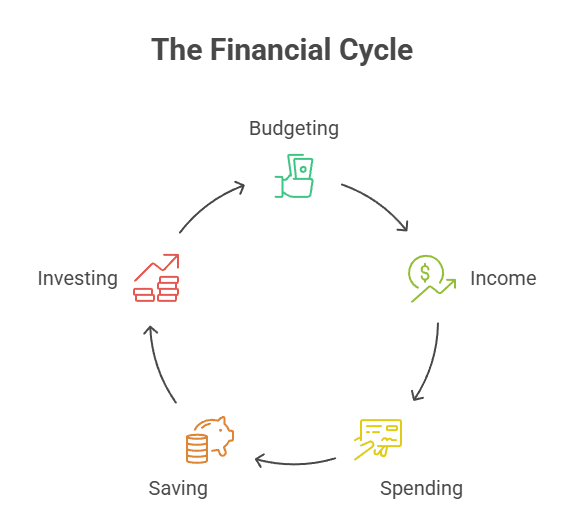
Understand how money flows through your life—from earning to investing.
1. The Budgeting System – Clarity Over Control
If you’ve ever tried budgeting and failed, you’re not alone.
I used to see budgeting as punishment—a way to cut joy out of my life and micromanage every penny. It never lasted. What changed everything was switching to a values-based budgeting system.
Instead of tracking every transaction, I focused on the why behind my spending. I asked: “What do I actually care about?” “Where do I want my money to go—on purpose?”
That shift created clarity without control. My budget became a reflection of my priorities—not a spreadsheet of shame.
Notion or Google Sheets – Easy to customize around your own categories
Cash envelope method – If you’re a tactile learner, this keeps spending visible and real
Real-life example: When I labeled my “fun money” category as non-negotiable, I stopped guilt-spending. Ironically, I spent less—because I finally trusted myself.
2. The Income System – Multiple Streams, One Purpose
We’ve all heard the advice: “Earn more!” Sure. But more income without a system often leads to more chaos.
When I started building multiple income streams—freelance writing, affiliate marketing, and consulting—I quickly realized I needed a way to manage it all. So I built a simple, centralized income system that kept things organized and purposeful.
How I Structured It:
All income → central business account
Monthly “owner’s draw” → personal checking
Automatically route a percentage to taxes, savings, and investments
Pattern break insight: Imagine your income like a river. It’s not about how wide it is—it’s about where it flows. More streams mean nothing if they leak out in all directions.
With a system in place, every dollar knows exactly where to go.
3. The Spending System – Conscious, Not Compulsive
Unconscious spending is a silent killer of financial peace. It’s that $7 latte, the “just browsing” online order, the weekend delivery spiral.
To curb this, I implemented a “permission-first” spending system. I automate essentials and financial goals first—so anything left is truly mine to spend guilt-free.
Key Strategies:
Auto-pay all fixed expenses (rent, insurance, subscriptions)
Set up automatic savings + investing before money hits checking
Allocate a fixed “fun money” allowance each month
Use a 48-hour rule before larger non-essentials
Mindset shift: The goal isn’t to spend less, it’s to spend intentionally. That’s what gives you control and joy.
4. The Saving System – Pay Yourself First (Then Forget It)
Here’s what most people get wrong about saving: They try to save what’s left after spending.
Spoiler alert: There’s usually nothing left.
That’s why I started paying myself first—automatically. Every time I get paid, a portion goes straight into goal-based savings buckets before I even see it.
How I Do It:
Auto-transfer to a high-yield savings account
Create sub-accounts: Emergency Fund, Travel, House Deposit, etc.
Use apps like Ally, Qapital, or even your bank’s “bucket” system
Visual tip: Label each savings bucket with a goal, not just a dollar amount. “Greece 2025” is way more motivating than “Misc. Savings.”
Even when I couldn’t save much, doing this consistently made me feel empowered—not deprived.
5. The Investing System – Slow, Steady, and Mostly Hands-Off
I used to think investing meant knowing the stock market inside out. I’d stress over headlines, try to time the dips, and constantly second-guess myself.
Now? I invest automatically, monthly, and rarely check the balance.
My System:
Set up monthly auto-deposit into my brokerage account
Reminder: You don’t need to “beat the market.” You just need to be in it, consistently.
“Time in the market beats timing the market — every time.” — Warren Buffett
If you’re nervous to start, begin with just $10/month. You’re not trying to get rich quick—you’re building the future in the background.
FAQs
Q: I’m overwhelmed. Where do I start? Start with one system—budgeting. It’s the foundation. Once you know where your money’s going, it’s easier to optimize the rest.
Q: What if I don’t make a lot of money yet? These systems scale. Even if you earn ₹15,000/month, you can route 5% to savings or build a basic budget. Consistency > amount.
Q: Is it okay if my system isn’t perfect? Absolutely. Systems evolve. I tweak mine quarterly. The key is building something that helps you stay intentional.
Final Thoughts: Build the Engine, Not Just the Outcome
The truth is, personal finance doesn’t have to be overwhelming, guilt-ridden, or restrictive.
It can be empowering, aligned, and low-maintenance—if you build the right systems.
Whether you’re freelancing, side hustling, or just trying to make ends meet, these 5 money systems can give you the structure and stability to stop surviving—and start building wealth on your terms.
Ready to stop hustling and start flowing?
Your Turn
Which money system do you already have—or want to build next? Drop a comment or share this post with a friend who needs a financial refresh.
Feeling like your paycheck disappears the moment it hits your account? You’re not alone—and you’re not powerless.
Let’s be real. Saving money sounds great in theory. But when rent, groceries, and bills are eating up most of your income, the idea of putting money aside feels impossible. Especially when the advice out there tells you to stash away six months of expenses—like, okay… where?
But here’s the thing: emergencies don’t wait until you’re financially ready. And while saving may seem out of reach right now, building an emergency fund is still doable—even on a tight budget.
Let’s walk through how you can start saving without turning your life upside down.
Why You Need an Emergency Fund—Even If You’re Broke
Think about this:
What happens if your phone suddenly breaks and you need a new one for work?
What if a family member falls sick and you need to cover their medical costs?
What if you lose your job next month?
These aren’t far-fetched situations. They happen every day, to people in all income brackets. And when you don’t have a financial cushion, your only options are usually credit cards, loans, or borrowing from friends and family—which can quickly snowball into stress and long-term debt.
An emergency fund gives you breathing room. It’s not about getting rich—it’s about avoiding getting stuck.
“An emergency fund is like a parachute—you hope you never have to use it, but when you need it, it’s everything.”
Let’s Be Honest—The Usual Advice Doesn’t Work for Everyone
You’ve probably heard: “Save six months of expenses.” Sure, that’s a solid goal. But for someone barely scraping by, it can feel like being told to climb Mount Everest without shoes.
If you’ve ever felt discouraged by traditional savings advice, here’s your permission to ignore it (for now).
Start where you are. Use what you have. Do what you can. That’s more than enough.
Track your savings goals with this simple, printable 30-day challenge.
Micro Steps You Can Start Today
Building your emergency fund doesn’t require a huge windfall. It starts with tiny, consistent actions. Here’s what you can try:
Set aside ₹50–₹100 a week. It doesn’t sound like much, but over time, it adds up. ₹100 a week = ₹5,200 a year.
Use auto-save apps. Some banks or fintech apps round up your purchases and deposit the change into savings. It’s painless and automatic.
Cut one “meh” expense. Cancel a subscription you forgot about. Brew coffee at home 3 days a week. Find one thing that won’t hurt to skip—and redirect that money into your fund.
These aren’t sacrifices. They’re strategic swaps.
Creative Ways to Boost Your Savings (Without Feeling Deprived)
Saving doesn’t have to mean cutting back on everything fun. Try a few of these:
Sell stuff you don’t use. Old books, clothes, gadgets—turn them into cash with local apps or marketplaces.
Do one-time gigs. Platforms like Fiverr, Upwork, or local freelance work can help you earn quick money for your fund.
Try a “no-spend weekend.” Make it fun! Cook at home, play free games, binge your favorite shows—and save what you would’ve spent.
Pro tip: Treat saving like a challenge or game, not a punishment. It’s way more motivating.
Where Should You Keep Your Emergency Fund?
This part’s important. You want your money to be easy to access in a real emergency, but hard to dip into for everyday wants.
Avoid your checking account. Too tempting.
Look for a high-yield savings account. These offer better interest and are separate from your daily spending.
Name your account. Seriously—call it “Peace of Mind Fund” or “Emergency Only.” It’s a small psychological trick that makes a difference.
Staying Motivated When Money is Tight
Saving is hard. Doing it on a low income? Even harder. But motivation grows when you see progress.
Track your milestones. Hit ₹1,000? Celebrate. Hit ₹5,000? Dance a little.
Visual reminders help. Use a savings tracker, a jar, a sticky note—something physical you see every day.
Remember your why. Peace of mind. Less stress. No panic when life throws a curveball.
Real Talk: This is About Progress, Not Perfection
Maybe today you can only save ₹10. That’s okay. Tomorrow might be ₹100. The key is consistency, not size.
“Don’t wait until you have a lot to start. Start so you can have a lot later.”
The best time to start your emergency fund? Yesterday. The second-best time? Today.
Let’s Talk: What’s One Thing You Can Do This Week to Start Saving?
Maybe it’s skipping one delivery meal. Maybe it’s putting aside ₹50. Maybe it’s selling that old Bluetooth speaker you haven’t touched in a year.
Drop your idea in the comments—I’d love to hear it. Let’s support each other.
Feeling stuck doesn’t mean you’re failing. It just means you’re at the beginning of something new—and you’re taking the first step.
You’ve got this. 💪
Manage Consent
To provide the best experiences, we use technologies like cookies to store and/or access device information. Consenting to these technologies will allow us to process data such as browsing behavior or unique IDs on this site. Not consenting or withdrawing consent, may adversely affect certain features and functions.
Functional
Always active
The technical storage or access is strictly necessary for the legitimate purpose of enabling the use of a specific service explicitly requested by the subscriber or user, or for the sole purpose of carrying out the transmission of a communication over an electronic communications network.
Preferences
The technical storage or access is necessary for the legitimate purpose of storing preferences that are not requested by the subscriber or user.
Statistics
The technical storage or access that is used exclusively for statistical purposes.The technical storage or access that is used exclusively for anonymous statistical purposes. Without a subpoena, voluntary compliance on the part of your Internet Service Provider, or additional records from a third party, information stored or retrieved for this purpose alone cannot usually be used to identify you.
Marketing
The technical storage or access is required to create user profiles to send advertising, or to track the user on a website or across several websites for similar marketing purposes.