I still remember sitting in my car outside the grocery store, staring at my bank app in disbelief.
Where did it all go?
I’d gotten paid two weeks earlier, and somehow I was down to $83 in my checking account. Rent was paid, sure. Bills were covered. But everything else? It had just… disappeared.
That’s when I realized I had no idea how to track my spending. Not really. I knew the big stuff—rent, utilities, car payment. But the rest was a complete mystery. Twenty dollars here, forty there, endless small purchases that added up to a massive black hole in my finances.
Learning how to track your spending properly changed everything for me. Not with complicated spreadsheets or guilt-inducing budgets. Just simple, practical tracking that fit into my actual life.
If your money disappears and you don’t know where it goes, this guide will show you exactly what to do—even if you’ve tried tracking before and given up.
That moment when you realize your money is disappearing and you don’t know where it’s going.
Let’s start with the basics.
Tracking your spending means recording every purchase you make and organizing it into categories so you can see patterns, identify waste, and make intentional decisions about where your money goes.
It’s not budgeting. Budgeting is deciding where money should go before you spend it. Tracking is seeing where it actually went after you spent it.
Think of it like this: budgeting is your plan, tracking is your reality check.
Most people skip tracking and jump straight to budgeting. Then they wonder why their budget never works. You can’t build a realistic budget without knowing your actual spending patterns first. If you’re ready to create a budget after tracking, the Consumer Financial Protection Bureau offers a free budget worksheet to get started.
Tracking gives you that foundation. It’s the financial equivalent of turning on the lights in a dark room.
Why Most People Fail at Expense Tracking
Before we get into solutions, let’s talk about why tracking feels so hard.
The biggest reason? Nobody ever taught us how to do it in a way that actually fits into real life.
School didn’t cover it. Personal finance advice assumes you have unlimited time and motivation. Banking apps show transactions, sure, but they don’t help you understand patterns or make better choices.
So most people either:
Try to track perfectly, get overwhelmed, and quit
Use a system that’s too complicated to maintain
Feel too guilty about their spending to look at it
Assume they’re just “bad with money” instead of recognizing they lack visibility
None of these are character flaws. They’re just predictable outcomes when you don’t have a realistic tracking system.
Here’s what actually happens when you don’t track spending:
Small purchases become invisible. That $6 coffee doesn’t register as “spending money.” Neither does the $12 lunch, the $8 snack, or the $15 impulse buy. But together? That’s over $40 in one day that your brain doesn’t count.
Subscriptions multiply silently. You sign up for a free trial, forget to cancel, and suddenly you’re paying $15/month for something you used once. Multiply that by five or six subscriptions and you’re bleeding $75-100 every month.
You can’t tell the difference between a bad week and a bad habit. Did you overspend this week because it was unusual, or because you always overspend? Without tracking, you can’t know.
The result? Constant low-level anxiety about money, even when you’re earning decent income.
How to Track Your Spending for Beginners: Start Simple
Alright, let’s get practical.
The best way to track expenses is whatever method you’ll actually use consistently. The fanciest system in the world is worthless if you abandon it after five days.
Here’s how to start without overwhelming yourself.
Do a Seven-Day Spending Observation
Before you set up any formal system, just observe.
For one week, write down every single thing you spend money on. Everything. Coffee, parking, groceries, bills, that app you downloaded, the tip you left—all of it.
Don’t judge yourself. Don’t try to change anything. Don’t organize it yet. Just collect raw data.
Use whatever’s easiest:
Notes app on your phone
A small notebook in your pocket
Voice memos to yourself
Receipts in an envelope
The tool doesn’t matter at this stage. What matters is capturing every purchase.
This observation week will probably shock you. Most people underestimate their spending by 30-50%. Seeing the actual numbers is eye-opening.
When I did this, I discovered I was spending $180 per month on delivery apps. I would’ve guessed maybe $60. The difference between perception and reality was massive.
Create Five Basic Categories
After your observation week, organize everything into simple categories.
Don’t create 30 categories. Don’t split “groceries” from “food” from “dining out” from “coffee.” That’s how you burn out.
Transportation (gas, public transit, rideshares, parking, car payment)
Daily life (clothing, personal care, phone, internet, household items)
Everything else (entertainment, hobbies, random purchases)
That’s it. Five categories. Simple enough that you’ll actually use them.
You can split categories later if needed. But start simple. Complexity kills habits.
Pick Your Tracking Method
Now choose how you’ll track going forward.
The notebook method: Carry a small notebook. Write down purchases as they happen. Total everything up weekly.
Best for: People who like writing things down and don’t want to rely on technology.
The phone notes method: Keep a running list in your notes app. Add purchases throughout the day. Review weekly.
Best for: People who always have their phone and prefer typing to writing.
The spreadsheet method: Create a simple spreadsheet with columns for date, category, amount, and notes. Update it daily or weekly.
Best for: People who like structure and don’t mind a few minutes of data entry.
The app method: Use a dedicated expense tracking app. Many categorize purchases automatically.
Best for: People who want automation and pretty graphs.
The bank statement method: Review your bank and credit card statements weekly. Highlight and categorize transactions.
Best for: People who use cards for everything and want the simplest possible approach.
I personally use a hybrid system. Quick notes in my phone throughout the day, then I transfer everything to a Google Sheet once a week during Sunday morning coffee. Takes me about eight minutes.
The key is matching the method to your lifestyle, not forcing yourself to use someone else’s “perfect” system.
How to Track Daily Spending Without It Taking Over Your Life
Consistency beats perfection. Here’s how to make tracking sustainable.
Build a Two-Minute Tracking Habit
Tracking should take less than two minutes per day. If it takes longer, you’ll quit.
The trick is capturing purchases immediately, when they’re fresh in your mind.
Create a trigger: Every time you put your wallet away, log the purchase. Every time you’re waiting for a transaction to process, write it down. Every time you get back to your car after shopping, add it to your list.
Connect tracking to something you already do automatically. That’s called habit stacking, and it works because you’re not trying to remember a completely new behavior.
If you forget during the day, set a phone reminder for 8pm. Spend three minutes reviewing your day and catching anything you missed. Check your bank app if you need to jog your memory.
The goal is 85-90% accuracy, not 100%. If you track most purchases, you’ll still see clear patterns. Don’t let perfectionism kill the habit.
Do a Weekly Money Review
This is where tracking becomes powerful.
Every week, sit down for 15 minutes and look at what you spent. Add up each category. Look for patterns.
I do mine every Sunday morning with coffee. It’s become a ritual I actually look forward to, weird as that sounds.
Questions to ask during your review:
What surprises me about this week’s spending?
Where did I spend more than expected?
Were there purchases I regret?
What brought real value to my life?
What could I change next week?
Write down observations. They’re more valuable than the numbers themselves.
This weekly review transforms raw data into understanding. Without it, you’re just collecting numbers that don’t mean anything.
Forgive Missed Days and Keep Going
You will forget to track sometimes. You’ll miss a day, maybe a few days. This is completely normal.
When you realize you missed tracking, just catch up. Don’t spiral into guilt. Don’t start over from scratch. Don’t decide you’ve failed.
Just update what you missed and continue forward.
Most people quit tracking because they miss a few days, feel bad about it, and convince themselves they’re not good at this. That’s nonsense. You just forgot. It happens to everyone. Move on.
Simple Methods to Track Your Spending Throughout the Month
After a few weeks of basic tracking, you’ll start seeing patterns. Now you can refine your approach.
Identify Your Top Three Spending Categories
Look at your data. Which three categories consistently get the most money?
For most people, it’s housing, food, and transportation. But your reality might be different. Maybe it’s food, shopping, and entertainment. Maybe it’s childcare, food, and debt payments.
Whatever your top three are, those deserve the most attention. Small improvements in big categories create bigger results than obsessing over tiny expenses.
When I analyzed my spending, my top three were rent (fixed, couldn’t change), food (way higher than necessary), and random shopping (stuff I didn’t need). Knowing this helped me focus my efforts where they’d actually matter.
Track Variable Expenses More Closely
Some expenses are fixed—rent, insurance, loan payments. They’re the same every month, so you don’t need to track them obsessively. Just verify they happened.
Variable expenses are different every time—groceries, gas, entertainment, shopping. These are where money disappears.
Focus your active tracking energy on variable expenses. That’s where you have control and where patterns emerge.
For fixed expenses, I just have a standing list that I check off monthly. For variable expenses, I track every transaction.
Notice When You Overspend (And Why)
After a month of tracking, patterns become visible.
Maybe you overspend every Friday because you’re exhausted from the work week. Maybe the first week after payday feels like a free-for-all. Maybe you shop when stressed or bored.
These patterns are gold. Once you see them, you can address the actual need instead of just throwing money at it.
I discovered I ordered delivery every time I had a stressful work day. It wasn’t about hunger—it was about comfort and not wanting to deal with one more thing. Once I saw that pattern, I started keeping easy backup meals for those days. My delivery spending dropped by 60%.
Pay attention to emotional triggers, time-based patterns, and situational spending. That’s where the insights live.
How to Monitor Spending Habits: Understanding Your Patterns
Tracking mechanics are important, but understanding what to do with your data matters more.
Compare This Month to Last Month
After two months of tracking, you can start making comparisons.
Did your food spending go up or down? Did you successfully cut entertainment costs? Did a new expense category appear?
Don’t just compare total spending. Compare categories. That’s where you’ll spot trends.
Month-over-month comparison shows whether changes you made actually worked. It also catches gradual increases that would otherwise be invisible.
I noticed my grocery bill had crept up by $40 over three months. Individually, the increases were small. Together, they were significant. Without tracking, I never would’ve caught it.
Separate Wants from Needs (Honestly)
One of the most valuable things tracking does is force honest conversations about wants versus needs.
We tell ourselves lots of stories. “I need this.” “I have to buy that.” “There’s no other option.”
Tracking reveals the truth. You don’t need delivery three times a week. You don’t need the premium version of every subscription. You don’t need most impulse purchases.
That doesn’t mean you should never buy wants. But call them what they are. “I’m choosing to spend $50 on this because I want it” is very different from “I need to spend $50 on this.”
Honest language creates better decisions.
Track Net Worth Changes Alongside Spending
This is more advanced, but powerful.
Every month, calculate your net worth: everything you own minus everything you owe. Write it down. If you’re unfamiliar with the concept, learn how to calculate your net worth and why it matters.
Then compare it to your spending. Are you spending less than you earn? Is your net worth going up?
If your net worth is flat or declining despite tracking, you need to either earn more or reduce fixed expenses. Tracking alone won’t solve that problem, but it will reveal it clearly.
Common Mistakes in Expense Tracking for Beginners
Let me save you from mistakes I made.
Creating Too Many Categories
I started with 23 categories. Twenty-three.
I had separate categories for coffee at home, coffee out, and coffee while traveling. I split entertainment into streaming, events, and hobbies. I differentiated between different types of shopping.
It was insane. I spent more time deciding where purchases belonged than actually tracking them.
Keep categories broad at first. You can always split them later if a category gets too big. But start simple.
Five to eight categories is plenty for beginners.
Only Tracking Big Purchases
Small purchases add up to big totals.
That $4 coffee seems harmless. But 20 of them per month is $80. The $8 lunch five times a week is $160. The $3 snacks add up.
Track everything, especially at first. Small purchases often reveal the biggest opportunities for improvement.
Once you understand your patterns, you can be more selective. But don’t start there.
Waiting for the Perfect System
There is no perfect tracking system. There’s only the system you’ll actually use.
Stop researching apps. Stop watching videos about the ultimate method. Stop waiting for the perfect spreadsheet template.
Start with anything. Literally anything. A napkin works. A text message to yourself works. A voice memo works.
Start imperfectly now instead of perfectly never.
Judging Yourself Harshly
Tracking reveals spending you regret. That’s the point—seeing it helps you avoid it next time.
But beating yourself up doesn’t help. Shame doesn’t create change. It just makes you want to stop tracking.
Observe your spending neutrally, like a scientist collecting data. The numbers aren’t good or bad. They’re just information.
Separate observation from judgment. See what happened, understand why it happened, decide what to do differently. No guilt required.
Practical Steps to Track Your Spending Starting Today
Enough theory. Here’s exactly what to do right now.
Step 1: Write down everything you’ve spent money on today. Right now. Open your phone’s notes app and list it.
Step 2: Set a daily reminder for 8pm. Label it “Track spending.” When it goes off, spend two minutes logging the day’s purchases.
Step 3: Choose one of the tracking methods I described. Pick the simplest one that feels doable.
Step 4: Put a recurring event in your calendar for Sunday mornings called “Weekly money review.” Block 20 minutes.
Step 5: Commit to tracking for one month. Just one. You can quit after that if you hate it.
That’s it. Five concrete actions. Do them today.
Don’t wait for Monday. Don’t wait until the first of the month. Don’t wait until you feel ready.
Start now with whatever you have available.
Tools and Resources (Use What Works for You)
You don’t need fancy tools to track spending effectively. But if you want them, here are options.
For pen and paper people: Any small notebook works. I like ones that fit in a pocket. Moleskine cahiers are nice but a $1 notebook works just as well.
For spreadsheet people: Google Sheets is free and accessible from anywhere. Excel works too. Keep the template simple—date, category, amount, notes. That’s all you need.
For app people: Mint, YNAB (You Need A Budget), PocketGuard, EveryDollar, Goodbudget. Pick one, try it for a month. If you don’t like it, try another. They all track spending, just with different approaches.
If you’re on Android and want something simple for manual tracking, “Buckwheat” is available on the Google Play Store. It’s straightforward, focuses on manual expense entry without automation, and works well for people who want a no-frills approach to logging purchases.
For automatic people: Most banks now offer built-in spending tracking. It’s not perfect at categorization, but it requires zero effort and gives you a starting point.
I know people who’ve transformed their finances with a $1 notebook. I know people with premium apps who still have no idea where their money goes.
The tool matters less than the consistency.
What to Do With Your Tracking Data
Tracking for its own sake doesn’t help much. You need to use what you learn.
Identify One Change Per Month
Look at your data. Pick the easiest problem to solve. Change that one thing.
Maybe it’s canceling a subscription. Maybe it’s packing lunch twice a week. Maybe it’s finding a cheaper option for something you buy regularly.
One change. That’s it. Let it become normal before adding another change.
This might feel slow, but slow actually works. Trying to overhaul everything at once is how you end up changing nothing.
Question Automatic Spending
Tracking reveals purchases you make on autopilot. The same coffee every morning. The same streaming services you barely watch. The same expensive convenience when a cheaper option exists.
Not all automatic spending is bad. But some of it is just habit, not preference.
Question it. “Do I actually want this, or am I just used to buying it?”
Sometimes the answer is yes, you want it. Great. Keep it. But sometimes you realize you don’t care that much, and that awareness changes behavior naturally.
Build Emergency Awareness
Tracking shows you how much you actually need to cover basics. This information is crucial for emergency planning.
If you know your absolute minimum monthly expenses, you know how much emergency savings you need. You know how tight things would get if income dropped. You know which expenses you could cut in a crisis. Use an emergency fund calculator to determine your target savings amount based on your tracked expenses.
This isn’t fun to think about, but it’s important. Tracking gives you the data to plan realistically.
Frequently Asked Questions
How do you track spending if you use cash?
Track it the same way. Write it down as you spend it, or collect receipts and log them later. Cash is actually easier to track in some ways because it’s more tangible and immediate.
What’s the easiest way to track daily expenses for beginners?
The easiest method is the one you’ll actually use. For most people, that’s either a notes app on their phone or a small notebook they keep with them. Start with whichever feels more natural to you.
Should I track my partner’s spending too?
Only if you share finances and they agree to it. If you have joint accounts or shared expenses, tracking together helps. But respect privacy for separate accounts. You can’t force someone else to track if they don’t want to.
How detailed should expense tracking be?
Detailed enough to understand patterns, but not so detailed that tracking becomes a burden. “Groceries $87” is fine. You don’t need to list every item unless you’re trying to optimize grocery spending specifically.
What if I hate looking at my spending because it makes me feel guilty?
This usually means you’re judging yourself too harshly. Try to observe neutrally. The numbers aren’t good or bad—they’re just information that helps you make better decisions. Separate the observation from self-judgment.
Your Next Step: Start Tracking Your Spending Today
You’ve read this far, which means you’re serious about getting control of your money.
Here’s what to do right now:
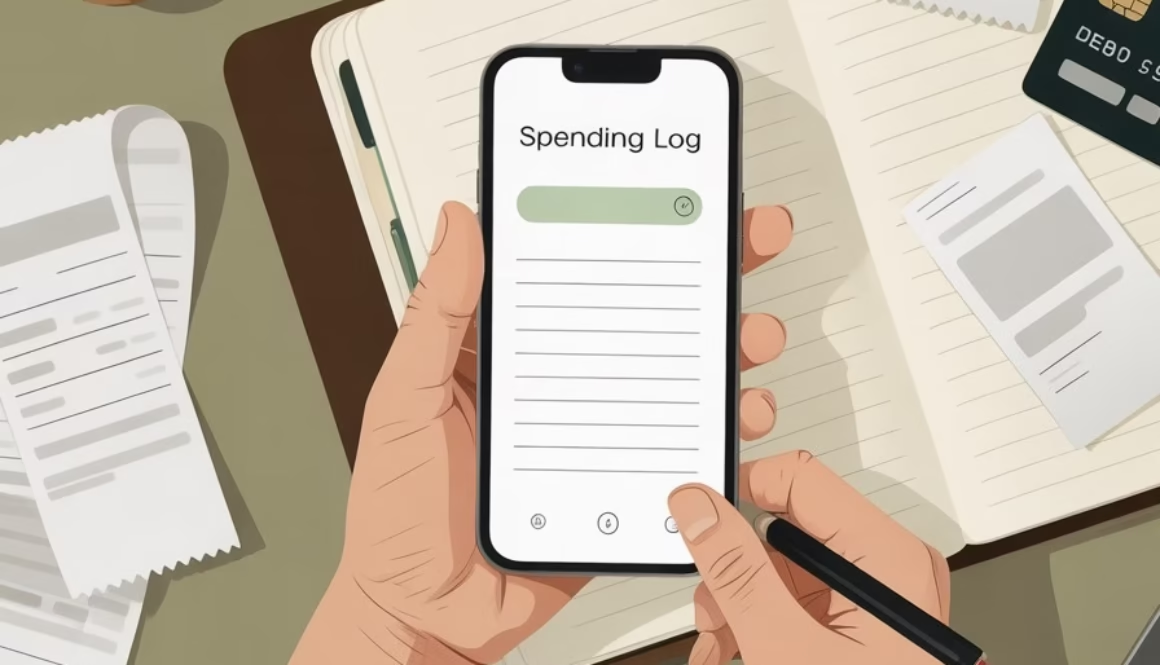
Open your phone’s notes app. Create a new note called “Spending Log.” Write down everything you’ve purchased today.
That’s it. That’s your first action.
Tomorrow, add tomorrow’s purchases to the list. The day after, do it again.
Do this for one week. Just seven days of writing down what you spend.
After that week, come back to this guide. Follow the steps for choosing a method, creating categories, and setting up your weekly review.
Learning how to track your spending properly is one of the most valuable financial skills you can develop. It’s not exciting, it’s not sexy, but it works.
And it gets easier with time. The habit builds. The patterns become obvious. The decisions become natural.
A few months from now, you’ll look back and wonder how you ever managed money without tracking it. You’ll see your past self stumbling in the dark and feel grateful you finally turned on the lights.
You know that feeling when you sit down to finally make a budget?
You’ve got your coffee. Your bank statements are open. You’re ready to take control of your money.
Then boom. Confusion hits.
Rent is $1,200 every month. Easy enough. But groceries? Last week you spent $80. The week before, $150. What number do you put in your budget?
And that car insurance bill that shows up twice a year? Where does that go?
Here’s what’s actually happening: You’re trying to budget without understanding the fundamental difference between expenses that stay the same (fixed) and expenses that bounce around (variable). This single gap causes more budget failures than overspending ever will. You can’t control what you can’t categorize.
Most people abandon their budgets within 30 days. Not because they lack discipline. Because they built their budget on a shaky foundation that treats all money the same way.
Understanding fixed vs variable expenses is the secret to building a budget that survives real life. Not a perfect spreadsheet that falls apart after three days. A real system you can actually stick to.
Let’s make this crystal clear before we go deeper.
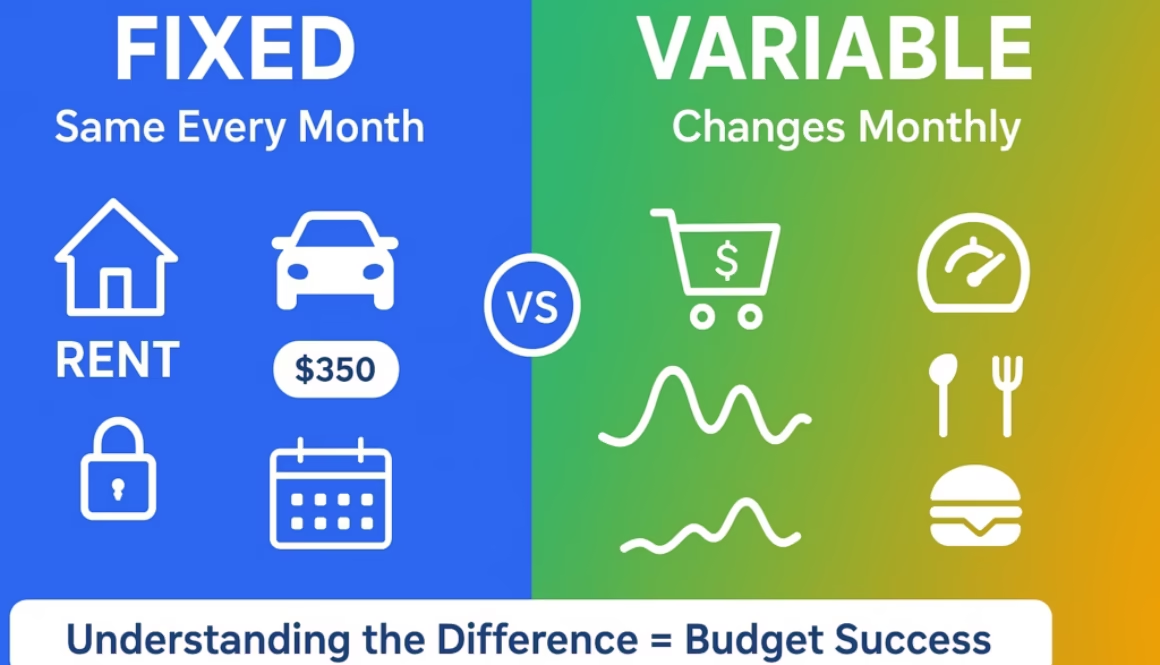
Fixed Expenses: Costs that stay the same amount every month. They’re predictable and usually locked in by contract, lease, or subscription. You know exactly what you’ll pay before the bill arrives.
Variable Expenses: Costs that change from month to month based on your usage, choices, or circumstances. The amount fluctuates, and you won’t know the final cost until after you’ve spent the money.
Examples: groceries, utilities, gas, dining out, entertainment, clothing, medical expenses
The crucial difference: Fixed expenses represent past commitments you can’t easily change. Variable expenses represent present choices you control daily.
What Fixed Expenses Actually Mean
Think about your rent.
Doesn’t matter if you get a bonus at work or if you’re barely scraping by that month. Your landlord still wants the same amount. That’s a fixed expense.
Fixed expenses stay the same. Month after month. You know exactly what’s coming.
Common fixed expenses include:
Rent or mortgage payments
Car loan payments
Student loan payments
Insurance premiums (health, auto, renters, life)
Phone and internet bills
Subscription services (Netflix, Spotify, gym)
Childcare or tuition
HOA fees
Property taxes
See the pattern? These are commitments you made. Contracts you signed. Services you subscribed to.
Why Fixed Expenses Are Easy (and Hard)
The good news? Fixed expenses are predictable. You can plan around them. You know your car payment is $350, so you make sure $350 is sitting there when the bill comes.
The bad news? They’re sticky. You can’t just cut them in half next month because money’s tight.
Want to lower your rent? You’ve got to move. Want to ditch that car payment? You need to pay off the loan or sell the car.
These changes take time. Sometimes months. Sometimes years.
Quick takeaway: Fixed expenses give you stability but cost you flexibility. They’re the easiest to budget but the hardest to reduce quickly.
What Variable Expenses Really Look Like
Now let’s talk about the expenses that bounce around.
Your electric bill is a perfect example. Run the AC all summer? Maybe you’re paying $150. Nice spring weather where you barely use heating or cooling? Could be $60.
Same bill. Wildly different amounts.
Typical variable expenses:
Groceries
Dining out and takeout
Utilities (electricity, water, gas)
Transportation costs (gas, public transit, ride-shares)
Clothing and personal care
Entertainment
Gifts and celebrations
Home and car repairs
Medical expenses and prescriptions
Pet care
Notice something? These expenses depend on your choices and circumstances.
You control how much you spend on groceries. Whether you meal prep or buy expensive convenience foods. Whether you stick to a list or throw random stuff in your cart.
Why Variable Expenses Get Messy
Here’s the thing. They feel optional even when they’re not.
You have to eat. So groceries aren’t really optional. But spending $200 versus $500? That’s where the choices live.
This flexibility is great. It means you have control. But it also means it’s easy to overspend without noticing.
Most budget disasters happen in the variable expense zone.
Quick takeaway: Variable expenses are where you have the most daily control and the most opportunity to blow your budget. They require active tracking, not just planning.
Key Differences Between Fixed and Variable Expenses
Let’s cut through the textbook stuff and talk about what actually matters.
Characteristic
Fixed Expenses
Variable Expenses
Predictability
You know the exact amount before the bill arrives
You won’t know the final cost until after spending
Flexibility
Difficult to change short-term; requires major decisions
Can adjust immediately with different choices
Budget Method
Assign the exact known amount
Estimate based on past patterns and set a target
Control Level
Low day-to-day control; committed amounts
High day-to-day control; every purchase is a choice
When to Reduce
Requires planning 3-12 months ahead
Can course-correct mid-month
Bottom line: Fixed expenses limit your flexibility. Variable expenses shape your day-to-day spending power.
If you want a deeper understanding of how fixed vs variable expenses work in real life, this helpful budgeting guide explains the differences with simple examples and practical tips you can apply right away. It’s especially useful if you’re trying to figure out where your money actually goes each month and how to gain better control over it.
Real Budgets: How This Plays Out
Let me show you how this works in actual life.
Sarah: Freelance Designer
Her income bounces between $3,000 and $5,000 monthly.
Fixed expenses: $1,850
Rent: $1,200
Car payment: $280
Health insurance: $320
Phone bill: $50
Variable expenses: $1,400 average
Groceries: $300-400
Utilities: $80-120
Gas: $150-200
Dining out: $200-300
Personal care: $100-200
Entertainment: $50-150
Sarah’s strategy: Cover fixed expenses first from every paycheck. Whatever’s left goes to variable categories. In lower-income months, she cuts back on eating out and shopping.
The Martinez Family
Two adults, two kids. Combined income of $7,500 monthly.
Fixed expenses: $4,200
Mortgage: $2,400
Two car payments: $650
Insurance bundle: $420
Internet/streaming: $110
Childcare: $600
Student loan: $320
Variable expenses: $2,400 average
Groceries: $800
Utilities: $250
Gas: $300
Dining out: $250
Kids’ activities: $300
Medical/pharmacy: $200
Home maintenance: $150
Miscellaneous: $150
Remaining: $900
With little breathing room, they’re working on reducing fixed costs by refinancing their mortgage and paying off one car within the year.
Key insight from both examples: Your fixed-to-variable ratio determines your financial flexibility. Higher fixed expenses mean less room to maneuver when income drops or surprise costs hit.
The Grocery Question Everyone Asks
“Are groceries fixed or variable expenses?”
I get this question constantly.
Groceries are variable expenses.
Here’s why people get confused. You have to eat, so groceries feel as essential as rent. Non-negotiable, right?
But unlike rent, the amount changes based on what you buy, where you shop, and whether you waste food.
Some months you stock up on sale items and spend less. Other months you grab expensive pre-made stuff and spend more.
The Smart Approach
Many budgeters treat groceries as semi-fixed. They calculate their three-month average and budget that amount consistently.
This creates predictability while acknowledging the spending might vary by $50 to $100.
Other Confusing Expenses
Utilities? Variable. Usage changes with seasons and habits.
Streaming subscriptions? Fixed. Same price monthly regardless of how much you watch.
Semi-annual car insurance? Still fixed. The amount doesn’t change, just the frequency.
Medical expenses? Variable. You might spend zero one month and $500 the next.
Pet care? Mostly variable (food, vet visits) with some fixed costs (pet insurance).
Reality check: Some expenses live in a gray area. What matters more than the label is how you plan for them in your budget.
How to Build Your Budget Using Both Types
Understanding the difference is great. But how do you actually use this information?
Step 1: Calculate Your Fixed Expense Baseline
Add up everything that stays the same month after month.
This total is your baseline—the absolute minimum you need to function.
Warning sign: If this number exceeds 50% of your take-home pay, you’ve got a problem. You’re locked into commitments that don’t leave enough room for daily living and saving.
Step 2: Analyze Your Variable Spending Patterns
Grab three months of bank statements. Go through them category by category.
Look for:
Your average monthly spending in each category
Patterns (do you always overspend on restaurants?)
Unexpected costs that pop up regularly
Step 3: Set Realistic Variable Targets
Don’t set yourself up to fail. If you’ve spent $400 monthly on groceries for six months straight, don’t budget $200.
Start with your actual averages. Then pick one or two categories where you can reasonably cut back.
Step 4: Build Buffer Money
Life happens. Set aside $200-500 for unexpected variable costs. This isn’t permission to blow your budget. It’s acknowledging reality.
Step 5: Track Weekly, Not Just Monthly
Variable expenses need ongoing attention. Check in every few days.
Spent 80% of your grocery budget by the 15th? Time to get creative with pantry meals for the rest of the month.
Action step: Right now, list every expense you paid last month. Mark each as F (fixed) or V (variable). If you’re not sure, it’s probably variable.
The 50/30/20 Rule (And Why It Sometimes Doesn’t Work)
You’ve probably heard of this budgeting framework:
50% of income → needs
30% → wants
20% → savings and debt
It’s popular because it’s simple. But here’s what most articles don’t tell you.
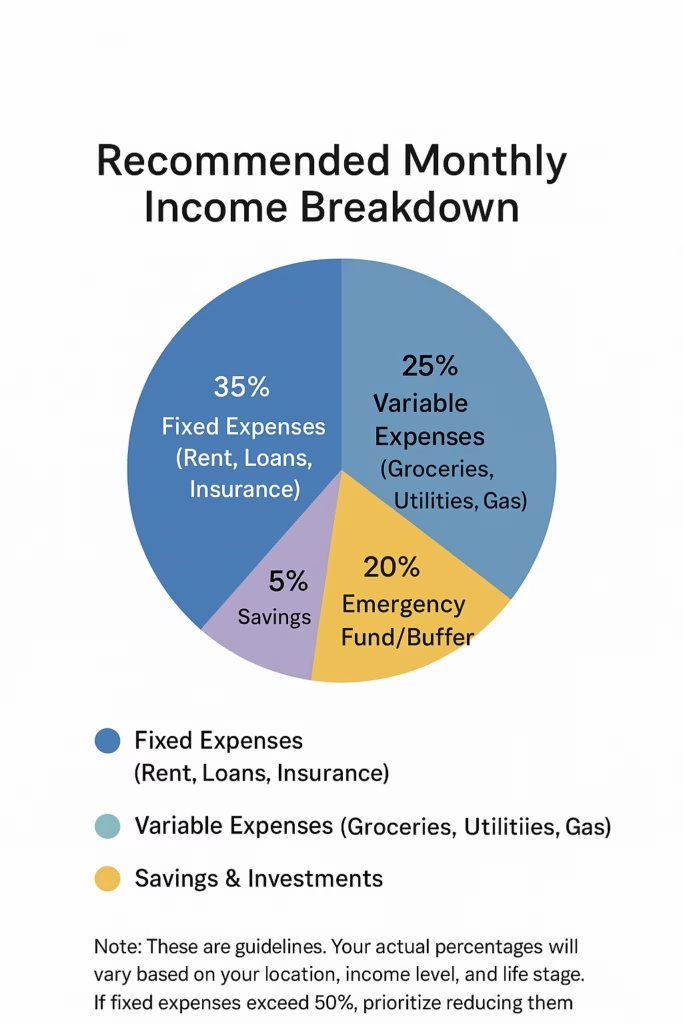
A healthy budget typically allocates 35% to fixed expenses, 25% to variable expenses, 20% to emergency funds, and 20% to savings. If your fixed expenses exceed 50%, prioritize reducing them for better financial flexibility.
Your “savings” (20%) should be treated as fixed: Set up automatic transfers. Treat it like a bill you owe yourself. Don’t wait to see “what’s left” at month’s end.
The Problem
If your fixed expenses alone eat up 70% of your income, this rule won’t work.
You’ll need to tackle those fixed commitments first. Lower the rent by getting a roommate. Pay off a car loan. Cancel subscriptions.
Only then will the 50/30/20 framework become useful.
How to Actually Manage Fixed Expenses
Let’s get tactical.
Audit Your Subscriptions Quarterly
Most people pay for stuff they don’t use. That gym membership you haven’t visited in three months. The streaming service you forgot about.
Go through your bank statements. Cancel anything you’re not actively using.
Even $10 monthly subscriptions add up to $120 yearly.
Negotiate or Shop Around
Fixed expenses feel permanent. But many are negotiable.
Tactics that work:
Call insurance companies and ask for better rates
Check internet and phone plan rates annually
Refinance loans if interest rates dropped
Consider downsizing housing if costs are crushing you
Plan for Irregular Fixed Expenses
Car insurance might hit twice a year. Amazon Prime bills annually. Property taxes come quarterly.
The solution: Take the annual cost, divide by 12, and set aside that amount monthly in a separate savings account.
When the bill comes, you’re ready. No stress.
Limit New Fixed Commitments
Before signing up for any new recurring payment, ask yourself:
Will I use this enough to justify the cost?
Can I commit to this for at least a year?
Every new fixed expense reduces your financial flexibility.
Quick takeaway: Your fixed expenses are yesterday’s decisions affecting today’s flexibility. Review them quarterly and be ruthless about what stays.
How to Actually Manage Variable Expenses
Variable expenses need different tactics.
Use Cash Envelopes (Physical or Digital)
Assign a specific amount to each variable category. When it’s gone, it’s gone.
This creates real constraints. You can’t overspend if the money literally isn’t there.
Don’t want to carry cash? Use a budgeting app that creates virtual envelopes.
Track Spending in Real-Time
Don’t wait until month’s end to check your budget. By then it’s too late.
Check every few days. Quick review. Where do you stand? If you’re running high in one category, pull back immediately.
Identify Your Spending Triggers
Variable expenses often spike because of emotions.
Rough day → ordered takeout
Bored Sunday → browsed online shops
Stressed week → retail therapy
Pay attention to patterns. When do you overspend? Why? Once you understand your triggers, you can interrupt the habit.
Create Simple Spending Rules
Rules reduce decision fatigue:
Only eat out twice a week
Wait 24 hours before buying anything over $50
Meal plan every Sunday to avoid impulse grocery trips
Walk or bike for trips under two miles
No online shopping after 9pm
Use Sinking Funds for Predictable Irregulars
Some variable expenses are unpredictable in timing but totally predictable in happening. Your car will need repairs eventually. Holidays come every year.
Set aside small amounts monthly for these categories. When the expense hits, you’ve got money waiting.
Quick takeaway: Variable expenses are won or lost in the moment. Your system needs to catch overspending before it happens, not after.
Why This Actually Matters
When you don’t separate fixed and variable expenses, you feel powerless. Money just disappears. Bills just happen.
But when you understand the difference, you take back control.
You realize two things:
Fixed expenses are past decisions. Commitments you made months or years ago. You can’t change them today, but you can make a plan to reduce them over time.
Variable expenses are present decisions. Choices you’re making right now. Today. You have power here.
Want to order pizza? That’s a choice. Want to cook the chicken in your fridge instead? Also a choice.
This transforms budgeting from punishment into strategy.
The Financial Freedom Connection
People with financial freedom didn’t all get there by earning six figures.
They managed the relationship between their fixed and variable expenses. They kept fixed expenses low compared to income. This created breathing room. Margin. Space.
That margin becomes savings. That margin becomes the ability to handle emergencies without panic. That margin becomes options.
Options to switch careers. Options to travel. Options to take risks. Options to say no to stuff that doesn’t serve you.
That’s what financial freedom actually is. Not being rich. Having options.
Mistakes People Make (And How to Avoid Them)
Mistake 1: Treating Everything the Same
If you lump all expenses together, you miss the strategic opportunity. You can’t cut your rent this month, but you absolutely can cut restaurant spending.
Fix: Separate your expenses into two columns. Fixed and variable. Right now. You’ll immediately see where your control lives.
Mistake 2: Getting Locked Into Too Many Fixed Expenses
“It’s only $15 a month.” True. But add up ten of those decisions and you’ve committed to $150 monthly that you can’t easily undo.
Fix: Apply the “one-year test.” Before adding any subscription, ask: Will I still want this in 12 months?
Mistake 3: Ignoring Variable Expense Patterns
Just because something varies doesn’t mean you should ignore what you typically spend.
Fix: Calculate three-month averages for each variable category. Use those as your baseline targets.
Mistake 4: Not Planning for Irregular Bills
Annual subscriptions and semi-annual insurance payments blindside people every time.
Fix: List every non-monthly bill you pay. Set up a sinking fund for each one.
Mistake 5: Being Too Rigid With Variable Categories
Life happens. You’ll overspend sometimes. The goal isn’t perfection—it’s awareness and course correction.
Fix: Allow 10% cushion in your variable budget. Use it guilt-free when needed.
Mistake 6: Never Reviewing Fixed Commitments
What made sense two years ago might not make sense now.
Fix: Calendar a quarterly “fixed expense audit.” Review every subscription and recurring bill.
Advanced Moves for When You’ve Got the Basics Down
The 70/20/10 Split for Variable Expenses
Within your variable spending, aim for:
70% on necessities (groceries, utilities, basic transportation)
20% on quality-of-life (reasonable dining out, personal care)
10% on pure fun (entertainment, hobbies)
This prevents you from being either miserable or reckless.
Automate Everything Possible
Set up autopay for fixed expenses. You’ll never miss a due date or pay a late fee.
Set up automatic transfers to savings accounts for irregular fixed expenses.
Automation removes the mental load and the temptation.
Build a One-Month Buffer
Work toward keeping one full month of expenses in your checking account at all times. This means December’s income pays January’s bills.
This buffer eliminates paycheck-to-paycheck stress.
Run Quarterly No-Spend Challenges
Pick one category of variable spending. Do a 30-day challenge. No restaurants. No clothes shopping. No random Amazon purchases.
This resets your baseline, breaks habits, and shows you what you actually need versus what you’ve normalized.
Try Zero-Based Budgeting
Give every dollar a job before the month starts. This works especially well with variable expenses because it forces intentional decisions instead of mindless spending.
How to Cut Costs When You Need To
Sometimes you need to reduce expenses fast. Here’s how.
Cutting Fixed Expenses (Long-Term Strategies)
Housing:
Get a roommate to split costs
Move to a cheaper area or smaller place
Refinance your mortgage if rates dropped
Negotiate rent at lease renewal
Transportation:
Go from two cars to one if possible
Trade in for a cheaper reliable used car
Pay extra toward car loan to eliminate payment faster
Use up pantry and freezer items before buying more
Utilities:
Adjust thermostat a few degrees
Unplug unused devices
Switch to LED bulbs
Take shorter showers
Transportation:
Combine errands into one trip
Carpool when possible
Walk or bike for nearby errands
Maintain your vehicle to prevent expensive repairs
Dining Out:
Set a firm weekly dollar limit
Reserve restaurants for special occasions only
Find free entertainment alternatives
Host potlucks instead of restaurant meetups
Shopping:
Buy only when actually needed, not when bored
Shop secondhand
Learn basic skills (simple alterations, haircuts)
Use products completely before buying new ones
The key: Attack both types simultaneously. Cut variable expenses now for immediate relief. Make a plan to reduce fixed expenses over the next 6-12 months.
Comparison Table: Fixed vs Variable Expenses
Fixed Expenses (Same Every Month)
Variable Expenses (Change Monthly)
🏠 Rent/Mortgage – Same amount locked by lease or loan
🛒 Groceries – Changes based on buying and eating habits
🚗 Car Payment – Fixed installment per loan agreement
🐕 Pet Care & Supplies – Food, vet visits, grooming—varies
Note: Some expenses blur the lines. If you budget the same amount for groceries every month regardless of actual spending, you’re treating it as “semi-fixed” for planning purposes. The key is understanding which expenses you can control immediately (variable) versus those requiring planning to change (fixed).
Quick Answers to Common Questions
What percentage of my income should go to fixed expenses?
Aim for 50% or less of your take-home pay. If you’re over 60%, you’ll struggle to save and handle surprises. The lower your fixed expense percentage, the more flexibility you have.
Can fixed expenses ever change?
Yes, but not easily or often. You can refinance a loan, move to cheaper housing, or cancel subscriptions—but these are deliberate decisions that take effort, not spontaneous adjustments.
How do I budget for unpredictable variable expenses?
Look at your past three months of spending. Calculate your average for each category. Budget slightly higher than that average to give yourself cushion. Track weekly to catch overspending early.
Should I focus on cutting fixed or variable expenses first?
Both matter, different timelines. Cut variable expenses now for immediate results (requires ongoing discipline). Simultaneously, work on a plan to reduce fixed expenses over the next 6-12 months (creates permanent savings).
What if my fixed expenses are way over 50% of my income?
You have three options: increase income, reduce fixed expenses, or both. This might mean taking on extra work, getting a roommate, selling a vehicle, or moving to more affordable housing. Not easy, but necessary for financial stability.
Are credit card payments fixed or variable expenses?
The minimum payment is fixed—you must pay at least that amount monthly. But the total you owe is variable based on your spending. Treat the minimum as fixed in your budget. Put any extra payments in your debt payoff strategy.
How often should I review my budget?
Check variable spending weekly to stay on track. Do a full budget review monthly. Run a deep analysis quarterly to identify patterns, adjust amounts, and look for opportunities to reduce costs.
Is it better to have more fixed or variable expenses?
Neither is inherently better, but lower fixed expenses give you more flexibility. If 70% of your income goes to fixed costs, you’re locked in with little room to adjust. If only 35% is fixed, you have space to save, invest, and handle surprises. Aim for a balance that leaves breathing room.
Take Action: Your Next 24 Hours
Understanding fixed vs variable expenses isn’t about memorizing definitions or perfectly categorizing every transaction.
It’s about building awareness of how your money moves.
Your fixed expenses represent commitments—the life you’ve locked into through leases, loans, and recurring payments. Your variable expenses represent choices—the life you’re creating day by day through small decisions.
Here’s what to do right now:
List your expenses from last month. Every single one.
Mark each as F (fixed) or V (variable).
Add up your fixed expenses and calculate what percentage of your income they consume.
Pick one fixed expense to reduce over the next 90 days (cancel a subscription, shop for better insurance rates, make extra car payments).
Pick one variable category to track closely this week (groceries, dining out, or whatever tends to blow your budget).
That’s it. Five steps. Twenty minutes of work.
This isn’t about building the perfect budget. It’s about taking control through small improvements that compound over time.
Start today.
Go to Next Lesson:
How to Track Your Spending: A Practical Guide That Actually Works
Understanding the difference between fixed and variable expenses is the first step—but knowing where your money actually goes is what turns that knowledge into action. In the next lesson, you’ll learn how to track your spending in a simple, realistic way, so you can spot patterns, control variable expenses, and make better financial decisions without feeling overwhelmed.
👉 Read next:How to Track Your Spending: A Practical Guide That Actually Works
For deeper insights into personal finance strategies, certified financial planners and established financial education organizations offer comprehensive budgeting guides and tools. Look for resources that align with your specific financial situation and goals.
I’ll never forget the morning I checked my bank account and saw $47 staring back at me. It was still two weeks until payday. lets talk about this How to Make a Monthly Budget That Actually Works
Here’s the reality: 78% of Americans live paycheck to paycheck, according to recent financial surveys. But here’s what most people don’t realize—you don’t need to earn more money to break this cycle. You just need a system.
Quick Answer: A monthly budget is a simple plan that tracks your income and expenses, helps you prioritize spending, and ensures you’re saving at least 10-20% of your income. Using methods like the 50/30/20 rule or zero-based budgeting, you can take control of your finances in under 30 minutes per week.
This guide is based on 2025 financial best practices from the Consumer Financial Protection Bureau and certified financial planners. Whether you’re trying to build an emergency fund, pay off debt, or simply stop wondering where your money went, this beginner-friendly guide will show you exactly how to create and stick to a budget that works in real life.
Think about it this way: if you were driving cross-country, you’d use GPS, right? You wouldn’t just get in the car and hope you end up in the right place.
Your budget is your financial GPS.
Most people choose monthly budgets because the majority of recurring bills operate on a monthly cycle—rent, utilities, subscriptions, and loan payments all typically come due once per month.
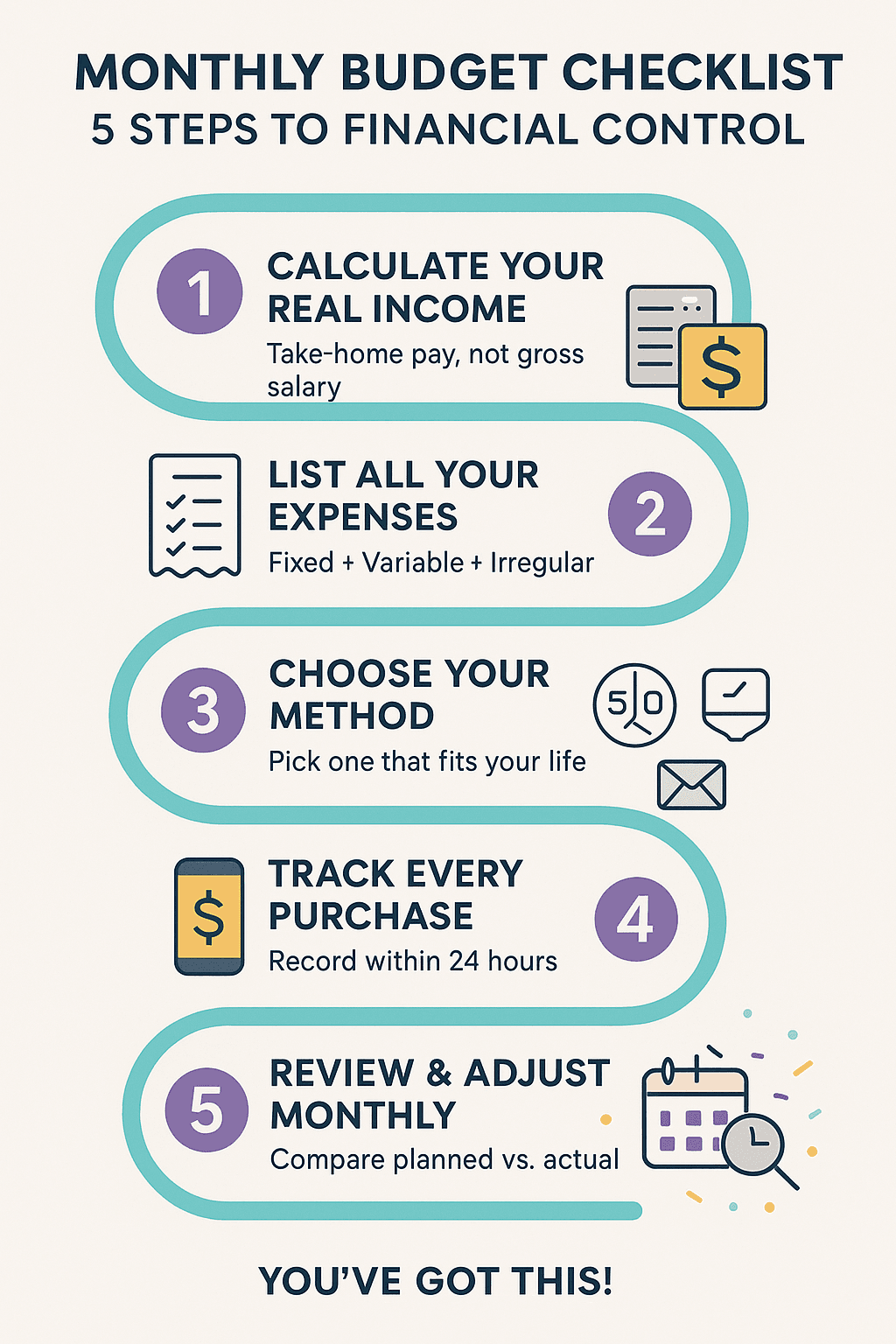
Step 1: Calculate Your Real Take-Home Income (Not Your Salary)
This is where most people mess up right from the start.
They look at their salary and think, “Great, I make $4,000 a month!” But that’s not what hits your bank account.
Find Your Net Income
Net income = Take-home pay after all deductions
Pull up your last few paystubs or check your bank account. Look for the number that actually gets deposited, including deductions for:
Federal and state taxes
Social Security and Medicare
Health insurance premiums
Retirement contributions (401k, IRA)
Other automatic deductions
Example calculation:
Gross monthly salary: $4,500
Taxes and deductions: -$1,100
Net monthly income: $3,400 ← This is your real number
Income Frequency Conversion
Pay Frequency
Calculation Method
Weekly
Multiply by 4.33
Bi-weekly (every 2 weeks)
2 paychecks most months (3 in some months)
Semi-monthly (twice per month)
2 paychecks consistently
Monthly
Use the full amount
Handling Variable or Irregular Income
Freelancer? Server? Commission-based job?
Here’s the safe approach:
Track your income for 3-6 months
Use your lowest-earning month as your baseline budget
During higher-earning months, direct extra income to savings or debt payoff
Create a buffer account to smooth out income variations
Pro tip: Only include side hustle income if it’s reliable and consistent (at least $200+ monthly for 3+ months).
Step 2: Track and Categorize Every Single Expense
This part is eye-opening.
Most of us have no idea how much we actually spend. Time to become a financial detective.
Solution: Create sinking funds by setting aside money monthly.
Example: If you spend $600 on holiday gifts annually, save $50/month in a dedicated “Holiday Fund.”
Step 3: Choose the Right Budgeting Method for Your Personality
There’s no “best” budgeting method. The best budget is the one you’ll actually use.
Method Comparison Table
Budgeting Method
Best For
Complexity
Flexibility
50/30/20 Rule
Beginners, simple approach
Low
High
Zero-Based Budgeting
Detail-oriented planners
High
Medium
Envelope System
Visual learners, overspenders
Medium
Low
Pay Yourself First
People who struggle to save
Low
High
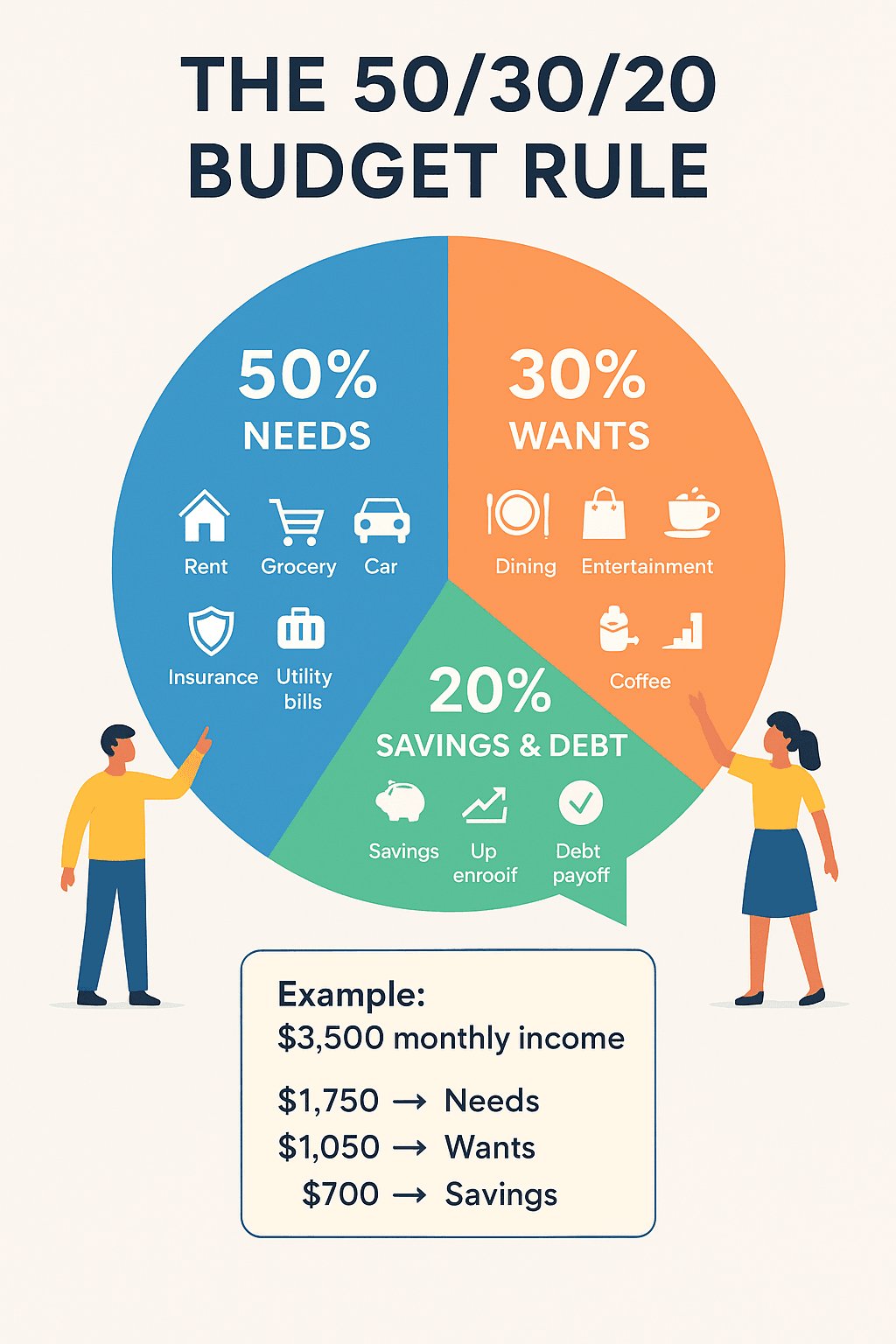
A simple visual breakdown of the 50/30/20 rule to help you understand how to make a monthly budget that actually works.
The 50/30/20 Rule (Perfect for Beginners)
Divide your after-tax income into three buckets:
50% for Needs: Rent, groceries, utilities, insurance, minimum debt payments
30% for Wants: Dining out, entertainment, hobbies, shopping
20% for Savings/Debt: Emergency fund, retirement, extra debt payments
Example with $3,500 monthly take-home:
$1,750 → Needs
$1,050 → Wants
$700 → Savings and debt payoff
According to Bankrate, financial experts consistently recommend this 20% savings rate as a minimum target.
Zero-Based Budgeting (For Maximum Control)
Every single dollar gets assigned a job until you reach zero.
Example with $3,500 monthly income:
$1,200 → Rent
$400 → Groceries
$250 → Car payment
$150 → Gas
$100 → Utilities
$300 → Student loans
$500 → Savings
$300 → Fun money
$200 → Irregular expenses fund
$100 → Miscellaneous
Total: $3,500 (Zero remaining)
Every dollar has a purpose. Maximum awareness and control.
The Envelope System (Old School, Still Effective)
Allocate cash to labeled envelopes for each spending category. When an envelope’s empty, you stop spending in that category.
Modern adaptation: Use digital envelope apps like Goodbudget or create separate checking accounts for each category.
Pay Yourself First (Automated Savings)
Save first, budget the rest.
Automatic transfer to savings on payday
Treat savings as a non-negotiable “bill”
Budget remaining income for expenses
This method ensures consistent progress toward savings goals.
Step 4: Track Your Spending Throughout the Month (This Is Where the Magic Happens)
Creating a budget is 20% of the work. Tracking is where transformation happens.
Choose Your Tracking Tool
Budgeting Apps (Automated):
YNAB (You Need A Budget) – Best for zero-based budgeting
Monarch Money – Great for couples and families
EveryDollar – Simple and affordable
Goodbudget – Digital envelope system
Empower – Combines budgeting with investment tracking
Spreadsheets (Customizable):
Google Sheets (free, cloud-based)
Microsoft Excel
Free downloadable templates
Manual Tracking:
Paper notebook and pen
Bank’s built-in budgeting features
Weekly Budget Review (15 Minutes Every Sunday)
Check each category:
Am I on track or over budget?
Any surprise expenses coming this week?
Do I need to move money between categories?
What spending decisions am I proud of?
Record Every Purchase
The golden rule: Record every transaction within 24 hours.
Yes, even the small ones. Especially the small ones. Those $3 coffees and $8 lunches are silent budget killers.
Use your phone immediately after purchases. Takes five seconds.
Step 5: Review and Adjust at Month’s End
End of month is judgment day. Time to compare planned vs. actual spending.
The Monthly Reality Check
Go through each category:
Category
Budgeted
Actual
Difference
Groceries
$400
$475
-$75 (over)
Entertainment
$150
$95
+$55 (under)
Dining Out
$100
$230
-$130 (over)
Don’t judge yourself. Just observe and learn.
Finding Budget Gaps
Your first few months will reveal forgotten categories:
Pet food and vet care
Oil changes and car maintenance
Birthday gifts throughout the year
Annual credit card fees
Quarterly subscriptions
This is normal. Every forgotten category makes next month’s budget more accurate.
Celebrate Your Wins
Did you stick to your grocery budget? Celebrate that.
Did you save money this month? Acknowledge it.
Positive reinforcement makes budgeting sustainable long-term.
A five-step monthly budget checklist to help beginners learn how to make a monthly budget and stay in control of their money.
How Much Should You Budget for Each Category?
While everyone’s situation is unique, these guidelines help you evaluate if spending is on track.
Recommended Budget Percentages
Category
Recommended % of Take-Home Pay
Notes
Housing
25-30%
Rent/mortgage, property tax, HOA
Transportation
15-20%
Car payment, gas, insurance, maintenance
Food (Groceries)
10-15%
Varies by family size and location
Savings
20%+
Emergency fund + retirement
Debt Repayment
10-15%
Beyond minimum payments
Utilities
5-10%
Electric, water, gas, internet, phone
Insurance
10-15%
Health, life, disability (if not deducted)
Personal/Discretionary
5-10%
Entertainment, dining out, hobbies
Detailed Category Guidance
Housing (25-30% maximum): If you’re spending over 35%, consider getting a roommate, downsizing, or increasing income. High housing costs make other financial goals nearly impossible.
Transportation (15-20% maximum): Includes car payments, insurance, gas, maintenance, and public transit. If over 20%, consider refinancing, using public transit more, or downsizing vehicles.
Food:
Single person: $250-400/month for groceries
Family of four: $600-1,000/month
Dining out belongs in discretionary spending, not food budget
Savings (20% minimum): Build emergency fund covering 3-6 months of expenses first, then focus on retirement and long-term goals.
Even with good intentions, these pitfalls sabotage most budgets.
Mistake #1: Using Gross Income Instead of Net
The Problem: Budgeting based on salary before taxes creates a budget with money that doesn’t exist.
Example:
Gross salary: $50,000/year ($4,166/month)
Take-home after taxes: $3,200/month
Gap: $966/month of money that’s not available
Solution: Always budget based on take-home pay (net income).
Mistake #2: Being Unrealistically Restrictive
The Problem: Cutting all enjoyment leads to burnout and spending splurges.
Solution: Include reasonable amounts for entertainment and discretionary spending. It’s better to budget $100 for fun and stick to it than budget $0 and blow $300 in frustration.
Mistake #3: Set It and Forget It
The Problem: Life changes constantly—raises, moves, new babies, paid-off loans. Static budgets become irrelevant.
Solution: Review and adjust quarterly or when significant life changes occur.
Mistake #4: Treating Savings as Optional
The Problem: “I’ll save whatever’s left” means saving nothing.
Solution: Make savings a line item. Automate transfers to savings on payday.
The truth: The tool matters far less than consistent use. Choose whatever you’ll actually use regularly.
Automation Strategies
Set up automatic transfers for:
Savings (immediate transfer on payday)
Bill payments (avoid late fees)
Debt payments (ensure consistency)
Caution: Monitor account balance to avoid overdrafts when multiple automatic payments occur close together.
When Your Budget Isn’t Working: Troubleshooting Guide
Been budgeting for months but still stressed? Something needs adjustment.
Problem 1: Consistently Over Budget
Possible causes:
Budgeted amounts are unrealistically low
Not tracking consistently
Spending leak in small purchases
Income too low for expenses
Solutions:
Review 3 months of actual spending and adjust categories upward
Commit to recording every transaction within 24 hours
Identify and address specific leaking categories
Consider increasing income or making lifestyle changes
Problem 2: Budget Feels Too Restrictive
Possible causes:
Too many “wants” categorized as “needs”
No allowance for enjoyment
Wrong budgeting method for personality
Solutions:
Add unrestricted “fun money” category ($50-100)
Switch to 50/30/20 for more flexibility
Include small rewards for hitting goals
Re-evaluate need vs. want categories
Problem 3: Irregular Income Makes Budgeting Impossible
Solutions:
Base budget on minimum earnings from past 6 months
Create buffer fund equal to one month’s expenses
Prioritize bills by importance (essentials first)
Save excess during high-earning months for lean months
Consider the “average month” method over 6-12 months
Problem 4: Emergency Expenses Keep Destroying Budget
Solutions:
Increase emergency fund target (you may need more)
Create dedicated sinking funds for “predictable emergencies”
Add miscellaneous buffer category (5-10% of budget)
Review if “emergencies” could be anticipated (car maintenance, medical)
📋 Compliance & Financial Disclaimer
Important Notice:
The information provided in this article is for educational and informational purposes only and should not be construed as financial advice. Every individual’s financial situation is unique.
Please note:
This content is not a substitute for professional financial planning or advice
Budget recommendations are general guidelines and may not suit your specific circumstances
Tax laws and financial regulations change; consult current IRS guidance for tax-related questions
The author is not a certified financial planner, accountant, or tax professional
Before making significant financial decisions:
Consult with a qualified financial advisor
Review your specific situation with a certified public accountant (CPA)
Consider seeking guidance from a fee-only financial planner
Budget percentages and recommendations are based on widely accepted financial planning principles but may require adjustment for your individual needs, location, and goals.
Accuracy Notice: While every effort has been made to ensure accuracy, financial information and app features may have changed since publication. Verify current details directly with service providers.
Frequently Asked Questions About Monthly Budgeting
How do I make a monthly budget if I’ve never budgeted before?
Start simple: (1) Calculate your take-home income, (2) List all expenses for one month by reviewing bank statements, (3) Use the 50/30/20 rule to allocate 50% to needs, 30% to wants, and 20% to savings. Track spending for the first month without judgment—just observe where money goes. Adjust in month two based on what you learned.
What’s the easiest budgeting method for beginners?
The 50/30/20 rule is the easiest for beginners because it provides clear structure without overwhelming detail. You only need to track three categories instead of dozens. It’s flexible enough to accommodate different lifestyles while ensuring you save at least 20% of income.
How much should I budget for groceries per month?
Grocery budgets vary by location and family size: Single person: $250-400/month, Couple: $400-600/month, Family of four: $600-1,000/month. These are baseline ranges for home cooking. Your actual needs depend on dietary restrictions, local food costs, and eating habits. Track actual spending for 2-3 months to find your realistic number.
Can I create a budget with irregular or variable income?
Yes. Use your lowest-earning month from the past 6 months as your baseline budget. During higher-earning months, direct excess income to savings or debt rather than increasing lifestyle spending. Create a buffer account equal to 1-2 months of expenses to smooth income variations between paychecks.
What budgeting app is best for couples?
Monarch Money is highly rated for couples in 2025 because it offers real-time sync, collaboration features, and the ability for both partners to access and update the budget simultaneously. YNAB and Goodbudget also work well for couples. Choose an app that both partners are willing to use consistently.
How do I stick to a budget when unexpected expenses keep coming up?
Build an emergency fund covering 3-6 months of expenses and create sinking funds for predictable irregular expenses (car maintenance, medical, gifts, annual fees). Add a 5-10% “miscellaneous” buffer category to your monthly budget for truly unexpected costs. Review if your “emergencies” could actually be anticipated and planned for.
Should I pay off debt or save money first?
Build a small emergency fund ($500-1,000) first to avoid going deeper into debt when surprises happen. Then aggressively pay off high-interest debt (credit cards over 15% APR) while maintaining minimum payments on other debts. Once high-interest debt is eliminated, increase emergency fund to 3-6 months of expenses while paying down remaining debt.
Take Control of Your Money Today
Three months from now, you could be looking at your bank account with confidence instead of anxiety.
You could have money saved for the first time in years. You could be making real progress on goals that once felt impossible.
But only if you start.
Here’s your action plan for this week:
Calculate your real take-home income today
Track every expense for 7 days without judgment
Choose one budgeting method to try for 30 days
Set up automatic savings transfer for your next payday
Schedule 15 minutes next Sunday for your first budget review
Remember, your first budget will probably be wrong in several ways. That’s completely normal. Each month teaches you something new about your money habits.
Budgeting isn’t about restriction—it’s about freedom. Freedom to spend confidently on things you value while building the future you want.
Sarah stared at her bank account on her phone, confused. She’d gotten paid just five days ago, and somehow only $47 remained. The bills weren’t even due yet. Where had all her money gone?
If this sounds familiar, you’re not alone. Recent surveys show that nearly half of Americans couldn’t cover their expenses for 90 days. If they lost their income, and one in three has no savings at all. The problem isn’t that people don’t earn enough—it’s that most of us were never taught the fundamental skills of managing money.
Understanding personal finance for beginners doesn’t require a finance degree or complicated spreadsheets. It simply means learning practical strategies to earn, save, spend, and grow your money wisely. Whether you’re 22 or 52, starting your financial education today can transform your entire future.
This comprehensive guide will walk you through everything you need to build a solid financial foundation, avoid costly mistakes, and create the financially secure life you deserve.
Personal finance encompasses every decision you make about money throughout your life. From your first paycheck to your retirement years, how you manage your finances shapes your present circumstances and future possibilities.
Think of personal finance as your financial operating system. Just as your phone needs an operating system to function properly, your life needs a financial system to run smoothly. Without one, you’re essentially winging it—hoping everything works out while leaving yourself vulnerable to unexpected challenges.
The core components of what is personal finance include:
Earning and Income Management: Understanding your take-home pay and maximizing your earning potential through career development and side opportunities.
Spending and Budgeting: Making deliberate choices about where your money goes rather than wondering where it went.
Saving and Emergency Funds: Building a safety net that protects you when life throws curveballs your way.
Debt Management: Understanding the difference between helpful debt and harmful debt, and developing strategies to become debt-free.
Investing and Wealth Building: Growing your money over time through smart investment choices that align with your goals.
Protection and Insurance: Safeguarding your financial future against unexpected events like illness, accidents, or job loss.
Why does mastering these personal finance basics matter so much? Because your relationship with money affects nearly every aspect of your life. Financial stress can damage relationships, harm your health, and prevent you from pursuing your dreams. Conversely, financial confidence opens doors—letting you buy a home, travel, support your family, and retire comfortably.
Research consistently shows that people with basic financial literacy are four times less likely to struggle making ends meet each month. They’re also significantly more prepared for retirement and better equipped to handle economic uncertainty.
The empowering truth is this: personal finance is only about 20% knowledge and 80% behavior. You don’t need to become a financial expert to succeed. You simply need to understand the fundamentals and consistently apply them.
Essential Money Management for Beginners: Building Your Foundation
Money management for beginners starts with understanding where you stand right now. Before you can chart a course to financial success, you need to know your starting point.
Taking Your Financial Snapshot
Begin by gathering all your financial documents: bank statements, credit card bills, loan statements, pay stubs, and any investment accounts. Don’t judge yourself during this process—you’re simply collecting information.
Calculate your total monthly income after taxes. This is your take-home pay, not your gross salary. If you’re paid weekly or biweekly, multiply one paycheck by the number of paychecks you receive annually, then divide by 12 to find your average monthly income.
Next, list all your monthly expenses. Track every single purchase for at least one month—yes, even that $4 coffee. Most people are genuinely surprised when they see their actual spending patterns in black and white. The $10 meal delivery here, the $15 impulse purchase there—these small decisions accumulate into hundreds of dollars monthly.
Categorize your expenses into three groups:
Fixed Expenses: These recurring costs stay relatively consistent—rent or mortgage payments, insurance premiums, car payments, minimum debt payments, and subscriptions.
Variable Necessities: Essential expenses that fluctuate monthly—groceries, utilities, gas, household supplies, and medications.
Discretionary Spending: Non-essential purchases like dining out, entertainment, hobbies, clothing beyond basics, and impulse buys.
This exercise reveals your spending reality, not your perception. You might believe you spend $300 monthly on groceries but discover it’s actually $500 when you include those quick convenience store runs and takeout meals you mentally categorized differently.
Understanding Your Cash Flow
Cash flow simply means the movement of money in and out of your life. Positive cash flow occurs when more money comes in than goes out. Negative cash flow means you’re spending more than you earn—usually through credit cards or loans, which compounds financial problems through interest charges.
Calculate your monthly cash flow with this simple formula:
Monthly Income – Monthly Expenses = Cash Flow
If your result is positive, excellent—you have room to accelerate your financial goals. If it’s zero, you’re living paycheck to paycheck with no buffer for emergencies. If it’s negative, you’re accumulating debt and need immediate action.
Understanding your cash flow isn’t about judgment—it’s about empowerment. You can’t fix problems you don’t know exist, and you can’t celebrate progress without measuring it.
How to Create a Budget That Actually Works
Creating a budget is the single most powerful tool for achieving financial stability and reaching your money goals. Yet the word “budget” makes many people uncomfortable, conjuring images of deprivation and penny-pinching.
Here’s the reality: how to create a budget properly means building a spending plan that reflects your values and priorities while ensuring you cover necessities and build for the future. A good budget shouldn’t feel like a financial straitjacket—it should feel like freedom.
Step-by-Step Budget Creation
Step 1: Calculate Your Monthly Take-Home Income
Start with your actual income—the amount deposited into your account after taxes and deductions. Include all income sources: primary job, side hustles, freelance work, child support, or regular passive income.
For irregular income, review the past three to six months and use the lowest amount as your baseline. This conservative approach prevents overestimating what you’ll earn.
Step 2: List Your Essential Expenses First
Your budget should always prioritize the “Four Walls”—the absolute essentials you need to survive:
Housing (rent/mortgage)
Utilities (electric, water, heat, internet)
Food (groceries, not restaurants)
Transportation (car payment, insurance, gas, or public transit)
Add other non-negotiable expenses: insurance premiums, minimum debt payments, childcare, and medications.
Step 3: Add Your Financial Goals
Before allocating money to discretionary spending, designate funds for:
Emergency fund contributions (we’ll discuss this soon)
Debt payments beyond minimums
Retirement contributions
Other savings goals
Treating savings as a bill you must pay ensures it actually happens rather than hoping money remains at month’s end.
Step 4: Allocate Remaining Funds
Now assign the rest to variable expenses and wants:
Groceries and household items
Clothing and personal care
Entertainment and dining out
Hobbies and recreation
Miscellaneous expenses
Be realistic but intentional. If you historically spend $200 monthly on restaurants, don’t budget $50—you’ll fail immediately. Instead, start with $150 and gradually reduce it as you develop new habits.
Step 5: Make Every Dollar Count
Use a zero-based budgeting approach where Income – Expenses = Zero. This doesn’t mean spending everything—it means deliberately assigning every dollar a job. If you have $500 remaining after covering expenses, decide its purpose: $300 to emergency fund, $150 to debt, $50 to fun money.
Choosing Your Budgeting Method
Several effective budgeting frameworks exist. Choose one that matches your personality and lifestyle:
The 50/30/20 Rule: Allocate 50% of income to needs, 30% to wants, and 20% to savings and debt repayment. This simple framework works well for beginners who want clear guidelines without excessive tracking.
Zero-Based Budget: Assign every dollar a specific purpose until your income minus expenses equals zero. This method provides maximum control and awareness but requires more detailed tracking.
Envelope System: Withdraw cash for variable spending categories, dividing it into physical or digital envelopes. When an envelope empties, you stop spending in that category. This tangible approach helps visual learners and reformed overspenders.
Pay Yourself First: Automatically transfer savings percentages to separate accounts before spending on anything else. The remainder becomes your spending money without detailed category tracking.
Experiment to find what works. Many people combine approaches—using the 50/30/20 framework with automatic savings transfers and zero-based budgeting for discretionary categories.
Budgeting Method
Best For
How It Works
Pros
Cons
50/30/20 Rule
Beginners who want a simple starting point
50% needs, 30% wants, 20% savings/debt
Easy to follow, flexible
Not ideal for tight incomes
Zero-Based Budgeting
People who want full control
Every rupee/dollar is assigned a job
Maximizes awareness & control
Takes more time to maintain
Envelope System (Digital or Cash)
Overspenders, emotional spenders
Money is divided into categories with limits
Great for controlling impulse spending
Harder to follow digitally
Pay-Yourself-First Method
Anyone trying to build savings fast
Savings are automated before expenses
Builds wealth quickly
Requires discipline to adjust spending
Making Your Budget Stick
Creating a budget takes an hour. Living with one requires consistent effort. These strategies help:
Review weekly: Spend 15 minutes every Sunday reviewing your spending against your budget. Adjust as needed before small problems become big ones.
Use technology: Budgeting apps like EveryDollar, YNAB (You Need a Budget), or Mint automate tracking by connecting to your accounts and categorizing transactions.
Build in flexibility: Life happens. Include a “miscellaneous” category for unexpected small expenses so you’re not constantly revising your entire budget.
Involve your household: If you share finances with a partner, budget together. Shared ownership prevents resentment and ensures both people work toward common goals.
Celebrate milestones: When you successfully stick to your budget for three months or hit a savings target, acknowledge the achievement. Financial discipline deserves recognition.
Remember, your first budget will be imperfect. That’s expected. Each month teaches you more about your actual spending patterns and helps you refine the plan. Progress, not perfection, is the goal.
Financial Planning for Beginners: Setting Goals That Matter
Random acts of saving rarely lead anywhere meaningful. Financial planning for beginners means defining what you actually want money to help you achieve, then creating a roadmap to get there.
Why Financial Goals Matter
Without clear objectives, your budget becomes arbitrary numbers on a spreadsheet rather than a purposeful plan. Goals transform saving from deprivation into intention—you’re not giving up today’s pleasure for nothing; you’re exchanging it for tomorrow’s greater satisfaction.
Research in behavioral psychology shows that people with specific, written financial goals are significantly more likely to achieve them than those with vague aspirations to “save more” or “get out of debt someday.”
Creating SMART Financial Goals
Effective goals follow the SMART framework:
Specific: “Save money” is vague. “Build a $1,000 starter emergency fund” is specific.
Measurable: Quantify your goal so you can track progress. “Save $200 monthly” beats “save when I can.”
Achievable: Stretch yourself, but remain realistic. Saving $2,000 monthly on a $3,000 income isn’t achievable—it’s fantasy.
Relevant: Your goals should align with your values and life circumstances. Don’t pursue someone else’s definition of financial success.
Time-Bound: Set deadlines. “Build emergency fund by December 31” creates urgency that “someday” lacks.
Categorizing Your Goals by Timeline
Financial goals typically fall into three timeframes:
Short-Term (0-2 years):
Build a starter $1,000 emergency fund
Pay off high-interest credit card debt
Save for a vacation or major purchase
Build a full 3-6 month emergency fund
Medium-Term (2-10 years):
Save for a home down payment
Purchase a reliable vehicle with cash
Build a wedding fund
Start a business or go back to school
Long-Term (10+ years):
Save for children’s education
Build retirement accounts
Pay off your mortgage
Achieve financial independence
Prioritize ruthlessly. You can’t pursue fifteen goals simultaneously—you’ll spread resources too thin and accomplish nothing. Focus on 2-3 goals at a time, accomplishing them sequentially.
The Priority Order That Works
While everyone’s situation differs, this sequence typically makes sense:
Save a starter emergency fund ($1,000-$2,000)
Pay off high-interest debt (credit cards, payday loans)
Build a full emergency fund (3-6 months of expenses)
Contribute to retirement accounts (especially if employer matches)
Pay off moderate-interest debt (car loans, student loans)
Save for other goals (house, education, vacations)
Pay off low-interest debt (mortgage) and build wealth
This progression balances security, debt freedom, and long-term growth. Each completed goal creates momentum and frees up money for the next one.
Visualizing and Tracking Progress
Make your goals tangible:
Create a visual tracker—a thermometer chart, progress bar, or jar you fill
Calculate exactly what’s needed: “I need to save $167 monthly for 6 months to reach my $1,000 emergency fund goal”
Celebrate milestones along the way, not just final achievement
Share your goals with an accountability partner
When you connect emotionally with your goals—seeing the beach house you’re saving for or imagining the freedom of being debt-free—you’ll find the discipline to make daily decisions that align with your long-term vision.
How to Build an Emergency Fund for Beginners
Picture this: Your car breaks down on Monday. The repair costs $800. Do you pay with cash, or does this unexpected expense spiral into credit card debt?
This scenario illustrates why building an emergency fund is the cornerstone of financial security. An emergency fund is simply money set aside specifically for unexpected expenses or income loss—your financial safety net.
Why Emergency Funds Are Non-Negotiable
Life’s curveballs are inevitable, not hypothetical. Medical emergencies, job loss, home repairs, car breakdowns—these aren’t questions of if but when. Without savings, each crisis forces you into debt, setting back your financial progress and creating stress.
Research shows that people with emergency savings report significantly lower financial stress and better overall wellbeing. Even having just $2,000 saved can be as powerful for your peace of mind as having $1 million in assets—because it’s immediately accessible when you need it.
How Much Should You Save?
Emergency fund targets depend on your life stage and debt situation:
Starter Emergency Fund ($1,000-$2,000):
If you have consumer debt (credit cards, personal loans, anything except your mortgage), start here. This small cushion prevents new debt while you attack existing balances.
One thousand dollars won’t cover every emergency, but it handles most common surprises: a broken appliance, minor car repair, or small medical bill. It’s achievable quickly and provides immediate breathing room.
Full Emergency Fund (3-6 Months of Expenses):
Once you’re debt-free, build comprehensive protection. Calculate your true monthly living expenses—not your income, but what you actually need to survive: housing, utilities, food, transportation, insurance, and minimum debt payments.
Multiply this by 3-6 months based on:
Lean toward 3 months if: You have stable employment, dual income household, strong job market in your field, no dependents
Lean toward 6+ months if: Self-employed, single income household, unstable industry, several dependents, health concerns, supporting aging parents
For example, if your essential monthly expenses total $3,000, a three-month fund needs $9,000 while a six-month fund requires $18,000.
Where to Keep Your Emergency Fund
Emergency money needs three characteristics: safety, accessibility, and modest growth.,
High-Yield Savings Accounts: These accounts typically offer 4-5% annual interest—significantly better than traditional savings accounts at 0.01%. Your emergency fund should grow while it waits. Online banks usually offer the highest rates.
Money Market Accounts: Similar to savings accounts but may have slightly higher rates and limited check-writing abilities. Generally safe and liquid.
Avoid These Options:
Checking accounts (too accessible for daily spending temptation)
Investment accounts (market volatility could reduce your fund when you need it most)
CDs (penalties for early withdrawal defeat the purpose)
Under your mattress (no growth, not protected against theft/fire)
Separate your emergency fund from your primary checking account. This psychological distance reduces temptation to dip into it for non-emergencies while keeping it accessible within 1-2 business days.
Building Your Fund Without Overwhelm
The full emergency fund number can feel massive and paralyzing. Break it into achievable milestones:
Start with $500: This micro-goal builds momentum and handles many small emergencies.
Reach $1,000: You’ve now got basic protection and can breathe easier.
Hit $2,000: Research shows this amount dramatically improves financial wellbeing.
Continue to full target: Once you’re debt-free, aggressively fund until you reach your 3-6 month goal.
Treat emergency fund contributions like a bill. Set up automatic transfers every payday—even $25 or $50 weekly adds up. You won’t miss money you never see.
Finding Money to Save
“But I have nothing left to save!” is the most common objection. Try these strategies:
Redirect found money: Tax refunds, work bonuses, gift money, or side hustle income goes directly to emergency savings before you’re tempted to spend it.
The savings challenge: Save $1 the first week, $2 the second, $3 the third, and so on. By week 52, you’ll have saved $1,378 with minimal pain.
Cut one thing: Identify one subscription or regular expense you won’t miss. Cancel it and automatically redirect that amount to savings.
Round-up apps: Some banking apps round purchases to the nearest dollar and save the difference. These micro-savings accumulate surprisingly fast.
Challenge yourself: Try a no-spend month on specific categories—no restaurants, no shopping, no entertainment purchases. Bank every dollar you would have spent.
Remember, building your emergency fund isn’t the finish line—it’s the foundation. Once established, you’ll maintain it while pursuing other financial goals. And if you must use it (that’s what it’s for!), immediately begin replenishing it before resuming other savings objectives.
Understanding and Managing Debt Wisely
Debt isn’t inherently evil, but it requires careful management. Understanding how to navigate debt while working toward debt freedom is crucial for personal finance basics.
Good Debt vs. Bad Debt
Not all debt deserves equal urgency in repayment:
Potentially Good Debt:
Mortgage (building equity in an appreciating asset)
Student loans (investing in increased earning potential)
Small business loans (generating income and building assets)
These typically feature lower interest rates and finance things that potentially increase in value or earning capacity.
Financing rapidly depreciating items (furniture, electronics, vehicles beyond your means)
These feature high interest rates and finance consumption rather than investment.
Debt Repayment Strategies
Two primary methods help eliminate debt systematically:
The Debt Snowball: List debts from smallest balance to largest, regardless of interest rate. Pay minimums on everything while attacking the smallest balance with intensity. Once eliminated, roll that payment to the next smallest debt.
This method provides quick psychological wins that build momentum and motivation. Humans respond better to visible progress than mathematical optimization.
The Debt Avalanche: List debts from highest to lowest interest rate. Attack the highest rate first while paying minimums on others.
Mathematically optimal—you’ll pay less interest total and finish faster. However, if you don’t see progress quickly, you might lose motivation before experiencing benefits.
Choose the method matching your personality. Disciplined, patient savers might prefer the avalanche. If you need emotional wins to maintain motivation, use the snowball.
Credit Cards: Powerful Tool or Financial Trap?
Credit cards aren’t the enemy—misused credit cards are.
Used wisely:
Build credit history and improve credit scores
Provide consumer protections and fraud safeguards
Offer rewards and cashback
Create free short-term loans when paid in full monthly
Used poorly:
Trap you in high-interest debt cycles
Enable spending beyond your means
Damage credit scores through high utilization or missed payments
Create financial and emotional stress
The golden rule: Only charge what you can pay in full when the statement arrives. If you can’t follow this rule, don’t use credit cards until you develop better spending discipline.
Practical Debt Management Tips
Pay more than minimums: Minimum payments mostly cover interest, barely touching principal. Even an extra $25 monthly significantly accelerates payoff and reduces total interest paid.
Avoid new debt while paying off existing debt: You can’t dig yourself out of a hole while simultaneously digging deeper. Commit to no new debt until current balances are clear.
Negotiate lower rates: Call credit card companies and request lower interest rates, especially if you’ve made consistent on-time payments. Many will agree rather than risk losing you to a balance transfer.
Use windfalls strategically: Tax refunds, bonuses, gifts, or inheritance? Put them toward debt rather than lifestyle inflation.
Track your debt-free date: Calculate exactly when you’ll eliminate debt given your current payment plan. This tangible timeline motivates consistency.
Debt elimination isn’t just mathematical—it’s emotional and psychological. The freedom of owing nothing creates options and reduces stress in ways that compound interest never can.
How to Manage Money Wisely: Daily Habits That Build Wealth
Financial success isn’t about one big decision—it’s about hundreds of small daily choices that compound over time. Learning how to manage money wisely means developing habits that automatically steer you toward financial health.
The 24-Hour Rule
Before any unplanned purchase over $50, wait 24 hours. This cooling-off period reveals whether you truly want something or were experiencing impulse temptation.
Add items to a wish list with the date. Revisit in a week or month. You’ll find many “must-haves” were fleeting desires you’ve completely forgotten about.
Automate Good Behavior
Willpower is finite and unreliable. Automation removes decision fatigue:
Automatic transfers to savings every payday
Automatic retirement contributions
Automatic bill payments (avoiding late fees)
Automatic debt payments above minimums
Set up these systems once, then benefit indefinitely. You’re building wealth without thinking about it.
Practice Conscious Spending
Every purchase is a vote for the life you want. Ask yourself before spending:
Does this align with my values and goals?
Will I care about this in a week? A month? A year?
Is there a less expensive alternative that serves the same purpose?
Am I buying this to solve a real problem or fill an emotional void?
Conscious spending isn’t about deprivation—it’s about intention. Spend lavishly on what you love, cutting mercilessly on what you don’t.
The Weekly Money Date
Schedule 15-30 minutes weekly to review your finances:
Check account balances and recent transactions
Review budget categories and adjust as needed
Update progress toward goals
Address any concerning trends before they become problems
This consistent attention prevents small issues from becoming financial crises and keeps your goals front-of-mind.
Build Financial Margin
Margin is the space between your means and your lifestyle. Living at exactly your income limit leaves no room for life’s variations and opportunities.
Aim to live on 80-90% of your income, saving the rest. This breathing room provides options when unexpected opportunities or challenges arise.
Learn to Say No
Financial health often requires declining requests:
“No, I can’t lend you money”
“No, I can’t go to that expensive restaurant”
“No, I won’t cosign that loan”
“No, I’m not buying rounds tonight”
Your financial wellbeing is more important than temporary social approval. True friends support your goals and respect your boundaries.
Take free online courses about investing, budgeting, or debt management
Follow reputable financial educators on social media
The more you know, the better decisions you’ll make. Financial literacy compounds like interest—early investment pays dividends forever.
Common Personal Finance Mistakes to Avoid
Even well-intentioned people make costly financial errors. Awareness helps you sidestep these common pitfalls.
1. Not Having a Budget
Flying blind financially is the most fundamental mistake. Without tracking income and expenses, you can’t identify problems, make improvements, or measure progress. Even a simple budget beats no budget every time.
2. Living Paycheck to Paycheck by Choice
Some people legitimately struggle with low income, but many live paycheck to paycheck despite earning well. They inflate lifestyle to match income, leaving no margin for emergencies or savings. This lifestyle stress is completely avoidable through conscious spending choices.
3. Ignoring Emergency Funds
Treating emergency funds as optional luxury leaves you vulnerable to spiraling into debt at the first unexpected expense. Without savings, you’re always one crisis away from financial disaster.
4. Paying Only Minimum Payments
Minimum credit card payments primarily cover interest, barely touching principal. You could pay for years while your balance barely drops. Aggressive repayment saves thousands in interest and achieves freedom exponentially faster.
5. Not Understanding Interest
Many people don’t grasp how interest compounds—both for and against them. High-interest debt grows frighteningly fast, while invested money grows surprisingly slow initially. Understanding this math changes behavior dramatically.
6. Co-Signing Loans
When you co-sign, you’re legally responsible for the full debt if the primary borrower defaults. This generous gesture frequently destroys credit scores, depletes savings, and ruins relationships. Support loved ones differently—help them find appropriate loans or improve their credit rather than risking your financial health.
7. Lifestyle Inflation
When income increases, expenses typically rise to match—bigger home, nicer car, expensive hobbies. Instead, banking raises and bonuses accelerates wealth building. Live like you make 10-20% less than actual income.
8. Emotional Spending
Using shopping as therapy, spending when stressed, or making major purchases when emotionally dysregulated leads to regret and debt. Develop non-spending coping mechanisms for emotional needs.
9. Keeping Up with Others
Your neighbor’s new car or friend’s vacation photos shouldn’t dictate your spending. You don’t know their financial situation—they might be drowning in debt behind the Instagram facade. Run your own race based on your values and means.
10. Neglecting Insurance
Skipping health, auto, renters, or life insurance to save money backfires catastrophically when disasters strike. Adequate insurance is protection, not waste. The premiums are minuscule compared to potential uncovered catastrophes.
11. Not Starting Retirement Savings Early
Time is your most powerful wealth-building tool. Starting retirement contributions in your twenties versus your forties can mean hundreds of thousands of dollars difference at retirement due to compound growth. Every year you delay costs you exponentially.
12. Making Investment Decisions Based on Hype
Chasing hot stocks, cryptocurrency trends, or get-rich-quick schemes based on social media buzz rarely ends well. Steady, diversified, long-term investing beats speculation almost always. Boring wins.
Learning from others’ mistakes costs far less than making them yourself. Awareness is half the battle—the other half is choosing differently when temptation strikes.
How to Track Income and Expenses Easily
Tracking spending sounds tedious, but modern tools make it nearly effortless. Without tracking, you’re guessing about your finances rather than knowing.
Manual Tracking Methods
Notebook or Spreadsheet: Old-school but effective. Record every transaction in a simple log. Weekly, categorize expenses and compare to your budget. Requires discipline but provides complete control.
Envelope System: Withdraw monthly cash for variable spending categories. Divide into labeled envelopes—groceries, entertainment, clothing, etc. When an envelope empties, spending in that category stops until next month. Extremely effective for visual learners and those overcoming overspending habits.
Digital Tracking Tools
Budgeting Apps: Applications like Mint, YNAB (You Need A Budget), EveryDollar, and PocketGuard connect to your bank accounts and credit cards, automatically categorizing transactions. You review and approve categorizations rather than manually entering everything.
Bank Tools: Many banks now offer built-in spending categorization and budget tools within their apps. Check if your bank provides these features before downloading separate apps.
Spreadsheet Templates: Google Sheets or Excel templates offer more flexibility than apps while providing calculation automation. Numerous free templates are available online.
Making Tracking Sustainable
Start simple: Track just major categories initially—housing, food, transportation, entertainment. Add detail gradually as the habit solidifies.
Make it routine: Check transactions daily during your morning coffee or evening wind-down. Five minutes daily beats one overwhelming hour weekly.
Use one method consistently: Don’t app-hop constantly. Choose one system and stick with it for at least three months before evaluating effectiveness.
Review patterns monthly: Look for trends. Did restaurant spending increase? Was electricity unusually high? Understanding patterns enables meaningful adjustments.
Don’t judge yourself: Tracking reveals reality, not failure. Use information to improve, not to beat yourself up about past choices.
The goal isn’t perfect tracking—it’s sufficient awareness to make informed financial decisions and catch problems early.
Saving and Investing for Beginners: Building Long-Term Wealth
Saving and investing are different activities serving different purposes. Understanding this distinction is crucial for building comprehensive financial security.
Saving vs. Investing
Saving means setting aside money in safe, liquid accounts for short-term goals and emergencies. Your principal is protected, you can access funds quickly, but growth is modest (currently 4-5% in high-yield savings accounts).
Investing means putting money into assets with growth potential—stocks, bonds, real estate, businesses. Your money can grow substantially over time but involves risk and short-term volatility. Investments are for long-term goals (5+ years away).
The Saving Priority Order
Emergency fund in savings accounts (3-6 months of expenses)
Short-term goal savings (vacation fund, car replacement, home down payment)
High-interest savings accounts for all the above
Beginning Your Investment Journey
Once you have adequate emergency savings and have addressed high-interest debt, investing builds long-term wealth.
Start with Retirement Accounts:
401(k) through Employers: If your company offers 401(k) matching, contribute at least enough to capture the full match—it’s free money. A typical match might be 50% of your contribution up to 6% of salary. Not capturing this match is leaving significant compensation unclaimed.
IRAs (Individual Retirement Accounts): Traditional IRAs provide tax deductions now with taxes paid in retirement. Roth IRAs use after-tax money but grow tax-free forever. For most young people, Roth IRAs offer superior long-term benefits.
Contribution Targets: Aim to invest 10-15% of gross income for retirement. Can’t afford this initially? Start with 3-5% and increase by 1% annually or whenever you get raises.
Investment Basics for Beginners
Diversification is Protection: Don’t put all money in one investment. Spread across different asset types (stocks, bonds) and different companies/sectors. When one investment underperforms, others may compensate.
Index Funds Over Stock Picking: Picking individual stocks is essentially gambling—you’re betting you can predict the future better than millions of other investors. Index funds own tiny pieces of hundreds or thousands of companies, providing instant diversification and matching market returns. Over decades, this approach beats most professional investors.
Time Beats Timing: You cannot reliably predict market highs and lows. Instead of timing the market (impossible), spend time in the market. Long-term, consistent investing beats attempting to perfectly time entry and exit points.
Compound Growth is Magic: Small amounts invested young grow dramatically through decades of compound returns. Invest $200 monthly from age 25-65 at 8% average returns, and you’ll have roughly $700,000. Wait until 35 to start, and you’ll have only about $300,000—half as much despite contributing for 30 years instead of 40.
Starting When You’re Completely New
Robo-Advisors: Platforms like Betterment, Wealthfront, or your bank’s robo-advisor service ask questions about your goals and risk tolerance, then automatically build and manage a diversified portfolio. Perfect for beginners who want professional management without high fees.
Target-Date Funds: These “set it and forget it” funds automatically adjust from aggressive (more stocks) when you’re young to conservative (more bonds) as you approach retirement. Choose the fund closest to your expected retirement year.
Start Small but Start Now: Can’t invest much? Start anyway. Many platforms allow investing with no minimums. Investing $25 monthly teaches valuable lessons while building the habit. Increase contributions as income grows.
Keep Learning: Read beginner investment books, take free online courses, or consult with fee-only financial advisors. Never invest in anything you don’t understand.
The combination of consistent saving for near-term security and strategic investing for long-term growth creates comprehensive financial health. Both deserve attention in your financial plan.
How to Be Financially Responsible in Your 20s (And Beyond)
Your twenties set patterns that echo throughout life. Developing financial responsibility early creates exponential advantages.
Start Retirement Contributions Immediately
“I’m too young to worry about retirement” is perhaps the costliest mistake young adults make. In your twenties, time is your superpower. Money invested at 25 has four decades to compound before retirement—potentially doubling five or six times.
Starting retirement contributions in your twenties versus thirties can create hundreds of thousands of dollars difference despite similar total contributions. This happens because early contributions have so much longer to grow.
Build Credit Thoughtfully
Your credit score affects apartment rentals, car insurance rates, job opportunities, and loan terms for decades. Build it intelligently:
Get a starter credit card and pay the full balance monthly
Keep credit utilization under 30% of limits
Pay all bills on time—set up automatic payments
Check your credit report annually for errors
Don’t close old credit cards (length of history matters)
Live Below Your Means
The gap between what you earn and what you spend determines financial success more than income alone. Someone earning $50,000 who spends $40,000 has more financial power than someone earning $100,000 who spends $105,000.
Resist lifestyle inflation. When you get raises or promotions, bank the increase rather than immediately upgrading your apartment, car, or wardrobe. Living like you make 80% of your actual income creates margin for savings, investing, and handling life’s surprises.
Create Multiple Income Streams
Relying on one income source is risky. Explore side hustles aligned with your skills—freelancing, consulting, online businesses, or gig economy work. Additional income accelerates debt payoff and savings while building skills and reducing dependence on a single employer.
Invest in Yourself
Education, skills, health, and relationships are investments that compound forever. Take courses that increase earning potential. Network intentionally. Maintain physical and mental health—medical bills from neglected health devastate finances.
Your human capital—your ability to earn income—is your most valuable asset in your twenties. Nurture it aggressively.
Avoid Major Financial Mistakes
Certain decisions in your twenties create decade-long consequences:
Don’t accumulate consumer debt for lifestyle inflation
Don’t cosign loans for friends or romantic partners
Don’t skip insurance to save money
Don’t withdraw retirement funds early (penalties and lost growth are devastating)
Don’t make financial decisions to impress others
The freedom to make mistakes is greatest in your twenties because you have time to recover—but why waste years recovering from avoidable errors?
Practice Delayed Gratification
Your twenties present constant temptation—friends’ trips, expensive hobbies, lifestyle upgrades. Learning to delay gratification distinguishes those who build wealth from those who perpetually struggle.
You can have almost anything you want—just not everything simultaneously right now. Prioritize ruthlessly, achieve goals sequentially, and discover that delayed pleasures are often sweeter than instant gratification.
Financial responsibility isn’t about sacrifice—it’s about playing the long game while others sprint aimlessly.
Simple Personal Finance Tips That Make a Big Difference
Small changes compound into significant results. These simple personal finance tips require minimal effort but deliver maximum impact:
Automate Everything Possible
Set up automatic transfers to savings, automatic bill payments, automatic retirement contributions, and automatic debt payments above minimums. Automation removes decision fatigue and prevents forgotten payments.
Use Cash for Problem Categories
If certain spending categories consistently exceed budget—restaurants, shopping, entertainment—switch to cash-only. Physical money creates psychological friction that digital payments lack, naturally reducing overspending.
Implement a Spending Freeze
Choose one category monthly where you spend zero: no restaurants, no shopping, no entertainment purchases. Redirect the savings to financial goals while discovering free or low-cost alternatives.
Unsubscribe Relentlessly
Marketing emails trigger spending impulses. Unsubscribe from promotional emails and abandon shopping apps. You can’t buy what you don’t see.
Calculate Purchases in Work Hours
Before buying something, convert the cost to work hours. That $200 jacket represents 10+ hours of work after taxes. Worth it? Sometimes yes, often no. This mental shift reveals whether purchases align with your values.
Master the Grocery Store
Meal planning, shopping with lists, buying generic brands, and cooking at home are among the highest-return habits. Families easily save $300-500 monthly with improved grocery strategies.
Negotiate Everything
Call service providers annually to negotiate lower rates on internet, phone plans, insurance, and subscriptions. Companies often offer discounts to retain customers—you just need to ask.
Use the Library
Books, movies, music, magazines, online courses, audiobooks—libraries offer massive value absolutely free. Entertainment and education without cost.
Practice the One-In-One-Out Rule
When buying something new, remove something similar you already own. This prevents accumulation while maintaining intentional consumption habits.
Create a Found Money Plan
Decide in advance what you’ll do with windfalls before receiving them. Tax refunds, bonuses, gifts, rebates—these go to financial goals rather than lifestyle inflation. Decide the plan once rather than trusting willpower in the moment.
None of these tips alone transforms finances, but implementing five or six simultaneously creates remarkable momentum.
How to Start Budgeting with Low Income
“Budgeting is for people with money to manage. I’m broke!” This misconception prevents the very people who would benefit most from budgeting from using it.
The truth: budgeting matters more when income is limited. Every dollar must work harder, making intentional allocation critical.
Acknowledge the Reality
Low income creates genuine challenges. Budgeting won’t magically create money that doesn’t exist. However, it ensures every available dollar serves your priorities rather than disappearing into forgotten micro-purchases.
Start with the Four Walls
When money is extremely tight, prioritize these four absolute essentials first:
Food (basic groceries, not restaurants)
Shelter (rent/mortgage and utilities)
Transportation (to work)
Essential clothing and medicine
Everything else comes after these are covered. This prioritization ensures survival while you build toward stability.
Find Every Available Dollar
Cut to Essentials: Eliminate every non-essential expense temporarily—subscriptions, entertainment, dining out, convenience purchases. This isn’t forever, but financial emergencies require intense focus.
Increase Income: Even $10 or $20 weekly from recycling, online surveys, neighborhood services (pet-sitting, lawn care), or selling unused items helps. Small amounts matter significantly at low income levels.
Seek Assistance: Research available resources without shame—food banks, utility assistance programs, community resources, government benefits. These programs exist to help during difficult times.
Negotiate Bills: Explain your situation to service providers and creditors. Many offer hardship programs, payment plans, or temporary relief you’ll never receive unless you ask.
Use Zero-Based Budgeting
With limited income, zero-based budgeting ensures every dollar has a specific assignment. This prevents “it disappeared somewhere” syndrome that’s devastating when money is already scarce.
Build a Micro Emergency Fund
Even $25 or $50 saved provides more security than zero. This tiny buffer prevents $20 overdraft fees or payday loan desperation when small emergencies strike.
Focus on Progress, Not Perfection
Your budget won’t look like someone earning double or triple your income—that’s expected. Compare your situation to your own past, not others’ present. Any improvement is success worth celebrating.
Low income budgeting requires more creativity and discipline, but the skills you develop during this season become superpowers when income eventually increases.
Step-by-Step Money Management Plan
Feeling overwhelmed by everything you’ve learned? This step-by-step money management plan provides a clear roadmap.
Month 1: Assess and Plan
Week 1: Gather all financial documents and calculate your complete financial picture—income, expenses, debts, assets.
Week 2: Track every purchase for two weeks to understand actual spending patterns.
Week 3: Create your first budget using your preferred method (50/30/20, zero-based, or envelope system).
Week 4: Set your initial SMART financial goals—starter emergency fund, specific debt payoff, or savings target.
Month 2-3: Build Your Foundation
Establish automatic savings: Set up automatic transfers to savings every payday for your starter emergency fund ($1,000-$2,000).
Implement your budget: Live on your budget, tracking daily and reviewing weekly. Adjust as you learn your true spending patterns.
Cut unnecessary expenses: Identify and eliminate spending that doesn’t align with your values or goals.
Open a high-yield savings account: Move your emergency fund to an account earning actual interest.
Month 4-6: Develop Habits
Complete your starter emergency fund: Hit that $1,000-$2,000 target through consistent contributions.
Start debt payoff: If you have high-interest debt, begin attacking it using snowball or avalanche method.
Review and refine your budget: By now you understand your patterns. Optimize category allocations.
Begin financial education: Read one personal finance book or take one online course on money management.
Month 7-12: Build Momentum
Continue debt elimination: If applicable, aggressively pay down consumer debt while maintaining minimum emergency fund.
Increase savings rate: Look for ways to save additional 1-2% of income.
Start retirement contributions: If you haven’t already, begin contributing to 401(k) or IRA, even if just 3-5% of income.
Evaluate progress: Compare your current financial situation to where you started. Celebrate improvements and identify areas needing attention.
Year 2: Accelerate
Build full emergency fund: Once consumer debt is eliminated, aggressively build 3-6 months of expenses in emergency savings.
Increase retirement contributions: Target 10-15% of gross income going to retirement accounts.
Pursue medium-term goals: Start saving for larger goals like home down payment or vehicle replacement.
Automate more: As habits solidify, automate additional aspects of your financial system.
Year 3+: Optimize and Grow
Maximize retirement contributions: Work toward maxing out 401(k) ($23,000 limit) and IRA ($7,000 limit) annually.
Diversify investments: Explore taxable investment accounts once retirement accounts are funded.
Increase income: Leverage skills and experience gained to negotiate raises, change jobs for better pay, or expand side hustles.
Consider additional goals: With strong foundation established, pursue goals like paying off mortgage early, funding children’s education, or achieving financial independence.
This timeline isn’t rigid—your pace depends on income, expenses, and existing debt. The key is consistent progress, not perfect execution.
Frequently Asked Questions About Personal Finance for Beginners
What is the 50/30/20 budget rule?
The 50/30/20 rule is a simple budgeting framework that allocates your after-tax income into three categories: 50% for needs (housing, utilities, groceries, transportation, insurance), 30% for wants (entertainment, dining out, hobbies, subscriptions), and 20% for savings and debt repayment beyond minimums. This provides clear guidelines without requiring detailed category tracking, making it ideal for beginners who want structure without complexity.
How much money should I have in my emergency fund?
Start with a $1,000-$2,000 starter emergency fund if you have consumer debt. Once debt-free, build a full emergency fund covering 3-6 months of essential living expenses. Choose 3 months if you have stable employment and dual income, or 6+ months if you’re self-employed, single income household, or have dependents. Calculate your actual monthly expenses for necessities only, then multiply by your target number of months.
Should I pay off debt or save money first?
Build a small starter emergency fund of $1,000-$2,000 first to prevent new debt during emergencies. Then aggressively attack high-interest debt like credit cards while maintaining that starter fund. Once consumer debt is eliminated, build your full 3-6 month emergency fund. This balanced approach provides basic protection while making progress on debt, preventing the cycle of paying off debt only to accumulate more when unexpected expenses hit.
How do I start investing with little money?
Begin with employer 401(k) plans if available, contributing at least enough to capture any company match. Open a Roth IRA through low-cost providers that don’t require minimums, such as robo-advisors or index fund companies. Start with whatever amount you can consistently afford, even $25-50 monthly. Choose target-date funds or total market index funds that provide instant diversification. As income grows, gradually increase contributions by 1% annually or whenever you receive raises.
What’s the difference between a Roth IRA and Traditional IRA?
Traditional IRAs provide tax deductions on contributions now, reducing your current taxable income, but you’ll pay taxes on withdrawals in retirement. Roth IRAs use after-tax money with no immediate deduction, but all growth and withdrawals in retirement are completely tax-free. For most young people in lower tax brackets, Roth IRAs offer better long-term value since you pay taxes at today’s likely lower rate and enjoy decades of tax-free growth.
How can I stop living paycheck to paycheck?
Start by tracking every expense for one month to identify where money actually goes. Create a realistic budget that prioritizes necessities first, then savings, then wants. Build even a small buffer of $500-1,000 through cutting unnecessary expenses, selling unused items, or earning extra through side work. Live on last month’s income if possible by getting one month ahead. Automate savings transfers every payday before you’re tempted to spend. Address underlying causes like lifestyle inflation or emotional spending through conscious reflection on your values and priorities.
Is it better to pay off debt or invest?
Generally, pay off high-interest debt (credit cards, payday loans, anything above 7-8% interest) before investing significantly beyond employer 401(k) matches. The guaranteed return from eliminating 18-24% interest debt beats uncertain investment returns. For moderate interest debt like student or car loans at 4-6%, you might split focus—making regular payments while also investing for retirement. For low-interest debt like mortgages at 3-4%, investing often makes more mathematical sense while making regular payments.
How do I create a budget when my income varies?
Use your lowest month’s income from the past 6-12 months as your baseline budget amount. This conservative approach ensures you can always cover necessities. When you earn above that baseline, immediately allocate the extra to specific goals—emergency fund, debt, or savings—rather than letting it disappear. Prioritize expenses in order of importance: start with the four walls (food, shelter, utilities, transportation), then other necessities, then savings, then wants. Build a larger emergency fund to compensate for income uncertainty.
Conclusion: Your Personal Finance Journey Starts Today
Personal finance for beginners isn’t about becoming a financial expert overnight. It’s about taking control of your money one decision at a time, building habits that compound into life-changing results.
You now understand the fundamentals: what personal finance encompasses, how to create a working budget, the importance of emergency funds, strategies for managing debt, and approaches to saving and investing. More importantly, you have a clear roadmap for implementation.
The perfect time to start was ten years ago. The second-best time is right now.
Begin with just one action today. Maybe it’s opening that high-yield savings account. Perhaps it’s tracking your spending for one week. Or possibly it’s having an honest conversation with your partner about financial goals. Whatever resonates most, do that one thing.
Tomorrow, do one more thing. Next week, another. Small consistent actions create momentum that transforms into unstoppable progress.
Your financial situation doesn’t define your worth, and past mistakes don’t determine your future. Every expert was once a beginner. Every financially stable person once struggled with these same challenges you’re facing.
The difference between financial stress and financial peace isn’t your income level—it’s your willingness to learn, apply proven principles consistently, and give yourself grace during the learning process.
Your journey to financial confidence and security starts with a single step. Take it today.
We are not promoting any of these websites. These links are shared only for educational purposes to help readers access reliable financial information.
I still remember the exact moment everything clicked for me. I was sitting at my kitchen table at 2 AM, calculator in one hand, tissues in the other, staring at a pile of credit card statements. $27,143.68. That’s what I owed. And honestly? I had no idea how I’d gotten there.
Maybe you’ve been there too. That sick feeling in your stomach when you realize the minimum payments aren’t even covering the interest. The shame of declining a friend’s dinner invitation because you can’t afford it. The panic when your car makes a weird noise because you know there’s no emergency fund.
Here’s what nobody tells you about debt: it’s not just a math problem. Sure, the numbers matter, but what really keeps us stuck is the emotional weight we carry. The shame. The fear. The feeling that we’re the only ones who can’t seem to figure this money thing out.
I want you to know something right now, before we go any further: you’re not broken. You’re not stupid. You’re not alone. According to recent data, the average American carries over $105,000 in total debt. Credit card balances alone average $6,730 per person, with monthly debt payments hitting $1,237 in 2025.
This guide isn’t about judgment or quick fixes. It’s about real strategies that actually work—the kind that helped me pay off my debt and have helped thousands of others do the same. I’m going to walk you through exactly how to get out of debt, step by step, in a way that fits your actual life.
Okay, real talk. When I first decided to tackle my debt, I thought “fast” meant wiping it out in a few months. Like I’d just manifest some money or something. Spoiler alert: that’s not how it works.
Getting out of debt fast doesn’t mean erasing $50,000 in six months (unless you win the lottery, in which case, congrats and call me). What it actually means is paying off your debt way faster than your credit card company hopes you will.
Think about it. If you’re making minimum payments on $10,000 in credit card debt at 18% interest, it’ll take you about 15 years and cost you an extra $9,000 in interest. Fast means cutting that timeline down to maybe 2-3 years instead. That’s huge.
Here’s the mindset shift that changed everything for me: this isn’t a sprint or a diet. It’s not about depri ving yourself until you snap and go on a spending spree. It’s about changing your relationship with money permanently—in a way that actually feels sustainable.
When you hear about someone paying off massive debt “fast,” what they’re really doing is:
Throwing every extra dollar at their debt instead of letting it sit
Finding creative ways to earn more money (we’ll talk about this)
Cutting expenses ruthlessly, but strategically
Building momentum with small wins
Staying committed even when it gets hard
I’m not gonna sugarcoat it—you didn’t accumulate this debt overnight, and you won’t eliminate it overnight either. But with the right approach, you can become debt-free years (or even decades) sooner than you ever thought possible. And that feeling? It’s worth every sacrifice.
The Hidden Psychology That Keeps You Stuck
Here’s something that might make you uncomfortable: getting out of debt isn’t really about math. I mean, yes, the numbers matter. But if it were just about math, we’d all be debt-free, right?
The real issue is what’s happening between your ears. And in your heart.
Why We Spend When We’re Hurting
Let me tell you about a Tuesday in March when I had the worst day at work. My boss criticized a project I’d worked on for weeks. I felt exhausted, unappreciated, defeated. You know what I did on the way home? Stopped at Target for “just a few things.”
$127 later, I walked out with candles, throw pillows, a new water bottle, and stuff I didn’t even remember grabbing. That’s emotional spending in action.
Research shows that emotional spending isn’t about the stuff we buy—it’s about trying to soothe feelings like stress, sadness, loneliness, or even excitement. We’re essentially medicating our emotions with shopping. And here’s the kicker: it works. For about 20 minutes. Then we’re left with the debt and the same feelings we were trying to escape.
The Weight That Nobody Talks About
You know what’s wild? Over half of American adults report that dealing with debt seriously messes with their mental health. We’re talking anxiety, depression, sleep problems, relationship stress—the works.
And it’s not just about the numbers on your statements. It’s about the shame of feeling like you should have it together by now. The fear that you’ll never be able to afford a house or retire or help your kids with college. The exhaustion of juggling it all and feeling like you’re getting nowhere.
A study found that half of all adults with debt problems are also struggling with mental health issues. That’s not a coincidence. Debt and mental health feed into each other in this vicious cycle.
Breaking Free From the Pattern
So how do we actually break this cycle? Here’s what worked for me and what I’ve seen work for hundreds of others:
Face it head-on, even though it’s scary. I avoided looking at my total debt for almost a year. Know what happened during that year? It grew. By a lot. The day I finally sat down and added it all up was terrifying. It was also the day I started getting better.
Figure out your triggers. For me, it was stress and FOMO (fear of missing out). For you, it might be boredom, loneliness, or celebrating good news. Spend one week tracking not just what you spend, but how you felt right before each purchase. Patterns will emerge. I promise.
Use the 48-hour rule. This one’s simple but powerful. When you want to buy something that isn’t an absolute necessity, wait 48 hours. Add it to a list if you need to. You’ll be shocked at how many things you forget about or realize you don’t actually want. The emotional urge passes, and you save money.
Find healthier coping strategies. This was hard for me because retail therapy felt like my only outlet for years. But I started replacing shopping with long walks while listening to podcasts, calling my best friend, or even just journaling. Sometimes I’d let myself have a good cry. It sounds silly, but it worked better than another impulse Amazon order.
The psychology stuff matters just as much as the budget stuff. Maybe even more. Because you can have the perfect debt repayment plan, but if you don’t understand why you got into debt in the first place, you’ll end up right back where you started.
Your Personal Debt Freedom Roadmap
Alright, let’s get into the practical stuff. This is your actual, step-by-step debt repayment plan template that you can start using today. Not tomorrow. Not Monday. Today.
Follow this proven 8-step roadmap to get out of debt fast. Start at the bottom with getting real about your numbers, and work your way up to celebrating your debt-free life. Each step builds momentum toward financial freedom.
Step 1: Get Real With Your Numbers
This is the hardest step, and it’s the first one because it has to be. You need to know exactly what you’re dealing with.
Grab a notebook, open a spreadsheet, or use your phone’s notes app. List every single debt you have:
Every credit card (yes, even the one with just $50 on it)
Student loans
Car loans
Personal loans
Medical bills
Money you owe friends or family
Everything
For each debt, write down:
The current balance
The interest rate
The minimum monthly payment
The due date
Then—and this is important—add them all up. Look at that total number. Breathe. Maybe cry a little if you need to. I won’t judge. I cried.
Here’s something helpful: pull your free credit report from annualcreditreport.com to make sure you haven’t forgotten anything. I discovered a medical bill in collections I didn’t even know about.
Step 2: Figure Out Your Debt-Free Date
Add up all those minimum payments. That’s the absolute least you need to pay each month to stay current on everything.
Now here’s the question that changes everything: how much extra can you throw at this debt? Even $50 or $100 extra per month makes a massive difference.
When I started, I could only scrape together an extra $75 per month. It felt like nothing against my $27,000 debt. But you know what? That $75 knocked years off my timeline.
Step 3: Pick Your Repayment Method
You’ve got two main options here, and we’ll dive deeper into both later:
The Debt Snowball: Pay off your smallest balance first, regardless of interest rate. This gives you quick psychological wins. When you’re feeling defeated and hopeless (which, let’s be honest, you probably are), those quick wins can keep you going.
The Debt Avalanche: Pay off your highest interest rate first. Mathematically, this saves you the most money over time.
Honestly? The “best” method is whichever one you’ll actually stick with. And that’s different for everyone.
Step 4: Build Your Bare-Bones Budget
I know, I know. Budgets feel restrictive and boring and like your mom is watching over your shoulder. But hear me out—this isn’t about restriction. It’s about awareness.
Pull up your last three months of bank and credit card statements. This part is uncomfortable, but it’s necessary. Categorize every single expense:
Things you absolutely need:
Housing (rent or mortgage)
Utilities
Insurance
Groceries (basic, actual groceries)
Transportation
Minimum debt payments
Things you want but don’t technically need:
Eating out and takeout
Entertainment and subscriptions
Shopping
Hobbies
Travel
Be brutally honest here. That daily coffee isn’t a need (I know, I know, it feels like one). Those streaming services you forget you have? Not a need.
Step 5: Cut Expenses (Without Hating Your Life)
When you’re trying to figure out how to pay off debt fast, cutting expenses is usually the fastest way to free up money.
Easy cuts that won’t hurt much:
Cancel subscriptions you don’t actually use (gym, streaming services, meal kits)
Switch to generic brands at the grocery store
Cook at home instead of eating out
Call your providers and negotiate (internet, phone, insurance—I’ve saved $150/month doing this)
Cancel cable and stick with one or two streaming services
Skip expensive entertainment and look for free stuff in your area
But here’s what I learned the hard way: don’t cut everything fun. Seriously.
When I first started, I cut everything. No restaurants, no coffee shops, no hanging out with friends, nothing fun at all. You know what happened? I lasted about six weeks before I cracked and went on a $400 spending spree out of pure misery.
Give yourself a small “fun money” category. Even if it’s just $50-100 per month. One woman I read about who paid off $87,000 in debt budgeted $100 a month just for herself. It made the whole thing sustainable.
Step 6: Find Ways to Earn More
Sometimes cutting expenses just isn’t enough, especially if you’re learning how to get out of debt with low income. You need more money coming in.
Quick ways to boost your income:
Sell stuff you don’t use on Facebook Marketplace, eBay, or Poshmark (I made $1,200 selling old clothes and electronics)
Pick up freelance work on Upwork or Fiverr
Drive for Uber or deliver food
Ask for a raise at work (seriously, when’s the last time you asked?)
Take overtime if it’s available
Rent out a spare room or parking space
Dog-sitting or babysitting
During my debt payoff, I picked up freelance writing gigs on weekends. It was exhausting, but every dollar went straight to debt. The extra $400-600 per month cut my timeline in half.
Step 7: Automate Everything You Can
Set up automatic payments for at least the minimum on every debt. Late fees will sabotage your progress faster than anything.
Then set up another automatic payment—your extra payment toward whichever debt you’re targeting first.
Why automate? Because on February 15th when your friend invites you to dinner and a concert, that money will already be gone to debt before you can talk yourself out of it. Future you will be grateful.
Step 8: Track Your Progress Like Your Life Depends On It
Create some kind of visual tracker. I used a big posterboard with a coloring-in design. Some people use spreadsheets with fancy graphs. Find what works for you.
Update it every single time you make a payment. Watch that number shrink.
And celebrate your wins, even the tiny ones:
Paid off a $200 medical bill? That’s worth celebrating
Made it a full month sticking to your budget? Celebrate that
Knocked out your first credit card? Do a happy dance
The experts at NerdWallet suggest celebrating these milestones to maintain momentum—and they’re absolutely right. Taking it step-by-step makes the whole mountain feel climbable instead of overwhelming.
Snowball or Avalanche? Choosing Your Strategy
Okay, this is where everybody gets stuck. Debt snowball vs avalanche method—which one should you choose?
I’m gonna break down both methods in plain English, then tell you how to decide.
The Debt Snowball: Quick Wins for Your Soul
Here’s how it works: you pay off your smallest debt first, regardless of the interest rate. Once that’s gone, you take the payment you were making on it and add it to the payment on your next smallest debt. And so on.
Example: Let’s say you’ve got:
Credit card 1: $500 at 22% interest
Credit card 2: $3,000 at 18% interest
Car loan: $8,000 at 6% interest
With the snowball method, you’d attack that $500 credit card first.
Why this works: Because in a few weeks or months, you’ll have completely eliminated one debt. Gone. Done. Crossed off your list. That feeling is powerful.
When I used the snowball method, paying off my first small credit card ($430) felt like I’d just summited Everest. It proved to me that I could actually do this. That psychological win kept me going through the tough months.
The downside: You’ll pay more in interest over time because you’re not prioritizing the expensive debt.
The Debt Avalanche: Maximum Money Savings
With the avalanche method, you pay off your highest interest rate debt first, regardless of the balance.
Same example, different strategy:
Credit card 1: $500 at 22% interest ← You’d start here
Credit card 2: $3,000 at 18% interest ← Then here
Car loan: $8,000 at 6% interest ← Finally this
Why this works: Mathematically, it saves you the most money on interest. If you’re motivated by numbers and optimization, this is your method.
The downside: If your highest-interest debt is also your biggest balance, your first payoff victory might be a year or more away. That can be discouraging.
As Investopedia explains, the avalanche method is mathematically optimal for minimizing interest costs, but it requires more patience and discipline to stay motivated.
The Comparison Table Everyone Needs
Factor
Debt Snowball
Debt Avalanche
Strategy
Smallest balance first
Highest interest rate first
Main benefit
Quick wins, staying motivated
Maximum interest savings
Best for
People who need encouragement and visible progress
People motivated by math and optimization
Total interest paid
More
Less
Time to first victory
Usually faster
Potentially slower if high-interest debt is large
Difficulty
Easier to stick with
Requires more discipline
Emotional impact
High—frequent victories feel amazing
Moderate—slower visible progress
Choosing between debt snowball and avalanche method? This comparison shows both strategies side-by-side. Snowball prioritizes smallest balances for quick wins and motivation. Avalanche targets highest interest rates for maximum savings. Both methods work—choose the one you’ll actually stick with on your journey to get out of debt.
So Which One Should You Actually Choose?
Here’s my honest answer: pick the one that matches your personality.
If you’ve been struggling with debt for years and feel defeated, go with the snowball. You need those wins to prove to yourself that you can do this. I’m serious. The psychological boost is worth the extra interest you’ll pay.
If you’re highly motivated by numbers and saving money, and you can stay disciplined without frequent victories, go with the avalanche.
Or do what I eventually did: start with the snowball to build momentum by knocking out 1-2 small debts quickly, then switch to the avalanche for maximum savings. There’s no rule saying you can’t combine strategies.
The method that works is the one you’ll actually follow through on. That’s it. That’s the secret.
Real People, Real Results: Stories That’ll Give You Hope
Let me introduce you to some people who faced down debt that seemed impossible and actually won. These aren’t fairy tales—they’re real stories that prove this stuff actually works.
The Woman Who Paid Off $77,000 in Under a Year
After years of avoiding her financial reality, one woman finally sat down and faced the truth: $77,000 in debt. The number made her physically ill.
But instead of giving up, she created something she called the “Budget-by-Paycheck” method. She realized that traditional monthly budgets weren’t working for her, so she planned out every paycheck individually.
Her secret? She didn’t try to be perfect. She budgeted $100 per month just for herself—for fun money, for breathing room, for being human. That little bit of permission to enjoy life made the whole thing sustainable.
What really turned things around was finding her “why.” She wasn’t just paying off debt—she was building a future where money stress wouldn’t control her life anymore. That purpose kept her going when it got hard.
The Teacher Who Conquered $20,000 While Learning to Live Without Credit Cards
Ariel, a teacher from Tampa, was drowning in $20,000 of debt with minimum payments hitting almost $1,000 per month. As someone working in education, finding that kind of money every month felt impossible.
She made a decision that scared her: she went through a debt relief program that helped consolidate her payments. But the real transformation happened when she learned to live without credit cards.
“I was also able to learn how to live without a credit card, which was huge for me,” she said. Breaking that cycle of relying on credit for everything—that was the game-changer.
The Couple Who Paid Off $147,000 (Including Their Mortgage)
Jackie and her husband had around $52,000 in consumer debt plus their mortgage. They’d been through unemployment, hospital bills, vet bills, car problems, and all the normal life chaos that happens.
Here’s what’s beautiful about their story: it wasn’t fast. They didn’t do anything dramatic. They just stuck to one simple rule: “only spend money you already have.”
No more borrowing. When life happened—and it did happen—they found ways to handle it without going back into debt. It took years, but they paid off everything, including their house.
Their story proves that you don’t have to pay off debt at lightning speed. You just have to keep going, even when progress feels slow.
The Gig Worker Who Found Relief
Kevin worked as an actor, personal trainer, narrator, and special events presenter in Los Angeles. His income was completely unpredictable—some months were great, others were terrible. But his bills? Those showed up like clockwork.
Debt piled up fast when work was slow. He felt stuck in a cycle he couldn’t escape.
Working with a debt relief program helped him consolidate everything into one payment he could actually afford based on his variable income. “It was extreme stress relief,” he said.
What They All Had in Common
Look at these stories and you’ll notice patterns:
They stopped avoiding their debt and faced it honestly
They found ways to increase income beyond their regular paycheck
They cut expenses, but not in ways that made them miserable
They knew WHY they wanted freedom—their deeper reason for doing this hard thing
They celebrated progress to stay motivated
They stuck with it through setbacks
As CNBC reports in their debt payoff stories, the people who successfully become debt-free aren’t superhuman. They’re just regular people who made a plan and refused to give up on it.
Debt might seem completely insurmountable while you’re staring at it from the bottom. But these people climbed that mountain. And honestly? You can too.
Mistakes I Made So You Don’t Have To
Let me save you some time, money, and heartache by sharing the biggest mistakes I made—and that I see other people making all the time.
Mistake #1: Consolidating Without Fixing the Problem
I consolidated my credit cards into a personal loan with a lower interest rate. Smart move, right?
Wrong. Because I didn’t address why I’d maxed out those cards in the first place. So guess what happened? Within six months, those credit cards were creeping back up. Now I had the loan payment AND new credit card debt.
Consolidation can be a great tool, but only if you’ve fixed your spending habits first. Otherwise, you’re just creating more debt on top of consolidated debt.
Do this instead: Spend at least one month tracking every penny and understanding your emotional triggers before you consolidate anything.
Mistake #2: Skipping the Emergency Fund
I was so eager to attack my debt that I threw every extra cent at it. Then my car needed a $800 repair. Guess where that money came from? Yep. Right back onto my credit card.
You cannot aggressively pay down debt without at least a small emergency cushion. I learned this lesson three times before it finally stuck.
Do this instead: Save $1,000 first (even if it kills you to not put it toward debt), then attack your debt with everything you’ve got.
Mistake #3: Trying to Pay Extra on Everything
In my enthusiasm, I tried to pay extra on all five of my debts simultaneously. It felt productive. It wasn’t.
Know what happened? After six months, I couldn’t see progress on any of them. Every balance looked basically the same. I got discouraged and almost quit.
Do this instead: Pay minimums on everything, then focus all extra money on ONE debt at a time. The progress you’ll see will keep you motivated.
Mistake #4: Being Too Restrictive
I went full scorched-earth on my budget. Canceled everything. No fun, no treats, no social life. I was miserable.
Two months in, I cracked. Spent $400 in one weekend because I felt so deprived. Then felt terrible about it and wanted to give up entirely.
Do this instead: Build in a small amount of fun money—$50, $100, whatever you can swing. This isn’t selfish. It’s survival.
Mistake #5: Not Negotiating
For the first year of my debt payoff, it never occurred to me to just ask for better terms. Then I read about someone who called their credit card company and asked for a lower interest rate.
They said yes??? Just like that???
So I tried it. Called all my credit cards. Got three out of five to lower my rates. Some by a lot. That conversation saved me probably $1,500 in interest over my payoff timeline.
Do this instead: Call everyone—credit cards, medical billing, service providers. The worst they can say is no. But often, they’ll say yes.
Mistake #6: Keeping It Secret
I didn’t tell anyone I was paying off debt for almost a year. I was too ashamed. But that meant I had no accountability and no support.
When I finally told my best friend, everything changed. She checked in on me. Celebrated wins with me. Suggested free activities when I couldn’t afford to go out. Having one person in your corner makes this whole thing less lonely.
Do this instead: Tell at least one trusted person about your goal. Even better, find someone who’s also paying off debt and check in with each other regularly.
Mistake #7: Treating It Like a Math Problem
This is the biggest one. I treated debt payoff like it was purely about numbers and spreadsheets. I didn’t address the emotional and psychological stuff.
So I paid off debt, but I didn’t change my relationship with money. And guess what? A couple years later, I found myself sliding back into debt because I hadn’t dealt with the root causes.
Do this instead: Work on your money mindset while you’re paying off debt. Journal about your triggers. Consider talking to a therapist about money stress. Join communities of people on the same journey.
Tools That Actually Help (Not Just More Apps)
Let’s talk about resources that genuinely make this journey easier. Not just random apps you’ll download and forget about.
Calculators That Show You the Finish Line
Seeing exactly when you’ll be debt-free makes it feel real instead of like some impossible dream.
Debt Payoff Planner (free app for iOS and Android): This one’s my favorite. You plug in your debts, and it shows you visual timelines for both snowball and avalanche methods. Watching those payoff dates move up as you make extra payments is incredibly motivating.
NerdWallet’s Debt Payoff Calculator: Head over to NerdWallet’s website and use their free calculator to see exactly how long it’ll take to become debt-free with your current payments versus accelerated payments. The difference will probably shock you.
Budgeting Tools That Don’t Feel Like Homework
YNAB (You Need A Budget): This one costs money ($99/year), but it’s worth it if you’re serious. The philosophy is “give every dollar a job.” It completely changed how I thought about money.
EveryDollar: Free version available. Based on zero-based budgeting. Straightforward and not overwhelming.
Mint: Completely free. Connects to all your accounts and tracks everything automatically. Good if you want a big-picture view without much effort.
Learning Resources That Actually Teach You Something
Books that changed my perspective:
The Total Money Makeover by Dave Ramsey (if you want a straightforward, no-nonsense approach to debt snowball)
Your Money or Your Life by Vicki Robin (if you want to understand the psychology behind your money choices)
I Will Teach You to Be Rich by Ramit Sethi (practical strategies without the guilt trips)
CNBC Select’s debt guides for real stories and practical advice from people who’ve actually done this
If You Need Professional Help
Sometimes DIY isn’t enough, and that’s okay. If your debt feels truly unmanageable, consider working with a nonprofit credit counseling agency:
National Foundation for Credit Counseling (NFCC): They’ll help you create a debt management plan and can even negotiate with creditors on your behalf.
Financial Counseling Association of America (FCAA): Offers free or low-cost counseling services.
A word of warning: avoid for-profit “debt settlement” companies that charge huge fees upfront. Stick with nonprofit organizations that actually want to help you, not just take your money.
Community Support That Keeps You Going
Don’t underestimate the power of connecting with people on the same journey:
r/personalfinance and r/DaveRamsey on Reddit: Active communities with tons of support and advice
#DebtFreeCommunity on Instagram and TikTok: Real people sharing their journeys, wins, and struggles
Debt-Free Community groups on Facebook: Search for groups focused on debt payoff—they’re full of encouragement and practical tips
Having people who get it makes those tough months bearable. Seriously. Find your people.
Your Questions Answered
How can I get out of debt fast with a low income?
This is the question I get most often, and I’m not gonna lie—it’s harder with a low income. But it’s not impossible. I’ve seen people making minimum wage pay off significant debt.
Find free entertainment—library books, hiking, free community events
Negotiate or pause services you can (call providers and explain your situation)
Apply for assistance programs if you qualify (there’s no shame in getting help)
Increase income any way you can:
Take on any side gig that uses skills you already have
Sell anything you don’t absolutely need
Look into gig work like food delivery if you have a car
Ask about overtime or additional shifts at work
Check if you’re eligible for earned income tax credit or other benefits
Even on a low income, paying an extra $50-75 per month changes your timeline dramatically. Start where you are. Every little bit actually matters.
Which is better—debt snowball or debt avalanche?
I’m gonna give you the most honest answer: whichever one you’ll actually stick with.
The avalanche method saves you more money on interest. That’s just math. But here’s what they don’t tell you: if you give up halfway through because you’re not seeing progress, you save zero dollars.
Choose snowball if:
You need quick wins to stay motivated (no judgment—most of us do)
You’ve struggled with debt for years and feel defeated
Your highest-interest debt is also your largest balance
You have several small debts you can eliminate quickly
Choose avalanche if:
You’re highly motivated by saving money
You can stay disciplined without frequent victories
Your highest-interest debt has a manageable balance
You’re comfortable with delayed gratification
The difference in total interest between the two methods is usually less than you think—often just a few hundred to a couple thousand dollars. Finishing the journey is worth way more than the mathematical difference.
My advice? Start with snowball to build momentum, then consider switching to avalanche once you’ve got some wins under your belt.
Can debt consolidation hurt my credit score?
Short answer: temporarily, maybe. Long-term, probably not if you handle it right.
Here’s what happens:
Applying for a consolidation loan creates a hard inquiry (small, temporary dip in your score)
Opening a new account lowers your average account age (slight impact)
If you close credit cards after consolidating, your available credit drops (could affect your utilization ratio)
But here’s the good news:
Making on-time payments on your consolidation loan boosts your score over time
Having fewer accounts to juggle means less chance of missing a payment
Lower utilization ratios (if you pay off credit cards but don’t close them) help your score
My credit score actually went up about 50 points six months after consolidating because I was finally making consistent on-time payments and my utilization ratio dropped.
The key is this: consolidate, then don’t rack up new debt. If you can’t trust yourself not to use those paid-off credit cards, cut them up or freeze them in a block of ice.
How long does it take to become debt-free?
I wish I could give you a simple answer, but it really depends on:
How much debt you have
Your income and how much extra you can pay
Your interest rates
How aggressive you want to be
What life throws at you along the way
Here are some realistic timelines based on what I’ve seen:
$5,000-$10,000 in debt: 1-2 years with focused effort $20,000-$30,000 in debt: 2-4 years depending on income $50,000+ in debt: 3-7 years with aggressive payoff strategy
One woman paid off $77,000 in less than a year, but she made extreme lifestyle changes and was super intense about it. That level of intensity works for some people, but it’s not the only way.
I took about 3.5 years to pay off $27,000. Some months I made huge progress. Other months life happened and I could barely scrape together extra payments. That’s normal.
Use a debt payoff calculator to see your projected timeline, then do everything you can to beat it. But also give yourself grace when things don’t go perfectly.
What’s the very first step to getting out of debt?
The absolute first step—before budgets, before strategies, before anything else—is to face your debt honestly and completely.
I know it’s scary. Trust me, I avoided this step for almost a year because I was terrified of what the total would be.
But here’s your day-one action plan:
1. Gather everything: Pull out every credit card statement, loan document, medical bill—all of it. Put it in one pile.
2. Make your list: Write down every debt with its balance, interest rate, and minimum payment. Use paper, a spreadsheet, your phone—whatever works for you.
3. Add it up: Calculate that total number. Yes, it might make you feel sick. That’s normal. Breathe through it.
4. Pull your credit report: Go to annualcreditreport.com (it’s actually free, despite the sketchy-sounding name) and check for anything you might have forgotten.
5. Sit with it: Give yourself permission to feel whatever you’re feeling—fear, shame, anger, overwhelm. All of it is valid.
6. Make one decision: Decide that today is the day you start changing this. Not tomorrow. Not Monday. Today.
That’s it. You don’t need to have all the answers yet. You just need to know where you stand and commit to moving forward.
Starting Today (Yes, Today)
Okay, we’ve covered a lot. You’ve got strategies, examples, warnings about mistakes, tools to help you. But none of it matters if you don’t actually start.
And I know what you’re thinking. “I’ll start on Monday.” “I’ll start next month when I get paid.” “I’ll start after the holidays.” “I’ll start when I feel ready.”
Here’s the truth I learned the hard way: you’ll never feel ready. There will never be a perfect time. There will always be a reason to wait.
What Debt Freedom Really Feels Like
Before we talk about action steps, let me tell you what’s waiting for you on the other side of this journey.
When I made my final debt payment, I didn’t feel the explosion of joy I’d expected. What I felt was peace. Deep, quiet peace.
I slept better that night than I had in years. Not because anything in my external life had changed in that moment, but because the weight was finally gone.
Now, a few years out, here’s what debt freedom looks like:
My paycheck is mine—not already spent before I even get it
When my friends suggest dinner out, I can say yes without panic
Car troubles are annoying, not catastrophic
I have actual savings that grow instead of disappearing
I can be generous with people I care about
I make spending choices based on my values, not my credit limit
Freedom doesn’t mean I’m rich. It means I’m in control. And that feeling is priceless.
Your Action Plan: What to Do Right Now
Don’t just close this tab and go back to scrolling. Make this the moment that changes everything.
Ready to get out of debt? This actionable checklist breaks down exactly what to do today, this week, this month, and this quarter. Start with hour-one actions like listing all your debts, then build momentum with weekly and monthly steps. Each checkbox represents progress toward your debt-free life. Download, print, and start checking off your wins!
In the next hour:
List all your debts with balances, interest rates, and minimums
Calculate your total debt (yes, look at that scary number)
Pull your free credit report to catch anything you missed
Decide whether snowball or avalanche fits your personality better
This week:
Track every single purchase for 7 days (every coffee, every app, everything)
Identify three expenses you can cut immediately
Set up automatic minimum payments on all debts
Tell one trusted person about your goal (accountability matters)
Find one way to earn an extra $100-500 this month
This month:
Create your first real budget that accounts for every dollar
Start building that $1,000 emergency fund
Make your first extra payment on your target debt
Join an online debt-free community for support
Create some kind of visual tracker and put it where you’ll see it daily
This quarter:
Pay off your first debt (if possible—celebrate like crazy when you do)
Review your budget and adjust what’s not working
Negotiate at least one bill or interest rate
Calculate your projected debt-free date
Write down your “why”—the real reason you want freedom
The Power of Starting Small
You don’t have to overhaul your entire life today. You don’t need a perfect plan. You don’t have to know exactly how you’ll pay off every dollar.
You just need to take one small action that moves you forward.
Pay $20 extra on one debt. Cancel one subscription you don’t use. Sell one item sitting in your closet. Track your spending for one day. Make one phone call to negotiate a bill.
That single action? It creates momentum. Momentum builds confidence. Confidence fuels bigger actions. Bigger actions create results. Results prove to you that this is actually possible.
I started with $25 extra toward my smallest debt. It felt laughably small against $27,000. But it proved I could do this. And that’s what I needed.
What to Do When It Gets Hard
Because it will get hard. There will be moments when you want to quit. When you feel like you’re not making progress fast enough. When everyone around you is spending freely and you’re stuck brown-bagging lunch.
Here’s what got me through those moments:
1. Look at how far you’ve come, not just how far you have to go. Keep every debt statement from when you started. On tough days, pull them out and compare them to now. Progress is still progress, even when it feels slow.
2. Remember your why. I kept a note in my wallet that said “Freedom > Stuff.” Every time I wanted to impulse buy something, I’d see it. What’s your why? Write it down. Look at it often.
3. Find your people. Connect with others paying off debt. The r/personalfinance community on Reddit got me through so many moments of doubt. You’re not alone in this.
4. Celebrate every single win. Paid off a $100 medical bill? That’s worth celebrating. Made it a month without using credit cards? Celebrate that. Progress is progress.
5. Give yourself grace. You’ll have months where you can’t pay extra because life happens. That’s okay. You’re not failing. You’re being human. Just get back on track next month.
One Last Thing Before You Go
I need you to know something. Your debt doesn’t define you.
It doesn’t mean you’re irresponsible or stupid or broken. It means you’re human. Maybe you had medical emergencies. Maybe you went through a job loss. Maybe you made some financial mistakes when you were younger. Maybe you were just trying to survive.
None of that changes your worth as a person.
But here’s what I also need you to know: you have the power to change this. You really do.
Thousands of people who felt just as hopeless as you might feel right now have walked this path and made it to the other side. People with more debt, less income, bigger challenges, and more setbacks than you.
The only difference between them and the people still stuck in debt? They started. They stumbled, they adjusted, they kept going. They had bad months and great months. They wanted to quit a hundred times but didn’t.
And one day—maybe in two years, maybe in five—they made their last payment and realized they were free.
That day is coming for you too.
Your Next Move
Close this tab. But before you do, commit to one action right now. One thing. It doesn’t have to be big.
Text a friend and tell them you’re starting your debt payoff journey. Open a spreadsheet and start listing your debts. Transfer $10 to a savings account to start your emergency fund. Cancel one subscription you don’t use.
Just do one thing that moves you forward.
Because getting out of debt fast—or even slowly—isn’t about having perfect circumstances or a huge income or everything figured out.
It’s about making the decision that today is the day things start changing. And then showing up tomorrow and making that same decision again.
You’ve got this. I believe in you. More importantly, you’re about to prove to yourself that you can do hard things.
Now go. Start. Your debt-free life is waiting.
Important Compliance & Disclaimer
Financial Disclaimer: Everything in this post is for informational and educational purposes only. I’m not a financial advisor, and this isn’t financial advice—it’s just my experience and research shared to help you on your journey.
Your financial situation is unique to you. What worked for me or others might not work exactly the same for you. Before making major financial decisions like debt consolidation, refinancing loans, or big budget changes, please talk to a certified financial planner (CFP), licensed financial advisor, or nonprofit credit counselor who can look at your specific situation.
The strategies, examples, and numbers I’ve shared are generalized. Interest rates, fees, and financial products change all the time, so always verify current terms with your lenders.
If dealing with debt is affecting your mental health (and it probably is—it affects most of us), please consider reaching out to a mental health professional too. Organizations like the National Foundation for Credit Counseling (NFCC) can connect you with both financial and mental health resources.
I’m not responsible for financial decisions you make based on what you’ve read here—but I’m rooting for you to succeed anyway. Do your homework, ask questions, and get professional guidance for your specific needs.
About This Guide: This post is based on personal experience, extensive research, and analysis of real debt payoff success stories and strategies as of October 2025. It’s designed to give you practical, actionable steps you can implement regardless of your income or debt amount.
Last Updated: October 2025
Remember: You don’t need to be perfect. You don’t need to have it all figured out. You just need to start with one small step today. Your debt-free future is closer than you think.
You know that sinking feeling when you check your bank account and wonder where the heck all your money went? Yeah, I’ve been there more times than I’d like to admit. Last month alone, I discovered I was paying for three different streaming services I hadn’t used since 2023. Three!
But here’s the crazy part—I’m not alone in this madness. My friend Sarah was spending $47 a month on a gym membership she’d used exactly twice in six months. Another buddy, Mike, had been auto-paying for a software subscription he’d completely forgotten about. We’re all drowning in financial chaos, aren’t we?
That’s when I stumbled onto something that literally changed my entire relationship with money: AI-powered financial apps that don’t just track your spending—they actually think for you. And I’m not talking about those boring budgeting apps your parents used. These are smart, witty, sometimes brutally honest digital assistants that have genuinely saved me hundreds of dollars.
Here’s what blew my mind: according to recent data from Bankrate, people using AI financial tools are saving between $80 to $500 every year. But honestly? I’ve saved way more than that, and I’ll show you exactly how.
The financial tech world is exploding right now. Market researchers predict we’re looking at a $26.67 billion industry by next year, and frankly, it makes perfect sense. These apps aren’t just crunching numbers—they’re learning your weird spending habits, calling out your bad decisions, and quietly fixing your finances while you sleep.
So grab a coffee (or tea, I don’t judge), and let me walk you through five AI money apps that have completely transformed how I handle my finances. Trust me, your future self will thank you.
1. Cleo: The Brutally Honest Friend Your Wallet Needs
Okay, confession time. I downloaded Cleo because a TikTok video promised it would “roast my spending habits.” I thought it’d be funny. What I didn’t expect was for this sassy little app to become my most trusted financial advisor.
Cleo doesn’t sugarcoat anything. When I spent $73 on takeout in one weekend (don’t ask), it literally messaged me: “Hun, you’ve spent more on food delivery this month than some people spend on groceries. Maybe it’s time to learn how to cook?” Ouch. But also… fair point.
What Makes Cleo Actually Useful
This isn’t your typical boring budgeting app. Cleo connects to your bank accounts and uses some seriously smart AI to understand exactly how you spend money. But instead of showing you charts and graphs that make your eyes glaze over, it talks to you like a real person.
The app automatically creates budgets based on how you actually spend money (not some fantasy version of yourself who meal preps every Sunday). It’ll save small amounts for you when it knows you won’t miss them—like $5 here, $12 there. I didn’t even notice, but somehow I had $347 saved up after three months.
The credit-building feature is pretty sweet too. If your credit score needs work, Cleo Builder helps you improve it without the usual headaches. It’s like having a financial coach who actually gets your sense of humor.
How Cleo Saved My Sanity (And My Bank Account)
Remember those subscription services I mentioned? Cleo spotted all of them within a week. It showed me I was hemorrhaging $127 monthly on services I’d completely forgotten about. That’s over $1,500 a year!
But here’s where it gets really clever—the app learned my spending patterns and started warning me before I went overboard. Every Friday around 6 PM (apparently my danger zone for impulse purchases), it’d send a gentle reminder about my weekly budget. Not preachy, just… aware.
The automatic savings feature is brilliant. Instead of those apps that round up purchases, Cleo analyzes when you have extra cash flow and quietly moves money to savings. I’ve consistently saved an extra $40-60 monthly without feeling restricted.
The Real Talk: What’s Actually Good and What’s Not
What I Love:
The personality keeps me engaged (most budget apps bore me to tears)
Spending insights that actually make sense
Automatic savings that doesn’t feel forced
Credit building tools that don’t require jumping through hoops
What Could Be Better:
Limited investing features compared to dedicated investment apps
The Plus version costs $5.99 monthly (though honestly, it pays for itself)
Some people find the sassy tone annoying (I think they’re missing out)
2. Rocket Money: The App That Canceled My Subscriptions So I Didn’t Have To
Can we talk about how much we all hate calling companies to cancel subscriptions? The hold music, the “retention specialists,” the guilt trips… ugh. Rocket Money handles all that nonsense for you, and it’s honestly life-changing.
I signed up skeptically, thinking “how good could it really be?” Within 24 hours, it had identified 11 recurring charges I’d completely lost track of. Eleven! Including a $19.99 meditation app I used maybe twice and somehow a second Netflix account (still have no idea how that happened).
Why Rocket Money Feels Like Having a Personal Assistant
The app scans your bank transactions with scary-good accuracy. It categorizes everything automatically and shows you exactly what you’re paying for and when. But the real magic happens when you want to cancel something.
Instead of spending your Saturday morning on hold with customer service, you literally just tap a button. Rocket Money handles the actual cancellation process. They’ll call the company, navigate their phone system, and deal with whatever retention tactics they throw at you.
The bill negotiation feature is where things get really interesting. The app will actually contact your service providers—cable, internet, phone, insurance—and negotiate better rates for you. I was skeptical until they knocked $43 off my monthly cable bill without me lifting a finger.
My Real Experience: The Numbers Don’t Lie
Here’s exactly what happened in my first month with Rocket Money:
Negotiated my internet bill down: $23 monthly savings
Spotted a duplicate charge on my credit card: $39 one-time recovery
That’s $170 in monthly savings, plus they caught a fraudulent charge. The app costs $6 monthly for premium features, so it literally paid for itself in the first week.
The subscription detection works better than anything I’ve tried. It even caught a $4.99 charge for a browser extension I’d installed and forgotten about months ago. Research shows the average person has 12 paid subscriptions but only actively uses 5. Rocket Money proves this stat painfully accurate.
The Honest Pros and Cons
What Actually Works:
Subscription detection is incredibly thorough
One-tap cancellation saves hours of phone calls
Bill negotiation has saved me real money
Clean interface that doesn’t overwhelm you
Where It Falls Short:
Budgeting features are basic compared to specialized apps
Bill negotiation takes a cut of your savings (though still worth it)
Customer support can be slow during busy periods
3. Monarch Money: When You Want Everything in One Place
I’ll be honest—I resisted Monarch Money for months because I thought I didn’t need “another” financial app. Boy, was I wrong. This thing is like having a financial advisor, investment tracker, and budgeting expert all rolled into one.
What sold me wasn’t the fancy features—it was how effortlessly it pulled together my entire financial life. Checking account, three credit cards, student loans, 401(k), even that random Robinhood account I’d been ignoring. Suddenly, I could see everything in one place without logging into twelve different apps.
Features That Actually Make a Difference
The AI categorization is spookily accurate. It learned that my monthly payment to “AMZN Mktp” wasn’t shopping—it was my Amazon Prime subscription. It figured out that Tuesday afternoon Starbucks runs were a pattern (apparently I have a meeting-induced caffeine dependency).
The goal-setting feature feels different from other apps. Instead of generic advice like “save $10,000,” it analyzes your actual cash flow and creates realistic timelines. When I wanted to save for a vacation, it suggested I could realistically save $2,400 in eight months based on my spending patterns.
The investment tracking goes way beyond showing account balances. It analyzes your portfolio allocation and spots potential issues. Mine was apparently too heavily weighted in tech stocks (who knew my FAANG obsession was financially risky?).
How It Changed My Financial Picture
The biggest revelation was seeing my net worth trend over time. Watching that line slowly creep upward became oddly motivating. It’s one thing to know you’re making progress; it’s another to see a visual representation of your financial growth.
Monarch caught several optimization opportunities I’d never considered. It noticed I had $3,000 sitting in a checking account earning nothing and suggested moving it to a high-yield savings account. That simple change nets me an extra $120 annually.
The spending analysis revealed patterns I never would’ve noticed. Apparently, I spend 31% more on groceries during stressful work periods (emotional shopping much?). Now I’m conscious of this tendency and can plan accordingly.
The Real Deal: What’s Great and What’s Not
Genuinely Helpful:
Complete financial overview without switching between apps
Smart categorization that learns from corrections
Investment analysis that doesn’t require a finance degree
Goal tracking with realistic timelines
Potential Drawbacks:
More expensive than single-purpose apps
Can feel overwhelming if you just need basic budgeting
Learning curve for accessing all features effectively
4. Betterment: Investing Without the Stress (Or Knowledge)
Let me paint you a picture: two years ago, my “investment strategy” consisted of whatever my 401(k) defaulted to and about $200 in a savings account earning 0.01% interest. I knew I should invest, but the thought of picking stocks or understanding market trends made my head spin.
Enter Betterment, which basically said, “Hey, we’ll handle all that complicated stuff. You just tell us your goals.” Best financial decision I’ve made in years.
How It Actually Works (In Normal Person Terms)
You answer some questions about your goals, timeline, and risk tolerance. Betterment’s AI creates a personalized portfolio and manages everything automatically. No stock picking, no timing the market, no second-guessing yourself at 2 AM during a market dip.
The rebalancing happens behind the scenes. When stocks go up and bonds go down (or vice versa), the app automatically adjusts to maintain your target allocation. It’s like having a financial advisor who never sleeps and never gets emotional about market fluctuations.
Tax-loss harvesting was a complete mystery to me until Betterment started doing it automatically. Essentially, it sells investments at a loss to offset gains elsewhere, reducing your tax bill. This fancy strategy used to require expensive advisors, but now it just… happens.
My Personal Results (With Real Numbers)
I started with $5,000 in a taxable account and began adding $300 monthly. After 18 months:
Account balance: $11,847
Total contributions: $10,400
Investment gains: $1,447
Not life-changing money, but here’s what matters—I didn’t stress about market volatility, didn’t make emotional decisions, and didn’t spend hours researching investments. The money just grew while I focused on other things.
The tax-loss harvesting saved me $89 in taxes last year according to eWeek’s analysis of AI financial platforms. That might not sound like much, but it’s $89 I wouldn’t have saved on my own.
The Realistic Pros and Cons
Why It Works for Me:
Completely automated—set it and forget it
Tax optimization I’d never handle myself
Goal-based approach that makes sense
Way cheaper than human financial advisors
What Might Not Work for Everyone:
No individual stock picking if you want control
Limited cryptocurrency options
Annual management fee (though still much lower than traditional advisors)
5. Origin Financial: The AI That Actually Answers Your Money Questions
This one’s newer on the scene, but Origin Financial feels like a glimpse into the future of personal finance. Instead of just tracking your money, it actually answers your financial questions in plain English. Like, you can literally ask, “Should I pay extra on my mortgage or invest the money?” and get a personalized answer based on your actual situation.
I was skeptical at first (talking to an AI about complex financial decisions felt weird), but the responses were surprisingly thoughtful and nuanced. It’s like having a financial planner available 24/7 who actually knows your complete financial picture.
What Makes Origin Different
The conversational AI is genuinely impressive. I asked about refinancing my student loans, and it analyzed my current rates, credit score, and loan terms to give specific recommendations. Not generic advice—actual analysis based on my numbers.
The platform pulls in all your accounts and provides holistic recommendations. When I got a raise, it suggested adjusting my 401(k) contributions, updating my emergency fund target, and even mentioned I might qualify for better insurance rates.
The scenario planning is particularly cool. It can model major life changes—buying a house, having kids, changing careers—and show how these decisions would impact your finances long-term.
Real-World Application
When I was considering a job change that involved a $15,000 salary cut but better benefits, Origin ran the numbers on everything: health insurance savings, commute costs, retirement contributions, tax implications. The analysis showed the “pay cut” would actually save me money overall.
The debt optimization feature created a payoff strategy for my credit cards and student loans that would save me over $2,800 in interest compared to my current approach. I never would’ve figured that out on my own.
One question I asked: “Is it worth paying PMI to buy a house now, or should I wait until I have 20% down?” The AI considered current home prices in my area, rent costs, mortgage rates, and investment returns to give a surprisingly nuanced answer.
Comprehensive analysis of your entire financial situation
Scenario planning for major life decisions
Continuously learning from your questions and situation
Potential Concerns:
Relatively new platform with fewer user reviews
Comprehensive features might be overkill for simple needs
Premium pricing for full access to all features
The Bottom Line: AI Tools Are Changing Everything
Here’s what I’ve learned after using these apps for over a year: AI financial tools aren’t just helpful—they’re becoming essential. They’re not replacing financial advisors for complex situations, but they’re handling all the tedious, everyday money management that most of us either ignore or stress about.
The average American spends 5 hours monthly on financial tasks. These apps have cut that down to maybe 30 minutes for me. The time savings alone is worth it, but the money saved and peace of mind gained? That’s life-changing.
What excites me most is how these tools are leveling the playing field. You don’t need a huge account balance to access sophisticated financial strategies anymore. AI budgeting tools and investing platforms are putting professional-level insights into everyone’s hands.
The technology keeps getting better too. These apps learn your habits, predict your needs, and optimize your finances in ways that would’ve seemed impossible just a few years ago.
Your Most-Asked Questions (Because I Get Them A Lot)
Are these AI apps actually safe with my bank info?
I get this question constantly, and honestly, the security concern is valid. But here’s the thing—these reputable apps use the same 256-bit encryption your bank uses. They connect through secure services like Plaid and only have read-only access to your accounts. They can see your transactions but can’t move money or make changes. I’ve been using them for over a year with zero security issues.
Can AI replace my financial advisor completely?
Short answer: not for everything. These apps excel at budgeting, basic investing, and routine financial management. But for complex stuff like estate planning, tax strategy, or major life transitions, you’ll still want human expertise. Think of AI tools as incredibly powerful supplements to professional advice when you need it.
How do these AI investing apps decide what to buy?
The investment apps use algorithms that analyze thousands of data points—your risk tolerance, timeline, market conditions, historical patterns. They typically follow proven strategies like modern portfolio theory and invest in low-cost index funds rather than trying to pick individual winning stocks. It’s less “AI picking hot stocks” and more “AI applying time-tested investment principles.”
Will these apps work with my small local bank?
Most major AI financial apps support thousands of financial institutions through secure connection services. However, smaller local banks or credit unions might not be compatible. I’d recommend checking the app’s website for a list of supported institutions before signing up.
What do these apps typically cost?
Most offer free basic versions with premium features ranging from $3-15 monthly. Investment apps usually charge 0.25-0.65% of your invested assets annually. Compared to human financial advisors who typically charge 1% or more, these AI tools offer significant savings while providing many of the same services.
Look, managing money doesn’t have to be this overwhelming, stress-inducing nightmare we’ve all accepted as normal. These AI tools have genuinely transformed how I think about and handle my finances.
The best part? You don’t have to overhaul your entire financial life overnight. Start with whichever app addresses your biggest pain point—whether that’s forgotten subscriptions, investment anxiety, or just basic budget tracking. Try one for a month and see how it feels.
These aren’t just apps; they’re digital financial advisors that are available 24/7, never judge your spending decisions (okay, Cleo judges a little), and continuously work to optimize your money while you focus on living your life.
The future of personal finance is here, and it’s smarter, more personalized, and way less stressful than anything we’ve had before. The question isn’t whether AI will change how we manage money—it already has. The question is: are you ready to let it help you?
So, which app are you going to download first? Drop a comment and let me know—I’d love to hear about your experience with these tools or answer any questions you might have.
Disclaimer: This article is for educational purposes only. The apps mentioned are shared as examples of AI money apps that may help with budgeting and financial management. We are not affiliated with or promoting any specific brand. Always do your own research before using financial tools, and use them responsibly based on your personal situation.
Last Friday, I watched my friend Sarah literally calculate whether she could afford extra guac at Chipotle. She pulled out her phone, opened her budgeting app, and started doing mental math about her “dining out” category while the line backed up behind her.
And honestly? I felt bad for her. Not because she was being careful with money – that’s smart. But because she looked absolutely miserable doing it.
This is what traditional budgeting does to us. It turns every single purchase into a moral judgment. Want that latte? You’re irresponsible. Ordering dinner because you worked until 9 PM? Clearly you don’t care about your financial future.
I’m calling BS on all of that.
What if budgeting didn’t have to feel like self-punishment? What if managing money could feel as simple and guilt-free as your Netflix subscription hitting your card every month?
You don’t stress about Netflix, right? You don’t feel guilty when you binge-watch three episodes in a row. You just… enjoy it. Because you’ve already decided it’s worth the money, and that decision is done.
That’s exactly how the Netflix budget works. And it’s been a complete game-changer for me and thousands of other people who were tired of feeling broke even when we weren’t.
Why Your Current Budget Makes You Want to Scream
It’s All About Control (And That’s Exhausting)
Traditional budgets operate on this weird assumption that you’re naturally terrible with money and need to be controlled at every turn. Like you’re some kind of financial toddler who can’t be trusted near a credit card.
The result? You end up tracking every damn penny. Did you spend $4.67 on coffee this morning? Better log it in your “beverages” category. Grabbed lunch with a coworker? Hope you remember to categorize that correctly later.
It’s exhausting. And frankly, it’s insulting.
The “Cut Everything Fun” Mentality
I cannot tell you how many budgeting “experts” have told me to eliminate dining out completely. Or to make coffee at home every single day. Or to find “free entertainment” instead of actually doing things I enjoy.
Here’s the thing – I work hard. I pay my bills. I’m saving for retirement. Why should I feel guilty about wanting Thai food on a Wednesday night when I’ve had a brutal day?
These ultra-restrictive approaches don’t work because they ignore a basic truth: life is meant to be lived, not just survived.
The Perfectionism Trap
Traditional budgets set you up to fail by demanding perfection. Overspend your “entertainment” category by $3? Suddenly you’re a failure who “can’t stick to a budget.”
I spent years thinking I was bad with money because I couldn’t stick to those rigid category limits. Turns out, the system was the problem, not me.
Why Your Brain Rebels
There’s actual science behind why restrictive budgets backfire. When you tell your brain it “can’t” have something, it immediately wants that thing more. It’s the same reason crash diets don’t work – the restriction creates obsession.
Your brain doesn’t distinguish between “I can’t afford this coffee” and “I can’t have this coffee.” Both feel like deprivation, and deprivation makes us miserable and eventually leads to rebellion.
Enter the Netflix Budget (Yes, I Named It After a Streaming Service)
The “Aha” Moment
The idea hit me while I was mindlessly approving my Netflix payment. I realized I never stress about this charge. I never feel guilty about watching shows. I never question whether it’s “worth it” each month.
Why? Because I’d already made that decision once. Netflix provides value, fits my budget, and makes me happy. Decision made. Move on with life.
What if I could treat all my spending this way?
How It Actually Works
The Netflix budget flips traditional budgeting on its head. Instead of micro-managing every purchase, you create “subscriptions” for different areas of your life. Just like you subscribe to Netflix, Spotify, or your gym membership.
Here’s the beautiful part: once you set up these “subscriptions,” you stop making individual spending decisions about routine stuff. The decision is already made.
Your “Essential Life” subscription covers rent, utilities, groceries, transportation – the stuff you need to function as a human being.
Your “Future Self” subscription automatically goes to savings, investments, and debt payments. Non-negotiable.
Your “Freedom” subscription is for everything that makes life worth living – restaurants, entertainment, random Target runs, whatever brings you joy.
Your “Life Happens” subscription builds a fund for irregular stuff like car repairs, medical bills, or that wedding gift you forgot about.
Why This Changes Everything
When you spend money from your Freedom subscription, there’s no guilt. No tracking individual purchases. No moral judgment about whether you “should” be buying something.
This eliminates what behavioral economists call the “pain of paying ” – that uncomfortable feeling you get when spending money. When you’ve already mentally “spent” that money by allocating it to your Freedom subscription, the actual purchase feels neutral instead of painful.
You’re not overspending – you’re spending exactly what you planned to spend on the things that matter to you.
Setting Up Your Netflix Budget (The Real, Practical Steps)
Step 1: Figure Out Your Numbers (Without Judgment)
Before you change anything, just observe what you’re currently doing. Look at three months of spending and group things naturally:
What do you absolutely have to pay each month?
What do you spend on food and transportation?
What goes to fun, dining out, entertainment, and random purchases?
What (if anything) goes to savings and debt payments?
Don’t judge these numbers. Don’t immediately think “I should spend less on X.” Just see where you are right now.
Step 2: Design Your Personal Subscriptions
Now create your monthly “subscriptions” based on your real life:
Essential Life Subscription: Rent, utilities, insurance, minimum debt payments, basic groceries, transportation. This is your “I need these things to function” payment.
Future Self Subscription: Savings, investments, extra debt payments. Pay this like it’s a bill you can’t skip.
Freedom Subscription: Everything that makes life enjoyable. Don’t separate this into tiny categories. One number. One decision.
Life Happens Subscription: Start with whatever you can manage – even $50/month helps when random stuff comes up.
Step 3: Automate What You Can
Set up automatic transfers so you’re not making these decisions every month. Your Future Self subscription should hit savings the day you get paid. Your Freedom subscription can go to a separate checking account.
The goal is to remove as many money decisions as possible from your daily life.
Step 4: Live Your Life
This is the best part. When you want dinner with friends, you check your Freedom subscription balance. If the money’s there, you go. No guilt. No complicated tracking. No moral crisis over a $15 burger.
Real Examples (From Real People)
Jake, 26, Teacher ($42,000/year): Jake was drowning in budget categories and gave up tracking anything. Now he pays himself first ($400 to Future Self), covers essentials ($1,900), gives himself $350/month in Freedom money, and puts $100 toward Life Happens. Simple. Sustainable. Actually works.
Mia, 29, Marketing Manager ($65,000/year): Mia’s Freedom subscription is $600/month. Some months she spends it all on weekend trips. Other months she barely touches it because she’s in a Netflix-and-homemade-dinner phase. The flexibility keeps her sane.
Roommates Sam and Alex ($90,000 combined): They split essentials, each contribute to a shared Life Happens fund, and keep separate Freedom subscriptions. No arguments about who spent what where.
Why This Actually Works for People Our Age
We Already Think in Subscriptions
Look at your phone. Netflix, Spotify, Amazon Prime, probably some meal kit service, maybe a meditation app. You’re already comfortable with the subscription model for everything else in your life.
The Netflix budget just extends this to your entire financial picture.
It Matches How We Actually Live
We don’t live in our parents’ world where you planned every grocery store trip and never ate out. We work weird hours, have social lives, and sometimes need dinner delivered at 9 PM on a Tuesday.
Traditional budgets pretend this reality doesn’t exist. The Netflix budget embraces it.
It’s Flexible Without Being Chaotic
You have structure (your subscriptions are predictable) but flexibility in how you use them. Had a cheap month? Your Freedom money rolls over or goes to extra savings. Had an expensive month? You know exactly when you’ll get more Freedom money and can plan accordingly.
It Reduces Decision Fatigue
You know what’s exhausting? Making 47 financial decisions every day. Should I buy coffee? Can I afford lunch out? Is this grocery bill too high?
The Netflix budget eliminates most of these micro-decisions. You made the big decisions once (how much to spend in each area), and now you just live your life within those parameters.
The Mistakes That’ll Mess This Up (Learn From My Failures)
Thinking “Freedom” Means “Unlimited”
Your Freedom subscription has a limit, just like Netflix costs a specific amount each month. The difference is you get to choose how to spend it without guilt or detailed tracking.
I learned this the hard way when I treated my Freedom subscription like a suggestion rather than a boundary. Don’t do that.
Forgetting You Have Real Financial Goals
The Freedom subscription is amazing, but don’t let it crowd out your Future Self subscription. That automatic savings transfer needs to happen before you fund your fun money.
Making It Complicated Again
The whole point is simplicity. Don’t create 15 different “subscriptions.” Don’t track every purchase within your Freedom money. Don’t turn this into the complicated system you’re trying to escape.
Skipping the Life Happens Fund
This was my biggest mistake initially. I thought I could handle irregular expenses with my Freedom subscription or regular savings. Wrong. Car repairs, medical bills, and surprise expenses will happen. Plan for them.
Not Adjusting When Life Changes
Your subscriptions aren’t set in stone. Got a raise? Increase your Future Self subscription and maybe your Freedom subscription too. New expensive hobby? Adjust accordingly. The system should evolve with your life.
The Tools That Make This Easier (But Don’t Overthink It)
Simple Banking Setup
All you really need is a few bank accounts:
Main checking for Essential Life subscription
Savings for Future Self subscription
Separate checking for Freedom subscription
Savings for Life Happens fund
Most banks let you set up automatic transfers between accounts. Use that.
Apps That Play Nice With This System
If you like apps:
YNAB works great if you think of categories as subscriptions
PocketGuard shows spending without over-categorizing
Your bank’s app probably does automatic transfers
If you’re in India:
Jupiter has good automation features
Fi works well for younger users
Most major banks now offer automatic transfers
For investing your Future Self subscription:
Betterment or Wealthfront for hands-off investing
Your bank’s investment platform if you want to keep it simple
Kuvera if you’re in India
The Spreadsheet Option
Honestly? Sometimes a simple spreadsheet works best. List your subscriptions, track them monthly, done. Don’t overcomplicate it.
Making the Switch (Your Actual Action Plan)
This Week: Observe
Don’t change anything yet. Just look at your last three months of spending and see where money actually goes. Group things naturally – don’t force traditional budget categories that don’t make sense for your life.
Next Week: Design
Create your subscription amounts based on what you observed:
How much do your true essentials cost?
How much can you realistically put toward future goals?
How much do you want for freedom and flexibility?
How much can you manage for irregular expenses?
Make sure these numbers add up to less than your income. If they don’t, adjust the Freedom subscription first.
Week Three: Set Up Systems
Open accounts if you need them. Set up automatic transfers. Put bills on autopay where it makes sense. The goal is to automate the boring stuff so you can focus on living.
Week Four: Test Drive
Live the system for a month. See how it feels. Notice what works and what doesn’t. This is just a test – you can adjust anything that’s not working.
Month Two: Refine
Make small tweaks based on what you learned. Maybe your Freedom subscription needs to be higher. Maybe you can put more toward savings. Small adjustments, not complete overhauls.
The Mental Shift That Changes Everything
Here’s what I want you to understand: this isn’t really about money. It’s about giving yourself permission to live your life without constant financial anxiety.
Traditional budgeting makes you feel guilty for being human. For wanting things. For not being perfectly optimized in every spending decision.
The Netflix budget says: you’re an adult who works hard and makes reasonable decisions. You deserve to enjoy your money within sensible boundaries.
When you remove the guilt and constant micro-management from spending, something interesting happens. You naturally start making better decisions because you’re not in rebellion mode anymore.
You stop wanting things just because you “can’t” have them. You start spending on what actually matters to you instead of random impulse purchases driven by restriction-rebellion cycles.
It’s About Values, Not Rules
Every time Netflix charges your card, you’re saying “this is worth it to me.” The Netflix budget extends that mindset to all your spending.
Your Freedom subscription isn’t about limiting fun – it’s about being intentional with fun. Your Future Self subscription isn’t about sacrifice – it’s about taking care of the person you’ll be in 10 years.
This system works because it aligns with your actual values instead of fighting against them.
Your Money Should Work for Your Life, Not Against It
Look, personal finance advice loves to act like money management is some sort of moral test. Like if you’re not living on rice and beans while maxing out every possible savings account, you’re somehow failing at life.
That’s garbage.
You work hard. You deserve to enjoy the money you earn. And you can do that while still being responsible about your future.
The Netflix budget isn’t about perfect optimization or impressing some finance guru on social media. It’s about creating a system that works for your actual life – the one where you sometimes work late and need dinner delivered, where you want to meet friends for drinks, where unexpected stuff happens and you need to handle it without derailing everything.
Money is a tool. It should make your life better, not more stressful.
When you treat your spending like subscriptions you’ve thoughtfully chosen rather than temptations you need to resist, everything changes. You stop feeling guilty about normal purchases. You stop having moral crises over pizza. You start using money as a tool to create the life you actually want.
The Freedom You’ve Been Looking For
Financial freedom isn’t about having a million dollars (though that’s nice too). It’s about not having to think about money every single day.
It’s being able to say yes to dinner with friends without calculating anything. It’s handling a car repair without panic because you planned for stuff like that. It’s buying something you want without guilt because it fits within the boundaries you’ve set for yourself.
The Netflix budget gives you that freedom. Not by eliminating money decisions, but by making the important decisions once and then living your life.
Ready to Try Something That Actually Works?
I’ll be honest – the Netflix budget isn’t revolutionary because it’s complicated. It’s revolutionary because it’s simple and actually sustainable.
You don’t need to become a different person to make this work. You don’t need to stop enjoying things or track every penny or feel guilty about being human.
You just need to think about money a little differently.
Here’s what I want you to do right now:
Look at your bank account or credit card statement. Pick one month and add up what you spent on fun stuff – restaurants, entertainment, random purchases, whatever made you happy.
That number? It’s not shameful. It’s information. It tells you what you naturally spend when you’re not restricting yourself.
Now imagine if you could spend that same amount every month without any guilt, tracking, or moral judgment. Just pure enjoyment within a boundary you set for yourself.
Comment below and tell me: What’s the first “subscription” you want to set up for yourself? Is it automating your savings so you stop feeling guilty about it? Creating a guilt-free fun fund? Building up that emergency buffer so unexpected expenses don’t stress you out?
Or share this post if you know someone who’s tired of feeling guilty about normal purchases. Sometimes the best gift you can give someone is permission to stop being so hard on themselves about money.
Your next move matters. You can keep doing what you’re doing and keep getting the same stressed-out results. Or you can try something different that actually works with your psychology instead of against it.
What’s it going to be?
Frequently Asked Questions
What exactly is the Netflix budget method?
The Netflix budget treats your spending like monthly subscriptions instead of restrictive categories. You create “subscriptions” for essentials, savings, fun money, and irregular expenses. Once these are set up, you spend within those subscriptions without guilt or detailed tracking – just like you don’t feel guilty about watching Netflix after paying for it.
Is this better than the 50/30/20 rule everyone talks about?
The Netflix budget is more flexible and psychologically easier to stick with. The 50/30/20 rule gives you percentages but doesn’t help with the guilt and decision fatigue that kill most budgets. Plus, it doesn’t account for irregular expenses that can derail your progress. The Netflix budget handles all of that by design.
How can I budget without cutting out fun stuff?
That’s exactly what the Freedom subscription is for. Instead of eliminating fun, you give it a dedicated monthly amount and spend it however makes you happiest. Some months that might be restaurants, other months it might be concert tickets or a weekend trip. The key is having that money set aside specifically for enjoyment.
What if I spend more than my Freedom subscription allows?
If it happens occasionally, no big deal – just adjust next month. If it happens consistently, either increase your Freedom subscription (and decrease something else) or look at why you’re overspending. Maybe your amount is too low for your actual lifestyle, or maybe you’re using spending to deal with stress or boredom.
How much should I put in each “subscription”?
Start with your current spending patterns and adjust from there. A rough guideline: 50-60% for essentials, 20-25% for your Future Self subscription, 15-25% for Freedom subscription, and 5-10% for Life Happens fund. But these should reflect your actual priorities and situation, not some perfect formula.
Can this work if I have debt?
Absolutely. Include minimum debt payments in your Essential subscription, and put any extra debt payments in your Future Self subscription. The key is treating debt payments like any other non-negotiable subscription – you pay it automatically before funding your Freedom subscription.
What about couples – how do we make this work together?
You can share Essential and Future Self subscriptions for joint goals, but keep separate Freedom subscriptions so nobody has to justify their individual purchases. Many couples find this reduces money arguments because the big decisions are made together, but day-to-day spending doesn’t require negotiation.
Is this just for people who make good money?
Nope. The Netflix budget works at any income level because it’s about organizing the money you have, not spending more money. Someone making $35,000 can use this system just as effectively as someone making $75,000 – the subscription amounts are just different.
Note: We’re not promoting any specific financial apps or services in this post. Any tools mentioned are just examples – please research and choose financial products that work best for your situation and always use them at your own discretion.
Picture this: You’re sitting at your kitchen table on a Sunday evening, staring at your bank statement with a growing sense of confusion. Where did all your money go this month? You remember getting paid, paying your rent, grabbing lunch a few times, maybe ordering takeout once or twice… but somehow, your account balance doesn’t reflect the careful spending you thought you were doing.
If you checked your bank statement today, would your spending match what you think you’re spending?
You’re not alone. Millions of people worldwide struggle with this exact scenario, whether they’re earning $3,000 in Chicago, £2,500 in Manchester, €2,800 in Berlin, or ₹60,000 in Mumbai. The currency changes, but the challenge remains the same: how do you create a budget that actually works without becoming a slave to spreadsheets?
Enter the 50/30/20 rule – arguably the simplest yet most effective budgeting method that has helped millions of people take control of their finances, regardless of where they live or how much they earn.
What is the 50/30/20 Rule?
The 50/30/20 rule is a straightforward budgeting framework that divides your after-tax income into three clear categories:
50% for Needs – Essential expenses you can’t avoid
30% for Wants – Things you enjoy but could live without
20% for Savings & Debt Repayment – Your financial future
This isn’t just another budgeting fad. The rule was popularized by Senator Elizabeth Warren and her daughter Amelia Warren Tyagi in their book “All Your Worth: The Ultimate Lifetime Money Plan.” What makes this approach revolutionary is its simplicity and flexibility – it works whether you’re a fresh graduate in Tokyo earning ¥300,000 monthly or a seasoned professional in Toronto bringing home CAD $5,000.
Why the 50/30/20 Rule Works Globally
Unlike complex budgeting systems that require you to track every coffee purchase, the 50/30/20 rule budget is percentage-based, not currency-based. This means:
No conversion headaches – The math works in dollars, pounds, euros, rupees, or any currency
Scales with income – Whether you earn $30,000 or $100,000 annually, the proportions remain effective
Cultural flexibility – Adapts to different spending patterns across countries and cultures
Beginner-friendly – You don’t need a finance degree to understand it
“The beauty of the 50/30/20 rule lies in its universality. I’ve used it successfully with clients earning $25,000 in rural America and executives making $250,000 in Manhattan. The percentages adapt, but the peace of mind remains constant.” – Sarah Chen, Certified Financial Planner
Breaking Down Each Category: The 50/30/20 Framework
The 50%: Your Needs (Essential Expenses)
Your needs category should consume no more than 50% of your after-tax income. These are expenses that you absolutely cannot avoid – the non-negotiables that keep your life functioning.
What qualifies as a “need”:
Housing & Utilities
Food & Groceries
Transportation
Insurance & Healthcare
Rent/Mortgage payments
Essential groceries
Car payments/lease
Health insurance premiums
Electricity & gas
Basic household supplies
Fuel/gas
Life insurance
Water & sewer
Public transport passes
Mandatory auto insurance
Internet (basic plan)
Car maintenance & repairs
Property taxes
Important distinction: Notice that we said “basic Internet plan” not “premium streaming package.” The line between needs and wants can sometimes blur, but a good rule of thumb is: Could I survive without this for three months? If the answer is no, it’s likely a need.
The 30%: Your Wants (Lifestyle Expenses)
This is where life gets fun. Your wants category gets 30% of your after-tax income and covers everything that makes life enjoyable but isn’t strictly necessary for survival.
Common wants include:
Dining out and takeaway orders
Streaming subscriptions (Netflix, Spotify, etc.)
Gym memberships and fitness classes
Shopping for non-essential items
Entertainment and movies
Travel and vacations
Hobbies and recreational activities
Premium versions of services you need (like upgrading from basic to unlimited mobile plans)
The mindset shift: Many people feel guilty about spending on wants, but this category is crucial for maintaining a sustainable budget. When you give yourself permission to spend 30% on enjoyment, you’re less likely to blow your entire budget on impulse purchases.
The 20%: Your Savings and Debt Repayment (Your Financial Future)
This final category might be the most important for your long-term financial health. Every month, 20% of your after-tax income should go toward:
Short-term savings goals (vacation fund, new car, home down payment)
High-interest debt repayment (credit cards, personal loans)
The order matters: If you have high-interest debt (anything above 7-8% interest), prioritize paying that off before building long-term savings. The interest you’ll save often outweighs potential investment returns.
Family dining (£600), Kids’ activities (£400), Entertainment (£300), Shopping (£450), Subscriptions (£200)
Savings (20%)
CAD $1,300
RRSP contributions (£600), RESP for kids (£400), Emergency fund (£300)
Example 4: Freelancer in Berlin, Germany
Monthly After-Tax Income: €2,800 (varies monthly)
Category
Amount
Specific Allocations
Needs (50%)
€1,400
Rent (€800), Health insurance (€200), Groceries (€250), Phone & Internet (€50), Transportation (€100)
Wants (30%)
€840
Restaurants & cafes (€350), Travel fund (€200), Gym & wellness (€90), Entertainment (€200)
Savings (20%)
€560
Business emergency fund (€300), Retirement savings (€200), Tax savings (€60)
Notice the pattern? Regardless of the currency or location, the proportions remain consistent. The simple budgeting rule adapts to local costs while maintaining the same fundamental structure.
Step-by-Step Guide: How to Budget Your Salary Using the 50/30/20 Rule
Step 1: Calculate Your After-Tax Income
Your budgeting foundation starts with knowing exactly how much money you have to work with each month. This means your salary after taxes, insurance premiums, retirement contributions, and any other automatic deductions.
For employees:
Look at your pay stub’s “net pay” or “take-home pay”
If paid bi-weekly, multiply by 26 and divide by 12 for monthly income
If paid weekly, multiply by 52 and divide by 12
For freelancers/self-employed:
Take your gross monthly income
Subtract estimated taxes (typically 20-30% depending on your tax bracket)
Subtract health insurance and other business expenses
The remainder is your “after-tax” equivalent
Pro tip: If your income varies month to month, use the lowest monthly income from the past 12 months as your baseline. This creates a buffer for higher-income months.
Step 2: List All Your Current Expenses
Before you can apply the 50/30/20 rule, you need to understand where your money currently goes. Spend a week tracking every expense, or review your last three months of bank and credit card statements.
For periodic expenses, divide the annual cost by 12 to get a monthly equivalent.
Step 3: Categorize Each Expense
Now comes the sometimes tricky part: deciding whether each expense is a need or want. Here’s a practical framework:
The “Necessity Test”:
Could I maintain my health, safety, and basic livelihood without this expense?
Would eliminating this expense prevent me from working or fulfilling basic obligations?
Is this the most basic version of something I truly need?
Common categorization challenges:
Expense
Need or Want?
Reasoning
Netflix subscription
Want
Entertainment isn’t essential for survival
Internet service
Need
Required for work/communication in modern life
Gym membership
Want*
*Unless required for specific health conditions
Organic groceries
Partial
Base grocery budget is a need; premium for organics is a want
Car payment
Need*
*Depends on public transport availability in your area
Designer clothes
Want
Basic clothing is a need; brand premiums are wants
Step 4: Calculate Your Current Ratios
Add up each category and divide by your after-tax income to see your current spending ratios:
Current Needs: $_______ ÷ $_______ = % Current Wants: $ ÷ $_______ = % Current Savings: $ ÷ $_______ = _______%
Common first-time results:
Needs: 60-70% (often too high)
Wants: 25-35% (varies widely)
Savings: 0-10% (usually too low)
Don’t panic if your numbers don’t match the 50/30/20 target yet. Most people need to make adjustments.
Step 5: Make Adjustments to Reach 50/30/20
If your needs exceed 50%:
Negotiate bills (call providers for discounts)
Consider lifestyle changes (smaller apartment, different location)
Explore ways to increase income
Look for less expensive alternatives for necessary services
If your wants exceed 30%:
Identify your highest-value wants (what brings you the most joy?)
Cut or reduce lower-value expenses
Set spending limits for discretionary categories
Use the “24-hour rule” for non-essential purchases over a certain amount
If your savings fall short of 20%:
Start with any amount – even 5% is better than 0%
Automate transfers to make saving effortless
Gradually increase the percentage each month
Consider increasing your income through side hustles or career advancement
Step 6: Automate Your System
The most successful budgeting for beginners approach involves automation:
Set up automatic transfers:
Savings account (for your 20% goal)
Separate “wants” checking account (for your 30% limit)
Keep needs money in your primary checking account
Use the “pay yourself first” principle:
Schedule savings transfers for the day after your paycheck arrives
This ensures you save before you can spend
Consider multiple bank accounts:
Primary checking: Needs (50%)
Secondary checking or debit card: Wants (30%)
High-yield savings: Emergency fund and short-term goals
Investment accounts: Long-term savings
Advanced Strategies and Customizations
When Your Needs Exceed 50%: High Cost-of-Living Adjustments
Living in expensive cities like San Francisco, London, Zurich, or Sydney can make the standard 50/30/20 rule feel impossible. Here are modified approaches:
The 60/20/20 Rule:
Increase needs to 60%
Reduce wants to 20%
Maintain 20% savings
The Temporary 70/20/10 Rule:
Accept 70% for needs temporarily
Reduce wants to 20%
Save just 10% while working toward higher income or lower housing costs
Geographic arbitrage strategies:
Consider remote work opportunities
Explore less expensive neighborhoods with reasonable commute times
Evaluate the total cost of living, not just housing (some expensive cities offer higher salaries that offset costs)
Handling Irregular Income
Freelancers, commission-based workers, and seasonal employees need modified approaches:
The Base + Surplus Method:
Calculate your lowest monthly income from the past 12 months
Apply 50/30/20 to this “base” amount
For surplus income months:
50% to savings/debt repayment
30% to wants (enjoy the good months!)
20% to next month’s base budget (smoothing income volatility)
The Annual Average Approach:
Calculate your total annual income
Divide by 12 for monthly budget
Set aside surplus in good months to cover shortfalls in low-income months
Cultural and Family Adaptations
The 50/30/20 rule budget may need adjustments based on cultural values and family situations:
Family-centric cultures:
Include family support as a “need” if culturally expected
Consider joint budgeting for extended family expenses
This works well in countries with less robust social safety nets
Student-focused families:
Children’s education might be a higher priority than personal wants
Consider 45/25/30 (needs/wants/savings+education)
Comparing the 50/30/20 Rule with Other Budgeting Methods
Understanding how the 50/30/20 rule stacks up against other popular budgeting methods can help you choose the best approach for your personality and financial situation.
50/30/20 vs. Zero-Based Budgeting
Zero-Based Budgeting:
Every dollar is assigned a specific purpose
Income minus expenses equals zero
Requires tracking every expense category
Comparison:
Factor
50/30/20 Rule
Zero-Based Budgeting
Simplicity
⭐⭐⭐⭐⭐
⭐⭐
Flexibility
⭐⭐⭐⭐
⭐⭐
Detailed Control
⭐⭐⭐
⭐⭐⭐⭐⭐
Time Investment
Low
High
Best for
Busy professionals, beginners
Detail-oriented people, debt payoff
When to choose zero-based: If you’re paying off significant debt or have very specific financial goals that require precise tracking.
50/30/20 vs. Envelope System
Envelope System:
Cash allocated to specific spending categories
When the envelope is empty, spending stops
Prevents overspending through physical limitations
Comparison:
Factor
50/30/20 Rule
Envelope System
Overspending Prevention
⭐⭐⭐
⭐⭐⭐⭐⭐
Digital Integration
⭐⭐⭐⭐⭐
⭐⭐
Flexibility
⭐⭐⭐⭐
⭐⭐
Security
⭐⭐⭐⭐⭐
⭐⭐ (cash risks)
Best for
Digital-native users
Cash spenders, impulse buyers
When to choose envelopes: If you struggle with overspending and find physical cash limitations helpful.
50/30/20 vs. Pay Yourself First
Pay Yourself First:
Save and invest before paying any other expenses
Usually involves saving 10-20% immediately
Spend remaining money freely
Comparison:
Factor
50/30/20 Rule
Pay Yourself First
Savings Priority
⭐⭐⭐⭐
⭐⭐⭐⭐⭐
Spending Control
⭐⭐⭐⭐
⭐⭐
Balance
⭐⭐⭐⭐⭐
⭐⭐⭐
Goal Achievement
⭐⭐⭐⭐
⭐⭐⭐⭐⭐
Best for
Balanced approach seekers
Aggressive savers
When to choose pay yourself first: If you have aggressive financial goals and excellent spending discipline.
Common Mistakes and How to Avoid Them
Mistake #1: Misclassifying Wants as Needs
The problem: “I need my daily coffee shop latte because I can’t function without caffeine.”
The reality: You need caffeine; you want the $5 artisanal version.
The solution: Be honest about the difference between the core need and the premium version. Budget for basic needs, then decide if the premium version fits in your wants category.
Mistake #2: Ignoring Irregular Expenses
The problem: Car repairs, holiday gifts, and annual insurance premiums blow up your carefully planned budget.
The solution: Create a “sinking fund” within your savings category:
Calculate annual irregular expenses
Divide by 12
Save that amount monthly
Use dedicated sub-accounts or envelopes for different irregular expenses
Mistake #3: All-or-Nothing Thinking
The problem: “I spent 35% on wants this month instead of 30%, so I’m a budgeting failure.”
The solution: Think in trends, not perfection. If you average close to 50/30/20 over three months, you’re succeeding. Some months will be off due to life events, and that’s normal.
Mistake #4: Not Adjusting for Life Changes
The problem: Using the same budget percentages when income, family size, or life circumstances change significantly.
The solution: Review and adjust your budget quarterly. Major life events (marriage, children, job changes, health issues) may require temporary or permanent modifications to your ratios.
Mistake #5: Forgetting About Taxes on Savings
The problem: Not accounting for taxes on investment gains or forgetting that traditional retirement contributions reduce current taxable income.
The solution: Understand the tax implications of your savings vehicles:
Traditional 401(k)/IRA contributions reduce current taxes
Roth contributions are taxed now but grow tax-free
Consider the 50/30/20 rule as a long-term goal rather than immediate requirement
Scenario 2: Very High Income
Challenge: When needs represent less than 30% of income, the traditional ratios might not optimize wealth building.
Alternative approaches:
50/20/30: Maintain lifestyle flexibility while increasing savings
40/20/40: Aggressive wealth-building approach
Geographic arbitrage: Maintain higher savings rate by living in lower-cost areas
Scenario 3: Debt Overwhelm
Challenge: High-interest debt makes the traditional 20% savings rate insufficient for debt repayment.
Modified approach:
50/30/20 with debt priority: Use the entire 20% for debt repayment until high-interest debt is eliminated
50/25/25: Reduce wants temporarily to accelerate debt payoff
Debt avalanche within the 20%: Pay minimums on all debts, then attack highest interest rates with remaining funds
Scenario 4: Approaching Retirement
Challenge: Traditional ratios might not build sufficient retirement wealth for older workers who started saving late.
Catch-up strategies:
40/20/40: Dramatically increase savings rate
50/15/35: Reduce current lifestyle to build retirement security
Maximize employer matching: Ensure you’re getting full employer 401(k) matching before other savings
The Psychology of the 50/30/20 Rule
Why It Works: Behavioral Economics
The 50/30/20 rule succeeds where other budgeting methods fail because it aligns with human psychology:
Simplicity reduces decision fatigue: With only three categories to consider, you avoid the mental exhaustion that comes with tracking 15+ budget categories.
Permission to spend: The 30% wants category eliminates the guilt and restriction that make people abandon budgets. You can enjoy life without feeling like you’re “cheating.”
Automatic prioritization: By putting savings first (before discretionary spending), you build wealth without relying on leftover willpower at the end of the month.
Flexibility within structure: The broad categories accommodate life’s unpredictability while maintaining overall financial discipline.
Building Long-Term Habits
Start with awareness, not perfection: Track your spending for one month without trying to change anything. Understanding your current patterns is the first step.
Use the “1% better” principle: If you’re currently saving 5%, don’t jump to 20% immediately. Increase to 6% this month, 7% next month, and gradually work toward your goal.
Celebrate small wins: When you successfully stick to your budget for a week, acknowledge the achievement. Positive reinforcement builds lasting habits.
Plan for setbacks: Everyone goes over budget sometimes. The key is returning to your system quickly rather than abandoning it entirely.
Adapting the 50/30/20 Rule for Different Life Stages
Young Adults (22-30)
Typical challenges:
Lower starting salaries
Student loan payments
Building credit history
Establishing emergency funds
Adaptations:
Student loans: Include minimum payments in “needs,” extra payments in “savings” category
Credit building: Use credit cards for wants category, pay off monthly
Emergency fund priority: Focus savings on 3-month emergency fund before long-term investing
Shared housing: Take advantage of lower housing costs to maximize savings rate
Established Professionals (30-45)
Typical challenges:
Peak earning years
Family planning considerations
Home ownership
Career advancement investments
Adaptations:
Mortgage vs. rent: Both are “needs,” but mortgage builds equity
Family planning: Budget for childcare, family insurance, larger housing
Career investment: Professional development might be a “need” for career growth
Tax optimization: Maximize retirement contributions for tax benefits
Pre-Retirement (45-65)
Typical challenges:
Catch-up retirement savings
Peak expenses (teenagers, aging parents)
Health insurance planning
Estate planning
Adaptations:
Increased savings rate: Consider 50/20/30 or more aggressive ratios
Healthcare costs: Budget for increasing medical expenses
Catch-up contributions: Use IRS catch-up contribution limits for retirement accounts
Multiple goals: Balance retirement savings with college funding and parent care
Retirement (65+)
Typical challenges:
Fixed income management
Healthcare cost increases
Inflation protection
Legacy planning
Adaptations:
Income replacement: Focus on maintaining lifestyle rather than wealth building
Healthcare budgeting: Expect 15-20% of income for healthcare needs
Inflation hedging: Maintain some growth investments to protect purchasing power
Legacy planning: Consider gifting strategies within wants category
Global Perspectives: How Different Countries Approach the 50/30/20 Rule
United States: Healthcare and Retirement Focus
Unique considerations:
High healthcare costs require larger needs budget
Limited social safety net emphasizes personal savings
Complex tax advantages for retirement savings
Common adaptations:
Healthcare: 10-15% of needs budget
Retirement: Maximize employer 401(k) matching
Emergency fund: 6-12 months due to employment volatility
European Union: Social Safety Nets and High Taxes
Unique considerations:
Higher tax rates reduce take-home pay
Stronger social safety nets reduce individual savings pressure
Universal healthcare reduces needs budget
Common adaptations:
Adjust for post-tax income (often significantly lower)
Smaller emergency funds (3-6 months) due to unemployment benefits
Focus savings on retirement and lifestyle goals
United Kingdom: Property and Pension Changes
Unique considerations:
High property prices affect housing budgets
Auto-enrollment pensions change savings dynamics
Help-to-Buy schemes affect home ownership goals
Common adaptations:
Housing: Often 35-40% of needs budget in expensive areas
Pension: Maximize employer contributions and government matching
Property savings: Dedicated house deposit savings outside standard 20%
India: Family Obligations and Gold Investment
Unique considerations:
Extended family financial responsibilities
Cultural preference for gold and property investment
Monsoon and festival seasons affect spending patterns
Common adaptations:
Family support: Include as “needs” if culturally expected
Festival budgeting: Create sinking funds for seasonal expenses
Investment preferences: Balance modern investment approaches with cultural preferences
Australia: Superannuation and High Cost of Living
Unique considerations:
Mandatory superannuation (retirement savings)
High cost of living in major cities
Strong mining economy creates income volatility in some regions
Gather three months of bank and credit card statements
List every expense, no matter how small
Day 3-4: Categorize expenses
Sort expenses into needs, wants, and current savings
Calculate current percentages
Identify the biggest gaps from 50/30/20 target
Day 5-7: Set realistic goals
If you’re far from 50/30/20, set intermediate targets
Choose specific areas for improvement
Set timeline for reaching ideal ratios
Week 2: System Setup
Banking structure:
Open high-yield savings account for emergency fund
Consider separate checking account for wants spending
Set up automatic transfers for savings
Technology setup:
Choose budgeting app or spreadsheet system
Connect accounts for automatic tracking
Set up spending alerts for category limits
Automation:
Schedule automatic savings transfers
Set up retirement contributions
Automate regular bills to reduce decision fatigue
Week 3: Implementation
Start tracking:
Begin using your chosen tracking system
Review spending daily for the first week
Adjust categories as needed based on real spending
Make initial cuts:
Cancel unused subscriptions
Negotiate bills where possible
Identify quick wins for expense reduction
Week 4: Optimization and Habit Building
Fine-tune your system:
Adjust based on first month’s experience
Solve any automation or tracking issues
Celebrate successes and learn from overspending
Plan for next month:
Set specific spending plans for irregular expenses
Prepare for known challenges (travel, events, etc.)
Continue building automatic habits
Measuring Success: Key Performance Indicators
Monthly Metrics
Budget variance: How close did you come to 50/30/20 targets?
Target: Within 5% of each category
Good: Within 10% of each category
Needs improvement: More than 10% variance
Savings rate trajectory: Is your savings percentage increasing over time?
Excellent: Steady month-over-month improvement
Good: Quarterly improvements with occasional setbacks
Needs attention: Stagnant or declining savings rate
Emergency fund growth: Track months of expenses covered
Month 1-3: Focus on reaching $1,000 starter fund
Month 4-12: Build toward 3-month expense coverage
Month 13+: Expand to 6-month coverage for job security
Quarterly Reviews
Expense category trends: Are your needs, wants, and savings ratios moving in the right direction?
Goal achievement: How are you progressing toward specific financial milestones?
System effectiveness: Is your tracking and automation working smoothly, or do you need adjustments?
The Human Side: My Personal Journey with the 50/30/20 Rule
Let me share something personal with you. When I first discovered the 50/30/20 rule three years ago, I was skeptical. Like many people, I thought I needed a complex spreadsheet with dozens of categories to manage my money properly. I was wrong.
My first month tracking revealed some uncomfortable truths. I was spending 65% of my income on “needs” (many of which were actually wants in disguise), 30% on wants, and saving just 5%. The fancy coffee shop visits I justified as “networking meetings”? Those went into the wants category. The premium cable package I “needed” for work? Basic internet was a need; the sports channels were a want.
The beauty of this system isn’t its rigidity—it’s its forgiveness. When I overspent on wants by 8% in month two, I didn’t abandon the system. I adjusted, learned, and got back on track. By month six, I was consistently hitting 50/25/25, and by the end of year one, I’d saved more money than in the previous three years combined.
The most surprising benefit wasn’t the money I saved—it was the peace of mind. No more Sunday evening anxiety about where my money went. No more guilt about buying things I enjoyed. The 30% wants category gave me permission to live while the 20% savings gave me confidence about my future.
Real Stories from Real People
Sarah, 28, Marketing Manager in Austin
“I always felt guilty about my spending until I started using 50/30/20. Now I know that going out to dinner with friends isn’t ‘bad’ spending—it’s part of my planned 30%. This mindset shift was game-changing.”
Michael, 35, Software Developer in London
“As a contractor with irregular income, I modified the rule to use my lowest monthly income as the baseline. During good months, extra money goes straight to savings. It’s helped me smooth out the income rollercoaster.”
Priya, 42, Teacher in Mumbai
“Including family support as a ‘need’ made this work for our culture. My parents’ monthly support isn’t optional—it’s as essential as rent. The 50/30/20 rule adapted beautifully to our family values.”
James and Lisa, Parents in Toronto
“With two kids, our needs percentage is closer to 55%, but we’re okay with that. The rule gave us a framework to discuss money openly as a couple. We’re aligned on our financial goals for the first time in our marriage.”
Advanced Psychological Strategies for Long-Term Success
The “Money Date” Technique
Schedule a weekly 15-minute “money date” with yourself (or your partner). Review your spending, celebrate wins, and course-correct if needed. This isn’t about judgment—it’s about awareness.
What to discuss:
Biggest spending surprises this week
Wins worth celebrating (stayed under wants budget, increased savings, etc.)
Upcoming expenses that need planning
Emotional spending triggers you noticed
The “30-Day Want Rule”
For any want over $100, wait 30 days before purchasing. Write it down with today’s date. If you still want it in 30 days and it fits your wants budget, buy it guilt-free. You’ll be amazed how often the desire passes.
The “Values Alignment Check”
Periodically ask yourself: Does my spending align with my values? If you value experiences over things, ensure your wants budget reflects that. If family is your priority, don’t feel guilty about spending more on family activities than personal hobbies.
The “Future Self” Visualization
When tempted to overspend, visualize your future self in 1, 5, and 10 years. What would that person want you to do with this money? This technique helps bridge the gap between immediate desires and long-term goals.
Technology Integration for the Digital Age
Smart Banking Features
Modern banks offer features that make the 50/30/20 rule almost automatic:
Automatic categorization: Many banks now automatically categorize transactions, making tracking effortless.
Spending alerts: Set up notifications when you approach your category limits.
Round-up savings: Automatically round up purchases and save the difference.
Multiple savings goals: Create separate savings buckets for emergency funds, vacation, and long-term goals.
AI-Powered Budgeting
New AI tools can analyze your spending patterns and suggest optimizations:
Identify subscriptions you rarely use
Find better deals on regular expenses
Predict future spending based on historical data
Alert you to unusual spending patterns
The Cashless Consideration
As society becomes increasingly cashless, digital spending can feel less “real.” Combat this by:
Using banking apps that show real-time balances
Setting up immediate spending notifications
Regularly reviewing transactions, not just monthly statements
Using visual budgeting apps that show spending in charts and graphs
Common Questions and Honest Answers
“What if I live paycheck to paycheck? Is 20% savings impossible?”
Honest answer: If you’re truly living paycheck to paycheck, start with 1-2% savings. The habit matters more than the amount initially. Focus first on reducing needs through negotiation, switching providers, or finding additional income sources. Even saving $25/month creates momentum and financial confidence.
“Should I pay off debt or save 20%?”
Honest answer: It depends on interest rates. High-interest debt (credit cards, personal loans over 8%) should be your priority. Use the 20% to attack this debt aggressively. Once high-interest debt is gone, build a $1,000 emergency fund, then focus on retirement savings with employer matching, then other goals.
“My rent is 40% of my income. Am I doing something wrong?”
Honest answer: Not necessarily. In expensive cities, 40-50% for housing is sometimes unavoidable. Consider the total lifestyle package: Can you walk to work? Are you building valuable career skills? Do you have lower transportation costs? Sometimes paying more for location saves money overall.
“Is it okay to spend less than 30% on wants?”
Honest answer: Absolutely! The 30% is a maximum, not a target. If you’re naturally frugal and prefer saving 35-40%, that’s fantastic. Just ensure you’re not creating an unsustainably restrictive lifestyle that leads to eventual overspending backlash.
“What about irregular expenses like car repairs or medical bills?”
Honest answer: Build irregular expenses into your system. Calculate your annual irregular costs (car maintenance, gifts, insurance, medical copays) and divide by 12. Save this amount monthly in a separate “sinking fund.” This prevents these expenses from derailing your budget.
The Environmental and Social Impact of Smart Budgeting
Mindful Consumption
The 50/30/20 rule naturally encourages mindful consumption. When you have a limited wants budget, you become more selective about purchases. This often leads to:
Buying fewer, higher-quality items that last longer
Reducing impulse purchases and packaging waste
Supporting businesses that align with your values
Choosing experiences over material goods
Social Influence and Community
Your budgeting success can positively influence others:
Friends may ask for advice when they see your financial stability
Family members might adopt similar approaches
You can support local businesses more consistently with planned spending
Your emergency fund means you’re less likely to need financial help from others
Economic Participation
People following the 50/30/20 rule become more stable economic participants:
Consistent saving supports banking and investment systems
Planned spending supports business revenue predictability
Emergency funds reduce reliance on credit during tough times
Long-term savings fuel economic growth through investment
Planning for Major Life Events
Getting Married: Merging Financial Systems
Before marriage:
Share your 50/30/20 breakdowns openly
Discuss different money values and habits
Decide on combined vs. separate account structures
After marriage:
Consider a “yours, mine, ours” approach: Individual want accounts plus shared needs/savings
Adjust percentages based on combined income and shared goals
Plan for efficiency gains (shared housing, combined insurance) and new expenses (wedding costs, potential children)
Starting a Family: Budgeting for Growth
Pre-baby planning:
Research childcare costs in your area
Build extra emergency fund (6-9 months instead of 3-6)
Consider life insurance needs
Plan for reduced income during parental leave
Post-baby adjustments:
Childcare goes in needs category
Kid activities and clothes in wants
College savings in the 20% (after emergency fund is solid)
Expect needs percentage to increase temporarily
Career Changes: Managing Income Transitions
Before leaving a job:
Build larger emergency fund (6-12 months)
Reduce wants spending to practice living on less
Research income potential in new field
Consider temporary 50/40/10 ratio during transition
During career transition:
Use lowest expected income for budgeting
Prioritize needs and emergency fund preservation
View job search expenses as needs
Plan celebration budget for when you land the new role
Buying a Home: The Biggest Purchase
Pre-purchase preparation:
Save down payment outside of emergency fund
Research total homeownership costs (maintenance, taxes, insurance)
Consider how mortgage payment fits into 50% needs budget
Plan for moving and initial furnishing costs
Post-purchase adjustments:
Include maintenance budget in needs (typically 1-3% of home value annually)
Home improvements can be wants or needs depending on urgency
Property taxes and insurance are needs
Mortgage principal payment builds wealth within the needs category
International Considerations and Currency Management
Multi-Currency Budgeting
For expats or people with income in multiple currencies:
Base currency approach:
Choose one currency as your “base” for budgeting
Convert all income and expenses monthly
Account for exchange rate fluctuations in emergency fund
Local currency adaptation:
Budget in the currency where you pay most expenses
Maintain emergency fund in local currency
Consider currency hedging for large savings goals
Country-Specific Adaptations
High-tax countries (Denmark, Belgium, France):
Work with post-tax income, which may be 50-60% of gross
Factor in extensive social benefits when calculating needs
Consider lower emergency fund needs due to strong safety nets
Maintain larger emergency funds due to economic volatility
Consider foreign currency savings for major goals
Countries with mandatory savings (Singapore CPF, Australia Super):
Adjust voluntary savings rate based on mandatory contributions
Focus additional savings on goals not covered by mandatory systems
Use mandatory savings knowledge to optimize voluntary contributions
The Science Behind Financial Behavior Change
Understanding Your Money Personality
Research shows people have different “money personalities” that affect budgeting success:
The Saver: Naturally frugal, may need permission to spend on wants The Spender: Enjoys purchases, needs structure to control wants spending The Avoider: Prefers not thinking about money, benefits from automation The Monk: Values-driven spending, needs alignment between budget and beliefs The Worrier: Anxious about money, needs larger emergency funds for peace of mind
Behavioral Economics Principles
Loss aversion: People hate losing money more than they enjoy gaining it. Use this by framing overspending as “losing” money from future goals.
Present bias: We overvalue immediate rewards vs. future benefits. Combat this by making future goals vivid and specific.
Social proof: We follow others’ behavior. Share your budgeting success and find communities of like-minded savers.
Anchoring: We rely heavily on the first piece of information. Use 50/30/20 as your anchor, even if you adjust the percentages.
Building Lasting Habits
Habit stacking: Attach budget review to existing habits. “After I have my morning coffee, I’ll check my spending from yesterday.”
Environment design: Make good choices easier. Use separate accounts, automatic transfers, and visual reminders of your goals.
Identity-based habits: Think of yourself as “someone who manages money well” rather than “someone trying to stick to a budget.”
Find an accountability partner for weekly check-ins
Join online communities focused on financial goals
Consider working with a financial advisor for complex situations
Share your knowledge with others who could benefit
Final Thoughts: Your Money, Your Rules
The 50/30/20 rule isn’t magic—it’s a framework. A starting point. A way to bring intention and awareness to your financial decisions without turning budgeting into a part-time job.
Some months you’ll nail it perfectly. Others, life will throw curveballs that blow your budget out of the water. Both scenarios are normal and expected. The goal isn’t perfection; it’s progress and peace of mind.
Remember why you started reading this guide in the first place. Maybe you were tired of money stress. Perhaps you wanted to save for something important. Or you simply wanted to feel more in control of your financial life.
The 50/30/20 rule can help you achieve all of these goals, but only if you start. Not next month. Not when your income increases. Not when life gets “less busy.”
Start today. Start imperfectly. Start with whatever income you have right now.
Your future self will thank you.
Take Control of Your Financial Future Today
Ready to transform your relationship with money? The 50/30/20 rule has helped millions of people worldwide gain financial confidence and build wealth, regardless of their starting point or income level.
Don’t wait for the “perfect” time to start—there isn’t one.
Start Your 50/30/20 Journey Right Now:
✅ Calculate your current ratios using the framework in this guide ✅ Download a budgeting app or create a simple tracking spreadsheet ✅ Set up one automatic savings transfer for tomorrow ✅ Share this guide with someone who could benefit from financial clarity
Your financial transformation begins with a single step. Take that step today.
Need personalized guidance? Bookmark this page and revisit it monthly as you build your budgeting habits. Remember: progress over perfection, always.
Start budgeting. Start saving. Start building the financial future you deserve.
Let’s be honest—if you’re reading this in September 2025, there’s a good chance your financial goals for the year aren’t exactly where you hoped they’d be. Maybe you started January with big dreams of saving more, spending less, and finally getting your money situation together. Then life happened. Unexpected expenses, that “temporary” subscription that became permanent, or maybe you just got a little too comfortable with online shopping during those late-night scrolling sessions.
Here’s the thing: you’re not alone, and more importantly, you’re not out of time.
With smart budgeting moves 2025 strategies, these final four months can actually become your financial comeback story. I’ve seen people completely transform their money situation in a single quarter when they focus on the right moves at the right time. The economic landscape of 2025 has thrown us some curveballs—from stubborn inflation that’s finally cooling down to interest rates that actually make saving worthwhile again—but these same challenges have created opportunities for those ready to adapt.
Whether you’re a recent grad drowning in student loans, a young professional trying to balance YOLO spending with future planning, or someone who just wants to stop feeling anxious every time they check their bank balance, this guide is for you. We’re going to cut through the overwhelm and focus on ten practical moves that can create real change before January 1st rolls around.
1. Get Brutally Honest: Conduct Your No-Judgment Budget Audit
Remember when you used to avoid checking your bank balance because ignorance felt safer than disappointment? We’ve all been there. But here’s what I’ve learned: you can’t fix what you won’t face.
The classic 50/30/20 budget rule isn’t just some boring financial framework—it’s actually a reality check that most people desperately need. When I help people apply this rule, they’re often shocked by what they discover.
30% for wants: Everything that makes life enjoyable but isn’t essential
20% for your future self: Savings, extra debt payments, investments
I want you to grab your last three months of bank statements (yes, right now) and spend 30 minutes categorizing every expense. Don’t judge yourself—just get curious about your patterns. Most people discover they’re actually spending 40% on wants while saving maybe 8%. That’s not a moral failing; it’s just information.
Here’s what usually surprises people: those $5 coffee runs add up to $100+ monthly, streaming services they forgot about cost $50+ monthly, and impulse purchases (hello, Amazon) often hit $200+ monthly. Once you see these patterns, you can’t unsee them—and that awareness becomes the foundation for every other smart budgeting moves 2025 strategy we’ll discuss.
Pro tip: Use your banking app’s built-in categorization feature or download Mint for a week. Don’t worry about perfection—worry about honesty.
2. Save Your Holiday Budget (And Your January Self)
Can we talk about how the holidays absolutely wreck budgets? It’s like every December, we collectively forget that gifts, travel, and celebrations cost money, then act surprised when January arrives with credit card bills and regret.
This year, let’s be different. This year, let’s be the person who enjoys the holidays without the financial hangover.
Sinking funds are your secret weapon here. Think of them as savings accounts with a specific job—they sit there quietly accumulating money so that when December hits, you’re ready instead of stressed.
Start these funds immediately (like, this week):
Holiday gifts: $75-125/month depending on your list
Travel expenses: Even if it’s just gas money to visit family
Holiday food and entertainment: Because December groceries always cost more
New Year activities: Whether it’s a night out or a quiet celebration
Here’s the math that’ll motivate you: If you save $100 monthly for the next four months, you’ll have $400 for holidays instead of $400 in credit card debt come February. Same money, completely different stress level.
I recommend setting up automatic transfers to a separate savings account (or even just different savings “buckets” if your bank offers them) on the same day you get paid. Make it automatic so you don’t have to rely on willpower when that paycheck hits and suddenly you “need” those new shoes.
3. Let Technology Do the Heavy Lifting (Finally!)
Look, I get it. Another budgeting app sounds about as exciting as watching paint dry. But here’s the thing—2025’s financial technology has gotten genuinely impressive, and ignoring it is like insisting on using a flip phone because smartphones are “too complicated.”
The AI-powered budgeting tools available now can predict your spending patterns, warn you before you overspend, and even negotiate bills for you. It’s like having a financially responsible friend who never gets tired of helping you make good decisions.
What to look for in 2025’s apps:
Predictive alerts: “Hey, you usually overspend on weekends, and you’re close to your dining budget”
Automatic optimization: Apps that move money to high-yield accounts automatically
Bill negotiation: Some apps will literally call your internet provider and negotiate a lower rate
Smart savings recommendations: “Based on your income pattern, you could save $50 more monthly”
Popular options include YNAB (which teaches you to budget like a pro), Rocket Money (great for finding and canceling forgotten subscriptions), and PocketGuard (perfect if you want simple spending limits). The Consumer Financial Protection Bureau has excellent guidance on choosing legitimate financial apps that protect your data.
The goal isn’t to become dependent on technology—it’s to use it as training wheels while you build better money habits. Think of it as outsourcing the boring parts so you can focus on the bigger picture.
4. Make Your Emergency Fund Actually Work for You
Here’s something that frustrated me for years: financial experts telling me to keep 3-6 months of expenses in a savings account earning 0.01% interest while inflation ate away at my purchasing power. That advice made sense when interest rates were near zero, but 2025 is different.
With high-yield savings accounts now offering 4-5% APY, your emergency fund can actually grow while it protects you. But here’s the smart part—you don’t need to keep it all in one place.
The tiered emergency fund strategy:
Month 1: Keep in checking for immediate access (car breaks down, urgent medical bill)
Months 2-3: High-yield savings account for quick access (job loss, major repair)
Months 4-6: Treasury bills or CDs if you have stable employment (true emergency backup)
This approach means your emergency fund earns real money while still being available when you need it. It’s one of those smart budgeting moves 2025 that feels almost too simple to be effective—until you see your emergency fund growing instead of just sitting there.
Reality check: If you don’t have any emergency fund yet, start with $500. That’s enough to handle most minor emergencies and prevent you from reaching for credit cards. Build from there.
5. Pay Yourself First (Before You Can Spend It)
I used to be the person who promised myself I’d save “whatever was left” at the end of the month. Spoiler alert: there was never anything left. Then I learned about paying myself first, and it changed everything.
The concept is simple: treat your savings like a bill that must be paid before you spend money on anything else. Set up automatic transfers that happen the day your paycheck hits your account, before you have time to mentally spend that money on other things.
Here’s the hierarchy that actually works:
Emergency fund: Until you have that first $1,000 saved
Employer 401(k) match: This is free money—always take it
High-interest debt payments: Beyond the minimums
Your specific goals: House down payment, vacation, starting a business
Start small if you need to—even $25 per paycheck builds the habit and momentum. I’ve watched people go from saving nothing to saving 20% of their income using this method, not because they suddenly earned more money, but because they automated good decisions.
The psychological effect is powerful too. When saving happens automatically, you adapt your spending to what’s left instead of the other way around. It’s like portion control for your finances.
6. Stop Feeding the Credit Card Monster
Let’s talk about credit card debt because it’s probably costing you more than you realize. In 2025, average credit card APRs have climbed to 20-25%, which means minimum payments barely touch the actual balance. You’re essentially working to pay the bank instead of building your own wealth.
I know debt payoff feels overwhelming when you’re staring at multiple balances, but here’s what I want you to remember: every extra dollar you put toward high-interest debt is like earning a guaranteed 20%+ return on investment. You can’t get that kind of guaranteed return anywhere else.
Choose your debt-crushing strategy:
Debt avalanche: Pay minimums on everything, throw extra money at highest interest rate first (mathematically optimal)
Debt snowball: Pay minimums on everything, attack smallest balance first (psychologically motivating)
Both work. The best method is the one you’ll actually stick with.
Finding that extra money: Look, I’m not going to tell you to skip your daily coffee (though if you’re buying $6 lattes twice daily, we should probably talk). Instead, find one meaningful cut: cancel one streaming service you barely use, eat out one less time per week, or pick up one small side gig monthly. Even an extra $75 monthly can save you thousands in interest over time.
This is where smart budgeting moves 2025 get real—small sacrifices now create huge wins later.
7. Don’t Leave Money on the Table: Maximize Retirement Contributions
I’m going to share something that might sting a little: every dollar you don’t contribute to retirement accounts before December 31st is gone forever. Those contribution limits don’t roll over, and the tax benefits disappear at midnight on New Year’s Eve.
For 2025, you can contribute $23,000 to a 401(k) ($30,500 if you’re 50+) and $7,000 to an IRA ($8,000 if you’re 50+). If those numbers sound impossible, let’s break it down realistically.
Year-end retirement boost strategy:
Check how much you’ve contributed so far this year
Calculate how much you could increase your 401(k) contribution for the remaining paychecks
Consider a small IRA contribution if you get a year-end bonus
Don’t forget about HSA contributions if you have a high-deductible health plan
Even increasing your 401(k) contribution by 1-2% for the rest of the year makes a difference. And here’s something most people don’t realize: if your company offers a Roth 401(k) option and your income is lower this year than usual, it might be smart to contribute to Roth instead of traditional. You’ll pay taxes now at a lower rate instead of later at potentially higher rates.
This isn’t just about retirement—it’s about building wealth systematically and reducing your current tax burden. That’s the kind of smart budgeting moves 2025 thinking that separates people who struggle with money from people who build wealth.
8. Become a Negotiation Ninja (It’s Easier Than You Think)
Here’s something that used to terrify me: calling companies to negotiate bills. I thought it was confrontational, time-consuming, and probably wouldn’t work anyway. Then I tried it and saved $150 monthly in about two hours of phone calls.
Companies expect people to negotiate in 2025. Competition is fierce, customer acquisition costs are high, and retention departments have real power to offer discounts. They’d rather reduce your bill than lose you to a competitor.
Bills worth the 15-minute phone call:
Cell phone plans (seriously, they almost always have “promotions” available)
Internet and cable (mention competitor prices you’ve researched)
Auto and home insurance (shop around, then let your current company match)
Credit card annual fees (threaten to cancel, they often waive them)
Streaming services (call and say you’re thinking of canceling)
My negotiation script that actually works: “Hi, I’ve been a customer for [time period] and I’m happy with the service, but I’m reviewing my budget and these costs are getting difficult to manage. I’ve seen that [competitor] offers similar service for $X less. Is there anything you can do to help me lower my monthly cost so I can stay with you?”
Be friendly but firm. If the first person can’t help, politely ask to speak with retention or customer loyalty department. The worst they can say is no, and you’ll be exactly where you started—except now you’ll know for sure.
Spending one Saturday morning making these calls could save you $100-300 monthly. That’s $1,200-3,600 annually for a few hours of slightly awkward phone conversations. Those are pretty good hourly wages.
9. Build Your Side Income Before Everyone Else Catches On
The gig economy gets a lot of criticism, but here’s what I’ve observed: people who diversify their income streams feel more financially secure, even when their main job is stable. It’s not about hustling yourself to exhaustion—it’s about creating options and building skills that pay.
2025 offers unique opportunities:
Remote work has normalized online freelancing
Creator economy platforms make monetizing skills easier
AI tools can help you work more efficiently in side gigs
Economic uncertainty makes companies more open to hiring freelancers
Low-commitment ways to start:
Sell skills you already have: Writing, graphic design, tutoring, social media management
Monetize your stuff: Declutter your space and sell on Facebook Marketplace, Poshmark, or eBay
Use your space: Rent parking, storage, or even your car through peer-to-peer platforms
Share your knowledge: Create online courses, start a newsletter, or offer consulting
I’m not suggesting you quit your job and become a full-time entrepreneur tomorrow. I’m suggesting you test small income experiments that could grow into something meaningful. Even an extra $200-400 monthly can accelerate every other financial goal you have.
The beautiful thing about side income is that it often starts as a small experiment and grows into real financial security. Some of the most successful people I know started with side hustles that eventually replaced their main income. But even if yours stays small, that extra money becomes fuel for your other smart budgeting moves 2025.
10. Stop Making Budgeting Harder Than It Needs to Be
I used to think budgeting meant tracking every penny, using complex spreadsheets, and feeling guilty about every purchase. That approach lasted about three weeks before I gave up entirely. Then I learned that the best budgeting system is the one you’ll actually use consistently.
Simplicity wins over complexity:
Automate the important stuff: Savings, bill payments, investments
Use percentage-based thinking: Instead of “save $347.83 monthly,” aim for “save 15% of income”
Focus on trends, not daily perfection: If you overspend one week, adjust the next week
Build in flexibility: Life happens, budgets should bend without breaking
The Global Economic Prospects data suggests that 2026 might bring new economic opportunities for those positioned with strong financial foundations. The habits you build in these final months of 2025 will determine how ready you are to capitalize on whatever comes next.
Systems that actually stick:
Schedule monthly “money dates” with yourself to review progress
Set up automatic savings increases when you get raises
Create simple tracking methods you’ll actually use
Celebrate small wins instead of waiting for perfection
11. Master the Art of Strategic Spending
Not all spending is created equal, and learning to distinguish between different types of purchases will change how you think about money forever. I call this “strategic spending”—making intentional choices about where your money goes instead of just reacting to whatever catches your attention.
The three categories that matter:
Investment spending: Things that save money or make money long-term (quality cookware, professional development, reliable transportation)
Experience spending: Memories and relationships that genuinely enhance your life
Impulse spending: Everything else that you buy without thinking
The goal isn’t to eliminate all impulse spending—that’s unrealistic and frankly, a little sad. The goal is to be intentional about it. Maybe you budget $100 monthly for completely frivolous purchases and enjoy them guilt-free, knowing you’ve covered your bases first.
This mindset shift is one of the most powerful smart budgeting moves 2025 because it changes your relationship with spending from reactive to proactive.
12. Create Your Debt-Free Timeline (With Real Dates)
Debt payoff feels impossible when you think about it as one giant mountain to climb. It becomes manageable when you break it down into monthly milestones with actual dates attached.
Here’s how to create your debt-free roadmap:
List every debt with current balance, minimum payment, and interest rate
Calculate how much extra you can realistically pay monthly (start with $50-100)
Use a debt payoff calculator to see your new timeline
Mark specific debts’ payoff dates on your calendar
Plan small celebrations for each milestone
For example: “Credit Card A will be paid off by March 15th, 2026. Student Loan B will be done by August 2027.” Suddenly, debt freedom isn’t some vague future concept—it’s March 15th, 2026.
The psychological power of specific dates cannot be overstated. Instead of “someday I’ll be debt-free,” you get “in 18 months, I’ll have an extra $350 monthly to spend on whatever I want.” That’s motivating.
13. Build Wealth While You Sleep (Automation Edition)
The wealthiest people I know aren’t necessarily the highest earners—they’re the ones who built systems that work whether they’re paying attention or not. Automation is how you scale good financial decisions without burning out on constant decision-making.
The complete automation setup:
Paycheck arrives: Goes into checking account
Day 1: Automatic transfer to high-yield savings (emergency fund + goals)
Day 2: Automatic investment contribution (retirement accounts, index funds)
Day 3: Automatic extra debt payment
Throughout month: Automated bill payments to avoid late fees
This system means your money works toward your goals before you have a chance to spend it impulsively. You adapt your lifestyle to what’s left instead of hoping there’s something left for savings.
Start with automating just one thing this week. Maybe it’s a $50 transfer to savings every payday. Next week, add automatic bill payments. The month after, set up investment contributions. Building these systems gradually prevents overwhelm while creating lasting change.
Your Real-World Action Plan (No Overwhelm Allowed)
I know we’ve covered a lot, but here’s the truth: trying to implement everything at once is a recipe for burnout and giving up. Instead, let’s focus on progress over perfection with a realistic timeline.
Week 1: Foundation
Spend one evening doing your honest budget audit
Set up one sinking fund for holidays
Research high-yield savings accounts (don’t overthink it—just pick one with good reviews and no fees)
Week 2: Automation Begins
Set up automatic transfers for your emergency fund
Download one budgeting app and connect your accounts
Make one phone call to negotiate a monthly bill
Week 3: Debt Strategy
Create your specific debt payoff timeline with real dates
Set up automatic extra payments to your chosen debt
Research one potential side income opportunity (don’t commit yet, just explore)
Week 4: Future Planning
Increase retirement contributions if possible
Set up 2026 financial systems and calendar reminders
Celebrate your progress (seriously—acknowledgment matters)
The Mindset Shift That Changes Everything
Here’s what I wish someone had told me earlier: budgeting isn’t about restriction—it’s about intention. It’s not about denying yourself everything you want—it’s about making sure your money goes toward things you actually value instead of disappearing into the void of thoughtless spending.
The most successful smart budgeting moves 2025 come from people who see budgeting as a tool for freedom, not a set of rules to follow perfectly. When you know exactly where your money goes and why, you can make conscious choices about trade-offs instead of wondering where it all went.
Maybe you decide to spend less on clothes so you can travel more. Maybe you choose a smaller apartment so you can invest more aggressively. Maybe you pick up a side gig so you don’t have to choose between experiences and savings. These aren’t sacrifices—they’re strategic decisions that align your spending with your values.
Why This Matters More in 2025
The economic environment we’re navigating requires more intentional financial planning than previous years. Inflation, while cooling, has permanently reset many prices. Interest rates have made debt more expensive but savings more profitable. The job market remains competitive, making emergency funds and diversified income more important than ever.
But here’s the opportunity: people who adapt their financial strategies to current realities will be positioned to thrive, while those who stick to outdated approaches will continue struggling. The smart budgeting moves 2025 we’ve discussed aren’t just about surviving—they’re about positioning yourself to capitalize on future opportunities.
Your Financial Comeback Starts Now
Look, I can’t promise that implementing these strategies will make you rich overnight. But I can promise that starting today will put you in a fundamentally different financial position by January 1st, 2026.
The person who audits their budget this week, sets up automation next week, and starts earning side income next month will be amazed at their progress by year-end. Meanwhile, the person who waits for “perfect timing” or “more motivation” will still be struggling with the same money issues come New Year’s Day.
You have 120 days left in 2025. That’s enough time to build momentum, see real results, and create habits that will serve you for decades. Your future self is counting on the decisions you make today.
Start with one thing. Not tomorrow, not Monday, not after you finish this article. Pick the strategy that resonates most with your current situation and take the first step today. Small actions, taken consistently, create life-changing results.
Your financial comeback story starts now. What’s your first move going to be?
Frequently Asked Questions
What is the 50/30/20 budgeting rule in 2025?
The 50/30/20 rule remains one of the most effective budgeting frameworks, adapted for 2025’s economic realities. Allocate 50% of your after-tax income to needs (housing, utilities, groceries, minimum debt payments), 30% to wants (entertainment, dining out, hobbies), and 20% to savings and debt payoff. With current high-yield savings rates of 4-5%, that 20% savings portion can actually grow substantially compared to previous years.
How can I save money fast before 2026?
The fastest way to save money quickly involves three immediate actions: conduct a spending audit to find hidden money drains, set up automatic sinking funds for upcoming holiday expenses, and negotiate one major monthly bill. These budgeting hacks 2025 can free up $200-400 monthly within just a few weeks of implementation.
What’s the smartest budgeting app in 2025?
The best app depends on your needs: YNAB excels at teaching zero-based budgeting principles, Rocket Money is excellent for finding and canceling forgotten subscriptions, and PocketGuard offers simple spending limits with predictive alerts. Modern AI-powered features in these apps can now predict spending patterns and provide real-time optimization suggestions.
How much should I save for holiday expenses this year?
Start with 1% of your annual income or $75-150 monthly from September through December. These year-end savings tips help you avoid the January credit card hangover that affects millions of people every year. Even saving $50 monthly for four months gives you $200 in cash instead of $200 in debt.
Is it too late to improve my credit score before 2026?
It’s never too late to start improving your credit score. Focus on paying down credit card balances below 30% of limits, making all payments on time, and avoiding new debt applications. These holiday money tips combined with debt reduction strategies can improve your score by 50-100 points within 3-6 months.
Should I invest or pay off debt first?
If you have high-interest debt (credit cards at 20%+ APR), prioritize debt payoff after building a small emergency fund ($500-1,000). However, always contribute enough to your 401(k) to get the full employer match—that’s an immediate 100% return on investment that beats paying off debt mathematically.
I used to think managing money just meant saving a little here and there, cutting back on takeout, and hoping I could stick to a budget. But somehow, despite my best efforts, I always felt behind.
Every time I managed to save a bit, life would hit me with something—car trouble, medical bills, a surprise wedding invitation across the country. When I tried investing, I’d end up withdrawing the money just to cover basic expenses. It felt like I was constantly hustling to get ahead, but never actually gaining ground.
It wasn’t until I stopped obsessing over numbers—and started focusing on systems—that everything changed.
Why Systems > Willpower
Most of us try to “fix” our finances with short bursts of efforts : a no-spend month, a new budget app, a viral investing hack. But real financial transformation doesn’t come from hacks—it comes from structure. From money systems that run quietly in the background, supporting your goals even when life gets messy.
Today, my money feels steady—even when things around me aren’t. And I owe that to the five systems I’m about to share with you.
These aren’t rigid rules or complicated spreadsheets. They’re simple, values-based systems that helped me go from stressed and reactive to confident and in control.
Let’s dive into the exact money systems that transformed my financial life—and how you can build them into yours.
Understand how money flows through your life—from earning to investing.
1. The Budgeting System – Clarity Over Control
If you’ve ever tried budgeting and failed, you’re not alone.
I used to see budgeting as punishment—a way to cut joy out of my life and micromanage every penny. It never lasted. What changed everything was switching to a values-based budgeting system.
Instead of tracking every transaction, I focused on the why behind my spending. I asked: “What do I actually care about?” “Where do I want my money to go—on purpose?”
That shift created clarity without control. My budget became a reflection of my priorities—not a spreadsheet of shame.
Notion or Google Sheets – Easy to customize around your own categories
Cash envelope method – If you’re a tactile learner, this keeps spending visible and real
Real-life example: When I labeled my “fun money” category as non-negotiable, I stopped guilt-spending. Ironically, I spent less—because I finally trusted myself.
2. The Income System – Multiple Streams, One Purpose
We’ve all heard the advice: “Earn more!” Sure. But more income without a system often leads to more chaos.
When I started building multiple income streams—freelance writing, affiliate marketing, and consulting—I quickly realized I needed a way to manage it all. So I built a simple, centralized income system that kept things organized and purposeful.
How I Structured It:
All income → central business account
Monthly “owner’s draw” → personal checking
Automatically route a percentage to taxes, savings, and investments
Pattern break insight: Imagine your income like a river. It’s not about how wide it is—it’s about where it flows. More streams mean nothing if they leak out in all directions.
With a system in place, every dollar knows exactly where to go.
3. The Spending System – Conscious, Not Compulsive
Unconscious spending is a silent killer of financial peace. It’s that $7 latte, the “just browsing” online order, the weekend delivery spiral.
To curb this, I implemented a “permission-first” spending system. I automate essentials and financial goals first—so anything left is truly mine to spend guilt-free.
Key Strategies:
Auto-pay all fixed expenses (rent, insurance, subscriptions)
Set up automatic savings + investing before money hits checking
Allocate a fixed “fun money” allowance each month
Use a 48-hour rule before larger non-essentials
Mindset shift: The goal isn’t to spend less, it’s to spend intentionally. That’s what gives you control and joy.
4. The Saving System – Pay Yourself First (Then Forget It)
Here’s what most people get wrong about saving: They try to save what’s left after spending.
Spoiler alert: There’s usually nothing left.
That’s why I started paying myself first—automatically. Every time I get paid, a portion goes straight into goal-based savings buckets before I even see it.
How I Do It:
Auto-transfer to a high-yield savings account
Create sub-accounts: Emergency Fund, Travel, House Deposit, etc.
Use apps like Ally, Qapital, or even your bank’s “bucket” system
Visual tip: Label each savings bucket with a goal, not just a dollar amount. “Greece 2025” is way more motivating than “Misc. Savings.”
Even when I couldn’t save much, doing this consistently made me feel empowered—not deprived.
5. The Investing System – Slow, Steady, and Mostly Hands-Off
I used to think investing meant knowing the stock market inside out. I’d stress over headlines, try to time the dips, and constantly second-guess myself.
Now? I invest automatically, monthly, and rarely check the balance.
My System:
Set up monthly auto-deposit into my brokerage account
Reminder: You don’t need to “beat the market.” You just need to be in it, consistently.
“Time in the market beats timing the market — every time.” — Warren Buffett
If you’re nervous to start, begin with just $10/month. You’re not trying to get rich quick—you’re building the future in the background.
FAQs
Q: I’m overwhelmed. Where do I start? Start with one system—budgeting. It’s the foundation. Once you know where your money’s going, it’s easier to optimize the rest.
Q: What if I don’t make a lot of money yet? These systems scale. Even if you earn ₹15,000/month, you can route 5% to savings or build a basic budget. Consistency > amount.
Q: Is it okay if my system isn’t perfect? Absolutely. Systems evolve. I tweak mine quarterly. The key is building something that helps you stay intentional.
Final Thoughts: Build the Engine, Not Just the Outcome
The truth is, personal finance doesn’t have to be overwhelming, guilt-ridden, or restrictive.
It can be empowering, aligned, and low-maintenance—if you build the right systems.
Whether you’re freelancing, side hustling, or just trying to make ends meet, these 5 money systems can give you the structure and stability to stop surviving—and start building wealth on your terms.
Ready to stop hustling and start flowing?
Your Turn
Which money system do you already have—or want to build next? Drop a comment or share this post with a friend who needs a financial refresh.
To provide the best experiences, we use technologies like cookies to store and/or access device information. Consenting to these technologies will allow us to process data such as browsing behavior or unique IDs on this site. Not consenting or withdrawing consent, may adversely affect certain features and functions.
Functional
Always active
The technical storage or access is strictly necessary for the legitimate purpose of enabling the use of a specific service explicitly requested by the subscriber or user, or for the sole purpose of carrying out the transmission of a communication over an electronic communications network.
Preferences
The technical storage or access is necessary for the legitimate purpose of storing preferences that are not requested by the subscriber or user.
Statistics
The technical storage or access that is used exclusively for statistical purposes.The technical storage or access that is used exclusively for anonymous statistical purposes. Without a subpoena, voluntary compliance on the part of your Internet Service Provider, or additional records from a third party, information stored or retrieved for this purpose alone cannot usually be used to identify you.
Marketing
The technical storage or access is required to create user profiles to send advertising, or to track the user on a website or across several websites for similar marketing purposes.