Beginner’s Guide to Bank Accounts (2026): Types, Benefits, and How to Choose the Right One
You just got your first paycheck. Exciting, right?
But then reality hits. Where do you actually put this money?
Carrying cash feels risky. Keeping it at home seems outdated. And everyone keeps telling you to “open a bank account” like it’s the simplest thing in the world.
Except… it’s not that simple when you’re doing it for the first time.
Here’s something most people won’t tell you: nearly 40% of first-time account holders choose the wrong type of account initially. They end up paying unnecessary fees, earning zero interest on their savings, or struggling with minimum balance requirements they didn’t even know existed.
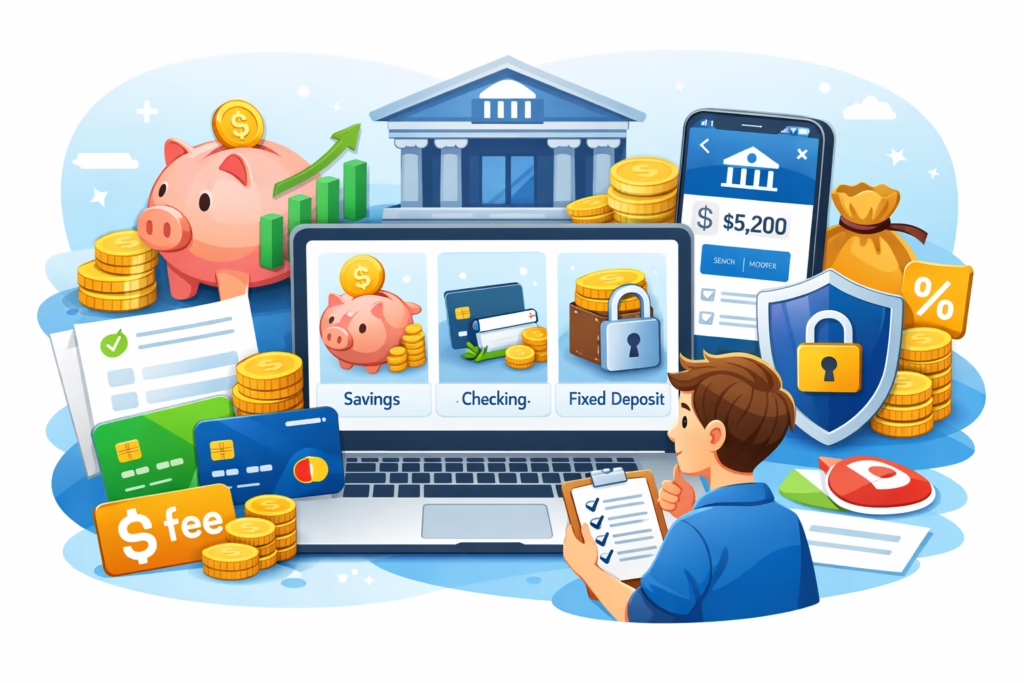
This guide will walk you through everything about bank accounts in plain English. You’ll learn what different accounts actually do, how to pick one that fits your life, and the mistakes that cost beginners real money. By the end, you’ll feel confident making banking decisions instead of guessing or just picking whatever your friend recommended.
I’ve spent years helping people understand personal finance. This guide combines current banking practices, real beginner experiences, and straightforward advice that actually helps.
Let’s start from the beginning.
Table of content
- What Beginners Should Expect from a Modern Bank Account in 2026
- Bank Account vs Digital Wallet: Understanding the Difference
- Bank Accounts for Different Countries: What Changes Globally
- What Exactly Is a Bank Account? A Beginner’s Guide Explanation
- Breaking Down Types of Bank Accounts for Beginners
- Savings Account vs Current Account: Which One Do You Need?
- Beginner’s Guide: How to Choose the Right Bank Account for Your Situation
- Which Bank Account Is Best for Students and First-Time Users?
- Common Mistakes That Cost Beginners Money
- Banking Terms Explained Without the Jargon
- How to Keep Your Bank Account Safe
- Digital Banks vs Traditional Banks: What’s the Difference?
- Important Disclaimers (The Boring But Necessary Stuff)
- Questions Beginners Actually Ask
- Your Next Steps
What Beginners Should Expect from a Modern Bank Account in 2026
Banking has changed a lot in the past few years.
If you’re opening your first account now, certain features should be standard. Not “premium perks”—just normal expectations.
Real-time notifications
You should get instant alerts when:
- Money goes in or out
- Your card is used anywhere
- Your balance hits certain levels
- Someone tries accessing your account
If a bank can’t do this, that’s a red flag.
Instant transfers
Moving money between your accounts should happen immediately. Not “1-3 business days.”
Services like Zelle (US), UPI (India), and Faster Payments (UK) make instant transfers normal now.
Smart spending insights
Good banking apps now automatically categorize your spending. You can see how much you spent on food, transport, entertainment without manually tracking.
Not every bank does this well. But it’s becoming standard.
Virtual debit cards
Many apps let you create temporary card numbers for online purchases. Use them once and disable them.
This protects your real card number from sketchy websites.
Easy card controls
You should be able to:
- Freeze your card instantly from your phone
- Set spending limits
- Block certain transaction types
- Enable/disable international use
All without calling anyone or visiting a branch.
Account aggregation
Some banking apps let you see accounts from multiple banks in one place.
Not essential for beginners. But useful if you have accounts at different banks.
AI fraud monitoring
Modern banks use artificial intelligence to detect unusual activity.
If someone tries using your card in another country while you’re home, the system catches it immediately.
This protection should be automatic and free.
Bank Account vs Digital Wallet: Understanding the Difference
Before we dive deeper into account types, let me clear up a massive confusion point.
Many beginners think bank accounts and digital wallets are the same thing. They’re not.
What a Bank Account Actually Is
A bank account is issued by a licensed bank or financial institution.
Your money is:
- Protected by government insurance (FDIC, DICGC, or equivalent)
- Actually deposited with a regulated financial institution
- Earning interest (in savings accounts)
- Fully under banking regulations and consumer protections
Examples: Checking accounts, savings accounts at Chase, Wells Fargo, HDFC Bank, Barclays, Commonwealth Bank
What a Digital Wallet Actually Is
A digital wallet is a payment service that stores money digitally for quick transactions.
Your money is:
- Held by a payment company (not always a bank)
- Often not earning interest
- Sometimes not fully insured
- Designed for convenience, not long-term storage
Examples: PayPal, Venmo, Cash App, Paytm, PhonePe, Google Pay (when storing balance)
The Key Differences That Matter
| Feature | Bank Account | Digital Wallet |
|---|---|---|
| Primary purpose | Storing and growing money safely | Quick payments and transfers |
| Insurance protection | Yes, up to regulatory limits | Varies, sometimes limited |
| Interest earnings | Yes (on savings accounts) | Rarely |
| Withdrawal options | ATM, transfer, check | Usually transfer to bank first |
| Regulation | Strict banking regulations | Payment service regulations (less strict) |
| Best for | Primary financial management | Everyday transactions, splitting bills |
When Each Makes Sense
Use a bank account when:
- This is your primary place to store money
- You’re building savings or an emergency fund
- You need full consumer protection
- You want your money to earn interest
- You’re receiving salary or regular income
Use a digital wallet when:
- You’re splitting restaurant bills with friends
- You need to send small amounts quickly
- You’re making frequent online payments
- You want convenience for everyday transactions
- You’re keeping small amounts for spending (not saving)
The Confusion That Costs Money
Some people keep thousands of dollars in digital wallets because it’s convenient.
Problems with this:
- No interest earnings (money sits there doing nothing)
- Less regulatory protection if something goes wrong
- Not designed for long-term money storage
- Risk if the service has issues
The smart approach:
Keep your main money in a proper bank account. Use digital wallets for convenience with smaller amounts.
Think of it this way: Your bank account is your home. Your digital wallet is your pocket. You don’t store everything you own in your pocket.
One Important Exception
Some digital wallet companies are now becoming actual banks (called “neobanks”).
Examples: Chime, Dave, MoneyLion
When they offer “bank accounts,” they’re partnering with or becoming licensed banks. Your money gets proper FDIC insurance.
Always check: Is this wallet just a payment service, or is it actually offering a real bank account?
Look for mentions of FDIC insurance (US), DICGC (India), or equivalent in your country.
Bank Accounts for Different Countries: What Changes Globally
Banking fundamentals work similarly everywhere. But specific details change based on where you live.
Let me highlight what varies across different regions.
Account Number Systems Differ
US and India: Use routing numbers + account numbers
Europe and many other countries: Use IBAN (International Bank Account Number)
IBAN is longer and includes country code, bank identifier, and account number all in one string.
Both systems work fine. Just know which one your country uses when setting up payments.
Not All Countries Use Checks
In many countries, checks are basically extinct.
Europe, much of Asia, and parts of Latin America rarely use them. Everything happens through electronic transfers.
If you’re in one of these countries, ignore the “check-writing” features banks advertise. You won’t need them.
Minimum Balance Culture Varies
Countries with strict requirements: India, Philippines, some African nations
Banks often require substantial minimum balances (₹10,000, ₱15,000, etc.) and charge significant fees if you drop below.
Countries with relaxed requirements: US, UK, much of Europe
Many banks offer zero-minimum accounts, especially for students.
Why this matters:
If you’re in a country with strict balance rules, choosing the right account type becomes even more critical. You can’t afford to ignore minimum balance requirements.
Government Banks Play Different Roles
In some countries: Government-owned banks dominate and offer the safest, most accessible options for beginners.
Examples: Post Office accounts in India, state banks in various countries.
In other countries: Private banks dominate and government banks are less common.
For beginners: In countries with strong government banking systems, these often provide the most beginner-friendly accounts with lowest fees.
Online Banking Matters More in Some Regions
Developed markets: Online banks compete with traditional banks as equals.
Emerging markets: Online banks and digital wallets are actually leapfrogging traditional banking.
In countries where physical bank access is limited, mobile banking becomes the primary way people manage money.
If you’re in one of these markets, prioritizing a bank with an excellent mobile app matters even more than in developed markets.
Cash Deposits Are Handled Differently
Some countries: Cash deposits at any bank branch or ATM are normal.
Other countries: You can only deposit at your specific bank’s locations.
Increasingly common: Digital-only banks partner with retail stores for cash deposits (deposit at a convenience store, not a bank).
Check how your bank handles cash deposits if you regularly deal with physical money.
International Money Transfers
If you’re an expat, migrant, or frequently send money across borders:
Look for banks that integrate with international transfer services like Wise, Western Union, or local remittance providers.
Traditional bank wire transfers are expensive ($25-50 per transfer).
Modern alternatives cost $3-10 for the same service.
The Universal Truth
Despite these differences, the core principles remain the same everywhere:
- Separate accounts for spending vs saving
- Avoid unnecessary fees
- Understand minimum balance requirements
- Choose accounts that match your actual usage
- Monitor for fraud regularly
Location changes the specifics. Not the fundamentals.
What Exactly Is a Bank Account? A Beginner’s Guide Explanation
Think of a bank account as a secure digital wallet.
Instead of stuffing cash under your mattress or in your drawer, you hand it to a licensed bank. They store it electronically, keep it safe, and let you access it whenever you need.
Simple concept. But here’s what makes it powerful.
What Happens Behind the Scenes
Let me walk you through real scenarios.
When you put money in:
You deposit cash at a branch or ATM. Or someone transfers money to you digitally.
The bank immediately updates your balance. That money is now protected by government insurance. In most countries, even if the bank somehow fails, your deposits are safe up to certain limits.
In the US, that’s $250,000 per account through FDIC insurance. In India, it’s ₹5 lakh through DICGC coverage.
The bank doesn’t just sit on your money, though. They lend it to other people and businesses. That’s how they make profit. And they share a tiny portion of that profit with you through interest.
When you take money out or spend it:
You swipe your debit card at a store. Or withdraw cash from an ATM. Maybe you send money to a friend online.
Your account balance drops instantly (or within a day for checks).
Everything gets recorded. You can see exactly where your money went.
Why This Matters More Than You Think
Here’s the thing about keeping cash at home.
It doesn’t grow. It just sits there losing value to inflation. A $100 bill today buys less than it did last year.
But money in a savings account? It earns interest. Not much sometimes, but it’s something.
Plus, you can’t lose your entire savings to a fire, theft, or simple forgetfulness. Banks provide security that cash in a drawer never will.
The Catch Nobody Mentions Upfront
Banks aren’t running a charity.
They make money from your account in several ways:
- They keep the difference between what they pay you in interest (maybe 0.5%) and what they charge borrowers (around 7-10%)
- Monthly fees if you don’t meet certain requirements
- Charges when you overdraw your account
- Fees for using ATMs outside their network
- Penalties for dropping below minimum balance requirements
The good news? Most of these fees are completely avoidable once you know the rules.
That’s what we’ll cover next.
Breaking Down Types of Bank Accounts for Beginners
Different accounts exist because people use money differently.
A student paying rent once a month has different needs than a freelancer receiving twenty small payments each week.
Let me break down each type in a way that actually makes sense.
1.Checking Account (Also Called Current Account in Some Countries)
What it’s designed for: Money you’re actively using
This is your everyday spending account. Your salary gets deposited here. You pay bills from here. You buy groceries and gas with the debit card linked to this account.
Key features:
- Unlimited transactions without penalties
- Comes with a debit card
- Often includes check-writing privileges
- Usually earns little to no interest
- Easy access through ATMs and online banking
Here’s who needs this:
Anyone receiving regular income and paying regular expenses. Which is probably you.
Real example:
Sarah gets paid $2,500 every two weeks. Her checking account receives the deposit. She pays $900 rent, $150 utilities, $400 groceries, and other daily expenses. Her balance goes up and down constantly throughout the month.
That’s exactly what checking accounts are built for.
Common minimum balance: $0 to $1,500
Many banks now offer no-minimum checking accounts, especially for students or if you set up direct deposit.
2.Regular Savings Account
What it’s designed for: Money you want to keep safe and grow slowly
This isn’t for money you’re spending next week. It’s for money you’re setting aside.
Key features:
- Earns interest on your balance (currently 0.40% to 1.20% at traditional banks)
- Limited withdrawals (some banks restrict you to 3-6 per month)
- Usually no debit card
- Interest compounds over time
- Protected by the same insurance as checking
Here’s who needs this:
Anyone building an emergency fund or saving for something specific.
Real example:
Marcus wants $6,000 saved for emergencies. He automatically transfers $250 from checking to savings every payday. The savings account keeps that money separate from his daily spending. Plus it earns a small amount of interest.
After a year, he has $3,000 saved plus about $15 in interest earnings. Not huge, but better than nothing.
Common minimum balance: $0 to $500
3.High-Yield Savings Account
What it’s designed for: Maximizing interest while keeping money accessible
This is like a regular savings account that actually pays you decent interest.
Key features:
- Much higher interest rates (3.80% to 4.50% currently)
- Usually offered by online-only banks
- Same safety protections as traditional accounts
- May require higher minimum deposits
- All transactions happen electronically
The numbers that matter:
Let’s compare two scenarios with $10,000 saved:
Regular savings at 0.40%: Earns $40 per year
High-yield savings at 4.00%: Earns $400 per year
That’s $360 extra for literally zero additional effort.
Here’s who needs this:
Anyone with money sitting in a regular savings account earning basically nothing.
Common minimum balance: $0 to $2,500
4.Certificate of Deposit (CD)
What it’s designed for: Higher guaranteed returns when you won’t need money for a while
A CD is a time-locked savings tool. You agree not to touch your money for a specific period. In exchange, the bank pays you higher interest.
Key features:
- Terms range from 3 months to 5 years
- Higher interest than regular savings (2.50% to 5.00% currently)
- Your money is locked until the term ends
- Early withdrawal triggers penalties
- Rate is guaranteed for the entire term
When this makes sense:
You’ve saved $5,000 for a car you’re definitely buying in 18 months. Put it in an 18-month CD at 4.50% instead of checking at 0%. You’ll earn extra interest while the money sits there anyway.
When this doesn’t make sense:
You might need the money earlier. Or interest rates are rising and you’ll get better rates in a few months.
5.Money Market Account
What it’s designed for: Better interest with some flexibility
Think of this as a hybrid between checking and savings.
Key features:
- Interest rates similar to high-yield savings
- Usually comes with limited check-writing or debit card access
- Higher minimum balance requirements ($1,000 to $10,000)
- Transactions typically limited to 6-10 per month
- Best for larger emergency funds
The confusion factor:
Many beginners see “debit card included” and treat this like a checking account. Then they get hit with fees for making too many transactions.
Don’t do that.
Use a money market account like a savings account that has an emergency escape hatch.
Common minimum balance: $1,000 to $10,000
6. Joint Bank Account
What it’s designed for: Shared finances between two or more people
Joint accounts let multiple people access and manage the same account equally.
Key features:
- Two or more account holders with equal access
- Both people can deposit, withdraw, and see all transactions
- Both are responsible for overdrafts and fees
- Available for both checking and savings accounts
- Useful for couples, families, or roommates sharing expenses
Real-life example:
Alex and Jordan get married. They open a joint checking account for shared expenses: rent, groceries, utilities. They both deposit money monthly and both can pay bills from it.
When this makes sense:
Married couples managing household expenses together. Parents and adult children managing family finances. Roommates splitting rent and utilities fairly.
When this can cause problems:
Early in relationships (if things go wrong, both people have full access to all money). When one person is irresponsible with money. With anyone you don’t completely trust.
Important warning:
In a joint account, both people have 100% access to 100% of the money. One person can withdraw everything without the other’s permission. There’s no “my half, your half” protection.
Only open joint accounts with people you deeply trust with your finances.
Common minimum balance: Same as individual accounts of the same type
Savings Account vs Current Account: Which One Do You Need?
This confuses a lot of people, especially in countries where both terms are commonly used.
Let me clear it up with a simple comparison.
| Feature | Savings Account | Current Account |
|---|---|---|
| Main purpose | Storing money safely | Managing frequent transactions |
| Who needs it | Individuals, students, employees | Businesses, merchants, freelancers with many transactions |
| Transaction limits | Usually 3-6 per month without fees | Unlimited transactions |
| Interest earned | Yes (0.40% to 4.50% depending on type) | Usually no |
| Minimum balance | Lower ($0 to $500) | Higher ($1,000 to $5,000) |
| Overdraft option | Rarely available | Often available for businesses |
| Best for | Building savings, emergency funds | Running a business with many daily transactions |
When You Actually Need a Savings Account
You’re receiving a monthly salary or regular income. You want that money to grow through interest. You’re not running a business with constant transactions.
That’s most people reading this guide.
When You Actually Need a Current Account
You run a small business receiving payments from many customers. You’re writing checks frequently. You need overdraft protection for business cash flow.
If you’re just starting your first job or managing personal finances, you probably don’t need a current account at all.
Here’s What Confuses Beginners
Banks sometimes push current accounts because they’re more profitable. They have higher fees and minimum balances.
Don’t get talked into something you don’t need.
If you’re managing personal finances—even if you’re a freelancer—a regular checking account or savings account combination works perfectly fine.
Beginner’s Guide: How to Choose the Right Bank Account for Your Situation
Stop trying to find the “perfect” account.
Instead, answer these five questions honestly. Your answers will tell you exactly what you need.
Question 1: What Will You Actually Use This Account For?
Be specific here.
“Receiving my paycheck and paying monthly bills”
→ You need a basic checking account
“Storing money I’m not planning to spend soon”
→ You need a savings account
“Building an emergency fund that earns decent interest”
→ You need a high-yield savings account
“Saving for a specific purchase happening in 2 years”
→ You need a CD or high-yield savings
Question 2: How Often Will You Touch This Money?
This matters more than you think.
Several times per week: Get a checking account with a large ATM network near you
A few times per month: Regular savings works fine
Once per quarter or less: High-yield savings or money market account
Not at all for 6 months to 3 years: Consider a CD
Question 3: Can You Honestly Maintain a Minimum Balance?
Be realistic about your financial situation right now.
You can keep $1,500+ consistently:
More account options available, including ones with better perks
You can keep $500-1,000:
Mid-tier accounts with moderate requirements work
Your balance often drops below $500:
Prioritize no-minimum accounts (many online banks offer these)
You’re starting with less than $100:
Look for student accounts or beginner checking with zero minimums
Don’t pick an account with requirements you can’t meet. Those monthly fees add up fast.
Question 4: Do You Need In-Person Banking?
This is a personal preference thing.
Yes, I want to deposit cash and get face-to-face help:
Choose a traditional bank with local branches
No, I’m fine doing everything online:
Online banks usually offer better interest rates and lower fees
Sometimes, but rarely:
Get a traditional bank for checking (frequent use) and an online bank for savings (better rates)
Question 5: What’s Your Income Situation Right Now?
Your income pattern matters for choosing the right account.
Regular monthly salary:
Traditional checking plus savings combination
Irregular income from freelancing or gig work:
Checking with no minimum balance plus automatic savings transfers when money comes in
Very low or no income (student, between jobs):
Student checking or no-fee checking, skip savings until income stabilizes
Multiple income streams:
Consider multiple savings accounts for different purposes
Quick Decision Guide
Let me make this even simpler:
First job, paying rent and bills: Checking + basic savings
Student with part-time work: Student checking + high-yield savings for anything extra
Building emergency fund: Checking for bills + high-yield savings for the fund
Saving for something specific 2+ years away: Checking + CD matching your timeline
Freelancer with unpredictable income: No-minimum checking + multiple savings accounts (one for taxes, one for emergencies)
Pick the scenario closest to your situation. Start there.
You can always add or change accounts later as your needs evolve.
Quick Decision Table for Beginners
Not sure which account type fits your situation? This table gives you a starting point:
| Your Situation | Best Account Type | Why This Works |
|---|---|---|
| First job, monthly salary | Checking + Savings | Covers daily spending and builds savings |
| College/university student | Student Checking + HYSA | No fees during school, maximizes interest |
| Freelancer or gig worker | No-minimum Checking + Separate Savings | Handles irregular income without penalties |
| Building emergency fund | High-Yield Savings | Grows money faster while keeping it accessible |
| Saving for specific goal (1-3 years) | CD or HYSA | Higher guaranteed returns, removes temptation |
| Part-time income, no major expenses | Basic Savings only | Simple, earns interest, covers your needs |
| Small business owner | Checking + Business Checking | Separates personal and business finances |
Use this as a starting point, not a rigid rule. Your specific situation might need adjustments.
Which Bank Account Is Best for Students and First-Time Users?
Students and first-job earners face unique challenges.
Lower balances. Irregular income. Zero experience managing accounts.
Here’s what actually works when you’re just starting out.
Features That Actually Matter
1. Zero monthly fees (or fees waived until age 25)
Without consistent income, even a $10 monthly fee can drain your account quickly.
Many banks specifically waive fees for students enrolled in college or high school. Take advantage of this while you can.
2. No minimum balance requirement
Your balance will go up and down a lot while you’re learning. You need an account that won’t punish you for dropping to $50 during a tough week.
3. Overdraft protection without huge fees
Beginners often miscalculate their balance. An account that simply declines the transaction is much better than one that charges $35 in fees.
Some banks let you link checking to savings for automatic overdraft protection. Others just decline purchases when you’re out of money.
Both are better than surprise fees.
4. Good mobile app
You won’t visit branches often. You need to check balances, deposit checks by photo, and transfer money from your phone easily.
A clunky app makes everything harder.
5. Free ATM access near you
Getting charged $3 every time you need $20 cash adds up insanely fast.
Look for banks with ATMs near your campus, apartment, or job. Or choose one that reimburses ATM fees.
The Smart Two-Account Setup for Students
Here’s what I recommend:
Account 1: Student Checking
This is where your job deposits paychecks. This is what you use for daily spending. It’s linked to your debit card.
Zero balance requirements. Zero monthly fees.
Examples: Chase College Checking, Bank of America Advantage SafeBalance, Wells Fargo Clear Access
Account 2: High-Yield Online Savings
This is where you transfer $50-100 monthly if you can manage it. Emergency money only.
Why online? Because it earns 4% instead of 0.40% at traditional banks.
Examples: Ally Online Savings, Marcus by Goldman Sachs, Discover Online Savings
Common Student Mistakes (And How to Avoid Them)
1. Mistake: Opening an account just because your parents use that bank
Your parents probably have mortgages, investment accounts, and much higher balances. Their banking needs are completely different from yours.
What works for them might cost you money in fees.
Better approach: Research student-specific accounts based on your actual needs.
2. Mistake: Ignoring the account terms because “it’s free”
“Free” almost always has conditions attached. Maintain $500 minimum. Set up direct deposit. Stay under age 25.
Miss one condition and suddenly you’re paying $12-15 monthly.
Better approach: Read the summary. If there’s a minimum balance, ask yourself honestly: “Can I actually keep this much in my account every month?”
3. Mistake: Getting a debit card and treating it like unlimited money
Unlike credit cards, debit cards spend money you actually have right now.
Many students overdraft in the first month because they don’t check their balance before swiping.
Better approach: Check your balance before making purchases over $20. Set up low-balance alerts that text you when you drop below $50.
4. Mistake: Using out-of-network ATMs constantly
Your bank charges $3. The ATM owner charges $3. That’s $6 per withdrawal.
Withdraw $40 weekly and you’re throwing away $312 per year.
Better approach: Find a bank with ATMs near campus. Or get cash back at grocery stores instead of using ATMs.
Common Mistakes That Cost Beginners Money
Let’s talk about the expensive errors that actually happen to real people.
These aren’t theoretical. They’re what costs beginners hundreds (sometimes thousands) of dollars in the first year.
Mistake 1: Keeping Everything in One Checking Account
Here’s what happens:
You have $3,500 in checking. That includes your $3,000 emergency fund, $300 for rent, and $200 for groceries.
You see “$3,500 available” and think you can afford that $400 purchase.
Two weeks later, rent is due and you’re suddenly $200 short.
Why this costs money:
You accidentally spend money that was supposed to go elsewhere. Plus that emergency fund earns 0% interest in checking when it could earn 4% in savings.
That’s $120 per year lost just from keeping money in the wrong type of account.
The fix:
Use at least two accounts. Checking for spending and bills. Savings for money you shouldn’t touch.
Even better: separate savings accounts for different goals.
Mistake 2: Paying Monthly Fees You Could Easily Avoid
Here’s the scenario:
Your account charges $12 monthly. You could avoid this by maintaining a $500 balance or setting up direct deposit.
But you don’t do either. You don’t even notice for months.
The math:
$12 × 8 months = $96 gone
For many students, that’s groceries for two weeks.
The fix:
Ask explicitly when opening any account: “What fees does this have and exactly how do I avoid them?”
Set a monthly phone reminder to verify you’re meeting the requirements.
Mistake 3: Ignoring Your Balance and Overdrawing
This one hurts.
You buy coffee ($5), lunch ($12), and gas ($35) in one day.
You thought you had $200. You actually had $150.
Your rent check for $800 bounces. The bank charges $35 for overdraft. Your landlord charges $50 for the bounced check.
Total damage: $85 in fees you didn’t need to pay
Some landlords also report late payments, which can hurt your rental history.
The fix:
Check your balance through the mobile app before purchases over $20.
Set up alerts that text you when balance drops below $100.
Mistake 4: Not Reading Fine Print on “High Interest” Accounts
The marketing says: “Earn up to 4.50% interest!”
You deposit $2,000. After one year, you’ve earned only $8.
What happened:
The fine print said you need $10,000 minimum to get 4.50%. Under that, you get 0.40%.
You saw the big advertised number. You missed the actual requirement.
The fix:
Ask three specific questions before opening any account:
- What’s the ACTUAL interest rate with my expected balance?
- What minimum balance is required to earn that rate?
- What happens if I drop below that minimum?
Mistake 5: Linking Everything to Autopay and Forgetting
You sign up for a gym ($30/month) and two streaming services ($15 each).
Six months later, you stopped going to the gym. You barely watch one streaming service. But you forgot to cancel.
The waste:
Gym: $30 × 6 months = $180
Unused streaming: $15 × 6 months = $90
Total: $270 thrown away
The fix:
Set a calendar reminder every 3 months: “Review all automatic payments.”
Ask yourself: “Am I actually using this?”
Cancel anything you’re not actively using that day.
Mistake 6: Using Out-of-Network ATMs Without Thinking
Your bank charges $3 per withdrawal. The ATM owner charges $3.
That’s $6 every time you need cash.
Do this twice per week: $6 × 8 times monthly × 12 months = $576 per year
You’re literally paying $576 for the convenience of using the wrong ATM.
The fix:
Choose a bank with ATMs near where you actually spend time.
Or get cash back at grocery stores (usually free).
Or switch to an account that reimburses ATM fees.
Mistake 7: Mixing Personal and Side Hustle Money
You start freelancing. Clients pay you through your personal checking. You pay business expenses from the same account.
Tax time comes. You have absolutely no idea what was business income versus personal money.
You either overpay taxes or risk an audit trying to guess.
The fix:
The moment you start receiving money from clients (not an employer), open a second checking account.
Doesn’t have to be a “business account” yet. A second personal checking works fine initially.
Keep all business transactions separate from day one.
Banking Terms Explained Without the Jargon
Banks love complicated language. Let me translate.
APY (Annual Percentage Yield)
The interest rate your account earns, including compounding.
If you see “4.00% APY,” your money grows about 4% over a year.
Higher numbers are better for savings accounts.
Overdraft
Spending more money than you have in your account.
Example: You have $100. You buy something for $120. You’re overdrawn by $20.
Your balance is now negative.
Overdraft Fee
The penalty banks charge when you overdraft.
Usually $30-35 per transaction that causes an overdraft.
Overdraw three times in one day? That’s $90-105 in fees on top of the money you didn’t have.
Overdraft Protection
A service that links your checking to savings.
When you overspend, the bank automatically moves money from savings to cover it.
Sometimes free. Sometimes has a small fee ($10-12 per transfer).
Still way cheaper than overdraft fees.
Minimum Balance
The lowest amount you must keep in your account to avoid fees or earn interest.
Some accounts require $0. Others require $500-1,500.
Drop below this amount and you typically pay monthly fees.
Direct Deposit
Your employer sending your paycheck electronically straight to your bank.
No paper check. No delays. No trips to the bank.
Many accounts waive fees if you set this up.
ACH Transfer
Electronic money movement between accounts.
When you transfer $100 from savings to checking online, that’s an ACH transfer.
Usually takes 1-3 business days.
Free at most banks.
Wire Transfer
Faster electronic money movement for larger amounts.
Usually costs $15-30 per transfer.
Gets money there same day.
Used when speed really matters.
Routing Number
A 9-digit code identifying your bank.
You need this to set up direct deposit or receive money from other banks.
Find it at the bottom of checks or in your online account.
Account Number
Your specific account’s ID number at that bank.
Combined with the routing number, it tells the system exactly where money should go.
Compound Interest
Interest earned on both your original deposit and previous interest earned.
Example: $1,000 at 4% earns $40 year one.
Year two, you earn 4% on $1,040 (not just the original $1,000).
It grows faster over time.
FDIC Insured (DICGC in India)
Government protection on your deposits.
US: Up to $250,000 per account type per bank
India: Up to ₹5 lakh
Even if the bank fails, you get your money back up to these limits.
Debit Card vs Credit Card
Debit card: Spends money already in your account. Balance drops immediately.
Credit card: Borrows money from the bank. You pay it back later. You get a monthly bill.
Mobile Check Deposit
Taking a photo of a paper check with your phone to deposit it.
No branch visit needed.
Money usually available in 1-2 business days.
Statement
A monthly summary of all transactions, fees, and interest.
Shows everything that happened in your account that month.
Hold on Deposit
When you deposit a check, the bank might not give you the money immediately.
They “hold” it for 1-5 business days to verify the check is real and the money exists.
Large checks or new accounts often face longer holds.
How to Keep Your Bank Account Safe
Security isn’t just about hackers.
It’s about practical habits that protect your money from common threats.
Protecting Against Fraud
Never share account details with anyone claiming to be your bank
Real banks will NEVER call, text, or email asking for:
- Your account number
- Your routing number
- Your debit card PIN
- Your online banking password
If someone contacts you asking for these, it’s a scam.
Hang up. Look up your bank’s real phone number. Call them directly.
Set up account alerts immediately
Free text notifications when:
- Your balance drops below $50
- A purchase over $200 processes
- Your debit card gets used online
- Someone tries logging in from a new device
These catch problems in minutes instead of weeks.
Use strong, unique passwords
Your banking password should be different from your email, social media, and everything else.
If you can’t remember multiple passwords, use a password manager.
Turn on two-factor authentication
Requires a code sent to your phone when logging in.
Even if someone steals your password, they can’t access your account without your phone.
Check your account at least twice per week
Log in. Look for transactions you don’t recognize.
Thieves often test with small charges ($3-10) before making big ones.
Report unauthorized charges immediately
You usually have 60 days to report fraud and get your money back.
After that, you might be out of luck.
Don’t wait.
Protecting Yourself From Your Own Mistakes
Use credit cards for online shopping when possible
If a website charges you wrong or gets hacked, disputing with a credit card is much easier than getting cash back to your checking account.
Your debit card connects directly to your cash. Credit cards create a protective barrier.
Don’t save debit card info on retail websites
Every saved card is another potential target for hackers.
Re-entering your card number each time is a small inconvenience compared to dealing with fraud.
Check ATMs for skimmers before using them
Wiggle the card reader. Does it feel loose? Look different than usual?
Criminals install “skimmers” that steal your card information.
If something feels off, use a different ATM.
Use well-lit ATMs in high-traffic areas
Gas station ATMs at 2 AM are targets for both skimmers and physical theft.
Bank branch ATMs during daytime are much safer.
Don’t write your PIN on your debit card
I know someone who actually did this. Don’t be that person.
Memorize it.
What to Do When Something Goes Wrong
If you spot an unauthorized transaction:
- Call your bank immediately (number on your card)
- Report the specific transaction
- Request a new debit card
- File a fraud report
- Watch your account closely for 30 days
If your debit card is lost or stolen:
- Use your banking app to lock the card instantly
- Call the bank to report it
- Request a replacement
- Review recent transactions for fraud
If you overdraft unexpectedly:
- Deposit money to cover the negative balance ASAP
- Call the bank and politely explain what happened
- Ask if they’ll waive the fee as a one-time courtesy (many will for first incidents)
- Set up low-balance alerts to prevent it from happening again
Digital Banks vs Traditional Banks: What’s the Difference?
This is a newer question that didn’t exist 10 years ago.
Digital banks (also called online banks or neobanks) are changing how banking works.
Let me explain the real differences.
Traditional Banks
What they are:
Physical banks with branches you can walk into. Think Chase, Bank of America, Wells Fargo, HDFC, ICICI.
Pros:
- Face-to-face customer service when you need help
- Can deposit cash easily
- ATMs often nearby and fee-free
- Some people just feel more comfortable with physical locations
- Established trust and reputation
Cons:
- Lower interest rates on savings (usually 0.40% vs 4.00% at online banks)
- Higher monthly fees
- More minimum balance requirements
- Limited hours (branches close at night and on weekends)
Best for:
People who deposit cash regularly. Those who want in-person help. Anyone uncomfortable with all-online banking.
Digital Banks (Online Banks)
What they are:
Banks that exist entirely online. No physical branches. Everything happens through apps and websites.
Examples: Ally, Marcus by Goldman Sachs, Chime, Discover Bank
Pros:
- Much higher interest rates (3.80%-4.50% on savings)
- Usually no monthly fees
- No or very low minimum balances
- 24/7 access through apps
- Lower overhead costs mean better rates for customers
Cons:
- Can’t deposit cash (you’d need to use money orders or transfer from another bank)
- No face-to-face help (customer service is phone/chat only)
- Some people feel nervous without physical locations
- Slightly slower for some transactions
Best for:
People who rarely use cash. Those comfortable with technology. Anyone building savings who wants better interest rates.
The Hybrid Approach (What I Recommend)
Use both types for different purposes.
Traditional bank for checking:
Your daily spending account. Easy cash deposits. Local ATM access.
Digital bank for savings:
Your emergency fund and savings goals. Way better interest rates. Money you rarely need to touch.
This gives you convenience where you need it and better returns where it matters.
As mentioned earlier, modern bank accounts in 2026 should include features like real-time notifications, instant transfers, smart spending insights, and AI fraud monitoring as standard offerings, not premium add-ons.
What About Neobanks? (Chime, Cash App, Venmo)
These are even newer than online banks.
They’re app-based financial services that partner with traditional banks for insurance coverage.
Pros:
- Super easy to set up
- No fees for most things
- Great apps
- Quick money transfers
- Early direct deposit (get paid 2 days early)
Cons:
- Sometimes limited features
- Customer service can be frustrating
- Not always FDIC insured (check carefully)
- May have transaction limits
Best for:
Tech-savvy younger users. Side hustles and gig work. People who want simple, no-hassle banking.
Not ideal for:
Large savings you want to grow. Complex banking needs. Anyone who wants comprehensive financial services.
How to Decide
Ask yourself:
Do you deposit cash regularly? → Traditional bank
Do you want maximum interest on savings? → Digital bank
Do you need both? → Use one of each
There’s no single right answer. Pick what fits your actual lifestyle.
Important Disclaimers (The Boring But Necessary Stuff)
Let me be clear about what this guide is and isn’t.
What this guide does:
- Explains general banking concepts and principles
- Helps you understand different account types and how to choose
- Shows you how to avoid common beginner mistakes
- Provides educational information based on current banking practices
What this guide doesn’t do:
- Give you personalized financial advice for your specific situation
- Recommend exact banks or specific products to open
- Guarantee any financial outcomes or account performance
- Replace professional guidance for complex financial situations
Important things to know:
Banking products, interest rates, and fees change constantly. Information here reflects conditions in early 2025. Always verify current details directly with banks before making decisions.
Regulations vary significantly by country and region. This guide provides international principles with some US and Indian examples. Your country may have different rules, insurance limits, and account types.
Every person’s financial situation is unique. What works well for one individual may not suit another. Consider consulting a qualified financial advisor for personalized guidance.
Before opening any account:
- Research multiple options in your area
- Read all terms and disclosures carefully
- Ask questions when anything is unclear
- Verify the bank is properly licensed and insured
Banking can feel overwhelming at first. But millions of people successfully manage accounts every day. Start with the basics. Ask questions. Learn as you go.
Questions Beginners Actually Ask
1. Before You Open Your First Bank Account, Have This Ready
Opening an account is straightforward when you’re prepared. Here’s exactly what you need:
Required documents:
- Government-issued ID (driver’s license, passport, or national ID card)
- Proof of address (utility bill, lease agreement, or official mail from the last 3 months)
- Tax ID number (Social Security number in the US, PAN card in India, or equivalent in your country)
- Phone number that you actually use
- Email address you check regularly
Financial requirements:
- Minimum opening deposit (varies by account, often $0-$100)
- Funding source for that deposit (cash, transfer from another account, or check)
Optional but helpful:
- Backup bank account details (if opening online, some banks verify identity by making small test deposits)
- Employment information (some banks ask, though not always required)
- Existing bank statements (if you have a banking history)
Pro tip: Call the bank before visiting or starting an online application. Ask: “What exactly do I need to open a [specific account type]?” This prevents wasted trips or incomplete applications.
2.How much money do I need to open my first bank account?
Honestly? It depends on the account.
Some student checking accounts and basic savings accounts let you start with $0. You can open the account and add money later.
Other accounts want $25 to $100 upfront.
Premium accounts with higher interest might require $500 to $1,000 initially.
Here’s what you need to ask before opening anything:
“What’s the minimum deposit to open this account?”
And also: “Is there a minimum balance I have to keep after opening it?”
These are two different things. Many beginners get confused here.
You might only need $25 to open an account. But you might need to maintain $500 to avoid fees. Big difference.
3.Can I have multiple bank accounts?
Yes. Absolutely yes.
There’s no limit on how many accounts you can have.
Most people should actually have at least two accounts:
One for spending (checking)
One for saving (savings)
Some people have even more. Separate savings for emergencies, vacations, car fund, whatever.
The only warning: don’t open more accounts than you can actually monitor.
Every account needs occasional attention. Check for fraud. Watch for fees. Keep track of balances.
Three to four accounts is manageable for most people. Ten accounts might be overkill unless you have a specific system.
4.What’s the difference between a bank and a credit union?
Banks are for-profit companies owned by shareholders.
They tend to have:
- More locations and ATMs
- Better technology and apps
- Higher fees
- Lower interest rates on savings
They exist to make profit for shareholders.
Credit unions are non-profit cooperatives owned by members (that’s you if you have an account there).
They tend to have:
- Better interest rates
- Lower fees
- Fewer branches
- Sometimes less fancy technology
They exist to serve members, not make profit.
Both are equally safe if properly insured. FDIC for banks, NCUA for credit unions in the US.
Choose based on which offers better terms for your specific needs. Not based on the bank vs credit union label.
5.How long does it take to open a bank account?
Online applications: 10-20 minutes to fill out the form.
You’ll need:
- Government ID (driver’s license or passport)
- Social Security number or tax ID
- Your address and phone number
- Employment information
The bank then verifies everything. This can take anywhere from a few minutes to 3 business days.
Once approved, you can often start using the account immediately for transfers.
Your physical debit card arrives by mail in 7-10 business days.
In-person at a branch: Can be faster if you bring all required documents.
You might walk out with a temporary debit card the same day. The permanent one still arrives by mail.
6.What if I move to a different state or country?
Moving within your country:
Most national banks work across all states. Your account continues normally.
Just update your address in the bank’s system (online or by calling them).
Request a new debit card with your new address if needed.
Everything else stays the same. Same account number. Same routing number. Same features.
Moving to a different country:
This gets more complicated.
Some banks let you keep your account open from abroad. Others don’t.
You’ll almost certainly need to open a local account in your new country for daily transactions.
If you’re moving internationally, research banks in your destination country that work with expats. They usually make account opening easier for foreigners.
Also check: Can you keep your home country account open? Will it cost extra? How will you access it?
7.What if I can’t maintain the minimum balance?
First, check your account terms. Understand exactly what happens if you drop below the minimum.
Usually: You get charged a monthly fee ($5-15 typically).
Then you have options:
Option 1: Switch account types
Many banks offer basic accounts with $0 minimum requirements. Ask if you can switch to one of those.
Option 2: Move to a different bank
Online banks frequently have no minimums and no fees. Worth exploring.
Option 3: Link accounts
Some banks waive fees if your combined checking and savings balance meets the minimum. Even if checking alone doesn’t.
Option 4: Set up direct deposit
Many accounts waive minimum balance requirements if you have direct deposit active. Even small deposits count.
Don’t just ignore the problem.
Those monthly fees drain an already low account even faster. Deal with it proactively.
8.Is online banking safe?
Yes, when you take basic precautions.
Online banks use the same security measures as traditional banks:
- Encryption for data transmission
- Multi-factor authentication
- FDIC insurance on deposits
- Fraud monitoring systems
The safety issues come from user behavior, not the technology.
What makes it safe:
- Using strong passwords
- Enabling two-factor authentication
- Not clicking suspicious links
- Checking accounts regularly
- Using secure WiFi (not public networks for banking)
What makes it risky:
- Reusing passwords across sites
- Clicking links in texts/emails claiming to be your bank
- Sharing login information
- Never checking your account
- Using public WiFi for financial transactions
The bank’s security is solid. Your habits determine actual safety.
9.Can I open a bank account with bad credit?
Yes, usually.
Here’s what confuses people:
Opening a bank account doesn’t require a credit check in most cases. Credit scores matter for loans and credit cards, not checking or savings accounts.
What banks do check: ChexSystems
This is a database tracking banking history. It shows:
- Bounced checks
- Overdrafts you didn’t pay back
- Accounts closed for fraud
- Unpaid bank fees
If you have serious banking problems in ChexSystems, some banks might deny you.
What to do if you’re denied:
- Ask why specifically
- Get your ChexSystems report (free once yearly at ChexSystems.com)
- Dispute errors if any exist
- Look for “second chance” checking accounts designed for people with banking problems
- Consider prepaid cards temporarily until you rebuild banking history
Bad credit doesn’t automatically mean no bank account. Unpaid banking debts might.
10.What happens if I don’t use my bank account for a long time?
This is called account inactivity or dormancy. It’s more serious than many beginners realize.
What counts as inactive:
Most banks consider an account dormant if there’s no activity for 12-24 months. “Activity” usually means:
- Deposits or withdrawals
- Transfers in or out
- Using your debit card
- Even logging into online banking sometimes counts
Simply having money sitting there doesn’t count as activity.
What happens to dormant accounts:
Different banks and countries have different rules, but common consequences include:
In many Asian countries (especially India):
- Account gets frozen after 12-24 months of inactivity
- You can’t access money until you visit the branch
- May require re-verification of identity (re-KYC)
- Sometimes stops earning interest
- May start charging maintenance fees even if previously waived
In the US and many Western countries:
- Account may be flagged as dormant
- May incur dormancy fees
- After several years, money might be turned over to the state as “unclaimed property”
- You can still claim it, but it’s a hassle
How to avoid this problem:
Set a calendar reminder every 6 months to make at least one transaction. Even tiny actions work:
- Transfer $1 from savings to checking
- Use your debit card to buy something small
- Log in and move money between your own accounts
If you know you won’t use an account for a long time, consider:
- Setting up automatic monthly transfers (even $5)
- Closing the account properly instead of abandoning it
- Combining accounts to reduce the number you need to maintain
If your account is already dormant:
Visit the bank branch with your ID. They’ll reactivate it, though they might ask you to:
- Verify your identity
- Update your contact information
- Explain why the account was inactive
Don’t just ignore a dormant account. It can create problems when you actually need the money.
Your Next Steps
You’ve made it through everything you need to know about bank accounts as a beginner.
Let me summarize what matters most.
The fundamentals:
Bank accounts keep your money safe and help it grow. Different types serve different purposes. Choose based on how you’ll actually use the account, not marketing promises.
Avoid fees aggressively.
Banking shouldn’t cost you money when you’re starting out. Plenty of no-fee accounts exist. Find them.
Understand the terms before opening anything.
What’s the minimum balance? How do you avoid monthly fees? What’s the actual interest rate? Where are free ATMs?
Get clear answers first.
Monitor regularly but don’t stress.
Check your balance twice a week. Review transactions. Set up alerts.
This becomes automatic within a month.
Start simple and build gradually.
Begin with one checking account. Add a savings account when comfortable. Explore higher-interest options once you have money to save.
You don’t need everything perfect on day one.
Your immediate action:
Open or review one account this week. Just one.
If you don’t have a bank account: Decide whether you need checking (daily use) or savings (storing money). Research three options that fit your requirements. Pick one and open it.
If you already have an account: Review whether it still works for your situation. Are you paying avoidable fees? Could you earn better interest elsewhere? Would adding a second account help?
Banking confidence comes from action, not perfection.
You don’t need the absolute best account to start. You need an account that works reasonably well and doesn’t drain your money through fees.
Start there. Learn by doing. Adjust as needed.
Remember this:
Banking is a tool. Nothing more.
Choose the right tool for your needs. Use it correctly. It’ll support your financial life quietly without drama.
You’re not guessing anymore. You understand how this works now.
Take the first step this week.
Go to Next Lesson:
Credit Score 101: What It Is, Why It Matters, and How to Improve It
Opening a bank account is one of the first steps toward building a healthy financial life. But simply having a bank account isn’t enough—you also need to understand how your financial behavior affects your credit profile.
In the next guide, you’ll learn what a credit score is, why lenders care about it, and the simple habits that can help you build and improve your score over time.
👉 Read next: Credit Score101: What It Is, Why It Matters, and How to Improve It