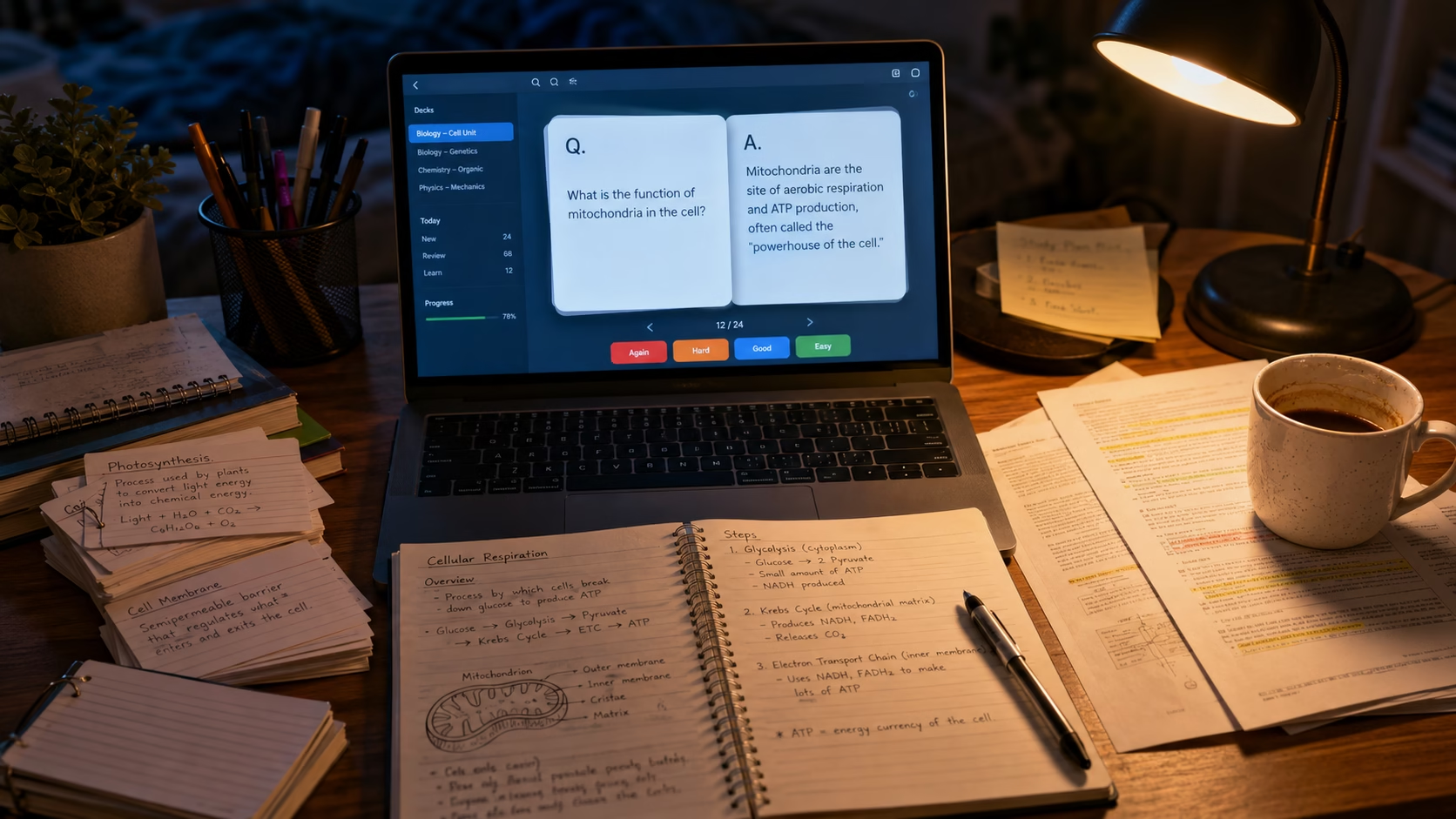
I Used an AI Flashcard Generator to Study for a Week — Here’s What Actually Happened
It’s Sunday night. I have a biology test in five days, and a stack of notes I haven’t touched.
Normally this is where I’d panic and hand-make flashcards until midnight. This time I tried something different: I let an AI flashcard generator do the card-making for me, and I wrote down what happened every day for a week.
An AI flashcard generator reads your notes and turns them into question-and-answer cards automatically, then schedules your reviews using spaced repetition so you see each card right before you’re likely to forget it. That’s the whole concept. Everything below is what it actually looked like to use one for seven straight days — not a sales pitch, not a “top 10 tools” roundup.
If you want to try this yourself, here’s what you need:
- Your existing notes — typed, PDF, or even a photo of handwritten pages works with most tools
- An AI flashcard generator (I used RemNote, though the process is similar across most tools)
- About 10–15 minutes a day for review once your cards exist
That’s genuinely it.
Table of Contents
- Why I Tried This
- What Is an AI Flashcard Generator?
- How I Set Up the Test
- What Actually Happens When You Feed It Notes
- Day by Day: What Worked and What Didn’t
- AI Flashcards vs. Manual Flashcards
- Where It Struggled
- Tips If You Want to Try This
- FAQ
- Final Thoughts
Why I Tried This
I’m building an online presence around research and learning right now, so I document things as I go. AI flashcard generators kept coming up in conversations I was reading, and I’d rather test something myself than trust someone else’s review. I also genuinely needed to study. Two problems, one experiment.
What Is an AI Flashcard Generator?
A regular flashcard is simple: question on one side, answer on the other. You’ve probably made these with index cards at some point.
An AI flashcard generator does the same job, faster. You give it your notes — a textbook chapter, a PDF, a paragraph you typed out — and it reads through the material and generates the cards itself. No typing required on your end.
Most of these tools also build in spaced repetition, which isn’t new. It traces back over a century to Hermann Ebbinghaus, a researcher who mapped out how memory fades on a predictable curve. Review something right before you’re about to forget it, and it sticks far better than cramming it all in one sitting.
This isn’t a fringe theory. A meta-analysis covering more than 800 experiments found the same result consistently: spaced review beats cramming, almost without exception (you can read the full study on PubMed).
So an AI flashcard generator is really two things bundled together:
- Automatic card creation
- Automatic review scheduling
That’s the entire pitch.
How I Set Up the Test
I wanted this to be fair — not set up to make the tool look good or bad.
So I picked two subjects that couldn’t be more different. First, biology: dense, definition-heavy, full of process names I still can’t pronounce. Second, basic SEO concepts I’m learning for my own content work — less black-and-white, more judgment call.
I fed both sets of notes into the AI flashcard generator and kept a notebook next to my laptop, writing down what I noticed each day.
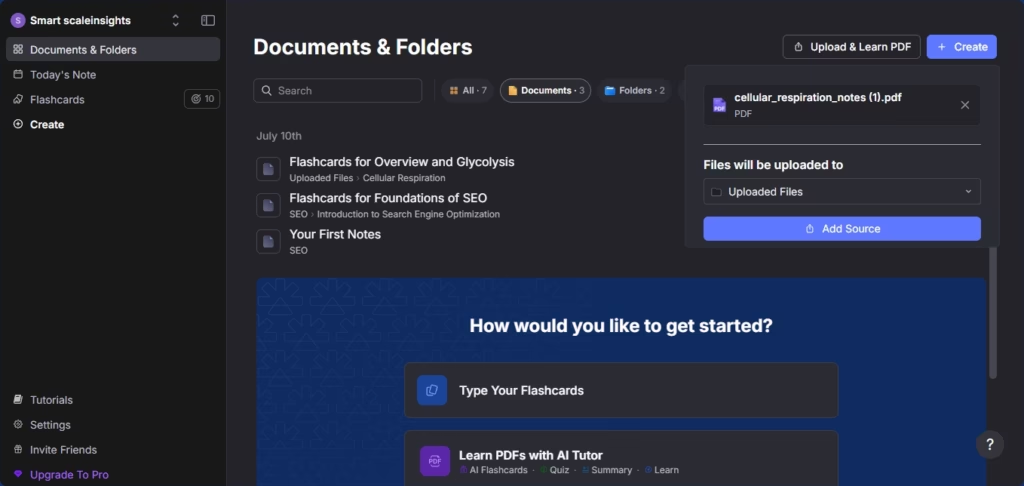
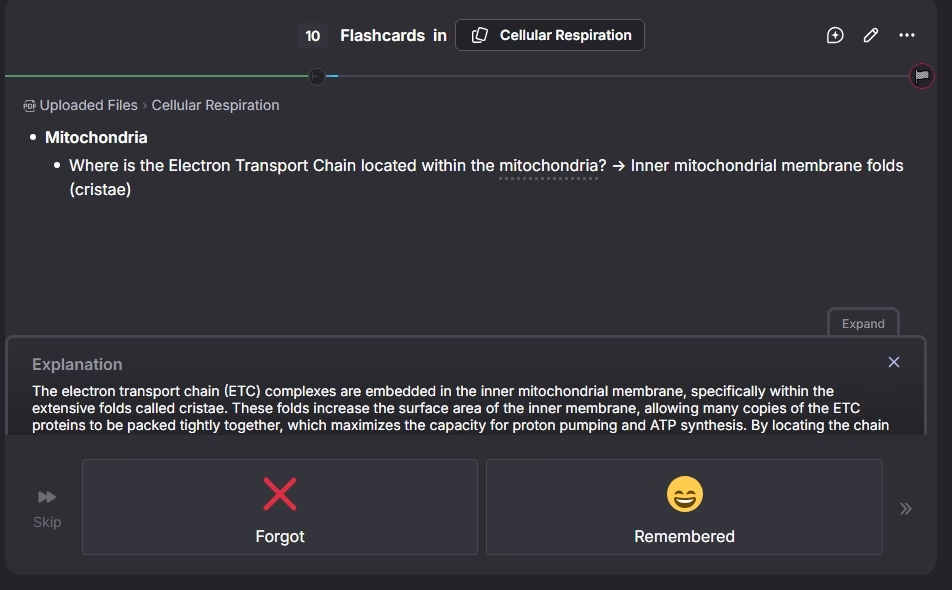
I used RemNote for the whole experiment — a note-taking app that generates flashcards from your documents and runs them through spaced repetition. I’m linking their help center so you can see the real feature set instead of taking my word for it. Other tools work similarly, but the screenshots and steps below are specifically from RemNote.
What Actually Happens When You Feed It Notes
Here’s the part most posts about these tools skip — the actual mechanics.
- You paste in your notes, or upload a file.
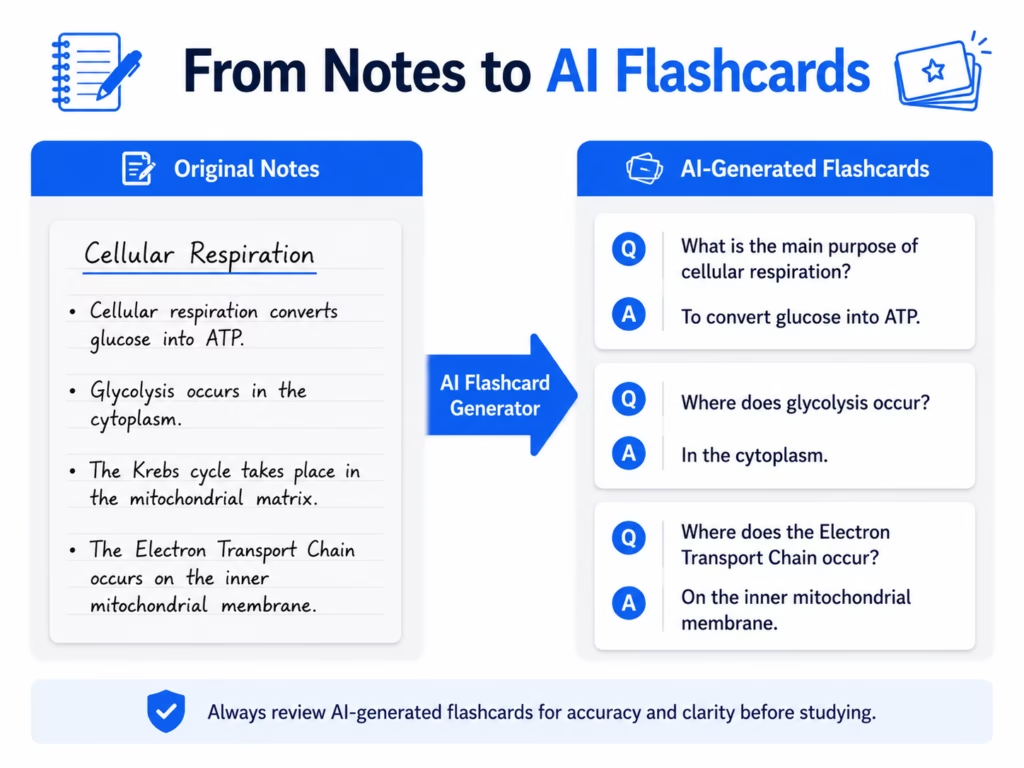
- The tool scans the text and pulls out key facts, terms, and concepts.
- It generates a batch of question-and-answer pairs.
- You review the batch — keep what’s good, edit or delete what isn’t.
- The app schedules your reviews, resurfacing each card right before you’re likely to forget it.
The logic behind that last step, roughly, looks like this:
if (student_recalled_card_correctly):
    increase_review_interval(card)
else:
    decrease_review_interval(card)
    show_card_again_sooner
Nothing magical — it’s essentially an if-else statement wrapped around your memory. But it works, because it’s built on decades of research into how forgetting actually happens.
Day by Day: What Worked and What Didn’t
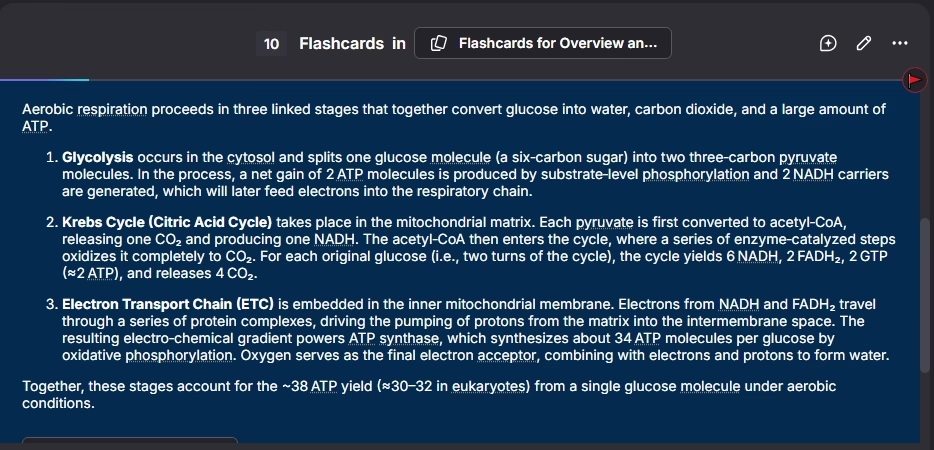
Day 1–2. I pasted in about three pages of biology notes. Within two minutes I had 40 flashcards — something that would’ve taken me close to an hour by hand. Not every card was great, though. A few were oddly worded, and some tested tiny, irrelevant details instead of the concepts that actually mattered. I deleted around 15% of them.
Day 3–4. This is where it got interesting. Instead of reviewing all 40 cards every day, the app only surfaced the ones I was close to forgetting. Fewer cards per session, same or better retention. I wasn’t expecting that.
Day 5. SEO notes went in, and this is where things got shaky. The AI handled straightforward facts fine, but nuance tripped it up. A point about keyword placement — something that depends heavily on context — got flattened into an oversimplified true/false statement. The nuance disappeared, and so did the actual lesson.
Day 6–7. I compared both approaches side by side: one topic studied with hand-made cards, the other with AI-generated cards plus spaced repetition. Results below.
AI Flashcards vs. Manual Flashcards
| Factor | AI Flashcard Generator | Manual Flashcards |
|---|---|---|
| Time to create cards | Minutes | 45–60+ minutes |
| Accuracy on factual topics | High | High |
| Accuracy on nuanced topics | Lower — tends to oversimplify | Higher, since you control the framing |
| Review scheduling | Automatic (spaced repetition built in) | Manual — easy to forget or skip |
| Mental effort during creation | Low | High |
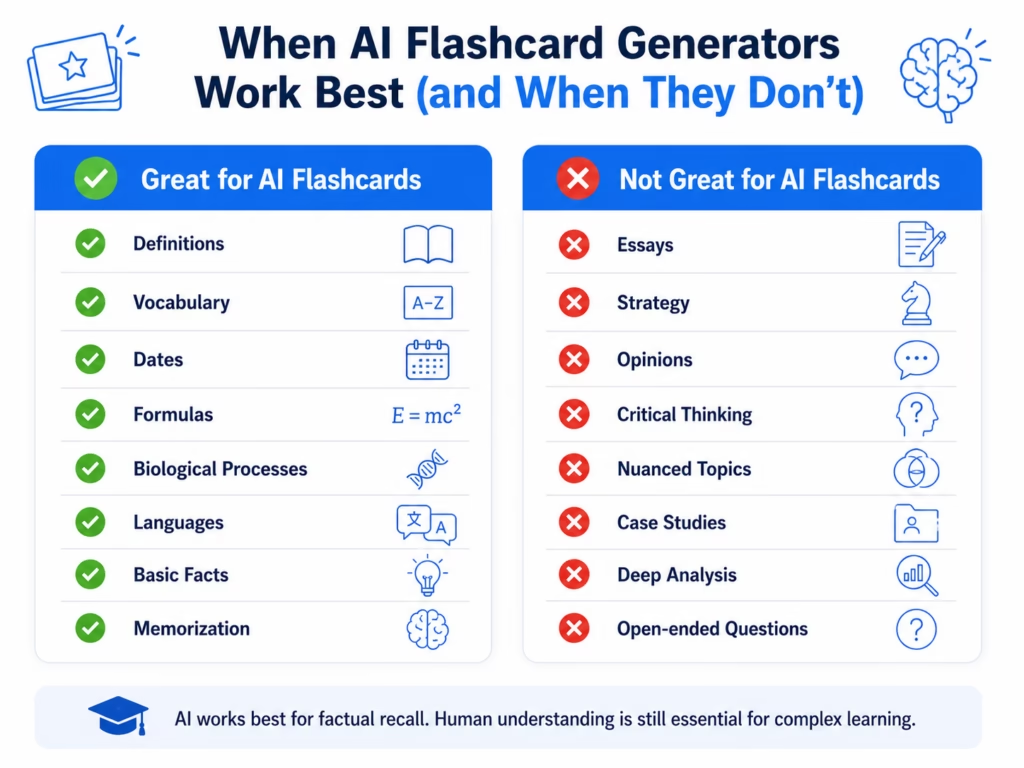
| Best suited for | Definitions, vocabulary, dates, formulas, processes | Anything requiring nuance, opinion, or personal framing |
Neither one wins outright. They’re just built for different jobs.
Where It Struggled
I want to be straight about this part, since a lot of AI tool write-ups skip it.
The generator was genuinely weak at anything requiring judgment. Nuanced, opinion-based, or strategy-heavy material got flattened into oversimplified facts. It wasn’t wrong exactly — it was just thin, missing the “why” behind the “what.”
That tracks with something the cognitive scientists at Retrieval Practice point out: retrieval-based tools work best for information with a clear right answer, not for open-ended reasoning.
Great for facts. Not great for arguments.
Tips If You Want to Try This
A few things I wish someone had told me on day one:
- Check every card before you trust it. The AI gets things mostly right, not perfectly right — skim the batch and delete anything vague or wrong.
- Feed it clean notes. Messy input makes messy flashcards. Garbage in, garbage out.
- Save it for facts, not opinions. Definitions, vocabulary, formulas, dates, and processes are fair game. Nuanced arguments or subjective strategy need extra scrutiny.
- Actually use the spaced repetition feature. Don’t just generate cards and cram them in one sitting — the real value is in the scheduling, not just the card-making.
- Remember it’s a memory tool, not an understanding tool. Flashcards test recall; they don’t replace actually thinking through why something works. Research in medical education found that students who combined self-testing with spaced repetition performed better on licensing exams — but they still had to understand the material first (full study on PMC/NCBI).
FAQ
Does an AI flashcard generator actually save time compared to making cards by hand?
Yes, for the card-creation step. In my test, generating 40 cards took under two minutes versus close to an hour manually. You still need time to review and edit afterward, so it’s not zero effort — just a lot less.
Can an AI flashcard generator replace studying entirely?
No. It speeds up card creation and handles review scheduling, but it doesn’t understand the material for you. You still have to read, think, and make sense of it yourself.
Is it good for subjects like history, math, or vocabulary?
Generally yes, especially for vocabulary, formulas, dates, and definitions — anything fact-based is where it performs best.
Is it good for essay-based or opinion-based subjects?
Less so. In my test it oversimplified nuanced points into flat facts, stripping out the context that actually mattered.
What is spaced repetition, and why does it matter for flashcards?
It’s a review method where you see information again right before you’re likely to forget it, instead of on a fixed daily schedule. Research going back to the 1880s, confirmed repeatedly since, shows it beats cramming for long-term retention.
Final Thoughts
One week isn’t a scientific study, and I want to be upfront about that. This is one person’s honest experience, not a peer-reviewed conclusion.
But here’s what I actually took away from it: the AI flashcard generator didn’t make me smarter, and it didn’t make studying effortless. What it did was remove the boring part — the manual card-making — so I had more time left for the part that actually matters: reviewing and understanding the material.
If you’re a student, a self-taught learner, or someone building a skill on the side, that trade-off is probably worth testing for yourself. Not because it’s a breakthrough — just because it saves time on the tedious part and hands that time back to you.
Try it for a few days and track your own results before you judge it either way. That’s really the only fair test.