You know that sinking feeling when you check your bank account and wonder where the heck all your money went? Yeah, I’ve been there more times than I’d like to admit. Last month alone, I discovered I was paying for three different streaming services I hadn’t used since 2023. Three!
But here’s the crazy part—I’m not alone in this madness. My friend Sarah was spending $47 a month on a gym membership she’d used exactly twice in six months. Another buddy, Mike, had been auto-paying for a software subscription he’d completely forgotten about. We’re all drowning in financial chaos, aren’t we?
That’s when I stumbled onto something that literally changed my entire relationship with money: AI-powered financial apps that don’t just track your spending—they actually think for you. And I’m not talking about those boring budgeting apps your parents used. These are smart, witty, sometimes brutally honest digital assistants that have genuinely saved me hundreds of dollars.
Here’s what blew my mind: according to recent data from Bankrate, people using AI financial tools are saving between $80 to $500 every year. But honestly? I’ve saved way more than that, and I’ll show you exactly how.
The financial tech world is exploding right now. Market researchers predict we’re looking at a $26.67 billion industry by next year, and frankly, it makes perfect sense. These apps aren’t just crunching numbers—they’re learning your weird spending habits, calling out your bad decisions, and quietly fixing your finances while you sleep.
So grab a coffee (or tea, I don’t judge), and let me walk you through five AI money apps that have completely transformed how I handle my finances. Trust me, your future self will thank you.
1. Cleo: The Brutally Honest Friend Your Wallet Needs
Okay, confession time. I downloaded Cleo because a TikTok video promised it would “roast my spending habits.” I thought it’d be funny. What I didn’t expect was for this sassy little app to become my most trusted financial advisor.
Cleo doesn’t sugarcoat anything. When I spent $73 on takeout in one weekend (don’t ask), it literally messaged me: “Hun, you’ve spent more on food delivery this month than some people spend on groceries. Maybe it’s time to learn how to cook?” Ouch. But also… fair point.
What Makes Cleo Actually Useful
This isn’t your typical boring budgeting app. Cleo connects to your bank accounts and uses some seriously smart AI to understand exactly how you spend money. But instead of showing you charts and graphs that make your eyes glaze over, it talks to you like a real person.
The app automatically creates budgets based on how you actually spend money (not some fantasy version of yourself who meal preps every Sunday). It’ll save small amounts for you when it knows you won’t miss them—like $5 here, $12 there. I didn’t even notice, but somehow I had $347 saved up after three months.
The credit-building feature is pretty sweet too. If your credit score needs work, Cleo Builder helps you improve it without the usual headaches. It’s like having a financial coach who actually gets your sense of humor.
How Cleo Saved My Sanity (And My Bank Account)
Remember those subscription services I mentioned? Cleo spotted all of them within a week. It showed me I was hemorrhaging $127 monthly on services I’d completely forgotten about. That’s over $1,500 a year!
But here’s where it gets really clever—the app learned my spending patterns and started warning me before I went overboard. Every Friday around 6 PM (apparently my danger zone for impulse purchases), it’d send a gentle reminder about my weekly budget. Not preachy, just… aware.
The automatic savings feature is brilliant. Instead of those apps that round up purchases, Cleo analyzes when you have extra cash flow and quietly moves money to savings. I’ve consistently saved an extra $40-60 monthly without feeling restricted.
The Real Talk: What’s Actually Good and What’s Not
What I Love:
The personality keeps me engaged (most budget apps bore me to tears)
Spending insights that actually make sense
Automatic savings that doesn’t feel forced
Credit building tools that don’t require jumping through hoops
What Could Be Better:
Limited investing features compared to dedicated investment apps
The Plus version costs $5.99 monthly (though honestly, it pays for itself)
Some people find the sassy tone annoying (I think they’re missing out)
2. Rocket Money: The App That Canceled My Subscriptions So I Didn’t Have To
Can we talk about how much we all hate calling companies to cancel subscriptions? The hold music, the “retention specialists,” the guilt trips… ugh. Rocket Money handles all that nonsense for you, and it’s honestly life-changing.
I signed up skeptically, thinking “how good could it really be?” Within 24 hours, it had identified 11 recurring charges I’d completely lost track of. Eleven! Including a $19.99 meditation app I used maybe twice and somehow a second Netflix account (still have no idea how that happened).
Why Rocket Money Feels Like Having a Personal Assistant
The app scans your bank transactions with scary-good accuracy. It categorizes everything automatically and shows you exactly what you’re paying for and when. But the real magic happens when you want to cancel something.
Instead of spending your Saturday morning on hold with customer service, you literally just tap a button. Rocket Money handles the actual cancellation process. They’ll call the company, navigate their phone system, and deal with whatever retention tactics they throw at you.
The bill negotiation feature is where things get really interesting. The app will actually contact your service providers—cable, internet, phone, insurance—and negotiate better rates for you. I was skeptical until they knocked $43 off my monthly cable bill without me lifting a finger.
My Real Experience: The Numbers Don’t Lie
Here’s exactly what happened in my first month with Rocket Money:
Negotiated my internet bill down: $23 monthly savings
Spotted a duplicate charge on my credit card: $39 one-time recovery
That’s $170 in monthly savings, plus they caught a fraudulent charge. The app costs $6 monthly for premium features, so it literally paid for itself in the first week.
The subscription detection works better than anything I’ve tried. It even caught a $4.99 charge for a browser extension I’d installed and forgotten about months ago. Research shows the average person has 12 paid subscriptions but only actively uses 5. Rocket Money proves this stat painfully accurate.
The Honest Pros and Cons
What Actually Works:
Subscription detection is incredibly thorough
One-tap cancellation saves hours of phone calls
Bill negotiation has saved me real money
Clean interface that doesn’t overwhelm you
Where It Falls Short:
Budgeting features are basic compared to specialized apps
Bill negotiation takes a cut of your savings (though still worth it)
Customer support can be slow during busy periods
3. Monarch Money: When You Want Everything in One Place
I’ll be honest—I resisted Monarch Money for months because I thought I didn’t need “another” financial app. Boy, was I wrong. This thing is like having a financial advisor, investment tracker, and budgeting expert all rolled into one.
What sold me wasn’t the fancy features—it was how effortlessly it pulled together my entire financial life. Checking account, three credit cards, student loans, 401(k), even that random Robinhood account I’d been ignoring. Suddenly, I could see everything in one place without logging into twelve different apps.
Features That Actually Make a Difference
The AI categorization is spookily accurate. It learned that my monthly payment to “AMZN Mktp” wasn’t shopping—it was my Amazon Prime subscription. It figured out that Tuesday afternoon Starbucks runs were a pattern (apparently I have a meeting-induced caffeine dependency).
The goal-setting feature feels different from other apps. Instead of generic advice like “save $10,000,” it analyzes your actual cash flow and creates realistic timelines. When I wanted to save for a vacation, it suggested I could realistically save $2,400 in eight months based on my spending patterns.
The investment tracking goes way beyond showing account balances. It analyzes your portfolio allocation and spots potential issues. Mine was apparently too heavily weighted in tech stocks (who knew my FAANG obsession was financially risky?).
How It Changed My Financial Picture
The biggest revelation was seeing my net worth trend over time. Watching that line slowly creep upward became oddly motivating. It’s one thing to know you’re making progress; it’s another to see a visual representation of your financial growth.
Monarch caught several optimization opportunities I’d never considered. It noticed I had $3,000 sitting in a checking account earning nothing and suggested moving it to a high-yield savings account. That simple change nets me an extra $120 annually.
The spending analysis revealed patterns I never would’ve noticed. Apparently, I spend 31% more on groceries during stressful work periods (emotional shopping much?). Now I’m conscious of this tendency and can plan accordingly.
The Real Deal: What’s Great and What’s Not
Genuinely Helpful:
Complete financial overview without switching between apps
Smart categorization that learns from corrections
Investment analysis that doesn’t require a finance degree
Goal tracking with realistic timelines
Potential Drawbacks:
More expensive than single-purpose apps
Can feel overwhelming if you just need basic budgeting
Learning curve for accessing all features effectively
4. Betterment: Investing Without the Stress (Or Knowledge)
Let me paint you a picture: two years ago, my “investment strategy” consisted of whatever my 401(k) defaulted to and about $200 in a savings account earning 0.01% interest. I knew I should invest, but the thought of picking stocks or understanding market trends made my head spin.
Enter Betterment, which basically said, “Hey, we’ll handle all that complicated stuff. You just tell us your goals.” Best financial decision I’ve made in years.
How It Actually Works (In Normal Person Terms)
You answer some questions about your goals, timeline, and risk tolerance. Betterment’s AI creates a personalized portfolio and manages everything automatically. No stock picking, no timing the market, no second-guessing yourself at 2 AM during a market dip.
The rebalancing happens behind the scenes. When stocks go up and bonds go down (or vice versa), the app automatically adjusts to maintain your target allocation. It’s like having a financial advisor who never sleeps and never gets emotional about market fluctuations.
Tax-loss harvesting was a complete mystery to me until Betterment started doing it automatically. Essentially, it sells investments at a loss to offset gains elsewhere, reducing your tax bill. This fancy strategy used to require expensive advisors, but now it just… happens.
My Personal Results (With Real Numbers)
I started with $5,000 in a taxable account and began adding $300 monthly. After 18 months:
Account balance: $11,847
Total contributions: $10,400
Investment gains: $1,447
Not life-changing money, but here’s what matters—I didn’t stress about market volatility, didn’t make emotional decisions, and didn’t spend hours researching investments. The money just grew while I focused on other things.
The tax-loss harvesting saved me $89 in taxes last year according to eWeek’s analysis of AI financial platforms. That might not sound like much, but it’s $89 I wouldn’t have saved on my own.
The Realistic Pros and Cons
Why It Works for Me:
Completely automated—set it and forget it
Tax optimization I’d never handle myself
Goal-based approach that makes sense
Way cheaper than human financial advisors
What Might Not Work for Everyone:
No individual stock picking if you want control
Limited cryptocurrency options
Annual management fee (though still much lower than traditional advisors)
5. Origin Financial: The AI That Actually Answers Your Money Questions
This one’s newer on the scene, but Origin Financial feels like a glimpse into the future of personal finance. Instead of just tracking your money, it actually answers your financial questions in plain English. Like, you can literally ask, “Should I pay extra on my mortgage or invest the money?” and get a personalized answer based on your actual situation.
I was skeptical at first (talking to an AI about complex financial decisions felt weird), but the responses were surprisingly thoughtful and nuanced. It’s like having a financial planner available 24/7 who actually knows your complete financial picture.
What Makes Origin Different
The conversational AI is genuinely impressive. I asked about refinancing my student loans, and it analyzed my current rates, credit score, and loan terms to give specific recommendations. Not generic advice—actual analysis based on my numbers.
The platform pulls in all your accounts and provides holistic recommendations. When I got a raise, it suggested adjusting my 401(k) contributions, updating my emergency fund target, and even mentioned I might qualify for better insurance rates.
The scenario planning is particularly cool. It can model major life changes—buying a house, having kids, changing careers—and show how these decisions would impact your finances long-term.
Real-World Application
When I was considering a job change that involved a $15,000 salary cut but better benefits, Origin ran the numbers on everything: health insurance savings, commute costs, retirement contributions, tax implications. The analysis showed the “pay cut” would actually save me money overall.
The debt optimization feature created a payoff strategy for my credit cards and student loans that would save me over $2,800 in interest compared to my current approach. I never would’ve figured that out on my own.
One question I asked: “Is it worth paying PMI to buy a house now, or should I wait until I have 20% down?” The AI considered current home prices in my area, rent costs, mortgage rates, and investment returns to give a surprisingly nuanced answer.
Comprehensive analysis of your entire financial situation
Scenario planning for major life decisions
Continuously learning from your questions and situation
Potential Concerns:
Relatively new platform with fewer user reviews
Comprehensive features might be overkill for simple needs
Premium pricing for full access to all features
The Bottom Line: AI Tools Are Changing Everything
Here’s what I’ve learned after using these apps for over a year: AI financial tools aren’t just helpful—they’re becoming essential. They’re not replacing financial advisors for complex situations, but they’re handling all the tedious, everyday money management that most of us either ignore or stress about.
The average American spends 5 hours monthly on financial tasks. These apps have cut that down to maybe 30 minutes for me. The time savings alone is worth it, but the money saved and peace of mind gained? That’s life-changing.
What excites me most is how these tools are leveling the playing field. You don’t need a huge account balance to access sophisticated financial strategies anymore. AI budgeting tools and investing platforms are putting professional-level insights into everyone’s hands.
The technology keeps getting better too. These apps learn your habits, predict your needs, and optimize your finances in ways that would’ve seemed impossible just a few years ago.
Your Most-Asked Questions (Because I Get Them A Lot)
Are these AI apps actually safe with my bank info?
I get this question constantly, and honestly, the security concern is valid. But here’s the thing—these reputable apps use the same 256-bit encryption your bank uses. They connect through secure services like Plaid and only have read-only access to your accounts. They can see your transactions but can’t move money or make changes. I’ve been using them for over a year with zero security issues.
Can AI replace my financial advisor completely?
Short answer: not for everything. These apps excel at budgeting, basic investing, and routine financial management. But for complex stuff like estate planning, tax strategy, or major life transitions, you’ll still want human expertise. Think of AI tools as incredibly powerful supplements to professional advice when you need it.
How do these AI investing apps decide what to buy?
The investment apps use algorithms that analyze thousands of data points—your risk tolerance, timeline, market conditions, historical patterns. They typically follow proven strategies like modern portfolio theory and invest in low-cost index funds rather than trying to pick individual winning stocks. It’s less “AI picking hot stocks” and more “AI applying time-tested investment principles.”
Will these apps work with my small local bank?
Most major AI financial apps support thousands of financial institutions through secure connection services. However, smaller local banks or credit unions might not be compatible. I’d recommend checking the app’s website for a list of supported institutions before signing up.
What do these apps typically cost?
Most offer free basic versions with premium features ranging from $3-15 monthly. Investment apps usually charge 0.25-0.65% of your invested assets annually. Compared to human financial advisors who typically charge 1% or more, these AI tools offer significant savings while providing many of the same services.
Look, managing money doesn’t have to be this overwhelming, stress-inducing nightmare we’ve all accepted as normal. These AI tools have genuinely transformed how I think about and handle my finances.
The best part? You don’t have to overhaul your entire financial life overnight. Start with whichever app addresses your biggest pain point—whether that’s forgotten subscriptions, investment anxiety, or just basic budget tracking. Try one for a month and see how it feels.
These aren’t just apps; they’re digital financial advisors that are available 24/7, never judge your spending decisions (okay, Cleo judges a little), and continuously work to optimize your money while you focus on living your life.
The future of personal finance is here, and it’s smarter, more personalized, and way less stressful than anything we’ve had before. The question isn’t whether AI will change how we manage money—it already has. The question is: are you ready to let it help you?
So, which app are you going to download first? Drop a comment and let me know—I’d love to hear about your experience with these tools or answer any questions you might have.
Disclaimer: This article is for educational purposes only. The apps mentioned are shared as examples of AI money apps that may help with budgeting and financial management. We are not affiliated with or promoting any specific brand. Always do your own research before using financial tools, and use them responsibly based on your personal situation.
Picture this: You’re 25, scrolling through Reddit at 2 AM, wondering if you should dump your entire paycheck into VTSAX or finally sign up for that coding bootcamp you’ve been bookmarking for months.
Let me tell you something that keeps most twenty-somethings awake at night: the paralyzing choice between traditional investing and betting on yourself. I’ve been there. We’ve all been there.
You know that gnawing feeling when your financially-savvy friend brags about their portfolio gains while you’re still figuring out what the heck a Roth IRA even is? Meanwhile, part of you wonders if that expensive course could actually change your life—or if it’s just another shiny object promising the world.
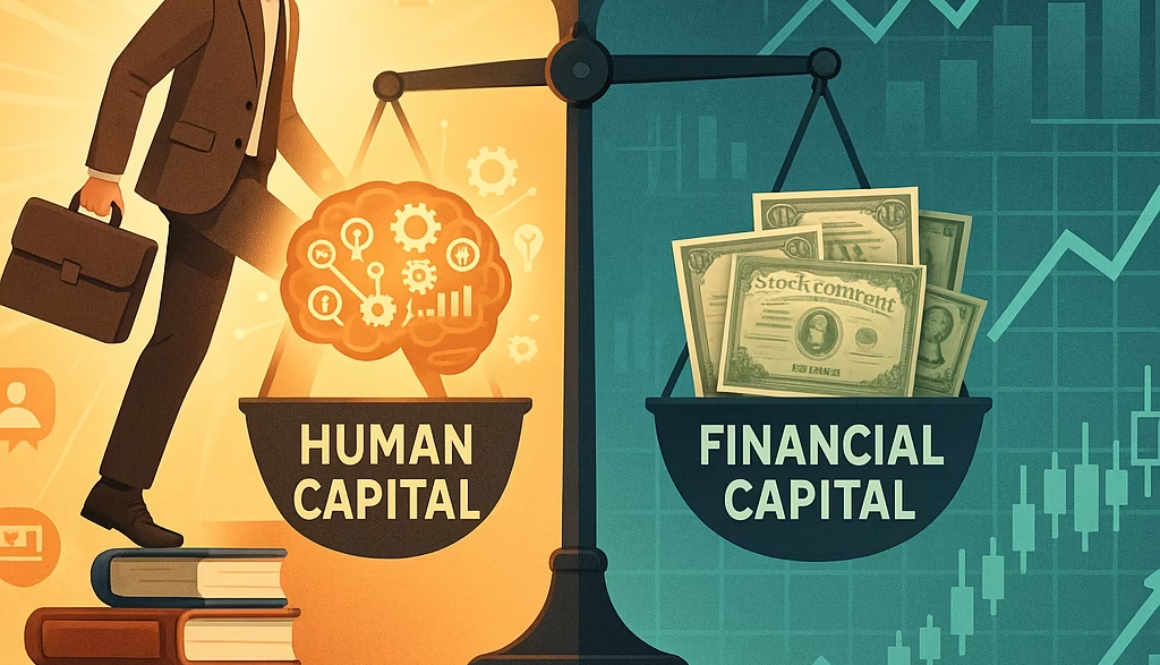
Here’s what I’ve learned after years of watching friends take both paths (and trying both myself): investing in yourself vs stock market isn’t really about choosing sides. It’s about understanding when each approach makes sense and why your biggest asset might not be what you think it is.
The truth is, while the stock market has delivered solid returns for decades—roughly 10% annually if you’re keeping score—some of the smartest investments I’ve seen friends make had nothing to do with ticker symbols. They had everything to do with leveling up their skills, expanding their networks, and betting on their own potential.
Stick with me as we dive into why your human capital might just be sitting on the investment opportunity of a lifetime.
Let’s Talk Numbers (But Not the Boring Kind)
What the Stock Market Actually Delivers
Look, I’m not here to bash the stock market. It’s been pretty good to people who stick with it. The S&P 500 has averaged around 10% returns annually over the long haul, and recent five-year stretches have been even better—we’re talking 13.6% before inflation kicks in.
If you toss $10,000 into a broad market index fund and forget about it:
After 10 years: $26,533
After 20 years: $70,400
After 30 years: $186,740
Those numbers look impressive, right? And honestly, they are. But here’s where things get interesting.
The Human Capital Game-Changer
Personal investments work completely differently. Instead of that steady, predictable climb, you can sometimes see massive jumps that make stock gains look like pocket change.
Let me share some real stories (names changed, but these are actual people I know):
Maria’s Career Pivot: She was stuck managing a retail store for $35K a year. Frustrated and feeling trapped, she scraped together $5,000 for a coding bootcamp. Six months later, she was interviewing for developer roles. Two years in? She’s pulling in $85,000. That’s a 1,600% return that happened faster than most stocks can blink.
James and the Power of Showing Up: This guy spent $2,000 over 18 months just… showing up places. Industry conferences, networking events, premium LinkedIn subscriptions. Sounds like a waste, right? Wrong. One conversation at a random meetup led to a consulting gig that netted him $45,000 extra that year. Sometimes it really is about who you know.
The MBA Question: Yeah, business school is expensive. But the data shows top-tier MBAs can add $1.2 million to your lifetime earnings. Even after student loans and opportunity costs, we’re often looking at 15%+ annual returns.
The difference? These returns compound differently than stock gains. They create new income streams, open doors to opportunities, and build capabilities that keep paying dividends for decades.
Why Betting on Yourself Often Wins: The Real Reasons
1. You Are Your Own Blue-Chip Stock
Here’s something that dawned on me during the 2020 market crash: while everyone was freaking out about their portfolios, the people who had invested heavily in themselves were… mostly fine. Their skills didn’t disappear. Their networks didn’t evaporate. Their knowledge didn’t lose value.
Your capabilities are like the ultimate recession-proof asset. They can’t be stolen, manipulated by Wall Street, or wiped out by a market crash. They actually tend to get more valuable over time, especially if you keep building them.
Think about it this way: millennials are already spending nearly $300 a month on personal development because they instinctively understand this. Organizations are catching on too—87% of companies now agree that executive coaching delivers high ROI because they see the results firsthand.
The compound effect here is wild:
Learn Spanish? Suddenly you’re eligible for international roles
Develop leadership skills? Watch your career trajectory shift into overdrive
Get technical certifications? Your hourly rate just doubled
2. You’re in the Driver’s Seat
Stock market investing means you’re along for the ride. Sure, you can choose your funds and rebalance occasionally, but ultimately you’re betting on thousands of companies managed by people you’ll never meet, influenced by economic forces none of us fully understand.
Self-investment? You control the variables that matter:
Stock Market (You’re a Passenger):
Economic cycles happen to you
Interest rate changes affect your returns
Corporate scandals tank your holdings
Market sentiment swings wildly
Self-Investment (You’re the Driver):
You decide how hard to study
You choose which skills to prioritize
You control your networking efforts
You pick your mentors and opportunities
This control creates something powerful: agency. Instead of anxiously refreshing your portfolio app (we’ve all been there), you’re actively building something that can’t be taken away from you.
3. The Acceleration Effect is Real
Traditional career progression without investment looks pretty predictable: 3-5% annual salary bumps if you’re lucky. But strategic self-investment can create those magical 20-50% jumps that completely change your financial trajectory.
I’ve watched this happen over and over. Companies that invest in employee development see massive returns—we’re talking $8,053 in value per employee annually through increased productivity, lower turnover, and reduced healthcare costs. If employers see that kind of ROI, imagine what you could create for yourself.
The pattern I’ve noticed among friends who’ve made these jumps:
They identify a skill gap in their industry
They invest time and money filling that gap
They position themselves as the go-to person for that skill
Opportunities start flowing their way
4. Multiple Revenue Streams Become Possible
Your stock portfolio basically has two ways to make you money: the stocks go up, or they pay dividends. That’s it.
But when you invest in yourself, you’re not just improving one income stream—you’re potentially creating several:
Your primary job gets better (promotions, raises)
Consulting opportunities emerge
Side businesses become viable
You can create passive income (courses, books, speaking)
Board positions and advisory roles open up
Your network starts sending opportunities your way
I know people who started with one skill development investment and ended up with three or four different income sources within a couple of years. Try getting that diversification from a stock portfolio.
5. Your Network Becomes Your Net Worth (Yes, It’s Cliché Because It’s True)
This might be the most undervalued part of self-investment. You can’t buy relationships with stock purchases, but the right conference, course, or mentorship program can introduce you to people who completely change your career trajectory.
Strong professional relationships lead to:
Job opportunities before they’re posted
Partnership possibilities you never saw coming
Mentorship that accelerates your growth
Referral business that shows up automatically
Investment opportunities most people never hear about
Emotional support when things get tough
I’ve seen careers made by a single conversation at the right event. You can’t replicate that through your brokerage account.
When Stocks Actually Win (Because Balance Matters)
Before you start liquidating everything to fund your personal development budget, let’s be real about when traditional investing makes more sense.
The Beauty of Passive Wealth Building
Stocks are beautifully passive once you set them up. Buy a broad market index fund, set up automatic contributions, and let compounding do its thing. No studying required, no networking events, no late nights learning new skills.
Self-development, on the other hand, demands constant effort. It’s active. It’s tiring. Sometimes you just want your money to work without you having to work too.
Predictability Has Its Place
While individual stocks can be roller coasters, broad market indexes have shown remarkable consistency over decades. The data is clear: if you can wait 20+ years, you’re very likely to see positive returns.
Personal development is messier. Not every course delivers. Not every networking investment pays off. Not every skill you develop becomes valuable. There’s execution risk that doesn’t exist with passive index investing.
Time Is the Ultimate Advantage
Starting early with consistent stock market investing creates wealth through time rather than effort. Einstein’s compound interest really is magical when you give it decades to work.
A 25-year-old who consistently invests $500 monthly until retirement will likely end up a millionaire without breaking a sweat. That’s powerful, and it doesn’t require you to be exceptional at anything other than consistency.
Lower Risk, Lower Stress
Diversified index investing is about as low-risk as investing gets. You’re betting on the entire economy rather than your ability to execute on personal development plans.
Some people sleep better knowing their financial future doesn’t depend entirely on their ability to stay motivated, pick the right skills, or execute perfectly on their plans.
The Smart Play: Why It’s Not Either/Or
Here’s what I’ve learned from watching friends succeed (and fail) at both approaches: the winners don’t choose sides. They create a strategic balance that evolves with their life stage.
The Age-Based Allocation That Actually Makes Sense
Your Twenties and Early Thirties (High Self-Investment Phase):
70% of available investment capital into personal development
30% into stock market (emergency fund + employer matching)
Why this works: Your human capital is most moldable right now. You have time to recover from mistakes, energy to put in extra effort, and decades for those skill investments to compound.
Time management training (more capacity = more opportunities)
Skills That Scale:
Technical abilities that are hard to outsource
Leadership and communication skills that open doors
Creative capabilities that differentiate you
Entrepreneurial skills that create options
Real Stories from Real People
Let me share some detailed examples of how this actually works in practice.
Sarah’s Marketing Makeover
Sarah was 28, working as a marketing coordinator at a traditional retailer for $65,000. She felt stuck watching younger people get promoted while she did the same tasks year after year.
Her Investment Strategy: $8,000 over 18 months
Google Ads certifications: $500
HubSpot inbound marketing courses: $1,200
Three major industry conferences: $3,500
Personal branding consultant: $2,800
The Results: Within 18 months, she landed a senior digital marketing role at a tech startup. Base salary jumped to $95,000 plus equity that could be worth significant money if the company succeeds.
The ROI: 375% return on investment in direct salary increase, not counting the equity upside or accelerated career trajectory.
What Made It Work: Sarah didn’t just take random courses. She researched what skills were in highest demand, got certified in the most valuable platforms, and networked strategically at events where hiring managers actually attended.
Michael’s Accounting Transformation
Michael was 31, working as a staff accountant for $52,000 and feeling invisible. He watched other people get promoted while he processed the same transactions day after day.
His Investment: $12,000 over 24 months
CPA exam preparation materials: $3,000
Part-time MBA (with employer contribution): $8,000 personal cost
Industry networking events and CPA society membership: $1,000
The Results: Promoted to Controller within 18 months at $78,000, with clear path to CFO roles in the future.
The ROI: 217% return, but more importantly, he broke out of the staff accountant track entirely.
Key Insight: Michael combined credentials (CPA) with broader business knowledge (MBA) and relationship building. The combination created exponential value.
Lisa’s Teaching Side Hustle
Lisa was 26, teaching elementary school for $45,000 and loving the work but struggling financially. She wanted to increase her income without leaving education.
Her Investment: $4,500 over 12 months
Course creation training program: $2,500
Professional website development and branding: $1,500
The Results: Created online courses for teachers that generated $30,000 in additional income the first year, growing to $50,000 by year two.
The ROI: 567% return in year one, with ongoing passive income that continues growing.
The Magic: Lisa leveraged her existing expertise and network. She didn’t try to become something completely different—she amplified what she already knew.
The Certainty Trap: Stock investing feels safer because we can look at historical charts and feel confident about long-term returns. Self-investment requires betting on uncertain personal outcomes.
But here’s the thing: the stock market’s past performance really doesn’t guarantee future results, even though we act like it does. Your ability to grow and adapt might actually be more predictable than market returns.
The Effort Asymmetry: Buying stocks takes five minutes online. Learning new skills takes months of consistent effort.
This is actually a feature, not a bug. The effort required creates a moat around your investment. Anyone can buy the same stocks you own, but not everyone will put in the work to develop the same capabilities.
The Comparison Problem: It’s easy to compare your portfolio performance to standard benchmarks. Personal growth is harder to quantify and compare, which makes it feel less real.
Start tracking your personal metrics the same way you’d track investment returns. Salary progression, opportunity flow, network quality, skill acquisition—make it as measurable as your stock portfolio.
Building the Right Mindset
Think Like a CEO of Yourself: You’re running a business with one primary asset: you. How would a smart CEO allocate resources between R&D (skill development) and financial investments?
Most successful companies spend 3-5% of revenue on R&D. You should probably be spending 10-20% of your income on personal R&D, especially early in your career.
Embrace Smart Risk-Taking: The biggest risk isn’t market volatility—it’s becoming irrelevant in a rapidly changing economy.
I’ve watched entire job categories disappear in the last decade. The people who thrived were those who had continuously invested in staying adaptable and learning new skills.
Process Over Outcomes: Just like successful investors focus on consistent contributions rather than daily portfolio fluctuations, focus on consistent personal development rather than immediate results.
The compound effect of daily learning and skill building creates exponential returns, but it takes time to become visible.
Consulting opportunities that emerged from your expertise
Business revenue from ventures enabled by your development
Career Advancement Metrics:
How often you get promoted (and by how much)
Time it takes to reach new salary milestones
Quality of opportunities that come your way unsolicited
Industry recognition, awards, or speaking invitations
The Harder-to-Measure Stuff (That Might Matter More)
Professional Confidence:
Your comfort level taking on new challenges
Willingness to negotiate salary and terms
Ability to pivot quickly during economic uncertainty
Sense of control over your career trajectory
Network Effects:
Access to decision-makers in your industry
Frequency of unsolicited job opportunities
Quality of mentorship relationships you can access
Speed at which you can get introductions or advice
Life Satisfaction:
Alignment between your work and interests
Sense of purpose and meaning in your career
Work-life balance improvements
General optimism about your future
Common Mistakes (Learn from Others’ Failures)
The Shiny Object Problem
Jumping from course to course without deep implementation. I’ve watched friends accumulate certifications like Pokemon cards while their careers stagnated because they never actually applied what they learned.
Better to master one valuable skill deeply than to dabble in twenty different areas.
Forgetting the Fundamentals
Chasing advanced certifications while lacking basic professional skills. I know people with impressive technical credentials who can’t communicate effectively, manage their time, or build relationships.
Sometimes the highest-ROI investment is improving your fundamentals: writing, speaking, time management, emotional intelligence.
The Perfectionism Trap
Waiting for the “perfect” course, mentor, or opportunity instead of starting with available options and iterating.
Perfect is the enemy of good, and good enough today beats perfect someday. Start with what’s available and upgrade as you go.
Ignoring Practical ROI
Investing in self-improvement that feels good but doesn’t translate to career or income advancement. Not all learning is created equal from an investment perspective.
Always ask: “How will this specific investment make me more valuable in the marketplace?”
Looking Ahead: Future-Proofing Your Strategy
Trends Worth Paying Attention To
Artificial Intelligence Integration: Whether you love it or fear it, AI is reshaping every industry. Skills in working with AI, understanding its capabilities and limitations, and applying it effectively are becoming valuable across all fields.
Remote Work Mastery: Digital communication, virtual team leadership, and remote project management aren’t temporary pandemic skills—they’re permanent career assets.
Sustainability and ESG: Environmental and social governance expertise is becoming crucial across sectors as companies face increasing pressure to operate responsibly.
Data Fluency: The ability to understand, analyze, and work with data is becoming as fundamental as basic literacy for knowledge workers.
The Meta-Skills That Matter Most
As the pace of change accelerates, the specific skills you learn today might be obsolete in five years. This makes meta-skills—the ability to learn and adapt—more valuable than any particular expertise.
Learning How to Learn: Understanding how you absorb information most effectively, how to practice efficiently, and how to transfer knowledge between domains.
Adaptability and Resilience: Comfort with change, ability to bounce back from setbacks, and skill at pivoting when circumstances shift.
Systems Thinking: Understanding how different parts of complex systems interact, and ability to see patterns and connections others miss.
Emotional Intelligence: Reading people, managing relationships, and navigating office politics will never be automated away.
Your 90-Day Action Plan (Because Planning Without Action is Just Dreaming)
Month 1: Assessment and Research
Week 1: Take Inventory
List every skill, certification, and capability you currently have
Assess the strength of your professional network honestly
Identify the gap between where you are and where you want to be
Calculate your current earning trajectory if nothing changes
Week 2: Market Research
Research salary ranges for roles you want in 2-3 years
Identify the 3-5 most valuable skills in your target area
Find the best learning resources, courses, and mentors
Talk to people already doing what you want to do
Week 3: Budget and Plan
Decide how much you can realistically invest annually
Prioritize your skill development areas by ROI potential
Create a 12-month learning plan with specific milestones
Set up systems to track your progress and results
Week 4: First Steps
Enroll in your first high-priority course or program
Join one relevant professional association or online community
Reach out to three potential mentors or industry contacts
Start documenting your learning journey (blog, LinkedIn, journal)
Month 2: Build Momentum
Execute on your plan consistently
Attend networking events or virtual meetups
Complete your first course or certification milestone
Apply new skills in your current role immediately
Share your learning progress publicly (builds accountability)
Month 3: Measure and Adjust
Assess early results
Gather feedback from colleagues and supervisors
Track any immediate income or opportunity improvements
Adjust your plan based on what’s working and what isn’t
Plan your next quarter of investments
The Technology Advantage: Making Your Money Go Further
Digital Learning Revolution
We’re living through the golden age of accessible education. Platforms like Coursera, Udemy, MasterClass, and industry-specific training sites offer world-class instruction for a fraction of what it used to cost.
You can literally learn from Nobel Prize winners, industry leaders, and top university professors for less than most people spend on coffee each month.
AI as Your Personal Development Assistant
Tools like ChatGPT and Claude can serve as personalized tutors, practice partners, and feedback providers. They’re available 24/7, infinitely patient, and can adapt to your learning style.
I’ve started using AI to create custom practice scenarios, generate feedback on my writing, and even role-play difficult conversations. It’s like having a personal coach for the cost of a subscription.
Virtual Networking Opportunities
Geographic limitations used to severely constrain your professional network. Now, through LinkedIn, industry forums, virtual conferences, and online communities, you can build relationships with anyone, anywhere.
Some of the most valuable connections I’ve made in recent years have been entirely virtual, developed through thoughtful engagement in online communities.
Global Context: Your Advantages and Opportunities
The American Mobility Advantage
If you’re in the US, you have unique advantages for self-investment ROI. Our culture accepts and even celebrates job hopping and career pivots. What might be seen as instability in other cultures is often viewed as ambition and growth here.
This cultural acceptance means the returns on skill development and career transitions can be higher than in more hierarchical societies.
International Opportunities
The rise of remote work and digital businesses has created unprecedented opportunities to monetize your skills across international markets.
I know freelancers charging US rates while living in lower-cost countries, effectively multiplying their purchasing power. The global marketplace for skills has never been more accessible.
Economic Cycles and Investment Timing
Recession-Resistant Skills
During economic downturns, certain capabilities become more valuable:
Cost reduction and efficiency optimization expertise
Digital transformation and automation skills
Crisis management and turnaround experience
Sales and revenue generation abilities
Essential services and maintenance knowledge
Boom Period Opportunities
During economic expansion, different skills command premium prices:
Smart self-investors develop skills that remain valuable across economic cycles.
Frequently Asked Questions (The Real Questions People Ask)
Should I really prioritize self-investment over stocks at 25?
At 25, you typically have 40+ years of earning potential ahead of you. The compound effect of increased earning power from strategic self-investment often dramatically outweighs stock market returns over that timeframe.
That said, don’t completely ignore traditional investing. Take advantage of any employer 401k matching (it’s free money), and start building good saving habits. But heavily weight toward self-investment while your human capital is most moldable.
How do I know which personal development investments will actually pay off?
Focus on skills that are:
In high and growing demand
Difficult for others to replicate quickly
Aligned with your natural strengths and interests
Valued by employers or clients who can pay well
Research job postings in roles you want, talk to people already doing that work, and prioritize skills that show up repeatedly as requirements or preferences.
What if I invest in myself and it doesn’t work out?
This is a valid concern, but consider the alternative: what if you don’t invest in yourself and stay stuck where you are? That’s actually a much riskier scenario in a rapidly changing economy.
Even “failed” self-investments usually teach you something valuable. I’ve never met anyone who regretted learning new skills, expanding their network, or trying to grow—even when the specific outcome wasn’t what they expected.
How much of my income should I spend on personal development?
A general guideline is 10-20% of your gross income, but this should be higher (potentially 30-50%) in your twenties when the ROI potential is greatest.
Always prioritize high-impact investments over expensive but low-value options. A $50 book that changes how you think might be worth more than a $5,000 course that teaches you nothing new.
Can I really balance self-investment with traditional investing?
Absolutely. The key is being strategic about the balance based on your age, income, and goals. Most successful people gradually shift from heavy self-investment in their twenties to more traditional wealth-building as they age.
The exact balance depends on your risk tolerance, career trajectory, and personal circumstances, but the principle of doing both strategically is sound.
The Bottom Line: Personal Development ROI vs Stock Returns – Your Future Starts With a Choice
Look, I’m not going to lie to you. Personal development ROI vs stock returns isn’t really a fair fight when you’re young. Your human capital is almost certainly your highest-ROI asset, especially if you’re strategic about developing it.
But here’s what I’ve learned watching friends succeed with both approaches: the real winners don’t treat this as an either/or decision. They understand that different life phases call for different investment strategies.
In your twenties and thirties, you probably are your own best investment. Your skills can’t be stolen, your network can’t crash, and your capabilities tend to appreciate over time. The returns from strategic self-development often dwarf what you can get from the stock market.
But traditional investing has its place too. It provides stability, predictability, and the magic of compound returns over long periods. The goal isn’t to choose one forever—it’s to be strategic about the balance at each stage of your life.
Your human capital won’t wait for you to be ready. The stock market will always be there when you are.
The question isn’t whether you can afford to invest in yourself. It’s whether you can afford not to.
Ready to Make Your Move?
The difference between where you are and where you want to be often comes down to the investments you make in yourself today. Your future self is counting on the decisions you make right now.
The stock market will compound your money. But investing in yourself compounds your life.
What are you waiting for?
Disclaimer: This article shares personal observations and educational content about investment strategies—it’s not personalized financial advice. Everyone’s situation is different, and what works for one person might not work for another. Consider talking to a financial advisor and career counselor to create a plan that makes sense for your specific goals and circumstances. Both self-investment and market investing involve risks, and there’s no guarantee of specific results. Make informed decisions based on your own research and professional guidance.
Last week, I was grabbing coffee with my friend Sarah when she showed me something on her phone that made my jaw drop. Her investment portfolio had grown 23% in the past year—but that wasn’t the shocking part. What blew me away was that every single investment was helping fight climate change.
“I used to think I had to choose between making money and saving the planet,” she laughed, stirring her oat milk latte. “Turns out I was completely wrong.”
Sarah isn’t alone in discovering the power of climate finance 2025. Across coffee shops, office break rooms, and family dinner tables, a quiet revolution is happening. Young investors are realizing they don’t have to park their money in companies that conflict with their values. Instead, they’re building wealth by funding the solutions our planet desperately needs.
But here’s where it gets interesting—and where I initially got confused too. When I first heard about “climate finance,” I pictured boring government meetings and corporate boardrooms filled with people in suits discussing carbon taxes. I couldn’t have been more wrong.
Climate finance has evolved into one of the most exciting investment opportunities of our lifetime. We’re talking about funding the technologies that will reshape how we generate energy, grow food, build cities, and move around the planet. And the best part? You don’t need a trust fund or a finance degree to participate.
The numbers tell an incredible story. According to recent data, green investments 2025 have attracted over $4 trillion globally, with individual investors making up the fastest-growing segment. My own portfolio journey started with just $200 in a renewable energy fund two years ago—today, that investment has doubled while helping finance wind farms across the Midwest.
Yet despite all this momentum, I still meet people who think sustainable investing means accepting lower returns or limiting their options. That might have been true a decade ago, but 2025 is a completely different landscape. Government incentives are flowing, technology costs are plummeting, and major corporations are committing billions to clean energy transitions.
The challenge isn’t finding good sustainable investing strategies—it’s choosing among the overwhelming array of options. Should you invest in solar companies or carbon capture technology? Green bonds or renewable energy ETFs? Impact investing platforms or sustainable real estate?
That’s exactly what we’re going to tackle together. I’ve spent months researching, testing, and sometimes learning from mistakes (like the time I put too much money in a single clean energy stock that dropped 30% in a week—ouch). What I’ve discovered are seven investment categories that strike the perfect balance between impact and returns.
Whether you’re someone who checks their investment apps daily or prefers a set-it-and-forget-it approach, whether you have $50 or $5,000 to start with, this guide will show you practical ways to align your money with your values while building long-term wealth.
1. Renewable Energy ETFs: Riding the Clean Energy Wave
The Energy Revolution in Your Portfolio
I’ll never forget the moment renewable energy investing clicked for me. I was driving through West Texas, and the landscape was dotted with hundreds of wind turbines spinning gracefully against a bright blue sky. My phone buzzed with a notification that my renewable energy ETFs had hit a new high, and I realized I was literally watching my investment at work.
Renewable energy ETFs are like buying a ticket to the clean energy revolution without having to pick individual winners. Instead of trying to guess whether Solar Company A will beat Wind Company B, you’re investing in baskets of companies powering our transition away from fossil fuels.
Think of it this way: if the clean energy transition were a music festival, renewable energy ETFs would be your general admission pass. You get access to all the stages—solar, wind, hydroelectric, battery storage, and emerging technologies you’ve probably never heard of.
Popular options include the Invesco Solar ETF (TAN), which focuses specifically on solar companies, the First Trust Global Wind Energy ETF (FAN) for wind power exposure, and broader funds like the iShares Global Clean Energy ETF (ICLN) that spread across multiple renewable technologies.
Why 2025 Is the Sweet Spot for Clean Energy
Here’s what makes this moment in climate finance history so compelling: all the pieces are finally falling into place simultaneously.
First, the economics have flipped. When I started researching renewable energy five years ago, it was still more expensive than traditional power in most places. Today, solar and wind are the cheapest forms of electricity in 85% of the world. Solar costs have crashed 90% since 2010, while wind costs have dropped 70%. We’ve hit what economists call the “tipping point”—clean energy wins on economics alone, before you even consider environmental benefits.
Second, government support is unprecedented. The U.S. Inflation Reduction Act allocated $369 billion for clean energy incentives. Europe’s Green Deal committed €1 trillion to climate investments. Even traditionally fossil fuel-dependent countries like Saudi Arabia are investing hundreds of billions in solar projects.
Third, corporate demand is exploding. Amazon plans to be net-zero by 2040 and has already become the largest corporate buyer of renewable energy. Google has committed to running on 24/7 carbon-free energy by 2030. When tech giants with unlimited budgets choose renewable energy, it’s not philanthropy—it’s smart business.
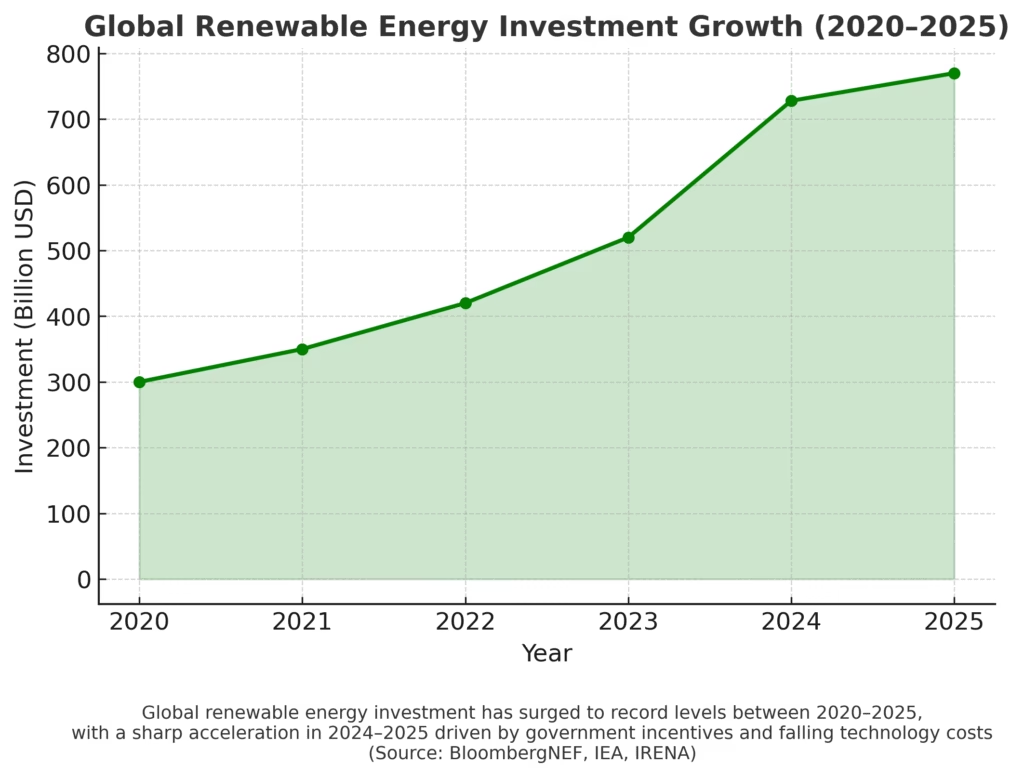
Global renewable energy investment has surged to record levels between 2020–2025, with a sharp acceleration in 2024–2025 driven by government incentives and falling technology costs (Source: BloombergNEF)”
Your First Steps into Clean Energy Investing
Starting with renewable energy ETFs feels overwhelming until you break it down into simple steps. I remember staring at my brokerage account for weeks before making my first purchase, paralyzed by choice. Here’s the approach I wish someone had shared with me:
Week 1: Start with broad exposure. The iShares Global Clean Energy ETF (ICLN) gives you instant diversification across solar, wind, hydroelectric, and battery companies worldwide. It’s like buying a little piece of the entire clean energy transformation for around $20 per share.
Month 1: Add automatic investing. Most brokerages let you automatically invest $25, $50, or $100 monthly. I started with $75 per month and gradually increased it as I became more comfortable. This dollar-cost averaging approach smooths out the volatility that’s common in emerging sectors.
Month 3: Consider specialized exposure. Once you’re comfortable with broad funds, you might add focused exposure to specific technologies. The Invesco Solar ETF (TAN) has been volatile but rewarding for patient investors, while newer funds focus on energy storage and grid modernization.
One crucial lesson I learned the hard way: renewable energy stocks can swing wildly day-to-day and month-to-month, but the long-term trajectory is unmistakable. My solar ETF dropped 25% during a rough patch in 2023, but recovered and reached new highs within six months. The key is thinking in years, not quarters.
2. Green Bonds: The Steady Eddie of Climate Finance
When Boring Becomes Beautiful
My grandmother always said, “Honey, not every investment needs to be exciting. Sometimes the boring ones make you the most money.” She would have loved green bonds 2025.
While renewable energy stocks grab headlines with their dramatic swings, green bonds are the steady, reliable foundation of climate finance. They work exactly like traditional bonds—you lend money to a government or corporation, they pay you regular interest, and eventually pay back your principal. The twist? Every dollar must fund environmental projects.
I like to think of green bonds as the “index funds” of climate investing. They’re not going to make you rich overnight, but they provide steady income while funding everything from offshore wind farms to electric bus fleets to forest restoration projects. It’s patient capital for patient investors.
The World Bank pioneered this market back in 2008, and I’m grateful they did. Their green bonds have funded over 130 climate projects across 70+ countries. When you buy a World Bank green bond, you might be helping finance solar installations in India, sustainable agriculture in Kenya, or flood protection systems in Vietnam.
The Green Bond Boom Is Just Getting Started
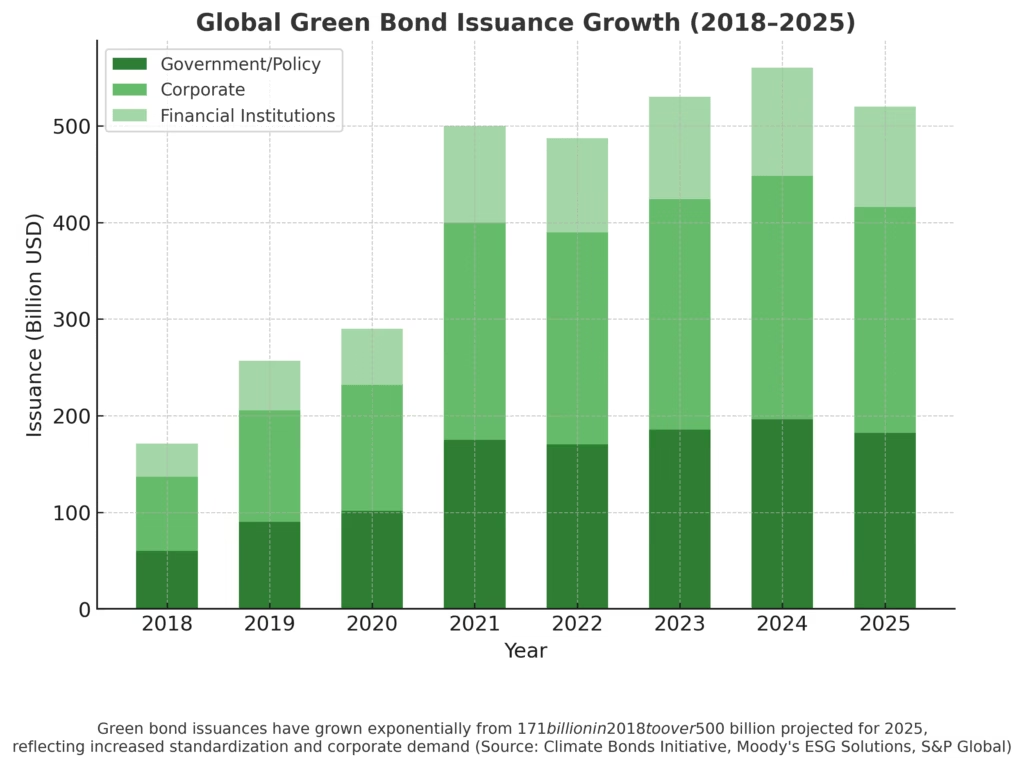
The growth trajectory of green bonds still amazes me. We’ve gone from virtually zero in 2007 to over $500 billion issued annually. But here’s what gets me excited about 2025: we’re entering the standardization phase.
For years, “greenwashing” was a legitimate concern—some bonds labeled as “green” were funding projects with questionable environmental benefits. New regulations from the EU, SEC, and other authorities are creating clear standards for what qualifies as truly green. This transparency is attracting institutional investors who were previously skeptical.
Three major trends are driving explosive growth in green bond markets:
Government Infrastructure Spending: Cities and countries need trillions for climate adaptation—sea walls, renewable energy grids, sustainable transportation systems. Green bonds are becoming their preferred funding mechanism.
Corporate Sustainability Transitions: Companies like Apple, Microsoft, and Walmart are issuing green bonds to fund their net-zero commitments. Apple’s $2.5 billion green bond program has financed everything from recycled materials to renewable energy for their facilities.
Investor Demand for Stability: In an uncertain economic environment, the predictable returns of green bonds appeal to investors seeking portfolio stability with environmental impact.
“Green bond issuances have grown exponentially from $171 billion in 2018 to over $500 billion projected for 2025, reflecting increased standardization and corporate demand (Source: Climate Bonds Initiative)”
Making Green Bonds Work in Your Portfolio
I used to think you needed $10,000 or more to access quality bonds, but the landscape has changed dramatically. Here are three beginner-friendly approaches I recommend:
Green Bond ETFs: The iShares Global Green Bond ETF (BGRN) instantly diversifies you across hundreds of green bonds from governments and corporations worldwide. At around $50 per share, it’s accessible to most investors and provides monthly dividend payments.
Treasury Direct Access: The U.S. Treasury occasionally issues green bonds that you can purchase directly through Treasury Direct with no fees or minimums. I bought my first $100 Treasury green bond this way, and the experience helped me understand how bonds work without any broker complexity.
Robo-Advisor Integration: Platforms like Betterment and Wealthfront now include green bonds in their ESG portfolios. If you’re investing $500+ monthly, this hands-off approach handles the bond selection and reinvestment automatically.
The beauty of green bonds in climate finance is their predictability. While I might lose sleep over a volatile clean energy stock, my green bond investments provide steady quarterly income regardless of market conditions. They’re the foundation that lets me take bigger risks with other parts of my portfolio.
3. ESG Portfolios: The Whole-Life Approach to Investing
Beyond Green: Building Complete Values-Based Portfolios
Last year, I had lunch with my college roommate Tom, who works in traditional finance. When I mentioned my ESG portfolios, he rolled his eyes and said, “So you only invest in tree-hugging companies now?”
I laughed and pulled up my portfolio on my phone. “Actually, Tom, I own Apple, Microsoft, Johnson & Johnson, and Visa. But I also avoid tobacco companies, weapons manufacturers, and fossil fuel giants. It’s not about tree-hugging—it’s about companies that manage risk well and think long-term.”
That’s the beauty of ESG investing. ESG stands for Environmental, Social, and Governance, which sounds corporate and boring until you realize it’s simply about investing in well-managed companies that consider their impact on the world.
Environmental factors include climate change mitigation, waste management, and resource conservation. Social factors cover employee relations, diversity and inclusion, and community impact. Governance examines leadership quality, executive compensation, and shareholder rights.
The genius of sustainable investing strategies through ESG is that you’re not limiting yourself to “green” companies. You’re choosing companies across all industries that operate responsibly and think beyond next quarter’s earnings.
Why ESG Is Becoming Mainstream in 2025
Five years ago, ESG investing was considered a niche strategy for wealthy individuals who could afford to sacrifice returns for values. That narrative has completely flipped.
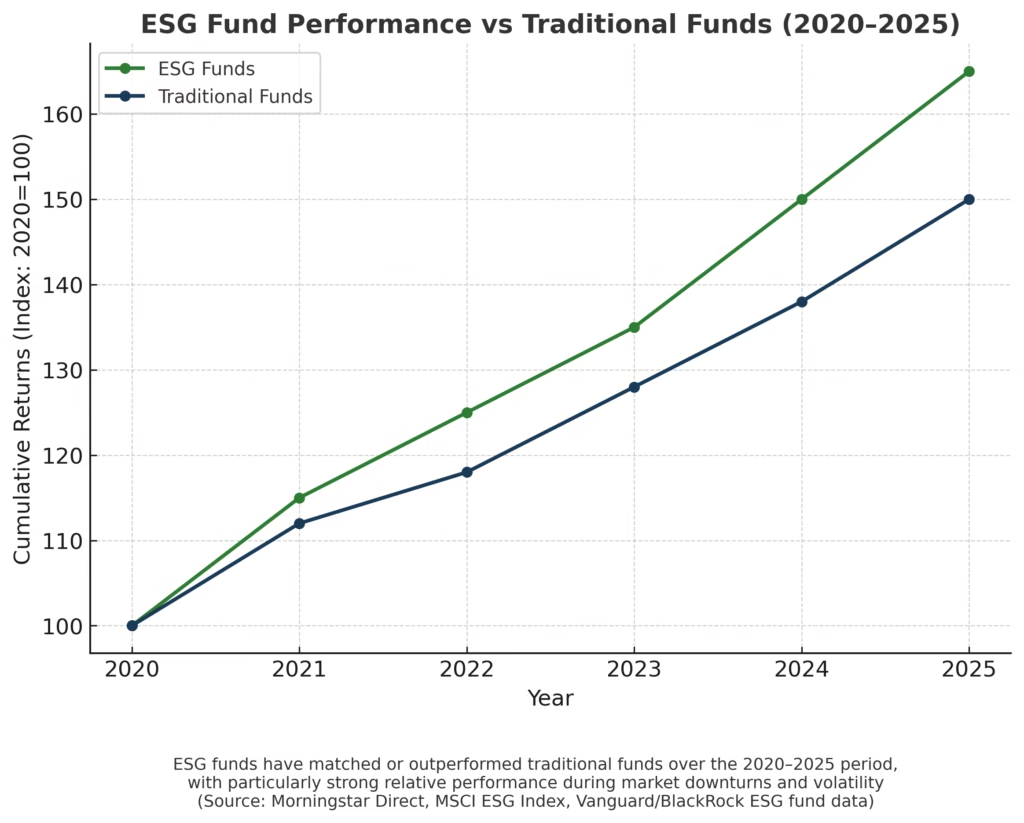
According to Morningstar’s comprehensive ESG research, 88% of ESG funds outperformed their traditional counterparts during the 2020 market downturn. During the COVID-19 crisis, companies with strong ESG practices proved more resilient—they had better employee relations, stronger supply chains, and more adaptable leadership.
The performance data keeps getting stronger. Over the past five years, the Vanguard ESG U.S. Stock ETF has delivered nearly identical returns to the broader market while excluding controversial industries. The iShares MSCI KLD 400 Social ETF has actually outperformed the S&P 500 over many time periods.
But performance is just one piece of the puzzle. ESG companies increasingly attract top talent, face fewer regulatory surprises, and build stronger customer loyalty. In our hyperconnected world, corporate scandals spread instantly and can destroy decades of brand value overnight.
“ESG funds have matched or outperformed traditional funds over the 2020-2025 period, with particularly strong relative performance during market downturns and volatility (Source: Morningstar Direct)”
Building Your First ESG Portfolio
Creating an ESG portfolio used to require extensive research and high minimums. Today, it’s as simple as opening any investment account. Here’s the step-by-step approach I used:
Foundation: Broad Market ESG Exposure. I started with the Vanguard ESG U.S. Stock ETF (ESGV), which gave me exposure to large American companies with strong ESG practices. At 0.12% annual fees, it’s incredibly cost-effective.
International Diversification. The Vanguard ESG International Stock ETF (VSGX) added exposure to European and Asian companies with strong sustainability practices. International diversification is always smart, and ESG standards are often even higher outside the U.S.
Fixed Income Stability. The Vanguard ESG U.S. Corporate Bond ETF (VCEB) provides steady income from bonds issued by companies with strong ESG credentials. This adds portfolio stability while maintaining values alignment.
Emerging Markets Consideration. As I became more comfortable, I added small exposure to ESG emerging markets through funds like the iShares MSCI Emerging Markets ESG Select ETF (ESGE).
The total expense ratio across these funds averages just 0.15% annually—barely higher than traditional index funds. Many robo-advisors now offer ESG portfolios that automatically balance these components based on your age, risk tolerance, and goals.
One question I get constantly: “Don’t you miss out on big oil and tobacco profits?” Sometimes, yes. But I also avoided the catastrophic losses when tobacco companies faced massive lawsuits, or when oil stocks crashed during the pandemic. Climate finance principles suggest that companies ignoring ESG risks may face significant headwinds in the coming decades.
4. Carbon Credit Investments: Turning Environmental Solutions into Assets
The Carbon Market Revolution
I’ll admit, when I first heard about carbon credit investments, I was skeptical. The whole concept seemed abstract—buying and selling the right to pollute? It felt like financial engineering rather than real environmental progress.
Then I dug deeper and realized carbon credits represent one of the most direct ways to put a price on environmental damage while creating financial incentives for cleanup. Here’s how it works in plain English:
Imagine the government sets a limit on how much pollution companies can emit. Companies that stay under their limit earn carbon credits. Companies that exceed their limit must buy these credits from cleaner companies. Suddenly, being environmentally responsible becomes profitable, while polluting becomes expensive.
But it goes beyond just trading pollution rights. Modern carbon markets also include credits for removing carbon from the atmosphere—through reforestation, direct air capture technology, or regenerative agriculture practices. When you invest in carbon credits, you’re literally funding projects that pull CO2 out of the air.
The voluntary carbon market has exploded as companies like Microsoft, Amazon, and Google race to achieve net-zero emissions. Microsoft alone has committed to spending $1 billion on carbon removal technologies. These corporate commitments are creating a massive market for high-quality carbon credits.
Why Carbon Credits Are Having a Moment
The transformation in carbon markets over the past few years has been remarkable. We’ve gone from a niche, poorly regulated market to an increasingly sophisticated system with real oversight and verification.
Satellite monitoring now tracks forest conservation projects in real-time. Blockchain technology provides transparent verification of carbon removal. Advanced sensors measure soil carbon sequestration on farms with unprecedented accuracy. These technological improvements are attracting institutional investors who demand verifiable results.
The regulatory landscape is also maturing rapidly. California’s cap-and-trade program has operated successfully for over a decade. The EU’s emissions trading system covers 40% of the bloc’s greenhouse gas emissions. New federal standards in the U.S. are expected to create even larger markets.
But here’s what makes 2025 particularly exciting for carbon credit investments: corporate demand is outstripping supply of high-quality credits. This supply-demand imbalance is driving prices higher and attracting serious investor attention.
The voluntary carbon credit market is projected to reach $100 billion by 2030, up from just $2 billion in 2022. Early investors who understand this space could benefit significantly as the market scales and matures.
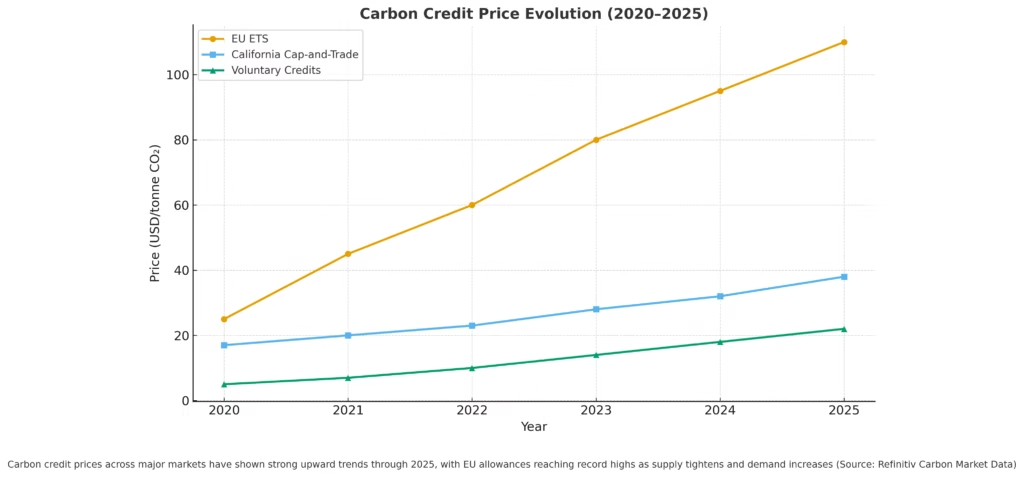
“Carbon credit prices across major markets have shown strong upward trends through 2025, with EU allowances reaching record highs as supply tightens and demand increases (Source: Refinitiv Carbon Market Data)”
Practical Approaches to Carbon Credit Investing
Accessing carbon credit investments used to require industry connections and minimum investments of $100,000+. Thankfully, that’s changing rapidly:
Carbon Credit ETFs: The KraneShares Global Carbon ETF (KRBN) tracks carbon allowance futures from major cap-and-trade programs. It’s available through any brokerage account and provides liquid exposure to carbon pricing across multiple markets.
Direct Purchase Platforms: Companies like Nori, Cloverly, and Gold Standard now allow individual investors to purchase verified carbon removal credits directly. You can start with as little as $20 and actually see the specific projects your money supports.
ESG Funds with Carbon Exposure: Many sustainable investing strategies now include companies involved in carbon markets—from technology firms developing carbon capture equipment to agricultural companies implementing carbon-sequestering practices.
Impact Investing Platforms: Services like RSF Social Finance offer funds that invest in carbon removal projects while providing returns to investors. These typically require higher minimums ($1,000+) but offer more direct project exposure.
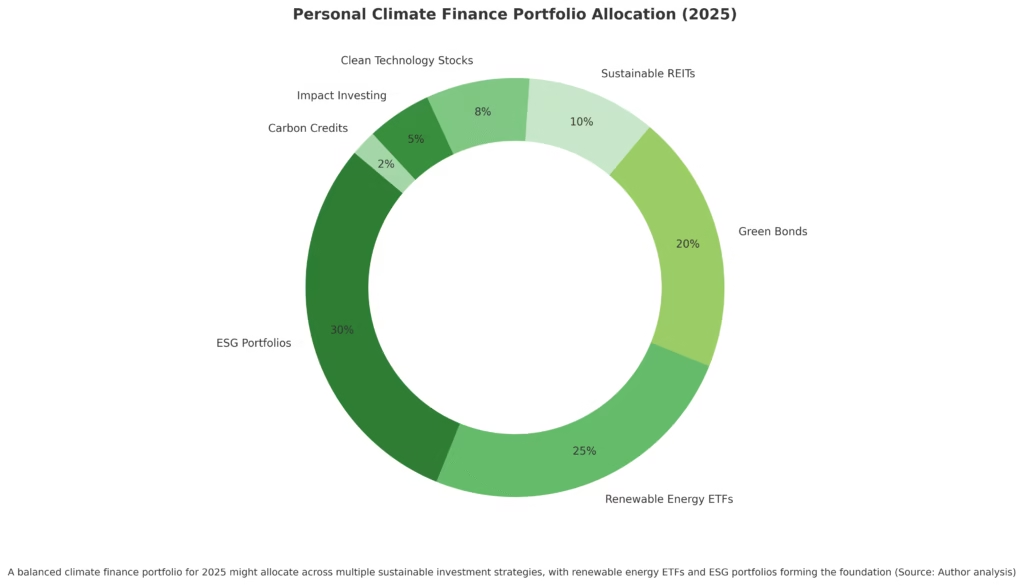
One crucial caveat: carbon credit investing is still emerging and can be volatile. I limit my carbon credit exposure to 5% of my overall climate finance portfolio. The potential is enormous, but it’s speculative enough that you shouldn’t bet money you can’t afford to lose.
5. Sustainable Real Estate Investment Trusts: Building Green, Building Wealth
The Quiet Revolution in Real Estate
While everyone talks about electric cars and solar panels, one of the biggest opportunities in climate finance 2025 is hiding in plain sight: the buildings around us.
Real estate accounts for nearly 40% of global carbon emissions, making it a critical frontier for climate action. But here’s the business opportunity disguised as an environmental challenge: green buildings consistently command higher rents, lower operating costs, and better tenant retention than conventional properties.
Sustainable REITs let you invest in portfolios of environmentally conscious properties without the headaches of direct real estate ownership. We’re talking about LEED-certified office buildings, energy-efficient apartments, solar-powered data centers, and properties designed for maximum resource efficiency.
I first got interested in sustainable REITs when I noticed the office building where I worked had installed solar panels, upgraded to LED lighting, and implemented smart climate controls. Our company actually chose that building partially because of its sustainability features and lower operating costs. That’s when I realized tenants increasingly prefer—and will pay premiums for—green buildings.
The Green Building Advantage in 2025
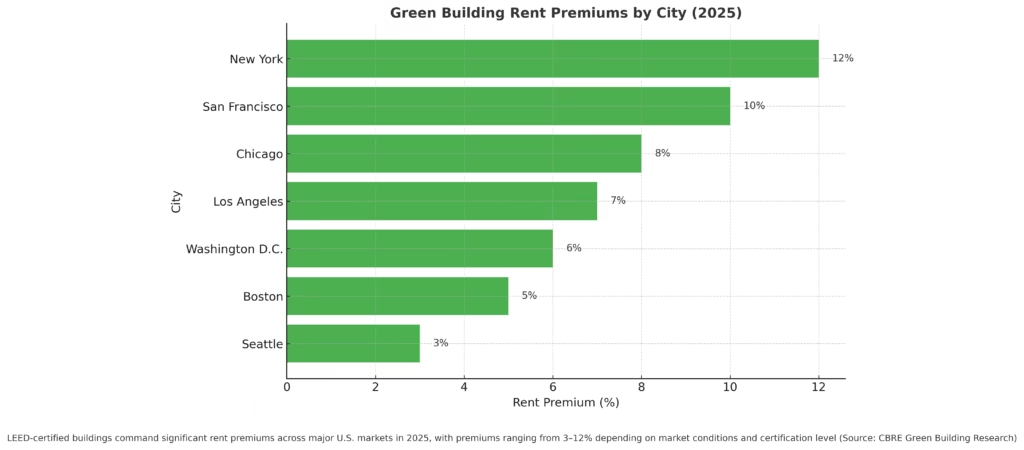
The data on green building performance is becoming impossible to ignore. Studies consistently show LEED-certified buildings achieve 3-7% higher rents and 4-10% higher property values than comparable conventional buildings.
But the financial advantages extend far beyond rent premiums. Green buildings typically have:
Lower Operating Costs: Energy-efficient systems reduce utility bills by 20-30%. Water-saving fixtures cut consumption significantly. Advanced building management systems optimize resource usage automatically.
Higher Occupancy Rates: Tenants stay longer in comfortable, efficient spaces. Companies increasingly mandate that their office spaces meet environmental standards for corporate sustainability reporting.
Regulatory Compliance: Cities from New York to San Francisco are implementing building performance standards. Properties that are already efficient will benefit, while others face costly retrofits.
Employee Productivity: Studies show people are more productive, have fewer sick days, and report higher satisfaction in green buildings. This makes them attractive to employers competing for talent.
The regulatory environment is accelerating these trends. New York City’s Local Law 97 requires large buildings to meet emissions limits or pay significant fines. Similar regulations are spreading to cities nationwide, creating competitive advantages for already-efficient properties.
“LEED-certified buildings command significant rent premiums across major U.S. markets in 2025, with premiums ranging from 3-12% depending on market conditions and certification level (Source: CBRE Green Building Research)”
Investing in Sustainable Real Estate
Getting exposure to sustainable real estate through REITs is surprisingly straightforward, though the options have expanded dramatically in recent years:
Specialized Green REITs: Hannon Armstrong Sustainable Infrastructure (HASI) focuses specifically on climate finance solutions—from solar installations to energy efficiency upgrades. Digital Realty Trust (DLR) operates highly efficient data centers that major tech companies prefer for their sustainability goals.
Broad REIT ETFs with ESG Screening: The Vanguard Real Estate ETF (VNQ) includes many REITs with strong environmental practices. The iShares Global REIT ETF (REET) provides international exposure to sustainable real estate markets.
Fractional Real Estate Platforms: Services like Fundrise and YieldStreet increasingly offer sustainable real estate investments with lower minimums than traditional REITs. I’ve invested in a solar-powered apartment development through Fundrise with just a $500 minimum.
Direct Green Real Estate Crowdfunding: Platforms like RealtyMogul and CrowdStreet occasionally offer investment opportunities in specific green building projects. These typically require higher minimums ($5,000-$25,000) but provide direct exposure to individual properties.
The dividend yields from sustainable REITs typically range from 3-6% annually, providing steady income while your capital potentially appreciates with property values. This combination of income and growth makes REITs particularly attractive for investors seeking regular cash flow from their sustainable investing strategies.
One strategy I’ve found effective: treating REITs as the “stable” portion of my climate portfolio. While clean energy stocks might swing wildly, my REIT investments provide predictable quarterly dividends that I can reinvest during market volatility.
6. Clean Technology Stocks: Betting on the Innovation Revolution
The Next Tesla Might Be in Your Portfolio
Remember when Tesla was just another startup burning through cash while trying to make electric cars? I missed that opportunity completely—I thought electric vehicles were a niche market for wealthy environmentalists. Seven years later, Tesla became one of the world’s most valuable companies, and traditional automakers are scrambling to catch up.
That missed opportunity taught me a crucial lesson about clean technology stocks: the next breakthrough companies are being built right now, and some of them are accessible to regular investors like us.
Clean technology investing goes far beyond solar panels and wind turbines. We’re talking about companies developing the innovations that will reshape entire industries: advanced battery storage, carbon capture and utilization, precision agriculture, alternative proteins, smart grid technologies, hydrogen fuel systems, and breakthrough materials we’re just beginning to understand.
The key insight that changed my perspective on cleantech investing: these aren’t just environmental companies—they’re technology companies that happen to solve environmental problems. The same innovation cycles that created Apple, Google, and Amazon are now focused on climate solutions, backed by unprecedented government support and corporate demand.
Why Cleantech Innovation Is Accelerating in 2025
The cleantech landscape today reminds me of the internet in the late 1990s—lots of experimentation, massive capital flows, and the sense that everything is about to change. Several factors are creating a perfect storm for innovation:
Cost Curves Are Breaking: Battery costs have fallen 90% in a decade. Solar manufacturing costs continue plummeting. Green hydrogen production is approaching cost parity with fossil fuels in some regions. When clean technologies become cheaper than dirty ones, adoption accelerates exponentially.
Talent Migration: Top engineers and entrepreneurs are flocking to climate tech. The same minds that built Facebook and Google are now focused on carbon capture, energy storage, and sustainable materials. This talent influx is accelerating innovation cycles dramatically.
Capital Availability: Venture capital funding for climate tech reached $16 billion in 2024. Government funding through programs like the Department of Energy’s loan guarantee program is providing patient capital for breakthrough technologies. Corporate venture arms are investing billions in potential game-changers.
Market Pull: Unlike previous cleantech booms that were purely policy-driven, today’s innovation is driven by genuine market demand. Companies need these solutions to meet their sustainability commitments, creating guaranteed customers for successful technologies.
According to analysis from the World Bank’s climate finance initiatives, the transition to clean energy alone will require $4 trillion annually through 2030—creating massive market opportunities for innovative companies.
[Chart: Clean Technology Patent Filings 2020-2025] This chart would show the exponential growth in climate tech patents, indicating accelerating innovation
Navigating Clean Technology Investments
Cleantech stock picking is inherently speculative, but there are ways to participate intelligently:
Start with Diversified Cleantech ETFs: The First Trust NASDAQ Clean Edge Green Energy Index Fund (QCLN) and Invesco WilderHill Clean Energy ETF (PBW) provide exposure to dozens of cleantech companies across multiple subsectors. This spreads your risk while capturing the sector’s growth.
Focus on Subsector Leaders: Rather than trying to pick the next Tesla, consider investing in subsector leaders with proven business models:
Energy Storage: Enphase Energy (ENPH) dominates residential solar storage
EV Infrastructure: ChargePoint (CHPT) is building out charging networks
Smart Grid: companies like Itron (ITRI) are modernizing electrical infrastructure
Consider Cleantech Venture Capital: Some platforms now offer access to early-stage cleantech investing. While risky, the potential returns can be substantial for breakthrough technologies.
Think in Themes, Not Individual Companies: Instead of betting on specific companies, consider investing across themes like electrification, decarbonization, or circular economy. This approach captures multiple winners while reducing single-company risk.
My cleantech allocation has grown to about 15% of my total climate finance portfolio, split between broad ETFs (60%), individual stock positions (30%), and more speculative early-stage investments (10%). I’ve learned to think in 5-10 year time horizons and ignore short-term volatility.
The most important lesson: cleantech investing requires patience and diversification. For every Tesla, there are dozens of companies that don’t make it. But the companies that do succeed often deliver life-changing returns while solving humanity’s biggest challenges.
7. Impact Investing Platforms: Where Purpose Meets Profit
Making Your Money Tell a Story
Six months ago, I received an email that made me smile in the middle of a busy workday. It was an update from Kiva, the microfinance platform, showing that a $25 loan I’d made to Maria, a baker in Guatemala, had been fully repaid. She’d used the money to buy ingredients and expand her business, eventually hiring two employees from her community.
Twenty-five dollars. Less than I spend on lunch most days. But that small loan helped someone build a business, support their family, and strengthen their community. That’s the power of impact investing—putting your money to work on problems you care about while earning returns.
Impact investing represents the most direct form of climate finance and social investing available to individual investors. Unlike traditional investing, where positive impact might be a happy side effect, impact investing makes measurable social and environmental benefits a primary objective alongside financial returns.
The spectrum is enormous: microfinance loans to entrepreneurs in developing countries, investments in clean water infrastructure, funding for affordable housing projects, agricultural finance that promotes sustainable farming practices, or education technology that improves learning outcomes in underserved communities.
The Impact Investing Explosion
The growth of impact investing still amazes me. We’ve gone from $25 billion in 2009 to over $1 trillion in managed impact investments today, according to the Global Impact Investing Network. But size isn’t the most impressive part—it’s the sophistication and variety of options now available.
Early impact investing required choosing between doing good and earning competitive returns. That false choice is disappearing rapidly. Modern impact investments increasingly deliver market-rate returns while creating measurable social and environmental benefits.
Several trends are driving this transformation:
Measurement Revolution: You can now track exactly how your investments perform on multiple dimensions. Did your clean energy investment generate jobs? How many people gained access to clean water? How much carbon was reduced? This transparency appeals to investors who want tangible proof their money is making a difference.
Technology Platforms: Digital platforms are making impact investing accessible to regular investors. You can now make microloans, invest in community development, or fund renewable energy projects from your phone with minimums as low as $25.
Institutional Adoption: Major universities, foundations, and pension funds are allocating significant portions of their portfolios to impact investments. This institutional interest is improving deal quality and standardizing reporting practices.
Generational Shift: According to research from the UN’s climate finance framework, 83% of millennials consider a company’s social and environmental commitments when making investment decisions, compared to 58% of baby boomers.
“A balanced climate finance portfolio for 2025 might allocate across multiple sustainable investment strategies, with renewable energy ETFs and ESG portfolios forming the foundation (Source: Author analysis)”
Getting Started with Impact Investing
The variety of impact investing options can feel overwhelming, but there are clear paths for beginners:
Microfinance Platforms: Kiva remains the easiest entry point—make loans as small as $25 to entrepreneurs worldwide. Oikocredit offers more traditional investment products focused on inclusive finance and sustainable agriculture with higher minimums but better returns.
Community Development Finance: RSF Social Finance and similar organizations offer funds that invest in underserved communities—affordable housing, small business development, sustainable agriculture. Minimum investments typically start around $1,000.
Robo-Advisor Impact Portfolios: Betterment’s Broad Impact portfolio automatically diversifies across impact investments including community development, environmental solutions, and social impact bonds. Wealthfront offers similar socially responsible portfolios.
Direct Impact Bonds: Social Finance and other platforms offer social impact bonds where you fund social programs (education, healthcare, criminal justice reform) and earn returns based on their measurable success.
Sector-Specific Platforms: Specialized platforms focus on specific impact areas:
Clean energy: Energea and similar platforms let you invest directly in solar and wind projects
Real estate: Platforms like Fundrise offer impact real estate investments
Agriculture: Steward and other platforms connect investors with sustainable farming operations
The key to successful impact investing is alignment—choose investments that match causes you genuinely care about. When you’re passionate about the mission, you’re more likely to stay committed through inevitable ups and downs.
My impact investing allocation has grown to about 10% of my total portfolio, split between microfinance (40%), community development (30%), clean energy projects (20%), and social impact bonds (10%). The returns vary significantly—some investments are purely philanthropic, while others have delivered competitive financial returns alongside social impact.
Frequently Asked Questions About Climate Finance 2025
What exactly is climate finance in 2025 and why should I care?
Climate finance in 2025 represents money flowing toward solutions for climate change—but it’s evolved far beyond government programs and corporate sustainability reports. For individual investors like us, it’s become one of the most compelling investment opportunities of our lifetime.
Think about it this way: the world needs to invest $4 trillion annually through 2030 just to meet basic climate goals. That massive capital requirement is creating opportunities for investors at every level, from $25 microloans for clean energy projects to shares in the companies building tomorrow’s infrastructure.
But here’s why you should care beyond environmental impact: climate finance investments are increasingly outperforming traditional investments. The same economic forces driving climate action—efficiency improvements, technology innovation, changing consumer preferences—are also driving strong returns for climate investors.
Are green investments actually profitable, or am I sacrificing returns for values?
This might be the most important question, and thankfully, the data is increasingly clear: green investments 2025 are not just competitive—they’re often superior to traditional investments.
My own portfolio tells this story. Over the past three years, my renewable energy ETFs have outperformed the S&P 500. My ESG funds have delivered virtually identical returns to broad market indexes while avoiding sectors that conflict with my values. Even my impact investments—the most values-driven portion of my portfolio—have generally met or exceeded my return expectations.
The academic research supports this experience. Morningstar’s analysis of ESG funds shows they outperformed traditional funds 88% of the time during market downturns. Companies with strong environmental practices tend to be better managed, face fewer regulatory surprises, and attract top talent.
Here’s the crucial insight: sustainable investing strategies often perform better because they focus on companies adapting to long-term trends rather than just optimizing for short-term profits.
How do I actually start climate investing with limited money and experience?
Starting climate finance investing is easier than most people think, and you don’t need thousands of dollars or a finance background.
Week 1: Open a brokerage account with Fidelity, Schwab, or Vanguard (all have $0 minimums and commission-free ETF trading). Start with $50-100 in a broad renewable energy ETF like ICLN or an ESG fund like ESGV.
Month 1: Set up automatic investing of $25-75 monthly into your chosen fund. This dollar-cost averaging approach smooths out volatility while building your position gradually.
Month 3: Consider adding international exposure through global ESG funds, or specific exposure to areas you’re passionate about (clean energy, sustainable real estate, impact investing).
The key is starting small and learning as you go. My first climate investment was $200 in a solar ETF two years ago. Today, my entire portfolio has a climate focus, but it grew organically as I learned what worked and what didn’t.
Is climate investing risky? What if clean energy stocks crash?
Climate investing does carry risks—any sector-focused investing is inherently more volatile than broad market investing. Clean energy stocks, in particular, can swing dramatically based on policy changes, commodity prices, or investor sentiment.
However, I’d argue that NOT investing in climate solutions is becoming the bigger risk. Traditional energy companies face increasing regulatory pressure, stranded asset risks, and competition from cheaper clean alternatives. The companies best positioned for our changing world are those adapting to rather than fighting these trends.
My approach to managing climate finance risk: diversification and time horizon. I spread my climate investments across multiple sectors (renewable energy, sustainable real estate, ESG stocks, green bonds) and think in 5-10 year timeframes rather than worrying about monthly fluctuations.
The volatility that scares some investors has actually created opportunities for patient investors. When clean energy stocks dropped 30% in early 2023, I increased my automatic investing rather than panicking. Six months later, those positions had recovered and reached new highs.
What’s the minimum amount I need to start, and which platform should I use?
You can literally start climate finance investing with $1 through fractional shares on platforms like Fidelity, Schwab, or Robinhood. But practically speaking, $50-100 gives you better diversification options and makes the account fees (if any) less significant.
Here’s my recommended progression based on investment amount:
$1-$50: Start with fractional shares of a broad ESG ETF like ESGV through Fidelity or Schwab (zero fees) $100-$500: Add a renewable energy ETF like ICLN and consider a green bond ETF like BGRN for stability $500-$2,000: Diversify across multiple sustainable investing strategies—ESG stocks, clean energy, sustainable REITs, impact investing through platforms like Kiva $2,000+: Consider individual clean technology stocks, direct impact investments, and specialized funds
Platform choice depends on your preferences:
Fidelity/Schwab/Vanguard: Best for traditional ETF investing with zero fees
Betterment/Wealthfront: Great for hands-off ESG portfolios with automatic rebalancing
Kiva/RSF Social Finance: Excellent for direct impact investing
Fundrise: Good for sustainable real estate with lower minimums
The most important thing isn’t which platform you choose—it’s starting somewhere and building the habit of values-aligned investing.
The Future Is Green, and It’s Happening Now
As I finish writing this guide, I’m looking at my investment app showing a portfolio that’s grown 28% over the past 18 months. But what makes me smile isn’t just the numbers—it’s knowing that every dollar is working toward solutions I believe in.
My renewable energy investments are funding wind farms in Iowa and solar installations in California. My green bonds helped finance electric bus fleets in Seattle and energy efficiency upgrades in Chicago schools. My microfinance loans are supporting entrepreneurs from Guatemala to Kenya. My ESG stocks include companies developing breakthrough battery technology and sustainable agriculture solutions.
This is what climate finance 2025 offers: the opportunity to build wealth while funding the transition to a more sustainable world. You’re not sacrificing returns for values—you’re recognizing that in our rapidly changing economy, sustainable investments may offer the best path to long-term wealth building.
The transformation is already happening faster than most experts predicted. Renewable energy costs continue plummeting. Corporate sustainability commitments are accelerating. Government policies are creating massive tailwinds for clean technology. Consumer preferences are shifting toward sustainable options across every category.
The question isn’t whether the clean economy will emerge—it’s already emerging. The question is whether you’ll participate in funding that transition and benefit from the opportunities it creates.
Climate finance isn’t perfect. Some investments will disappoint. Market volatility will test your patience. New technologies will disrupt existing ones. But these challenges exist in all investing—at least with climate finance, you’re betting on solutions to humanity’s biggest challenges rather than perpetuating them.
Every dollar you invest in renewable energy is a vote for clean air. Every ESG stock purchase supports better-managed companies. Every impact investment creates measurable benefits for communities around the world. Every green bond funds infrastructure we’ll need for decades to come.
But beyond the feel-good factor, sustainable investing strategies position you for the economy that’s emerging, not the one that’s disappearing. The companies thriving in 2035 will likely be those adapting to climate realities today.
My friend Sarah, who inspired this entire journey with her impressive portfolio performance, put it perfectly over coffee last week: “I used to think investing was about picking winners and losers in some abstract financial game. Now I realize I’m funding the world I want to live in while building financial security for my family. It feels like the most natural thing in the world.”
That’s the power of aligning your money with your values. You’re not just building wealth—you’re building a future worth having wealth in.
[Chart: Personal Climate Finance Portfolio Allocation Template] This final chart would show a sample portfolio allocation across the seven investment types discussed, providing readers with a visual template for their own climate finance journey
Ready to start your climate finance journey? Begin with one small step today. Open a brokerage account, invest $50 in a renewable energy ETF, or make a $25 microloan to an entrepreneur fighting climate change. Your future self—and the planet—will thank you.
Remember: This isn’t financial advice, and all investing carries risk. Consider consulting with a financial advisor about your specific situation. But don’t let perfect be the enemy of good—the best climate finance strategy is the one you actually implement.
Last Friday, I watched my friend Sarah literally calculate whether she could afford extra guac at Chipotle. She pulled out her phone, opened her budgeting app, and started doing mental math about her “dining out” category while the line backed up behind her.
And honestly? I felt bad for her. Not because she was being careful with money – that’s smart. But because she looked absolutely miserable doing it.
This is what traditional budgeting does to us. It turns every single purchase into a moral judgment. Want that latte? You’re irresponsible. Ordering dinner because you worked until 9 PM? Clearly you don’t care about your financial future.
I’m calling BS on all of that.
What if budgeting didn’t have to feel like self-punishment? What if managing money could feel as simple and guilt-free as your Netflix subscription hitting your card every month?
You don’t stress about Netflix, right? You don’t feel guilty when you binge-watch three episodes in a row. You just… enjoy it. Because you’ve already decided it’s worth the money, and that decision is done.
That’s exactly how the Netflix budget works. And it’s been a complete game-changer for me and thousands of other people who were tired of feeling broke even when we weren’t.
Why Your Current Budget Makes You Want to Scream
It’s All About Control (And That’s Exhausting)
Traditional budgets operate on this weird assumption that you’re naturally terrible with money and need to be controlled at every turn. Like you’re some kind of financial toddler who can’t be trusted near a credit card.
The result? You end up tracking every damn penny. Did you spend $4.67 on coffee this morning? Better log it in your “beverages” category. Grabbed lunch with a coworker? Hope you remember to categorize that correctly later.
It’s exhausting. And frankly, it’s insulting.
The “Cut Everything Fun” Mentality
I cannot tell you how many budgeting “experts” have told me to eliminate dining out completely. Or to make coffee at home every single day. Or to find “free entertainment” instead of actually doing things I enjoy.
Here’s the thing – I work hard. I pay my bills. I’m saving for retirement. Why should I feel guilty about wanting Thai food on a Wednesday night when I’ve had a brutal day?
These ultra-restrictive approaches don’t work because they ignore a basic truth: life is meant to be lived, not just survived.
The Perfectionism Trap
Traditional budgets set you up to fail by demanding perfection. Overspend your “entertainment” category by $3? Suddenly you’re a failure who “can’t stick to a budget.”
I spent years thinking I was bad with money because I couldn’t stick to those rigid category limits. Turns out, the system was the problem, not me.
Why Your Brain Rebels
There’s actual science behind why restrictive budgets backfire. When you tell your brain it “can’t” have something, it immediately wants that thing more. It’s the same reason crash diets don’t work – the restriction creates obsession.
Your brain doesn’t distinguish between “I can’t afford this coffee” and “I can’t have this coffee.” Both feel like deprivation, and deprivation makes us miserable and eventually leads to rebellion.
Enter the Netflix Budget (Yes, I Named It After a Streaming Service)
The “Aha” Moment
The idea hit me while I was mindlessly approving my Netflix payment. I realized I never stress about this charge. I never feel guilty about watching shows. I never question whether it’s “worth it” each month.
Why? Because I’d already made that decision once. Netflix provides value, fits my budget, and makes me happy. Decision made. Move on with life.
What if I could treat all my spending this way?
How It Actually Works
The Netflix budget flips traditional budgeting on its head. Instead of micro-managing every purchase, you create “subscriptions” for different areas of your life. Just like you subscribe to Netflix, Spotify, or your gym membership.
Here’s the beautiful part: once you set up these “subscriptions,” you stop making individual spending decisions about routine stuff. The decision is already made.
Your “Essential Life” subscription covers rent, utilities, groceries, transportation – the stuff you need to function as a human being.
Your “Future Self” subscription automatically goes to savings, investments, and debt payments. Non-negotiable.
Your “Freedom” subscription is for everything that makes life worth living – restaurants, entertainment, random Target runs, whatever brings you joy.
Your “Life Happens” subscription builds a fund for irregular stuff like car repairs, medical bills, or that wedding gift you forgot about.
Why This Changes Everything
When you spend money from your Freedom subscription, there’s no guilt. No tracking individual purchases. No moral judgment about whether you “should” be buying something.
This eliminates what behavioral economists call the “pain of paying ” – that uncomfortable feeling you get when spending money. When you’ve already mentally “spent” that money by allocating it to your Freedom subscription, the actual purchase feels neutral instead of painful.
You’re not overspending – you’re spending exactly what you planned to spend on the things that matter to you.
Setting Up Your Netflix Budget (The Real, Practical Steps)
Step 1: Figure Out Your Numbers (Without Judgment)
Before you change anything, just observe what you’re currently doing. Look at three months of spending and group things naturally:
What do you absolutely have to pay each month?
What do you spend on food and transportation?
What goes to fun, dining out, entertainment, and random purchases?
What (if anything) goes to savings and debt payments?
Don’t judge these numbers. Don’t immediately think “I should spend less on X.” Just see where you are right now.
Step 2: Design Your Personal Subscriptions
Now create your monthly “subscriptions” based on your real life:
Essential Life Subscription: Rent, utilities, insurance, minimum debt payments, basic groceries, transportation. This is your “I need these things to function” payment.
Future Self Subscription: Savings, investments, extra debt payments. Pay this like it’s a bill you can’t skip.
Freedom Subscription: Everything that makes life enjoyable. Don’t separate this into tiny categories. One number. One decision.
Life Happens Subscription: Start with whatever you can manage – even $50/month helps when random stuff comes up.
Step 3: Automate What You Can
Set up automatic transfers so you’re not making these decisions every month. Your Future Self subscription should hit savings the day you get paid. Your Freedom subscription can go to a separate checking account.
The goal is to remove as many money decisions as possible from your daily life.
Step 4: Live Your Life
This is the best part. When you want dinner with friends, you check your Freedom subscription balance. If the money’s there, you go. No guilt. No complicated tracking. No moral crisis over a $15 burger.
Real Examples (From Real People)
Jake, 26, Teacher ($42,000/year): Jake was drowning in budget categories and gave up tracking anything. Now he pays himself first ($400 to Future Self), covers essentials ($1,900), gives himself $350/month in Freedom money, and puts $100 toward Life Happens. Simple. Sustainable. Actually works.
Mia, 29, Marketing Manager ($65,000/year): Mia’s Freedom subscription is $600/month. Some months she spends it all on weekend trips. Other months she barely touches it because she’s in a Netflix-and-homemade-dinner phase. The flexibility keeps her sane.
Roommates Sam and Alex ($90,000 combined): They split essentials, each contribute to a shared Life Happens fund, and keep separate Freedom subscriptions. No arguments about who spent what where.
Why This Actually Works for People Our Age
We Already Think in Subscriptions
Look at your phone. Netflix, Spotify, Amazon Prime, probably some meal kit service, maybe a meditation app. You’re already comfortable with the subscription model for everything else in your life.
The Netflix budget just extends this to your entire financial picture.
It Matches How We Actually Live
We don’t live in our parents’ world where you planned every grocery store trip and never ate out. We work weird hours, have social lives, and sometimes need dinner delivered at 9 PM on a Tuesday.
Traditional budgets pretend this reality doesn’t exist. The Netflix budget embraces it.
It’s Flexible Without Being Chaotic
You have structure (your subscriptions are predictable) but flexibility in how you use them. Had a cheap month? Your Freedom money rolls over or goes to extra savings. Had an expensive month? You know exactly when you’ll get more Freedom money and can plan accordingly.
It Reduces Decision Fatigue
You know what’s exhausting? Making 47 financial decisions every day. Should I buy coffee? Can I afford lunch out? Is this grocery bill too high?
The Netflix budget eliminates most of these micro-decisions. You made the big decisions once (how much to spend in each area), and now you just live your life within those parameters.
The Mistakes That’ll Mess This Up (Learn From My Failures)
Thinking “Freedom” Means “Unlimited”
Your Freedom subscription has a limit, just like Netflix costs a specific amount each month. The difference is you get to choose how to spend it without guilt or detailed tracking.
I learned this the hard way when I treated my Freedom subscription like a suggestion rather than a boundary. Don’t do that.
Forgetting You Have Real Financial Goals
The Freedom subscription is amazing, but don’t let it crowd out your Future Self subscription. That automatic savings transfer needs to happen before you fund your fun money.
Making It Complicated Again
The whole point is simplicity. Don’t create 15 different “subscriptions.” Don’t track every purchase within your Freedom money. Don’t turn this into the complicated system you’re trying to escape.
Skipping the Life Happens Fund
This was my biggest mistake initially. I thought I could handle irregular expenses with my Freedom subscription or regular savings. Wrong. Car repairs, medical bills, and surprise expenses will happen. Plan for them.
Not Adjusting When Life Changes
Your subscriptions aren’t set in stone. Got a raise? Increase your Future Self subscription and maybe your Freedom subscription too. New expensive hobby? Adjust accordingly. The system should evolve with your life.
The Tools That Make This Easier (But Don’t Overthink It)
Simple Banking Setup
All you really need is a few bank accounts:
Main checking for Essential Life subscription
Savings for Future Self subscription
Separate checking for Freedom subscription
Savings for Life Happens fund
Most banks let you set up automatic transfers between accounts. Use that.
Apps That Play Nice With This System
If you like apps:
YNAB works great if you think of categories as subscriptions
PocketGuard shows spending without over-categorizing
Your bank’s app probably does automatic transfers
If you’re in India:
Jupiter has good automation features
Fi works well for younger users
Most major banks now offer automatic transfers
For investing your Future Self subscription:
Betterment or Wealthfront for hands-off investing
Your bank’s investment platform if you want to keep it simple
Kuvera if you’re in India
The Spreadsheet Option
Honestly? Sometimes a simple spreadsheet works best. List your subscriptions, track them monthly, done. Don’t overcomplicate it.
Making the Switch (Your Actual Action Plan)
This Week: Observe
Don’t change anything yet. Just look at your last three months of spending and see where money actually goes. Group things naturally – don’t force traditional budget categories that don’t make sense for your life.
Next Week: Design
Create your subscription amounts based on what you observed:
How much do your true essentials cost?
How much can you realistically put toward future goals?
How much do you want for freedom and flexibility?
How much can you manage for irregular expenses?
Make sure these numbers add up to less than your income. If they don’t, adjust the Freedom subscription first.
Week Three: Set Up Systems
Open accounts if you need them. Set up automatic transfers. Put bills on autopay where it makes sense. The goal is to automate the boring stuff so you can focus on living.
Week Four: Test Drive
Live the system for a month. See how it feels. Notice what works and what doesn’t. This is just a test – you can adjust anything that’s not working.
Month Two: Refine
Make small tweaks based on what you learned. Maybe your Freedom subscription needs to be higher. Maybe you can put more toward savings. Small adjustments, not complete overhauls.
The Mental Shift That Changes Everything
Here’s what I want you to understand: this isn’t really about money. It’s about giving yourself permission to live your life without constant financial anxiety.
Traditional budgeting makes you feel guilty for being human. For wanting things. For not being perfectly optimized in every spending decision.
The Netflix budget says: you’re an adult who works hard and makes reasonable decisions. You deserve to enjoy your money within sensible boundaries.
When you remove the guilt and constant micro-management from spending, something interesting happens. You naturally start making better decisions because you’re not in rebellion mode anymore.
You stop wanting things just because you “can’t” have them. You start spending on what actually matters to you instead of random impulse purchases driven by restriction-rebellion cycles.
It’s About Values, Not Rules
Every time Netflix charges your card, you’re saying “this is worth it to me.” The Netflix budget extends that mindset to all your spending.
Your Freedom subscription isn’t about limiting fun – it’s about being intentional with fun. Your Future Self subscription isn’t about sacrifice – it’s about taking care of the person you’ll be in 10 years.
This system works because it aligns with your actual values instead of fighting against them.
Your Money Should Work for Your Life, Not Against It
Look, personal finance advice loves to act like money management is some sort of moral test. Like if you’re not living on rice and beans while maxing out every possible savings account, you’re somehow failing at life.
That’s garbage.
You work hard. You deserve to enjoy the money you earn. And you can do that while still being responsible about your future.
The Netflix budget isn’t about perfect optimization or impressing some finance guru on social media. It’s about creating a system that works for your actual life – the one where you sometimes work late and need dinner delivered, where you want to meet friends for drinks, where unexpected stuff happens and you need to handle it without derailing everything.
Money is a tool. It should make your life better, not more stressful.
When you treat your spending like subscriptions you’ve thoughtfully chosen rather than temptations you need to resist, everything changes. You stop feeling guilty about normal purchases. You stop having moral crises over pizza. You start using money as a tool to create the life you actually want.
The Freedom You’ve Been Looking For
Financial freedom isn’t about having a million dollars (though that’s nice too). It’s about not having to think about money every single day.
It’s being able to say yes to dinner with friends without calculating anything. It’s handling a car repair without panic because you planned for stuff like that. It’s buying something you want without guilt because it fits within the boundaries you’ve set for yourself.
The Netflix budget gives you that freedom. Not by eliminating money decisions, but by making the important decisions once and then living your life.
Ready to Try Something That Actually Works?
I’ll be honest – the Netflix budget isn’t revolutionary because it’s complicated. It’s revolutionary because it’s simple and actually sustainable.
You don’t need to become a different person to make this work. You don’t need to stop enjoying things or track every penny or feel guilty about being human.
You just need to think about money a little differently.
Here’s what I want you to do right now:
Look at your bank account or credit card statement. Pick one month and add up what you spent on fun stuff – restaurants, entertainment, random purchases, whatever made you happy.
That number? It’s not shameful. It’s information. It tells you what you naturally spend when you’re not restricting yourself.
Now imagine if you could spend that same amount every month without any guilt, tracking, or moral judgment. Just pure enjoyment within a boundary you set for yourself.
Comment below and tell me: What’s the first “subscription” you want to set up for yourself? Is it automating your savings so you stop feeling guilty about it? Creating a guilt-free fun fund? Building up that emergency buffer so unexpected expenses don’t stress you out?
Or share this post if you know someone who’s tired of feeling guilty about normal purchases. Sometimes the best gift you can give someone is permission to stop being so hard on themselves about money.
Your next move matters. You can keep doing what you’re doing and keep getting the same stressed-out results. Or you can try something different that actually works with your psychology instead of against it.
What’s it going to be?
Frequently Asked Questions
What exactly is the Netflix budget method?
The Netflix budget treats your spending like monthly subscriptions instead of restrictive categories. You create “subscriptions” for essentials, savings, fun money, and irregular expenses. Once these are set up, you spend within those subscriptions without guilt or detailed tracking – just like you don’t feel guilty about watching Netflix after paying for it.
Is this better than the 50/30/20 rule everyone talks about?
The Netflix budget is more flexible and psychologically easier to stick with. The 50/30/20 rule gives you percentages but doesn’t help with the guilt and decision fatigue that kill most budgets. Plus, it doesn’t account for irregular expenses that can derail your progress. The Netflix budget handles all of that by design.
How can I budget without cutting out fun stuff?
That’s exactly what the Freedom subscription is for. Instead of eliminating fun, you give it a dedicated monthly amount and spend it however makes you happiest. Some months that might be restaurants, other months it might be concert tickets or a weekend trip. The key is having that money set aside specifically for enjoyment.
What if I spend more than my Freedom subscription allows?
If it happens occasionally, no big deal – just adjust next month. If it happens consistently, either increase your Freedom subscription (and decrease something else) or look at why you’re overspending. Maybe your amount is too low for your actual lifestyle, or maybe you’re using spending to deal with stress or boredom.
How much should I put in each “subscription”?
Start with your current spending patterns and adjust from there. A rough guideline: 50-60% for essentials, 20-25% for your Future Self subscription, 15-25% for Freedom subscription, and 5-10% for Life Happens fund. But these should reflect your actual priorities and situation, not some perfect formula.
Can this work if I have debt?
Absolutely. Include minimum debt payments in your Essential subscription, and put any extra debt payments in your Future Self subscription. The key is treating debt payments like any other non-negotiable subscription – you pay it automatically before funding your Freedom subscription.
What about couples – how do we make this work together?
You can share Essential and Future Self subscriptions for joint goals, but keep separate Freedom subscriptions so nobody has to justify their individual purchases. Many couples find this reduces money arguments because the big decisions are made together, but day-to-day spending doesn’t require negotiation.
Is this just for people who make good money?
Nope. The Netflix budget works at any income level because it’s about organizing the money you have, not spending more money. Someone making $35,000 can use this system just as effectively as someone making $75,000 – the subscription amounts are just different.
Note: We’re not promoting any specific financial apps or services in this post. Any tools mentioned are just examples – please research and choose financial products that work best for your situation and always use them at your own discretion.
Picture this: It’s 2:47 AM, and you’re lying in bed scrolling through your phone. Suddenly, an ad pops up for those noise-canceling headphones you’ve been eyeing. “Limited time offer – 40% off!” it screams. Your thumb hovers over the “Buy Now” button. You know you shouldn’t. You’ve got rent due next week, and your savings account is looking pretty sad. But those headphones… they’d make your morning commute so much better, right?
If this scenario sounds familiar, welcome to the club of millions struggling with the psychology of money 2025. Despite having access to budgeting apps that would make our grandparents weep with joy, AI financial advisors at our fingertips, and more financial education content than we could consume in a lifetime, we’re still making the same money mistakes our great-grandparents did. The only difference? Now we can do it faster, with one click, at any hour of the day.
I’ve spent the last decade studying why smart, educated people continue to make decisions that sabotage their financial futures. What I’ve discovered isn’t pretty, but it’s profoundly human. Our brains are still running on software designed for a world that no longer exists, while living in an environment specifically engineered to exploit every psychological weakness we have.
The numbers tell a sobering story. According to recent Federal Reserve data, the average American household is carrying $7,951 in credit card debt as we head deeper into 2025. That’s not just a statistic – that’s nearly 8,000 real families lying awake at night wondering how they’re going to make ends meet. And here’s the kicker: most of these people aren’t financially illiterate. They know they shouldn’t overspend. They understand compound interest. They’ve read the books, downloaded the apps, and maybe even taken a financial planning course. Yet here they are, trapped in the same cycle.
How We Got Here: The Perfect Storm of Modern Money
Let me tell you about Sarah, a marketing manager I interviewed last year. She’s 29, makes $75,000 annually, has a master’s degree, and considers herself financially savvy. She uses Mint to track her expenses, has automated savings transfers, and even contributes to her 401k. Yet last month, she spent $847 on things she didn’t plan for – a subscription box she forgot to cancel, impulse purchases while waiting for her coffee, and yes, those noise-canceling headphones at 3 AM.
Sarah’s story illustrates something crucial about money psychology in our current era: intelligence and awareness aren’t enough anymore. We’re fighting a battle our brains simply weren’t designed to win.
Think about it this way. Your great-grandmother had to physically walk to the store, count out actual bills, and hand them to another human being to make a purchase. Every transaction had natural friction built in – time to think, physical effort required, and the visceral experience of watching money leave her hands. These weren’t intentional psychological safeguards; they were just the reality of commerce.
Fast forward to today, and I can buy almost anything I want without speaking to another human, without handling physical money, and without leaving my couch. The psychological distance between desire and fulfillment has shrunk to practically zero. It’s like we’ve removed all the guardrails from a mountain road and then wonder why more cars are going off the cliff.
The Digital Dopamine Factory
Here’s what’s really happening in your brain when you make an online purchase. About 2-3 seconds before you click “buy,” your brain releases a flood of dopamine – the same neurotransmitter involved in addiction. This isn’t metaphorical; it’s measurable brain chemistry. The anticipation of getting something new literally hijacks the same neural pathways that evolved to help our ancestors survive.
But here’s the cruel twist: that dopamine hit peaks before you actually get the item. The moment of purchase is often the most satisfying part of the entire experience. By the time your package arrives, your brain has already moved on to the next potential source of that neurochemical reward.
I learned this the hard way during my own spending recovery. Yes, you read that right – someone who studies financial psychology for a living had to go through their own spending recovery. In 2019, I realized I was spending nearly $300 a month on books I wasn’t reading, courses I wasn’t taking, and productivity apps I wasn’t using. The irony wasn’t lost on me.
The wake-up call came when I found myself buying the same online course twice – once in 2018 and again in 2019 – because I’d completely forgotten about the first purchase. That’s when I realized that my relationship with money wasn’t about the money at all. It was about the feeling I got from buying things, from the possibility of becoming a better version of myself, from the momentary sense of control and progress.
Social Media: The Comparison Economy on Steroids
If individual psychology wasn’t challenging enough, we’ve now layered social comparison on top of it in ways that would have been unimaginable just two decades ago. Your Instagram feed isn’t just showing you products – it’s showing you lifestyles, identities, and versions of success that feel simultaneously attainable and desperately out of reach.
Research from Behavioral Economics reveals something fascinating about how we process social information online. When we see someone we perceive as similar to us showcasing a purchase – whether it’s a friend’s new car or an influencer’s morning routine – our brains don’t register it as advertising. Instead, we process it as social proof, as evidence of what’s normal or expected in our peer group.
This is particularly insidious because social media algorithms are designed to show us content that generates engagement, and nothing generates engagement quite like envy, desire, and social comparison. The platforms aren’t trying to help us make good financial decisions; they’re trying to keep us scrolling, clicking, and ultimately, buying.
Social media and emotional stress drive more than half of unplanned purchases in 2025.
Understanding Your Social Spending Triggers (Based on 2025 Research)Recent studies show that social media influence accounts for 31% of unplanned purchases, with stress and emotional spending contributing another 26%. Sales and discount pressure drive 23% of impulse buys, while peer recommendations account for 12%. The remaining 8% comes from various environmental factors like store layouts, music, and even weather patterns.
I remember interviewing Marcus, a 34-year-old software developer, who told me he’d spent $3,200 in six months trying to recreate the home office setups he saw on YouTube and LinkedIn. “I kept telling myself it was an investment in my productivity,” he explained. “But really, I think I was just trying to feel like I belonged in this world of successful remote workers I kept seeing online.”
Marcus’s insight cuts to the heart of what I call “identity spending” – purchases we make not because we need the item, but because we need to feel like the type of person who owns that item.
The Hidden Psychology Behind Why We Can’t Stop
The Identity Trap: Who You Buy Yourself to Be
Let’s dig deeper into this idea of identity spending, because it’s probably costing you more money than you realize. Every purchase you make sends a signal – to others, yes, but more importantly, to yourself – about who you are and who you aspire to be.
That $8 artisanal coffee isn’t just about caffeine; it’s about being someone who appreciates quality, who has sophisticated taste, who’s worth the extra expense. The premium gym membership isn’t just about fitness; it’s about being someone who prioritizes health, who belongs in spaces with other successful people, who invests in themselves.
None of this is necessarily wrong, but it becomes problematic when we start buying an identity rather than building one through our actions and values. I call this the “purchase-first, become-later” mentality, and it’s everywhere in our culture.
Think about the last five non-essential purchases you made. Now, honestly ask yourself: what were you really buying? Were you buying the item, or were you buying a feeling? Were you solving a practical problem, or were you trying to solve an identity problem?
This isn’t about shame or judgment. I’ve been there. We’ve all been there. The point is to develop awareness, because awareness is the first step toward choice, and choice is the first step toward freedom.
The Emotional Spending Spiral
These Three Emotional Responses Could Be Costing You. Here’s What They Are and What You Can Do About It by Investopedia explores how anxiety, depression, and stress create predictable spending patterns. But what the research doesn’t always capture is how these patterns feel from the inside.
Let me share something personal. In 2020, during the height of pandemic anxiety, I found myself ordering delivery food almost every day, despite having a fully stocked kitchen and decent cooking skills. The food wasn’t the point. The food was a way of treating myself, of creating a small bright spot in an otherwise uncertain and frightening world. It was self-care through commerce, comfort through consumption.
The problem with emotional spending isn’t the emotion itself – emotions are valid, and we all need ways to cope with stress, sadness, and uncertainty. The problem is that spending provides such temporary relief that we need to keep doing it, over and over again, just to maintain baseline emotional stability.
Here’s what typically happens: You feel stressed, anxious, or down. You make a purchase that provides temporary relief and a small dopamine boost. The feeling fades quickly, often replaced by buyer’s remorse or financial anxiety. This new anxiety then drives more spending, creating what psychologists call a “maladaptive coping cycle.”
Breaking this cycle isn’t about eliminating emotions or even eliminating all emotional spending. It’s about developing what I call “emotional spending literacy” – the ability to recognize when you’re shopping for feelings rather than things, and having alternative strategies ready.
The Technology Trap: When Our Tools Work Against Us
Here’s a paradox that keeps me up at night: the same technology that could help us make better financial decisions is often the very thing that enables our worst financial habits.
Consider the rise of artificial intelligence in both personal finance and marketing. On one hand, AI-powered budgeting apps can analyze your spending patterns, predict future expenses, and even automatically move money to savings when you’re likely to overspend. On the other hand, AI-powered marketing systems can predict when you’re most vulnerable to making a purchase, what products will appeal to your specific psychology, and even what time of day you’re most likely to buy something you don’t need.
It’s an arms race, and right now, the spending-inducing technology is winning.
Artificial intelligence shapes consumer behavior through recommendations, targeted ads, and predictive data analysis
How AI Influences Your Spending Decisions (2025 Data)Personalized AI recommendations increase impulse purchases by up to 43% compared to generic marketing. The average consumer receives 127 targeted ads per day, with AI systems analyzing everything from your browsing history and purchase patterns to your social media activity and even your smartphone’s accelerometer data to determine your mood and likelihood to buy.
But here’s what really bothers me about this technological landscape: it’s asymmetric. The companies trying to sell you things have teams of behavioral scientists, data analysts, and AI specialists working around the clock to understand and influence your purchasing decisions. Meanwhile, you’re expected to resist these sophisticated psychological techniques using nothing but willpower and maybe a basic budgeting app.
It’s like bringing a butter knife to a gunfight.
The subscription economy provides another perfect example of this asymmetry. Companies have discovered that it’s much easier to get you to say yes to a small recurring charge than a large one-time payment. They’ve optimized their systems to make signing up easy (often just one click) and canceling difficult (requiring phone calls, waiting periods, or navigating confusing websites).
The average household now manages between 12-15 active subscriptions, according to recent consumer research. These small charges – $9.99 here, $14.99 there – feel manageable individually but collectively represent hundreds of dollars in monthly expenses. And because they’re automated, they often fly under our psychological radar until we sit down to do a comprehensive budget review.
I learned this lesson when I discovered I was paying for three different cloud storage services (apparently, I’d forgotten about the first two when I signed up for the third), two meal planning apps I’d stopped using, and a language learning platform I’d accessed exactly twice in eighteen months. Total monthly damage: $47. Annual damage: $564. For services I wasn’t even using.
The 2025 Money Psychology Landscape: What’s Different Now
The Cryptocurrency Wild West
Let’s talk about something that wasn’t even on most people’s radar a decade ago: cryptocurrency psychology. I’ve interviewed dozens of people who’ve made and lost significant amounts of money in crypto markets, and what strikes me isn’t their technical understanding of blockchain technology or market analysis. What strikes me is how similar their emotional experiences are to traditional gambling addiction.
There’s Jake, a 26-year-old teacher who started with a $500 investment in Bitcoin and ended up taking out a $15,000 personal loan to invest in various altcoins. “It felt like I was finally getting ahead of the system,” he told me. “Everyone around me was struggling with student loans and low salaries, but crypto felt like my chance to leap ahead, to not have to wait thirty years to build wealth.”
The psychology here isn’t really about cryptocurrency at all. It’s about hope, about desperation, and about the very human desire to find a shortcut to financial security. Crypto markets just happened to provide a vehicle for these emotions, complete with 24/7 trading, social media communities that reinforce risky behaviors, and enough success stories to keep the dream alive.
The Creator Economy Illusion
Social media has also given rise to what I call the “creator economy illusion” – the belief that anyone can monetize their passion, build a personal brand, and achieve financial freedom through content creation. This isn’t necessarily wrong, but it’s created some interesting psychological side effects.
I’ve noticed a trend among younger adults who justify expensive equipment, courses, and tools as “investments in their side hustle” or “building their personal brand.” The $2,000 camera, the $500 microphone, the $297 online course about Instagram marketing – these purchases feel different from regular spending because they’re connected to the possibility of future income.
But here’s the uncomfortable truth: for every person who successfully monetizes their social media presence, there are thousands who spend more on the dream than they ever earn from it. The creator economy is real, but it’s also become a new vehicle for the same old identity spending and get-rich-quick psychology that’s always existed.
The Wellness-Industrial Complex
Another fascinating development in spending habits 2025 is the intersection of wellness culture and consumer spending. We’re living through what might be called the “optimization era,” where every aspect of life – sleep, productivity, fitness, mindfulness, even our morning routines – has become something to be optimized, tracked, and improved through the right products and services.
Walk into any upscale grocery store, and you’ll find $12 bottles of adaptogenic water, $35 bags of superfood powder, and $20 bars of “functional” chocolate. Open Instagram, and you’ll see ads for $200 sleep trackers, $300 meditation cushions, and $500 red light therapy devices.
This isn’t just about expensive products; it’s about how we’ve learned to medicalize normal human experiences and then sell solutions for them. Feeling tired? You need this supplement. Feeling anxious? You need this app. Feeling unproductive? You need this planner, this course, this system.
I’m not against wellness or self-improvement – quite the opposite. But I am concerned about how consumer culture has co-opted our legitimate desire for health and growth, turning it into another avenue for endless spending.
Breaking Free: Strategies That Actually Work
Step 1: Radical Honesty About Your Money Story
Before we get into tactics and tools, we need to get honest about something most people never examine: your money story. This is the collection of beliefs, experiences, and emotional associations that shape how you think about and interact with money.
Maybe your money story includes growing up in a household where money was scarce, where every purchase required careful consideration and sometimes heated discussions between your parents. Maybe it includes the memory of your family losing their home during a recession, creating a deep association between financial security and survival. Or maybe it includes growing up in relative comfort but with parents who used money as a form of control or love.
These early experiences create what psychologists call “money scripts” – unconscious beliefs that drive our financial behavior long into adulthood. Some common ones include:
“I have to spend money to show people I care about them”
“If I have money, something bad will happen to take it away”
“Rich people are greedy/shallow/unhappy”
“I don’t deserve to have money”
“Money will solve all my problems”
None of these beliefs are necessarily true or false, but they all influence behavior in powerful ways. The first step in changing your relationship with money is identifying which scripts are running in the background of your mind.
Try this exercise: Think about your earliest money-related memory. Maybe it’s getting your first allowance, or watching your parents argue about bills, or the first time you bought something with your own money. What emotions come up when you remember this experience? What did it teach you about what money means?
Step 2: Environmental Design (Make the Healthy Choice the Easy Choice)
Here’s a truth that took me years to accept: willpower is overrated. It’s a finite resource that gets depleted throughout the day, and it’s no match for sophisticated marketing systems designed by teams of behavioral scientists.
Instead of relying on willpower, focus on environmental design – structuring your physical and digital environments to make good financial decisions automatic and bad ones difficult.
This might look like:
Digital Environment Changes:
Removing shopping apps from your phone (you can still access them through web browsers, but this adds helpful friction)
Unsubscribing from promotional emails and texts (companies spend millions optimizing these messages to trigger purchases)
Using website blockers during vulnerable times (late nights, stressful periods, payday)
Setting up automatic transfers to savings that happen immediately when you get paid
Physical Environment Changes:
Keeping a list of everything you want to buy in a notebook, with a requirement to wait 72 hours before purchasing anything over $50
Using cash for discretionary categories like dining out or entertainment
Creating a designated space in your home for items you’ve bought but haven’t used – seeing this “purchase graveyard” can be powerfully motivating
Social Environment Changes:
Finding friends who share similar financial values and goals
Limiting time spent in environments specifically designed to encourage spending (malls, certain social media platforms, promotional events)
Joining communities focused on financial wellness, minimalism, or intentional living
I learned the power of environmental design when I realized that I was much more likely to overspend when I was tired, stressed, or bored. So I created what I call “spending speed bumps” for these vulnerable times. After 9 PM, I can’t make any online purchases without first texting a friend to tell them what I’m buying and why. On stressful days, I have to write down my emotional state before making any non-essential purchases. When I’m bored, I have a list of free activities to try before I’m allowed to browse shopping websites.
These aren’t perfect systems – I still occasionally override them – but they’ve reduced my impulse purchases by about 70%.
Step 3: The Psychology of Automation
One of the most powerful insights from behavioral psychology is that we’re much more likely to stick with default options than to actively choose alternatives. Financial services companies know this, which is why they’ve made it so easy to sign up for recurring charges and so difficult to cancel them.
But we can use this psychological tendency to our advantage by automating our healthy financial behaviors.
How can behavioral science help our spending habits? 5 questions for Wendy De La Rosa emphasizes something crucial: the most effective financial strategies are the ones that work whether you’re motivated or not, whether you’re having a good day or a bad day, whether you remember to do them or not.
Here’s what automation might look like:
Savings Automation:
Set up automatic transfers to happen the day you get paid, before you’ve had time to mentally allocate that money to expenses
Use apps that round up your purchases to the nearest dollar and save the difference
Automatically increase your 401k contribution by 1% every year
Set up separate automatic transfers for different goals (vacation, emergency fund, home down payment)
Bill and Subscription Management:
Automate all your fixed expenses so you never have to think about them
Set up calendar reminders to review and cancel unused subscriptions every three months
Use apps that track all your recurring charges and make cancellation easier
Investment Automation:
Set up automatic investment contributions to low-cost index funds
Use target-date funds that automatically adjust risk as you age
Consider robo-advisors for hands-off investment management
The beauty of automation is that it removes the decision-making burden from your daily life. Instead of having to choose to save money every month, or choose to invest every month, or choose to pay bills on time every month, these things just happen. This frees up your mental energy for other decisions and reduces the cognitive load of managing your finances.
Step 4: Developing Emotional Spending Literacy
Remember earlier when I talked about emotional spending and the maladaptive coping cycle? Breaking this pattern requires developing what I call emotional spending literacy – the ability to recognize when you’re shopping for feelings rather than things, and having alternative strategies ready.
This starts with building awareness of your emotional spending triggers. For the next week, try this experiment: before making any non-essential purchase, pause and ask yourself three questions:
What am I feeling right now?
What am I hoping this purchase will do for me emotionally?
Is there another way I could address this feeling that doesn’t involve spending money?
Don’t judge your answers – just notice them. You might discover that you shop when you’re lonely, or when you’re feeling behind in life, or when you’re celebrating small wins, or when you’re procrastinating on difficult tasks.
Once you identify your patterns, you can start developing alternative responses. If you shop when you’re lonely, maybe you call a friend instead. If you shop when you’re feeling behind, maybe you work on a personal project that gives you a sense of progress. If you shop when you’re procrastinating, maybe you use a productivity technique like the Pomodoro Method to tackle the task you’re avoiding.
The goal isn’t to eliminate all emotional spending – sometimes buying something small and meaningful can genuinely improve your mood and be worth the cost. The goal is to make these decisions consciously rather than automatically, and to have other tools in your emotional toolkit besides spending money.
Step 5: The Power of Community and Accountability
One of the most underutilized strategies for changing financial behavior is leveraging the power of social support and accountability. Humans are fundamentally social creatures, and we’re much more likely to stick with goals when other people know about them and support us.
This doesn’t mean you need to share the intimate details of your financial situation with everyone you know. But it does mean finding ways to connect with others who share your values around money and can support you in making the changes you want to make.
Automated savings and cash-only spending outperform willpower alone in controlling expenses.
Success rates of different spendings control methods. Studies show that automated savings systems have a 78% success rate for sustained behavior change, while cash-only spending approaches work for 71% of people who try them. Implementing waiting periods before purchases succeeds 65% of the time, while simply deleting shopping apps works for about 52% of people. Relying on willpower alone has only a 23% success rate, highlighting the importance of systematic approaches over individual determination.
This might look like:
Joining online communities focused on financial wellness, debt reduction, or intentional living
Starting a monthly money check-in with a trusted friend where you share your progress and challenges
Working with a financial therapist or counselor who specializes in the psychology of money
Participating in challenges like “no-spend months” or “mindful spending” experiments with others
Finding an accountability partner who’s also working on changing their relationship with money
I’ve seen people make dramatic improvements in their financial lives simply by having someone to text before making impulse purchases, or by participating in online forums where they could celebrate small wins and get support during difficult moments.
The key is finding the right level of accountability for your personality and situation. Some people thrive with public accountability and sharing their goals widely. Others prefer more private forms of support. Experiment to find what works for you.
Living Better With Money in 2025
Redefining Wealth in the Modern Era
As we work on changing our individual relationships with money, it’s worth stepping back and questioning some of the broader cultural messages about wealth and success that influence our spending decisions.
Traditional markers of success – the big house, the luxury car, the expensive clothes – were developed in a different economic era and may not serve us well in 2025. Housing costs have skyrocketed relative to incomes. Car ownership is becoming less necessary in many urban areas. The most successful people I know often live relatively simply, investing their money in experiences, relationships, and future financial security rather than status symbols.
This doesn’t mean asceticism or deprivation. It means being intentional about what wealth actually means to you, rather than accepting someone else’s definition.
For some people, wealth means freedom – the ability to choose how to spend their time without being constrained by financial necessity. For others, it means security – knowing they can handle unexpected expenses without panic. For others, it means generosity – being able to help family members, donate to causes they care about, or support their community.
What does wealth mean to you? Not what does society tell you it should mean, not what your parents thought it meant, not what social media suggests it means – what does it mean to you?
The Practice of Intentional Spending
Once you’ve gotten clearer on your personal definition of wealth and success, you can start practicing what I call “intentional spending” – making purchasing decisions based on your actual values rather than impulse, emotion, or social pressure.
Intentional spending isn’t about being frugal or cheap. It’s about being deliberate. It means spending generously on things that truly matter to you and cutting ruthlessly on things that don’t.
Maybe you discover that you deeply value experiences over things, so you cut back on shopping for clothes and home decor but maintain a robust travel budget. Maybe you realize that your morning coffee ritual is genuinely important to your daily happiness, so you keep that $5 daily latte but eliminate other small luxuries that don’t bring you joy.
Maybe you find that you care deeply about supporting local businesses and sustainable practices, so you’re willing to pay more for groceries and household items that align with these values, but you’re not interested in spending money on the latest tech gadgets.
The point isn’t to follow anyone else’s spending priorities – it’s to discover your own and then align your financial choices with them.
Building Anti-Fragile Financial Habits
Finally, as we think about money psychology in 2025 and beyond, I want to introduce the concept of anti-fragile financial habits. This term, borrowed from author Nassim Taleb, refers to systems that don’t just survive stress and chaos – they actually get stronger because of it.
Most people’s financial systems are fragile – they work fine when everything is going well, but they collapse under stress. You lose your job, get sick, or face an unexpected expense, and suddenly all your good intentions around budgeting and saving go out the window.
Anti-fragile financial habits, on the other hand, are designed to work especially well during difficult times. They’re built to handle the reality of human psychology under stress, rather than assuming you’ll always make rational decisions.
What might anti-fragile financial habits look like?
Multiple layers of automation so that your savings and investments continue even when you’re too stressed or busy to think about money
Emotional spending plans that acknowledge you’re going to make some impulse purchases when you’re upset, but limit the damage through predetermined spending accounts or dollar limits
Flexible budgeting systems that can accommodate changes in income, unexpected expenses, or shifts in priorities without falling apart entirely
Strong social support systems that provide accountability and encouragement during difficult financial periods
Diverse income streams so that losing one job doesn’t devastate your entire financial picture
Regular financial check-ins that help you spot problems early and adjust course before small issues become big ones
The goal is to create financial habits that work with your psychology, not against it, and that remain stable even when life gets messy.
Conclusion: Your Money, Your Psychology, Your Choice
As we wrap up this deep dive into the psychology of money 2025, I want to leave you with something important: you’re not broken if you’ve struggled with money. You’re not weak if you’ve made purchases you later regretted. You’re not a failure if you’ve tried budgeting systems that didn’t work for you.
You’re human, living in a world specifically designed to exploit the psychological weaknesses we all share. The deck is stacked against you, the game is rigged, and the fact that you’re even thinking about these issues puts you ahead of most people.
But here’s the empowering part: once you understand the game, once you see the psychological mechanisms at work, you can start to opt out. You can design your own system, build your own safeguards, and create your own definition of financial success.
The tools and knowledge to build wealth are more accessible than ever before. The challenge lies not in accessing information but in applying it consistently despite our psychological biases. And that’s exactly what we’ve been talking about – not just what to do, but how to actually do it, given the realities of human psychology.
Every small change compounds over time. Every moment of awareness creates the possibility for choice. Every choice, no matter how small, is a step toward the financial life you actually want rather than the one that just happens to you.
Remember, personal finance is personal. What works for your friend, your coworker, or some influencer online might not work for you, and that’s okay. The goal isn’t to follow someone else’s system perfectly – it’s to understand yourself deeply and create systems that work with your unique psychology, circumstances, and goals.
The psychology of money 2025 teaches us that our relationship with money is really a relationship with ourselves – our fears, our dreams, our values, and our vision of the future. Changing how you handle money isn’t just about improving your bank account balance; it’s about creating alignment between your deepest values and your daily choices.
And that, more than any budgeting app or investment strategy, is the foundation of real financial wellness.
Frequently Asked Questions About Money Psychology in 2025
What exactly is the psychology of money in 2025, and why is it different from previous years? The psychology of money in 2025 refers to how our ancient brain wiring interacts with modern financial technology, social media influence, and economic pressures. What makes it unique is the speed and sophistication of systems designed to trigger spending, combined with 24/7 access to purchasing opportunities and constant social comparison through digital platforms.
I understand budgeting and investing, so why do I still overspend on things I don’t need? Knowledge and behavior are two different things. Our emotional and psychological responses often override rational decision-making, especially when we’re tired, stressed, or experiencing strong emotions. Modern marketing specifically targets these psychological vulnerabilities, making overspending a predictable response rather than a character flaw.
How can I stop emotional spending without feeling deprived? Start by developing awareness of your emotional spending triggers, then create alternative responses that address the underlying feeling. Instead of eliminating emotional purchases entirely, set up a small “joy spending” budget that allows for occasional treats without derailing your financial goals. Focus on spending intentionally rather than automatically.
What are the biggest psychological traps that cause overspending in 2025? The major traps include social media comparison, identity spending (buying things to feel like a certain type of person), subscription creep, AI-powered personalized marketing, and the removal of natural friction from purchasing decisions. The combination of instant gratification technology and sophisticated behavioral targeting creates a perfect storm for overspending.
Is it normal to feel overwhelmed by money management, even with all the tools available today? Absolutely. Having more tools and information doesn’t necessarily make financial decisions easier – sometimes it makes them more complex. It’s completely normal to feel overwhelmed, and it’s important to remember that good financial management is more about consistent small actions than perfect knowledge or complex strategies.
Picture this: You’re sitting at your kitchen table on a Sunday evening, staring at your bank statement with a growing sense of confusion. Where did all your money go this month? You remember getting paid, paying your rent, grabbing lunch a few times, maybe ordering takeout once or twice… but somehow, your account balance doesn’t reflect the careful spending you thought you were doing.
If you checked your bank statement today, would your spending match what you think you’re spending?
You’re not alone. Millions of people worldwide struggle with this exact scenario, whether they’re earning $3,000 in Chicago, £2,500 in Manchester, €2,800 in Berlin, or ₹60,000 in Mumbai. The currency changes, but the challenge remains the same: how do you create a budget that actually works without becoming a slave to spreadsheets?
Enter the 50/30/20 rule – arguably the simplest yet most effective budgeting method that has helped millions of people take control of their finances, regardless of where they live or how much they earn.
What is the 50/30/20 Rule?
The 50/30/20 rule is a straightforward budgeting framework that divides your after-tax income into three clear categories:
50% for Needs – Essential expenses you can’t avoid
30% for Wants – Things you enjoy but could live without
20% for Savings & Debt Repayment – Your financial future
This isn’t just another budgeting fad. The rule was popularized by Senator Elizabeth Warren and her daughter Amelia Warren Tyagi in their book “All Your Worth: The Ultimate Lifetime Money Plan.” What makes this approach revolutionary is its simplicity and flexibility – it works whether you’re a fresh graduate in Tokyo earning ¥300,000 monthly or a seasoned professional in Toronto bringing home CAD $5,000.
Why the 50/30/20 Rule Works Globally
Unlike complex budgeting systems that require you to track every coffee purchase, the 50/30/20 rule budget is percentage-based, not currency-based. This means:
No conversion headaches – The math works in dollars, pounds, euros, rupees, or any currency
Scales with income – Whether you earn $30,000 or $100,000 annually, the proportions remain effective
Cultural flexibility – Adapts to different spending patterns across countries and cultures
Beginner-friendly – You don’t need a finance degree to understand it
“The beauty of the 50/30/20 rule lies in its universality. I’ve used it successfully with clients earning $25,000 in rural America and executives making $250,000 in Manhattan. The percentages adapt, but the peace of mind remains constant.” – Sarah Chen, Certified Financial Planner
Breaking Down Each Category: The 50/30/20 Framework
The 50%: Your Needs (Essential Expenses)
Your needs category should consume no more than 50% of your after-tax income. These are expenses that you absolutely cannot avoid – the non-negotiables that keep your life functioning.
What qualifies as a “need”:
Housing & Utilities
Food & Groceries
Transportation
Insurance & Healthcare
Rent/Mortgage payments
Essential groceries
Car payments/lease
Health insurance premiums
Electricity & gas
Basic household supplies
Fuel/gas
Life insurance
Water & sewer
Public transport passes
Mandatory auto insurance
Internet (basic plan)
Car maintenance & repairs
Property taxes
Important distinction: Notice that we said “basic Internet plan” not “premium streaming package.” The line between needs and wants can sometimes blur, but a good rule of thumb is: Could I survive without this for three months? If the answer is no, it’s likely a need.
The 30%: Your Wants (Lifestyle Expenses)
This is where life gets fun. Your wants category gets 30% of your after-tax income and covers everything that makes life enjoyable but isn’t strictly necessary for survival.
Common wants include:
Dining out and takeaway orders
Streaming subscriptions (Netflix, Spotify, etc.)
Gym memberships and fitness classes
Shopping for non-essential items
Entertainment and movies
Travel and vacations
Hobbies and recreational activities
Premium versions of services you need (like upgrading from basic to unlimited mobile plans)
The mindset shift: Many people feel guilty about spending on wants, but this category is crucial for maintaining a sustainable budget. When you give yourself permission to spend 30% on enjoyment, you’re less likely to blow your entire budget on impulse purchases.
The 20%: Your Savings and Debt Repayment (Your Financial Future)
This final category might be the most important for your long-term financial health. Every month, 20% of your after-tax income should go toward:
Short-term savings goals (vacation fund, new car, home down payment)
High-interest debt repayment (credit cards, personal loans)
The order matters: If you have high-interest debt (anything above 7-8% interest), prioritize paying that off before building long-term savings. The interest you’ll save often outweighs potential investment returns.
Family dining (£600), Kids’ activities (£400), Entertainment (£300), Shopping (£450), Subscriptions (£200)
Savings (20%)
CAD $1,300
RRSP contributions (£600), RESP for kids (£400), Emergency fund (£300)
Example 4: Freelancer in Berlin, Germany
Monthly After-Tax Income: €2,800 (varies monthly)
Category
Amount
Specific Allocations
Needs (50%)
€1,400
Rent (€800), Health insurance (€200), Groceries (€250), Phone & Internet (€50), Transportation (€100)
Wants (30%)
€840
Restaurants & cafes (€350), Travel fund (€200), Gym & wellness (€90), Entertainment (€200)
Savings (20%)
€560
Business emergency fund (€300), Retirement savings (€200), Tax savings (€60)
Notice the pattern? Regardless of the currency or location, the proportions remain consistent. The simple budgeting rule adapts to local costs while maintaining the same fundamental structure.
Step-by-Step Guide: How to Budget Your Salary Using the 50/30/20 Rule
Step 1: Calculate Your After-Tax Income
Your budgeting foundation starts with knowing exactly how much money you have to work with each month. This means your salary after taxes, insurance premiums, retirement contributions, and any other automatic deductions.
For employees:
Look at your pay stub’s “net pay” or “take-home pay”
If paid bi-weekly, multiply by 26 and divide by 12 for monthly income
If paid weekly, multiply by 52 and divide by 12
For freelancers/self-employed:
Take your gross monthly income
Subtract estimated taxes (typically 20-30% depending on your tax bracket)
Subtract health insurance and other business expenses
The remainder is your “after-tax” equivalent
Pro tip: If your income varies month to month, use the lowest monthly income from the past 12 months as your baseline. This creates a buffer for higher-income months.
Step 2: List All Your Current Expenses
Before you can apply the 50/30/20 rule, you need to understand where your money currently goes. Spend a week tracking every expense, or review your last three months of bank and credit card statements.
When Your Needs Exceed 50%: High Cost-of-Living Adjustments
Living in expensive cities like San Francisco, London, Zurich, or Sydney can make the standard 50/30/20 rule feel impossible. Here are modified approaches:
The 60/20/20 Rule:
Increase needs to 60%
Reduce wants to 20%
Maintain 20% savings
The Temporary 70/20/10 Rule:
Accept 70% for needs temporarily
Reduce wants to 20%
Save just 10% while working toward higher income or lower housing costs
This works well in countries with less robust social safety nets
Student-focused families:
Children’s education might be a higher priority than personal wants
Consider 45/25/30 (needs/wants/savings+education)
Comparing the 50/30/20 Rule with Other Budgeting Methods
Understanding how the 50/30/20 rule stacks up against other popular budgeting methods can help you choose the best approach for your personality and financial situation.
50/30/20 vs. Zero-Based Budgeting
Zero-Based Budgeting:
Every dollar is assigned a specific purpose
Income minus expenses equals zero
Requires tracking every expense category
Comparison:
Factor
50/30/20 Rule
Zero-Based Budgeting
Simplicity
⭐⭐⭐⭐⭐
⭐⭐
Flexibility
⭐⭐⭐⭐
⭐⭐
Detailed Control
⭐⭐⭐
⭐⭐⭐⭐⭐
Time Investment
Low
High
Best for
Busy professionals, beginners
Detail-oriented people, debt payoff
When to choose zero-based: If you’re paying off significant debt or have very specific financial goals that require precise tracking.
50/30/20 vs. Envelope System
Envelope System:
Cash allocated to specific spending categories
When the envelope is empty, spending stops
Prevents overspending through physical limitations
Comparison:
Factor
50/30/20 Rule
Envelope System
Overspending Prevention
⭐⭐⭐
⭐⭐⭐⭐⭐
Digital Integration
⭐⭐⭐⭐⭐
⭐⭐
Flexibility
⭐⭐⭐⭐
⭐⭐
Security
⭐⭐⭐⭐⭐
⭐⭐ (cash risks)
Best for
Digital-native users
Cash spenders, impulse buyers
When to choose envelopes: If you struggle with overspending and find physical cash limitations helpful.
50/30/20 vs. Pay Yourself First
Pay Yourself First:
Save and invest before paying any other expenses
Usually involves saving 10-20% immediately
Spend remaining money freely
Comparison:
Factor
50/30/20 Rule
Pay Yourself First
Savings Priority
⭐⭐⭐⭐
⭐⭐⭐⭐⭐
Spending Control
⭐⭐⭐⭐
⭐⭐
Balance
⭐⭐⭐⭐⭐
⭐⭐⭐
Goal Achievement
⭐⭐⭐⭐
⭐⭐⭐⭐⭐
Best for
Balanced approach seekers
Aggressive savers
When to choose pay yourself first: If you have aggressive financial goals and excellent spending discipline.
Common Mistakes and How to Avoid Them
Mistake #1: Misclassifying Wants as Needs
The problem: “I need my daily coffee shop latte because I can’t function without caffeine.”
The reality: You need caffeine; you want the $5 artisanal version.
The solution: Be honest about the difference between the core need and the premium version. Budget for basic needs, then decide if the premium version fits in your wants category.
Mistake #2: Ignoring Irregular Expenses
The problem: Car repairs, holiday gifts, and annual insurance premiums blow up your carefully planned budget.
The solution: Create a “sinking fund” within your savings category:
Calculate annual irregular expenses
Divide by 12
Save that amount monthly
Use dedicated sub-accounts or envelopes for different irregular expenses
Mistake #3: All-or-Nothing Thinking
The problem: “I spent 35% on wants this month instead of 30%, so I’m a budgeting failure.”
The solution: Think in trends, not perfection. If you average close to 50/30/20 over three months, you’re succeeding. Some months will be off due to life events, and that’s normal.
Mistake #4: Not Adjusting for Life Changes
The problem: Using the same budget percentages when income, family size, or life circumstances change significantly.
The solution: Review and adjust your budget quarterly. Major life events (marriage, children, job changes, health issues) may require temporary or permanent modifications to your ratios.
Mistake #5: Forgetting About Taxes on Savings
The problem: Not accounting for taxes on investment gains or forgetting that traditional retirement contributions reduce current taxable income.
The solution: Understand the tax implications of your savings vehicles:
Traditional 401(k)/IRA contributions reduce current taxes
Roth contributions are taxed now but grow tax-free
Consider the 50/30/20 rule as a long-term goal rather than immediate requirement
Scenario 2: Very High Income
Challenge: When needs represent less than 30% of income, the traditional ratios might not optimize wealth building.
Alternative approaches:
50/20/30: Maintain lifestyle flexibility while increasing savings
40/20/40: Aggressive wealth-building approach
Geographic arbitrage: Maintain higher savings rate by living in lower-cost areas
Scenario 3: Debt Overwhelm
Challenge: High-interest debt makes the traditional 20% savings rate insufficient for debt repayment.
Modified approach:
50/30/20 with debt priority: Use the entire 20% for debt repayment until high-interest debt is eliminated
50/25/25: Reduce wants temporarily to accelerate debt payoff
Debt avalanche within the 20%: Pay minimums on all debts, then attack highest interest rates with remaining funds
Scenario 4: Approaching Retirement
Challenge: Traditional ratios might not build sufficient retirement wealth for older workers who started saving late.
Catch-up strategies:
40/20/40: Dramatically increase savings rate
50/15/35: Reduce current lifestyle to build retirement security
Maximize employer matching: Ensure you’re getting full employer 401(k) matching before other savings
The Psychology of the 50/30/20 Rule
Why It Works: Behavioral Economics
The 50/30/20 rule succeeds where other budgeting methods fail because it aligns with human psychology:
Simplicity reduces decision fatigue: With only three categories to consider, you avoid the mental exhaustion that comes with tracking 15+ budget categories.
Permission to spend: The 30% wants category eliminates the guilt and restriction that make people abandon budgets. You can enjoy life without feeling like you’re “cheating.”
Automatic prioritization: By putting savings first (before discretionary spending), you build wealth without relying on leftover willpower at the end of the month.
Flexibility within structure: The broad categories accommodate life’s unpredictability while maintaining overall financial discipline.
Building Long-Term Habits
Start with awareness, not perfection: Track your spending for one month without trying to change anything. Understanding your current patterns is the first step.
Use the “1% better” principle: If you’re currently saving 5%, don’t jump to 20% immediately. Increase to 6% this month, 7% next month, and gradually work toward your goal.
Celebrate small wins: When you successfully stick to your budget for a week, acknowledge the achievement. Positive reinforcement builds lasting habits.
Plan for setbacks: Everyone goes over budget sometimes. The key is returning to your system quickly rather than abandoning it entirely.
Adapting the 50/30/20 Rule for Different Life Stages
Young Adults (22-30)
Typical challenges:
Lower starting salaries
Student loan payments
Building credit history
Establishing emergency funds
Adaptations:
Student loans: Include minimum payments in “needs,” extra payments in “savings” category
Credit building: Use credit cards for wants category, pay off monthly
Month 13+: Expand to 6-month coverage for job security
Quarterly Reviews
Expense category trends: Are your needs, wants, and savings ratios moving in the right direction?
Goal achievement: How are you progressing toward specific financial milestones?
System effectiveness: Is your tracking and automation working smoothly, or do you need adjustments?
The Human Side: My Personal Journey with the 50/30/20 Rule
Let me share something personal with you. When I first discovered the 50/30/20 rule three years ago, I was skeptical. Like many people, I thought I needed a complex spreadsheet with dozens of categories to manage my money properly. I was wrong.
My first month tracking revealed some uncomfortable truths. I was spending 65% of my income on “needs” (many of which were actually wants in disguise), 30% on wants, and saving just 5%. The fancy coffee shop visits I justified as “networking meetings”? Those went into the wants category. The premium cable package I “needed” for work? Basic internet was a need; the sports channels were a want.
The beauty of this system isn’t its rigidity—it’s its forgiveness. When I overspent on wants by 8% in month two, I didn’t abandon the system. I adjusted, learned, and got back on track. By month six, I was consistently hitting 50/25/25, and by the end of year one, I’d saved more money than in the previous three years combined.
The most surprising benefit wasn’t the money I saved—it was the peace of mind. No more Sunday evening anxiety about where my money went. No more guilt about buying things I enjoyed. The 30% wants category gave me permission to live while the 20% savings gave me confidence about my future.
Real Stories from Real People
Sarah, 28, Marketing Manager in Austin
“I always felt guilty about my spending until I started using 50/30/20. Now I know that going out to dinner with friends isn’t ‘bad’ spending—it’s part of my planned 30%. This mindset shift was game-changing.”
Michael, 35, Software Developer in London
“As a contractor with irregular income, I modified the rule to use my lowest monthly income as the baseline. During good months, extra money goes straight to savings. It’s helped me smooth out the income rollercoaster.”
Priya, 42, Teacher in Mumbai
“Including family support as a ‘need’ made this work for our culture. My parents’ monthly support isn’t optional—it’s as essential as rent. The 50/30/20 rule adapted beautifully to our family values.”
James and Lisa, Parents in Toronto
“With two kids, our needs percentage is closer to 55%, but we’re okay with that. The rule gave us a framework to discuss money openly as a couple. We’re aligned on our financial goals for the first time in our marriage.”
Advanced Psychological Strategies for Long-Term Success
The “Money Date” Technique
Schedule a weekly 15-minute “money date” with yourself (or your partner). Review your spending, celebrate wins, and course-correct if needed. This isn’t about judgment—it’s about awareness.
What to discuss:
Biggest spending surprises this week
Wins worth celebrating (stayed under wants budget, increased savings, etc.)
Upcoming expenses that need planning
Emotional spending triggers you noticed
The “30-Day Want Rule”
For any want over $100, wait 30 days before purchasing. Write it down with today’s date. If you still want it in 30 days and it fits your wants budget, buy it guilt-free. You’ll be amazed how often the desire passes.
The “Values Alignment Check”
Periodically ask yourself: Does my spending align with my values? If you value experiences over things, ensure your wants budget reflects that. If family is your priority, don’t feel guilty about spending more on family activities than personal hobbies.
The “Future Self” Visualization
When tempted to overspend, visualize your future self in 1, 5, and 10 years. What would that person want you to do with this money? This technique helps bridge the gap between immediate desires and long-term goals.
Technology Integration for the Digital Age
Smart Banking Features
Modern banks offer features that make the 50/30/20 rule almost automatic:
Automatic categorization: Many banks now automatically categorize transactions, making tracking effortless.
Spending alerts: Set up notifications when you approach your category limits.
Round-up savings: Automatically round up purchases and save the difference.
Multiple savings goals: Create separate savings buckets for emergency funds, vacation, and long-term goals.
AI-Powered Budgeting
New AI tools can analyze your spending patterns and suggest optimizations:
Identify subscriptions you rarely use
Find better deals on regular expenses
Predict future spending based on historical data
Alert you to unusual spending patterns
The Cashless Consideration
As society becomes increasingly cashless, digital spending can feel less “real.” Combat this by:
Using banking apps that show real-time balances
Setting up immediate spending notifications
Regularly reviewing transactions, not just monthly statements
Using visual budgeting apps that show spending in charts and graphs
Common Questions and Honest Answers
“What if I live paycheck to paycheck? Is 20% savings impossible?”
Honest answer: If you’re truly living paycheck to paycheck, start with 1-2% savings. The habit matters more than the amount initially. Focus first on reducing needs through negotiation, switching providers, or finding additional income sources. Even saving $25/month creates momentum and financial confidence.
“Should I pay off debt or save 20%?”
Honest answer: It depends on interest rates. High-interest debt (credit cards, personal loans over 8%) should be your priority. Use the 20% to attack this debt aggressively. Once high-interest debt is gone, build a $1,000 emergency fund, then focus on retirement savings with employer matching, then other goals.
“My rent is 40% of my income. Am I doing something wrong?”
Honest answer: Not necessarily. In expensive cities, 40-50% for housing is sometimes unavoidable. Consider the total lifestyle package: Can you walk to work? Are you building valuable career skills? Do you have lower transportation costs? Sometimes paying more for location saves money overall.
“Is it okay to spend less than 30% on wants?”
Honest answer: Absolutely! The 30% is a maximum, not a target. If you’re naturally frugal and prefer saving 35-40%, that’s fantastic. Just ensure you’re not creating an unsustainably restrictive lifestyle that leads to eventual overspending backlash.
“What about irregular expenses like car repairs or medical bills?”
Honest answer: Build irregular expenses into your system. Calculate your annual irregular costs (car maintenance, gifts, insurance, medical copays) and divide by 12. Save this amount monthly in a separate “sinking fund.” This prevents these expenses from derailing your budget.
The Environmental and Social Impact of Smart Budgeting
Mindful Consumption
The 50/30/20 rule naturally encourages mindful consumption. When you have a limited wants budget, you become more selective about purchases. This often leads to:
Buying fewer, higher-quality items that last longer
Reducing impulse purchases and packaging waste
Supporting businesses that align with your values
Choosing experiences over material goods
Social Influence and Community
Your budgeting success can positively influence others:
Friends may ask for advice when they see your financial stability
Family members might adopt similar approaches
You can support local businesses more consistently with planned spending
Your emergency fund means you’re less likely to need financial help from others
Economic Participation
People following the 50/30/20 rule become more stable economic participants:
Consistent saving supports banking and investment systems
Planned spending supports business revenue predictability
Emergency funds reduce reliance on credit during tough times
Long-term savings fuel economic growth through investment
Planning for Major Life Events
Getting Married: Merging Financial Systems
Before marriage:
Share your 50/30/20 breakdowns openly
Discuss different money values and habits
Decide on combined vs. separate account structures
After marriage:
Consider a “yours, mine, ours” approach: Individual want accounts plus shared needs/savings
Adjust percentages based on combined income and shared goals
Plan for efficiency gains (shared housing, combined insurance) and new expenses (wedding costs, potential children)
Maintain larger emergency funds due to economic volatility
Consider foreign currency savings for major goals
Countries with mandatory savings (Singapore CPF, Australia Super):
Adjust voluntary savings rate based on mandatory contributions
Focus additional savings on goals not covered by mandatory systems
Use mandatory savings knowledge to optimize voluntary contributions
The Science Behind Financial Behavior Change
Understanding Your Money Personality
Research shows people have different “money personalities” that affect budgeting success:
The Saver: Naturally frugal, may need permission to spend on wants The Spender: Enjoys purchases, needs structure to control wants spending The Avoider: Prefers not thinking about money, benefits from automation The Monk: Values-driven spending, needs alignment between budget and beliefs The Worrier: Anxious about money, needs larger emergency funds for peace of mind
Behavioral Economics Principles
Loss aversion: People hate losing money more than they enjoy gaining it. Use this by framing overspending as “losing” money from future goals.
Present bias: We overvalue immediate rewards vs. future benefits. Combat this by making future goals vivid and specific.
Social proof: We follow others’ behavior. Share your budgeting success and find communities of like-minded savers.
Anchoring: We rely heavily on the first piece of information. Use 50/30/20 as your anchor, even if you adjust the percentages.
Building Lasting Habits
Habit stacking: Attach budget review to existing habits. “After I have my morning coffee, I’ll check my spending from yesterday.”
Environment design: Make good choices easier. Use separate accounts, automatic transfers, and visual reminders of your goals.
Identity-based habits: Think of yourself as “someone who manages money well” rather than “someone trying to stick to a budget.”
Find an accountability partner for weekly check-ins
Join online communities focused on financial goals
Consider working with a financial advisor for complex situations
Share your knowledge with others who could benefit
Final Thoughts: Your Money, Your Rules
The 50/30/20 rule isn’t magic—it’s a framework. A starting point. A way to bring intention and awareness to your financial decisions without turning budgeting into a part-time job.
Some months you’ll nail it perfectly. Others, life will throw curveballs that blow your budget out of the water. Both scenarios are normal and expected. The goal isn’t perfection; it’s progress and peace of mind.
Remember why you started reading this guide in the first place. Maybe you were tired of money stress. Perhaps you wanted to save for something important. Or you simply wanted to feel more in control of your financial life.
The 50/30/20 rule can help you achieve all of these goals, but only if you start. Not next month. Not when your income increases. Not when life gets “less busy.”
Start today. Start imperfectly. Start with whatever income you have right now.
Your future self will thank you.
Take Control of Your Financial Future Today
Ready to transform your relationship with money? The 50/30/20 rule has helped millions of people worldwide gain financial confidence and build wealth, regardless of their starting point or income level.
Don’t wait for the “perfect” time to start—there isn’t one.
Start Your 50/30/20 Journey Right Now:
✅ Calculate your current ratios using the framework in this guide ✅ Download a budgeting app or create a simple tracking spreadsheet ✅ Set up one automatic savings transfer for tomorrow ✅ Share this guide with someone who could benefit from financial clarity
Your financial transformation begins with a single step. Take that step today.
Need personalized guidance? Bookmark this page and revisit it monthly as you build your budgeting habits. Remember: progress over perfection, always.
Start budgeting. Start saving. Start building the financial future you deserve.
Let’s be honest—if you’re reading this in September 2025, there’s a good chance your financial goals for the year aren’t exactly where you hoped they’d be. Maybe you started January with big dreams of saving more, spending less, and finally getting your money situation together. Then life happened. Unexpected expenses, that “temporary” subscription that became permanent, or maybe you just got a little too comfortable with online shopping during those late-night scrolling sessions.
Here’s the thing: you’re not alone, and more importantly, you’re not out of time.
With smart budgeting moves 2025 strategies, these final four months can actually become your financial comeback story. I’ve seen people completely transform their money situation in a single quarter when they focus on the right moves at the right time. The economic landscape of 2025 has thrown us some curveballs—from stubborn inflation that’s finally cooling down to interest rates that actually make saving worthwhile again—but these same challenges have created opportunities for those ready to adapt.
Whether you’re a recent grad drowning in student loans, a young professional trying to balance YOLO spending with future planning, or someone who just wants to stop feeling anxious every time they check their bank balance, this guide is for you. We’re going to cut through the overwhelm and focus on ten practical moves that can create real change before January 1st rolls around.
1. Get Brutally Honest: Conduct Your No-Judgment Budget Audit
Remember when you used to avoid checking your bank balance because ignorance felt safer than disappointment? We’ve all been there. But here’s what I’ve learned: you can’t fix what you won’t face.
The classic 50/30/20 budget rule isn’t just some boring financial framework—it’s actually a reality check that most people desperately need. When I help people apply this rule, they’re often shocked by what they discover.
30% for wants: Everything that makes life enjoyable but isn’t essential
20% for your future self: Savings, extra debt payments, investments
I want you to grab your last three months of bank statements (yes, right now) and spend 30 minutes categorizing every expense. Don’t judge yourself—just get curious about your patterns. Most people discover they’re actually spending 40% on wants while saving maybe 8%. That’s not a moral failing; it’s just information.
Here’s what usually surprises people: those $5 coffee runs add up to $100+ monthly, streaming services they forgot about cost $50+ monthly, and impulse purchases (hello, Amazon) often hit $200+ monthly. Once you see these patterns, you can’t unsee them—and that awareness becomes the foundation for every other smart budgeting moves 2025 strategy we’ll discuss.
Pro tip: Use your banking app’s built-in categorization feature or download Mint for a week. Don’t worry about perfection—worry about honesty.
2. Save Your Holiday Budget (And Your January Self)
Can we talk about how the holidays absolutely wreck budgets? It’s like every December, we collectively forget that gifts, travel, and celebrations cost money, then act surprised when January arrives with credit card bills and regret.
This year, let’s be different. This year, let’s be the person who enjoys the holidays without the financial hangover.
Sinking funds are your secret weapon here. Think of them as savings accounts with a specific job—they sit there quietly accumulating money so that when December hits, you’re ready instead of stressed.
Start these funds immediately (like, this week):
Holiday gifts: $75-125/month depending on your list
Travel expenses: Even if it’s just gas money to visit family
Holiday food and entertainment: Because December groceries always cost more
New Year activities: Whether it’s a night out or a quiet celebration
Here’s the math that’ll motivate you: If you save $100 monthly for the next four months, you’ll have $400 for holidays instead of $400 in credit card debt come February. Same money, completely different stress level.
I recommend setting up automatic transfers to a separate savings account (or even just different savings “buckets” if your bank offers them) on the same day you get paid. Make it automatic so you don’t have to rely on willpower when that paycheck hits and suddenly you “need” those new shoes.
3. Let Technology Do the Heavy Lifting (Finally!)
Look, I get it. Another budgeting app sounds about as exciting as watching paint dry. But here’s the thing—2025’s financial technology has gotten genuinely impressive, and ignoring it is like insisting on using a flip phone because smartphones are “too complicated.”
The AI-powered budgeting tools available now can predict your spending patterns, warn you before you overspend, and even negotiate bills for you. It’s like having a financially responsible friend who never gets tired of helping you make good decisions.
What to look for in 2025’s apps:
Predictive alerts: “Hey, you usually overspend on weekends, and you’re close to your dining budget”
Automatic optimization: Apps that move money to high-yield accounts automatically
Bill negotiation: Some apps will literally call your internet provider and negotiate a lower rate
Smart savings recommendations: “Based on your income pattern, you could save $50 more monthly”
Popular options include YNAB (which teaches you to budget like a pro), Rocket Money (great for finding and canceling forgotten subscriptions), and PocketGuard (perfect if you want simple spending limits). The Consumer Financial Protection Bureau has excellent guidance on choosing legitimate financial apps that protect your data.
The goal isn’t to become dependent on technology—it’s to use it as training wheels while you build better money habits. Think of it as outsourcing the boring parts so you can focus on the bigger picture.
4. Make Your Emergency Fund Actually Work for You
Here’s something that frustrated me for years: financial experts telling me to keep 3-6 months of expenses in a savings account earning 0.01% interest while inflation ate away at my purchasing power. That advice made sense when interest rates were near zero, but 2025 is different.
With high-yield savings accounts now offering 4-5% APY, your emergency fund can actually grow while it protects you. But here’s the smart part—you don’t need to keep it all in one place.
Month 1: Keep in checking for immediate access (car breaks down, urgent medical bill)
Months 2-3: High-yield savings account for quick access (job loss, major repair)
Months 4-6: Treasury bills or CDs if you have stable employment (true emergency backup)
This approach means your emergency fund earns real money while still being available when you need it. It’s one of those smart budgeting moves 2025 that feels almost too simple to be effective—until you see your emergency fund growing instead of just sitting there.
Reality check: If you don’t have any emergency fund yet, start with $500. That’s enough to handle most minor emergencies and prevent you from reaching for credit cards. Build from there.
5. Pay Yourself First (Before You Can Spend It)
I used to be the person who promised myself I’d save “whatever was left” at the end of the month. Spoiler alert: there was never anything left. Then I learned about paying myself first, and it changed everything.
The concept is simple: treat your savings like a bill that must be paid before you spend money on anything else. Set up automatic transfers that happen the day your paycheck hits your account, before you have time to mentally spend that money on other things.
Employer 401(k) match: This is free money—always take it
High-interest debt payments: Beyond the minimums
Your specific goals: House down payment, vacation, starting a business
Start small if you need to—even $25 per paycheck builds the habit and momentum. I’ve watched people go from saving nothing to saving 20% of their income using this method, not because they suddenly earned more money, but because they automated good decisions.
The psychological effect is powerful too. When saving happens automatically, you adapt your spending to what’s left instead of the other way around. It’s like portion control for your finances.
6. Stop Feeding the Credit Card Monster
Let’s talk about credit card debt because it’s probably costing you more than you realize. In 2025, average credit card APRs have climbed to 20-25%, which means minimum payments barely touch the actual balance. You’re essentially working to pay the bank instead of building your own wealth.
I know debt payoff feels overwhelming when you’re staring at multiple balances, but here’s what I want you to remember: every extra dollar you put toward high-interest debt is like earning a guaranteed 20%+ return on investment. You can’t get that kind of guaranteed return anywhere else.
Choose your debt-crushing strategy:
Debt avalanche: Pay minimums on everything, throw extra money at highest interest rate first (mathematically optimal)
Debt snowball: Pay minimums on everything, attack smallest balance first (psychologically motivating)
Both work. The best method is the one you’ll actually stick with.
Finding that extra money: Look, I’m not going to tell you to skip your daily coffee (though if you’re buying $6 lattes twice daily, we should probably talk). Instead, find one meaningful cut: cancel one streaming service you barely use, eat out one less time per week, or pick up one small side gig monthly. Even an extra $75 monthly can save you thousands in interest over time.
This is where smart budgeting moves 2025 get real—small sacrifices now create huge wins later.
7. Don’t Leave Money on the Table: Maximize Retirement Contributions
I’m going to share something that might sting a little: every dollar you don’t contribute to retirement accounts before December 31st is gone forever. Those contribution limits don’t roll over, and the tax benefits disappear at midnight on New Year’s Eve.
For 2025, you can contribute $23,000 to a 401(k) ($30,500 if you’re 50+) and $7,000 to an IRA ($8,000 if you’re 50+). If those numbers sound impossible, let’s break it down realistically.
Year-end retirement boost strategy:
Check how much you’ve contributed so far this year
Calculate how much you could increase your 401(k) contribution for the remaining paychecks
Consider a small IRA contribution if you get a year-end bonus
Don’t forget about HSA contributions if you have a high-deductible health plan
Even increasing your 401(k) contribution by 1-2% for the rest of the year makes a difference. And here’s something most people don’t realize: if your company offers a Roth 401(k) option and your income is lower this year than usual, it might be smart to contribute to Roth instead of traditional. You’ll pay taxes now at a lower rate instead of later at potentially higher rates.
This isn’t just about retirement—it’s about building wealth systematically and reducing your current tax burden. That’s the kind of smart budgeting moves 2025 thinking that separates people who struggle with money from people who build wealth.
8. Become a Negotiation Ninja (It’s Easier Than You Think)
Here’s something that used to terrify me: calling companies to negotiate bills. I thought it was confrontational, time-consuming, and probably wouldn’t work anyway. Then I tried it and saved $150 monthly in about two hours of phone calls.
Companies expect people to negotiate in 2025. Competition is fierce, customer acquisition costs are high, and retention departments have real power to offer discounts. They’d rather reduce your bill than lose you to a competitor.
Bills worth the 15-minute phone call:
Cell phone plans (seriously, they almost always have “promotions” available)
Internet and cable (mention competitor prices you’ve researched)
Auto and home insurance (shop around, then let your current company match)
Credit card annual fees (threaten to cancel, they often waive them)
Streaming services (call and say you’re thinking of canceling)
My negotiation script that actually works: “Hi, I’ve been a customer for [time period] and I’m happy with the service, but I’m reviewing my budget and these costs are getting difficult to manage. I’ve seen that [competitor] offers similar service for $X less. Is there anything you can do to help me lower my monthly cost so I can stay with you?”
Be friendly but firm. If the first person can’t help, politely ask to speak with retention or customer loyalty department. The worst they can say is no, and you’ll be exactly where you started—except now you’ll know for sure.
Spending one Saturday morning making these calls could save you $100-300 monthly. That’s $1,200-3,600 annually for a few hours of slightly awkward phone conversations. Those are pretty good hourly wages.
9. Build Your Side Income Before Everyone Else Catches On
The gig economy gets a lot of criticism, but here’s what I’ve observed: people who diversify their income streams feel more financially secure, even when their main job is stable. It’s not about hustling yourself to exhaustion—it’s about creating options and building skills that pay.
AI tools can help you work more efficiently in side gigs
Economic uncertainty makes companies more open to hiring freelancers
Low-commitment ways to start:
Sell skills you already have: Writing, graphic design, tutoring, social media management
Monetize your stuff: Declutter your space and sell on Facebook Marketplace, Poshmark, or eBay
Use your space: Rent parking, storage, or even your car through peer-to-peer platforms
Share your knowledge: Create online courses, start a newsletter, or offer consulting
I’m not suggesting you quit your job and become a full-time entrepreneur tomorrow. I’m suggesting you test small income experiments that could grow into something meaningful. Even an extra $200-400 monthly can accelerate every other financial goal you have.
The beautiful thing about side income is that it often starts as a small experiment and grows into real financial security. Some of the most successful people I know started with side hustles that eventually replaced their main income. But even if yours stays small, that extra money becomes fuel for your other smart budgeting moves 2025.
10. Stop Making Budgeting Harder Than It Needs to Be
I used to think budgeting meant tracking every penny, using complex spreadsheets, and feeling guilty about every purchase. That approach lasted about three weeks before I gave up entirely. Then I learned that the best budgeting system is the one you’ll actually use consistently.
Simplicity wins over complexity:
Automate the important stuff: Savings, bill payments, investments
Use percentage-based thinking: Instead of “save $347.83 monthly,” aim for “save 15% of income”
Focus on trends, not daily perfection: If you overspend one week, adjust the next week
Build in flexibility: Life happens, budgets should bend without breaking
The Global Economic Prospects data suggests that 2026 might bring new economic opportunities for those positioned with strong financial foundations. The habits you build in these final months of 2025 will determine how ready you are to capitalize on whatever comes next.
Systems that actually stick:
Schedule monthly “money dates” with yourself to review progress
Set up automatic savings increases when you get raises
Create simple tracking methods you’ll actually use
Celebrate small wins instead of waiting for perfection
11. Master the Art of Strategic Spending
Not all spending is created equal, and learning to distinguish between different types of purchases will change how you think about money forever. I call this “strategic spending”—making intentional choices about where your money goes instead of just reacting to whatever catches your attention.
The three categories that matter:
Investment spending: Things that save money or make money long-term (quality cookware, professional development, reliable transportation)
Experience spending: Memories and relationships that genuinely enhance your life
Impulse spending: Everything else that you buy without thinking
The goal isn’t to eliminate all impulse spending—that’s unrealistic and frankly, a little sad. The goal is to be intentional about it. Maybe you budget $100 monthly for completely frivolous purchases and enjoy them guilt-free, knowing you’ve covered your bases first.
This mindset shift is one of the most powerful smart budgeting moves 2025 because it changes your relationship with spending from reactive to proactive.
12. Create Your Debt-Free Timeline (With Real Dates)
Debt payoff feels impossible when you think about it as one giant mountain to climb. It becomes manageable when you break it down into monthly milestones with actual dates attached.
Here’s how to create your debt-free roadmap:
List every debt with current balance, minimum payment, and interest rate
Calculate how much extra you can realistically pay monthly (start with $50-100)
Use a debt payoff calculator to see your new timeline
Mark specific debts’ payoff dates on your calendar
Plan small celebrations for each milestone
For example: “Credit Card A will be paid off by March 15th, 2026. Student Loan B will be done by August 2027.” Suddenly, debt freedom isn’t some vague future concept—it’s March 15th, 2026.
The psychological power of specific dates cannot be overstated. Instead of “someday I’ll be debt-free,” you get “in 18 months, I’ll have an extra $350 monthly to spend on whatever I want.” That’s motivating.
13. Build Wealth While You Sleep (Automation Edition)
The wealthiest people I know aren’t necessarily the highest earners—they’re the ones who built systems that work whether they’re paying attention or not. Automation is how you scale good financial decisions without burning out on constant decision-making.
The complete automation setup:
Paycheck arrives: Goes into checking account
Day 1: Automatic transfer to high-yield savings (emergency fund + goals)
Day 2: Automatic investment contribution (retirement accounts, index funds)
Day 3: Automatic extra debt payment
Throughout month: Automated bill payments to avoid late fees
This system means your money works toward your goals before you have a chance to spend it impulsively. You adapt your lifestyle to what’s left instead of hoping there’s something left for savings.
Start with automating just one thing this week. Maybe it’s a $50 transfer to savings every payday. Next week, add automatic bill payments. The month after, set up investment contributions. Building these systems gradually prevents overwhelm while creating lasting change.
Your Real-World Action Plan (No Overwhelm Allowed)
I know we’ve covered a lot, but here’s the truth: trying to implement everything at once is a recipe for burnout and giving up. Instead, let’s focus on progress over perfection with a realistic timeline.
Week 1: Foundation
Spend one evening doing your honest budget audit
Set up one sinking fund for holidays
Research high-yield savings accounts (don’t overthink it—just pick one with good reviews and no fees)
Download one budgeting app and connect your accounts
Make one phone call to negotiate a monthly bill
Week 3: Debt Strategy
Create your specific debt payoff timeline with real dates
Set up automatic extra payments to your chosen debt
Research one potential side income opportunity (don’t commit yet, just explore)
Week 4: Future Planning
Increase retirement contributions if possible
Set up 2026 financial systems and calendar reminders
Celebrate your progress (seriously—acknowledgment matters)
The Mindset Shift That Changes Everything
Here’s what I wish someone had told me earlier: budgeting isn’t about restriction—it’s about intention. It’s not about denying yourself everything you want—it’s about making sure your money goes toward things you actually value instead of disappearing into the void of thoughtless spending.
The most successful smart budgeting moves 2025 come from people who see budgeting as a tool for freedom, not a set of rules to follow perfectly. When you know exactly where your money goes and why, you can make conscious choices about trade-offs instead of wondering where it all went.
Maybe you decide to spend less on clothes so you can travel more. Maybe you choose a smaller apartment so you can invest more aggressively. Maybe you pick up a side gig so you don’t have to choose between experiences and savings. These aren’t sacrifices—they’re strategic decisions that align your spending with your values.
Why This Matters More in 2025
The economic environment we’re navigating requires more intentional financial planning than previous years. Inflation, while cooling, has permanently reset many prices. Interest rates have made debt more expensive but savings more profitable. The job market remains competitive, making emergency funds and diversified income more important than ever.
But here’s the opportunity: people who adapt their financial strategies to current realities will be positioned to thrive, while those who stick to outdated approaches will continue struggling. The smart budgeting moves 2025 we’ve discussed aren’t just about surviving—they’re about positioning yourself to capitalize on future opportunities.
Your Financial Comeback Starts Now
Look, I can’t promise that implementing these strategies will make you rich overnight. But I can promise that starting today will put you in a fundamentally different financial position by January 1st, 2026.
The person who audits their budget this week, sets up automation next week, and starts earning side income next month will be amazed at their progress by year-end. Meanwhile, the person who waits for “perfect timing” or “more motivation” will still be struggling with the same money issues come New Year’s Day.
You have 120 days left in 2025. That’s enough time to build momentum, see real results, and create habits that will serve you for decades. Your future self is counting on the decisions you make today.
Start with one thing. Not tomorrow, not Monday, not after you finish this article. Pick the strategy that resonates most with your current situation and take the first step today. Small actions, taken consistently, create life-changing results.
Your financial comeback story starts now. What’s your first move going to be?
Frequently Asked Questions
What is the 50/30/20 budgeting rule in 2025?
The 50/30/20 rule remains one of the most effective budgeting frameworks, adapted for 2025’s economic realities. Allocate 50% of your after-tax income to needs (housing, utilities, groceries, minimum debt payments), 30% to wants (entertainment, dining out, hobbies), and 20% to savings and debt payoff. With current high-yield savings rates of 4-5%, that 20% savings portion can actually grow substantially compared to previous years.
How can I save money fast before 2026?
The fastest way to save money quickly involves three immediate actions: conduct a spending audit to find hidden money drains, set up automatic sinking funds for upcoming holiday expenses, and negotiate one major monthly bill. These budgeting hacks 2025 can free up $200-400 monthly within just a few weeks of implementation.
What’s the smartest budgeting app in 2025?
The best app depends on your needs: YNAB excels at teaching zero-based budgeting principles, Rocket Money is excellent for finding and canceling forgotten subscriptions, and PocketGuard offers simple spending limits with predictive alerts. Modern AI-powered features in these apps can now predict spending patterns and provide real-time optimization suggestions.
How much should I save for holiday expenses this year?
Start with 1% of your annual income or $75-150 monthly from September through December. These year-end savings tips help you avoid the January credit card hangover that affects millions of people every year. Even saving $50 monthly for four months gives you $200 in cash instead of $200 in debt.
Is it too late to improve my credit score before 2026?
It’s never too late to start improving your credit score. Focus on paying down credit card balances below 30% of limits, making all payments on time, and avoiding new debt applications. These holiday money tips combined with debt reduction strategies can improve your score by 50-100 points within 3-6 months.
Should I invest or pay off debt first?
If you have high-interest debt (credit cards at 20%+ APR), prioritize debt payoff after building a small emergency fund ($500-1,000). However, always contribute enough to your 401(k) to get the full employer match—that’s an immediate 100% return on investment that beats paying off debt mathematically.
Now lets talk about the psychology of spending but first picturize the below seen for a moment.
Picture this: It’s 11:47 PM on a Tuesday. You’re exhausted from another draining day, scrolling mindlessly through your phone in bed. Your thumb hovers over that “Buy Now” button for the third time this week—a face serum promising to solve all your skin problems, currently 50% off but only for the next 2 hours and 13 minutes.
Your logical brain whispers, “You already have skincare products you haven’t even opened.” But your tired, stressed brain screams back, “But what if this is THE one? What if I wake up tomorrow and it’s full price again? What if I miss out?”
Click. Purchase complete. Instant relief floods through you—for about 30 seconds. Then comes that familiar sinking feeling in your stomach. Its the basic example of the psychology of spending
Sound painfully familiar? You’re sitting in a club with millions of members, and trust me, none of us applied for membership.
Let me tell you about Rachel, a brilliant 29-year-old nurse I met last month. She sat across from me at a coffee shop, hands wrapped around her latte like it was anchoring her to reality. “I found seven unopened packages on my doorstep yesterday,” she said, shaking her head. “Seven. I don’t even remember ordering half of them. I felt like I was discovering evidence of crimes I’d committed in my sleep.”
Rachel’s story isn’t unique—it’s becoming the norm. We’re living through what I call the “Great Spending Awakening,” where millions of people are suddenly realizing their money seems to vanish into thin air, leaving behind a trail of regret and stuff they don’t really need.
But here’s what nobody talks about: this isn’t your fault. You’re not weak, undisciplined, or bad with money. You’re a human being with a very human brain, trying to navigate a world specifically designed to separate you from your cash.
The Uncomfortable Truth About The Psychology of Spending
Last week, I asked my newsletter subscribers a simple question: “What’s your biggest money shame?” The responses broke my heart. Hundreds of people confessing to secret purchases, hidden debt, and the crushing weight of financial regret they carry alone.
“I spent $340 on workout clothes last month. I haven’t been to the gym once.” – Sarah, 34
“I have 14 subscriptions I forgot about. FOURTEEN. That’s $127 a month just… disappearing.” – Mike, 41
“I bought a $200 planner to ‘get my life together.’ It’s still in the box three months later.” – Emma, 26
These aren’t isolated incidents. Americans are carrying over $4.2 trillion in consumer debt, and the average household now spends $1,986 more annually than they did just a decade ago, even when we account for inflation.
But here’s the kicker: we’re not becoming suddenly terrible at math. We’re being psychologically outmaneuvered by some of the smartest people on the planet.
Dr. Kit Yarrow, who studies consumer psychology at Golden Gate University, put it perfectly when she told me: “Today’s retailers aren’t just selling products—they’re selling feelings, identities, and solutions to problems you didn’t know you had. They’ve become emotional architects, and most of us don’t even realize we’re walking through their carefully designed maze.”
The Invisible Puppet Strings: What’s Really Controlling Your Spending
Your Brain on Shopping: The Dopamine Hijack
Let me paint you a picture of what happens inside your skull when you see something you want to buy. Your brain releases a flood of dopamine—the same chemical that makes chocolate taste amazing and makes people addicted to gambling.
But here’s the mind-bending part: you get the biggest dopamine hit not when you actually buy something, but when you think about buying it. The anticipation is literally more rewarding than the actual purchase.
This is why browsing Amazon at midnight feels so intoxicating. Your brain is essentially getting high off the possibility of acquisition, even if you never add anything to your cart.
Dr. Robert Sapolsky, a Stanford neuroscientist, explains it this way: “Your brain evolved to reward you for spotting potential resources. When our ancestors saw a fruit tree, dopamine flooded their system to motivate them to go get those calories. Today, that same system fires when you spot a ‘potential purchase’—and retailers have figured out exactly which buttons to push.”
Jennifer, a teacher from Portland, experienced this firsthand. “I used to spend entire evenings just browsing online stores,” she told me. “I called it ‘window shopping,’ but really I was getting addicted to that feeling of wanting things. The actual buying was almost… anticlimactic.”
The Emotional Spending Trap: When Shopping Becomes Self-Medication
Remember Rachel, the nurse with seven mystery packages? When we dug deeper into her spending patterns, we discovered something fascinating and heartbreaking. Her biggest splurges happened every Thursday evening—specifically, after her most challenging shift in the ICU.
“I never connected my spending to work stress,” she admitted. “I just thought I was rewarding myself for getting through another tough day. But looking back, I was literally trying to buy my way out of feeling overwhelmed.”
This is emotional regulation through consumption, and it’s epidemic. A Cornell University study tracked people’s emotions and spending habits for six months. The results were eye-opening: participants experiencing negative emotions spent 30% more money, even when those emotions had absolutely nothing to do with shopping.
But here’s where it gets really interesting: we don’t just shop to feel better. We shop to temporarily escape from feeling anything at all.
Dr. Tim Kasser, who’s spent decades researching materialism and well-being, explains: “Shopping provides a brief vacation from whatever emotional discomfort you’re experiencing. It’s not that people think buying things will solve their problems—it’s that buying things makes them forget about their problems, even if just for a moment.”
Meet David, a 35-year-old accountant who realized he was spending nearly $600 monthly on what he euphemistically called “stress relief purchases.” Energy drinks, gadgets, clothes he’d wear once. “I was medicating my anxiety with Amazon packages,” he laughs now. “It was the most expensive therapy I never realized I was getting.”
The Social Media Trap: When Everyone Else’s Life Becomes Your Shopping List
Social media isn’t just showing you photos—it’s rewiring your understanding of what a “normal” life looks like. Every perfectly curated Instagram post, every TikTok haul, every Pinterest board is quietly whispering: “This is what people like you should have.”
Your brain automatically calibrates these images as your reference point for normal. See enough people your age wearing $150 skincare routines, and suddenly your $30 drugstore moisturizer feels inadequate. See enough beautifully organized homes, and your perfectly functional space feels like a failure.
Dr. Rachel Calogero, a social psychologist at the University of West England, calls this “lifestyle inflation through social comparison.” Her research shows that people who spend more time on visual social platforms report higher levels of financial dissatisfaction, even when their actual financial situation hasn’t changed.
A University of Pittsburgh study followed 500 people for six months, tracking their social media use alongside their spending habits. For every additional hour spent on Instagram, TikTok, or Pinterest, participants spent an average of $203 more per month.
Marcus, a 28-year-old graphic designer, put it perfectly: “I didn’t realize I was getting a daily dose of advertising disguised as inspiration. Every scroll session was basically a masterclass in things I didn’t know I was supposed to want.”
The Convenience Revolution: Death by a Thousand Clicks
We’re living through the greatest reduction in purchase friction in human history. One-click buying. Face ID payments. Buy-now-pay-later options. Subscription services that auto-renew. Every innovation removes another barrier between wanting something and having it.
This might seem like pure convenience, but it’s psychologically devastating for impulse control. MIT research shows that people spend 12-18% more when using cards versus cash. Recent studies suggest contactless payments increase spending by another 5-10%. And buy-now-pay-later services? They increase purchase likelihood by up to 40%.
But it goes deeper than payment methods. The entire retail ecosystem has shifted toward what behavioral economists call “frictionless consumption.” Same-day delivery eliminates the waiting period that might change your mind. Pre-filled cart information removes the mental effort of entering payment details. Even package tracking gives you a dopamine hit before the item arrives.
Lisa, a marketing manager from Denver, described the moment she realized how much convenience was costing her: “I was tracking a package that I’d ordered literally 20 minutes earlier. I thought, ‘When did I become someone who needs instant gratification for things I don’t even really want?’ That’s when I knew I had to make some changes.”
The Marketing Mind Games: When Billion-Dollar Psychology Meets Your Wallet
Companies spend over $600 billion annually studying exactly how to trigger your spending impulses. They employ teams of neuroscientists, behavioral economists, and social psychologists. They know which colors make you buy faster (red creates urgency, blue builds trust), which words increase conversion rates (“limited time” boosts sales by 30%), and how to make you feel like you’re getting a steal even when you’re overpaying.
But the most sophisticated techniques are the ones you don’t even notice:
Anchoring: That $100 jacket marked down from $200 feels like a bargain, even if you’d never pay $100 for it originally. Your brain latches onto that first price as a reference point, making everything else seem reasonable by comparison.
Scarcity Manufacturing: “Only 2 left in stock!” often means they’re controlling inventory levels to create artificial urgency. Airlines do this constantly—show you that there’s “only 1 seat left at this price” when they actually have dozens available.
Social Proof Manipulation: “4,847 people bought this item in the last 24 hours” might be accurate, but it’s strategically displayed at the exact moment you’re most likely to convert. They know you’re on the fence, and they’re giving you a reason to jump.
Loss Aversion Triggers: “Your cart will expire in 15 minutes” activates your fear of losing something you don’t even own yet. Your brain treats potential losses as more painful than equivalent gains are pleasurable.
Tom, a software engineer, told me: “I started recognizing these tactics everywhere. Once you see the matrix, you can’t unsee it. That ‘limited time offer’ that’s been running for three months. The ‘free shipping on orders over $50’ when you only need something that costs $35. The email that arrives right when you abandon your cart. It’s all orchestrated.”
The Real Cost of Overspending (Spoiler: It’s Not Just the Money)
Before we talk solutions, let’s get honest about what overspending actually costs you. The financial damage is just the tip of the iceberg—the real costs run much deeper.
The Mental Load: When Money Stress Hijacks Your Brain
Every purchase you regret takes up precious real estate in your mind. Every credit card statement that makes your stomach drop drains mental energy you could be using for things that actually matter to you.
Dr. Sendhil Mullainathan’s groundbreaking research on the psychology of scarcity shows that financial worry literally reduces your cognitive capacity. When part of your brain is constantly managing money anxiety, you have less mental bandwidth for everything else—creativity, relationships, problem-solving, joy.
Amanda, a 38-year-old therapist, described it beautifully: “I realized I was carrying this constant low-level hum of financial anxiety. It was like background music I didn’t notice until it stopped. I was spending so much mental energy managing my spending regrets and figuring out how to pay for things that I had nothing left for the life I actually wanted to create.”
The Relationship Ripple Effect
Money is the leading cause of stress in relationships, but overspending creates a particularly toxic dynamic. It’s not just about the numbers—it’s about trust, communication, and shared values.
When you’re secretly ordering things online, hiding packages, or making purchases you know your partner wouldn’t approve of, you’re creating distance in your most important relationships. Even if they never find out about specific purchases, they can feel the stress and disconnection.
James and Maria, married for 12 years, almost divorced over spending issues. “It wasn’t about the money,” Maria told me. “It was about feeling like we were living parallel financial lives. James would get packages delivered that he’d ‘forgotten’ he ordered. I started feeling like I was married to a stranger.”
The good news? Once they started addressing the psychology behind their spending patterns instead of just arguing about dollars and cents, their relationship got stronger than it had been in years.
Future Self Sabotage: The Compound Cost of Impulse
Here’s some math that might make you pause: every $100 you spend on impulse purchases today could be worth $800-1,200 in retirement if invested wisely over 30 years. But the real cost isn’t just financial—it’s the freedom those future dollars would have bought you.
Every impulse purchase is a tiny vote for a future where you have less flexibility, fewer options, and more financial stress. It’s a decision to prioritize your current emotional state over your future self’s well-being.
But even more than the money, you’re trading away future possibilities. The career risks you can’t take because you need steady income to service debt. The relationships you might compromise because financial stress makes you irritable and distracted. The experiences you’ll miss because you’re too worried about money to be present.
The Erosion of Self-Trust
Perhaps most devastatingly, chronic overspending erodes your confidence in your own decision-making abilities. When you repeatedly make purchases you regret, you start to doubt your judgment in other areas too.
This creates what psychologists call “learned helplessness” around money. You begin to believe you’re just “bad with money” instead of recognizing that you’re fighting against sophisticated psychological manipulation designed by teams of experts.
Kelly, a nurse practitioner, put it perfectly: “I started feeling like I couldn’t trust myself around money. That feeling bled into other areas of my life. If I couldn’t make good choices about something as basic as spending, how could I trust myself to make good choices about my career, my relationships, my health? It was like I lost faith in my own judgment.”
Breaking Free: Science-Backed Strategies That Work With Your Psychology
Here’s the empowering truth: once you understand the psychological forces at play, you can work with them instead of against them. These strategies aren’t about willpower—they’re about designing your environment and habits to support your actual goals.
Strategy 1: The Enhanced 24-Hour Rule (Your New Best Friend)
The basic 24-hour rule is simple: wait 24 hours before making any non-essential purchase over $50. But here’s the upgrade that makes it bulletproof:
During the waiting period, write down exactly why you want the item, how you’re feeling right now, and what problem you think this purchase will solve. This engages your prefrontal cortex—the rational, planning part of your brain—and creates awareness around your emotional triggers.
Sarah, a marketing executive from Austin, swears by this technique. “I realized that 80% of the time, I was trying to buy my way out of feeling frustrated with my job. Once I saw the pattern, I started dealing with the actual problem instead of medicating it with purchases.”
How to implement this:
Save items in your cart or take a photo of them in-store
Set a phone reminder for 24 hours later with the question: “Do I still want this and why?”
Write down your current emotional state: tired, stressed, excited, bored?
Note what you hope this purchase will change about your life
When the reminder goes off, reassess both the purchase and your feelings
Research from the Journal of Consumer Research shows this technique reduces regrettable purchases by 73%. But more importantly, it helps you understand your own patterns.
Instead of thinking about purchases in terms of dollars, think about them in terms of time, opportunity cost, and future value. If you make $25 per hour after taxes, that $100 impulse buy costs you four hours of work. But let’s go deeper.
The Complete Cost Framework:
Time Cost: How many hours of my life does this represent?
Opportunity Cost: What am I not buying/saving/investing by choosing this?
Future Cost: What could this money be worth if invested for 10/20/30 years?
Joy Cost: Will this purchase bring me more happiness than those alternatives?
Jessica, a freelance writer, uses a smartphone calculator to run these numbers in real-time. “When I saw that the $300 boots would cost me 20 hours of work, prevent me from adding to my emergency fund, and could be worth $900 in my retirement account, they suddenly didn’t seem so appealing.”
But she takes it further: “I also ask myself, ‘What would bring me more joy—these boots, or the peace of mind of having a larger emergency fund?’ Usually, it’s the peace of mind.”
Strategy 3: Automate Your Good Intentions (Remove Willpower from the Equation)
The most effective way to save money is to make it automatic. Set up transfers to separate savings accounts for different goals right after you get paid, before you have a chance to mentally allocate that money to spending.
The Multi-Bucket System:
Emergency fund (start with $500, build to 3-6 months of expenses)
Investment account (even $25/month compounds significantly over time)
“Fun fund” for guilt-free purchases (key: this prevents resentment)
Specific goal funds (vacation, house down payment, etc.)
Michael, an engineer from Seattle, started with just $50 per paycheck going to savings. “I didn’t even notice it at first. But seeing those accounts grow gave me this incredible sense of control that I’d never felt before. Now I save $500 per month automatically, and my spending anxiety has basically disappeared.”
Pro tip: Time these transfers for 2-3 days after you get paid. This gives your brain time to register the income but not enough time to make spending plans with it.
Make it just a little bit harder to spend money and you’ll spend significantly less. Research shows that even small amounts of friction can reduce impulse purchases by up to 40%.
Digital Friction Techniques:
Remove all saved payment information from shopping websites
Log out of shopping apps after every use
Use browser extensions that add 10-second delays to purchases
Move shopping apps off your phone’s home screen
Unsubscribe from retailer email lists and text alerts
Physical Friction Methods:
Use cash for discretionary spending categories
Keep credit cards in a different room from where you usually browse online
Write purchase amounts in a physical notebook before buying
Shop with a predetermined list and stick to it
Emma, a teacher from Phoenix, implemented these changes gradually. “The first week was annoying because I had to keep entering my credit card info. But by week three, I realized how many purchases I was abandoning just because it took an extra 30 seconds. Those weren’t things I really wanted—they were just impulses.”
Strategy 5: The Gratitude Inventory Method (Love What You Have)
Before making any purchase, ask yourself: “What do I already own that serves this purpose or brings me similar joy?”
Keep a running “gratitude inventory”—a list, photo album, or even a dedicated Instagram account showcasing things you already own and love. When you’re tempted to buy something new, review this first.
Maria, a nurse from Chicago, takes this to the next level: “Before buying anything, I have to use something I already own but haven’t used in the past month. It’s incredible how much stuff I rediscovered. I found skincare products I’d forgotten about, books I never read, workout equipment gathering dust. I felt rich in my own home.”
She also implemented what she calls “gratitude shopping”: “When I feel the urge to buy something, I go through my closet or my kitchen and appreciate what I already have. I’ll put on an outfit I haven’t worn in a while, or cook with ingredients I’d forgotten about. It gives me that same dopamine hit without spending money.”
Strategy 6: Reframe Your Money Language (From Restriction to Intention)
The words you use to talk to yourself about money matter enormously. Your subconscious mind responds differently to restriction versus intention.
Instead of: “I can’t afford this” Try: “I’m choosing to use this money for my emergency fund”
Instead of: “I shouldn’t buy this” Try: “I’m investing this money in my future freedom”
Instead of: “I have to save money” Try: “I get to build wealth for my future self”
This isn’t just positive thinking—it’s reframing scarcity as abundance. You’re not missing out; you’re choosing something better.
Rachel, the nurse I mentioned earlier, said this shift was life-changing: “Instead of feeling deprived, I started feeling empowered. Every time I didn’t buy something, I felt like I was making a vote for the life I actually wanted instead of just reacting to whatever marketing message I’d encountered that day.”
Strategy 7: The 10-10-10 Future Self Rule
Before making any significant purchase, mentally transport yourself into the future and ask:
How will I feel about this purchase in 10 minutes?
How will I feel about it in 10 months?
How will I feel about it in 10 years?
This temporal distancing helps you think beyond the immediate emotional state that’s driving the purchase. Your future self becomes a trusted advisor.
David, the accountant who was spending $600 monthly on stress purchases, uses this religiously: “I picture myself in 10 years looking back at this moment. Would future David thank me for buying this, or would he rather I had put the money toward something more meaningful? Usually, the answer is pretty clear.”
Strategy 8: The Values Alignment Check (Does This Match Who You Want to Be?)
Before any significant purchase, ask: “Does this align with my stated values and long-term goals?”
If you value experiences over possessions, that expensive gadget should trigger a red flag. If you value financial security, any debt-financed purchase should be questioned. If you value environmental sustainability, fast fashion should give you pause.
Create a simple values statement for yourself. Something like: “I value financial security, meaningful experiences, and environmental responsibility.” Keep it somewhere visible and reference it before purchases.
Advanced Strategies: Building Your Personal Spending Intelligence
Emotional Spending Trigger Mapping
For two weeks, track every purchase along with your emotional state. Rate yourself on a 1-10 scale in these areas:
Stress level
Energy level
Happiness level
Social connection level
Work satisfaction level
Look for patterns. Do you spend more when stressed? When lonely? When tired? This data becomes your early warning system.
Lisa, a social worker, discovered she spent the most money on Sundays when she was dreading the upcoming work week. “Once I recognized the pattern, I could plan for it. Sunday became self-care day with free or cheap activities—hiking, calling friends, cooking. My Sunday spending dropped to almost zero.”
The 30-Day Want List (Your Desire Tracker)
Keep a running list of everything you want to buy. Review it monthly and cross off things you no longer want. You’ll be amazed how many “must-haves” become “why did I want that?” within a few weeks.
This technique works because it separates the desire from the action. You’re not denying yourself—you’re just creating space between wanting and having.
Kevin, a graphic designer, has been keeping a want list for two years: “I’d say 70% of the things on my list eventually get crossed off because I realize I didn’t really want them—I just wanted the feeling I thought they’d give me. The 30% that remain are usually things I genuinely value and end up loving.”
Environmental Design for Better Decisions
Your environment shapes your behavior more than willpower ever will. Design your spaces and digital life to support good financial decisions:
Physical Environment:
Remove clutter that makes you feel like you need more stuff
Create a dedicated space for reviewing finances and making purchase decisions
Display visual reminders of your financial goals
Keep a photo of your dream vacation or house where you’ll see it when tempted to buy
Digital Environment:
Unfollow brands and lifestyle accounts that trigger spending urges
Follow accounts focused on contentment, minimalism, or financial wisdom
Use apps that show you your account balances before purchases
Set up phone wallpapers that remind you of your goals
The Weekly Money Check-In (Your Financial Pulse)
Every Sunday, spend 15 minutes reviewing:
What did I spend money on this week?
How do I feel about those purchases?
What triggered any regrettable spending?
What did I do well with money this week?
What’s one small improvement I can make next week?
This isn’t about judgment—it’s about awareness. You’re building your financial self-knowledge.
Building Your Support System: You Don’t Have to Do This Alone
Find Your Money Accountability Partner
Share your financial goals with someone you trust and respect. Research shows you’re 65% more likely to achieve a goal if you share it with someone, and 95% more likely if you have regular check-ins.
Choose someone who:
Shares similar values around money
Won’t judge your past mistakes
Is comfortable having honest conversations
Will celebrate your wins without encouraging overspending
Join Communities with Aligned Values
Surround yourself with people who normalize the financial behavior you want to develop. This might be:
Online communities like r/personalfinance or r/financialindependence
Local investment clubs or financial meetup groups
FIRE (Financial Independence, Retire Early) communities
Minimalism or intentional living groups
The goal isn’t to find perfect people—it’s to find people who are trying to be intentional about money instead of just reacting to every spending impulse.
Work with Professionals When Needed
If overspending is significantly impacting your life, don’t hesitate to seek professional help:
Financial Therapists help address the emotional and psychological aspects of money management. They’re trained in both therapy and financial planning.
Fee-Only Financial Planners can help create comprehensive strategies without trying to sell you products.
Therapists Specializing in Behavioral Issues can help with underlying emotional triggers, anxiety, or depression that might be driving overspending.
Remember: asking for help isn’t a sign of weakness. It’s a sign of wisdom.
The Neuroscience of Change: Why This Takes Time (And That’s Okay)
Your brain has literally carved neural pathways around your current spending habits. Every time you’ve made an impulse purchase, you’ve strengthened the neural connections that make it easier to do again. These aren’t character flaws—they’re learned patterns.
Building new habits means creating new neural pathways, which takes time and repetition. Neuroscientist Dr. Ann Graybiel’s research shows it takes an average of 66 days for a new habit to become automatic—not the 21 days often cited.
More importantly, your brain will resist change initially because it interprets any deviation from established patterns as potentially dangerous. This isn’t personal—it’s biology.
Be patient with yourself. You’re not just changing behaviors; you’re literally rewiring your brain. That takes time, compassion, and consistency.
When You Slip Up (Because You’re Human)
You’re going to make purchases you regret. That’s not failure—that’s being a human being with a human brain going up against billion-dollar psychology machines. Here’s how to handle setbacks with grace:
Don’t Catastrophize: One regrettable purchase doesn’t undo all your progress. It’s data, not a verdict on your character.
Analyze Without Judgment: What triggered this purchase? What were you feeling? What need were you trying to meet? This information helps prevent future slips.
Get Back on Track Immediately: Don’t let one impulse purchase become a spending spree. The next decision is always a fresh start.
Return What You Can: Many stores have generous return policies. There’s no shame in changing your mind.
Forgive Yourself: Self-compassion is more motivating than self-criticism. Treat yourself with the same kindness you’d show a good friend.
Learn and Adjust: What system or strategy might have prevented this? How can you strengthen your defenses for next time?
Remember: progress, not perfection, is the goal.
The Bigger Picture: What This Journey Is Really About
This isn’t really about money. It’s about freedom, intentionality, and reclaiming control of your life from forces that profit from your impulsiveness.
Every time you pause before a purchase, you’re exercising a form of quiet rebellion against a system designed to keep you spending. You’re choosing consciousness over automation, intention over impulse.
You’re also investing in a deeper relationship with yourself. Instead of being driven by external pressures and unconscious patterns, you’re learning to make choices that align with your actual values and long-term happiness.
This journey toward financial intentionality often becomes a gateway to intentionality in other areas of life. People who take control of their spending often find themselves making more deliberate choices about their time, relationships, career, and health.
Your Money, Your Rules, Your Life
The goal isn’t to become someone who never enjoys buying anything. It’s to become someone who spends money consciously, on things that genuinely add value to the life you want to live.
Some of the happiest, most financially successful people I know still make purchases others might consider frivolous. The difference? They make these purchases intentionally, as part of a broader plan that reflects their values and goals.
Jennifer, the teacher who used to find mystery packages on her doorstep, now has a completely different relationship with money. “I still buy things I want,” she says, “but now I buy them because I’ve decided they fit into my life, not because I’m trying to solve some emotional problem or because Instagram told me I needed them.”
She’s built a six-month emergency fund, increased her retirement contributions by 5%, and still has money for things she genuinely enjoys. Most importantly, she sleeps better at night and trusts herself around money.
Taking Action: Your Gentle Path Forward
Change doesn’t happen overnight, and it doesn’t require perfection. Start small and build momentum gradually.
Week 1-2: Choose one strategy that resonates with you most. Maybe it’s the 24-hour rule, or creating some digital friction, or starting a gratitude inventory. Commit to trying it consistently.
Week 3-4: Add one more strategy. Perhaps set up an automatic savings transfer or start tracking your emotional spending triggers.
Month 2: Begin implementing the reframing language and values alignment check. These mental shifts take time to feel natural.
Month 3: Add more advanced strategies like the want list or weekly money check-ins. Refine what’s working and adjust what isn’t.
Month 4 and beyond: This is when the changes start feeling less like strategies and more like natural parts of who you are.
Remember: the companies trying to get your money have teams of psychologists, unlimited marketing budgets, and decades of research on their side. Be patient and compassionate with yourself as you learn to navigate this landscape more intentionally.
Your future self—the one with less financial stress, more freedom, and genuine confidence in their financial decisions—is cheering you on every step of the way.
The Choice You Make Every Day
Every single day, you make dozens of small financial decisions. Each one is an opportunity to either reinforce old patterns or build new ones. Each one is a chance to vote for the kind of life you want to live.
The psychology of spending stops being your enemy once you understand it. It becomes a tool you can use to design a life that reflects your actual values instead of just your momentary impulses.
What kind of life are you going to choose?
What’s one spending trigger you recognize in your own life? Even just noticing the pattern is a victory worth celebrating. Start there, and remember—you’re not trying to become perfect. You’re just trying to become more intentional.
Freelancer’s Survival Guide: Learn practical tips, tools, and strategies to succeed as a freelancer in 2025.
Look, I’ll be straight with you. Last year, I watched my friend Mike—a talented web developer—hand over $12,000 more in taxes than he needed to. Why? He didn’t know about a simple home office deduction that could’ve saved him thousands.
That’s the thing about freelancer taxes. The system feels like it’s designed to confuse us. One day you’re celebrating landing a big client, the next you’re staring at a tax bill that makes your stomach drop.
But here’s what I’ve learned after seven years of freelancing (and making plenty of expensive mistakes): the tax code actually has tons of breaks for people like us. You just need to know where to look.
Most freelancers chase gigs. The successful ones build relationships. They don’t just deliver work—they create trust, show up consistently, and make themselves indispensable. Instead of scrambling for new clients every month, they nurture a few high-value partnerships that keep the pipeline flowing. They also know how to market themselves with quiet confidence—no shouting, just clarity. Whether it’s teaming up with other freelancers or refining their niche, they treat freelancing like a business, not a hustle. That mindset shift? It’s what turns sporadic income into sustainable success
Why 2025 is Different for Freelancers
Remember when freelancing meant being the “weird one” who worked from coffee shops? Those days are long gone. We’re 73 million strong in the US alone, and governments worldwide are finally catching up to how we actually work.
This year brought some real changes that affect your wallet:
The IRS dropped the 1099-K reporting threshold back to $600. Translation? If you made more than $600 through platforms like PayPal or Stripe, expect paperwork.
Countries are rolling out “digital nomad” tax rules faster than you can say “remote work.” Estonia, Portugal, Dubai—they all want a piece of the location-independent pie.
Cryptocurrency payments? Yeah, they’re not flying under the radar anymore. Most countries now have clear rules about reporting crypto income.
And here’s something interesting—AI tools and automation software are getting clearer deduction guidelines. That ChatGPT Plus subscription might actually be tax-deductible now.
The Universal Tricks That Work Anywhere
Before we dive into country-specific stuff, let me share the strategies that’ll save you money regardless of where you file your taxes.
The “Workspace Everywhere” Approach
Forget everything you think you know about home office deductions. The old rule about needing a “dedicated room”? That’s changing fast.
I work from my kitchen table, my local library, and three different coffee shops depending on my mood. Guess what? I can deduct portions of all those expenses.
Here’s what actually counts:
That corner of your living room where you set up shop every morning
Your monthly internet bill (at least the business portion)
Coworking spaces and day passes
Even your “mobile office” budget for cafes (if you can prove it’s regular work)
Keep a simple log. Nothing fancy—just note where you worked and for how long. I use a basic Notes app on my phone. Takes 30 seconds and has saved me thousands.
The Equipment Purchase Timing Game
Most people think you have to spread equipment costs over several years. Wrong. Many countries let you deduct the full amount immediately if you’re smart about it.
In the US, Section 179 lets you deduct up to $1.16 million in equipment purchases. The UK gives you up to £1 million through their Annual Investment Allowance. Canada has accelerated depreciation for tech equipment.
I bought a $3,000 laptop and a $800 monitor setup last January. Deducted the whole thing immediately instead of spreading it over three years. That’s real money back in my pocket.
The Travel Documentation System
This one’s huge and most freelancers mess it up. Every trip to see a client, attend a conference, or work from a different city can potentially save you money.
But you need proof. I learned this the hard way when the IRS questioned a $2,400 conference trip and I couldn’t document the business purpose properly.
Now I keep everything:
Receipts for transportation, hotels, meals
Conference schedules and networking event tickets
Notes about who I met and potential business outcomes
Even photos from business dinners (timestamps help)
The Subscription Strategy Nobody Talks About
All those monthly charges adding up on your credit card? Most are probably deductible business expenses.
Adobe Creative Suite, Notion, Slack, that project management tool you use—it all counts. I went through my subscriptions last year and found $2,800 in business expenses I’d been ignoring.
Pro tip: Use a separate credit card for business subscriptions. Makes tracking infinitely easier.
Country Breakdowns: What’s Actually Changing
United States: The Good, Bad, and Confusing
Let’s start with the elephant in the room—the 1099-K threshold drama. After bouncing around for years, it’s back at $600 for 2024 tax filings. This means more paperwork, but also more opportunities to legitimize your business expenses.
The Qualified Business Income deduction is still alive and kicking. If you qualify (most freelancers do), you can deduct 20% of your business income. On a $100,000 year, that’s potentially $20,000 off your taxable income.
Real example: Jessica, a freelance copywriter I know, made $95,000 last year. Between her QBI deduction ($19,000), home office expenses ($4,800), and business equipment purchases ($6,200), she reduced her taxable income to $65,000. That saved her roughly $8,500 in federal taxes alone.
The catch? You need to track everything meticulously. The IRS doesn’t care that you “probably” spent money on business stuff. They want receipts.
United Kingdom: IR35 Isn’t Going Away
If you’re freelancing in the UK, IR35 is probably keeping you up at night. The rules determine whether you’re a “disguised employee” or a genuine freelancer, and getting it wrong is expensive.
The good news? HMRC released a new online tool to help determine your status. It’s not perfect, but it’s better than guessing.
Here’s what changed for 2025:
Personal allowance increased to £12,950
Corporation tax rates stayed at 19% for smaller companies
New creative industry tax reliefs (great for designers and content creators)
Real example: David runs IT consultancy through a limited company. He pays himself the personal allowance as salary (£12,950) and takes the rest as dividends. This saves him about £3,000 per year in National Insurance compared to being employed.
The trick is proving you’re genuinely running a business, not just doing employee work through a company structure.
India: Digital Economy Rules Are Tightening
India’s been aggressive about taxing digital services, especially for freelancers working with international clients.
The Equalization Levy hits hard—2% on international digital services. But there’s a silver lining: the presumptive taxation scheme under ITR-4 lets digital service providers pay tax on just 6% of gross income instead of actual profits.
Real example: Priya, a digital marketing consultant, made ₹40 lakhs last year. Instead of calculating actual business expenses and profits, she opted for presumptive taxation. She paid tax on ₹2.4 lakhs (6% of gross) instead of potentially higher actual profits. This saved her approximately ₹3.5 lakhs in taxes.
New for 2025: TDS (Tax Deducted at Source) now applies to professional services over ₹30,000. Make sure your clients know about this to avoid payment complications.
Canada: The Digital Nomad Challenge
Canada’s been updating its tax residency rules because so many people are working remotely now. The question isn’t just where you work—it’s where you have “significant residential ties.”
For 2025, they’ve clarified some gray areas:
Home office expenses can be simplified (up to $500 using the flat-rate method)
Enhanced Capital Cost Allowance for business equipment
Clearer rules for determining tax residency for nomadic workers
The key is understanding that Canadian tax residency isn’t just about time spent in Canada. Your family, home, bank accounts—it all matters.
European Union: VAT Simplification (Finally)
The EU’s been working on simplifying VAT for digital services, and 2025 brings some actual improvements.
The One-Stop Shop (OSS) system is getting better. If you’re providing digital services across EU borders, you can register in one country and handle VAT for all EU sales through that single registration.
Germany spotlight: They increased the tax-free allowance to €11,604 and introduced a simplified home office deduction (€6 per day, maximum €1,260 per year). Not huge money, but every bit helps.
Advanced Moves for Higher Earners
Once you’re making solid freelance income (think $75,000+), some advanced strategies become worth the complexity.
International Tax Structure Planning
This is where it gets interesting. I know freelancers who’ve saved tens of thousands by thinking strategically about tax residency.
Portugal’s NHR program lets new residents pay just 20% tax on foreign-sourced professional income for 10 years.
Estonia’s e-Residency gives you access to their business environment and EU market without requiring physical presence.
Dubai’s freelance visas offer 0% personal income tax for many types of freelance work.
Real example: Carlos, a software consultant making $180,000 annually from US clients, moved to Portugal under the NHR program. His effective tax rate dropped from 37% (in California) to 20% on his foreign income. That’s saving him over $30,000 per year.
The caveat? These strategies require real lifestyle changes and proper planning. You can’t just “pretend” to be a tax resident somewhere.
Retirement Account Supercharging
Here’s something most freelancers miss: you can often contribute way more to retirement accounts than traditional employees.
In the US, a Solo 401(k) lets you contribute as both employer and employee—up to $70,000 for 2025 (or 100% of income if less).
Real example: Tom, a freelance photographer earning $120,000, maxed out his Solo 401(k) contribution at $70,000. This reduced his taxable income to $50,000 and saved him approximately $18,000 in taxes while building retirement savings.
Business Entity Optimization
Choosing how to structure your freelance business matters more as you earn more.
S-Corp election in the US can save serious money on self-employment taxes once you’re earning $60,000+.
UK Limited Company structure can provide dividend tax advantages over sole trader status.
Canadian Corporation allows income splitting opportunities in some situations.
The key is timing these decisions right and understanding the additional complexity they create.
The Mistakes That Cost Real Money
After years of doing this (and talking to hundreds of other freelancers), here are the mistakes I see over and over:
Mixing Money Streams
Using your personal checking account for business is like trying to untangle Christmas lights in January. Technically possible, but why make life harder?
Open a business account. Even a basic checking account works. Use it exclusively for business income and expenses. Come tax time, you’ll thank yourself.
The Quarterly Payment Trap
Nothing stings like a $15,000 tax bill in April when you thought you’d have a refund. Ask me how I know.
Set aside 25-30% of every payment for taxes. Automate it if possible. I have a separate savings account just for taxes, and money goes there before I even see it.
Documentation Disasters
“I think I spent about $3,000 on business stuff last year.”
The IRS doesn’t care what you think. They want proof.
Use an app (I like Expensify), take photos of receipts immediately, or at minimum keep a simple spreadsheet. Do it in real-time, not at year-end when you’re trying to remember what that $87 charge from six months ago was for.
Ignoring International Treaties
If you’re working with international clients, tax treaties between countries can save you significant money through reduced withholding rates.
The US-UK treaty, for example, can reduce withholding from 30% to 0% on many types of freelance services. But you have to know about it and file the right forms.
Tools That Actually Help
Expense Tracking That Doesn’t Suck
Expensify: Great for receipt scanning, integrates with banks
FreshBooks: Combines invoicing with expense management
Wave: Free accounting software that’s surprisingly good
DIY Record Keeping
Create simple spreadsheets for:
Monthly income by client
Business expenses by category
Mileage logs for client visits
Equipment purchases and dates
Tax Software Worth Using
US: FreeTaxUSA (actually free for federal, unlike others)
UK: FreeAgent or TaxCalc
Canada: StudioTax (completely free) or TurboTax
India: ClearTax or TaxBeast
Your 2025 Tax Calendar
January-March: Foundation Setting
Separate business and personal finances (if you haven’t already)
Consider income deferral strategies (if cash flow allows)
Organize records for tax prep
Real People, Real Results
Sarah’s Story: The Graphic Designer Who Cracked the Code
Sarah was paying way too much in taxes. She made $110,000 freelancing but was getting killed on self-employment taxes.
Here’s what she changed:
Made an S-Corp election (saved ~$3,800/year in SE tax)
Started tracking home office expenses properly (20% of housing costs)
Documented all client travel and meals
Maxed out Solo 401(k) contributions
Result: Reduced effective tax rate from 28% to 18%. She’s saving over $11,000 annually while building retirement savings.
Marco’s International Play
Marco, a UX designer, was earning €85,000 from clients across Europe but paying Italian taxes at 43%.
His solution:
Established tax residency in Portugal (NHR program)
Structured work through Portuguese freelance visa
Optimized client invoicing for treaty benefits
Result: Effective tax rate dropped to 20% on foreign income, saving €19,550 annually.
Amit’s Digital Strategy
Amit was making ₹65 lakhs as a software consultant but struggling with complex tax compliance.
His approach:
Switched to presumptive taxation (ITR-4)
Optimized TDS management with clients
Structured equipment purchases for maximum deductions
Result: Simplified compliance while reducing effective tax rate from 30% to 12%.
Questions Everyone Asks
“Can I really deduct that coffee shop expense?”
If you’re regularly working from there and can document it, probably yes. Keep location logs and receipts. The key is “ordinary and necessary” for your business.
“What if I work from multiple countries?”
Tax residency gets complicated fast. Generally, you’re taxed where you have the strongest ties (home, family, accounts). Consider getting professional advice if you’re earning significant income across borders.
“How long do I keep these records?”
Usually 3-6 years depending on your country. I keep everything digitally in cloud storage. Takes up no physical space and I can access it anywhere.
“Should I incorporate my freelance work?”
Depends on income level and goals. Generally makes sense above $60-75k annually, but every situation is different. The additional complexity needs to pay for itself.
“What’s the audit red flag I should worry about most?”
Inconsistent reporting and poor documentation. If your numbers don’t make sense compared to previous years or your industry, expect questions. Keep good records and be reasonable with claims.
Planning Beyond This Year
Freelancing isn’t getting simpler, but the opportunities are growing. Here’s what’s coming:
AI tax tools are getting scary good at categorizing expenses and finding deductions. We’re probably 2-3 years from having personal tax AI assistants.
International tax coordination is improving. More bilateral agreements are being signed to prevent double taxation and simplify compliance.
Digital nomad infrastructure continues expanding. More countries are creating specific visa categories for remote workers with clear tax implications.
Cryptocurrency integration is becoming standard. Expect clearer guidance and better tools for tracking crypto payments and taxes.
Your Next Steps
Alright, here’s your action plan:
This week:
Set up that business bank account (seriously, stop putting this off)
Create a simple spreadsheet for tracking income by client
This month:
Review last year’s tax return for missed opportunities
Calculate what you should be setting aside for quarterly payments
Research any international tax obligations
This quarter:
Consider whether business structure changes make sense
Plan any major equipment purchases
Set up retirement account if you don’t have one
Ongoing:
Track expenses daily (it takes 30 seconds)
Review tax strategy quarterly
Stay informed about rule changes
The Bottom Line
Look, taxes are never going to be fun. But they don’t have to be the nightmare that keeps you awake at 3 AM wondering if you’ve missed something important.
The freelance economy is massive now, and tax systems are adapting (slowly, but they’re adapting). Those of us who understand the rules and work within them have real advantages.
I’ve gone from dreading tax season to actually looking forward to it. Not because I love paperwork (I definitely don’t), but because I know I’m keeping every dollar I legally can.
That’s the difference between freelancers who struggle financially and those who thrive. It’s not always about earning more—sometimes it’s about keeping more of what you earn.
Start with the basics: separate accounts, track everything, set money aside. Build from there. Your future self will thank you.
Remember: this is educational information, not professional tax advice. Tax laws are complex and change frequently. When in doubt, consult with a qualified tax professional who understands your specific situation.
Look, Rate Cuts are almost certain next month—the Fed’s signaling after Jackson Hole has markets pricing in 85% odds—and most people are about to get caught flat-footed.
Your high-yield savings account that’s paying you a sweet 4.5% right now? It’s not going to stay that way. And that mortgage you’ve been putting off refinancing because rates seemed “too high”? Well, they’re about to get more interesting.
I’ve been watching this setup for months, and frankly, I’m tired of seeing smart people lose money because they didn’t have a clear game plan. So here’s yours.
This isn’t some theoretical piece about monetary policy. This is exactly what I’d do with my own money over the next 30 days—and what I’m actually doing with mine.
Why I’m Obsessing Over the Next Month
Here’s what’s keeping me up at night: we’re in this weird sweet spot where rates are still high enough to be worth capturing, but low enough that borrowing opportunities are opening up.
Most people will wake up in October wondering why their savings account APY dropped to 3.8% and kicking themselves for not acting. Don’t be most people.
What’s happening right now:
Some banks are already quietly shaving rates (I’ve seen three banks drop 0.10-0.15% in the past two weeks)
Treasury bills are still paying 5%+ but probably not for long
Mortgage rates are sitting in this uncomfortable middle ground—not low enough to rush into, not high enough to ignore
The window for smart positioning? It’s measured in weeks, not months.
My 30-Day Action Plan (Steal This)
Week 1: Fix Your Cash Situation
Days 1-2: The Great HYSA Audit
I know, I know. Checking bank rates isn’t exactly thrilling Saturday morning content. But here’s the thing—10 minutes of boredom now saves you hundreds in lost interest later.
Pull up every savings account you have. Write down the current APY. Now compare it to what Marcus, Ally, or Capital One 360 is offering today (spoiler: probably 4.50-5.25%).
My personal rule: If I’m leaving more than 0.50% on the table, I move the money. Period.
The math is brutal when you think about it. On $25,000, that’s $125 a year you’re literally giving away for… what? Convenience? Loyalty to a bank that clearly doesn’t value yours?
Look, everyone says “3-6 months of expenses” but let’s be real about what that actually means for you. Rent/mortgage, groceries, utilities, minimum debt payments, and maybe some buffer for the unexpected car repair, medical bill or emergency fund.
Calculate that number. Be honest about it.
Now here’s where it gets interesting: if you can find a no-penalty CD paying meaningfully more than your HYSA (I’m talking 0.40%+ difference), consider parking your emergency fund there. Marcus is doing 4.75% on their no-penalty CD right now. Ally’s at 4.50%.
Days 5-7: Your First T-Bill Ladder
If you’ve never bought Treasury bills, this week you’re going to learn. It’s easier than opening a checking account, and right now it’s one of the few true “free money” opportunities left.
Open a Treasury Direct account (treasurydirect.gov). Yes, the website looks like it was designed in 2003. Yes, it works perfectly fine.
Start with 4-week or 8-week bills. Here’s why: when rates are falling, you want to be able to reinvest frequently. Longer-term bills lock you into today’s rates, which sounds good until rates stop falling and start climbing again.
Week 2: Get Your Debt House in Order
Days 8-10: The Refi Math Nobody Talks About
Everyone obsesses over getting the “perfect” rate, but here’s what actually matters: your break-even timeline.
Take your current mortgage balance and rate. Plug it into any mortgage calculator with different rate scenarios. What rate would get your closing costs paid back in under 24 months?
That’s your trigger. Not 6%, not 5.5%, not whatever financial Twitter is arguing about this week. Your number, based on your actual situation.
Write it down. Put it somewhere you’ll see it. When rates hit that number, you have 30 days to get your paperwork together and start shopping.
Days 11-12: Variable Debt Triage
This is where most people mess up. They get excited about optimizing their savings while completely ignoring the variable-rate debt that’s about to get cheaper.
HELOCs, variable student loans, adjustable-rate mortgages—list them all. Here’s my controversial take: if you have high-interest variable debt, paying it down aggressively right now might be smarter than chasing an extra 0.25% in your savings account.
Why? Because when rates cut, your debt gets cheaper but your savings get cheaper too. The debt relief is immediate; the savings hit happens gradually.
Days 13-14: Have Some Uncomfortable Conversations
Nobody likes calling their bank to negotiate. I get it. But here’s the thing—most people won’t do it, which means banks are usually willing to work with the few who ask.
Try this with your current bank:
“Look, I’ve been banking here for [however long], and I’m looking at [competitor] offering [whatever rate]. I don’t really want to move my accounts, but that’s a meaningful difference. What can you do to keep my business?”
Works about 60% of the time. The other 40% of the time, you switch banks and earn more money. Either way, you win.
Week 3: Get Sophisticated (But Not Stupid)
Days 15-17: CD Laddering Without the Confusion
CD ladders sound complicated, but they’re just a way to hedge your bets on where rates are going.
My approach: start with 3-month CDs. If the Fed cuts 0.25% in September, build out to 6-12 months. If they shock everyone with 0.50%, extend to 18-24 months.
Don’t overthink this. The goal isn’t to perfectly time the market. It’s to avoid having all your money repricing lower at exactly the same time.
Days 18-21: Bond Fund Cleanup
If you own bond funds or ETFs, check their average duration. Anything over 3 years is going to get interesting (and not in a good way) if rates keep moving around.
I’m not saying dump everything and hide under your mattress. I’m saying maybe take some profits on that long-duration bond fund that’s been treating you well and move to something shorter-term until we see how this plays out.
Week 4: Lock It In and Set It Up
Days 22-24: Execute the Plan
This is where you stop planning and start doing.
Buy those T-bills. Move that HYSA money. Set up the CD ladder.
And for the love of all that’s holy, put actual calendar reminders for when your CDs mature. Future you will thank present you for not having to remember when that 6-month CD comes due.
Days 25-27: Mortgage Shopping Prep
If you’re anywhere close to refinancing, get your paperwork together now. Tax returns from the last two years, recent pay stubs, bank statements.
Shop around, but do it smart. Submit all your applications within a 14-45 day window so they count as one inquiry on your credit report instead of multiple hits.
Days 28-30: Set Your Alerts and Forget
Calendar reminders for Jackson Hole announcements. Rate alerts on mortgage sites. Monthly check-ins on your overall positioning.
The goal is to set things up so well that you don’t have to think about this stuff every day. Because honestly, who has time for that?
Real Talk: Common Scenarios
If You’ve Got $50K+ Sitting Around
Small cut (0.25%): Keep your emergency fund in the best HYSA you can find. Put the rest in short-term T-bills and maybe test the waters with a 6-month no-penalty CD.
Bigger cut (0.50%): Get more aggressive with CD ladders. Maybe look at I Bonds for money you won’t need for a year (they’re paying 5.27% right now, by the way).
If You’re Eyeing a Mortgage Refi
7%+ current rate: Start shopping now. Seriously, what are you waiting for?
6-7% current rate: Get your docs ready and start shopping after the first cut.
Under 6%: Relax. Monitor the situation, but don’t stress about timing the market perfectly.
If You’re Retired or Close to It
Keep it simple. CD ladders, T-bills, high-quality bonds with short duration. This isn’t the time to get fancy or reach for yield.
Your goal is income replacement, not wealth building. Different game, different rules.
What Not to Do (Learn From My Mistakes)
Don’t chase yield into sketchy investments just because your HYSA rate dropped. I’ve seen too many people get burned reaching for an extra percent in places they shouldn’t.
Don’t lock up everything for years. Markets change, opportunities arise, life happens. Keep some flexibility.
Don’t ignore your variable debt while optimizing your savings. I see this constantly—people obsessing over earning an extra 0.10% while carrying variable debt that could drop significantly.
The Scripts That Actually Work
For HYSA rate matching: “Hi, I’ve been banking here for [X years] with about [$XXX] in deposits. [Competitor bank] just offered me [rate]% on their savings account. I’d rather not move everything, but that’s real money. Can you match it?”
For HELOC negotiations: “I’m reviewing my HELOC before rates start moving. I’ve got excellent payment history and I’m looking at options. What’s the best margin you can offer to keep my business here?”
Keep it simple. Be direct. Don’t oversell your position.
If You Only Have 48 Hours
Move your emergency fund to the highest-paying HYSA you can find today (transfers take 3-5 business days)
Open Treasury Direct and buy an 8-week T-bill with whatever excess cash you have
Calculate your mortgage refi trigger point and set a rate alert
Throw an extra payment at your highest-rate variable debt
That’s it. Everything else is optimization. These four moves will position you better than 90% of people.
Mark Your Calendar
August 23: Jackson Hole wraps up—watch for any Powell clarity
September 18: FOMC decision day
October 1: Review and adjust based on what actually happened
November 7: Next FOMC meeting—maybe another cut
Bottom Line
Rate cuts are coming whether we’re ready or not. The question is whether you’re going to be the person who positioned smartly beforehand or the person scrambling to catch up afterward.
I’d rather spend 30 days being slightly overprepared than 12 months being underoptimized.
Most important thing you can do today? Start moving money to higher-yield accounts. Everything else can wait 48 hours, but bank transfers take time.
Perfect timing is impossible anyway. Good positioning? That’s totally doable.
Current as of August 2025. Rates change fast—always verify before making moves. And hey, if you’ve got a complex situation, maybe chat with a financial advisor. This is a playbook, not personalized advice.
To provide the best experiences, we use technologies like cookies to store and/or access device information. Consenting to these technologies will allow us to process data such as browsing behavior or unique IDs on this site. Not consenting or withdrawing consent, may adversely affect certain features and functions.
Functional
Always active
The technical storage or access is strictly necessary for the legitimate purpose of enabling the use of a specific service explicitly requested by the subscriber or user, or for the sole purpose of carrying out the transmission of a communication over an electronic communications network.
Preferences
The technical storage or access is necessary for the legitimate purpose of storing preferences that are not requested by the subscriber or user.
Statistics
The technical storage or access that is used exclusively for statistical purposes.The technical storage or access that is used exclusively for anonymous statistical purposes. Without a subpoena, voluntary compliance on the part of your Internet Service Provider, or additional records from a third party, information stored or retrieved for this purpose alone cannot usually be used to identify you.
Marketing
The technical storage or access is required to create user profiles to send advertising, or to track the user on a website or across several websites for similar marketing purposes.