The Psychology of Spending: Why We Overspend and How to Break the Cycle
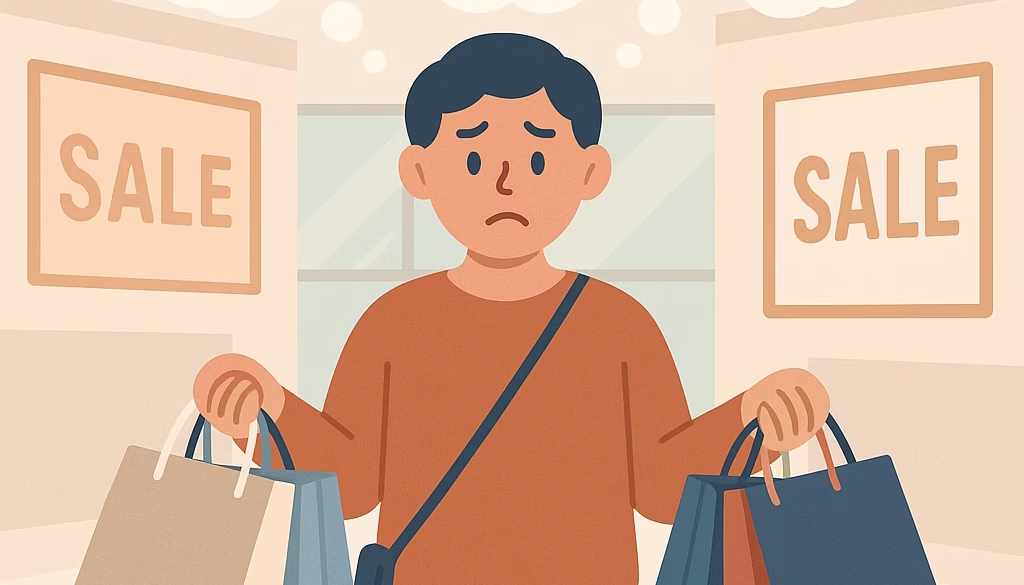
Now lets talk about the psychology of spending but first picturize the below seen for a moment.
Thank you for reading this post, don't forget to subscribe!
Picture this: It’s 11:47 PM on a Tuesday. You’re exhausted from another draining day, scrolling mindlessly through your phone in bed. Your thumb hovers over that “Buy Now” button for the third time this week—a face serum promising to solve all your skin problems, currently 50% off but only for the next 2 hours and 13 minutes.
Your logical brain whispers, “You already have skincare products you haven’t even opened.” But your tired, stressed brain screams back, “But what if this is THE one? What if I wake up tomorrow and it’s full price again? What if I miss out?”
Click. Purchase complete. Instant relief floods through you—for about 30 seconds. Then comes that familiar sinking feeling in your stomach. Its the basic example of the psychology of spending
Sound painfully familiar? You’re sitting in a club with millions of members, and trust me, none of us applied for membership.
Let me tell you about Rachel, a brilliant 29-year-old nurse I met last month. She sat across from me at a coffee shop, hands wrapped around her latte like it was anchoring her to reality. “I found seven unopened packages on my doorstep yesterday,” she said, shaking her head. “Seven. I don’t even remember ordering half of them. I felt like I was discovering evidence of crimes I’d committed in my sleep.”
Rachel’s story isn’t unique—it’s becoming the norm. We’re living through what I call the “Great Spending Awakening,” where millions of people are suddenly realizing their money seems to vanish into thin air, leaving behind a trail of regret and stuff they don’t really need.
But here’s what nobody talks about: this isn’t your fault. You’re not weak, undisciplined, or bad with money. You’re a human being with a very human brain, trying to navigate a world specifically designed to separate you from your cash.
The Uncomfortable Truth About The Psychology of Spending
Last week, I asked my newsletter subscribers a simple question: “What’s your biggest money shame?” The responses broke my heart. Hundreds of people confessing to secret purchases, hidden debt, and the crushing weight of financial regret they carry alone.
“I spent $340 on workout clothes last month. I haven’t been to the gym once.” – Sarah, 34
“I have 14 subscriptions I forgot about. FOURTEEN. That’s $127 a month just… disappearing.” – Mike, 41
“I bought a $200 planner to ‘get my life together.’ It’s still in the box three months later.” – Emma, 26
These aren’t isolated incidents. Americans are carrying over $4.2 trillion in consumer debt, and the average household now spends $1,986 more annually than they did just a decade ago, even when we account for inflation.
But here’s the kicker: we’re not becoming suddenly terrible at math. We’re being psychologically outmaneuvered by some of the smartest people on the planet.
Dr. Kit Yarrow, who studies consumer psychology at Golden Gate University, put it perfectly when she told me: “Today’s retailers aren’t just selling products—they’re selling feelings, identities, and solutions to problems you didn’t know you had. They’ve become emotional architects, and most of us don’t even realize we’re walking through their carefully designed maze.”
The Invisible Puppet Strings: What’s Really Controlling Your Spending
Your Brain on Shopping: The Dopamine Hijack
Let me paint you a picture of what happens inside your skull when you see something you want to buy. Your brain releases a flood of dopamine—the same chemical that makes chocolate taste amazing and makes people addicted to gambling.
But here’s the mind-bending part: you get the biggest dopamine hit not when you actually buy something, but when you think about buying it. The anticipation is literally more rewarding than the actual purchase.
This is why browsing Amazon at midnight feels so intoxicating. Your brain is essentially getting high off the possibility of acquisition, even if you never add anything to your cart.
Dr. Robert Sapolsky, a Stanford neuroscientist, explains it this way: “Your brain evolved to reward you for spotting potential resources. When our ancestors saw a fruit tree, dopamine flooded their system to motivate them to go get those calories. Today, that same system fires when you spot a ‘potential purchase’—and retailers have figured out exactly which buttons to push.”
Jennifer, a teacher from Portland, experienced this firsthand. “I used to spend entire evenings just browsing online stores,” she told me. “I called it ‘window shopping,’ but really I was getting addicted to that feeling of wanting things. The actual buying was almost… anticlimactic.”
The Emotional Spending Trap: When Shopping Becomes Self-Medication
Remember Rachel, the nurse with seven mystery packages? When we dug deeper into her spending patterns, we discovered something fascinating and heartbreaking. Her biggest splurges happened every Thursday evening—specifically, after her most challenging shift in the ICU.
“I never connected my spending to work stress,” she admitted. “I just thought I was rewarding myself for getting through another tough day. But looking back, I was literally trying to buy my way out of feeling overwhelmed.”
This is emotional regulation through consumption, and it’s epidemic. A Cornell University study tracked people’s emotions and spending habits for six months. The results were eye-opening: participants experiencing negative emotions spent 30% more money, even when those emotions had absolutely nothing to do with shopping.
But here’s where it gets really interesting: we don’t just shop to feel better. We shop to temporarily escape from feeling anything at all.
Dr. Tim Kasser, who’s spent decades researching materialism and well-being, explains: “Shopping provides a brief vacation from whatever emotional discomfort you’re experiencing. It’s not that people think buying things will solve their problems—it’s that buying things makes them forget about their problems, even if just for a moment.”
Meet David, a 35-year-old accountant who realized he was spending nearly $600 monthly on what he euphemistically called “stress relief purchases.” Energy drinks, gadgets, clothes he’d wear once. “I was medicating my anxiety with Amazon packages,” he laughs now. “It was the most expensive therapy I never realized I was getting.”
The Social Media Trap: When Everyone Else’s Life Becomes Your Shopping List
Social media isn’t just showing you photos—it’s rewiring your understanding of what a “normal” life looks like. Every perfectly curated Instagram post, every TikTok haul, every Pinterest board is quietly whispering: “This is what people like you should have.”
Your brain automatically calibrates these images as your reference point for normal. See enough people your age wearing $150 skincare routines, and suddenly your $30 drugstore moisturizer feels inadequate. See enough beautifully organized homes, and your perfectly functional space feels like a failure.
Dr. Rachel Calogero, a social psychologist at the University of West England, calls this “lifestyle inflation through social comparison.” Her research shows that people who spend more time on visual social platforms report higher levels of financial dissatisfaction, even when their actual financial situation hasn’t changed.
A University of Pittsburgh study followed 500 people for six months, tracking their social media use alongside their spending habits. For every additional hour spent on Instagram, TikTok, or Pinterest, participants spent an average of $203 more per month.
Marcus, a 28-year-old graphic designer, put it perfectly: “I didn’t realize I was getting a daily dose of advertising disguised as inspiration. Every scroll session was basically a masterclass in things I didn’t know I was supposed to want.”
The Convenience Revolution: Death by a Thousand Clicks
We’re living through the greatest reduction in purchase friction in human history. One-click buying. Face ID payments. Buy-now-pay-later options. Subscription services that auto-renew. Every innovation removes another barrier between wanting something and having it.
This might seem like pure convenience, but it’s psychologically devastating for impulse control. MIT research shows that people spend 12-18% more when using cards versus cash. Recent studies suggest contactless payments increase spending by another 5-10%. And buy-now-pay-later services? They increase purchase likelihood by up to 40%.
But it goes deeper than payment methods. The entire retail ecosystem has shifted toward what behavioral economists call “frictionless consumption.” Same-day delivery eliminates the waiting period that might change your mind. Pre-filled cart information removes the mental effort of entering payment details. Even package tracking gives you a dopamine hit before the item arrives.
Lisa, a marketing manager from Denver, described the moment she realized how much convenience was costing her: “I was tracking a package that I’d ordered literally 20 minutes earlier. I thought, ‘When did I become someone who needs instant gratification for things I don’t even really want?’ That’s when I knew I had to make some changes.”
The Marketing Mind Games: When Billion-Dollar Psychology Meets Your Wallet
Companies spend over $600 billion annually studying exactly how to trigger your spending impulses. They employ teams of neuroscientists, behavioral economists, and social psychologists. They know which colors make you buy faster (red creates urgency, blue builds trust), which words increase conversion rates (“limited time” boosts sales by 30%), and how to make you feel like you’re getting a steal even when you’re overpaying.
But the most sophisticated techniques are the ones you don’t even notice:
Anchoring: That $100 jacket marked down from $200 feels like a bargain, even if you’d never pay $100 for it originally. Your brain latches onto that first price as a reference point, making everything else seem reasonable by comparison.
Scarcity Manufacturing: “Only 2 left in stock!” often means they’re controlling inventory levels to create artificial urgency. Airlines do this constantly—show you that there’s “only 1 seat left at this price” when they actually have dozens available.
Social Proof Manipulation: “4,847 people bought this item in the last 24 hours” might be accurate, but it’s strategically displayed at the exact moment you’re most likely to convert. They know you’re on the fence, and they’re giving you a reason to jump.
Loss Aversion Triggers: “Your cart will expire in 15 minutes” activates your fear of losing something you don’t even own yet. Your brain treats potential losses as more painful than equivalent gains are pleasurable.
Tom, a software engineer, told me: “I started recognizing these tactics everywhere. Once you see the matrix, you can’t unsee it. That ‘limited time offer’ that’s been running for three months. The ‘free shipping on orders over $50’ when you only need something that costs $35. The email that arrives right when you abandon your cart. It’s all orchestrated.”
The Real Cost of Overspending (Spoiler: It’s Not Just the Money)
Before we talk solutions, let’s get honest about what overspending actually costs you. The financial damage is just the tip of the iceberg—the real costs run much deeper.
The Mental Load: When Money Stress Hijacks Your Brain
Every purchase you regret takes up precious real estate in your mind. Every credit card statement that makes your stomach drop drains mental energy you could be using for things that actually matter to you.
Dr. Sendhil Mullainathan’s groundbreaking research on the psychology of scarcity shows that financial worry literally reduces your cognitive capacity. When part of your brain is constantly managing money anxiety, you have less mental bandwidth for everything else—creativity, relationships, problem-solving, joy.
Amanda, a 38-year-old therapist, described it beautifully: “I realized I was carrying this constant low-level hum of financial anxiety. It was like background music I didn’t notice until it stopped. I was spending so much mental energy managing my spending regrets and figuring out how to pay for things that I had nothing left for the life I actually wanted to create.”
The Relationship Ripple Effect
Money is the leading cause of stress in relationships, but overspending creates a particularly toxic dynamic. It’s not just about the numbers—it’s about trust, communication, and shared values.
When you’re secretly ordering things online, hiding packages, or making purchases you know your partner wouldn’t approve of, you’re creating distance in your most important relationships. Even if they never find out about specific purchases, they can feel the stress and disconnection.
James and Maria, married for 12 years, almost divorced over spending issues. “It wasn’t about the money,” Maria told me. “It was about feeling like we were living parallel financial lives. James would get packages delivered that he’d ‘forgotten’ he ordered. I started feeling like I was married to a stranger.”
The good news? Once they started addressing the psychology behind their spending patterns instead of just arguing about dollars and cents, their relationship got stronger than it had been in years.
Future Self Sabotage: The Compound Cost of Impulse
Here’s some math that might make you pause: every $100 you spend on impulse purchases today could be worth $800-1,200 in retirement if invested wisely over 30 years. But the real cost isn’t just financial—it’s the freedom those future dollars would have bought you.
Every impulse purchase is a tiny vote for a future where you have less flexibility, fewer options, and more financial stress. It’s a decision to prioritize your current emotional state over your future self’s well-being.
But even more than the money, you’re trading away future possibilities. The career risks you can’t take because you need steady income to service debt. The relationships you might compromise because financial stress makes you irritable and distracted. The experiences you’ll miss because you’re too worried about money to be present.
The Erosion of Self-Trust
Perhaps most devastatingly, chronic overspending erodes your confidence in your own decision-making abilities. When you repeatedly make purchases you regret, you start to doubt your judgment in other areas too.
This creates what psychologists call “learned helplessness” around money. You begin to believe you’re just “bad with money” instead of recognizing that you’re fighting against sophisticated psychological manipulation designed by teams of experts.
Kelly, a nurse practitioner, put it perfectly: “I started feeling like I couldn’t trust myself around money. That feeling bled into other areas of my life. If I couldn’t make good choices about something as basic as spending, how could I trust myself to make good choices about my career, my relationships, my health? It was like I lost faith in my own judgment.”
Breaking Free: Science-Backed Strategies That Work With Your Psychology
Here’s the empowering truth: once you understand the psychological forces at play, you can work with them instead of against them. These strategies aren’t about willpower—they’re about designing your environment and habits to support your actual goals.
Strategy 1: The Enhanced 24-Hour Rule (Your New Best Friend)
The basic 24-hour rule is simple: wait 24 hours before making any non-essential purchase over $50. But here’s the upgrade that makes it bulletproof:
During the waiting period, write down exactly why you want the item, how you’re feeling right now, and what problem you think this purchase will solve. This engages your prefrontal cortex—the rational, planning part of your brain—and creates awareness around your emotional triggers.
Sarah, a marketing executive from Austin, swears by this technique. “I realized that 80% of the time, I was trying to buy my way out of feeling frustrated with my job. Once I saw the pattern, I started dealing with the actual problem instead of medicating it with purchases.”
How to implement this:
- Save items in your cart or take a photo of them in-store
- Set a phone reminder for 24 hours later with the question: “Do I still want this and why?”
- Write down your current emotional state: tired, stressed, excited, bored?
- Note what you hope this purchase will change about your life
- When the reminder goes off, reassess both the purchase and your feelings
Research from the Journal of Consumer Research shows this technique reduces regrettable purchases by 73%. But more importantly, it helps you understand your own patterns.
Strategy 2: True Cost Analysis (Time + Opportunity + Future)
Instead of thinking about purchases in terms of dollars, think about them in terms of time, opportunity cost, and future value. If you make $25 per hour after taxes, that $100 impulse buy costs you four hours of work. But let’s go deeper.
The Complete Cost Framework:
- Time Cost: How many hours of my life does this represent?
- Opportunity Cost: What am I not buying/saving/investing by choosing this?
- Future Cost: What could this money be worth if invested for 10/20/30 years?
- Joy Cost: Will this purchase bring me more happiness than those alternatives?
Jessica, a freelance writer, uses a smartphone calculator to run these numbers in real-time. “When I saw that the $300 boots would cost me 20 hours of work, prevent me from adding to my emergency fund, and could be worth $900 in my retirement account, they suddenly didn’t seem so appealing.”
But she takes it further: “I also ask myself, ‘What would bring me more joy—these boots, or the peace of mind of having a larger emergency fund?’ Usually, it’s the peace of mind.”
Strategy 3: Automate Your Good Intentions (Remove Willpower from the Equation)
The most effective way to save money is to make it automatic. Set up transfers to separate savings accounts for different goals right after you get paid, before you have a chance to mentally allocate that money to spending.
The Multi-Bucket System:
- Emergency fund (start with $500, build to 3-6 months of expenses)
- Investment account (even $25/month compounds significantly over time)
- “Fun fund” for guilt-free purchases (key: this prevents resentment)
- Specific goal funds (vacation, house down payment, etc.)
Michael, an engineer from Seattle, started with just $50 per paycheck going to savings. “I didn’t even notice it at first. But seeing those accounts grow gave me this incredible sense of control that I’d never felt before. Now I save $500 per month automatically, and my spending anxiety has basically disappeared.”
Pro tip: Time these transfers for 2-3 days after you get paid. This gives your brain time to register the income but not enough time to make spending plans with it.
Strategy 4: Create Strategic Friction (Make Spending Slightly Harder)
Make it just a little bit harder to spend money and you’ll spend significantly less. Research shows that even small amounts of friction can reduce impulse purchases by up to 40%.
Digital Friction Techniques:
- Remove all saved payment information from shopping websites
- Log out of shopping apps after every use
- Use browser extensions that add 10-second delays to purchases
- Move shopping apps off your phone’s home screen
- Unsubscribe from retailer email lists and text alerts
Physical Friction Methods:
- Use cash for discretionary spending categories
- Keep credit cards in a different room from where you usually browse online
- Write purchase amounts in a physical notebook before buying
- Shop with a predetermined list and stick to it
Emma, a teacher from Phoenix, implemented these changes gradually. “The first week was annoying because I had to keep entering my credit card info. But by week three, I realized how many purchases I was abandoning just because it took an extra 30 seconds. Those weren’t things I really wanted—they were just impulses.”
Strategy 5: The Gratitude Inventory Method (Love What You Have)
Before making any purchase, ask yourself: “What do I already own that serves this purpose or brings me similar joy?”
Keep a running “gratitude inventory”—a list, photo album, or even a dedicated Instagram account showcasing things you already own and love. When you’re tempted to buy something new, review this first.
Maria, a nurse from Chicago, takes this to the next level: “Before buying anything, I have to use something I already own but haven’t used in the past month. It’s incredible how much stuff I rediscovered. I found skincare products I’d forgotten about, books I never read, workout equipment gathering dust. I felt rich in my own home.”
She also implemented what she calls “gratitude shopping”: “When I feel the urge to buy something, I go through my closet or my kitchen and appreciate what I already have. I’ll put on an outfit I haven’t worn in a while, or cook with ingredients I’d forgotten about. It gives me that same dopamine hit without spending money.”
Strategy 6: Reframe Your Money Language (From Restriction to Intention)
The words you use to talk to yourself about money matter enormously. Your subconscious mind responds differently to restriction versus intention.
Instead of: “I can’t afford this” Try: “I’m choosing to use this money for my emergency fund”
Instead of: “I shouldn’t buy this” Try: “I’m investing this money in my future freedom”
Instead of: “I have to save money” Try: “I get to build wealth for my future self”
This isn’t just positive thinking—it’s reframing scarcity as abundance. You’re not missing out; you’re choosing something better.
Rachel, the nurse I mentioned earlier, said this shift was life-changing: “Instead of feeling deprived, I started feeling empowered. Every time I didn’t buy something, I felt like I was making a vote for the life I actually wanted instead of just reacting to whatever marketing message I’d encountered that day.”
Strategy 7: The 10-10-10 Future Self Rule
Before making any significant purchase, mentally transport yourself into the future and ask:
- How will I feel about this purchase in 10 minutes?
- How will I feel about it in 10 months?
- How will I feel about it in 10 years?
This temporal distancing helps you think beyond the immediate emotional state that’s driving the purchase. Your future self becomes a trusted advisor.
David, the accountant who was spending $600 monthly on stress purchases, uses this religiously: “I picture myself in 10 years looking back at this moment. Would future David thank me for buying this, or would he rather I had put the money toward something more meaningful? Usually, the answer is pretty clear.”
Strategy 8: The Values Alignment Check (Does This Match Who You Want to Be?)
Before any significant purchase, ask: “Does this align with my stated values and long-term goals?”
If you value experiences over possessions, that expensive gadget should trigger a red flag. If you value financial security, any debt-financed purchase should be questioned. If you value environmental sustainability, fast fashion should give you pause.
Create a simple values statement for yourself. Something like: “I value financial security, meaningful experiences, and environmental responsibility.” Keep it somewhere visible and reference it before purchases.
Advanced Strategies: Building Your Personal Spending Intelligence
Emotional Spending Trigger Mapping
For two weeks, track every purchase along with your emotional state. Rate yourself on a 1-10 scale in these areas:
- Stress level
- Energy level
- Happiness level
- Social connection level
- Work satisfaction level
Look for patterns. Do you spend more when stressed? When lonely? When tired? This data becomes your early warning system.
Lisa, a social worker, discovered she spent the most money on Sundays when she was dreading the upcoming work week. “Once I recognized the pattern, I could plan for it. Sunday became self-care day with free or cheap activities—hiking, calling friends, cooking. My Sunday spending dropped to almost zero.”
The 30-Day Want List (Your Desire Tracker)
Keep a running list of everything you want to buy. Review it monthly and cross off things you no longer want. You’ll be amazed how many “must-haves” become “why did I want that?” within a few weeks.
This technique works because it separates the desire from the action. You’re not denying yourself—you’re just creating space between wanting and having.
Kevin, a graphic designer, has been keeping a want list for two years: “I’d say 70% of the things on my list eventually get crossed off because I realize I didn’t really want them—I just wanted the feeling I thought they’d give me. The 30% that remain are usually things I genuinely value and end up loving.”
Environmental Design for Better Decisions
Your environment shapes your behavior more than willpower ever will. Design your spaces and digital life to support good financial decisions:
Physical Environment:
- Remove clutter that makes you feel like you need more stuff
- Create a dedicated space for reviewing finances and making purchase decisions
- Display visual reminders of your financial goals
- Keep a photo of your dream vacation or house where you’ll see it when tempted to buy
Digital Environment:
- Unfollow brands and lifestyle accounts that trigger spending urges
- Follow accounts focused on contentment, minimalism, or financial wisdom
- Use apps that show you your account balances before purchases
- Set up phone wallpapers that remind you of your goals
The Weekly Money Check-In (Your Financial Pulse)
Every Sunday, spend 15 minutes reviewing:
- What did I spend money on this week?
- How do I feel about those purchases?
- What triggered any regrettable spending?
- What did I do well with money this week?
- What’s one small improvement I can make next week?
This isn’t about judgment—it’s about awareness. You’re building your financial self-knowledge.
Building Your Support System: You Don’t Have to Do This Alone
Find Your Money Accountability Partner
Share your financial goals with someone you trust and respect. Research shows you’re 65% more likely to achieve a goal if you share it with someone, and 95% more likely if you have regular check-ins.
Choose someone who:
- Shares similar values around money
- Won’t judge your past mistakes
- Is comfortable having honest conversations
- Will celebrate your wins without encouraging overspending
Join Communities with Aligned Values
Surround yourself with people who normalize the financial behavior you want to develop. This might be:
- Online communities like r/personalfinance or r/financialindependence
- Local investment clubs or financial meetup groups
- FIRE (Financial Independence, Retire Early) communities
- Minimalism or intentional living groups
The goal isn’t to find perfect people—it’s to find people who are trying to be intentional about money instead of just reacting to every spending impulse.
Work with Professionals When Needed
If overspending is significantly impacting your life, don’t hesitate to seek professional help:
Financial Therapists help address the emotional and psychological aspects of money management. They’re trained in both therapy and financial planning.
Fee-Only Financial Planners can help create comprehensive strategies without trying to sell you products.
Therapists Specializing in Behavioral Issues can help with underlying emotional triggers, anxiety, or depression that might be driving overspending.
Remember: asking for help isn’t a sign of weakness. It’s a sign of wisdom.
The Neuroscience of Change: Why This Takes Time (And That’s Okay)
Your brain has literally carved neural pathways around your current spending habits. Every time you’ve made an impulse purchase, you’ve strengthened the neural connections that make it easier to do again. These aren’t character flaws—they’re learned patterns.
Building new habits means creating new neural pathways, which takes time and repetition. Neuroscientist Dr. Ann Graybiel’s research shows it takes an average of 66 days for a new habit to become automatic—not the 21 days often cited.
More importantly, your brain will resist change initially because it interprets any deviation from established patterns as potentially dangerous. This isn’t personal—it’s biology.
Be patient with yourself. You’re not just changing behaviors; you’re literally rewiring your brain. That takes time, compassion, and consistency.
When You Slip Up (Because You’re Human)
You’re going to make purchases you regret. That’s not failure—that’s being a human being with a human brain going up against billion-dollar psychology machines. Here’s how to handle setbacks with grace:
Don’t Catastrophize: One regrettable purchase doesn’t undo all your progress. It’s data, not a verdict on your character.
Analyze Without Judgment: What triggered this purchase? What were you feeling? What need were you trying to meet? This information helps prevent future slips.
Get Back on Track Immediately: Don’t let one impulse purchase become a spending spree. The next decision is always a fresh start.
Return What You Can: Many stores have generous return policies. There’s no shame in changing your mind.
Forgive Yourself: Self-compassion is more motivating than self-criticism. Treat yourself with the same kindness you’d show a good friend.
Learn and Adjust: What system or strategy might have prevented this? How can you strengthen your defenses for next time?
Remember: progress, not perfection, is the goal.
The Bigger Picture: What This Journey Is Really About
This isn’t really about money. It’s about freedom, intentionality, and reclaiming control of your life from forces that profit from your impulsiveness.
Every time you pause before a purchase, you’re exercising a form of quiet rebellion against a system designed to keep you spending. You’re choosing consciousness over automation, intention over impulse.
You’re also investing in a deeper relationship with yourself. Instead of being driven by external pressures and unconscious patterns, you’re learning to make choices that align with your actual values and long-term happiness.
This journey toward financial intentionality often becomes a gateway to intentionality in other areas of life. People who take control of their spending often find themselves making more deliberate choices about their time, relationships, career, and health.
Your Money, Your Rules, Your Life
The goal isn’t to become someone who never enjoys buying anything. It’s to become someone who spends money consciously, on things that genuinely add value to the life you want to live.
Some of the happiest, most financially successful people I know still make purchases others might consider frivolous. The difference? They make these purchases intentionally, as part of a broader plan that reflects their values and goals.
Jennifer, the teacher who used to find mystery packages on her doorstep, now has a completely different relationship with money. “I still buy things I want,” she says, “but now I buy them because I’ve decided they fit into my life, not because I’m trying to solve some emotional problem or because Instagram told me I needed them.”
She’s built a six-month emergency fund, increased her retirement contributions by 5%, and still has money for things she genuinely enjoys. Most importantly, she sleeps better at night and trusts herself around money.
Taking Action: Your Gentle Path Forward
Change doesn’t happen overnight, and it doesn’t require perfection. Start small and build momentum gradually.
Week 1-2: Choose one strategy that resonates with you most. Maybe it’s the 24-hour rule, or creating some digital friction, or starting a gratitude inventory. Commit to trying it consistently.
Week 3-4: Add one more strategy. Perhaps set up an automatic savings transfer or start tracking your emotional spending triggers.
Month 2: Begin implementing the reframing language and values alignment check. These mental shifts take time to feel natural.
Month 3: Add more advanced strategies like the want list or weekly money check-ins. Refine what’s working and adjust what isn’t.
Month 4 and beyond: This is when the changes start feeling less like strategies and more like natural parts of who you are.
Remember: the companies trying to get your money have teams of psychologists, unlimited marketing budgets, and decades of research on their side. Be patient and compassionate with yourself as you learn to navigate this landscape more intentionally.
Your future self—the one with less financial stress, more freedom, and genuine confidence in their financial decisions—is cheering you on every step of the way.
The Choice You Make Every Day
Every single day, you make dozens of small financial decisions. Each one is an opportunity to either reinforce old patterns or build new ones. Each one is a chance to vote for the kind of life you want to live.
The psychology of spending stops being your enemy once you understand it. It becomes a tool you can use to design a life that reflects your actual values instead of just your momentary impulses.
What kind of life are you going to choose?
What’s one spending trigger you recognize in your own life? Even just noticing the pattern is a victory worth celebrating. Start there, and remember—you’re not trying to become perfect. You’re just trying to become more intentional.
Resources for Continued Learning:
- Federal Reserve Consumer Credit Statistics – Track national consumer debt trends
- Bureau of Labor Statistics Consumer Expenditure Surveys – Average household spending data
- American Psychological Association Stress in America Reports – Annual stress and money research
- Journal of Consumer Research – Latest academic research on consumer psychology
- National Endowment for Financial Education – Free, research-based financial education resources
Recommended Tools:
- YNAB (You Need A Budget) for intentional spending planning
- Mint or Personal Capital for expense tracking
- Qapital or Digit for automatic micro-saving
- Various browser extensions for purchase delays
- Bank apps with automatic transfer capabilities
Remember: Small, consistent changes compound into life-changing results. Your financial future is built one conscious decision at a time.