AI Tools Every Creator Needs in 2026: Build Your Intentional Creator Stack
This isn’t a list of shiny AI tools. It’s a creator-tested system for working faster without losing your voice.
It’s 3 AM. You’re still editing that video you filmed six hours ago.
Your eyes hurt. Your back aches. And you’ve got three more pieces of content to finish before Friday.
I’ve been there. Staring at timelines. Drowning in tabs. Wondering if there’s a better way.
Here’s what I learned after burning out twice and rebuilding my entire workflow: AI tools every creator needs in 2026 aren’t magic bullets. They won’t make you creative. They won’t build your audience overnight.
But used right? They’ll give you back your energy.
The energy to actually think. To connect with your community. To create work that matters.
By the end of this guide, you’ll know exactly which AI tools for creators in 2026 to use, how to choose them without overwhelming yourself, and how to use them without losing what makes your work yours.
Let’s dig in.
How This List Was Chosen
Before we start, here’s how I selected these AI content creation tools:
Tools I use weekly or daily. Not things I tested once. Tools that survived real-world creator workflows for 12+ months.
Tools that save time without killing originality. If a tool flattens your voice into generic content, it’s not here.
Tools that will still matter in 12-18 months. I focused on fundamental capabilities, not flash-in-the-pan features that’ll be obsolete by summer.
Tools chosen for creators, not enterprises. You’re not managing a 50-person team. You need tools that work for solo creators or small teams.
According to Buffer’s State of Social Media report, 73% of marketers use AI tools in their content workflows—but most struggle with maintaining authenticity. This isn’t affiliate-driven. It’s workflow-driven.
Table of Contents
- Understanding AI Tools Every Creator Needs in 2026
- The Five Categories of Best AI Tools for Content Creators
- AI Tools Every Creator Needs at Different Stages
- A Simple Creator AI Workflow Stack (2026 Edition)
- Real Creator Workflows (How I Actually Use These Tools)
- All-in-One vs. Specialized AI Tools: What Creators Actually Need
- Simple Automation That Saved Me 10 Hours a Week
- AI Tools for Creators in 2026: What’s Coming Next
- What AI Tools Every Creator Needs Still Can’t Replace
- FAQ: Honest Answers About AI Tools for Creators
- Your Next Move
Understanding AI Tools Every Creator Needs in 2026
When people talk about the best AI tools for content creators, most lists are garbage.
They’re just affiliate link dumps.
“Here are 47 tools you absolutely must try!”
No. Stop. That’s not helpful.
Here’s the reality: You don’t need 47 tools.
You need maybe five. Seven max.
The right ones. Used consistently. Integrated into workflows that actually make sense.
What Changed in 2026
I started using AI tools for YouTubers and bloggers seriously in early 2024.
Back then? Everything felt experimental. Glitchy.
Two years later, things are different.
The tools matured. They actually work now. Reliably.
The workflows emerged. We figured out what works and what’s just noise.
The philosophy shifted. It’s no longer about replacing humans.
It’s about amplifying what makes us human.
Think of it this way: AI tools are like having an intern who never sleeps.
They handle the tedious stuff. The repetitive tasks.
You stay focused on strategy. Story. Connection.
Why Most Creators Get This Wrong
I see creators make the same mistake constantly.
They download every new AI app.
Spend hours watching tutorials.
Try to use everything at once.
Then they burn out harder than before.
Here’s what works instead: Start with one pain point. Just one.
For me, it was video editing. I was spending 8-10 hours per video.
I found one AI editing tool. Learned it deeply. Built it into my process.
That single change bought me back 6 hours per video.
Then I tackled the next pain point.
Slow and intentional beats fast and chaotic every time. <h2 id=”five-categories”>The Five Categories of Best AI Tools for Content Creators</h2>
After two years of testing, five categories emerged as essential.
Let me walk you through each one.
1. Research and Ideation Tools
What it helps with: Validating content ideas before you create them.
Finding what your audience actually wants.
Who it’s best for: Creators tired of guessing what will perform.
Anyone who’s created content that got crickets.
Real example: I thought my audience wanted advanced YouTube tactics.
Research tools showed they were searching “how to stay consistent with a full-time job” 12x more.
I pivoted. Engagement doubled.
Why it matters in 2026: In 2026, creators who can iterate ideas daily without creative fatigue will win—and validation tools make that possible.
You stop wasting time on content that won’t land.
Tools that work: AnswerThePublic shows real search queries.
SparkToro reveals what your audience actually reads and watches.
Even Google’s autocomplete is underrated if you use it systematically.
When NOT to use this: If you’re creating pure art or experimental content.
Some work doesn’t need validation. It needs expression.
2. Writing and Scripting Assistants
What it helps with: Organizing chaotic thoughts.
Beating blank page syndrome.
Reformatting content across platforms.
Who it’s best for: Writers who need structure help.
Creators who brain-dump ideas but struggle with organization.
Real example: I brain dump everything into voice notes while walking.
AI transcribes and organizes my rambling.
I rewrite it in my voice.
The AI organized my chaos—it didn’t write my content.
Why it matters in 2026: Creator sustainability means protecting your creative energy.
Writing assistants handle structural grunt work so you can focus on insights only you can provide.
What they handle well: Beat blank page syndrome.
Expand outlines. Reformat content. Catch unclear phrasing.
What they don’t do: Original insights. Personal stories.
Strategic positioning. Emotional nuance. That’s your job.
When NOT to use this: First drafts of deeply personal stories.
Let your raw voice flow first. Polish later.
3. Visual Content Creation Tools
What it helps with: Creating professional visuals without design skills.
Maintaining brand consistency across platforms.
Who it’s best for: Creators who can’t design but need scroll-stopping thumbnails, social graphics, and branded content.
Real example: My YouTube click-through rate improved 40% when I started using AI for thumbnail concepts.
I describe what I want. It generates options. I pick and customize.
Why it matters in 2026: Visual standards keep rising.
Audiences expect professional-looking content.
AI design tools democratize access to quality visuals.
The trick nobody talks about: Train the AI on your brand.
Feed it examples. Tell it your colors and typography.
Then every output feels cohesive.
Tools worth trying: Midjourney for creative imagery.
DALL-E for precise control.
Canva’s AI features for quick social graphics.
When NOT to use this: Brand identity development. Logo design.
Anything requiring deep strategic thinking about visual positioning.
4. Video and Audio Editing Automation
What it helps with: Removing technical editing drudgery.
Generating captions. Creating short-form clips from long-form content.
Who it’s best for: Video creators drowning in editing.
Podcasters who dread post-production.
Anyone spending 6+ hours editing per video.
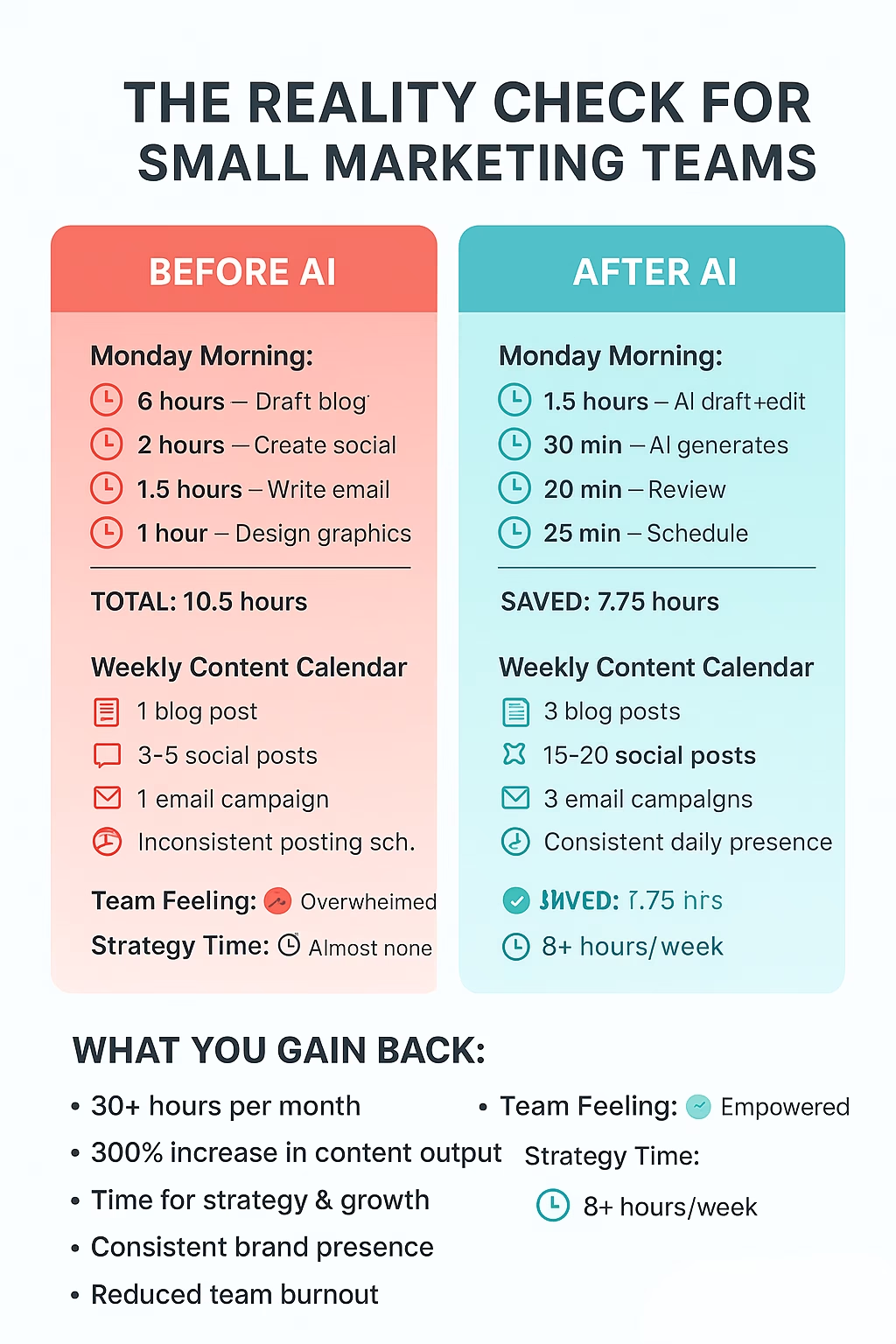
Real example: I went from 8 hours of editing per video to 2.5 hours.
AI removes filler words, generates captions, and identifies viral moments.
I handle creative decisions only.
Why it matters in 2026: The creators winning in 2026 are consistent, not perfect.
Editing automation lets you ship more often without sacrificing quality.
What I still handle: Pacing and rhythm. B-roll placement.
Emotional flow. Final quality check.
AI handles technical execution. I handle creative direction.
Popular options: Descript for transcription-based editing.
Opus Clip for repurposing long-form.
Adobe’s AI features keep improving.
CapCut is solid for mobile.
When NOT to use this: Highly stylized videos where every cut matters creatively.
Documentary-style content requiring precise narrative control.
5. Distribution and Repurposing Engines
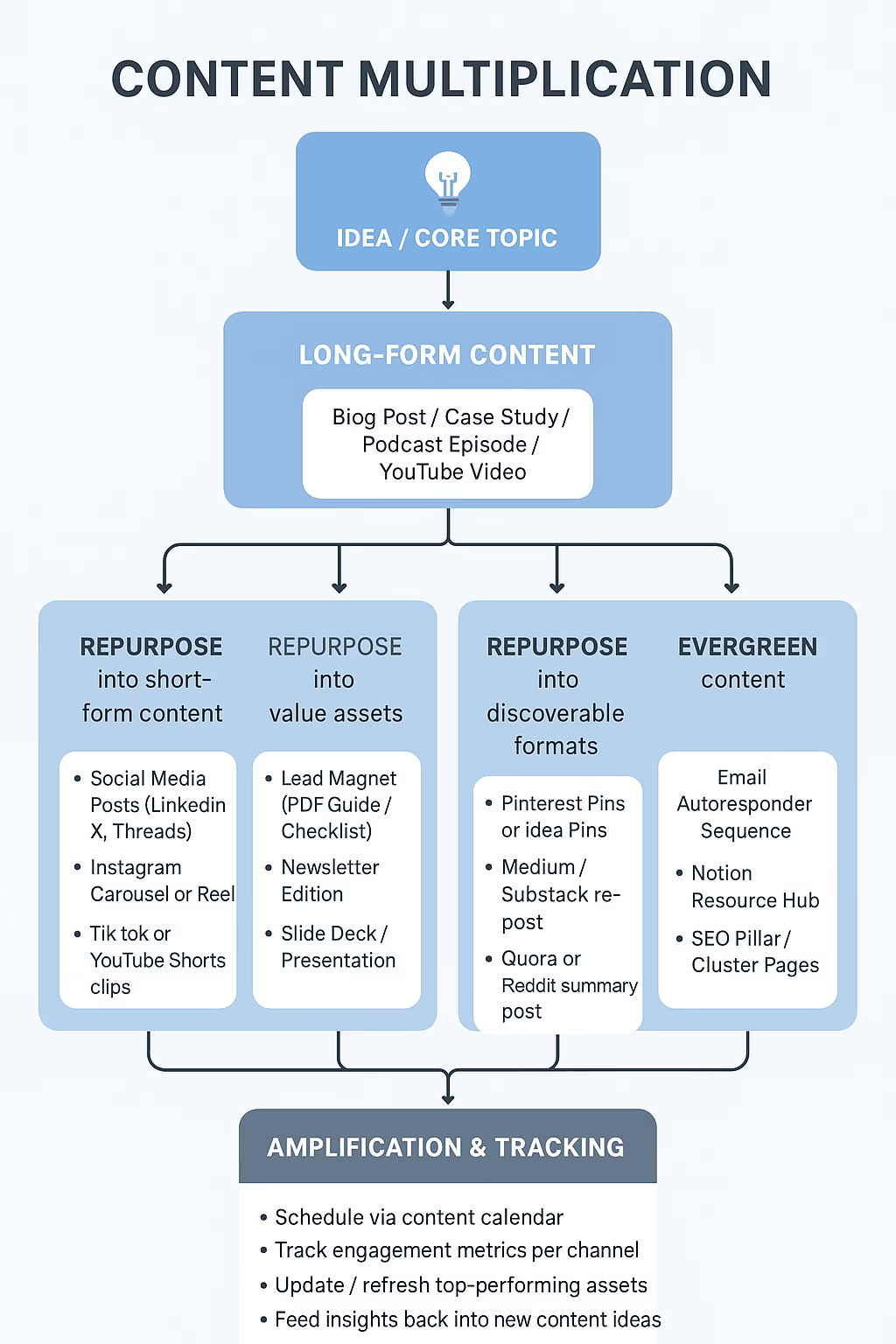
What it helps with: Turning one piece of content into platform-specific formats.
Maintaining cross-platform presence without multiplying workload.
Who it’s best for: Creators who know they should post on multiple platforms but can’t find the time.
Anyone feeling platform FOMO.
Real example: My weekly YouTube video becomes 15+ pieces automatically.
Vertical clips for TikTok. Quote graphics for Instagram. Newsletter content.
My reach increased 3x.
Why it matters in 2026: Attention is fragmented across platforms.
The creators who meet audiences where they already are will build faster.
My workflow: Create one pillar piece.
AI extracts moments, generates vertical versions, writes platform-specific captions, schedules everything.
One video. Zero extra filming.
Tools to explore: Repurpose.io for automation.
OpusClip for clip selection.
Buffer or Later for scheduling.
When NOT to use this: When a piece of content is platform-specific by nature.
Some content loses meaning when reformatted.
AI Tools Every Creator Needs at Different Stages
The best AI tools for content creators change depending on where you are in your journey.
Here’s what to prioritize at each stage.
Beginner Creators (0-1,000 Subscribers/Followers)
Your biggest challenge: Creating consistently while learning fundamentals.
Essential creator automation tools:
1. One all-in-one writing assistant (ChatGPT or Claude)
Use it to organize thoughts and overcome blank page syndrome
2. Basic visual creation tool (Canva with AI features)
Create professional-looking thumbnails and graphics without design skills
3. Simple video editor with AI (CapCut or Descript’s free tier)
Remove filler words and generate captions automatically
Cost: $0-40/month
Focus: Build consistency habits before optimizing workflows.
Don’t get distracted by advanced tools yet.
Consistent / Growing Creators (1,000-50,000 Subscribers/Followers)
Your biggest challenge: Maintaining quality while increasing output frequency.
Essential creator AI workflow:
1. Research and ideation tool (AnswerThePublic or SparkToro)
Validate ideas before creating to improve hit rate
2. Professional video editing AI (Descript or Opus Clip paid)
Save 5-8 hours per week on editing
3. Repurposing automation (Repurpose.io or OpusClip)
Turn one video into 10+ platform-specific pieces
4. Email/scheduling automation (ConvertKit + Zapier)
Automate distribution so you focus on creation
Cost: $100-180/month
Focus: Build a repeatable creator AI workflow that lets you ship faster without quality drops.
Full-Time Creators (50,000+ Subscribers/Followers)
Your biggest challenge: Scaling without losing your unique voice or burning out.
Essential AI tools for YouTubers and bloggers:
1. Predictive analytics tool (TubeBuddy or VidIQ with AI features)
Forecast content performance before creating
2. Specialized tools per content type
Best-in-class for video, audio, writing—whatever defines your brand
3. Advanced automation suite (Zapier Professional + multiple integrations)
Connect 5-7 tools into seamless workflows
4. Brand voice training (Custom GPT or fine-tuned model)
Train AI specifically on your style for faster, on-brand outputs
5. Team collaboration tools (Notion AI or Monday.com AI)
Coordinate with editors, assistants, collaborators
Cost: $250-400/month
Focus: Protect your creative energy for strategy and high-value creation.
Automate everything else ruthlessly.
A Simple Creator AI Workflow Stack (2026 Edition)
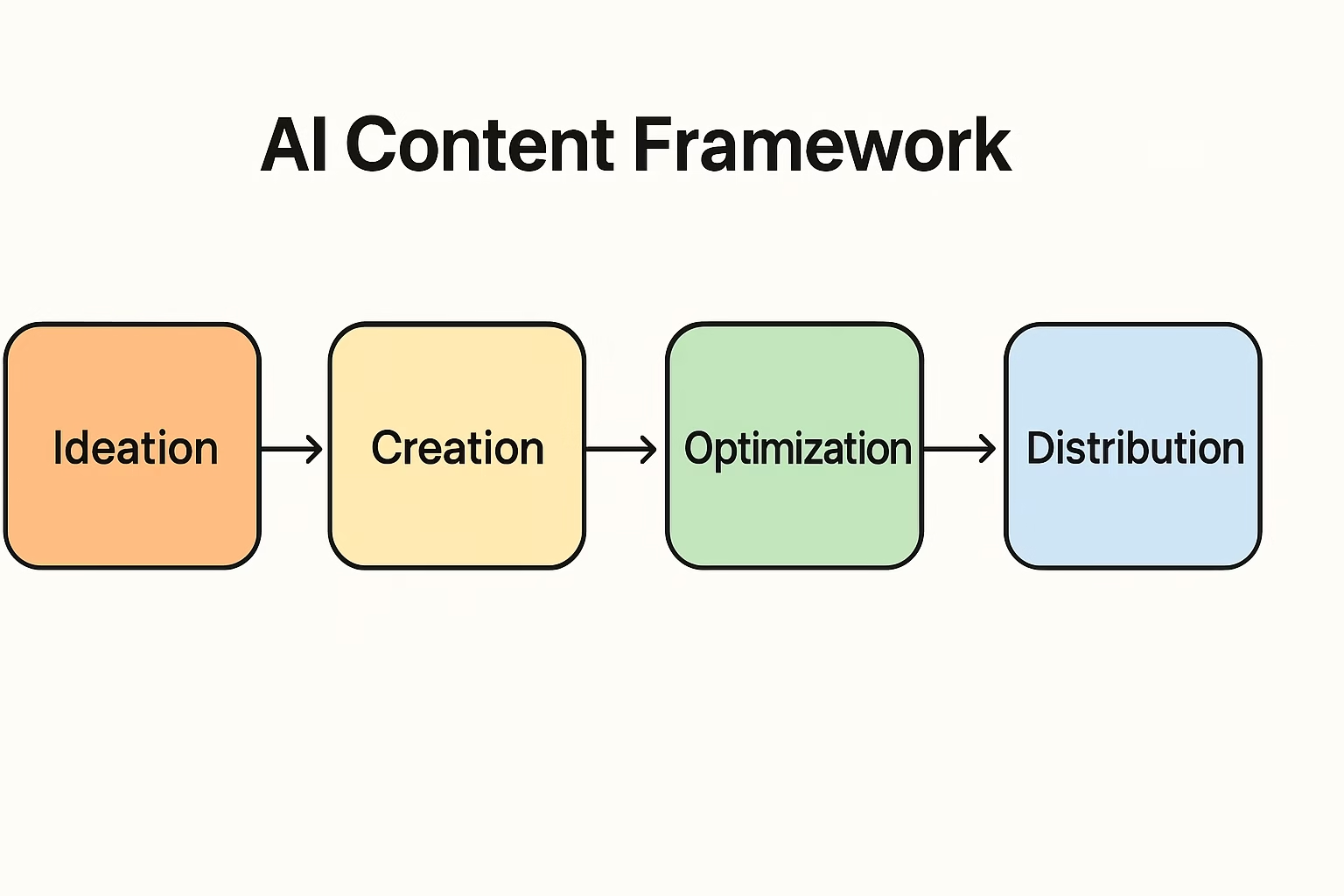
Here’s a minimal but complete stack covering ideation → creation → editing → publishing:
Research & Validation: AnswerThePublic or SparkToro
Find what your audience actually wants before creating
Writing & Organization: Claude, ChatGPT, or Jasper
Turn brain dumps into structured content
Visual Creation: Midjourney or Canva AI
Create scroll-stopping visuals without design skills
Video Editing: Descript or Opus Clip
Cut editing time by 60-70%
Distribution: Repurpose.io or Buffer
One piece of content → multiple platforms automatically
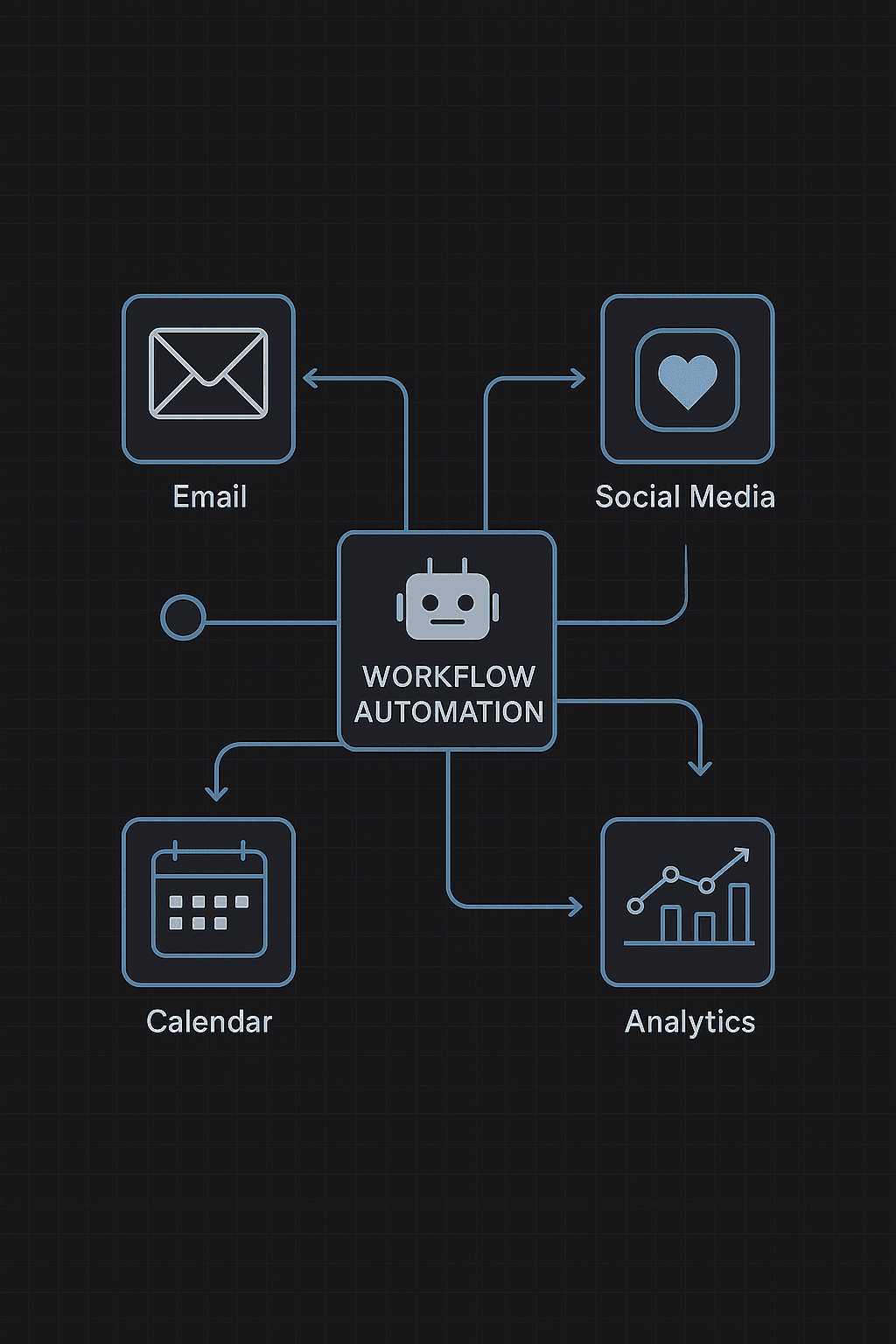
Bonus – Automation Glue: Zapier
Connect everything into seamless workflows
Total monthly cost: $100-200 depending on tier choices.
Time saved: 10-15 hours weekly once fully implemented.
The reality: You don’t need all of these immediately.
Start with whichever category solves your biggest pain point.
Real Creator Workflows (How I Actually Use These Tools)
Theory is nice. Let me show you my actual workflows.
My Monday: Newsletter Week
9:00 AM – AI research tool shows which past topics got highest engagement.
Not gut feeling. Data.
9:30 AM – Three potential topics emerge.
I pick the one I have the strongest personal angle on.
10:00 AM – Write first draft. No AI yet.
Just me and my stories. I establish voice first.
11:30 AM – Paste draft into AI writing assistant.
Prompt: “Tighten this. Flag unclear sentences. Keep my voice intact.”
12:00 PM – Accept maybe 60% of suggestions. Reject the rest.
1:00 PM – AI generates three headline options. I pick one and modify it.
2:00 PM – Final review.
AI suggests optimal send time based on past data.
Total AI involvement: 45 minutes.
Total creative control: 100% mine.
My Thursday: Video Production
Morning – Film 25-minute video.
Outline only. No script. Scripts make me sound robotic.
12:00 PM – Upload to AI editing tool.
It processes while I eat lunch.
1:00 PM – AI removed 4 minutes of “ums” and pauses.
Generated captions with 95% accuracy.
I spend 30 minutes fixing the 5% and adjusting pacing.
2:00 PM – Tool identifies seven potential clips.
Three are good. Two are decent. Two miss.
I approve the five worth using.
2:30 PM – AI generates vertical versions, platform-specific captions, thumbnail concepts.
3:00 PM – Review everything.
Adjust generic captions. Pick favorite thumbnail. Schedule.
Total editing time: 2.5 hours instead of 8.
Quality: Honestly? Better.
Because I spent energy on creative decisions, not technical drudgery.
My Real Mistake (So You Don’t Make It)
Six months ago, I tried to automate everything at once.
Signed up for 12 different AI tools.
Tried to build the “perfect” workflow.
Spent more time configuring tools than creating content.
Result? Published less. Stressed more.
My audience noticed the quality drop.
What I learned: Add one tool at a time.
Master it completely. Build it into your routine.
Then add the next one.
All-in-One vs. Specialized AI Tools: What Creators Actually Need
Should you use one platform that does everything?
Or separate tools that each do one thing really well?
I’ve tried both. Here’s what I learned.
| Factor | All-in-One Platforms | Specialized Tools |
|---|---|---|
| Best For | Beginners, tight budgets | Quality-focused pros |
| Learning Curve | Easy—one interface | Multiple tools to master |
| Monthly Cost | $20-60 | $100-250 combined |
| Quality Output | Good for 80% of tasks | Exceptional where it matters |
| Brand Consistency | Limited customization | Deep brand training |
| Integration | Built-in automation | Requires Zapier connections |
| Flexibility | Locked into one system | Can swap tools as needed |
What I Actually Use (The Hybrid Approach)
I use both. Strategically.
My all-in-one handles: Daily social posts, quick graphics, content scheduling, basic analytics.
My specialized tools handle: Weekly YouTube videos, newsletter automation, podcast editing.
Why this works: Bulk work happens on the all-in-one.
Content that defines my brand gets specialized treatment.
Cost: $40/month all-in-one + $120/month specialized = $160/month total.
What that buys: 15-20 hours back each week.
Better quality on signature content.
Consistent cross-platform presence.
Less than what I used to spend on coffee while stress-editing at midnight.
How to Choose Based on Where You Are
Just starting: Begin with one all-in-one platform.
Don’t overwhelm yourself.
Try platforms like Lately for social, or Descript for video.
Established: Identify your signature content format.
Invest in a specialized tool for that.
Keep everything else on your all-in-one.
Scaling a business: Build a specialized stack.
Each tool should be best-in-class.
Connect everything with automation.
The question to ask: “What content makes people choose me over someone else?”
That’s where you invest in specialized creator automation tools.
Everything else? Good enough is actually good enough.
Simple Automation That Saved Me 10 Hours a Week
Let me show you the single automation that changed my workflow.
It’s not complicated. You don’t need coding skills.
But it saves me 60-90 minutes every week.
The problem: Every Sunday, I publish a YouTube video.
I wanted to turn it into newsletter content.
But manually transcribing and reformatting took 90 minutes.
I kept procrastinating. My newsletter became inconsistent.
The automation:
WHEN I publish new YouTube video
  THEN YouTube sends video to transcription AI

  Transcription AI converts speech to text
  THEN sends text to writing AI

  Writing AI receives prompt:
    "Convert this transcript into 600-word newsletter.
     Keep conversational tone.
     Lead with main insight.
     End with thought-provoking question.
     Format in short paragraphs."

  Output goes to Google Docs

  SEND email notification:
    "Your newsletter draft is ready"
What this does: Every Sunday at 10 AM, this runs automatically.
By 10:15 AM, I have a newsletter draft waiting.
What I still do: Spend 20-30 minutes adding personal stories, adjusting tone, writing a better intro, choosing subject lines, final quality check.
Total time now: 30 minutes instead of 90.
Tools I used: Zapier connects everything.
YouTube API triggers it.
Descript handles transcription.
Claude or ChatGPT for writing.
Google Docs for storage.
Setup time: About 2 hours initially.
Mostly following step-by-step templates.
Was it worth it? I’ve saved 60 minutes weekly for 26 weeks.
That’s 26 hours total. More than three full workdays back.
Yeah. Worth it.
Other Automations I Use
Instagram Stories from YouTube: When I post a video, AI generates 5 story slides with key quotes and auto-posts them.
Saves 20 minutes weekly.
Blog post to social captions: When I publish a post, AI extracts key points and writes platform-specific posts.
Saves 30 minutes weekly.
Email welcome series: When someone joins my list, AI customizes their welcome sequence based on which lead magnet they downloaded.
Runs 24/7 without me.
Total time saved: About 10 hours per week.
That’s a part-time job’s worth of hours.
I use those hours for strategy, community engagement, and rest.
The work that actually matters.
AI Tools for Creators in 2026: What’s Coming Next
Most articles about AI content creation tools focus on what exists now.
Let me tell you what’s coming. And why it matters for your strategy.
Predictive Content Analytics
I started testing predictive AI tools four months ago.
They analyze your past content, audience behavior, and platform trends.
Then they forecast which ideas will perform before you invest time.
Real example: I had three video ideas ready.
My gut said produce the AI tools list first.
The predictive tool said the vulnerable personal story would perform 3x better with my specific audience.
I trusted the data. Published the vulnerable piece.
It became my highest-performing video in six months.
Why this matters in 2026: You stop guessing.
You create with confidence based on pattern recognition no human could match.
The limitation: These tools are maybe 70% accurate in my testing.
But 70% beats pure gut instinct.
Voice Cloning for Global Reach
This one feels like science fiction. But I’m using it right now.
I recorded my podcast in English.
AI cloned my voice and generated Spanish and Portuguese versions.
Same inflection. Same emotion. My actual voice pattern.
Ethical note: I only use this for my own content.
And I disclose it clearly to listeners.
The impact: My podcast reach expanded 40% overnight.
I’m reaching audiences I could never serve before.
Without recording everything twice.
Where this is headed: By late 2026, most creators will offer content in multiple languages through their own AI-generated voice.
Early adopters will own global markets.
Real-Time Collaborative AI
New tools let you and AI work in the same space simultaneously.
Like Google Docs, but your collaborator suggests ideas in real-time as you write.
How I’m using this: When I write scripts, the AI suggests alternative phrasings as I type.
Sometimes they’re better. Sometimes not.
But that instant feedback speeds up my thinking.
It’s less like using a tool.
More like bouncing ideas off a creative partner.
Where this fails: The AI can’t match human creative intuition.
It suggests safe choices. Predictable structures.
You still bring the weird, interesting angles.
Ethical Transparency Features
Platforms are building native disclosure tools.
Ways to automatically tag which parts of your content AI assisted with.
Why this matters in 2026: Five years from now, audiences will expect this.
Creators who build transparency habits now will have massive trust advantages.
What I’m doing: Testing disclosure formats in YouTube descriptions.
“AI-edited for pacing. AI-generated thumbnail concepts. Script and story 100% human.”
Engagement hasn’t dropped. Comments actually improved.
People appreciate honesty.
The Three Questions That Matter More Than Tools
As AI capabilities expand, three questions separate thriving creators from struggling ones:
1. Does this tool make me more me, or less me?
Bad AI tools flatten your voice.
Good ones amplify what makes you unique.
My test: If someone read my content without my name on it, would they still know it’s mine?
If not, I’m using AI wrong.
2. Am I building skills or building dependencies?
Using AI to handle editing? Smart delegation.
Using AI because you never learned to write clear sentences? Dangerous.
My rule: I only automate tasks I’ve already mastered manually.
Core skills stay sharp. Efficiency increases.
3. What happens when this tool disappears?
AI companies get acquired. Features change. Tools shut down.
If your entire business depends on one AI platform, you’re vulnerable.
My approach: Build processes, not dependencies.
Document workflows so I can switch tools if needed.
Own my audience on platforms I control—email and website.
What AI Tools Every Creator Needs Still Can’t Replace
Let’s talk about limitations.
Because if I only tell you what AI does well, I’m lying to you.
What AI Absolutely Cannot Do
Original reporting and research.
AI can summarize existing information brilliantly.
It cannot interview a source. Break a story. Uncover insights nobody else found.
Lived experience.
Every story I tell about burning out, rebuilding, failing publicly?
AI can’t manufacture that.
Your mistakes. Your breakthroughs. Your unique journey.
That’s your moat.
Strategic business decisions.
Should you launch a course or take sponsors?
Double down on YouTube or pivot to LinkedIn?
AI gives you data. You provide judgment.
Emotional intelligence.
Reading your community’s unspoken needs.
Knowing when to be vulnerable.
Understanding cultural context and timing.
Still completely human territory.
Long-term vision.
AI optimizes for patterns in existing data.
It tells you what worked before.
Visionary creators imagine what doesn’t exist yet.
Why This Is Actually Good News
As AI tools become universal, your human advantages matter more.
Not less.
Everyone will have access to the same AI tools.
What separates you?
Your taste. Your curation. Your unique perspective.
Your interpretation. Facts are free.
Your unique take on those facts? That’s valuable.
Your connection. People don’t follow content.
They follow people they trust.
My actual experience: The more I use AI tools, the more my human skills matter.
Strategic thinking. Storytelling. Authentic community engagement.
These skills appreciated in value. They didn’t depreciate.
The Creator Advantages in 2026
Curation over creation.
Any creator can pump out content.
Skilled creators curate ideas worth paying attention to.
That’s the new scarcity.
Connection over content.
AI-generated content is abundant.
Genuine human connection is still rare.
Context over information.
Information is free and infinite.
Context—why this matters for your specific situation—that’s valuable.
Taste over technique.
AI executes flawlessly.
It can’t develop editorial judgment.
FAQ: Honest Answers About AI Tools for Creators
Let me answer the questions I get asked constantly.
No corporate speak. Just real answers.
Are AI tools replacing creators in 2026?
No. But they’re changing what it means to be a creator.
AI tools handle execution.
Creators provide strategy, taste, and authentic connection.
The creators at risk aren’t being replaced by AI.
They’re being out-created by other humans who use AI strategically.
Think about photography.
When cameras became accessible to everyone, photographers didn’t disappear.
They evolved.
The ones who thrived focused on composition. Storytelling. Artistic vision.
Same thing happening now.
My prediction: In three years, using AI tools will be table stakes.
Like knowing how to use a camera.
What separates successful creators won’t be whether they use AI.
It’ll be how distinctively human their perspective remains.
How many AI tools does a creator really need?
Between 5-7 specialized tools. Or 2-3 all-in-one platforms.
More than that? You’re managing tools instead of creating content.
I had 14 subscriptions at one point.
My productivity actually decreased.
Less than 5? You’re probably doing manual work that could be automated.
The breakdown:
Writers: 3-4 tools (research, writing assist, grammar, distribution)
Video creators: 6-7 tools (research, scripting, editing, thumbnails, transcription, repurposing, analytics)
Multi-platform creators: 5-6 tools (one all-in-one + 2-3 specialized for signature content + automation connector)
My current stack: Six tools total. Three daily. Three weekly.
That’s my sweet spot.
What skills matter more than the best AI tools for content creators?
Four skills future-proof your creator career:
1. Strategic thinking – Deciding what to create and why.
Understanding your audience deeply.
No AI can build your unique strategy.
2. Storytelling fundamentals – Structure, pacing, emotional arc, narrative tension.
These principles are thousands of years old.
They worked in Ancient Greece. They work on TikTok.
They’ll work in 2030.
3. Audience psychology – Why does your specific community care?
What keeps them up at night?
AI can’t tell you this. Relationships do.
4. Business acumen – Monetization strategy. Positioning. Pricing. Partnership negotiation.
AI can’t negotiate your brand deals or decide your pricing.
My experience: The creators struggling with AI aren’t struggling because they don’t know which tools to use.
They’re struggling because they skipped fundamentals.
Master these four skills and you’ll thrive regardless of which AI tools dominate next year.
Can I build an audience using only AI-generated content?
Technically? Yes. Strategically? No.
You can generate endless content with AI.
But building an audience requires trust.
Trust comes from consistency. Vulnerability. Genuine expertise.
The successful creators using AI heavily do two things:
1. They add substantial human value – Original insights from experience.
Personal stories AI couldn’t know.
Contrarian takes.
Curated recommendations based on real testing.
2. They’re transparent – They don’t pretend AI content came purely from their brain.
This honesty builds trust.
What I’ve observed: Pure AI content might get views.
It won’t build a loyal community that buys from you.
Because people don’t buy from content.
They buy from people they trust.
How do creators use AI ethically in 2026?
Ethical AI use comes down to transparency and value-add.
Always disclose: AI-generated images, voices, or video.
Entire articles or scripts written primarily by AI.
Any content that could mislead without disclosure.
Optional but recommended: Using AI for editing and polishing.
AI-assisted research and outlining.
Repurposing workflows.
Never necessary: Grammar checkers. Spell check.
Basic scheduling automation.
The trend: Every platform is moving toward transparency requirements.
YouTube already requires disclosure for AI-altered content.
Other platforms will follow.
My approach: I disclose everything in YouTube descriptions.
“AI-edited for pacing and filler word removal. Thumbnail concepts AI-generated, customized by hand. Research AI-assisted. Script and storytelling 100% human.”
The response: Engagement stayed the same.
Comments actually improved.
People appreciate honesty.
The creators who hide AI use and get caught later?
Their trust tanks permanently.
Be transparent now. Build trust early.
When disclosure becomes mandatory, you’ll already have that credibility.
Your Next Move
Here’s the truth about AI tools every creator needs in 2026.
They’re not here to replace you.
They’re here to amplify what makes you irreplaceable.
The creators thriving right now aren’t the ones with the longest tool lists or the most sophisticated automations.
They’re the ones who protected their creative energy.
Who used AI to handle the tedious work so they could focus on what actually builds audiences: authentic perspective, strategic thinking, and genuine human connection.
Your First Step Tomorrow
Pick one category from this guide.
Choose one tool that solves your biggest time drain.
Not five tools. Not a complete overhaul. One tool.
My suggestion:
If video editing drains you most → start with editing AI
If research paralyzes you → start with ideation tools
If distribution overwhelms you → start with repurposing automation
Master that one tool completely.
Give it 30 days of consistent use.
Build it into your routine until it feels automatic.
Then add the next one.
You’re Still the Creator
AI tools won’t write your story.
They won’t decide your strategy.
They won’t build relationships with your community.
That’s still on you. That’s always been on you.
But they will give you time back. Energy back. Creative space back.
And in 2026, that might be the competitive advantage that matters most.
Start Creating
Now go build something worth sharing.
Which of these AI tools for YouTubers and bloggers would change your workflow the most?
Drop a comment. I read every one. And I actually reply.
Bookmark this—AI tools will change, but creator principles won’t.
I’ll update this guide as tools evolve, but the fundamentals of intentional tool use stay the same.
Want to dive deeper into creator strategies? Check out HubSpot’s Content Marketing resources for data-driven insights on what’s working right now. Or explore Neil Patel’s SEO and content guides for practical tactics you can implement today.
Go to Next Lesson:
How to Use AI for Blog Writing Without Losing Your Voice (A Real Creator’s Workflow)
Now that you’ve explored the essential AI tools creators use to speed up their workflow, the next logical question is:
How do you actually use AI to write blog posts without sounding robotic or generic?
Many creators start using AI for blog writing because it saves time—but they quickly worry about losing their unique voice or publishing content that feels artificial. The truth is that AI works best as a collaborative writing assistant, not a replacement for your perspective and experience.
In the next guide, you’ll learn a practical creator workflow for using AI in blog writing, including how to structure posts faster, edit AI drafts properly, and keep your personal voice intact while producing content more efficiently.
👉 Read next: How to Use AI for Blog Writing Without Losing Your Voice (A Real Creator’s Workflow)