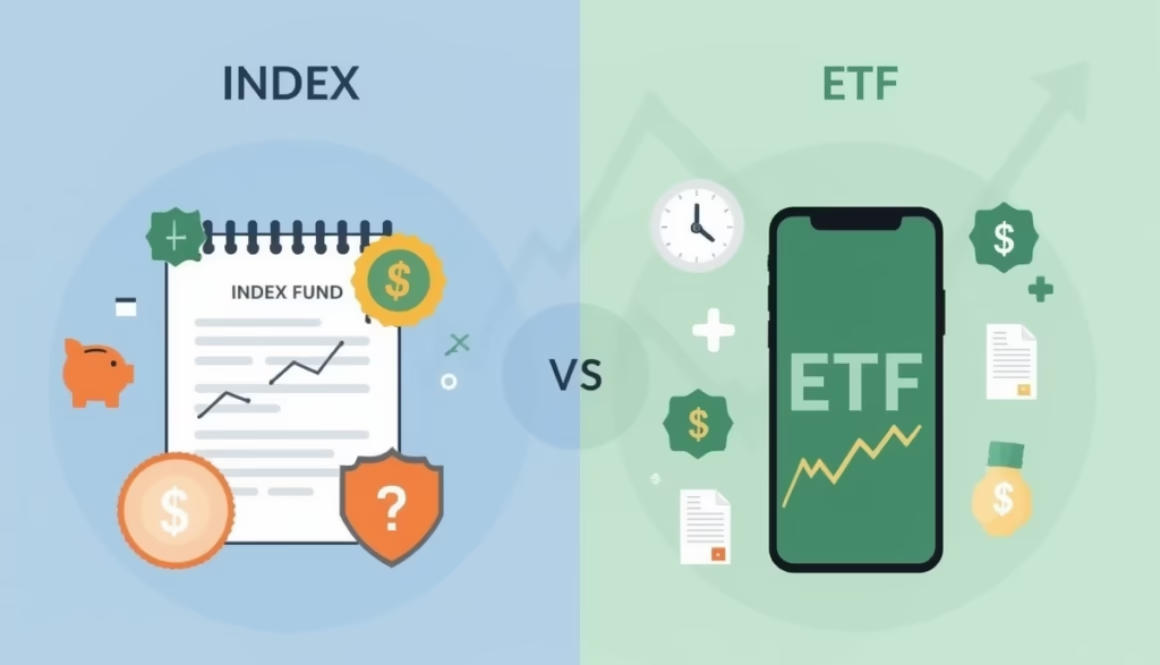
Index Funds vs. ETFs: Which Is Best for First-Time Investors?
So you’ve finally decided to start investing. Congrats! That’s a huge step.
But now you’re staring at your screen, completely overwhelmed. Everyone keeps throwing around terms like “index funds” and “ETFs,” and honestly? They sound pretty much the same. When you try to Google the difference between index funds vs ETFs, you get a thousand confusing articles that make your head spin.
I get it. I’ve been there.
Here’s what nobody tells you upfront: there’s no universal “right answer.” The best choice depends entirely on your situation—how much you’re starting with, whether you want to automate everything, and what kind of account you’re using.
This guide isn’t going to bore you with textbook definitions. Instead, I’m going to walk you through exactly what matters, show you real numbers (not vague percentages), and give you a simple five-question framework to figure out which option fits your life. By the end, you’ll actually know what to do next.
Let’s dive in.
What’s the Deal with Index Funds and ETFs Anyway?
Before we get into the whole index funds vs ETFs comparison, let me break down what these things actually are—without the Wall Street jargon.
Index funds are basically bundles of stocks. Instead of buying shares in just one company (like Apple or Tesla), you’re buying a tiny piece of hundreds or even thousands of companies all at once. They’re designed to copy a specific market index—think the S&P 500, which tracks 500 of the biggest U.S. companies.
When you buy an index fund, you purchase it directly from a company like Vanguard or Fidelity. The trade happens once per day after the market closes, and you pay whatever that day’s price is (called the “net asset value” or NAV). No drama, no minute-by-minute price watching.
ETFs (Exchange-Traded Funds) do basically the same thing—they track market indexes and give you that same instant diversification. The big difference? ETFs trade on stock exchanges all day long, just like regular stocks. You can buy and sell them whenever the market’s open, and the price bounces around constantly.
Here’s what they’ve got in common:
- You get instant diversification (one purchase = hundreds or thousands of companies)
- Both charge super low fees compared to those fancy actively managed funds
- Both are “passive” investments—they just follow an index instead of trying to outsmart it
- Both are perfect for beginners who want to invest long-term without stressing
The confusing part? Many companies now offer the same index in both formats. Like, Vanguard has a mutual fund version that tracks the S&P 500 (called VFIAX) and an ETF version (VOO) that tracks the exact same thing.
Yeah, it’s weird. But stick with me—I’ll help you figure out which one makes sense for you.
Related topic: 5 Powerful Reasons Investing in Yourself
The Real Differences Between Index Funds vs ETFs (The Stuff That Actually Matters)
Alright, let’s cut through the noise. Here are the differences that’ll actually affect your day-to-day investing life.
When You Can Buy and Sell Them
Index funds? You can only trade them once a day, right after the market closes. Whatever the closing price is, that’s what you get.
ETFs? You can trade them all day long while the market’s open, and the price changes constantly—just like buying a stock.
Now, here’s the thing. If you’re a beginner building long-term wealth (which you should be), this difference doesn’t really matter. You’re not day-trading. You’re not trying to time the market. You’re playing the long game.
But I’ll be honest with you—sometimes having too much flexibility is dangerous. When you can watch prices bounce around all day and trade whenever you want, it’s way too tempting to make emotional decisions. And emotional investing is how people lose money.
How Much You Need to Get Started
This is where things get interesting.
A lot of traditional index funds have minimum investments. We’re talking $1,000, $3,000, sometimes even more. When you’re just starting out and maybe only have a few hundred bucks to invest, that feels impossible.
ETFs? Most don’t have minimums beyond the cost of a single share. And with fractional share investing (which most major brokers now offer), you can literally start with $10 if you want.
Real example: Let’s say you want to invest in Vanguard’s Total Stock Market fund. The index fund version (VTSAX) requires $3,000 minimum. The ETF version (VTI) costs about $250 per share—or if your broker offers fractional shares, you could start with whatever you’ve got.
For beginners, this is huge. You don’t have to wait until you’ve saved up thousands of dollars. You can start today.
Index Funds vs ETFs: Fees & Costs
Both index funds and ETFs are cheap—that’s one of their biggest selling points. But let’s get specific.
The main fee you’ll pay is called the expense ratio. This is the annual percentage the fund company charges to manage your investment. For most broad market index funds and ETFs, you’re looking at somewhere between 0.03% to 0.20%. In real dollars, that’s $3 to $20 per year for every $10,000 you invest.
Not bad at all.
ETFs usually have slightly lower expense ratios—we’re talking a difference of maybe 0.01% or 0.02%. That’s not nothing over decades, but it’s also not game-changing.
Here’s the catch with ETFs: there’s something called a bid-ask spread. That’s the difference between what buyers are willing to pay and what sellers want. It’s usually just a few cents per share, but if you’re making lots of small purchases, it adds up.
Index funds don’t have that problem. You just buy at the day’s closing price, no spread to worry about. And most fund companies let you set up automatic monthly investments without any trading costs at all.
According to Fidelity’s research on fund costs, the real cost difference for most investors is minimal—what matters more is picking the investment you’ll actually stick with.
The Tax Thing Everyone Ignores (But Shouldn’t)
Okay, this is where ETFs really shine—but only if you’re investing in a regular taxable brokerage account.
ETFs are more tax-efficient than index funds thanks to something called the “in-kind creation and redemption process.” I know that sounds like gibberish, so here’s what it actually means:
When you own an index fund and other investors sell their shares, the fund manager sometimes has to sell stocks to pay them. When they sell stocks that have gone up in value, it creates capital gains taxes—and guess what? Those taxes get passed on to everyone who owns the fund, including you, even though you didn’t sell anything.
ETFs have a structural loophole that lets them avoid this problem most of the time. Vanguard’s analysis of ETF tax efficiency shows that ETFs distribute significantly fewer capital gains to shareholders.
But here’s the important part: This only matters in a taxable account. If you’re investing through a 401(k), IRA, or any other retirement account, you don’t pay taxes on gains until you withdraw the money anyway. So the tax advantage completely disappears.
Inside a retirement account, index funds vs ETFs are basically equal on taxes.
Setting It and Forgetting It (Automation)
Index funds make automatic investing ridiculously easy. You can tell your broker, “Take $200 from my checking account every month and buy shares of this fund.” Done. It happens automatically. Dividends get reinvested automatically. You literally don’t have to think about it.
ETFs? It’s more complicated. Some brokers let you set up automatic ETF purchases, but not all of them. And even when they do, you might need to buy whole shares (unless fractional shares are available). Dividend reinvestment usually works, but you have to make sure it’s turned on.
If your ideal investing style is “set it up once and never look at it again” (which, honestly, is the smartest approach for most people), index funds have a real advantage here.
Let’s Compare Everything Side by Side
I made you a table so you can see all the differences in one place:
| Feature | Index Funds | ETFs |
|---|---|---|
| When you can trade | Once per day at closing | Anytime during market hours |
| Minimum to start | Usually $1,000–$3,000+ | Price of 1 share (~$50–$500), or less with fractional shares |
| Expense ratios | 0.03%–0.20% | 0.03%–0.20% (often slightly lower) |
| Trading costs | None | Potential bid-ask spread (usually pennies) |
| Tax efficiency | Good | Better (especially in taxable accounts) |
| Automatic investing | Super easy | Depends on your broker |
| Dividend reinvestment | Automatic | Usually available but you have to enable it |
| Best for | Retirement accounts, automatic investors, larger starting amounts | Taxable accounts, small starting amounts, fractional investing |
Real Numbers: Let Me Show You the Actual Math
Enough with vague percentages. Let’s run through a real scenario with actual dollar amounts.
The scenario: You’re 25 years old. You’ve got $5,000 saved up to invest right now, and you can afford to add $300 every month going forward. You want to invest in an S&P 500 fund. Let’s compare the costs over 30 years.
Option A: Index Fund (Vanguard VFIAX)
- Starting investment: $5,000 ✓
- Expense ratio: 0.04% per year
- Trading costs: $0
- Set up automatic $300 monthly deposits
What it costs you on $5,000: $2 per year
What it costs when you’ve grown to $100,000: $40 per year
Option B: ETF (Vanguard VOO)
- Starting investment: $5,000 (about 11 shares at roughly $450 each)
- Expense ratio: 0.03% per year
- Bid-ask spread: about $0.02 per share per trade
- You make 12 manual purchases per year
What it costs you on $5,000: $1.50 (expense ratio) + about $0.24 (bid-ask spreads) = $1.74 per year
What it costs when you’ve grown to $100,000: $30 (expense ratio) + minimal spreads = about $30–$32 per year
So what’s the difference? The ETF saves you about $8–$10 per year on a $100,000 portfolio. Over 30 years, assuming 7% annual returns, you’d end up with roughly $1,500–$2,000 more with the ETF.
That’s real money. But here’s what I want you to really think about:
If the hassle of manually buying ETF shares every month causes you to skip even two or three months of investing because you forgot or got busy, you’ll lose way more than that $2,000 in potential returns.
Consistency beats cost optimization every single time.
Where You’re Investing Changes Everything (The Account Type Matters)
Most beginner guides completely skip this, but it’s actually super important. Let me break down how the index funds vs ETFs debate changes depending on what kind of account you’re using.
Retirement Accounts (401(k), Traditional IRA, Roth IRA)
Inside these accounts, you don’t pay taxes on your investment gains as they happen. With traditional accounts, you only pay taxes when you retire and withdraw the money. With Roth accounts, you never pay taxes on the gains at all (since you already paid taxes on the money before you put it in).
What this means: The tax advantage of ETFs completely disappears.
In a retirement account, it doesn’t matter whether you pick an index fund or an ETF. Choose whichever has lower fees and fits your investing style better.
Regular Taxable Brokerage Accounts
This is where the tax efficiency of ETFs actually matters.
Let’s say you invest $20,000 in a taxable account. Over 10 years, a traditional index fund might distribute $500 in capital gains because other investors sold their shares and the fund had to pay them by selling stocks. If you’re in the 15% capital gains tax bracket, that’s $75 in extra taxes you have to pay—even though you didn’t sell anything.
An ETF tracking the same index would probably distribute little to no capital gains, saving you that $75. And if you keep investing for 20, 30, or 40 years, those savings really add up—potentially thousands of dollars.
Bottom line: For taxable brokerage accounts, ETFs have a meaningful tax advantage. For retirement accounts, it’s a wash.
The 5-Question Framework: Your Personal Answer
Forget generic advice. Answer these five questions honestly, and you’ll know exactly which option is right for you.
Question 1: How much money are you starting with?
- Less than $1,000 → Go with an ETF (way lower barrier to entry)
- Between $1,000 and $3,000 → Either works (but check the specific fund’s minimum)
- More than $3,000 → Either works (you can afford most index fund minimums)
Question 2: What kind of account are you using?
- Retirement account (401k, IRA, Roth IRA) → Either works (tax benefits are equal)
- Regular taxable brokerage account → ETF wins (better tax efficiency matters here)
Question 3: How often will you be investing?
- Regularly (every month or paycheck) and I want it on autopilot → Index fund (automation is easier)
- Regularly but I’m fine doing it manually → ETF (slightly lower costs)
- Just one lump sum → Either works
Question 4: Does your broker offer commission-free ETF trades AND fractional shares?
- Yes to both → ETF (you get maximum flexibility with no extra costs)
- No to either one → Index fund (avoid the trading friction)
Question 5: Be honest—are you tempted to check prices and trade frequently?
- Yeah, maybe → Index fund (removes the temptation entirely)
- No, I’m committed to long-term investing → Either works
Your Answer
Choose an index fund if:
- You’re investing in a retirement account
- You want completely automatic, hands-off investing
- You’re starting with $3,000 or more
- You want to remove any temptation to trade emotionally
Choose an ETF if:
- You’re investing in a regular taxable account
- You’re starting with less than $1,000
- Your broker offers fractional shares and commission-free trading
- You want the absolute lowest expense ratios possible
Still can’t decide? Start with an ETF. It’s more flexible for most beginners, especially now that fractional shares and zero-commission brokers are common. You can always buy index funds later or switch as your portfolio grows. Don’t let perfect be the enemy of good enough.
Mistakes I See Beginners Make All the Time
Let me save you from the common pitfalls I’ve seen (and made myself).
Mistake #1: Getting paralyzed by expense ratios
Yes, fees matter. But the difference between 0.03% and 0.05% is literally $2 per year on $10,000. Don’t let a tiny fee difference stop you from investing or make you pick something that doesn’t fit your strategy.
Mistake #2: Buying way too many funds
You don’t need five different index funds. You don’t need an “aggressive growth ETF” plus a “value ETF” plus a “dividend ETF.” A single total stock market fund gives you exposure to thousands of companies. Keep it simple.
Mistake #3: Trying to time the market with ETFs
Just because ETFs let you trade all day doesn’t mean you should. The research is crystal clear on this: time in the market beats timing the market. Every. Single. Time.
Mistake #4: Ignoring which account type you’re using
Stressing about ETF tax efficiency inside a Roth IRA where it doesn’t matter? Or choosing an index fund for your taxable account when an ETF would save you money? Both are common mistakes that are easy to avoid.
Mistake #5: Not starting at all
This is the biggest one. Analysis paralysis is real. The worst mistake isn’t picking the “wrong” option in the index funds vs ETFs debate—it’s overthinking it so much that you never actually invest.
Both are excellent choices. Just pick one and start.
What About International Stocks and Bonds?
Everything we’ve talked about applies to international stock funds and bond funds too.
For international stocks, ETFs often have a tiny edge on expense ratios. Total international stock market ETFs usually charge around 0.06%–0.08%, while the mutual fund versions might charge 0.11%–0.15%. We’re talking small differences, but over decades with a large portfolio, it adds up.
For bonds, the differences are pretty minimal. Both index bond funds and bond ETFs are low-cost and tax-efficient. One quirk: bond ETFs can sometimes trade at small premiums or discounts to their actual value during volatile markets, which doesn’t happen with index funds. But for buy-and-hold investors, it’s not a big deal.
My advice: Use the same framework we’ve been talking about. If you’re building a classic three-fund portfolio (U.S. stocks, international stocks, and bonds), you can absolutely mix and match—maybe ETFs for your taxable account and index funds for your IRA. There’s no rule that says you have to pick one and stick with it everywhere.
Okay, So How Do I Actually Start?
You’ve made it through the complete comparison of index funds vs ETFs. Here’s what to actually do next:
Step 1: Open a brokerage account
Pick a broker with low fees and a good selection. NerdWallet’s broker comparison tool can help, but the big names like Vanguard, Fidelity, Charles Schwab, or Betterment (if you want a robo-advisor) are all solid choices. Most have $0 account minimums now.
Step 2: Choose your first fund
For most beginners, a total U.S. stock market fund is perfect. Some examples:
- Index funds: Vanguard Total Stock Market (VTSAX) or Fidelity Total Market (FSKAX)
- ETFs: Vanguard Total Stock Market ETF (VTI) or Fidelity Total Market ETF (ITOT)
These give you exposure to basically the entire U.S. stock market in one purchase.
Step 3: Make your first investment
Start with whatever you’re comfortable with. Even $100 is a real start. The most important thing is getting skin in the game. You can always add more later.
Step 4: Set up regular contributions
This is where the magic happens. Whether it’s automatic monthly investments (easiest with index funds) or calendar reminders to buy ETF shares, consistency is your secret weapon. Even $50 or $100 per month compounds dramatically over decades.
Step 5: Leave it alone
Seriously. Check your account maybe once a quarter if you really need to. Don’t panic when the market drops—it always does eventually, and those drops are actually opportunities to buy more shares at better prices.
The hardest part of investing isn’t picking the right fund. It’s resisting the urge to tinker and staying invested through the ups and downs.
So… Index Funds or ETFs for First-Time Investors?
After breaking down every angle, here’s my honest take: both are excellent choices, and your personal situation matters way more than any universal “best” answer.
The index funds vs ETFs debate isn’t really about finding a winner—it’s about finding the right fit for your life. ETFs give you lower barriers to entry, better tax efficiency in taxable accounts, and slightly lower costs. Index funds give you easier automation, no trading headaches, and remove the temptation to watch prices all day.
For most first-time investors in 2025, I’d lean slightly toward ETFs. They’re more accessible (thanks to fractional shares), more flexible, and more tax-efficient for the long haul. Plus, most major brokers now offer commission-free trading, which removes one of the old arguments against them.
But if you’re investing mainly through a 401(k) or IRA, or if you know yourself well enough to know you’ll thrive with completely automatic monthly investments you never think about, index funds are equally fantastic.
Here’s the real secret nobody wants to tell you: the best investment is the one you’ll actually make and stick with for decades. Pick one, start investing consistently, and let compound interest work its magic.
You’ve got this.