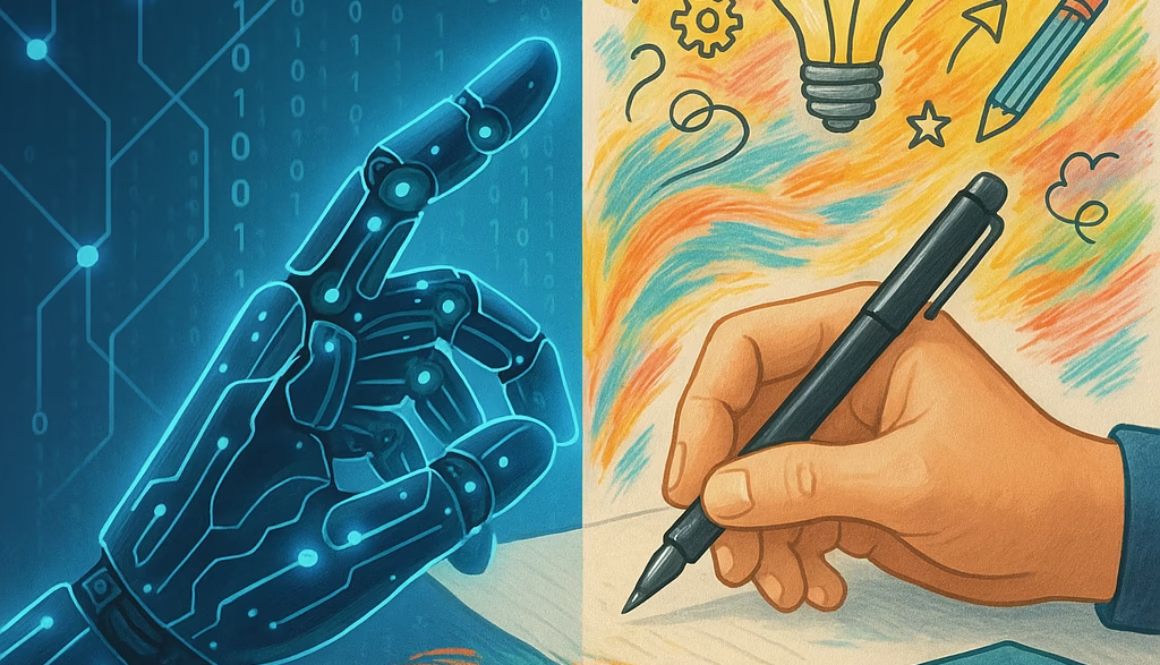
AI vs Human Creativity: Why I Stopped Fighting AI and Started Dancing With It
Look — AI vs. Human Creativity is not a battle, it is a partnership waiting to happen.
Let me tell you about the night that changed everything for me as a content creator.
It was 11:47 PM on a Tuesday. My coffee had gone cold hours ago, and I was staring at what had to be the most intimidating blank Google Doc of my career. The client brief was sitting next to my laptop, mocking me with its impossible deadline: “Comprehensive content strategy for product launch. Need it by Thursday.”
My brain felt like static. You know that feeling when you’ve been thinking so hard that your thoughts start running in circles? That was me. I’d been brainstorming for three straight hours and had exactly zero usable ideas to show for it.
Then, almost out of desperation, I opened ChatGPT.
Within thirty seconds, it had spit out five different angles for the campaign. Were they perfect? Hell no. But one of them—something about focusing on customer transformation stories—sparked something in my brain. Suddenly, I remembered my conversation with Sarah, a small business owner who’d told me how their product had literally saved her company during the pandemic.
That’s when it hit me: this wasn’t about AI replacing my creativity. It was about AI giving my creativity room to breathe.
The Great Creative Myth We’re All Buying Into
Here’s what nobody talks about in all these heated debates about artificial intelligence taking over creative jobs: we’ve been thinking about this completely wrong.
The internet is flooded with articles asking whether AI will kill human creativity. Marketing gurus are either declaring AI the death of authentic content or dismissing it as soulless robot gibberish. Meanwhile, actual creators—the people doing the work every day—are quietly figuring out something far more interesting.
We’re not in a war between humans and machines. We’re in a dance.
Think about it this way: when digital cameras emerged, photographers didn’t abandon composition, lighting, or storytelling. Instead, they gained a tool that freed them from the technical constraints of film development. The best photographers didn’t fight the technology—they mastered it and used it to push their creative boundaries further than ever before.
That’s exactly what’s happening with AI and content creation right now.
Where AI Actually Shines (And Where It Absolutely Doesn’t)
Let me be brutally honest about what AI can and can’t do, based on two years of working with it daily.
AI’s Superpowers: The Stuff That Used to Drain Your Soul
now lets take a look on the AI vs Human Creativity strengths
| AI Strengths | Human Strengths |
|---|---|
| Speed & Efficiency – Generates ideas, outlines, and drafts in seconds | Emotional Intelligence – Understands nuanced feelings and cultural context |
| Data Processing – Analyzes trends, keywords, and performance metrics instantly | Personal Experience – Draws from lived experiences and authentic stories |
| Pattern Recognition – Identifies successful content structures and formats | Intuitive Leaps – Makes creative connections that defy logical patterns |
| 24/7 Availability – Never gets tired, frustrated, or has creative blocks | Cultural Sensitivity – Understands timing, context, and audience nuances |
| Consistent Output – Maintains quality across large volumes of content | Risk-Taking – Willing to break rules and try unconventional approaches |
| Research Synthesis – Quickly compiles and organizes information from multiple sources | Brand Voice – Develops and maintains authentic, distinctive communication style |
| SEO Optimization – Suggests keywords and technical improvements efficiently | Quality Judgment – Knows when to ignore data in favor of creative instinct |
| Objective Analysis – Removes personal bias from performance evaluation | Storytelling – Transforms information into compelling narratives that resonate |
| Scalability – Handles multiple projects simultaneously without burnout | Ethical Oversight – Ensures content aligns with values and cultural sensitivity |
| Language Variation – Suggests multiple ways to express the same idea | Authentic Connection – Creates genuine rapport with specific audiences |
Research That Doesn’t Make You Want to Cry
Remember spending entire afternoons digging through Google search results, trying to find that one perfect statistic or example? AI can pull relevant information, identify trends, and even suggest sources in minutes. Last week, I asked Claude to help me research emerging social media platforms for Gen Z users. In ten minutes, I had a comprehensive overview that would have taken me three hours to compile manually.
Brainstorming Partner That Never Gets Tired
AI doesn’t have bad days. It doesn’t get frustrated when you ask for the fifteenth variation of a headline. It doesn’t judge your weird ideas or get impatient when you’re struggling to articulate what you want. Sometimes the best thing about AI is that it’s always ready to help you think through problems, no matter how scattered your initial thoughts might be.
Content Structure Without the Overwhelm
One thing AI excels at is taking your jumbled thoughts and organizing them into logical structures. I’ll often dump my random ideas into a prompt and ask it to help me see patterns or suggest how to organize everything. It’s like having a really good editor who can see the forest when you’re lost in the trees.
SEO Optimization That Doesn’t Feel Robotic
AI can analyze keywords, suggest semantic variations, and help you understand search intent without turning your content into keyword-stuffed garbage. The key is using it as a research tool rather than letting it write your actual content.
Where AI Falls Flat (And Always Will)
Personal Stories AI Can’t Fake
No AI system can replicate the story of how your grandmother’s apple pie recipe became the inspiration for your business, or how you felt the first time a customer told you your product changed their life. These experiences are uniquely yours, and they’re often what makes content truly memorable.
Cultural Nuance and Timing
AI might understand that certain words have different meanings in different contexts, but it doesn’t truly grasp why a particular phrase hits different when used by someone from Brooklyn versus someone from Birmingham. It doesn’t understand the subtle cultural signals that make content feel authentic to specific communities.
Intuitive Creative Leaps
Some of the best creative work comes from making connections that don’t immediately make logical sense. The ability to say “what if we approached this completely differently?” and then trust your gut about a direction that feels right but can’t be explained—that’s purely human territory.
Reading the Room
AI can analyze data about what content performs well, but it can’t sense the cultural moment we’re living in. It doesn’t know that your audience is feeling overwhelmed by productivity content right now and might respond better to something more vulnerable and authentic.
The Real Secret: It’s Not About Balance, It’s About Leadership
Here’s where most advice about human-AI collaboration gets it wrong. Everyone talks about “finding the right balance” between AI and human input, as if you’re trying to perfectly portion out responsibilities.
But that’s not how great creative work happens.
The secret is human leadership with AI amplification.
You—the human—set the vision, make the strategic decisions, and infuse the work with meaning. AI becomes your incredibly capable assistant, handling the tasks that drain your creative energy so you can focus on the stuff that only you can do.
My Current Creative Process (Messy But Effective)
Let me walk you through how I actually work with AI on a typical project, because the reality is messier and more interesting than most “systematic approaches” you’ll read about.
Monday Morning: The Chaos Phase
I start by dumping everything I know about the project into a conversation with Claude or ChatGPT. I’m not asking for perfect output—I’m thinking out loud with a really smart partner. I’ll share the client brief, my initial reactions, maybe some random ideas I had over the weekend. The AI helps me sort through this chaos and identify the most promising directions.
Tuesday: Research and Reality Check
This is where AI really shines. I’ll ask it to help me research competitors, find relevant statistics, identify content gaps in the market. But here’s the crucial part: I’m not just accepting what it gives me. I’m using it as a starting point for my own research. The AI might point me toward a trend I hadn’t considered, but then I’m digging deeper, finding the human stories behind the data.
Wednesday: Structure and First Draft
AI helps me organize my thoughts into a coherent structure. Sometimes I’ll even let it write a first draft based on our conversations, but only as a skeleton to build on. This draft usually reads like intelligent committee-speak—technically correct but completely soulless.
Thursday: The Human Magic
This is where I earn my keep. I rewrite everything in my own voice. I add the stories, the personal experiences, the specific details that make content feel real. I look for places where I can surprise the reader, challenge conventional thinking, or share something genuinely useful based on my own experience.
Friday: Polish and Optimization
Back to AI for SEO suggestions, readability improvements, and technical optimization. But even here, I’m selective. If an AI suggestion would compromise the authentic voice I’ve built, I ignore it.
The Psychology Behind Why This Actually Works
There’s fascinating research about how our brains respond to creative collaboration with AI, and it explains why this approach feels so natural once you get the hang of it.
When we’re stuck in pure creative mode, we often get trapped in what psychologists call “cognitive fixation”—we become so focused on our initial ideas that we can’t see alternatives. AI breaks us out of this tunnel vision by offering completely different starting points.
But here’s the interesting part: studies show that when humans edit and refine AI-generated content, we often produce work that’s more creative than what we would have created from scratch. The AI provides a creative scaffold that we can build on, modify, and transform into something uniquely our own.
Why Your Brain Loves Having an AI Creative Partner
Reduced Cognitive Load
When AI handles the basic structure and research, your brain has more capacity for the complex creative work—storytelling, emotional connection, strategic thinking. It’s like having someone else handle the grocery shopping so you can focus on creating an amazing meal.
Permission to Experiment
There’s something liberating about starting with an AI draft that you plan to completely rewrite anyway. It removes the pressure of making every word perfect from the beginning. You can be more experimental, more willing to try unconventional approaches.
Faster Iteration Cycles
Instead of spending hours perfecting a single approach, you can quickly explore multiple directions and see which ones resonate. This rapid iteration often leads to more innovative solutions than the traditional “think really hard and hope for inspiration” approach.
Real-World Examples: When Human-AI Collaboration Creates Magic
Let me share some specific examples of how this collaboration has played out in my work and the work of other creators I know.
Case Study 1: The Viral LinkedIn Post That Almost Wasn’t
My friend Marcus runs a small design agency. He was struggling to create content that would help him stand out in the crowded design space on LinkedIn. Every post he wrote felt generic, like something every other designer was already saying.
We decided to experiment with AI collaboration. Marcus used ChatGPT to research common pain points that small businesses face when working with designers. The AI identified several issues, but one stood out: clients who change their minds constantly during projects.
Here’s where the human magic happened. Instead of writing another “how to handle difficult clients” post, Marcus remembered a specific project where a client had requested 47 different logo variations. He turned that experience into a story about the hidden costs of indecision, using the AI research as supporting evidence but leading with his personal narrative.
The post got 15,000 views and landed him three new clients who specifically mentioned that they appreciated his transparency about the design process.
Case Study 2: The Newsletter That Saved a Struggling Startup
Lisa runs a sustainable fashion startup that was struggling to connect with customers. Her newsletters were getting low open rates and even lower engagement. She knew she needed to improve her content but felt overwhelmed by all the conflicting advice about email marketing.
Instead of trying to become a content marketing expert overnight, Lisa started using AI as a creative thinking partner. She would describe her customers’ problems and frustrations to the AI, then ask it to suggest content angles that might resonate.
But the breakthrough came when she stopped using AI suggestions directly and started using them as inspiration for her own stories. When AI suggested writing about “the true cost of fast fashion,” Lisa instead wrote about her own journey from shopping addict to conscious consumer, weaving in the data and statistics the AI had provided.
Her newsletter open rates doubled within two months, and her customer retention improved by 30%.
Case Study 3: The Blog Post That Changed Everything
This one’s personal. Last year, I was working with a productivity software company that was struggling to differentiate itself in an incredibly crowded market. Every angle we tried felt like something someone else had already covered.
I used AI to analyze successful content in the productivity space, looking for gaps and underexplored angles. The AI identified that most productivity content focused on systems and tools, but very little addressed the emotional aspects of productivity struggles.
That insight led me to interview actual users about their relationship with productivity apps. I discovered that many people felt guilty and frustrated when productivity systems didn’t work for them, but no one was talking about this emotional side.
The resulting blog post, “Why Productivity Apps Make You Feel Like a Failure (And What to Do About It),” became the company’s most-shared piece of content ever and directly led to a 25% increase in free trial signups.
The Dark Side: When AI Collaboration Goes Wrong
Let’s be honest about the pitfalls, because I’ve fallen into most of them.
The Template Trap
When you rely too heavily on AI-generated structures, your content starts feeling formulaic. I noticed this happening to my own work about six months ago—everything was starting to follow the same pattern because I was using similar prompts and accepting AI suggestions too readily.
This is exactly what researcher Ted Chiang warned about in his piece for The New Yorker, “A.I. Is Homogenizing Our Thoughts.” When everyone uses similar AI tools with similar prompts, we risk creating a kind of creative echo chamber where all content starts sounding eerily similar.
The solution was developing what I call “structural variety.” Now I intentionally ask AI for unconventional approaches: “How would a novelist structure this business case study?” or “What if we organized this like a recipe instead of a traditional how-to post?”
The Voice Homogenization Problem
This is probably the biggest risk of AI collaboration. If you’re not careful, your voice starts sounding like everyone else who’s using the same AI tools with similar prompts. The internet is already flooded with content that has that distinctive “AI-assisted” tone—polished but sterile, informative but forgettable.
The antidote is relentless personalization. I keep a document of phrases, stories, and perspectives that are uniquely mine. Whenever I’m editing AI-generated content, I actively look for places to inject these personal elements.
The Research Replacement Mistake
AI is incredibly good at summarizing existing information, but it can’t replace original research and thinking. I’ve seen creators become lazy about fact-checking, interviewing real people, or developing original insights because AI makes it so easy to compile existing knowledge.
The most successful content still comes from doing the work that AI can’t do: talking to real people, testing ideas in the real world, and bringing fresh perspectives to familiar topics.
Advanced Techniques: Getting More Creative With Your AI Partnership
Once you’re comfortable with basic AI collaboration, there are some more sophisticated approaches that can really elevate your work.
The Perspective Shift Method
Instead of asking AI to write about your topic directly, ask it to approach the subject from unusual perspectives. “How would a anthropologist write about social media marketing?” or “What would this look like from the perspective of someone who’s completely new to this industry?”
These perspective shifts often reveal angles you would never have considered on your own.
The Devil’s Advocate Approach
Use AI to challenge your own ideas. After you’ve developed your main argument or approach, ask the AI to identify potential counterarguments or weaknesses. This doesn’t mean you have to address every criticism, but it often leads to stronger, more nuanced content.
The Style Mimic Technique
This is ethically tricky territory, so use it carefully. You can ask AI to help you understand the structural elements that make certain writers effective, then apply those techniques to your own voice and content. For example: “What makes Malcolm Gladwell’s writing so engaging? How can I apply similar techniques to business content without copying his style?”
The Contrarian Research Method
Ask AI to find information that contradicts popular opinions in your field. This often uncovers interesting angles and helps you develop content that challenges conventional wisdom—which tends to be much more engaging than repeating what everyone else is already saying.
The Economics of Creative Collaboration
Let’s talk money, because that’s what really matters for most of us trying to make a living as creators.
Time Savings That Actually Add Up
Before I started working with AI, I estimated that research and first drafts took up about 60% of my content creation time. Now, those phases take maybe 20% of my time, which means I can either take on more clients or spend more time on the high-value work that clients really pay for—strategy, storytelling, and creative problem-solving.
But here’s the counterintuitive part: even though I’m “saving time” with AI, I’m actually spending more total time on each piece of content. The difference is that I’m spending that time on the parts that make content exceptional rather than just functional.
The Premium Positioning Opportunity
Clients are starting to specifically request creators who know how to work effectively with AI. It’s becoming a skill differentiator rather than a threat. The creators who can demonstrate thoughtful AI collaboration are often able to charge premium rates because they can deliver better results faster.
Quality at Scale Without Burnout
This might be the biggest economic advantage. With AI handling routine tasks, I can maintain high creative standards across more projects without the mental exhaustion that used to come with high-volume content creation.
Practical Systems: Making This Work in Your Daily Reality
Theory is nice, but let’s get into the nuts and bolts of actually implementing this approach.
Setting Up Your Creative Command Center
I’ve organized my AI tools like instruments in a band. Each one has a specific role:
- ChatGPT for brainstorming and conversational thinking-through-problems
- Claude for research synthesis and long-form content development
- Jasper for marketing copy when I need something with a specific promotional angle
- Grammarly (which has AI features) for final polish and tone adjustment
The key is not using them all for everything, but knowing which tool works best for which type of creative challenge.
The 3-Layer Editing Process
This is probably the most important tactical advice I can give you.
Layer 1: Structure and Logic (AI-Assisted) First pass is about organization, flow, and making sure all the pieces fit together logically. AI is excellent at identifying gaps in reasoning or suggesting transitions between ideas.
Layer 2: Voice and Personality (Human-Led) Second pass is where I rewrite everything in my own voice. This is where personal anecdotes get added, where I challenge conventional wisdom, where I make sure the content sounds like something I would actually say in conversation.
Layer 3: Audience Optimization (Collaborative) Final pass focuses on making sure the content will actually resonate with the intended audience. I use AI to help me think through potential reader objections or questions, but I make the final decisions about tone and approach based on my understanding of the audience.
Prompting Strategies That Actually Work
Most people’s AI prompts are terrible. They’re either too vague (“write a blog post about marketing”) or too restrictive (“write exactly 500 words about email marketing with three subheadings and a conclusion”).
Here are some prompting approaches that consistently produce better results:
The Context-Heavy Prompt Instead of just asking for content, I provide extensive context about the audience, the goals, the brand voice, and the specific challenge I’m trying to address. The more context you give AI, the more useful its output becomes.
The Iterative Conversation Rather than trying to get perfect output from a single prompt, I treat it like a conversation. I’ll ask for initial ideas, then refine based on what resonates, then ask for variations on the most promising concepts.
The Constraint-Based Prompt Sometimes the most creative solutions come from artificial constraints. “Write this as if you’re explaining it to your skeptical grandfather” or “Structure this like a mystery story where the solution is revealed at the end.”
The Psychology of Creative Collaboration (Why This Feels So Natural)
There’s something deeply human about creative collaboration, and AI partnerships tap into the same psychological patterns that make human creative teams effective.
Dr. Joel Chan and his colleagues at the University of Maryland have been studying what they call “meta-creativity”—the process of humans and AI working together to enhance creative output. In a recent Psychology Today article, “Meta-creativity: When humans and ai becomes collaborators“, they explain how this collaboration activates higher-order thinking skills that wouldn’t emerge from either humans or AI working alone.
The Beginner’s Mind Advantage
When you’re working with AI, you’re forced to articulate your ideas clearly and examine your assumptions. This process often reveals gaps in your own thinking or helps you discover connections you hadn’t noticed before.
It’s similar to the experience of trying to explain your work to someone outside your field—the act of explanation often leads to new insights.
Creative Confidence Through Safe Experimentation
One unexpected benefit of AI collaboration is that it gives you permission to try ideas that feel risky. Since you’re starting with AI-generated content that you plan to heavily modify anyway, there’s less pressure to make every initial idea perfect.
This psychological safety often leads to more experimental, innovative work.
The Compound Effect of Enhanced Creativity
The more you work with AI as a creative partner, the better you become at both using the tools effectively and recognizing your own creative strengths. It’s a skill that compounds over time.
There’s actually some fascinating research backing this up. A recent study on Designing Human and Generative AI Collaboration found that the most innovative outcomes happen when humans maintain creative leadership while using AI for computational support. The researchers discovered that creators who developed structured collaboration approaches consistently outperformed both pure AI generation and traditional human-only methods.
Industry-Specific Applications: How Different Creators Are Making This Work
Content Marketers
Sarah, who runs content marketing for a B2B software company, uses AI to analyze customer support tickets and identify common pain points that haven’t been addressed in their content yet. Then she interviews actual customers about these issues and creates content that directly addresses real frustrations.
The AI handles the data analysis and initial research, but Sarah’s interviews and storytelling make the content feel authentic and valuable.
Social Media Managers
James manages social media for a chain of local restaurants. He uses AI to analyze trending topics and suggest post ideas, but then he personally visits the restaurants, talks to staff and customers, and creates content based on real experiences.
His most successful posts combine AI-identified trends with authentic stories from the restaurant community.
Email Marketing Specialists
Maria runs email campaigns for e-commerce brands. She uses AI to analyze purchase data and suggest product recommendation flows, but then she crafts the actual email copy based on customer interviews and her understanding of the brand voice.
Her campaigns consistently outperform AI-only approaches because they feel personal and relevant rather than algorithmic.
Freelance Writers
Tom writes for multiple clients across different industries. He uses AI to quickly understand new industries and identify key topics, but his value comes from finding unique angles and adding insights that only come from years of writing experience.
His clients specifically hire him because he can deliver AI-enhanced efficiency with distinctly human creativity.
Common Mistakes That Kill Your Creative Mojo
Mistake #1: Treating AI Like a Magic Solution
AI won’t solve bad strategy, unclear messaging, or lack of audience understanding. If you don’t know what you’re trying to achieve or who you’re creating for, AI will just help you create more polished confusion.
Mistake #2: Editing Too Lightly
The biggest mistake I see creators make is taking AI output and just tweaking it around the edges. This usually results in content that feels almost human but not quite—which is often worse than content that’s obviously AI-generated.
If you’re going to use AI-generated content as a starting point, be prepared to rewrite extensively.
Mistake #3: Ignoring Your Instincts
AI is trained on existing patterns, which means it tends toward conventional approaches. If your instincts are telling you to try something completely different, trust them. The most memorable content often comes from breaking patterns, not following them.
Mistake #4: Forgetting About Your Audience
AI doesn’t know your audience the way you do. It doesn’t understand their inside jokes, their specific frustrations, or what makes them feel understood. Always filter AI suggestions through your knowledge of who you’re actually creating for.
The Ethics of Creative Collaboration (Yes, This Matters)
Transparency and Attribution
Should you tell your audience when you’ve used AI in your creative process? This is still an evolving question, but I lean toward transparency when it’s relevant. If AI played a significant role in research or ideation, I’ll often mention it briefly.
But here’s what I never do: I never publish content that’s primarily AI-generated, even if I’ve edited it. If AI contributed more than about 30% of the final content, I consider that crossing an ethical line.
The Originality Question
Using AI for creative work raises questions about what constitutes original content. My personal standard is that if I couldn’t recreate the core insights and perspectives without AI, then I haven’t done enough original thinking.
AI should enhance your creativity, not replace it.
Respecting Your Audience’s Intelligence
Readers can usually tell when content has been heavily influenced by AI, even if they can’t articulate exactly how. There’s a quality of generic helpfulness that AI-heavy content often has that feels unsatisfying to human readers.
The goal should always be creating content that feels genuinely valuable and authentic, regardless of what tools you used to create it.
Looking Forward: Where Creative Collaboration Is Headed
The Rise of AI-Native Creative Skills
We’re starting to see the emergence of creators who’ve grown up with AI tools and have developed sophisticated collaboration techniques from the beginning. These creators often produce work that seamlessly blends AI efficiency with human creativity in ways that feel completely natural.
Industry Differentiation Through Creative Process
I predict that in the next few years, creative professionals will increasingly differentiate themselves not just through their output, but through their creative process. Clients will want to work with creators who have developed sophisticated, effective approaches to human-AI collaboration.
The Authenticity Premium
As AI-generated content becomes more common, authentically human elements—personal stories, original research, unique perspectives—will become more valuable, not less. Creators who master the art of using AI to amplify these human elements will have a significant competitive advantage.
Your Personal AI Creative Collaboration Action Plan
Week 1: Experimentation Phase
Choose one piece of content you need to create this week. Try the basic AI collaboration approach: use AI for initial research and brainstorming, but do all the actual writing yourself.
Pay attention to:
- Which AI suggestions spark interesting ideas for you
- Where you feel the urge to go in a completely different direction
- What parts of the process feel most natural vs. forced
Week 2: Voice Development
Take a piece of AI-generated content (doesn’t matter what) and rewrite it completely in your own voice. Don’t just edit—rewrite from scratch using the AI content as inspiration only.
This exercise will help you understand the difference between your authentic voice and AI’s default style.
Week 3: Process Refinement
Develop your own workflow based on what you learned in weeks 1 and 2. What tools work best for you? At what points in the process is AI most helpful? Where do you do your best creative work?
Week 4: Quality Assessment
Compare your AI-collaborated content with content you’ve created using traditional methods. Look at engagement, feedback, and your own satisfaction with the work. Adjust your process based on what you discover.
The Bigger Picture: Why This Matters Beyond Content Creation
Preparing for an AI-Integrated Creative Economy
Whether we like it or not, AI tools are becoming standard in most creative industries. The creators who thrive will be those who learn to use these tools effectively while maintaining their unique creative identity.
This isn’t just about adapting to current technology—it’s about developing the skills to work effectively with whatever AI tools emerge in the future.
Democratization of Creative Tools
AI collaboration is making sophisticated creative techniques accessible to creators who might not have had access to them before. A solo entrepreneur can now produce content with the research depth and structural sophistication that used to require entire teams.
But this democratization only works if creators approach AI collaboration thoughtfully rather than using it as a shortcut to avoid doing creative work.
The Human Skills That Become More Important
As AI handles more routine creative tasks, certain human skills become more valuable:
- Cultural intelligence: Understanding what resonates with specific communities and why
- Emotional intelligence: Crafting content that creates genuine connections
- Strategic thinking: Knowing what problems are worth solving and why
- Storytelling: Turning information into narratives that people care about
- Critical thinking: Evaluating AI output and knowing when to ignore it
Building Your Creative Confidence in an AI World
Embracing the Learning Curve
Working effectively with AI as a creative partner is a skill that takes time to develop. Your first attempts will probably feel awkward, and you might question whether you’re doing it “right.”
There is no “right” way. The best approach is the one that consistently helps you create better content more efficiently while maintaining your authentic voice.
Developing Your Creative Intuition
The more you work with AI, the better you’ll become at recognizing which suggestions to pursue and which to ignore. This creative intuition is perhaps the most valuable skill you can develop.
Trust your instincts about what feels authentic and valuable. If an AI suggestion doesn’t resonate with you, there’s probably a good reason.
Finding Your Unique Collaboration Style
Every creator will develop their own approach to AI collaboration. Some prefer to use AI primarily for research and brainstorming, while others find it most valuable for structure and organization. Some creators like to start with AI-generated drafts, while others prefer to write first and use AI for editing and optimization.
The key is experimenting until you find the approach that enhances rather than constrains your natural creative process.
Conclusion: The Creative Future Is Already Here
Six months ago, I was skeptical about AI’s role in creative work. I worried that it would make content generic, that it would replace the human elements that make creative work meaningful, that it would turn all of us into glorified editors of machine-generated content.
I was wrong about all of that.
What I’ve discovered instead is that thoughtful AI collaboration actually makes room for more creativity, not less. When AI handles the routine work—the research, the structure, the optimization—I have more mental energy for the work that only humans can do: connecting with readers, telling stories that matter, and bringing fresh perspectives to familiar problems.
The creators who are thriving in this new landscape aren’t the ones who’ve mastered AI tools perfectly. They’re the ones who’ve learned to use these tools to amplify their uniquely human creative abilities.
This isn’t about becoming more efficient at creating generic content. It’s about having the time and mental space to create content that truly matters.
The choice isn’t between AI creativity and human creativity. The choice is between thoughtful collaboration and either stubborn resistance or lazy dependence.
Which path will you choose?
I’d love to hear about your own experiments with AI collaboration. What’s working? What isn’t? What have you discovered about your own creative process? Share your experiences in the comments—let’s learn from each other as we navigate this new creative landscape together.
And if you found this perspective useful, consider subscribing to my newsletter. I write weekly about the intersection of creativity, technology, and making a living as a creator in an increasingly AI-integrated world.