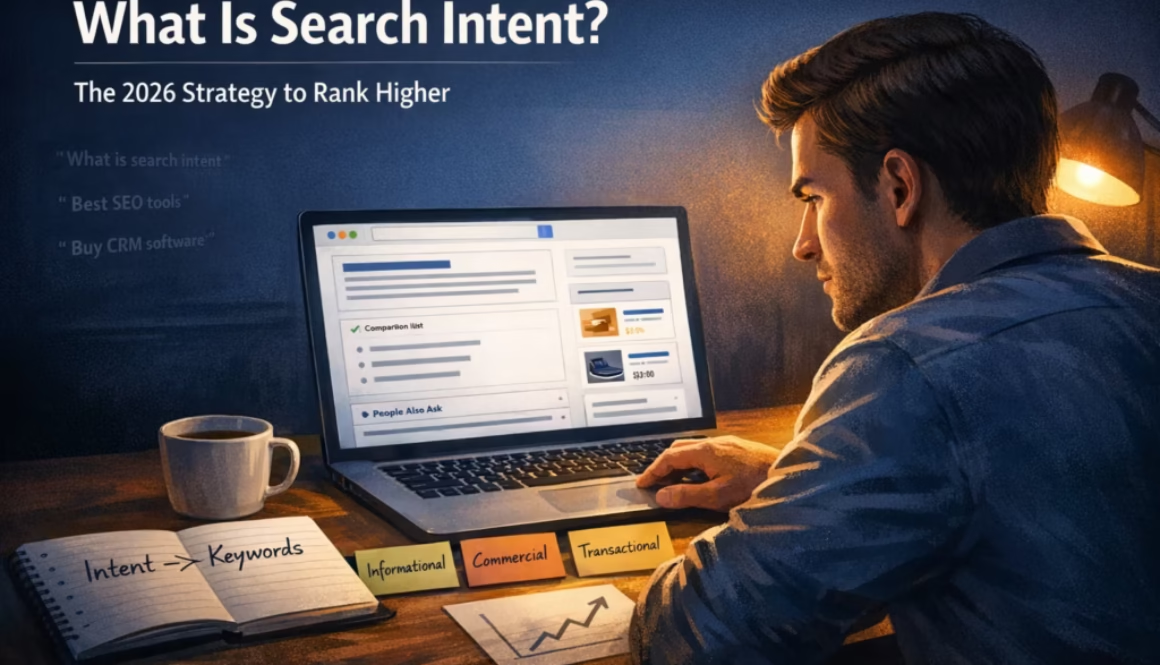
What Is Search Intent? The 2026 Strategy to Rank Higher by Matching Google’s Real User Intent
I still remember the moment I realized I’d been doing SEO completely wrong.
It was 2:47 AM. I was staring at Google Search Console, watching a blog post I’d spent three weeks perfecting sit at position 14. Not moving. Just… stuck there.
The backlinks were solid. I’d optimized every meta tag. The keyword density was textbook perfect. Hell, I even hired someone to proofread it twice.
And it was doing absolutely nothing.
That’s when I searched my own target keyword and actually looked at what was ranking. I mean really looked. And I felt like an idiot. My beautifully written 3,000-word deep-dive case study was competing against simple how-to guides and beginner tutorials. I’d written the wrong thing entirely.
Google didn’t care how good my writing was. It cared whether I was giving searchers what they actually wanted.
That night, I learned what search intent really means. And once I fixed that single mismatch, traffic jumped 600% in nine days.
What Is Search Intent? this guide is everything I wish someone had told me before I wasted months writing content for the wrong intent. You’ll learn what search intent actually is, why it’s become the make-or-break factor in 2026, and how to stop making the same mistake I did.
Let’s go.
Table of Content
- What Search Intent Actually Means (No BS Version)
- Why This Matters More Than Backlinks Now
- The 4 Types Everyone Talks About (With Real Examples)
- How I Actually Figure Out Intent (My Real Process)
- The Traffic Jump: What Happened When I Fixed One Page
- Questions People Keep Asking Me
- What To Do Right Now
What Search Intent Actually Means (No BS Version)
Search intent is just a fancy way of asking: “What does this person actually want?”
When someone types “running shoes” into Google, what are they looking for? Do they want to buy running shoes right this second? Are they trying to figure out which brand is best? Maybe they’re writing a school report about athletic footwear. Or they just want to know how running shoes are made because they’re curious.
Same two words. Four completely different intentions.
And here’s the thing that took me way too long to understand: Google has gotten scary good at figuring this out.
I used to think SEO was about matching keywords. Put “running shoes” on your page enough times, get some links pointing to it, and boom—rankings.
That hasn’t worked in years.
Google’s using AI systems now. RankBrain. BERT. The Helpful Content Update that destroyed half the internet in 2023. These aren’t just looking at words anymore—they’re analyzing what people do after they search.
Did someone click your result and immediately bounce back to Google? That’s a signal your content didn’t match what they wanted. Did they stay on your page for five minutes and then close their browser? Different story entirely.
Here’s what Google’s actually tracking:
User behavior after clicking your result
Are people sticking around? Reading? Scrolling? Or are they rage-clicking the back button within three seconds?
The specific words in the query
“Buy MacBook Pro” hits different than “MacBook Pro review” hits different than “how to choose a laptop.” Google knows this.
What’s worked before
If a million people searched “best pizza near me” and clicked on restaurant listings instead of recipe blogs, Google remembers that. Forever.
Context clues
Your location. Your device. What you searched five minutes ago. It all matters.
The technical term is “search intent.” But really, it’s just Google trying not to piss people off by showing them the wrong stuff.
And if your content doesn’t match? You’re invisible. I don’t care how many backlinks you have.
Why This Matters More Than Backlinks Now
I’m going to say something controversial.
In 2026, search intent matters more than backlinks.
Yeah, I said it. And yes, backlinks still matter—before you @ me in the comments. But I’ve seen too many pages with domain authority in the 20s outrank established sites with DA 60+ because they nailed the intent and the big sites didn’t.
Here’s another hot take: keyword research without intent analysis is completely outdated.
Most SEO tools still give you search volume, keyword difficulty, and related terms. Cool. But they’re solving a 2015 problem. They tell you what people search for, not what they actually want when they search for it. That’s the difference between data and insight.
Google’s not in the link-counting business anymore. They’re in the user-satisfaction business.
Let me show you why this shift happened.
Google’s Business Model Depends on You Being Happy
Google makes money from ads. People click ads when they trust Google’s results. If Google keeps showing you garbage, you’ll switch to… well, probably not Bing. But the threat exists.
So they watch everything. How long you stay on a page. Whether you scroll. If you bounce back trying other results—they call that “pogo-sticking.”
High pogo-stick rate = your content sucks for that query.
And Google will tank your rankings for it. I’ve watched it happen to my own pages. You rank okay at position 5, then slowly bleed to position 15 over three months as Google realizes people don’t like your result.
That’s the whole game.
The Data That Made Me Believe
Only 0.44% of searchers ever click to page two of Google.
Read that again.
If you’re ranking at position 11, you might as well not exist. You’re getting roughly the same traffic as position 87.
Position 11 is purgatory.
And the gap between position 3 and position 4? Massive. The gap between position 1 and position 3? Even bigger.
Position matters. And what determines position now isn’t just technical SEO or backlinks.
It’s whether people get what they wanted when they clicked your result.
AI Made This Even More Brutal
Google’s Helpful Content System launched in 2022. It’s specifically designed to punish content written for search engines instead of humans. And it’s gotten better at detecting that pattern every year.
If your content reads like you wrote it to rank instead of to help, you’re done. Google’s AI can detect SEO-first, user-second writing.
I know because I got hit in March 2024. Lost 40% of traffic overnight. Spent two months rewriting everything with intent first, keywords second.
Traffic came back. Lesson learned.
Intent Drives Conversions, Not Just Traffic
This is the part most people miss.
Getting traffic from the wrong intent is actually worse than getting no traffic at all.
If someone’s searching “what is CRM software” and lands on your CRM sales page, they’re not buying. They’re learning. They’ll bounce immediately, tank your conversion rate, and mess up your analytics.
But if someone’s searching “buy CRM software for small business” and lands on your comparison guide of the top 5 tools with pricing and trial links?
That’s money.
Here’s something most Western marketers miss: intent signals shift dramatically across global markets.
In mobile-heavy countries like India and Indonesia, voice search changes query patterns entirely. People ask full questions instead of typing keywords. “Which laptop is best for students under 30000 rupees” versus just “best student laptop.”
Different intent signals. Different content needs.
In markets where e-commerce trust is lower, transactional intent takes longer to develop. Someone in Brazil might research “best smartphones” ten times before feeling comfortable clicking “buy now.” The commercial research phase is extended.
And local language queries? They’re messy. Google’s intent detection for English is incredibly sophisticated. For Tamil or Swahili? Still catching up. There’s opportunity there if you understand the gap.
Matching intent means matching the buyer journey stage. When you do that, conversions skyrocket because you’re meeting people exactly where they are.
I’ve seen conversion rates triple just from fixing intent mismatches. Same traffic. Same product. Different content format.
The 4 Types Everyone Talks About (With Real Examples)
Okay, so there are four main types of search intent. Every SEO blog will tell you this. They’re not wrong.
But where everyone screws up is treating these like rigid categories. Real searches are messier than that. Sometimes a keyword has mixed intent. Sometimes Google’s interpretation shifts over time.
Still, understanding these four buckets helps. A lot.
1. Informational Intent
Someone wants to learn something. That’s it. They’re not buying. Not comparing. Just researching.
Most Google searches are informational—probably 70-80% of all queries.
Common patterns:
- Questions (how to, what is, why does, when should)
- Definitions and explanations
- Tutorials and guides
- “Tips for” or “ways to” type stuff
Real examples I’ve targeted:
- “How to identify search intent” ← Tutorial
- “What causes my phone to overheat” ← Explanation
- “Difference between SEO and SEM” ← Clarification
What works: Blog posts. How-to guides. Videos. The format matters less than whether you answer the question clearly.
What doesn’t work: Product pages. Sales pitches. Anything that tries to sell before teaching.
I learned this the hard way trying to rank a landing page for “what is marketing automation.” Yeah, that flopped. People wanted a definition, not a demo form.
2. Navigational Intent
Someone knows exactly where they want to go. They’re using Google as a shortcut instead of typing the URL.
Patterns:
- Brand names
- “Login” or “sign in” searches
- “[Company name] official site”
Examples:
- “Facebook login” ← They want to log into Facebook
- “Ahrefs blog” ← They want Ahrefs’ blog specifically
- “Amazon Prime” ← They want Amazon’s Prime page
What works: Your actual branded pages. Homepage. Login page.
What doesn’t work: Trying to rank for someone else’s brand.
You can’t do much with navigational intent unless it’s your brand. And if it is your brand and you’re not ranking? Your technical SEO is broken.
3. Commercial Intent (The Research Phase)
This is my favorite because it’s where buying decisions happen.
Commercial intent means someone knows they want to buy something eventually, but they’re still figuring out what. They’re comparing. Researching. Reading reviews.
This is NOT the same as transactional intent. That’s the confusion that cost me thousands in wasted ad spend once.
Patterns:
- “Best [product]”
- “Top [service]”
- “[Product] review”
- “vs” or “versus” comparisons
- “[Product] alternatives”
- “Affordable [category]”
Real examples from my own content:
- “Best keyword research tools for beginners” ← Comparison/listicle
- “Semrush vs Ahrefs” ← Head-to-head comparison
- “Shopify alternatives for dropshipping” ← Research intent
The difference from transactional: Commercial intent: “Which one should I choose?”
Transactional intent: “Where do I buy this specific thing?”
What works: Comparison articles. Listicles. “Best of” roundups. Product reviews. Buyer’s guides. Anything that helps someone make an informed decision.
Include pros and cons. Real pricing. Screenshots if possible. Be honest about limitations—it builds trust and actually converts better than hype.
What doesn’t work: Generic product descriptions. Sales pages without comparison context. Anything that feels like a hard pitch before helping them decide.
I’ve got a comparison guide that ranks #2 for a commercial intent keyword. Converts at 8%. My old product page for the same keyword? Ranked #8, converted at 0.3%.
Same visitors. Different intent match. 27x conversion difference.
4. Transactional Intent
This is go-time. Credit card out. Ready to buy, sign up, download, book, whatever.
Transactional searches are gold because these people have already decided. They just need to complete the action.
Patterns:
- “Buy [product]”
- “Order [service]”
- “[Product] price”
- “Download [software]”
- “Sign up for [service]”
- “Coupon” or “discount” or “deal”
- Specific product names with buying modifiers
Examples:
- “Buy iPhone 15 Pro Max” ← Ready to purchase
- “Book hotel in Tokyo” ← Ready to reserve
- “Subscribe to Netflix” ← Ready to sign up
- “Download Adobe Photoshop trial” ← Ready to get it
What works: Product pages. Pricing pages. Landing pages. Checkout flows. Anything that removes friction from completing the purchase.
Make your CTA obvious. Show trust signals like reviews, guarantees, secure payment badges. Don’t distract them with blog content—they’re ready now.
What doesn’t work: Long educational content. Comparisons (they already compared). Anything that delays the conversion.
One thing that surprised me: transactional intent pages should be short. I used to think more content = better SEO. But for “buy X” queries, Google wants clean, fast pages that get people to checkout. My best-converting transactional pages are under 500 words.
How I Actually Figure Out Intent (My Real Process)
Forget the tools for a second. I’m going to show you exactly how I analyze intent, step by step, the way I actually do it—not the way I’d explain it in a webinar.
Step 1 – I Google The Damn Thing
Seriously. That’s step one.
I open an incognito window (so my search history doesn’t mess with results), and I type in the exact keyword I want to rank for.
Then I just… look.
What’s ranking? What format is it? How long does the content seem? What angle are they taking?
This sounds too simple, but it’s the most reliable method I know. Google has processed millions of clicks for this keyword. The SERP is literally Google telling you what works.
What I’m looking for:
Are the top results blog posts? Product pages? Videos? Listicles?
Are they short and punchy or long and comprehensive?
Are they beginner-focused or advanced?
Do they have a specific angle? (budget options, enterprise solutions, etc.)
Example: I wanted to rank for “email marketing software.” I Googled it.
Top 10 results: Nine comparison listicles, one category page from a software directory.
That told me everything. The intent is commercial—people are comparing options. They don’t want definitions. They don’t want to buy yet. They want a “best of” list.
So I made a comparison listicle. Ranked #4 within two months.
Step 2 – I Check The SERP Features
Google adds all these extra features to the search results page. Featured snippets. “People Also Ask” boxes. Shopping results. Local pack. Video carousels.
These features are intent signals.
Featured snippet = informational
Google’s trying to answer the question directly.
Shopping results = transactional
People want to buy. Google’s showing products.
People Also Ask = informational
Shows related questions people are asking. Huge clue for content ideas.
Local pack (maps) = local intent
“Pizza near me” type searches.
Video carousel = visual learning preference
People want to see, not read.
I once targeted a keyword that had a featured snippet and five “People Also Ask” boxes. That’s Google screaming “THIS IS INFORMATIONAL INTENT.”
I wrote a comprehensive guide. Boom. Featured snippet in three weeks.
And that’s when it clicked.
Step 3 – I Analyze the Actual Ranking Content
This is where I spend the most time.
I click into the top 5-7 results and I skim them. Not reading for fun—I’m analyzing structure.
What I’m documenting:
- Word count (roughly)
- How many H2s they use
- Do they have data tables? Screenshots? Videos?
- How deep do they go? Surface-level or in-depth?
- What’s their intro like?
- Do they have FAQs?
- What’s the conclusion CTA?
I actually keep a Google Doc where I paste this info. Sounds nerdy. It is. But it works.
Because here’s the thing: if all the top-ranking results are 2,500-word deep dives with screenshots and data tables, and you publish a 600-word surface-level overview?
You’re not ranking.
Google’s showing you the expectations. Meet them or beat them.
But here’s what nobody tells you: word count means absolutely nothing if the intent is wrong.
I’ve seen 500-word pages outrank 5,000-word comprehensive guides because the short page matched intent perfectly and the long one didn’t.
“Best emergency plumber near me” doesn’t need 3,000 words about plumbing history. It needs a phone number, hours, and location. Fast.
Length is a byproduct of satisfying intent. Not a ranking factor on its own.
Step 4 – I Look For The Intent Mismatch Opportunities
This is my secret weapon.
Sometimes I find keywords where the top results don’t quite match the intent perfectly. There’s a gap.
Example: “SEO strategy” used to be dominated by case studies and specific tactic deep-dives. But the intent seemed broader—people wanted a complete overview, not one specific approach.
I wrote a comprehensive guide covering the full strategic approach instead of one tactic.
Jumped to position 1. Got the featured snippet.
The existing content was good. It just wasn’t quite what people wanted.
Tools I Actually Use (And Why)
Look, I use tools. But they’re not magic.
And here’s the uncomfortable truth most SEO experts won’t tell you: most tools mislabel intent.
They use algorithms to guess based on keyword modifiers. “Best” = commercial. “Buy” = transactional. Simple pattern matching.
But real intent is messier. “Best free CRM” might be informational if someone’s researching what exists. Or commercial if they’re comparing options. Or even transactional if “free” is their buy signal.
The tool just sees “best” and slaps a “commercial” label on it.
Only the SERP tells you what Google actually thinks. Everything else is a guess.
Google Search Console (Free)
This is where I find intent mismatches in my existing content. I filter for pages with high impressions but low clicks. That usually means the title/meta don’t match intent, or I’m ranking for the wrong version of the keyword.
Best use: Finding pages that need fixing.
Limitation: It only shows what’s already happening, not opportunities.
Ahrefs (Paid, Worth It)
I use this mostly for seeing what my competitors rank for and analyzing their content depth. The SERP overview feature is solid for quick intent analysis at scale.
Best use: Competitive research and finding content gaps.
Limitation: Expensive. And their “intent” label is automated, so it’s sometimes wrong.
Manual SERP Analysis (Free, Best)
Literally just Googling stuff and looking at it. No tool beats this for accuracy.
Best use: Understanding exactly what Google wants for a specific keyword.
Limitation: Time-consuming if you’re analyzing hundreds of keywords.
I used to rely on tools too much. Now I use them to find opportunities, but I always manually check the SERP before writing anything.
The Traffic Jump: What Happened When I Fixed One Page
Okay, story time. This is the case study I mentioned at the beginning.
The Setup:
In June 2024, I had a post targeting “content marketing strategy.” I’d spent about 15 hours writing it. Interviewed three marketing directors. Added original graphics. Got seven backlinks from decent sites.
It ranked at position 12.
Frustrating, right? Position 12 is the worst. You’re so close. But you’re invisible.
The Problem I Finally Saw:
After three months of this nonsense, I finally Googled my own keyword and actually looked at what was ranking.
Positions 1-5: Comprehensive how-to guides. Step-by-step frameworks. Beginner-friendly overviews.
My content: A detailed case study of one specific content strategy. Advanced terminology. Assumed you already knew the basics.
I’d written amazing content. For the wrong intent.
The keyword was informational with a “how-to” angle. My content was more “here’s an advanced example.”
That was it. Mismatch.
That’s when I stopped blaming backlinks.
What I Changed:
I didn’t start over. I restructured what I had.
Before:
- Intro about one company’s challenge
- Deep dive into their specific approach
- Results and metrics
- What we learned
After:
- What content marketing strategy actually means
- The 5-step framework anyone can use
- Examples from multiple industries (including my original case study)
- Common mistakes to avoid
- How to implement this yourself
Same research. Same expertise. Totally different structure.
The Results (And This Still Blows My Mind):
Day 7: Jumped from position 12 to position 3
Day 14: Hit the featured snippet (position 0)
Day 30: Stable at featured snippet
Traffic:
- Before: 47 visits/month
- After: 354 visits/month
- Increase: 653%
User Behavior:
- Bounce rate dropped from 71% to 41%
- Average time on page went from 1:23 to 4:17
- Pages per session increased (people clicked internal links)
CTR:
- Before: 2.1% (people saw it but didn’t click—bad title/meta fit)
- After: 11.3% (featured snippet = high CTR)
No new backlinks. No technical changes. Just intent.
That’s everything.
Here’s what I didn’t do:
- Build new backlinks
- Change any technical SEO
- Rewrite the URL or meta (I tweaked the meta description slightly, that’s it)
- Add more keywords
- Change the images
The only thing I changed was making the content match what people actually wanted when they searched “content marketing strategy.”
And Google rewarded that immediately.
The Lesson:
You can have domain authority 70. You can have 500 backlinks. You can have perfect technical SEO.
If your content doesn’t match search intent, you’re fighting uphill.
But if you nail the intent? Everything else becomes easier.
Questions People Keep Asking Me
These are real questions from real people who’ve read my stuff or hired me or argued with me on Twitter. Unfiltered.
“What is search intent in SEO and why does everyone suddenly care?”
Search intent in SEO just means understanding what someone actually wants when they type a query. Google cares about it because their business model depends on showing people relevant results. If they mess that up, people stop using Google.
The reason everyone’s talking about it now is because Google got really good at detecting intent mismatches around 2022-2023. The Helpful Content Update killed a bunch of sites that were technically SEO-optimized but weren’t actually helping users.
So it’s not new. It’s just enforced now.
“How do I actually identify search intent without paying for tools?”
Google it. Seriously.
Type your keyword into Google in incognito mode. Look at what’s ranking in the top 10. That’s what Google thinks matches the intent.
Are they all how-to guides? Informational.
Are they all product pages? Transactional.
Are they all listicles and comparisons? Commercial.
The SERP tells you everything. Free. Updated in real-time.
I use paid tools to save time when analyzing hundreds of keywords, but for individual keyword research, manual SERP analysis beats everything.
“Can one keyword have multiple types of search intent?”
Yeah, absolutely. And it’s confusing.
“Running shoes” could be informational (someone writing a report), commercial (someone comparing brands), or transactional (someone ready to buy).
But here’s the thing: Google usually picks one dominant intent and structures the SERP around that. You’ll see maybe 8 results matching the primary intent and 2 results serving a secondary intent.
Your job is to match the dominant intent. Don’t try to be everything to everyone on one page.
“What’s the actual difference between commercial and transactional intent?”
Commercial = researching before buying. “What should I buy?”
Transactional = ready to buy now. “Where do I buy this?”
The content format is completely different.
Commercial intent wants comparisons, reviews, pros/cons, decision-making help.
Transactional intent wants product pages, pricing, checkout buttons, “buy now” CTAs.
I wasted $3,000 in ad spend once sending commercial intent traffic to transactional landing pages. Conversion rate was 0.2%. When I sent them to a comparison guide instead, it jumped to 7%.
Match the stage they’re in.
“How often should I check if my content still matches intent?”
I do a full audit quarterly. But I monitor my top pages monthly.
Google’s interpretation of intent can shift. Especially for trending topics or competitive keywords. What worked in January might not work in June.
If you notice rankings dropping or bounce rate increasing on a previously solid page, check the SERP. It might have evolved and your content stayed static.
I’ve had pages that ranked great for two years suddenly drop because Google decided the intent shifted from informational to commercial. The keyword didn’t change. The results did.
What To Do Right Now
Okay, you’ve read 3,200 words about search intent. Cool.
Now what?
Don’t let this be another article you read and forget. Here’s exactly what to do in the next 48 hours.
Step 1: Find One Underperforming Page
Go to Google Search Console. Click “Performance.” Filter for pages that have more than 100 impressions in the last 3 months but are ranking below position 10.
Pick one. Just one.
These pages are getting impressions, which means people are seeing your result. But they’re not clicking or you’re not ranking high enough. Usually, that’s an intent problem.
Step 2: Google The Keyword You’re Trying To Rank For
Literally type it into Google. Incognito mode. Look at what’s actually ranking.
Ask yourself:
- Is my content the same format as the top 10?
- Is my angle similar or different?
- Am I more comprehensive or less?
- Am I matching the depth they expect?
Be honest. Don’t justify why yours is better. Just look at what’s working.
Step 3: Identify The Mismatch
This is usually obvious once you look.
Common mismatches I see constantly:
- Informational keyword → You wrote a sales page
- Commercial keyword → You wrote a basic definition
- Transactional keyword → You wrote a blog post
- How-to query → You wrote a case study
Write down what the intent is and what format matches it.
Step 4: Fix It
You don’t always need to rewrite from scratch.
Sometimes you just need to restructure. Add sections. Change your intro. Adjust your headings to match what’s ranking.
Sometimes you do need to start over. That’s okay too. Better to have one page that ranks than ten pages that don’t.
Give it 2-4 weeks. Watch what happens.
Step 5: Scale This
Once you’ve done it for one page and seen results, do it for five more. Then ten.
This isn’t a quick hack. It’s a fundamental shift in how you approach content.
But it works. I’ve built my entire content strategy around intent-first thinking, and it’s the only reason I compete with sites that have 10x my domain authority.
Resources That’ll Actually Help
I’m not going to pretend I invented this stuff. Here are the resources that taught me:
Google’s official documentation on ranking systems — Straight from the source. Explains how their AI interprets queries and matches results.
Ahrefs’ guide on search intent — One of the most comprehensive breakdowns of intent types with real SERP examples.
Search Engine Journal’s article on RankBrain — Helps you understand how Google’s AI actually learns from user behavior.
Final Thought
Search intent isn’t some advanced SEO tactic you learn after mastering everything else.
It’s the foundation.
Everything else—keywords, backlinks, technical optimization—works better when your content matches what people actually want.
I spent two years optimizing the wrong things before I figured this out. Don’t make that mistake.
Start with intent. Everything else falls into place.
Pick one page. Fix the intent. Come back in 30 days.
Watch what happens.
Go to Next Lesson:
Social Media Marketing for Beginners: The 7-Step 2026 Blueprint to Build an Audience from Zero
Understanding search intent helps you create content that matches what people are actually looking for on Google. But search traffic isn’t the only way to grow your audience.
Social media is another powerful channel that helps beginners get their content in front of real people faster. When used correctly, it can drive traffic, build an audience, and create early momentum while your SEO strategy grows.
In the next guide, you’ll learn a simple 7-step blueprint for social media marketing, including how to choose the right platform, create engaging posts, and start building an audience from zero.
👉 Read next: Social Media Marketing for Beginners: The 7-Step 2026 Blueprint to Build an Audience from Zero