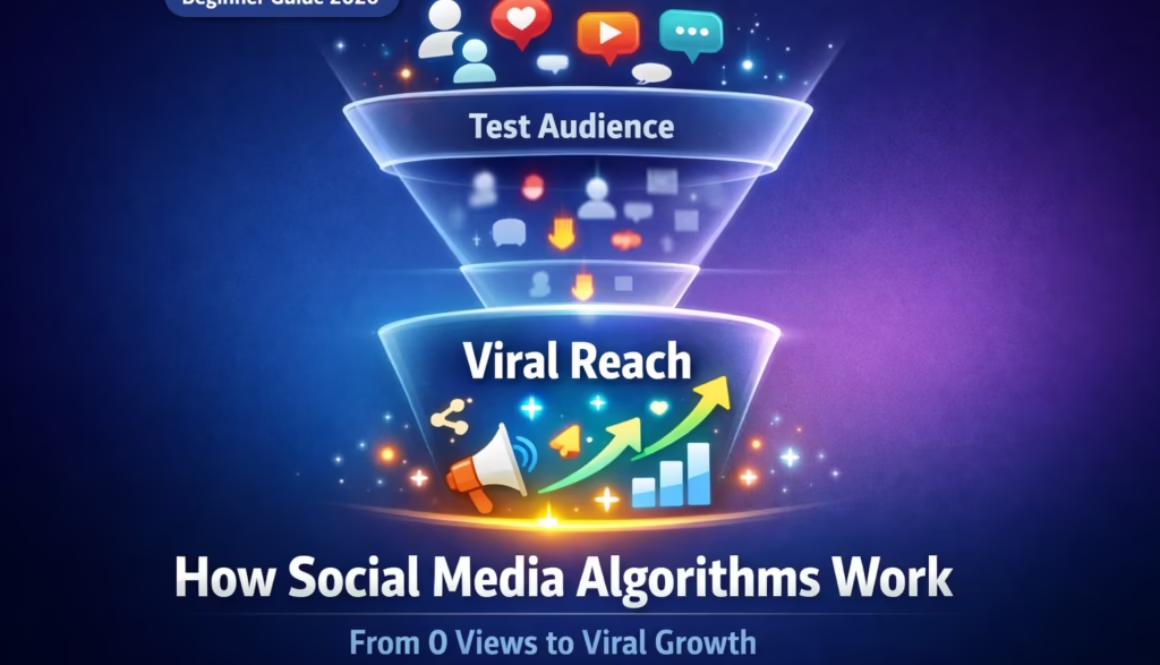
How Social Media Algorithms Work for Beginners: The Honest Guide to Growing and Earning Online in 2026
The Day I Realised It Wasn’t About Talent
If you’ve ever wondered how social media algorithms work for beginners — and why your content keeps getting ignored despite all your effort — you’re in exactly the right place.
I remember posting my first piece of content on Instagram. Spent three hours on it. Wrote the caption four times. Added hashtags I copied from some “growth hacks” video that was probably already outdated when I found it.
Posted it at 7pm on a Tuesday because some blog told me that was the magic hour.
Twelve views. Nine of which were probably me hitting refresh.
Here’s what stung — it wasn’t even bad content. I’d seen objectively worse stuff pull thousands of likes. So I did what every confused beginner does. I Googled “why my content is not getting views” at 11pm, half frustrated and half embarrassed.
That one search changed everything.
The answer had nothing to do with my talent. Nothing to do with the quality of what I made. It had everything to do with something I had completely, embarrassingly ignored.
The algorithm.
Now — I know how that word sounds. “The algorithm” gets thrown around like it’s some mystical force deciding who gets famous and who stays invisible forever. I believed that too. I thought it was rigged. Or random. Or both.
It’s neither.
Here’s the truth nobody explains properly: understanding how social media algorithms work is a learnable skill. Once you get it, growing online stops feeling like gambling and starts feeling like following a map.
This guide breaks down exactly how these systems work across YouTube, Instagram, and LinkedIn — in plain language that actually makes sense. No vague advice. Just the stuff that genuinely moves the needle.
Let’s go.
Table of Contents
- What Is a Social Media Algorithm? (Simple Definition)
- The Real Problem — Why Your Content Isn’t Getting Views
- How Social Media Algorithms Work for Beginners — The Simple Truth
- The Hidden Truth — Algorithms Are Prediction Engines
- Step-by-Step Strategy to Work With the Algorithm
- Platform Deep Dive: YouTube, Instagram, LinkedIn
- Real Case Study — How One Creator Cracked the Code
- New Side Hustles Using Algorithm Knowledge
- FAQ
- Conclusion
What Is a Social Media Algorithm? (Simple Definition)
A social media algorithm is a system that ranks and displays content based on how likely each user is to engage with it. It analyses behaviour signals — watch time, saves, shares, clicks, and comments — to decide which posts get pushed to more people and which ones stay buried.
In short: the algorithm’s job is to keep users on the platform as long as possible. Every decision it makes flows from that single goal.
That’s it. Everything else in this guide builds on that foundation.
The Real Problem — Why Your Content Isn’t Getting Views
Let me be blunt.
Most beginner content advice is genuinely useless. “Post consistently.” “Use the right hashtags.” “Be authentic.” Okay. Still getting 14 views. Thanks.
Here’s something nobody wants to say out loud: hashtags are largely overrated in 2026. Retention, saves, and watch time beat a wall of hashtags every single time. I ignored this for months — stuffing 30 hashtags onto posts the algorithm was never going to push anyway. Big mistake.
The real problem goes deeper than tactics. It starts with a misunderstanding of what these platforms actually are.
Instagram is not a gallery. YouTube is not a TV channel. LinkedIn is not a digital CV.
They are attention-selling machines.
Every platform makes money by keeping people glued to their app as long as possible. The algorithm’s entire job is figuring out which content does that best. It’s not personal. It doesn’t dislike you. It’s just ruthlessly optimising for attention.
Let me simplify this.
If your content is not getting views, it’s almost always one of these three things:
- Bad hook — people leave in the first second
- Weak retention — people don’t stick around long enough
- No niche clarity — the algorithm doesn’t know who to show you to
Fix those three. Everything changes.
Here’s what specifically kills most content before it gets a fair shot:
Weak hook. Your first line or first second didn’t stop the scroll. People left immediately. That exit signal is devastating to your reach. I messed this up for months — kept leading with context instead of the most interesting thing I had.
No niche clarity. If your last 10 posts bounce between cooking, fitness, travel, and motivational quotes — the algorithm has no idea who to show you to. You look like noise.
Posting and disappearing. You post then go offline for hours. Huge mistake. The first 30–60 minutes after posting are critical. The algorithm is watching early engagement to decide whether your post deserves wider reach.
Never checking analytics. Just posting and hoping. Never looking at which posts got saves, which got shares, where viewers dropped off. That data is a direct window into what the algorithm rewards.
Random posting schedule. Posting whenever you feel like it means the algorithm treats you like a stranger every time. It never builds a clear model of who your content is for.
The algorithm isn’t punishing bad content. It’s rewarding specific viewer behaviour. Fix the signals, and the reach follows.
How Social Media Algorithms Work for Beginners — The Complete Breakdown
Let’s break down how social media algorithms work for beginners in the simplest way possible.
At its core — and this is way simpler than most people make it — a social media algorithm is just a ranking system with one job: show each user the content most likely to keep them on the platform longer. Everything else flows from that.
The part that trips most beginners up: the algorithm doesn’t care about you. It cares about the viewer.
It’s constantly asking — “Will this specific person enjoy this specific piece of content enough to stay?” Your follower count? Almost irrelevant early on. Your posting frequency? Only useful when quality comes with it. Your likes? Less important than you’ve been told.
The Biggest Myth: Likes Equal Reach
Wrong. Likes are one of the weakest signals on most platforms. They require one tap and zero thought. The algorithm knows this.
Here’s what actually matters — and this is the core of understanding how social media algorithms work for beginners:
Completion rate — Did people watch or read to the end? A video watched 80% of the way through sends a powerful quality signal.
Saves — Someone saved your post. That means they found it valuable enough to return to. Enormous algorithmic weight.
Shares — Someone sent your content to a friend. The algorithm equivalent of a word-of-mouth recommendation.
Comments — Real ones. Actual responses and questions, not “great post!”
Click-through rate — Mostly YouTube. Did your thumbnail and title convince people to click?
Dwell time — Mostly LinkedIn. Did people stop scrolling and actually read?
Likes — Still count. Just not nearly as much as most people think.
I tested this directly. One post: 400 likes, almost no saves, reached 3,000 people. Another post: 80 likes, 200 saves, reached 18,000 people. Same account. Same week. The algorithm valued one behaviour far more than the other.
The Hidden Truth — Algorithms Are Prediction Engines
Here’s what most beginner guides skip entirely. And it’s genuinely the most important thing in this post.
Social media algorithms are not just ranking systems. They are AI-powered behaviour prediction engines.
Think about Netflix. It doesn’t just surface popular movies. It studies your specific habits — what you watched at midnight, where you paused, what you rewatched — and builds a model of what will keep you watching longer. Not people in general. You, specifically.
YouTube, Instagram, and LinkedIn work the same way — but across billions of users, simultaneously, in real time.
This is why TikTok went from obscure app to global phenomenon in under four years. Its prediction engine was simply better at figuring out what each individual user wanted to watch next. Every other platform has been racing to catch up since.
The Distribution Loop — How the Algorithm Pushes Content
Most beginners think content either “goes viral” or “flops” randomly.
That’s not how it works.
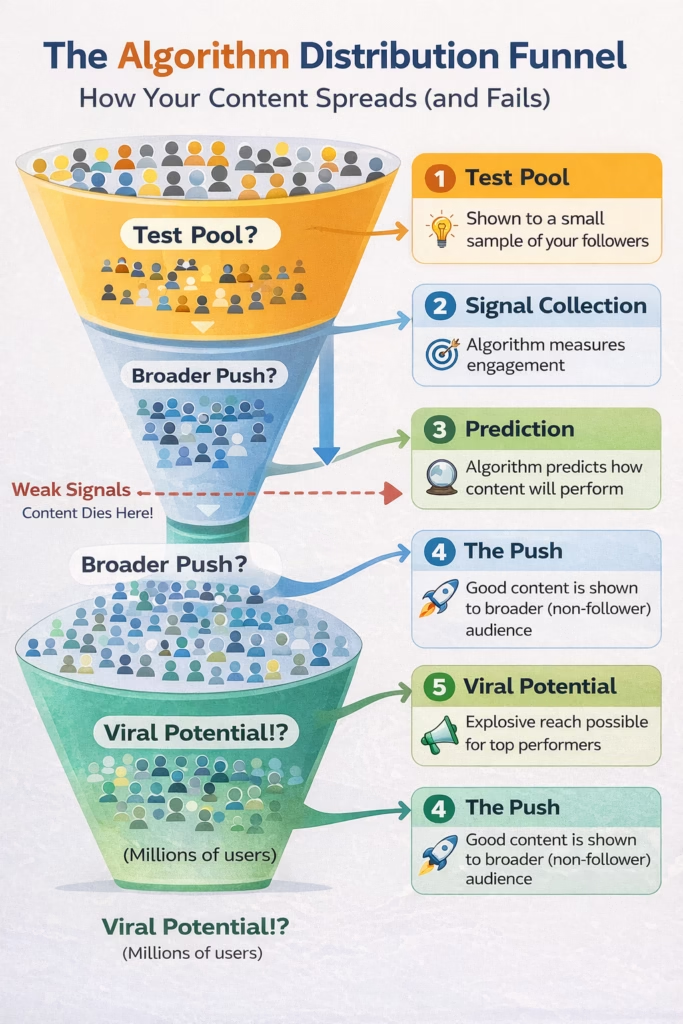
Every post goes through a filtering system first — and most content dies before it ever gets a real chance.
Look at this closely 👇
Here’s the part most people miss:
Your content doesn’t fail at the viral stage — it fails at the test stage.
If your hook is weak or people scroll away early, the algorithm never even gives you a second shot.
But if you can win that small test pool?
The algorithm does the heavy lifting for you.
Be honest — which stage do you think your content is failing at right now?
The hook… retention… or engagement?
When you post, here’s what happens behind the scenes:
Step 1 — The test pool. Your content is shown to a small slice of your existing audience. A few hundred people, sometimes less.
Step 2 — Signal collection. The algorithm watches closely. How quickly do people engage? Do they save, share, comment — or scroll past?
Step 3 — The prediction. Based on early signals, it predicts how your content will perform with a broader, colder audience.
Step 4 — The decision. Strong signals: your content gets pushed to non-followers — Explore, Home feeds, suggested videos. Weak signals: it stays buried.
Step 5 — The loop continues. As more people engage, the prediction updates. Distribution expands or contracts. The algorithm is always recalculating.
The practical takeaway: you don’t need to create content for millions. You need to nail the test phase with a smaller group first. Get that right, and the distribution handles itself.
I spent too long thinking I needed a viral moment to get noticed. Backwards. You need to score well in a room of 200 people. That’s where it starts.
Step-by-Step Strategy to Work With the Algorithm
Enough theory. Here’s what you actually do.
Step 1 — Hook Optimisation
If I could give one piece of advice to any beginner: obsess over your hooks.
The hook is the first 1–3 seconds of your video or the first line of your post. It’s the most important part of any content you make in 2026. The algorithm measures what percentage of your initial test audience stays past the opening. A bad hook means people exit immediately. That drop-off signal is catastrophic for reach.
A good hook does one of three things:
Triggers curiosity — “The one thing YouTube doesn’t tell creators about its recommendation system…”
Makes a bold promise — “I changed one thing in my strategy. My reach tripled in three weeks.”
Qualifies the viewer instantly — “If you’re a freelancer who can’t crack LinkedIn, this is exactly why.”
I used to open with context. “Hey guys, today we’re going to be talking about…” Worst thing you can do. Start with the most valuable thing you have. Every single time.
Step 2 — Retention Strategy
Getting the click is half the battle. Keeping people is where algorithm points are actually won. I learned this the hard way after months of decent hooks that didn’t follow through.
On YouTube, average view duration is the most powerful signal. Videos with 60%+ retention consistently get pushed by the recommendation engine. I tracked this obsessively on my own channel. The correlation is undeniable.
On Instagram Reels, it’s about loop rate. What percentage of people watched all the way through — and how many watched again? Design your Reels to loop naturally.
On LinkedIn, dwell time is king. Well-formatted, longer posts consistently outperform short ones. Give people a reason to stop and actually read.
Retention tactics that work:
- Break content into clear, fast-moving segments — give people a reason to stay at every stage
- Use pattern interrupts — change the angle, add a text callout, ask a mid-content question
- Always tease forward: “Stay until the end — Step 4 is the one most people skip”
- On LinkedIn, don’t give everything away before the “See More” click
Step 3 — Content Consistency
Here’s a take I genuinely believe: posting daily is one of the fastest ways to burn out — not grow.
I’ve watched so many beginners launch with a “post every day” plan, produce increasingly mediocre content by week three, and quit entirely by week six. Worst possible outcome.
Real consistency means predictable frequency, predictable format, predictable topic. The algorithm builds a trust score for your account over time. Reliable quality on a clear subject helps it find the right audience for you.
A realistic framework:
- YouTube: One video per week. Focus on evergreen topics that can rank in search for years.
- Instagram: Three to five Reels per week. One or two carousels. Stories when you have something genuinely worth sharing.
- LinkedIn: Three to four posts per week. Quality wins here more than anywhere else.
Step 4 — Niche Authority
The algorithm rewards specialists far more than generalists. When every piece of your content covers the same core topic, the algorithm builds a precise picture of who your content is for — and gets dramatically better at finding those people.
This is exactly how you grow on YouTube without subscribers. A tightly niched channel starts appearing in the suggested sidebar of popular channels in the same space. YouTube places you there because you serve the same audience. Your subscriber count is almost irrelevant to that process.
Quick test: If someone saw five random posts from your account without reading your bio, could they instantly tell what you’re about? If no — tighten the niche before anything else.
Step 5 — Engagement Signals
Most people create content, then wait for engagement to happen to them.
Flip that. Engineer your content to produce specific behaviours.
Want saves? Create genuinely useful reference content — tutorials, templates, numbered lists. Want shares? Write something that says what your audience wishes they could say. Want comments? End every post with a specific, low-barrier question.
After posting — stay active. Reply to every comment in the first hour with actual responses that prompt replies back. That live back-and-forth tells the algorithm your content is generating real conversation.
This is where most creators go wrong. They post great content and then disappear. Don’t do that.
Tools Worth Using
TubeBuddy — YouTube SEO, keyword research, A/B thumbnail testing. Strong free tier, real power in paid plans. Check out TubeBuddy here — the first tool to install if you’re serious about YouTube.
VidIQ — YouTube analytics and competitor research. Great for beginners, free plan gets you started.
Later — Instagram and LinkedIn scheduling with visual calendar and best-time predictions.
Metricool — Cross-platform analytics. Free plan is genuinely solid. Takes a few days to get comfortable with the UI.
Shield Analytics — LinkedIn-specific post analytics. The best tool for understanding what’s actually driving LinkedIn performance. Paid only, but worth it once you’re serious.
Platform Deep Dive — YouTube, Instagram, and LinkedIn
YouTube Algorithm Explained
YouTube is the world’s second-largest search engine. Content you post today can generate views three years from now. I have videos on channels I barely touch that still pull consistent weekly views from search alone.
The YouTube algorithm operates across three distinct surfaces:
The Home Feed — Personalised homepage every user sees. To land here: strong CTR combined with above-average watch time.
Search — Where evergreen content wins. This is how you genuinely grow on YouTube without subscribers. Target specific search queries, build high-retention videos around them, and your content can rank and get discovered by strangers for years. One video I posted got almost no views in week one, ranked for a search term two months later, and accumulated tens of thousands of views over the following year.
Suggested / Sidebar — Where explosive growth happens. When YouTube decides your content serves the same audience as a popular video, it places you in that video’s suggested sidebar. Target the same keywords as popular videos in your niche. Become the obvious “what to watch next.”
Core metrics YouTube weighs:
- CTR — Aim for 4–10%. Entirely your thumbnail and title’s job.
- Average View Duration — Keep above 40–50%. Above 60% is where recommendations really kick in.
- Viewer Satisfaction — Measured through post-watch behaviour. Do people keep watching YouTube after your video?
- Return Viewers — If people come back repeatedly, YouTube flags you as a reliable source worth promoting.
Want to understand how YouTube’s system actually works under the hood? Google’s own research paper on their neural network recommendation system is more readable than you’d expect — and changes how you think about content decisions.
The viral formula on YouTube: Irresistible thumbnail click → retention above 50% → a niche YouTube already knows viewers want. Hit all three consistently and you’re playing a different game.
Instagram Algorithm Explained
Instagram in 2026 is a Reels-first platform. That’s not opinion — it’s the company’s stated direction. Reels consistently get significantly more reach than static posts or carousels. If you’re not making short-form video, you’re swimming against the current.
What Instagram weighs most heavily:
Saves — The single most powerful signal. Tells Instagram this content was valuable enough to revisit.
Shares via DMs — When someone sends your Reel to a friend, that is the clearest possible quality signal on the platform.
Watch time and loops — Instagram tracks completion rate and how many people rewatched. Design Reels to loop naturally — end on a frame that flows back to the beginning.
Early comments — A cluster within the first 30–60 minutes tells the algorithm your content is sparking conversation. Protect this window.
How content goes viral on Instagram almost always starts with strong non-follower performance. Your Reel needs to score well enough in the initial test to reach the Explore page and Reels tab. Which comes back — again — to the hook.
Instagram’s own Creator Guide on growing with Reels has practical guidance on formats and distribution worth bookmarking.
LinkedIn Algorithm Explained
LinkedIn is the most underestimated platform for beginners right now. Most people see it as a job board and miss what it actually is: one of the highest-ROI platforms for freelancers, consultants, and service providers in 2026. Strong organic reach. Low competition compared to Instagram. An audience full of decision-makers with actual budgets.
How the staged distribution works:
Phase 1 — The Filter. Automated quality check. Too many external links in the post body, hashtag stuffing, or low-quality signals? Your post gets suppressed before most people see it. This explains why so many LinkedIn posts get almost no reach before the race even starts.
Phase 2 — The Initial Test. Shown to a small subset of your connections. What happens in the first 60–90 minutes is everything.
Phase 3 — Network Expansion. LinkedIn shows your post to the connections of people who engaged. One quality comment from someone with 8,000 followers is a partial broadcast to their entire network. The quality of your commenters matters almost as much as the quantity.
Dwell time is the most important metric on LinkedIn specifically. Well-structured, longer posts with short paragraphs and clear formatting consistently beat short updates.
Practical strategies:
- Post 7–9am or 5–6pm, Tuesday through Thursday
- Never put external links in the post body — drop them in the first comment instead
- Start every post with an open loop that makes “See More” feel unavoidable
- Reply to every comment quickly — each reply extends your post’s life in the feed
Platform Engagement Signals — Quick Reference
YouTube
- Watch Time / AVD 🔴 Highest → Directly triggers recommendations across Home and Suggested feeds
- Click-Through Rate 🔴 High → Controls whether YouTube pushes your video to the Home feed
- Likes / Comments / Shares 🟡 Medium → Builds channel authority and trust score over time
- Saves 🔴 Highest → The algorithm’s strongest quality indicator; signals evergreen value
- Shares via DMs 🔴 High → The most powerful viral push signal on the platform
- Reel Watch Time / Loops 🔴 High → Drives reach on the Explore page and Reels tab
- Comments (first hour) 🟡 Medium → Early engagement booster; triggers conversation signals
- Dwell Time 🔴 Highest → The core metric defining your content’s distribution score
- Comment Quality 🔴 High → Triggers second-wave distribution to commenter networks
- Reactions 🟡 Medium → Early engagement indicator; helps in Phase 2 testing window
Real Case Study — How One Creator Cracked the Code
(Details anonymised at this person’s request. Strategy, numbers, and timeline are real.)
I worked with a UX designer — I’ll call him Ravi — who started on LinkedIn in January 2025 with zero followers, zero connections, and zero strategy.
His first two weeks: posts like “Excited to share my journey!” and “Day 1 of documenting my career.”
Total combined reach: under 300 views.
He told me later: “I thought LinkedIn just didn’t work for people like me. I was this close to deleting the app.”
Here’s what changed.
Month 1–2: Brutal niche specificity.
He dropped the journey posts and picked one topic: UX mistakes that cost clients money. Every single post. Same subject, different angle. Four times a week, no exceptions.
LinkedIn’s algorithm started recognising his audience. It began showing his posts to UX designers, product managers, and startup founders — people he had no direct connection to. The niche became the distribution engine.
Month 3–4: Hook surgery.
He noticed posts opening with a counterintuitive statement got three to four times the dwell time of posts that opened with context.
He changed his formula. Instead of “Here are some UX tips I’ve learned…” — he started with “Most UX designers are solving the wrong problem. Here’s what I mean.”
Average post reach jumped from roughly 2,000 to 14,000 views within six weeks.
One thing changed. Just the hook. I ignored how important this was for months — probably the single most costly mistake I made in my own content journey.
Month 5–8: Engineered engagement.
Every post ended with one low-friction question. “Which of these three mistakes have you made? Drop a number below.” Comments flooded in. Those comments triggered Phase 3 distribution — his posts started reaching the networks of his most engaged commenters.
Biggest post: 220,000 organic views. By month eight: 26,000 followers, three to five inbound client inquiries per week.
What made it work? Not luck. A systematic understanding of how the algorithm pushes content — and deliberate optimisation of every signal at every stage.
He didn’t go viral and then understand the algorithm. He understood the algorithm and then went viral.
New Side Hustles Using Algorithm Knowledge
Here’s something most beginners overlook entirely.
Understanding how social media algorithms work isn’t just for growing your own account. It is a skill businesses will pay serious money for right now. Most companies are posting content and getting nowhere. They have no idea why. If you can explain it and fix it — you’re immediately valuable.
Side Hustle Earning Potential
| Side Hustle | Skill Required | Earning Potential | Best Platform |
|---|---|---|---|
| Content Strategist | Platform knowledge + writing | $500–$3,000/mo | LinkedIn, Twitter |
| Hook Writer / Copywriter | Copywriting, psychology | $300–$2,000/mo | All platforms |
| YouTube Automation | Research, editing, SEO | $500–$5,000/mo | YouTube |
| Social Media Manager | Scheduling, analytics | $800–$4,000/mo | Instagram, LinkedIn |
| Algorithm Consultant | Deep platform expertise | $1,000–$6,000/mo | All platforms |
Content Strategist
Businesses are desperate for people who understand platform mechanics and can build a content plan around them. Most know they need to post. Most have no idea what signals to optimise for.
Start with a free audit of a local business’s social presence. Show them specifically what’s killing their reach. That case study becomes your sales pitch. Charge $500–$3,000 per month once you have two or three solid examples.
YouTube Automation
Building faceless channels on evergreen topics — personal finance, productivity, tech reviews — using scripts, AI voiceovers, and stock footage. Done with strong SEO and algorithm knowledge, these channels generate passive AdSense income for years. Pick high-CPM niches: finance, legal, software. Takes three to six months to see meaningful revenue. But once a channel ranks, it earns while you’re doing something else.
Hook Writing
If you understand why hooks are everything — you’re sitting on a sellable skill. Creators and businesses hire hook writers on Upwork, Fiverr, and LinkedIn at $50–$150 per hook. The math speaks for itself.
Social Media Manager
The most accessible entry point. Local businesses, coaches, and online entrepreneurs pay $800–$2,000 per month for someone to handle their Instagram or LinkedIn presence.
Show results — even from your own account — and you can land paying clients within 30 days.
For finding clients without losing a chunk of every invoice, Contra is one of the best platforms for freelance social media work — zero commission on your earnings.
Frequently Asked Questions
1. How do social media algorithms work for beginners — is it the same across all platforms?
The core logic is identical: every platform maximises time spent on their app. But the specific signals differ completely. Understanding how social media algorithms work for beginners means learning the unique currency of each platform. YouTube pays in watch time and CTR. Instagram pays in saves and shares. LinkedIn pays in dwell time and comment quality. Treat them the same and you’ll underperform on all three.
2. Why is my content not getting views even though I post consistently?
Consistency is necessary — not sufficient. The three most common culprits: weak hooks (people leave in the first second), niche too broad (algorithm can’t match you to an audience), not engaging in the first 30–60 minutes after posting. Most people won’t tell you this — but fixing just one of those three can double your reach almost immediately.
3. How can I beat the social media algorithm in 2026?
You can’t beat it — but you don’t need to. You need to work with it. The best way to approach the social media algorithm in 2026 is to understand what behaviours it rewards — completion, saves, meaningful comments, shares — and create content that naturally triggers those behaviours. Do that consistently, and the algorithm becomes your best distribution tool.
4. Can I really grow on YouTube without subscribers?
Completely. YouTube’s search algorithm evaluates every video on its own merits. A brand-new channel can rank on Page 1 for a low-competition keyword and get discovered by thousands of people who’ve never heard of you. Focus on long-tail keyword research with TubeBuddy or VidIQ, build high-retention videos around those terms, and search will send you views independently of your subscriber count.
5. How does content go viral on YouTube and Instagram?
Virality follows a pattern — it just looks random from the outside. Content goes viral on YouTube and Instagram when it scores exceptionally well in the algorithm’s initial test phase. On YouTube: high CTR and above-average retention from the first batch of viewers. On Instagram: a high save, share, or rewatch rate from the first few hundred people who see the Reel. Design for those early signals. Virality is far more engineered than most people think.
Conclusion — The Algorithm Is Not Your Enemy
Here’s what I want you to walk away with.
The algorithm is not a hostile gatekeeper. It is a logical, learnable system that rewards people who understand what it’s looking for. And now you do.
You know why your content wasn’t getting views. You understand that these platforms are AI-powered prediction engines, not random slot machines. You have a five-step strategy you can apply today. You know the specific signals that YouTube, Instagram, and LinkedIn each respond to.
Most importantly: knowing how social media algorithms work is itself a skill worth real money in 2026. Businesses need people who understand this. Most of them have no idea where to start.
Let me be honest about one more thing.
Most people will read this, nod along, and never change anything. They’ll post the same content the same way and wonder why results don’t improve.
I wasted months guessing. You don’t have to.
The creators winning online right now are not always the most talented. They’re the ones who understand the system well enough to make it work in their favour.
You understand the system now.
Pick one platform. Go back through your last 10 posts. Ask three questions for each: Was my hook strong enough? Did I give people a real reason to save or share? Did I engage within the first hour? Write your next piece of content with those three questions as your guide. Repeat for 90 days.
The algorithm will find you. You just have to give it something worth pushing.
Found this useful? Share it with someone still wondering why their content isn’t getting views. Drop a comment below — which platform are you going all-in on in 2026?