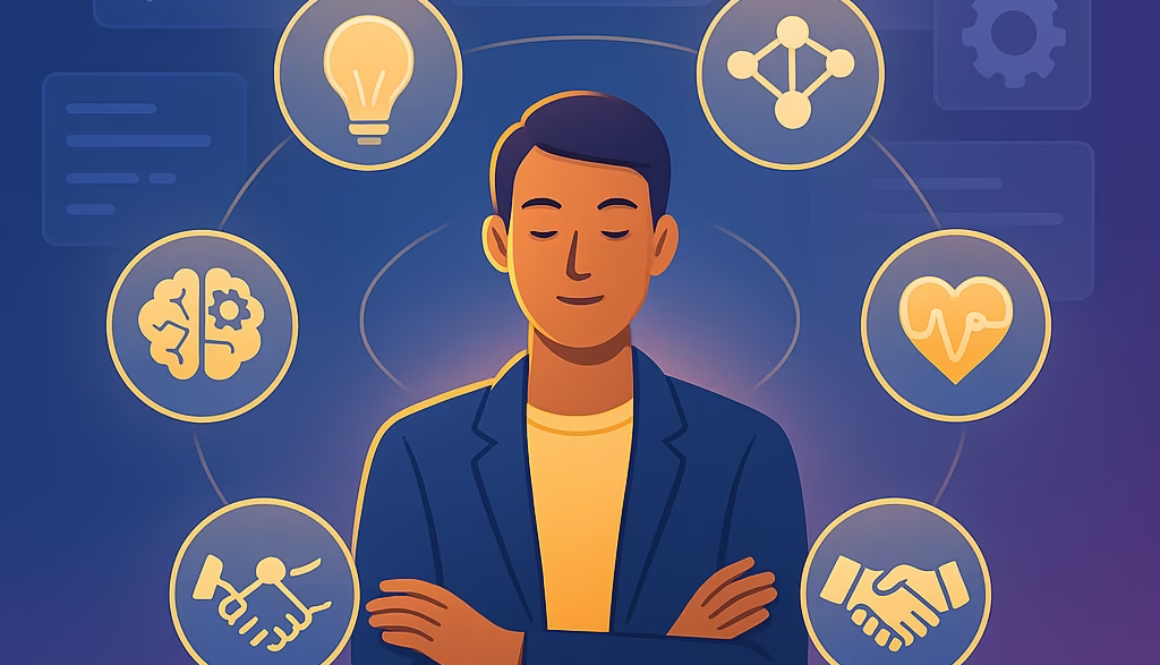
The Essential Meta-Skills That’ll Keep You Thriving While AI Reshapes Everything
Let me tell you something that might surprise you: I’ve watched countless professionals panic about AI over the past two years. They’re frantically trying to master every new tool that pops up, staying up late learning prompt engineering techniques, and constantly worrying about being replaced.
But here’s what I’ve noticed about the people who are actually winning right now—they’re not chasing every shiny AI object. Instead, they’ve figured out something much smarter.
They’re building what I call “meta skills for AI”—the deeper abilities that help them adapt quickly, think critically, and collaborate effectively with these tools, regardless of which specific platform is trending this week.
Think about it this way: remember when everyone was scrambling to learn specific social media platforms? Some people became MySpace experts right before Facebook took over. Others learned Facebook ads just as TikTok started dominating. But the marketers who really succeeded? They understood the underlying principles of audience engagement and storytelling that worked across any platform.
That’s exactly what’s happening with AI right now.
While your competitors are still figuring out whether to use ChatGPT or Claude, the professionals with strong meta skills are already three steps ahead. They’re not just using AI—they’re amplifying their human capabilities in ways that make them absolutely indispensable.
By the time you finish reading this, you’ll understand which specific abilities will keep you relevant (and highly paid) no matter how fast AI evolves. More importantly, you’ll know exactly how to start building these skills today.
learn about: AI in 2030 & Ai vs human creativity
What Meta-Skills Actually Mean (And Why Everyone Gets This Wrong)
Most people think meta skills are just fancy buzzwords for “soft skills.” That’s completely missing the point.
Meta skills for AI are your professional operating system. When your phone updates and all your apps look different, your operating system handles the transition seamlessly. When AI tools evolve and entire industries shift, your meta-skills help you navigate the chaos without breaking down.
Here’s the difference: Learning to use GPT-4 is a technical skill. Understanding how to quickly evaluate any AI tool’s capabilities, spot its limitations, and integrate it into your workflow—that’s a meta-skill.
I saw this play out perfectly with two freelance writers I know. Jake spent three months becoming a Jasper AI expert, learning every template and optimization trick. When Jasper updated their interface and pricing, he felt lost again. Meanwhile, his colleague Maria focused on developing strong AI collaboration principles and critical thinking abilities. When new writing tools emerged, Maria adapted in days while Jake struggled for weeks.
The reality check? AI can lower skill barriers, helping more people acquire proficiency in more fields, which means specific technical knowledge becomes less valuable while the ability to learn and adapt becomes priceless.
Why meta skills matter more than ever:
The half-life of specific AI skills is getting shorter. What you learn about a particular tool today might be outdated in six months. But your ability to quickly master new systems, think critically about outputs, and combine AI capabilities with human insight? Those skills compound over time.
I’ve seen marketing agencies completely transform their service offerings three times in the past year as new AI capabilities emerged. The agencies that survived and thrived weren’t the ones with the most technical AI knowledge—they were the ones with teams that could adapt quickly, think strategically, and maintain quality standards regardless of which tools they were using.
The Five Meta-Skills That Actually Matter
After observing hundreds of professionals navigate the AI transformation, I’ve identified five meta skills that separate the people thriving from those merely surviving. These are people skills, like leadership, teamwork, negotiation and relationship building—but they’re specifically enhanced for an AI-integrated world.
Learning Agility: Your Secret Weapon Against Obsolescence
This isn’t about being a fast learner. Anyone can watch YouTube tutorials. Learning agility means developing systematic approaches to extract value from new tools without getting overwhelmed by constant change.
My friend Sarah runs a small marketing agency. When GPT-3 launched, instead of panicking about AI replacing copywriters, she spent exactly two weeks experimenting with different approaches. Not months—two weeks. She developed a simple framework for testing new AI capabilities: try it on three different project types, document what works and what doesn’t, then decide whether to integrate it.
When GPT-4 came out, she applied the same framework and adapted in days. When Claude and other competitors emerged, same process. Now she’s charging 40% more than her competitors because clients trust her to maximize results with whatever tools give them the best advantage.
How to build this meta-skill:
Start with what I call the “15-minute rule.” When you encounter any new AI tool, spend exactly 15 minutes understanding its core function. Don’t try to master it immediately—just figure out what problem it solves and whether it’s worth your time to go deeper.
Keep a simple learning journal. Not a complicated system—just note what adaptation strategies work for you. Do you learn better by watching videos, reading documentation, or jumping in and experimenting? Once you know your learning patterns, you can apply them to any new tool.
Deliberately seek out situations that require quick adaptation. Join beta programs, volunteer for projects slightly outside your comfort zone, or simply try using familiar tools in completely new ways.
Critical Thinking: Your BS Detector for the AI Age
Here’s something most people don’t realize: AI can generate incredibly convincing content that’s completely wrong. Job-seekers must embrace a wider set of skills – but not just technological ones, and critical thinking tops that list.
Last month, a consulting client showed me an AI-generated business plan that looked sophisticated but contained fundamental flaws in market analysis. The AI had confidently projected 40% annual growth for a product in a declining market segment. Without strong critical thinking skills, my client would have wasted thousands of dollars pursuing that strategy.
This is happening everywhere. AI outputs often sound authoritative while being factually incorrect or logically flawed. The professionals who can quickly spot these issues and improve them are becoming incredibly valuable.
Developing your critical thinking muscle:
Practice what I call the “AI audit habit.” Before using any AI-generated content, ask yourself three questions: What assumptions is this making? What evidence supports these claims? What would I need to verify before acting on this information?
Study common logical fallacies and cognitive biases. AI often amplifies these patterns from its training data. Once you recognize them, you’ll spot problems much faster.
Learn to cross-reference AI outputs with multiple sources. Don’t just fact-check—look for contradictions, missing context, and unstated assumptions.
Creative Problem-Solving: Where Human Ingenuity Meets AI Power
This might be the most misunderstood meta-skill. Creative problem-solving in the AI era isn’t about competing with AI creativity—it’s about using AI as a thinking partner while bringing uniquely human insight to complex challenges.
Maria, a UX designer I know, perfectly demonstrates this approach. When asked to improve an e-commerce checkout process, she used AI to generate layout variations and analyze user flow data. But the breakthrough came when she noticed something the AI couldn’t see: users weren’t abandoning carts because of interface problems, but because of anxiety about data security.
Her human empathy identified an emotional problem that required a human solution. The AI provided the data analysis, but Maria’s creative insight solved the real issue.
Building creative collaboration skills:
Practice “AI-assisted brainstorming” regularly. Use AI to generate initial options, then apply human judgment to identify unexpected combinations and novel approaches. The magic happens in the intersection.
Develop knowledge across different domains. The more diverse your understanding, the more unique connections you can make that AI cannot replicate.
Always challenge AI suggestions with “What if we approached this completely differently?” thinking. AI tends to generate variations on existing patterns—human creativity breaks those patterns.
Emotional Intelligence: Your Irreplaceable Advantage
As AI handles more routine tasks, emotional intelligence becomes your premium differentiator. This goes far beyond basic empathy—it’s about understanding complex human motivations, navigating organizational dynamics, and building genuine trust relationships.
James works in B2B sales for a software company. When they implemented AI chat systems for initial customer inquiries, many worried about sales jobs disappearing. Instead, James found his role becoming more valuable. While AI handled information gathering efficiently, complex enterprise deals still required someone who could read between the lines, understand unstated concerns, and navigate multiple stakeholders with conflicting interests.
His emotional intelligence skills—reading non-verbal cues, building rapport, managing difficult conversations—became more important, not less.
Strengthening emotional intelligence for AI collaboration:
Practice active listening that goes deeper than surface-level responses. Focus on understanding the emotions and motivations behind what people are saying.
Learn to recognize and respond appropriately to emotional states in both digital and face-to-face interactions. This skill becomes crucial as more communication happens through AI-mediated channels.
Develop conflict resolution abilities that address underlying human needs, not just surface problems. AI can provide data and suggest solutions, but only humans can navigate the emotional complexity of interpersonal conflicts.
AI Collaboration: Working With Intelligence, Not Against It
The final essential meta-skill is learning how to collaborate effectively with AI systems. This goes way beyond knowing the right prompts—it’s about understanding how to augment human capabilities while maintaining quality and creativity.
Lisa, a content strategist, has developed what she calls her “AI partnership process.” She doesn’t just use AI to write articles. Instead, AI handles research compilation and creates first drafts, while she focuses on strategic positioning, brand voice refinement, and emotional resonance. Her clients pay premium rates because they get AI efficiency with human strategic thinking.
Advanced AI collaboration involves:
Understanding when to rely on AI and when human judgment is essential. AI excels at pattern recognition and data processing but struggles with context, nuance, and creative leaps.
Developing effective communication patterns with AI systems. This means learning to give clear instructions, ask better questions, and iterate efficiently.
Creating workflows that maximize both AI capabilities and human insight. The best results come from seamless integration, not treating AI as a separate tool.
Building These Skills Without Burning Out
The biggest mistake I see people make is trying to develop all these meta skills simultaneously while keeping up with every AI development. That’s a recipe for burnout.
Instead, focus on building sustainable habits that develop these abilities naturally over time.
Start with the foundation routine:
Week 1-2: Establish Your Learning Baseline
Spend just 15 minutes each morning exploring something AI-related. Could be a new tool, a different use case, or simply experimenting with a familiar tool in a new way.
Keep a simple log: What did you try? What worked? What surprised you? What questions came up?
Most importantly, practice explaining what you learned to someone else (even if it’s just writing it down for yourself).
Week 3-4: Add Critical Analysis
For any AI content you encounter during your workday, spend two minutes asking: “How would I verify this? What might be missing? What assumptions is this making?”
Do a weekly review: What AI outputs did you accept without questioning this week? Which ones should you have been more skeptical about?
Week 5-6: Integrate Creative Collaboration
Pick one ongoing work project and consciously use AI as a thinking partner, not just a task executor.
Document your process: When did AI help? When did you add the crucial human element? Where was the combination most powerful?
Daily micro-practices that actually work:
Morning routine (10 minutes): Try using a familiar tool in a completely new way. Read one article about AI applications outside your field. Practice explaining a complex concept in three different ways.
During work: Before using any AI tool, spend 30 seconds defining what good output looks like. After getting results, spend 60 seconds asking “What would I add, change, or question?” Have one important conversation each day without any AI assistance.
Evening reflection (10 minutes): Note one thing AI helped you accomplish and one thing that required uniquely human judgment. Identify one place you could have collaborated more effectively with AI. Plan one small experiment for tomorrow.
The Real Career Impact (What Nobody Talks About)
Here’s what the productivity gurus and AI evangelists won’t tell you: building meta skills for AI isn’t just about staying employable. It’s about positioning yourself for outsized success while others struggle to keep up.
I’ve watched this transformation happen in real-time over the past two years. AI’s integration into the workplace represents one of the most significant technological shifts in generations, and three distinct career paths have emerged:
Path 1: The Displaced – These are professionals who relied heavily on routine tasks without developing adaptability. They’re struggling because they’re competing directly with AI capabilities.
Path 2: The Stable – These people maintain their current roles by using AI tools but don’t fundamentally change their approach. They stay employed but see limited growth.
Path 3: The Accelerated – These are the professionals with strong meta skills who’ve learned to amplify their capabilities using AI. They’re experiencing career acceleration, increased compensation, and expanded opportunities.
Real success stories I’ve witnessed:
Marcus was a financial advisor worried about robo-advisors taking over his industry. Instead of competing with AI, he developed meta skills that let him focus on complex family financial planning while using AI for research and analysis. His client base tripled because he could offer both efficiency and sophisticated human judgment.
Jennifer worked as a marketing manager when her company implemented AI content generation. Her adaptability and critical thinking helped her transition from content creator to content strategist. She now oversees AI content production for multiple brands, earning significantly more than she ever did writing individual pieces.
The compounding effect nobody mentions:
Unlike technical skills that become obsolete, meta skills compound over time. Each new AI tool you master using strong meta skills makes the next one easier. Each complex problem you solve with AI collaboration strengthens your ability to tackle even bigger challenges.
This compounding effect means early investment in meta skills pays dividends for decades, while investment in specific technical skills often has much shorter payoff periods.
The Mistakes That Will Kill Your Progress
Even people who understand the importance of meta skills often make critical errors that limit their success. I’ve seen these patterns repeatedly, and they’re completely avoidable if you know what to watch for.
Mistake #1: Tool Obsession Over Skill Development
Tom, a graphic designer, spent four months becoming a Midjourney expert. He knew every parameter, every style technique, every optimization hack. When Stable Diffusion improved and Midjourney changed its pricing model, he felt behind again.
His colleague Sarah took a different approach. She spent 20% of her time learning tools and 80% developing visual communication principles and AI collaboration frameworks. When new image generation tools emerged, Sarah adapted quickly while Tom struggled.
The solution: Follow the 80/20 rule religiously. Spend most of your energy developing the meta skills that make learning any tool faster and more effective.
Mistake #2: Ignoring the Human Element
I’ve seen too many professionals assume technical AI knowledge is sufficient while neglecting communication, emotional intelligence, and creative thinking. This creates a dangerous trap: as AI handles more technical tasks, human skills become the primary differentiator.
The reality: Professionals who combine AI capabilities with sophisticated human judgment are increasingly valuable, while those with only technical AI skills face commoditization.
Mistake #3: Over-Relying on AI Without Developing Judgment
This is the most dangerous mistake I see. People start using AI outputs without developing the critical thinking necessary to evaluate and improve them. They become dependent rather than empowered.
When AI provides incorrect suggestions, they lack the judgment to recognize and fix problems. Instead of becoming more capable, they become bottlenecks in AI-enhanced workflows.
The solution: Always practice the “AI plus human judgment” approach. Define quality standards before using AI, critically evaluate results, and systematically develop your ability to spot and correct issues.
Your Next Steps (The Practical Reality)
If you’ve made it this far, you’re already ahead of most people who are still chasing individual AI tools rather than building lasting capabilities. But knowledge without action is just entertainment.
The professionals thriving in our AI-transformed world share one characteristic: they started building meta skills before it felt urgent. They recognized that future-proof abilities require consistent development over time, not frantic learning when change becomes unavoidable.
Start where you are, with what you have:
Choose one meta-skill to focus on this week. Just one. Pick the area where you feel weakest or where improvement would have the biggest impact on your work.
Begin with the smallest possible daily practice. Fifteen minutes is enough. Consistency beats intensity every time.
Find one person in your network who’s also interested in developing these capabilities. Share what you’re learning, discuss challenges, and hold each other accountable.
The long-term vision:
Remember, the goal isn’t to become an AI expert. The goal is to become a professional who thrives by combining human wisdom with AI capabilities. That combination will remain valuable for decades, regardless of which specific tools dominate the market.
The AI revolution is accelerating, not slowing down. But instead of fearing this change, you can position yourself to benefit from it. The meta skills you build today will compound for years, creating opportunities you can’t even imagine yet.
Ready to future-proof your career with skills that actually matter? Join our community of professionals who are building adaptability, critical thinking, and AI collaboration abilities that last. Get weekly insights, practical exercises, and early access to strategies that keep you ahead of the curve—not chasing it.
Questions People Actually Ask
What are meta-skills in the context of AI?
Meta skills for AI are the deeper, transferable abilities that help you work effectively with artificial intelligence regardless of which specific tools you’re using. Think adaptability, critical thinking, creative problem-solving, and emotional intelligence—but specifically developed for an AI-integrated world. Unlike technical skills that become outdated, these abilities become more valuable as AI evolves.
How do meta-skills differ from regular job skills?
Regular job skills are specific capabilities (like knowing Excel or Photoshop). Meta skills are the underlying abilities that help you quickly master any tool in your field. In the AI context, it’s the difference between memorizing ChatGPT prompts versus understanding how to collaborate effectively with any AI system.
Can artificial intelligence develop these meta-skills too?
AI can simulate some aspects of critical thinking and pattern recognition, but it cannot develop genuine adaptability, emotional intelligence, or the nuanced judgment that comes from human experience. These remain uniquely human advantages that become more valuable as AI handles routine work.
Which soft skills are most important for the AI era?
The most future-proof abilities include emotional intelligence, complex communication, creative problem-solving, adaptability, and collaborative skills. These help you provide value that AI cannot replicate while enhancing your ability to work effectively with AI systems.
How can I start building these capabilities today?
Begin with simple daily practices: spend 15 minutes exploring new AI applications while focusing on learning patterns rather than specific features. Practice questioning AI outputs with critical thinking. Use AI as a collaboration partner rather than just a task executor. Consistency matters more than intensity when developing these long-term capabilities.