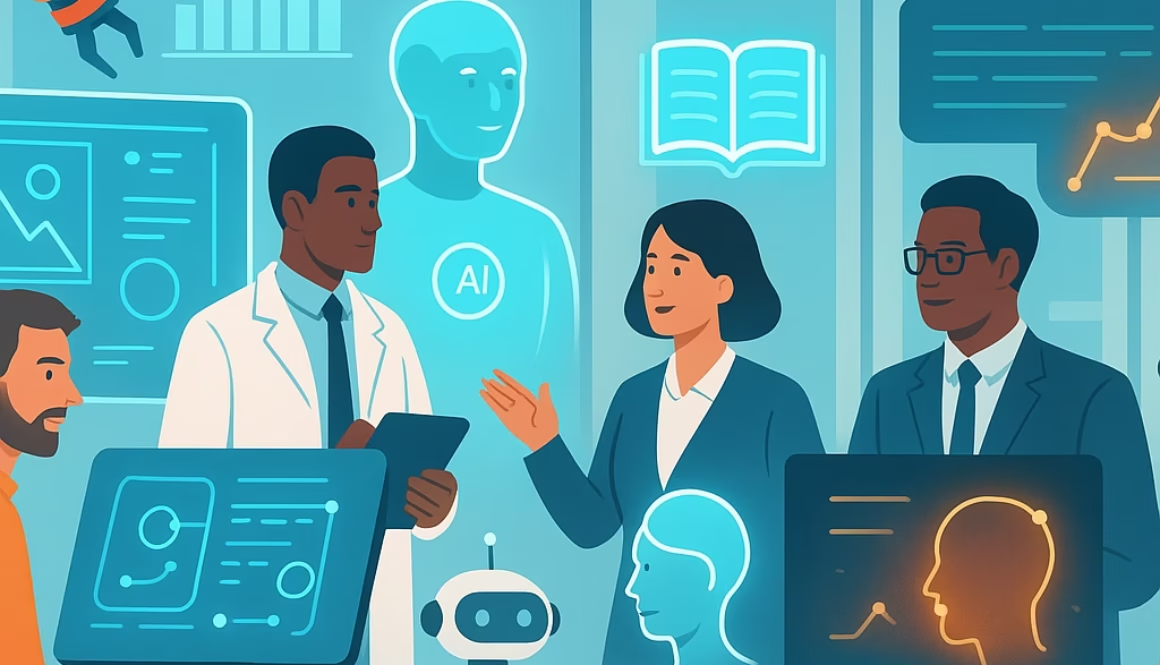
Is AI Replacing Jobs or Creating Them? The Truth in 2025
Last week, my friend, a freelance graphic designer, told me something that perfectly captures our current moment: “I’m terrified AI will replace me, but I’m also using it daily to work faster than ever before.” Her contradiction isn’t unique—it’s the reality millions of us are living through right now.
The AI job debate has reached a fever pitch in 2025. Every day brings new headlines: “AI Eliminates 50,000 Customer Service Jobs” sits right next to “Tech Giant Hires 10,000 AI Specialists.” It’s enough to give anyone whiplash.
But here’s what I’ve learned after speaking with dozens of professionals across industries, analyzing employment data, and witnessing AI’s real-world impact firsthand: the story isn’t as simple as “robots taking over” or “unlimited new opportunities.” According to the World Economic Forum’s Future of Jobs Report 2025, nearly 23% of current roles will change significantly due to AI adoption.
The truth is more nuanced, more human, and ultimately more hopeful than either extreme suggests.
The Reality Check: What’s Actually Happening Right Now
Let me start with what we’re seeing on the ground in 2025.
Yes, AI is eliminating certain jobs. Call centers are downsizing as chatbots handle routine inquiries. Data entry positions are disappearing as AI processes information faster than human fingers can type. Some news organizations are using AI to write basic financial reports and sports summaries.
But here’s the twist: for every job that’s being automated away, we’re seeing new roles emerge that didn’t exist five years ago. AI trainers, prompt engineers, automation specialists, and human-AI collaboration managers are becoming common job titles.
More importantly, most jobs aren’t disappearing—they’re transforming.
Take my friend Marcus, a marketing manager at a mid-sized company. Two years ago, he spent hours creating campaign reports manually. Now, AI generates those reports in minutes, freeing him to focus on strategy, creative direction, and building client relationships—the parts of his job that actually drive business results.
His job title hasn’t changed, but his daily work looks completely different. And he’s more valuable to his company than ever.
The Jobs Most at Risk: A Honest Assessment
Let’s be direct about which positions face the biggest challenges from AI automation in 2025:
High-Risk Categories
Routine Data Processing Roles
- Basic bookkeeping and data entry
- Simple financial analysis and reporting
- Routine legal document review
- Standard customer support tickets
Predictable Physical Tasks
- Assembly line manufacturing
- Basic inventory management
- Simple quality control inspections
- Routine maintenance scheduling
Content Creation at Scale
- Basic news reporting (earnings reports, sports scores)
- Simple product descriptions
- Routine social media posting
- Template-based writing
Why These Jobs Are Vulnerable
These positions share common characteristics: they involve repetitive tasks, follow clear rules, and produce predictable outputs. AI excels in exactly these areas.
But here’s what the doomsday articles miss: even in these categories, complete replacement is rare. Instead, we’re seeing job evolution, where humans handle exceptions, quality control, and complex decision-making while AI handles the routine work.
The Surprising Job Categories AI Is Actually Creating
While everyone focuses on job losses, something remarkable is happening: AI is creating entirely new categories of work faster than most people realize.
The New Job Landscape
AI Implementation Specialists Real companies are hiring people to figure out how to integrate AI into their workflows. These aren’t necessarily tech experts—they’re people who understand business processes and can bridge the gap between AI capabilities and practical applications.
Human-AI Collaboration Managers As teams start working alongside AI tools, someone needs to optimize that partnership. These roles involve training employees, establishing best practices, and ensuring AI augments rather than frustrates human work.
AI Ethics and Safety Officers With great power comes great responsibility. Companies are creating positions focused on ensuring AI is used responsibly, addressing bias, and maintaining human oversight.
Prompt Engineers and AI Trainers The art of communicating effectively with AI systems has become a legitimate skill set. Companies are paying well for people who can “speak AI” and train systems to produce better outputs.
The Hidden Job Growth
But the real job creation is happening in unexpected places. AI is making previously impossible business models viable, creating work in areas we couldn’t even imagine before:
- Micro-personalization specialists who create customized experiences for individual customers at scale
- AI-human interface designers who make complex AI systems usable for regular people
- Synthetic media creators who use AI to produce content that would have required entire production teams
- AI audit consultants who help businesses understand and improve their AI systems
Research by McKinsey suggests that while automation may reduce certain repetitive roles, it will also spark demand for creative, analytical, and AI-driven jobs.
Industry-by-Industry Reality Check
Let me walk you through what’s actually happening across major industries:
Healthcare: More Human Than Ever
Despite fears of AI doctors, healthcare is becoming more human-centered, not less. AI is handling diagnosis assistance, drug discovery, and administrative tasks, freeing medical professionals to spend more time with patients.
Dr. Jennifer Kim, an emergency room physician I spoke with, puts it perfectly: “AI helps me catch things I might miss when I’m exhausted, but it can’t hold a patient’s hand or navigate a difficult conversation with a family. The human elements of medicine are more important than ever.”
Education: Transformation, Not Replacement
Teachers aren’t being replaced by AI tutors. Instead, AI is becoming the ultimate teaching assistant. Educators are using AI to create personalized learning plans, generate practice problems, and identify students who need extra help.
The result? Teachers spend less time on administrative work and more time actually teaching and mentoring students.
Creative Industries: The Collaboration Revolution
This might surprise you, but creative professionals are among AI’s biggest beneficiaries. Writers use AI to overcome blank page syndrome. Designers use it to generate initial concepts and iterate faster. Musicians collaborate with AI to explore new sounds.
The key insight: AI amplifies creativity rather than replacing it. The most successful creative professionals in 2025 are those who’ve learned to dance with AI, not compete against it.
Future-Proofing Your Career: The Skills That Matter
Based on everything I’m seeing, here are the skills that will keep you valuable in an AI-driven economy:
The Irreplaceable Human Skills
Complex Problem-Solving AI can process information quickly, but humans excel at understanding context, reading between the lines, and solving problems that don’t have clear parameters.
Emotional Intelligence The ability to understand, empathize with, and motivate other humans becomes more valuable as routine tasks get automated. Leadership, counseling, sales, and team management all rely heavily on emotional intelligence.
Creative Thinking AI can remix existing ideas brilliantly, but humans drive true innovation. The ability to think originally, challenge assumptions, and imagine entirely new possibilities remains uniquely human.
Cross-Domain Thinking Humans excel at connecting insights across different fields and applying lessons from one industry to another. This kind of abstract thinking is still beyond current AI capabilities.
The New Technical Skills
AI Literacy You don’t need to become a programmer, but understanding how AI works, what it can and can’t do, and how to work effectively with AI tools is becoming as essential as computer literacy was in the 1990s.
Data Interpretation AI can process massive amounts of data, but humans are needed to interpret results, understand implications, and make strategic decisions based on insights.
Human-AI Collaboration Learning how to work effectively with AI—knowing when to trust it, when to question it, and how to combine AI capabilities with human judgment—is becoming a core workplace skill.
Actionable Steps: How to Thrive in the AI Era
For Individual Career Planning
1. Audit Your Current Role List your daily tasks and honestly assess which ones AI could potentially handle. Don’t panic—use this as a roadmap for evolution.
2. Lean Into Your Human Strengths Identify the parts of your job that require emotional intelligence, creative thinking, or complex problem-solving. Double down on developing these areas.
3. Experiment With AI Tools Start using AI in your current role. Learn how it can make you more efficient, and position yourself as the person who understands how to blend human and AI capabilities.
4. Build Cross-Functional Knowledge The most valuable professionals understand how their work connects to other departments and industries. AI makes this kind of broad thinking even more valuable.
For Business Leaders
1. Focus on Augmentation, Not Replacement The most successful AI implementations enhance human capabilities rather than eliminating them. Think about how AI can make your team more effective, not smaller.
2. Invest in Employee Transition Help your workforce adapt to working with AI rather than competing against it. This includes training, new role definitions, and clear communication about the company’s AI strategy.
3. Create New Value Streams AI enables business models that weren’t previously possible. Look for ways to serve customers better or enter new markets, rather than just cutting costs.
The Real Opportunity Hidden in the Disruption
Here’s something most people miss in the AI and jobs debate: we’re not just witnessing job displacement—we’re seeing the emergence of entirely new forms of value creation.
Think about ride-sharing. Before smartphones and GPS, the idea of summoning a stranger’s car with an app seemed absurd. But technology created an entirely new category of work for millions of drivers worldwide.
AI is creating similar opportunities, but they’re harder to see because they’re emerging gradually across all industries rather than appearing as one obvious new category.
The professionals thriving in 2025 aren’t those who ignored AI or those who feared it would replace them. They’re the ones who asked: “How can I use this tool to do things I never could before?”
Real Success Stories
Elena, Content Marketing Manager: Uses AI to research topics and generate first drafts, then applies her strategic thinking and brand knowledge to create campaigns that convert 40% better than before.
David, Small Business Owner: Implemented AI customer service for routine inquiries, allowing him to focus on business development. His company grew 60% last year while maintaining the same staff size.
Maria, Financial Advisor: Leverages AI for market analysis and portfolio optimization, freeing up time for client relationships and complex financial planning. Her client satisfaction scores have never been higher.
What This Means for You Right Now
If you’re feeling overwhelmed by the pace of change, you’re not alone. But here’s what I want you to remember:
Every major technological shift in history has created more jobs than it eliminated. The printing press didn’t eliminate storytellers—it created publishers, editors, and journalists. The internet didn’t eliminate commerce—it created e-commerce, digital marketing, and countless online services.
AI is following the same pattern, but the transition period can feel uncomfortable because change is happening so quickly.
Your Next Steps
This Week:
- Try one AI tool in your current role—ChatGPT for brainstorming, Grammarly for writing, or whatever fits your work
- Identify three tasks you do regularly that AI could potentially help with
This Month:
- Have a conversation with your manager about how AI might impact your role and industry
- Take an online course in AI literacy or data interpretation
This Year:
- Develop one skill that’s uniquely human (emotional intelligence, creative problem-solving, cross-industry thinking)
- Position yourself as someone who bridges human insight with AI capabilities
The Bottom Line: Adaptation, Not Fear
The question isn’t whether AI will change work—it already has. The question is whether you’ll be part of shaping that change or simply reacting to it.
The professionals succeeding in 2025 aren’t the ones with perfect technical skills or those who’ve avoided AI entirely. They’re the ones who’ve learned to be adaptable, curious, and focused on creating value for other humans.
Sarah, my designer neighbor I mentioned earlier? She’s now running AI design workshops for small businesses, teaching other creatives how to use AI tools while emphasizing the irreplaceable human elements of good design. Her income has doubled in the past year.
The future belongs to humans who can work with AI, not those who compete against it or ignore it.
The shift is happening whether we participate or not. The question is: will you help shape it?
What’s your experience with AI in your workplace? Are you seeing more collaboration or replacement in your industry? Share your thoughts—this conversation is just beginning, and your perspective matters.