AI in 2030: A Day in the Age of Artificial Intelligence
Close your eyes for a moment. It’s Monday morning, March 15th, 2030. Your phone isn’t buzzing with notifications because, well, you don’t really need it to anymore. Your day flows like a perfectly choreographed dance, and artificial intelligence is your invisible partner.
I know what you’re thinking – “Here we go again with another sci-fi prediction about robots taking over.” But here’s the thing: AI in 2030 doesn’t look like the Hollywood movies we grew up watching. It’s not about shiny robots or dystopian nightmares. It’s surprisingly… human.
Let me share Maya’s story with you. She’s a 34-year-old architect living in Portland, and her Monday morning might just change how you think about our AI-powered future.
6:00 AM: When Your Home Actually Cares About You
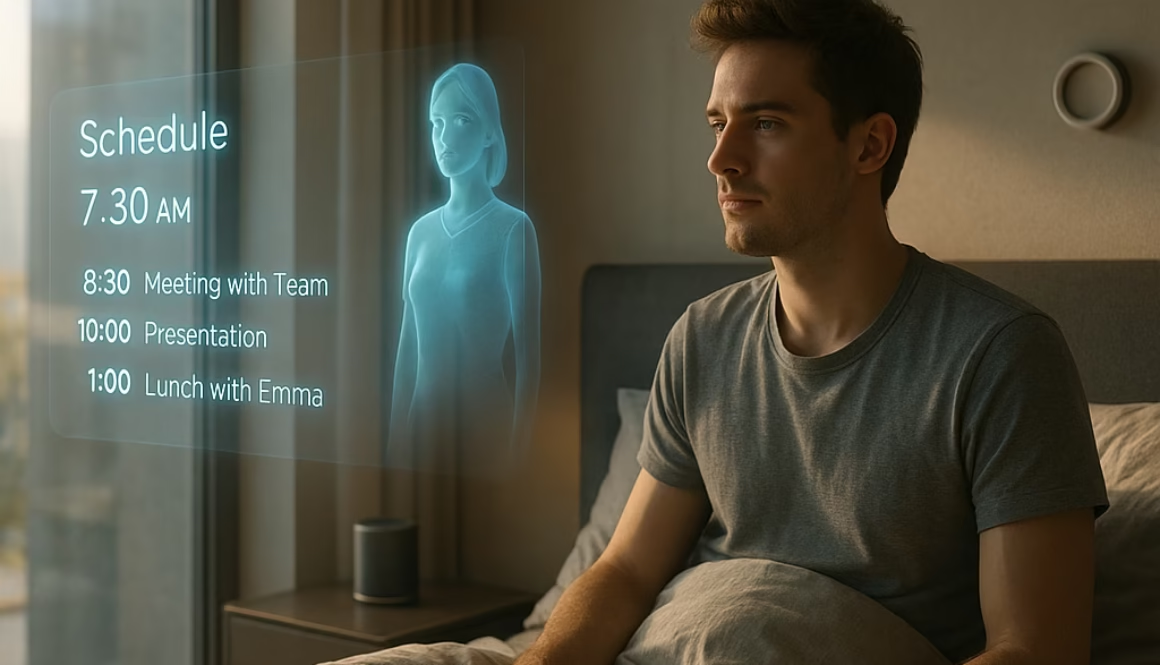
Maya doesn’t wake up to that soul-crushing alarm sound we all hate. Instead, her bedroom gradually brightens with soft, natural light that mimics a sunrise. Her AI companion – she calls her Aria – has been quietly watching over her sleep, not in a creepy way, but more like a caring friend who knows exactly when you need those extra five minutes.
“Morning, sleepyhead,” Aria’s voice is warm, almost teasing. “Rough night with that project deadline, huh? I could tell from your tossing and turning. How about we start with some gentle stretching instead of jumping straight into emails?”
Imagine this… An AI that doesn’t just manage your schedule but actually understands your emotional state and responds with genuine care.
Here’s what blows my mind: Aria learned Maya’s patterns over three years. She knows Maya gets shoulder tension when stressed, that she’s more creative after meditation, and that she secretly loves lavender but pretends it’s “too fancy.” Leading AI researchers have been remarkably accurate in their predictions about this kind of personalized intelligence emerging by 2030, as detailed in comprehensive studies like Silicon Prophets: What AI Researchers Predict for 2030.
Maya’s bathroom mirror shows her health stats – not in a clinical, intimidating way, but like a gentle check-in from a health-conscious friend. “Your hydration is looking good, but maybe skip the third coffee today?” it suggests with a hint of humor.
7:30 AM: Breakfast Without the Morning Chaos
You know that frantic morning routine where you’re simultaneously making coffee, checking emails, and trying to remember if you have milk? Maya doesn’t live in that chaos anymore.
Her smart kitchen has quietly prepared breakfast based on her health goals and yesterday’s meals. But here’s the beautiful part – when her colleague James texted the group chat about discovering an amazing new café, Aria immediately chimed in.
“I see James is raving about that matcha place downtown. Want to be spontaneous today? I can tweak your afternoon snack to make room for whatever deliciousness you find there.”
This is what AI in 2030 really means – it’s not about rigid optimization, but about creating space for spontaneity and human connection. The technology adapts to our desires, not the other way around.
8:15 AM: The Commute That Doesn’t Suck
I still remember sitting in traffic for an hour, white-knuckling the steering wheel and arriving at work already exhausted. Maya’s experience couldn’t be more different.
Her autonomous car seamlessly merges into the city’s transportation flow. Every vehicle, traffic light, and pedestrian crossing communicates in real-time, creating what engineers call “cooperative mobility.” But Maya doesn’t think about the technical wizardry – she’s having her morning coffee and catching up on industry news.
Imagine this… Commuting becomes productive, relaxing time instead of the stressful ordeal most of us endure today.
During the smooth 20-minute ride, Zander (her work AI) gives her the daily briefing. But he doesn’t just list meetings – he provides context that shows he actually understands workplace dynamics.
“Sarah from marketing seems overwhelmed about the campaign launch,” Zander mentions. “Her email tone yesterday was pretty stressed. Maybe a quick encouraging check-in would help the whole team’s energy?”
As experts at Fingent accurately predicted, AI will transform the world by 2030 by enhancing human relationships rather than replacing them.
9:00 AM: Creativity Amplified, Not Replaced
Maya’s architecture firm buzzes with an energy that would surprise anyone who worried AI would make human work obsolete. Instead of replacing architects, AI has become the ultimate creative collaborator.
When Maya sketches a building concept, her AI partner Blueprint doesn’t criticize or take over – it gets excited right alongside her. “Oh, I love this curved facade! What if we explored how afternoon light would play across it?” Blueprint suggests, instantly generating visualizations that would have taken Maya’s team days to create in 2024.
Imagine this… Your wildest creative ideas brought to life instantly, allowing you to explore possibilities you never could before.
“Remember when we used to spend entire afternoons calculating load-bearing requirements?” her colleague Tom laughs during their team meeting.
Maya grins. “Yeah, and now we spend that time actually dreaming up buildings that inspire people. I think we got the better deal.”
This is exactly what leading AI researchers meant when they discussed the creative renaissance coming in 2030. When mundane calculations happen instantly, human imagination can finally run free.
12:00 PM: Friendship in the Age of AI
Meeting friends for lunch, Maya notices something that would surprise the AI skeptics of 2024: people are more present than ever. Their AI assistants handle all the logistics – restaurant reservations, dietary accommodations, even finding the perfect table for their group’s conversation style – but nobody’s staring at screens.
Imagine this… Technology so seamlessly helpful that it disappears, leaving you fully present with the people you care about.
“It’s weird,” her friend Alex reflects over tacos. “I used to spend half my mental energy managing life’s logistics. Now I actually have headspace for the stuff that matters – like this conversation.”
But Jordan, ever the philosopher, raises the question that echoes through many discussions about AI in 2030: “Don’t you worry we’re becoming too dependent? Yesterday my AI went down for maintenance and I honestly couldn’t remember how to plan my own route to work.”
It’s a fair concern, and Maya has thought about it too. The balance between helpful assistance and maintaining personal agency remains one of the biggest conversations of their time.
3:00 PM: When AI Understands Human Nature
Back at the office, Maya joins a virtual brainstorming session for a new community center. The AI facilitator doesn’t dominate the conversation – instead, it notices when energy dips, suggests breaks when people seem frustrated, and highlights ideas that genuinely excite the team.
What strikes me about AI in 2030 is how it’s learned to work with human psychology rather than against it. The AI doesn’t make creative decisions; it creates conditions where human creativity thrives.
“I love how it caught that moment when Sarah’s eyes lit up about the rooftop garden idea,” Maya tells Tom later. “I might have missed that cue myself.”
This emotional intelligence in AI systems represents one of the most significant developments researchers predicted would emerge by 2030.
6:30 PM: Entertainment That Actually Enriches You
After work, Maya faces the age-old question: “What should I watch tonight?” But instead of scrolling endlessly through options, Aria has prepared a thoughtful suggestion.
“Based on your curiosity about ocean conservation from last week’s conversation, I found this fascinating documentary about underwater rewilding projects. But if you’re not in the mood for learning, I also queued up that comedy series you’ve been meaning to try.”
Imagine this… Entertainment recommendations that actually understand your growth goals and mood, not just your viewing history.
But Maya surprises herself: “Actually, Aria, I want you to pick something completely random. Something I’d never choose myself.”
This small act of rebellion illustrates something important about living with AI – the conscious choice to maintain unpredictability and personal growth.
9:00 PM: Privacy in an AI-Powered World
As Maya winds down, she performs a ritual that’s become second nature in 2030: reviewing her privacy dashboard. The transparency regulations of 2028 require all AI systems to show users exactly what data they collect and how it’s used.
Imagine this… Complete visibility and control over your digital footprint, with the ability to adjust privacy settings as easily as changing your phone’s ringtone.
“Aria,” Maya asks during this daily review, “do you think I rely on AI too much?”
“That’s really a question only you can answer,” Aria responds thoughtfully. “But I can share some observations: today you made 52 independent decisions without consulting me, you overrode three of my suggestions, and you chose spontaneity over optimization twice. You’re using AI as a tool while staying authentically yourself.”
This kind of self-reflection and conscious choice-making has become essential life skills in the age of AI.
The Real Story of AI in 2030
Maya’s day reveals something profound about AI in 2030: it’s not about humans becoming obsolete or technology taking control. Instead, it’s about creating space for what makes us most human – creativity, connection, spontaneity, and growth.
The challenges are real. Privacy concerns persist despite strong legal frameworks. Digital inequality creates gaps between those with access and those without. Some people struggle with over-dependence while others resist beneficial integration.
But what strikes me most about Maya’s world is how ordinary it feels. The technology has become so intuitive that it fades into the background, like electricity or running water. We don’t think about the miracle – we just live our lives, enhanced and empowered.
Looking Forward: The Human Heart of an AI Future
As Maya drifts off to sleep, her smart home gradually dims the lights and adjusts the temperature. Tomorrow will bring new challenges and opportunities in this AI-integrated world.
The most remarkable thing about AI in 2030 isn’t the sophisticated algorithms or seamless automation. It’s how humanity has adapted while maintaining its core values – curiosity, creativity, connection, and compassion. As researchers noted in their comprehensive study on AI predictions, we’ve become true partners with artificial intelligence rather than its masters or servants.
We’ve created a future that amplifies the best of human potential while handling the routine tasks that once consumed our time and energy. And maybe, just maybe, that’s exactly the future we needed.
Read more: The AI Revolution and AI Replacing Jobs or Creating
Frequently Asked Questions About AI in 2030
Here are some answers about AI in 2030. If you have question according to AI in 2030 you can reach me through
What will daily life look like with AI in 2030?
Daily life with AI in 2030 feels surprisingly natural and human-centered. Artificial intelligence handles routine decisions and complex logistics seamlessly, while humans focus on creativity, relationships, and meaningful work. The technology adapts to your preferences and emotional needs, creating more space for spontaneity and personal growth.
How will AI affect jobs by 2030?
Rather than eliminating jobs, AI in 2030 transforms how we work. Routine tasks become automated, but new roles emerge in creative collaboration, emotional intelligence, and human-centered problem solving. Most professionals work alongside AI as creative partners, spending more time on strategy and innovation.
Will AI companions become normal in the future?
AI companions will likely become as common as smartphones are today. They’ll serve as health coaches, work assistants, and personal organizers, but they’re designed to enhance human relationships rather than replace them. The goal is creating more time and mental space for meaningful human connections.
What are the biggest concerns about AI in 2030?
Key concerns include maintaining personal privacy, avoiding over-dependence on AI systems, and ensuring equitable access to AI benefits. However, strong regulatory frameworks and transparent design principles help address many of these challenges while preserving human autonomy and choice.
How will privacy work in an AI-integrated world?
Privacy in 2030 operates on principles of transparency and user control. People can see exactly what data their AI systems collect, how it’s used, and adjust permissions in real-time. Strong legal frameworks ensure that AI serves users’ interests while protecting sensitive information.
Want to explore more about the future of artificial intelligence and its impact on daily life? Subscribe to our newsletter for weekly insights into emerging technologies that put humans first.