Understanding AI Models: LLMs, Vision Models, and Predictive Models (Explained Simply)
Let me tell you something nobody admits: AI sounds complicated because people want it to sound complicated.
You’ve heard the terms thrown around—ChatGPT, Midjourney, Netflix’s algorithm. They’re all “AI,” right? But they work in completely different ways.
Think about your kitchen for a second. You’ve got a blender, an oven, and a fridge. All kitchen tools. But you’d never use a blender to bake bread. Same thing with AI models.
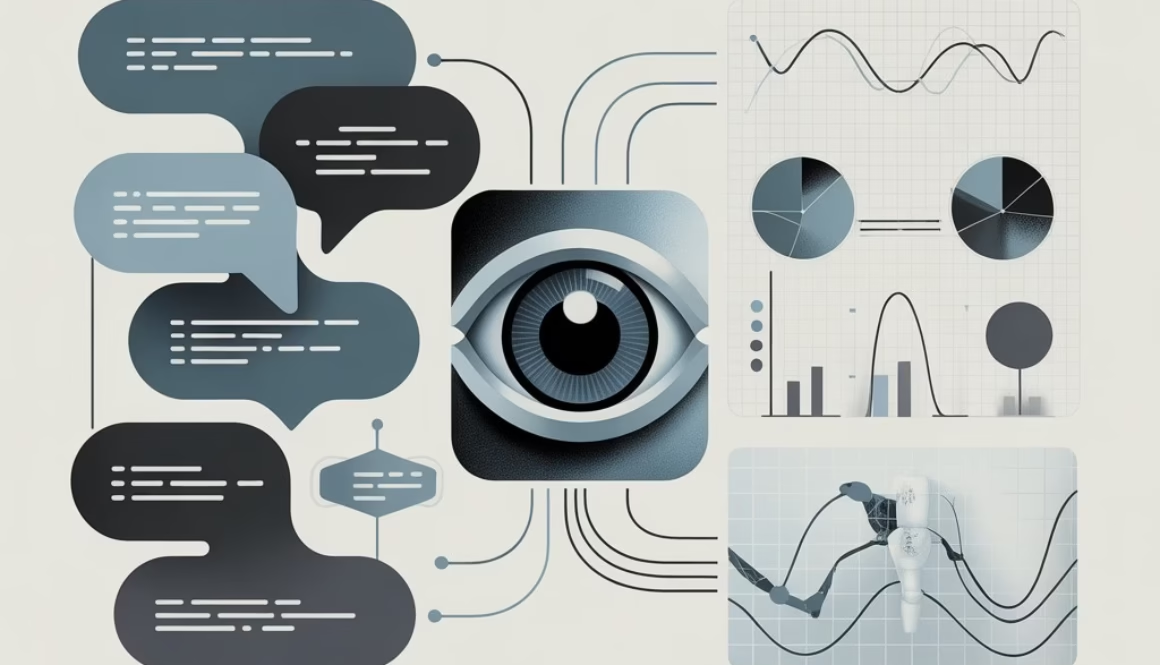
Large language models, vision models, and predictive models—they’re all artificial intelligence, but each one does something totally different. By the time you finish reading this, you’ll understand exactly what separates them, how they actually work, and why companies pick one over another.
lets drive into our topic understanding ai models
Table of Contents
- What Actually Is an AI Model?
- Large Language Models (LLMs): The Text Masters
- Vision Models: Teaching AI to See
- Predictive Models: The Fortune Tellers of AI
- Which AI Model Should You Use?
- How These AI Models Differ
- When AI Models Work Together
- Common Misconceptions About AI Models
- How to Evaluate AI Model Claims
- The Future of AI Models
- What You Actually Need to Consider
- What Non-Technical People Should Actually Do
What Actually Is an AI Model?
An AI model is a trained system that recognizes patterns and makes decisions based on what it learned from data.
Remember teaching a kid what a dog looks like? You show them pictures. Big dogs. Small dogs. Fluffy ones. Eventually, something clicks. The kid can now spot dogs they’ve never seen before.
AI models do the same thing, except instead of a kid looking at pictures, it’s a math system crunching through millions of examples. The “training” is when the model studies all that data. The “model” is what’s left after—the crystallized knowledge that can now make predictions or create outputs.
Different AI models get trained on different stuff. A model trained on text behaves nothing like one trained on images, which works nothing like one trained on sales numbers.
Large Language Models (LLMs): The Text Masters
What Are Large Language Models?
Large language models are AI systems built specifically for human language. When you chat with ChatGPT, Claude, or Google’s Gemini, you’re talking to an LLM.
The “large” part means two things. First, these models learn from massive amounts of text—huge chunks of the internet, millions of books, countless articles. Second, they contain billions of internal parameters that help them understand language patterns.
How LLMs Actually Work
Here’s the core: LLMs predict what word comes next.
If I write “The cat sat on the…”—you’d probably say “mat” or “chair.” You’re not psychic. You’ve just read enough English to know what typically follows. LLMs do exactly this, except they calculate mathematical probabilities across billions of possible word combinations.
But here’s where it gets interesting. Through training, they develop something that looks remarkably like actual understanding. They learn grammar, facts, reasoning patterns, even subtle stuff like tone and context.
When you ask an LLM to “explain quantum physics like I’m five,” it’s generating a brand new response by predicting the most appropriate word sequence based on everything it learned during training.
What LLMs Can and Can’t Do
LLMs excel at:
Writing and editing in virtually any style—formal business emails, creative stories, complex technical stuff simplified. They handle all of this naturally because they’ve seen millions of examples during training.
Following conversations across long threads. Unlike those annoying old chatbots that forgot what you said three messages ago, modern LLMs track context throughout entire discussions.
Translation between languages with real nuance—capturing meaning, idioms, and cultural context rather than word-for-word substitution.
LLMs struggle with:
Real-time information. An LLM trained in January 2025 knows nothing about February 2025. Their knowledge freezes at training cutoff, which is why many AI assistants now integrate web search capabilities to stay current.
Precise math calculations. LLMs can explain math beautifully but sometimes mess up basic arithmetic because they’re predicting plausible-looking numbers, not actually computing.
Complete factual reliability. LLMs occasionally “hallucinate”—generating confident-sounding but incorrect information.
Real-World Applications of LLMs
I see this mistake constantly: people assume all chatbots are the same. They’re not. Modern customer service chatbots powered by LLMs understand complex questions and provide helpful responses without frustrating customers with rigid scripts. Companies like Intercom have transformed customer support by implementing LLM-powered chatbots that handle everything from password resets to nuanced product recommendations—understanding context and intent in ways older systems never could.
Content creation tools help writers overcome blank-page syndrome and rewrite text for different audiences. Code assistants like GitHub Copilot suggest completions and debug problems—invaluable for both beginners and experienced developers. Educational platforms leverage LLMs as tutoring assistants that adapt to student confusion and provide instant feedback.
Vision Models: Teaching AI to See
What Are Computer Vision Models?
If LLMs are the language experts, vision models are the ones that understand images and video. Every time your phone unlocks by recognizing your face or a self-driving car identifies a pedestrian—that’s a vision model at work.
How Vision Models Learn to “See”
Vision models don’t “see” like we do.
When you look at a cat photo, your brain just knows it’s a cat. Vision models take a fundamentally different approach. To AI, every image is just a grid of numbers representing pixel colors.
During training, a vision model looks at millions of labeled images—thousands labeled “cat,” thousands labeled “dog,” thousands labeled “car.” Through this process, it learns which pixel patterns correspond to which objects.
So why does this matter? Objects have hierarchical features. To recognize a face, you first need to detect edges, then combine those edges into features like eyes and noses, then combine those features into a complete face. Modern vision models learn this hierarchy automatically. Early layers detect simple patterns like edges and textures. Middle layers combine these into parts—wheels, windows. Final layers assemble everything into complete objects.
Types of Vision Model Tasks
Image classification answers: “What’s in this image?” The model assigns the entire image to a category.
Object detection goes further, drawing bounding boxes around each identified object. Self-driving cars use this constantly to track vehicles, pedestrians, traffic signs, and road boundaries simultaneously.
Image segmentation achieves pixel-level precision, enabling medical imaging where radiologists need to know exactly which pixels represent a tumor versus healthy tissue. Photo editing apps use this to remove backgrounds with surgical precision. Augmented reality applications rely on it to overlay digital objects convincingly on real-world surfaces.
Facial recognition maps faces to unique mathematical signatures that remain consistent across different angles, lighting conditions, and expressions. Airport security systems use this to match travelers against watchlists in seconds.
Image generation flips the process entirely. Models like DALL-E and Midjourney create new images from text descriptions—synthesizing images that never existed before.
What Vision Models Can and Can’t Do
Vision models excel at:
Consistent, repetitive visual tasks at scale. A vision model can analyze thousands of medical scans per day without fatigue, maintaining the same level of attention on scan 10,000 as it did on scan 1.
Detecting subtle patterns humans might miss. In manufacturing quality control, vision models spot microscopic defects that would escape human inspectors. In agriculture, they identify early signs of plant disease from drone footage before symptoms become visible to farmers.
Operating in dangerous or inaccessible environments. Underwater inspection drones use vision models to assess oil rig damage. Space exploration rovers employ them to navigate alien terrain and identify geological features of interest.
This is where things get risky:
Conditions outside their training experience. A facial recognition system trained primarily on well-lit, front-facing photos might fail dramatically in dim lighting or with people wearing sunglasses. Self-driving car vision systems trained mostly on sunny California roads have struggled with heavy snow that obscures lane markings.
Adversarial attacks and edge cases. Researchers have shown that adding carefully designed stickers to stop signs can cause vision models to misclassify them as speed limit signs—a potentially catastrophic failure for autonomous vehicles.
Inherited bias from training data. Facial recognition systems trained predominantly on lighter-skinned faces have shown significantly higher error rates when identifying darker-skinned individuals. Medical imaging models trained on data from one demographic may perform poorly on others. These aren’t just technical glitches—they’re real problems affecting real people’s access to technology and healthcare.
Real-World Applications of Vision Models
Social media platforms use vision models to automatically tag friends, detect inappropriate content, and analyze what types of content keep you scrolling.
Healthcare applications employ vision models to analyze X-rays and MRIs, often detecting abnormalities human doctors might miss. Organizations like the Mayo Clinic have integrated vision AI and predictive analytics into their clinical workflows to improve diagnostic accuracy and patient care outcomes. Their radiology departments now use AI systems that flag potential issues in medical scans, helping doctors prioritize urgent cases and catch subtle abnormalities that might otherwise go unnoticed.
Dermatology apps now use vision models to provide preliminary skin cancer screenings by analyzing photos users take with their phones—though these should always be followed up with professional medical evaluation.
Retail sites use visual search—upload a photo of shoes you like and find similar products. Warehouse automation relies heavily on vision models for robots to identify, grasp, and sort packages. Some grocery stores use ceiling-mounted vision systems to track inventory on shelves in real-time.
Security systems leverage facial recognition, though this raises important questions about privacy and consent—especially when deployed in public spaces without clear notification.
Agriculture technology uses drone-mounted vision models to monitor crop health across vast fields, detect pest infestations before they spread, and optimize irrigation by identifying which specific areas need water.
Predictive Models: The Fortune Tellers of AI
What Are Predictive Models?
Predictive models might be the least flashy category, but they’re the most widely used in business. These models analyze historical data to forecast future outcomes.
Unlike LLMs that generate text or vision models that understand images, predictive models work with structured data—spreadsheets, databases, sensor readings, transaction logs. When Netflix suggests shows you might enjoy or your credit card company flags a suspicious transaction—that’s a predictive model.
How Predictive Models Work
The core idea: the past contains clues about the future.
A retail company wants to predict next month’s sales. A predictive model analyzes past sales data along with factors that influenced those sales—season, weather, promotional campaigns, economic indicators, competitor actions.
The model learns relationships: “When we ran promotions during summer weekends, sales increased by X percent. When unemployment rose, luxury item sales fell by Y percent.”
Once trained, the model forecasts based on current conditions with a stated level of confidence.
Categories of Predictive Models
Classification models predict categories: Will this customer churn or stay? Is this email spam? Will this loan default?
Regression models predict numerical values: How much will this house sell for? What will tomorrow’s temperature be?
Time series models specialize in data that changes over time—stock prices, website traffic, disease outbreak patterns. These models understand seasonality, trends, and cyclical patterns that repeat across days, weeks, or years.
Anomaly detection models identify unusual patterns. Fraud detection and network intrusion detection rely on spotting deviations from normal. Manufacturing equipment uses these to predict mechanical failures before they happen by detecting unusual vibration patterns or temperature readings.
Recommendation systems predict what you’ll like based on your past behavior and similarities to other users. These power not just entertainment platforms but also e-commerce suggestions, job recommendations on LinkedIn, and even romantic matches on dating apps.
What Predictive Models Can and Can’t Do
Predictive models excel at:
Finding complex patterns in massive datasets. They can consider hundreds of variables simultaneously—far more than any human analyst could track.
Consistent decision-making at scale. Where human judgment might vary based on mood or fatigue, a predictive model applies the same criteria to every case.
Quantifying uncertainty. Good predictive models don’t just make predictions—they tell you how confident those predictions are.
Predictive models struggle with:
Unprecedented situations. When COVID-19 hit, predictive models trained on historical data suddenly failed because nothing in their training resembled a global pandemic.
Explaining their reasoning. Many advanced predictive models work as black boxes. They can tell you “this loan applicant will likely default” but can’t always explain exactly why.
Distinguishing correlation from causation. A predictive model might notice that people who buy premium pet food also tend to have higher credit scores—but that doesn’t mean buying fancy dog food causes good credit.
Real-World Applications of Predictive Models
Financial institutions use predictive models for credit scoring, fraud detection, and risk assessment. Banks process millions of transactions daily, with AI flagging suspicious patterns in real-time. When your card is declined at an unusual location, that’s a predictive model protecting you from potential fraud.
Healthcare organizations predict patient outcomes and readmission risks. Hospitals use predictive models to forecast which emergency department patients will need to be admitted, helping them allocate beds and staff more efficiently. Some health systems predict which patients are at high risk of developing sepsis, enabling earlier intervention.
Supply chain management depends on predictive models for demand forecasting—companies like Amazon and Walmart use these predictions to stock products before customers even know they want them. During holiday seasons, these models help retailers avoid both stockouts and excess inventory that would need deep discounting.
Telecommunications companies use churn prediction models to identify customers likely to switch providers. When the model flags a high-risk customer, the company might proactively offer a retention discount. This is why you often get a “special offer” right when you’re considering switching carriers.
Marketing teams leverage predictive models to identify high-value customers and optimize ad spending. Email campaigns use predictive models to determine the best send time for each individual recipient based on when they’re most likely to open and engage.
Climate science uses sophisticated predictive models to anticipate weather patterns and project climate change impacts. These models integrate data from satellites, weather stations, ocean buoys, and historical records to forecast everything from tomorrow’s temperature to long-term climate trends.
Here’s Why This Matters in Practice
Every time you swipe your credit card, a predictive model analyzes that transaction in milliseconds against hundreds of factors:
Is this location consistent with your recent activity? If you bought coffee in Seattle this morning, a purchase in Miami this afternoon gets flagged. Is the merchant category typical for you? If you never shop at jewelry stores but suddenly there’s a $5,000 jewelry purchase, that’s suspicious. Is the purchase amount unusual? Does the transaction match temporal patterns—are you normally asleep at 3 AM but there’s activity now?
The model assigns a fraud probability score. Low risk: transaction goes through instantly. Medium risk: additional verification required. High risk: transaction declined, and you get a text asking to confirm. The model learns continuously from which flagged transactions turned out to be real fraud versus false alarms.
Which AI Model Should You Use?
When you’re trying to figure out which type of AI model fits your problem, ask yourself three questions:
What’s your input?
- Text (emails, documents, conversations) → Consider an LLM
- Images or video (photos, scans, camera feeds) → Consider a vision model
- Structured data (spreadsheets, databases, sensor logs) → Consider a predictive model
What output do you need?
- Generated language (writing, translation, summarization) → LLM
- Visual understanding (classification, detection, recognition) → Vision model
- Future prediction or category assignment (forecasts, probabilities, recommendations) → Predictive model
What’s your core goal?
- Communicate with users in natural language → LLM
- Understand or create visual content → Vision model
- Make data-driven predictions or decisions → Predictive model
Sometimes you’ll need more than one. An e-commerce site analyzing customer reviews uses an LLM to understand the text, a vision model to assess product photos, and a predictive model to forecast which products to stock based on sentiment trends.
The key is matching the model type to the data type and the decision you need to make. Don’t use an LLM when you need to predict next quarter’s revenue—that’s a job for predictive models. Don’t use a predictive model when you need to generate marketing copy—that’s what LLMs do.
How These AI Models Differ
Quick Comparison Table
| Feature | LLMs | Vision Models | Predictive Models |
|---|---|---|---|
| Input Data | Text (books, articles, conversations) | Images & video (photos, scans, footage) | Structured data (numbers, categories, time series) |
| Training Material | Written language, documents, web content | Labeled images, annotated videos | Historical records, transaction logs, sensor data |
| Primary Function | Understand and generate human language | Recognize patterns in visual information | Forecast outcomes based on historical patterns |
| Output Type | Generated text (responses, articles, summaries) | Visual classifications, object locations, modified images | Predictions (probabilities, categories, numerical values) |
| Best Used For | Writing, conversation, translation, explanation | Image recognition, visual inspection, facial identification | Sales forecasting, fraud detection, recommendations |
| Accuracy Style | Fluent but occasionally unreliable factually | High accuracy on trained scenarios, fails on edge cases | Probability-based forecasts with confidence levels |
| Real-Time Capability | Limited by training cutoff date | Real-time analysis of visual feeds | Real-time predictions based on current data |
| Common Failures | Hallucinations, outdated information, math errors | Poor lighting, adversarial examples, demographic bias | Unprecedented events, correlation vs causation confusion |
| Explainability | Can describe reasoning in natural language | Difficult to explain pixel-level decisions | Often works as “black box” with limited transparency |
| Example Applications | ChatGPT, content creation, customer service chatbots | Facial recognition, medical imaging, autonomous vehicles | Netflix recommendations, credit scoring, weather forecasting |
The Problems They Solve
LLMs excel when the challenge involves language: writing, translation, summarization, conversation.
Vision models shine when sight is the primary sense needed: identifying objects, analyzing images, navigating physical spaces.
Predictive models dominate when you need to forecast the future or make decisions based on numerical patterns.
When AI Models Work Together
Modern AI applications gain power through collaboration.
Consider your phone’s virtual assistant. You say, “Show me photos of my dog from last summer.” A speech recognition model converts your voice to text. An LLM parses your request. A vision model has already tagged your photos. A predictive model ranks results based on which photos you’ve viewed or shared before.
Smart home thermostats use predictive models to learn temperature preferences. When you ask about energy usage, an LLM translates your question and formats the response. Some systems use vision models to detect room occupancy.
E-commerce platforms use predictive models for recommendations, vision models for visual search, and LLMs to generate product descriptions and analyze reviews.
Autonomous vehicles combine vision models (analyzing camera feeds), sensor fusion models (combining data from cameras, radar, lidar, GPS), path planning models (predicting movement of other vehicles), and sometimes LLMs to explain driving decisions to passengers.
Healthcare diagnostics combine vision models analyzing medical images, predictive models assessing disease risk, and LLMs summarizing patient records and explaining findings.
Common Misconceptions About AI Models
“AI Understands Things Like Humans Do”
AI models recognize statistical patterns extraordinarily well, but that’s fundamentally different from human understanding.
An LLM can eloquently discuss loneliness without ever feeling lonely. A vision model can identify thousands of dog breeds but has no concept of “dog-ness” beyond pixel patterns. This distinction isn’t philosophical—it’s practical. It tells you exactly where AI will help and where it will confidently fail.
“Bigger Models Are Always Better”
Larger models often perform better on complex tasks, but they’re also slower and more expensive. A compact vision model trained specifically on medical X-rays will typically outperform a general image model for that task, even if the general model is much larger.
“AI Models Learn and Improve Over Time Automatically”
Most AI models are static after training. The ChatGPT responding to you today is identical to the one responding to millions of other users.
“AI Will Soon Replace Human Intelligence”
Current AI models excel at narrow, specific tasks but lack the flexible, general intelligence humans deploy effortlessly. An LLM can write beautiful prose but can’t learn to ride a bicycle. A vision model can identify thousands of objects but can’t improvise when its camera lens gets dirty.
How to Evaluate AI Model Claims
Ask: What’s the actual task? Marketing often obscures what an AI system actually does. Understanding the specific task helps you evaluate whether the AI is genuinely useful.
Consider the training data. AI models reflect their training data. An LLM trained primarily on English will struggle with other languages.
Look for transparency about limitations. Companies confident in their AI openly discuss what it can’t do. If a product only discusses capabilities, approach with skepticism.
Evaluate the human oversight level. The most reliable AI systems include human supervision for critical decisions. Publications like MIT Technology Review regularly examine AI bias, limitations, and ethical considerations—offering independent analysis that cuts through marketing hype. Their reporting on AI systems has exposed significant flaws in facial recognition accuracy, algorithmic bias in hiring tools, and limitations in medical AI that companies were reluctant to acknowledge publicly.
The Future of AI Models
The distinction between LLMs, vision models, and predictive models is already blurring. Models like GPT-4 Vision, Gemini, and Claude can process both text and images. Future models will seamlessly handle text, images, audio, video, and structured data simultaneously.
This matters because reality isn’t neatly divided into categories. When you ask, “What’s wrong with my plant?”—an AI that can analyze both your description and a photo will give better advice.
We’re seeing rapid progress in creating compact, specialized models that match or exceed larger models on specific tasks while running faster and cheaper. This will make AI accessible to smaller organizations and enable more on-device AI.
Massive research effort focuses on improving reliability—reducing hallucinations, enhancing logical reasoning, making models better at knowing what they don’t know.
Future AI systems will better adapt to individual users while maintaining privacy—understanding you specifically rather than just humans generally.
But here’s what rarely gets discussed: multimodal models face fundamental trade-offs. A model that does everything competently might not excel at anything specifically. The best language model and the best vision model might always be separate, specialized systems. We’re betting heavily on generalist AI when specialized tools might prove more reliable for critical applications.
The most exciting developments won’t be AI replacing humans—they’ll be AI augmenting human capabilities. Doctors with AI diagnostic assistance. Teachers with AI tutoring tools. Programmers with AI coding partners. Though even here, we should be cautious. We don’t yet know the long-term effects of humans becoming dependent on AI assistance for tasks they used to perform independently.
What You Actually Need to Consider
The ethical conversation around AI gets abstract quickly. Here’s what matters for the decisions you’ll actually face.
Consider a concrete example: an insurance company uses a predictive model to set your health insurance premium. The model analyzes thousands of data points—your age, location, past claims, even less obvious factors like your occupation and education level.
One day, you’re denied coverage, or quoted a price three times higher than your neighbor. When you ask why, the company says, “The AI determined you’re high risk.” But they can’t—or won’t—explain which specific factors drove that decision.
Was it your zip code? A past medical condition? Something correlated with risk that has nothing to do with your actual health?
This is where AI ethics becomes personal. You’re facing a consequential decision about your life made by a system nobody can fully explain. The model might be statistically accurate overall, but that doesn’t help you understand why you specifically got that result.
Now multiply this across loan applications, hiring decisions, college admissions, criminal sentencing recommendations, and countless other high-stakes scenarios.
Bias isn’t a bug—it’s inherited. When you encounter AI making important decisions about people, ask who trained it and on what data.
Privacy questions have no good answers yet. Your conversations with AI assistants, the photos you upload—all of this trains future models or informs current predictions. Assume nothing stays private unless explicitly guaranteed.
“Black box” decisions become everyone’s problem. When an AI denies your loan application and nobody can explain exactly why, that’s not a technical limitation—it’s a policy choice. We could demand explainability. We mostly don’t.
The environmental cost is real but rarely discussed. Training large AI models consumes as much energy as small cities. Every ChatGPT conversation has a carbon footprint.
What Non-Technical People Should Actually Do
Understanding AI fundamentals changes how you navigate the world.
When someone says “our AI does X,” you can now think: “Which type of model would actually do that? Does that make sense?”
Knowing LLMs occasionally hallucinate helps you fact-check outputs. Understanding vision models need good image quality helps you photograph things properly for analysis.
Whether adopting AI in your business, choosing AI-powered products, or understanding how AI impacts your daily life—this knowledge provides a foundation for better decisions.
The One Thing Most People Get Wrong
Stop fearing AI will become sentient. Start paying attention to how it’s being deployed right now—in hiring algorithms, content moderation, financial decisions, and criminal justice.
Understanding what different AI model types actually do—LLMs processing language, vision models analyzing images, predictive models forecasting outcomes—isn’t about becoming an expert. It’s about knowing enough to use them wisely, evaluate them critically, and participate in decisions about how they shape our world.
The real questions aren’t about future superintelligence. They’re about accountability, transparency, and fairness in systems already making consequential decisions about real people.
The question isn’t whether AI will impact your life. It already has. The question is whether you’ll understand it well enough to navigate that reality on your own terms.
Go to Next Lesson:
Everyday AI Use Cases: The Invisible Technology Shaping Your Daily Life (And Why You Should Care Right Now)
Now that you understand the different types of AI models—like large language models, vision models, and predictive systems—the next question is simple:
Where do these models actually show up in real life?
AI models don’t just exist in research labs. They quietly power many of the tools and services people use every day—from recommendation systems and navigation apps to spam filters and streaming platforms.
In the next guide, you’ll explore real-world examples of AI working behind the scenes, and see how these systems are already shaping the way we communicate, shop, travel, and make decisions.
👉 Read next: Everyday AI Use Cases: The Invisible Technology Shaping Your Daily Life (And Why You Should Care Right Now)