The first time I tried generating a 3,000-word article in a single prompt, it looked impressive.
Until I read it carefully.
The structure was there. The headings looked professional. The language sounded confident. But something was deeply off. Every paragraph had the same rhythm. Every section built logically into the next. There was no friction, no personality, no moment where you felt like a real person was behind the words.
I published it anyway. Didn’t even run a full read-through. I figured the AI had covered everything — why second-guess it?
The article cited a study claiming “72% of marketers say long-form content outperforms short-form in lead generation.” Sounded authoritative. Specific number. Perfect for backing up my argument.
Didn’t exist.
A reader called it out in the comments three days after publish. I spent an embarrassing twenty minutes trying to find the original source before accepting it was simply made up. The AI had generated a statistic that fit the narrative perfectly. And I had published it without checking.
That moment changed how I approach every piece. Not because I’m paranoid — but because I understood, finally, what AI tools actually are. They’re pattern matchers. Incredible ones. But they don’t know what’s true. They know what sounds true.
That article still lives in my drafts folder. I keep it there on purpose.
Here’s the uncomfortable truth most AI content guides won’t say out loud: most AI-generated long-form content currently on the internet is garbage. Not because AI is bad. Because people are using it wrong — hitting generate, skimming the output, clicking publish. Treating a thinking assistant like a vending machine.
And most AI content workflows are completely backwards. People generate first, then think about what they actually needed. That’s like building a house and then drawing the blueprint.
Creating high-quality long-form content using AI tools requires flipping that entirely. Strategy first. Architecture second. Generation third. Then — and this is the part everyone skips — a ruthless human editing pass that makes the content actually worth reading.
Anthropic’s research on large language model capabilities makes something clear that most content creators miss: these models perform best when given precise structure and constraints. The quality of your output is almost entirely determined by the quality of your input. Garbage prompt, garbage article.
This guide is the system I wish I’d had before I published that first embarrassing draft. No generic tool lists. No surface-level tips. Just the workflow, the prompting architecture, the SEO layer, the real risks, and where this space is actually heading.
Let’s get into it.
Who This Guide Is For
Before diving in — a quick check.
This guide is for people who are done with generic AI content advice and ready to build something that actually works. Specifically:
Bloggers scaling content production who want to publish more without sacrificing the voice and quality that built their audience
SaaS and B2B content teams trying to build genuine topical authority without hiring three more writers
Agencies managing AI workflows across multiple clients who need a repeatable, defensible system
Solo creators and consultants who want AI leverage but refuse to publish content that sounds like everyone else
If you’re looking for a tool list and a “5 steps to use ChatGPT” breakdown — this isn’t that. If you want the actual strategic framework that separates content that ranks from content that disappears, keep reading.
What Is Creating High-Quality Long-Form Content Using AI Tools?
Let’s define this properly. Not the polished marketing version — the real one.
Creating high-quality long-form content using AI tools means using AI as a collaborator, not a ghostwriter. You bring the strategy, the expertise, the perspective, and the editorial judgment. AI brings speed, breadth, and the ability to generate structured prose without staring at a blank page for two hours.
Long-form typically means anything over 1,500 words. But competitive content — the stuff that actually ranks and earns backlinks — usually sits between 2,500 and 5,000 words depending on the topic. A Backlinko analysis of over 11 million Google search results found that the average first-page result contained around 1,447 words. For genuinely competitive informational topics, that number goes higher. Longer, deeper content simply wins more of the signals search engines care about: backlinks, time-on-page, topical coverage, return visits.
The problem: they’re expensive and slow to produce without help.
A skilled writer with the right AI workflow can produce a research-backed, well-structured 3,500-word draft in three to four hours. The same piece, done manually from scratch, might take a full day or more. That compression is real — especially for content teams working at scale.
But that three-to-four hour timeline only works if you have an actual system.
Without one, you’ll spend three hours generating content and four more hours trying to fix it.
Why Long-Form Content Still Wins
The HubSpot State of Marketing Report shows consistently that companies prioritizing long-form content generate significantly more organic leads than those focused on shorter formats. The SEO math is straightforward — longer content covers more semantic ground, earns more backlinks, and gives Google more signals to work with.
If you’re wondering how to create long-form blog posts using AI that actually compete in search — the answer starts here. The length isn’t the strategy. The depth is. Long-form is just the format that makes genuine depth possible.
But it only works if the content is actually good.
That’s the entire point of this guide.
Why Most AI Content Workflows Are Completely Backwards
Type something like “write me a blog post about X”
Copy the output
Maybe run it through Grammarly
Publish
And then wonder why the content doesn’t rank. Why readers bounce. Why it feels hollow.
The problem isn’t the AI. The problem is skipping all the steps that actually matter.
Here’s a side-by-side look at what separates a content team that ranks from one that wonders why nothing works:
╔══════════════════════════════════╦══════════════════════════════════╗
║    ❌ BAD AI WORKFLOW             ║    ✅ GOOD AI WORKFLOW         ║
╠══════════════════════════════════╬══════════════════════════════════╣
║ "Write me a blog post about X"   ║ Research brief first. Always.    ║
║ One massive prompt               ║ Section-by-section generation    ║
║ Copy → Grammarly → Publish       ║ Depth injection pass             ║
║ No fact-checking                 ║ Fact-verify every claim          ║
║ Generic, neutral tone            ║ Human voice layered in           ║
║ No SEO review                    ║ Semantic gap analysis            ║
║ Isolated article                 ║ Fits inside a content cluster    ║
║ AI is the author                 ║ AI is the tool. You're the author║
╚══════════════════════════════════╩══════════════════════════════════╝
The right side takes more time upfront. It produces content that actually earns traffic. The left side is faster to publish and slower to rank — if it ranks at all.
Here’s what a professional workflow looks like:
Strategize → Architect → Research → Generate (section by section) → Deepen → Optimize → Humanize
Notice that “Generate” is step four. Not step one.
Most people start at step four. Then skip five through seven entirely.
That’s why their content looks AI-generated. Because it is — and it’s been left that way.
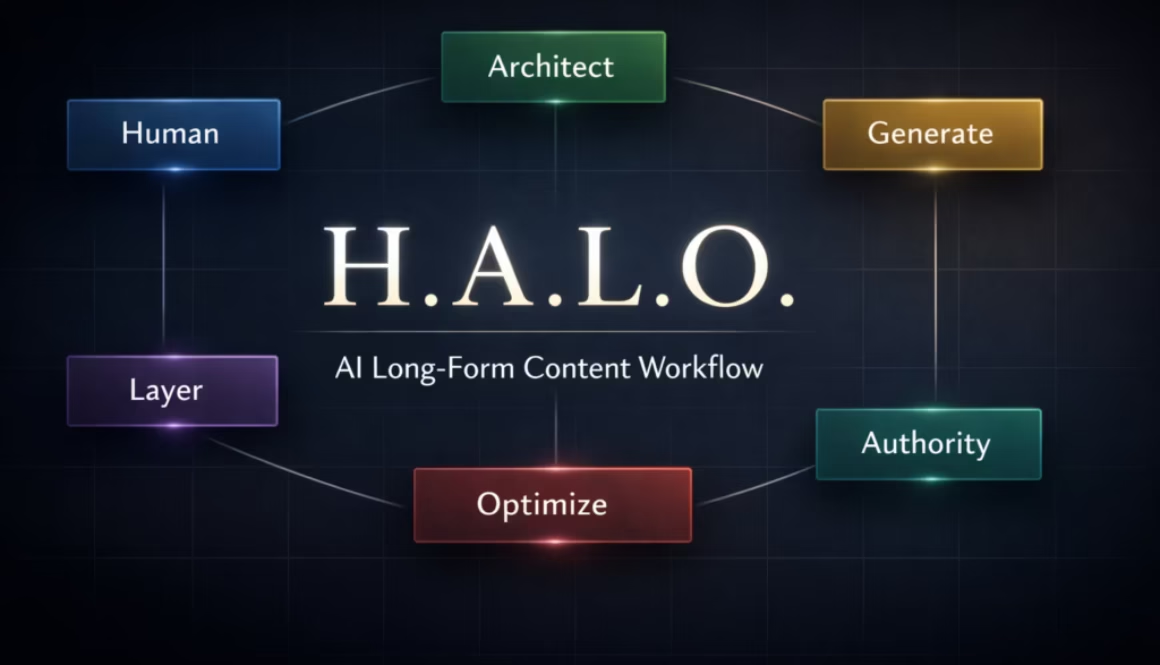
The framework later in this guide — I call it the H.A.L.O. Method — fixes this by making the human intelligence layer non-optional at every stage. Not just at the end. Not just for editing. At every stage.
Technical Breakdown: How AI Actually Generates Content
You don’t need a PhD to understand this. But you do need a mental model. Without it, you’re just hoping the model does what you want instead of directing it precisely.
Token Prediction — The Actual Mechanism
Large language models like GPT-4, Claude, or Gemini don’t “think” the way humans do. They generate text through token prediction. Given a sequence of input words and sub-words, the model calculates the most statistically probable next token. Then the next. Then the next.
Repeat 3,000 times.
That’s your article.
This is why vague prompts produce generic output. If your input is average, the model defaults to the most average response in its training distribution. Specific input pushes the model toward specific, non-generic territory.
And specific is what you want.
Transformer architecture — introduced in the 2017 paper “Attention Is All You Need” — allows modern LLMs to maintain context across thousands of tokens simultaneously. In plain terms: they can remember what the article was about when they’re writing paragraph thirty-seven. As long as you prompt them correctly.
Context Windows Matter More Than People Think
Every LLM has a context window — the maximum number of tokens it can process in a single session.
GPT-4 Turbo: up to 128,000 tokens. Claude: up to 200,000 tokens. This is significant for long-form content — it means the model can theoretically hold an entire 5,000-word article in active memory.
But here’s where it gets tricky.
Approaching that limit causes the model to lose coherence with earlier sections. You’ll notice this when section five contradicts something established in section two. The fix: generate section by section, feeding the model a running summary of what’s already been written before each pass. It keeps everything contextually grounded.
AI Tool Categories — What Actually Does What
Most people don’t realize there are distinct categories of AI tools for content creation. They all serve different functions. Using only one is like trying to cook a full meal with just a knife.
The key insight: these tools don’t replace each other. They each cover a different gap in your workflow. The best AI writing tools for bloggers are the ones that fit together into a coherent system — not the ones with the most impressive feature list.
What a Good Prompt Actually Looks Like
Here’s the logical structure behind a well-engineered content prompt. Think of this as pseudocode for your prompting approach:
This isn’t code you run anywhere. It’s the thinking behind a prompt that consistently produces better output.
The difference between prompting like this and typing “write me a section about X” is not subtle. It’s often the difference between a publishable draft and noise you’ll need to rewrite from scratch.
This is what AIprompt engineering for SEO content actually looks like at the operational level — not a theoretical concept, but a repeatable input structure that shapes every output you get from the model.
The H.A.L.O. Method: Step-by-Step Framework for Creating High-Quality Long-Form Content Using AI Tools
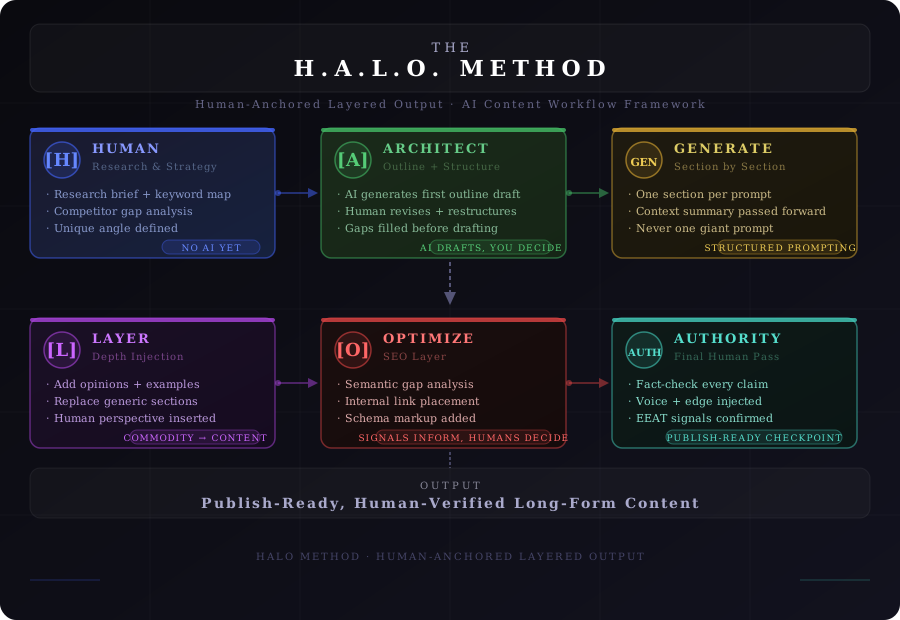
H.A.L.O. stands for Human-Anchored Layered Output.
It’s the system that prevents AI from doing what it naturally wants to do: produce smooth, comprehensive, emotionally neutral content that says nothing new.
Here’s the full workflow at a glance:
╔══════════════════════════════════════════════════════════════╗
║              THE H.A.L.O. METHOD — AT A GLANCE               ║
╠══════════════╦═══════════════════════════════════════════════╣
║ [H] HUMAN    ║  Research Brief → Strategy → Unique Angle     ║
║              ║  (No AI yet. This is YOUR thinking.)          ║
╠══════════════╬═══════════════════════════════════════════════╣
║ [A] ARCHITECT║  AI-Assisted Outline → Human Revision         ║
║              ║  (AI drafts. You restructure.)                ║
╠══════════════╬═══════════════════════════════════════════════╣
║ GENERATE     ║  Section-by-Section Drafting                  ║
║              ║  (Never full article in one prompt.)          ║
╠══════════════╬═══════════════════════════════════════════════╣
║ [L] LAYER    ║  Depth Injection → Examples → Opinions        ║
║              ║  (Human intelligence poured in.)              ║
╠══════════════╬═══════════════════════════════════════════════╣
║ [O] OPTIMIZE ║  SEO Signals → Semantic Terms → Schema        ║
║              ║  (Tools inform. Humans decide.)               ║
╠══════════════╬═══════════════════════════════════════════════╣
║ AUTHORITY    ║  Fact-Check → Voice → EEAT Signals            ║
║ PASS         ║  (The stage that makes it publishable.)       ║
╚══════════════╩═══════════════════════════════════════════════╝
The H.A.L.O. Method breaks creating high-quality long-form content using AI tools into six human-anchored stages — from research brief to publish-ready authority pass. Skip any stage and the quality collapses.
Skip any stage and the quality collapses.
I tested that the hard way. Early on I skipped the research stage entirely — jumped straight to outline, then generation. The resulting draft looked fine on the surface. Covered the topic. Hit the word count. But when I ran it through competitor analysis, it was saying the exact same things as the three top-ranking articles, just in slightly different words. Nothing new. No angle. No reason for anyone to choose my version over the others.
That piece never ranked. Still hasn’t.
H.A.L.O. Quick-Reference Checklist:
[ ] Research brief completed (keywords, gaps, unique angle, sources)
[ ] SEO tool run, gaps identified, integrated naturally
[ ] Every specific fact verified against a primary source
[ ] Full read-aloud pass for voice and transitions
[ ] Internal links added manually
[ ] EEAT signals present (author expertise, citations, real examples)
Stage 1: Research and Strategy (Human-Led, No AI Yet)
Before AI touches anything, you need a research brief. This is the most important document in your workflow and it takes about thirty to forty-five minutes to produce.
Your research brief includes:
Your focus keyword and 5–8 secondary keywords
The top 3–5 ranking articles for your target keyword (analyzed for gaps, not copied)
Your unique angle — what does your article say that theirs doesn’t?
5–8 credible source links
Your audience profile (who they are, what they already know, what they’re trying to do)
Here’s what a concrete result looks like when this is done properly.
A SaaS content team I worked with was producing four long-form articles per month manually. Each one required two writers, an editor, and roughly nine hours of combined work from first brief to publish. After implementing the H.A.L.O. workflow, their average dropped to just under three hours per article — same quality bar, same editorial standards. Within ninety days, they were publishing eleven articles a month with the same team size. Their organic traffic grew 34% over that quarter. Not because the AI was magic. Because the brief gave the AI something to work with instead of nothing.
The brief is what made that possible. Not the tools. The structure.
Stage 2: Outline Architecture
Now bring in the LLM — but only to generate the first outline draft. Then revise it yourself.
Prompt pattern:
"Generate a detailed H2/H3 outline for a [word count]-word article titled [title].
Target audience: [description]. Core topics: [from your brief].
Unique angle: [your differentiation]. Format: markdown."
Review the output critically. Ask yourself: does this cover the content gaps I identified? Does the structure serve the reader’s actual needs, or just check boxes? Does the flow make logical sense?
Restructure wherever the answer is no.
The outline is your blueprint. A bad blueprint means a bad building no matter how good the materials are.
Stage 3: Section-by-Section Generation
This is where people make the biggest mistake. They ask AI to write the entire article in one go.
Don’t.
Quality degrades sharply as generation length increases. Coherence breaks. Facts wander. Sections start contradicting each other. For each section, prompt like this:
"You're writing Section [X] of an article titled [title].
Outline: [paste full outline].
Summary of what's been written: [paste brief summary].
Now write: [paste H2 and its H3 subheadings].
Requirements: [your specific constraints for this section]."
This keeps the model grounded. It knows where it is in the article, what came before, and what needs to come next.
Stage 4: Depth Injection
Once you have a complete rough draft, read through it honestly.
What’s thin? What’s generic? What could have been written by anyone about anything?
Those sections need human intelligence injected. Specific examples. Real data points. Your actual opinions. Analogies that didn’t come from a language model. Perspectives that reflect genuine expertise.
This is the stage that separates content from commodity.
Generate multiple variations of weak paragraphs. Mix and select the best elements. You’re acting as an editor, not a passive recipient.
Stage 5: SEO Optimization
After the content is solid, run it through Surfer SEO, Clearscope, or MarketMuse. These tools compare your content against top-ranking pages and surface semantic terms and related concepts that are under-represented.
Use the recommendations as signals. Fill genuine gaps. Ignore the rest.
Prompt engineering for long-form content at this stage means asking AI to naturally integrate missing terms — not stuff them.
None. Not even after five rounds of editing. There’s always something that needs a human layer.
Your authority pass covers:
Factual verification — every specific statistic, citation, named claim, and date gets traced to a primary source. AI hallucinations happen constantly and confidently. Remember my “72% of marketers” incident. Every number is suspect until proven otherwise.
Voice and edge — find every passage that sounds measured, balanced, and emotionally neutral. That’s the AI voice bleeding through. Rewrite in your actual voice. Add an opinion. Push back on something.
Transitions — AI-generated sections often feel like separate documents stitched together. Read the full piece aloud. Smooth every join.
Internal links — identify where your existing content is directly relevant. Add those links manually.
EEAT signals — author credentials, original observations, cited external sources, real-world examples. Google’s Search Quality Rater Guidelines are explicit: Experience, Expertise, Authoritativeness, and Trustworthiness are evaluated on content quality — not production method. AI content that shows no evidence of real expertise gets filtered out, regardless of keyword density.
What This Looks Like in Practice: A Real Walkthrough
Let me make this concrete. Abstract workflow descriptions are useful. Watching it applied is better.
After running keyword research, I identify “AI SEO tools” as the focus keyword. Secondary targets include “best AI tools for SEO,” “AI content optimization,” and “how to use AI for keyword research.” I scan the top five ranking articles. Four of them are tool lists with affiliate links and minimal editorial depth. The gap: nobody has published a strategic guide on how to actually use these tools inside a workflow. That’s my angle.
I pull five source links — two from SEJ, one from Google’s developer documentation, one case study from a SaaS company, one academic paper on AI-assisted content analysis.
Step 2 — Outline (20 minutes)
I prompt Claude to generate a detailed H2/H3 outline using my research brief. The output is solid structurally but includes two redundant sections and misses the “workflow integration” angle entirely. I restructure it manually — remove the redundancy, add a dedicated section on integration, reorder three H2s for better logical flow.
Step 3 — Generation (90 minutes across six sections)
Each section is generated individually. For Section 3 (Comparing AI SEO Tool Categories), I give the model the full outline, a 100-word summary of sections 1–2, and specific constraints: three sentences per paragraph max, include the comparison table, reference only tools mentioned in the research brief.
The output is 80% usable on first pass.
Step 4 — Depth Injection (60 minutes)
Three sections feel thin after reading aloud. One on “prompt engineering for SEO” has no real examples. I write two original example prompts from scratch, rewrite one full paragraph with a contrarian opinion on keyword density targets, and add a specific client example (anonymized) to the case study section.
Surfer SEO flags three missing semantic terms: “semantic search,” “content brief,” and “NLP optimization.” I integrate the first two naturally into existing paragraphs. The third doesn’t fit without forcing it. I leave it out.
Step 6 — Authority Pass (45 minutes)
I verify every statistic. One is wrong — the tool cited a study from 2019 as if it were current. I find a 2024 update and swap it. I rewrite the introduction in a stronger personal voice, add two internal links to related guides, and add FAQ schema markup to the FAQ section.
Total time: 4 hours 35 minutes. Publishable immediately.
That’s the H.A.L.O. Method working as designed.
SEO Optimization Layer for Creating High-Quality Long-Form Content Using AI Tools
Let’s be direct.
SEO optimization for AI-generated articles is both easier and harder than for manually written content. Easier because AI naturally generates comprehensive topical coverage. Harder because that same comprehensiveness can become shallow if depth signals aren’t intentionally built in.
Most people searching “how to humanize AI-generated articles” are actually asking a different question underneath: how do I make this content worth reading AND worth ranking? Those are the same problem. A piece that reads like a human wrote it is usually a piece that signals genuine expertise — which is exactly what Google is trying to reward.
And here’s the thing nobody says in SEO guides written by people who make money selling SEO tools:
If your entire SEO strategy is “hit green in Surfer,” you’re not doing SEO. You’re doing compliance theater. Optimizing for a tool’s scoring algorithm, not for a human who landed on your page with a real question.
Those two things overlap. They’re not the same thing.
Use the tools. Just don’t let them think for you.
Also — word count doesn’t win rankings. Structured depth does. A tightly organized 2,200-word article that completely answers a specific question will outrank a bloated 4,500-word piece that meanders. Most long-form content is long because it’s unfocused. Not because it’s thorough.
Semantic Clustering — The Right Way to Organize AI Content
The biggest SEO mistake content teams make with AI: publishing isolated articles that don’t connect to anything.
Modern search rewards topical authority. That means your AI content strategy needs to be built around semantic clusters — a pillar page supported by 8 to 12 related cluster posts, each targeting a long-tail variation of the core topic.
When generating each piece, give the LLM full cluster context. Prompt it to reference and link to related content naturally. Over time, this creates a topical web that signals genuine subject expertise — not just keyword coverage.
Supporting articles to build around this guide specifically:
Each of those should link back here. This guide becomes the hub.
Internal Linking — More Intentional Than It Sounds
Every long-form piece should include at least three to five internal links to related content.
Build a simple spreadsheet tracking which articles link to which. Update it every time you publish something new. AI can help identify opportunities if you give it your full content library as context — but the final decisions belong to a human who understands the site’s architecture.
Don’t automate this part.
Seriously. I’ve seen sites where someone automated internal linking with an AI plugin. The result was a dense web of links that looked logical to a machine and made zero sense to a reader. Unrelated articles linked together. Anchor text that had nothing to do with the destination page. It confused users and confused Google.
The linking patterns across your site are a strategic signal. Treat them accordingly.
On-Page Fundamentals
These still apply, unchanged:
Focus keyword in the H1
Focus keyword in the first 100 words
Focus keyword in at least two H2 headings
Natural keyword variations throughout (not exact repetition)
Meta description with focus keyword and a clear value hook
FAQ schema markup where relevant
One thing the SEO optimization for AI-generated articles conversation often misses: structured data. Adding FAQ schema or HowTo schema to eligible sections dramatically improves how Google reads and surfaces your content. Most AI content skips this entirely.
Don’t.
Content Depth Signals
Search engines infer depth from multiple signals beyond word count: number of subheadings, comparison tables, external citations, multimedia elements, and how thoroughly the content covers related semantic territory.
Build these signals deliberately. Not as an afterthought.
Should You Worry About AI Detection Tools?
Short answer: less than you think.
Longer answer: it’s complicated, and worth understanding properly.
What AI Detectors Actually Do (And Don’t Do)
AI detection tools like ZeroGPT, Copyleaks, or Winston AI work by analyzing statistical patterns in text — sentence rhythm, vocabulary distribution, “perplexity” scores (how unpredictable the word choices are). Content that follows highly predictable language patterns gets flagged as AI-generated.
Here’s the problem.
These tools produce a significant number of false positives. They’ve flagged academic papers written by humans, sections of classic literature, and text written by non-native English speakers who naturally write in more structured, formal patterns. A 90% AI score from ZeroGPT means “this text has predictable statistical patterns.” It doesn’t definitively mean AI wrote it.
More importantly: Google has explicitly stated it doesn’t use AI detection tools to evaluate content. People ask “does Google penalize AI content?” constantly — and the answer is no, not directly. Google penalizes low-quality content. The fact that AI produced it is incidental. Its systems evaluate quality signals — expertise, depth, originality, user engagement — not production method. A deeply human piece of writing that answers nothing will not outrank a well-structured AI-assisted piece that genuinely helps readers.
What Actually Matters for Detection (If You Care)
If your content is flagging high, it’s usually because:
Sentence rhythm is too uniform (every paragraph the same length and structure)
Vocabulary is too formal and consistent (no casual phrases, no imperfect transitions)
There are no personal opinions, contrarian takes, or emotionally loaded sentences
The writing is “correct” in a way real humans rarely are for 4,000 words straight
The techniques in this guide — depth injection, human authority pass, rhythm disruption, personal voice — are the same things that lower detection scores. Because they make the content actually more human. Not just less detectable.
Fix the content. The detection scores follow.
Limitations, Risks, and the Ethical Stuff Nobody Wants to Talk About
Here’s where I’m going to say some things that most AI content guides carefully avoid.
AI Hallucinations Are a Bigger Problem Than You Think
LLMs make things up. That’s not a bug being slowly patched — it’s a fundamental characteristic of how token prediction works. The model generates statistically probable text. Sometimes the most probable text is a fabricated statistic, a misattributed quote, or a study that doesn’t exist.
The dangerous part? It does this with exactly the same confidence it uses for accurate information. No hesitation. No qualifier. Just a clean, authoritative-sounding claim that may be entirely fictional.
I know this firsthand. Remember that “72% of marketers” stat from the intro?
That wasn’t a hypothetical. That was me. Three days post-publish. Comments section. Mortifying.
The model generated a number that fit the narrative perfectly. It had no idea the study didn’t exist. It wasn’t lying — it was predicting. And statistically, a specific-sounding percentage attached to a plausible marketing claim is exactly the kind of text that appears in content like this.
Every specific claim. Every named study. Every percentage. Check it against the primary source before it goes anywhere near a publish button.
If you’re building an AI content fact-checking process into your workflow — and you should be — the simplest version is a three-column spreadsheet: Claim | Source Found | Verified Yes/No. Run every AI draft through it before the authority pass. Takes fifteen minutes. Saves you from publishing fiction dressed as expertise.
Training Data Bias — The Global Content Problem
LLMs are trained predominantly on text from certain demographic groups, in certain languages, reflecting certain cultural assumptions. Western. English-dominant. Specific in ways the model doesn’t explicitly acknowledge.
Here’s a concrete example of how this plays out.
A US-based marketing agency used AI to generate a campaign brief for a client’s Indian market launch. The AI confidently described the target customer as someone who “researches products on desktop, prefers email communication, and responds to urgency-based messaging.” That profile describes a US buyer segment reasonably well. In India’s 2024 digital landscape — where mobile-first browsing dominates, WhatsApp is a primary business communication channel, and trust-based relationship selling often outperforms urgency tactics — it was nearly useless. The cultural assumptions were invisible in the text but baked into every recommendation.
In Germany, where AI content transparency regulations are advancing alongside EU AI Act requirements, the same undisclosed AI content could expose brands to legal risk — not just reputational damage.
If you’re publishing for global audiences without culturally-aware human review, you’re likely producing content that feels off to significant portions of your readership. You may not hear about it. That doesn’t mean it’s not happening.
The Internet Is Filling With the Same Content
When every content team uses the same AI tools with similar prompts, something predictable happens.
The internet fills up with the same article written a thousand different ways. Same structure. Same examples. Same measured tone. Different company logos on top.
Go search any competitive B2B topic right now. Look at the top five results. Count how many use a six-step framework. Count how many reference the same three statistics. Count how many have an FAQ section with five questions that all start with “How do you…”
That’s not coincidence. That’s everyone running the same playbooks through the same models.
The counter-strategy is deliberate differentiation. Original data from your own research or surveys. Genuine expert perspective that can’t be synthesized from existing text. Proprietary frameworks with real names. Authentic storytelling that only you could have written.
These things have to come from you. If they don’t, someone else’s AI-generated article is just as good as yours. And eventually, neither of you will rank.
Disclosure — An Uncomfortable But Necessary Conversation
The ethics of AI content disclosure are still evolving. But the direction is clear.
Audiences increasingly expect transparency — especially in health, finance, legal, and editorial contexts. Several major publications have already adopted formal AI disclosure policies. The EU AI Act is bringing regulatory teeth. Other regions will follow.
Publishing AI-assisted content without disclosure isn’t illegal in most places right now. The reputational risk of being caught, as AI detection continues improving, is growing fast.
Be ahead of this. Not behind it.
The Hard Truth: Why 80% of AI Content Will Disappear
This is the section I almost didn’t write. It’s not comfortable. But it’s directional and you deserve an honest read on it.
Most AI content currently being published will not survive the next three years of search algorithm evolution.
Here’s the one-sentence version, and it’s worth reading twice: The average AI-assisted article published today adds nothing new — and search engines are increasingly rewarding original perspective, not surface-level coverage.
That’s not a prediction. It’s the current trajectory made explicit.
Here’s why.
Content inflation is accelerating. The total volume of published web content is growing faster than at any point in internet history — largely because AI has removed the production bottleneck. More content competing for the same keyword real estate means the bar for what actually ranks keeps rising.
AI sameness is a ranking liability. Google’s systems are becoming increasingly sophisticated at identifying content that covers a topic without adding anything genuinely new. Content that’s topically comprehensive but perspective-empty. This is exactly what unedited AI output produces.
Brand authority concentration is happening. As commodity content gets filtered out, search real estate is consolidating around recognizable brands and individual experts with demonstrable credibility. Unknown sites publishing generic AI content will find it harder to earn clicks even when they rank, because users are learning to skip sources they don’t recognize.
Algorithm filtering is inevitable. Every major Google update of the past three years has targeted a version of the same problem: content that exists to capture search traffic rather than to genuinely serve readers. HCU. EEAT. Core updates. They’re all pointed at the same thing.
The 20% of AI content that survives will be the content built on this framework: real strategy, real expertise, real editorial judgment, AI used as a tool rather than a replacement. That content will actually be harder to produce than manual writing was before AI existed — because it requires a higher bar of everything.
That’s not pessimistic. It’s an opportunity.
The teams that build this workflow now will have a significant advantage when the filtering intensifies.
Where Long-Form AI Content Is Actually Heading
A few directions are clear enough to plan around.
AI Agents Are Coming For Repetitive Content Workflows
The current model — human prompts, AI generates, human edits — is already being replaced at the margins by agentic systems. AI agents that autonomously break down content tasks, execute multi-step workflows, and use external tools without manual prompting at each step.
Early versions exist now. Claude’s tool-use capabilities and OpenAI’s agent frameworks are early implementations. Production-ready content agents are probably 18 to 36 months away from mainstream adoption.
When they arrive, the competitive advantage won’t belong to people who use AI. It’ll belong to people who design intelligent AI workflows.
Multilingual Scalability — With Important Caveats
AI translation has improved dramatically. Teams that previously needed dedicated writers for each language market can now produce base content in one language and run localization workflows across multiple markets at a fraction of the prior cost.
But AI still struggles with idiomatic language, cultural nuance, and domain-specific terminology — especially in languages with less training data representation. Human review for localized content remains essential. That’s the quality gate separating professionally localized content from something that reads like it was run through a translator.
The global opportunity is real. It requires the same human-in-the-loop approach. Just applied across more languages.
The Only Model That Survives: Human-AI Co-Creation
The “AI replaces writers” narrative is losing credibility fast. The content that performs best is consistently the content where a sharp human was deeply involved in strategy, editorial direction, and voice.
And no — this doesn’t mean AI replaces writers. It means lazy workflows get replaced.
The skill that compounds over the next five years isn’t just writing. It’s the ability to direct AI output with precision, maintain a distinctive editorial voice, and apply genuine subject expertise at the right points in the process.
Prompt engineering for long-form content is a real professional skill. Build it now.
FAQ
How do you create long-form blog posts using AI without sounding robotic?
Treat every AI draft as raw material, not finished writing. Read it aloud — you’ll immediately identify the flat, rhythmically perfect passages that feel inhuman. Break long sentences into short ones. Add personal opinions. Use imperfect transitions. Ask rhetorical questions. Include at least one moment where you push back on conventional wisdom or share something that went wrong. The more distinctively you write in the final editing pass, the less robotic the piece feels — because it isn’t robotic anymore. The AI built the scaffolding. You built the building.
What are the best AI tools for long-form content writing?
No single tool handles everything well. A solid stack: Claude or GPT-4 for drafting, Perplexity AI for research with live citations, Surfer SEO or Clearscope for optimization signals, and Hemingway Editor for readability pressure-testing. For high-volume teams, platforms like Jasper or Copy.ai add integration layers. But the system matters more than any specific tool. A great workflow with average tools outperforms a poor workflow with premium ones every time.
Can AI-generated long-form content rank on Google?
Yes. But “AI-generated” is doing a lot of work in that sentence. Thin, unedited AI output that adds nothing new? No. AI-assisted content where a real expert added genuine perspective, verified facts, cited credible sources, and wrote for actual humans rather than search engines? Absolutely. Google has been explicit: it evaluates content quality, not how it was produced. EEAT signals are what actually determine ranking performance.
How do you ensure factual accuracy in AI content?
Build a verification checkpoint into every editing pass. Flag every specific claim — statistics, named citations, dates, product details — and trace each one to a primary source. Not a secondary article that mentions the stat. The original study. The official report. The direct publication. Never trust AI to accurately cite its own sources. It will hallucinate citations with total confidence. For content in health, legal, or financial categories, a subject-matter expert review is the minimum responsible standard.
Is prompt engineering necessary for long-form AI writing?
It’s not a nice-to-have. It’s the entire lever. Without structured prompting, LLMs generate the statistical average of their training data — generic, measured, forgettable. Prompt engineering for long-form content — specifying audience, structure, tone, constraints, prior context, and quality signals — is the mechanism that turns AI from a content generator into a strategic collaborator. The gap between a carefully engineered prompt and a casual one isn’t 10% better output. It’s often the difference between something publishable and something you throw away.
Conclusion: Stop Treating AI Like a Vending Machine
Here’s the honest summary.
Creating high-quality long-form content using AI tools is one of the most valuable skills in content marketing right now. And it’s being wasted by the majority of people attempting it.
The ones publishing generic AI output? They’re building nothing. Not authority, not backlinks, not trust. They’re filling the internet with more noise. And Google is getting better — fast — at identifying exactly that kind of content and pushing it down.
The ones using AI as a strategic collaborator — inside a real workflow, with real editorial judgment, with genuine expert perspective layered in at every stage — they’re winning. Publishing faster. Covering more ground. Building content assets that compound over time while everyone else chases their tails.
The H.A.L.O. Method in this guide isn’t magic. It’s discipline.
Strategize before you generate. Architect before you draft. Inject human depth at every stage, not just the end. Verify every fact like your credibility depends on it — because it does. Edit with genuine opinions. Build for readers first, algorithms second.
Here’s what happens to people who don’t adapt:
They keep producing content that sounds like everyone else’s. They watch traffic plateau. They wonder why their AI-assisted workflow isn’t outperforming their old manual process. The answer is always the same — they optimized the generation step and ignored everything around it.
The writers who learn to direct AI with precision, who develop sharp editorial judgment, who bring real expertise and perspective to every piece — those people have an advantage that compounds. Skills that make them harder to automate, not easier.
That’s the version of this you want to be.
Want to go deeper? The H.A.L.O. Method prompt library — with ready-to-use templates for every stage of this workflow — is available as a free download. Sign up for the newsletter below and it lands in your inbox immediately. No fluff. Just the prompts.
Start with one article. Run your first H.A.L.O. workflow end to end. Notice the difference in output quality. Then do it again.
The gap between where you are and where the best AI-assisted content producers operate is mostly workflow.
And workflow is fixable.
Go to Next Lesson: How to Use AI for Research: Fact-Checking, Summaries & Smart Outlines That Actually Hold Up
Now that you understand how to create high-quality long-form content using AI tools, the next important skill is research.
Great content doesn’t come only from good writing—it comes from accurate information, reliable sources, and strong research foundations. While AI can help summarize papers, organize ideas, and speed up information gathering, it can also introduce mistakes if its outputs aren’t verified properly.
In the next guide, you’ll learn how to use AI for research responsibly, including techniques for fact-checking AI outputs, summarizing research papers without losing accuracy, and building structured outlines that are backed by real sources.
Look, I’ll be honest with you. five months ago, I met a person who is still copying and pasting between five different AI tools just to create one decent social media post and videos for clients. Text generator here, image creator there, audio tool, video generation somewhere else entirely. It was exhausting.
Then this research and my suggestions showed him something that completely changed his as will as my perspective. He pulled up his laptop during our coffee meeting and said, “Watch this.” In less than ten minutes, he created an entire brand campaign—logo, website copy, promotional videos, background music, even a podcast intro—all from one conversation with an AI tool.
I sat there, coffee getting cold, watching him work magic I didn’t even know was possible.
That moment? It marked the beginning of my deep dive into what everyone’s calling multimodal AI. And honestly, after spending the last few months testing every tool I could get my hands on, I can tell you this: if you’re still using text-only AI tools in 2025, you’re basically bringing a typewriter to a digital design studio.
What Is This Multimodal Thing Everyone’s Talking About?
Overview of the core data types AI can work with: text, images, audio, video, and code.
Okay, let’s skip the boring technical definitions. Here’s what multimodal AI actually means for people who create stuff for a living and there freelancing journey:
Imagine having a creative assistant who speaks every language—not just English, Spanish and any local language, but also “visual,” “audio,” “code,” and “video.” You describe your vision once, and this assistant creates everything you need across all these different formats. No more switching between apps. No more trying to maintain consistency across different tools. No more wanting to throw your computer out the window because nothing matches.
My friend Lisa runs a small marketing agency, and she explained it perfectly: “It’s like the difference between conducting an orchestra where every musician is in a different room versus having them all on the same stage, playing from the same sheet music.”
The old way—using separate tools for everything—felt like herding cats. You’d write something in ChatGPT, then try to create matching visuals in DALL-E, then hop over to another platform for audio, and somehow try to make it all work together. By the time you finished, half your creative energy was spent on logistics instead of actual creativity.
Why 2025 Became the Year Everything Changed
Here’s what most people don’t realize: we hit a tipping point sometime around March of this year. I remember it clearly because that’s when my freelance income doubled seemingly overnight.
The tools finally got good enough—and affordable enough—that regular people could create professional-quality content without needing a degree in graphic design or a Hollywood budget. My neighbor Tom, who runs a local plumbing business, now creates better-looking ads than some Fortune 150 companies I’ve worked with.
The statistics are pretty wild. According to the latest industry research, nearly two-thirds of content creators are now using multimodal AI. But here’s the kicker: most of them started in just the last eight months. This isn’t a gradual adoption curve—it’s more like a content creation revolution happening in real-time.
And the results speak for themselves. I’ve tracked my own productivity over the past year, and I’m creating about five times more content than I was in early 2024. Not just more content—better content and quality content. More engaging, more cohesive, more professional-looking stuff that actually converts.
Real Stories from Real People Using These Tools
Side-by-side comparison showing the transformation of basic content into polished AI-generated media.
The YouTube Creator Who Cracked the Code
Let me tell you about Marcus, a YouTube creator. He runs a channel about urban gardening, and for years, he struggled with the visual side of content creation. His gardening advice was solid, but his thumbnails looked like they were made in Microsoft Paint circa 2003.
Now Marcus describes his video concept in plain English—something like “cozy morning garden scene with fresh herbs, sunrise lighting, text overlay about 5-minute morning routine”—and gets back a thumbnail that looks professionally designed, script suggestions that match his conversational style, and even background music that complements the peaceful morning vibe he’s going for.
His channel views increased by 300% in four months. Same great content, but now it looks and feels as professional as channels with full production teams.
The Small Business Owner’s Marketing Breakthrough
Then there’s Carmen, who owns a boutique coffee roastery in Portland. Before multimodal AI, her marketing consisted of blurry iPhone photos and captions she wrote while standing in line at the grocery store.
Now she creates seasonal campaigns that look like they came from a high-end advertising agency. Fall campaign about cozy mornings? The AI generates warm, inviting images of steaming coffee cups, writes Instagram captions that perfectly capture that autumn feeling, creates matching Facebook ads, and even suggests email newsletter content—all maintaining her brand’s friendly, local vibe.
She told, “I used to spend my Sunday afternoons stressed about social media. Now I spend twenty minutes describing what I want, and the AI handles the rest. It’s given me my weekends back.”
The Teacher Who Revolutionized Her Classroom
Sarah teaches 7th-grade history, and she’s always been creative with her lessons. But creating engaging materials used to eat up her entire evening. She’d spend hours searching for historical images, writing worksheets, and trying to make everything visually interesting.
Multimodal AI changed her game completely. She now creates immersive historical experiences—period-accurate images alongside lesson plans, audio clips that sound like historical figures might have actually spoken, interactive timelines, and even short video dramatizations of historical events.
Her students are more engaged than ever, and Sarah actually has time for dinner with her family again.
Why Your Current Text-Only Tools Are Holding You Back
Here’s the uncomfortable truth: content doesn’t exist in isolation anymore.
When I write a blog post today, I need social media previews for three different platforms, an email newsletter version, probably an audio summary for busy readers, and definitely some eye-catching visuals to break up the text. Oh, and let’s not forget proper SEO optimization across all formats.
Try doing that with text-only tools. I dare you. You’ll spend more time reformatting and adapting content than actually creating it. Plus, good luck maintaining any kind of consistent voice or visual style across all those different platforms when you’re using six different tools.
Google’s algorithm updates have made this even more critical. The search engine increasingly favors rich, multimedia content. A blog post with relevant images, audio summaries, and interactive elements will crush a text-only article every single time—even if the writing in the text-only piece is objectively better.
User expectations have evolved too. Website visitors bounce within seconds if they encounter walls of text. They expect visual elements, quick video explanations, maybe an audio option for accessibility. Meeting these expectations with traditional tools requires either a full creative team or supernatural time management skills.
The Tools Actually Worth Your Time (And Money)
Free Options That Don’t Suck
ChatGPT Plus with DALL-E is probably where most people should start. The integration isn’t perfect, but it’s getting better every month. You can write blog posts and generate custom illustrations, create social media content with matching visuals, develop basic marketing materials. For $20 a month, it’s hard to beat the value.
Google’s Gemini has surprised me with how well it handles different content types. The integration with Google Workspace means you can generate content and immediately drop it into Docs, Slides, or Sheets. If you’re already living in the Google ecosystem, this feels seamless.
Microsoft Copilot deserves a mention if you’re stuck in corporate Microsoft land. Creating presentations with generated images, writing documents with accompanying charts, building spreadsheets with visual data representations—it all works surprisingly well together.
Professional Tools That Justify Their Price
Adobe’s Creative Suite with Firefly integration is where things get serious. Yes, it’s expensive. But if you create visual content professionally, this combination is pure magic. Generate images in Photoshop, create matching typography in Illustrator, develop video content in Premiere Pro—all while maintaining perfect visual consistency.
I’ve been using it for client work, and the time savings alone have paid for the subscription three times over.
Runway ML keeps pushing boundaries in video generation. Their latest models create professional-quality video content from text descriptions, complete with matching audio and visual effects. I recently created a product demo video that would have required a full production crew just two years ago.
Synthesia for AI video generation has reached scary-good quality levels. Creating training videos, product demonstrations, and personalized marketing content without expensive video equipment or talent? Yes, please.
Specialized Tools for Specific Needs
ElevenLabs for voice synthesis has become my go-to for audio content. The quality is often indistinguishable from human narrators, and being able to generate consistent voiceovers across multiple languages opens up global content opportunities I never had before.
Stable Diffusion platforms continue evolving, offering more control over image generation while integrating nicely with text-based workflows. The learning curve is steeper, but the creative control is unmatched.
How I Actually Use These Tools (Real Workflow Examples)
A visual roadmap showing how solopreneurs can use AI to generate and distribute content across platforms.
My Monday Morning Content Creation Routine
Every Monday, I plan my week’s content using multimodal AI. Here’s my actual process:
I start with a rough outline of topics I want to cover. Then I feed that into my preferred AI tool with specific instructions: “Create blog post outlines for these five topics, generate social media preview images for each, write email newsletter versions, and suggest podcast talking points.”
Twenty minutes later, I have a week’s worth of content planned, visually designed, and partially written. I spend the rest of Monday refining and personalizing everything, but the heavy lifting is done.
Client Project Example: Restaurant Rebrand
Last month, a local restaurant hired me to help with their rebrand. Instead of the traditional back-and-forth process that usually takes weeks, I used multimodal AI to create comprehensive brand packages in days.
I described their vision—”family-friendly Italian restaurant, warm and welcoming, emphasis on fresh ingredients and traditional recipes”—and generated logo concepts, color palettes, menu designs, social media templates, website mockups, and even background music suggestions for their dining room.
The client loved seeing everything together from the start. No more “Well, how will this logo look on business cards?” questions. They could see the complete brand experience immediately.
Content Repurposing That Actually Works
One of my favorite discoveries: multimodal AI excels at content repurposing. I can take a single piece of cornerstone content—say, a detailed blog post about marketing strategies—and instantly create:
Everything maintains the same core message but adapts perfectly to each platform’s unique requirements and audience expectations.
The Challenges Nobody Talks About
Quality Control Is Still Your Job
Don’t let anyone convince you these tools are perfect. They’re incredibly powerful, but they still generate content that needs human oversight. I’ve seen businesses publish AI-generated content with subtle errors that damaged their credibility.
My rule: every piece of AI-generated content gets reviewed by human eyes before it goes live. Period. This includes fact-checking, brand alignment verification, and basic quality assessment.
The Privacy Minefield
Most multimodal AI tools require uploading your content to cloud-based systems. For businesses handling sensitive information, this creates legitimate privacy concerns.
Read the terms of service. Understand where your data goes. Implement appropriate security measures. I’ve started using different tools for different types of content based on their privacy policies.
The Creativity Question
This one keeps me up at night sometimes. Are these tools making us more creative by removing technical barriers? Or are they homogenizing creative output because everyone’s using similar prompts and getting similar results?
I’ve found the answer depends entirely on how you use them. Treat AI as your final solution, and yes, your content will look like everyone else’s. Use AI as a starting point for creative exploration, and you’ll discover possibilities you never would have considered on your own.
Budget Reality Check
Professional-grade multimodal AI tools add up quickly. I’m currently spending about $300 per month across various subscriptions, and that’s considered modest by industry standards.
However, the productivity gains justify the cost. I’m creating five times more content than I was a year ago, and it’s higher quality stuff that converts better. The ROI is clear, but the upfront investment can be intimidating for small businesses or individual creators.
What’s Coming Next (And Why You Should Care)
Real-Time Content Generation
We’re moving toward AI systems that can generate and modify content in real-time. Imagine adjusting your presentation slides, graphics, and background music on the fly based on audience reactions during a live presentation.
I’ve seen early demos of this technology, and it’s mind-blowing. The implications for live streaming, video calls, and interactive presentations are huge.
Context-Aware AI
Future multimodal AI will better understand situational context, audience preferences, and cultural nuances. Instead of generating generic “professional” content, these systems will create materials specifically tailored to your industry, audience demographics, and brand personality.
AR and VR Integration
The boundary between traditional content creation and immersive experiences is disappearing. Multimodal AI tools are beginning to generate content for augmented and virtual reality applications.
I recently tested an early-stage tool that created AR product demonstrations from simple text descriptions. The potential for retail, education, and entertainment applications is staggering.
Collaborative AI Networks
We’re starting to see AI tools that can work together autonomously. One system generates concepts, another refines visual elements, a third optimizes for specific distribution channels—all without human intervention beyond the initial creative brief.
This collaborative approach promises to deliver even more sophisticated, cohesive content while requiring less manual coordination from creators.
Your Step-by-Step Action Plan
Week One: Assess and Choose
Take an honest look at your current content creation workflow. Where do you spend the most time? What causes the biggest headaches? Which tasks feel repetitive and mind-numbing?
Choose one multimodal AI tool that addresses your biggest pain point. Don’t try to solve everything immediately. Start small and build confidence.
Weeks Two Through Four: Experiment and Learn
Dedicate time to exploring your chosen tool’s capabilities. Create test content without pressure. Try different prompt styles and document what works best for your specific needs.
Start incorporating the tool into your regular workflow. Begin with content where mistakes won’t cause major problems. Refine your processes based on actual results, not theoretical best practices.
Track your time investment and quality improvements. This data will help you optimize your approach and justify expanding your toolkit.
Month Three: Scale and Expand
Add complementary tools that work well with your primary choice. Explore more sophisticated use cases. Consider taking on projects that would have been impossible with your previous workflow.
This is when the real transformation happens. You’ll start thinking differently about content creation, seeing possibilities that weren’t visible before.
The Bottom Line: Evolution or Extinction
The shift to multimodal AI isn’t just another tech trend that’ll fade away in six months. This represents a fundamental change in how we create and consume content.
Early adopters are already seeing significant competitive advantages in efficiency, quality, and audience engagement. The businesses and creators who embrace this transition now will have substantial head starts over those who wait.
But here’s what really matters: these tools don’t replace creativity—they amplify it. They remove technical barriers that prevented good ideas from becoming great content. They give individual creators capabilities that used to require entire production teams.
For content creators, marketers, educators, and business owners, 2025 is a unique inflection point. The multimodal AI landscape is mature enough to deliver real value but still evolving rapidly enough that early adopters can establish significant competitive moats.
The question isn’t whether you should incorporate multimodal AI into your workflow. The question is how quickly you can do it effectively.
After spending months testing these tools and seeing the results firsthand, I can tell you with certainty: the future of content creation is more integrated, efficient, and creatively liberating than most people realize.
The only remaining question is whether you’ll be part of this transformation or watching from the sidelines.
What About You?
I’m curious about your experience with these tools. Have you started experimenting with multimodal AI? Are you seeing the productivity improvements everyone talks about, or are you still skeptical about the whole thing?
Drop a comment below and share your thoughts. I read every single one, and I love hearing about real-world experiences from fellow creators navigating this rapidly evolving landscape.
Also—if you found this helpful, consider sharing it with other creators in your network. The more people who understand these tools and their potential, the more interesting the creative landscape becomes for all of us.
In today’s fast-paced digital world, attention is everything—and keeping it is harder than ever. As platforms become more saturated and consumers grow increasingly selective, businesses are rethinking how they connect with their audiences. That’s where Gen-AI video ads come in.
According to a recent report by the Interactive Advertising Bureau (IAB), 86% of advertisers are already using AI-powered video ads, and that number is only climbing. By 2026, experts predict over 40% of all video ads will be AI-generated.
But what’s behind this explosive growth? And more importantly—how can you use this trend to grow your business, drive conversions, and save on ad spend?
Let’s break it down.
🔍 What Are Gen-AI Video Ads?
Gen-AI video ads (short for generative artificial intelligence video advertisements) are marketing videos created using AI tools instead of traditional production methods.
These tools can:
Script, animate, and voice videos automatically
Personalize ads based on viewer data
Generate multiple versions of the same ad for different demographics
Instead of hiring a film crew, actors, and a production team, businesses can now generate custom video content with just a few clicks—making this a huge opportunity for freelancers, solopreneurs, and small businesses.
💥 Why Gen-AI Video Ads Are Blowing Up
1. Massive Cost Savings
Traditional video production is expensive. Between scripting, filming, editing, and distribution—it’s often out of reach for small businesses.
AI tools like Pictory, Synthesia, and AdCreative.ai are flipping the script. They let you create high-quality, professional-looking video ads at a fraction of the cost. No studio, no camera, no editor. Just your message—and a few smart clicks.
✅ Example: A 60-second AI-generated ad can cost as little as $30, compared to $2,000+ for traditional video.
2. Scalability Made Simple
Want to run 10 different versions of an ad for different regions, languages, or audiences? Gen-AI makes this easy.
You can generate personalized variations using:
Different voiceovers
Adjusted scripts
Targeted visuals
This level of customization helps brands deliver hyper-relevant content—without extra production time.
🚀 Real-World Success Stories
Big brands are already proving that Gen-AI works.
Nike’s “Dream Crazy” campaign used AI to create personalized video ads. The result? A whopping 60% increase in conversions.
P&G’s Secret brand adopted Gen-AI for a series of video campaigns and saw a 25% bump in product sales.
These aren’t just flukes—they’re data-driven examples of how personalization at scale can deliver massive ROI.
🧠 How You Can Get Started with Gen-AI Video Ads
You don’t need to be a tech expert or creative genius to start. Here’s a simple framework to launch your first campaign:
Step 1: Choose Your AI Video Tool
Pictory – Great for turning blog posts into videos
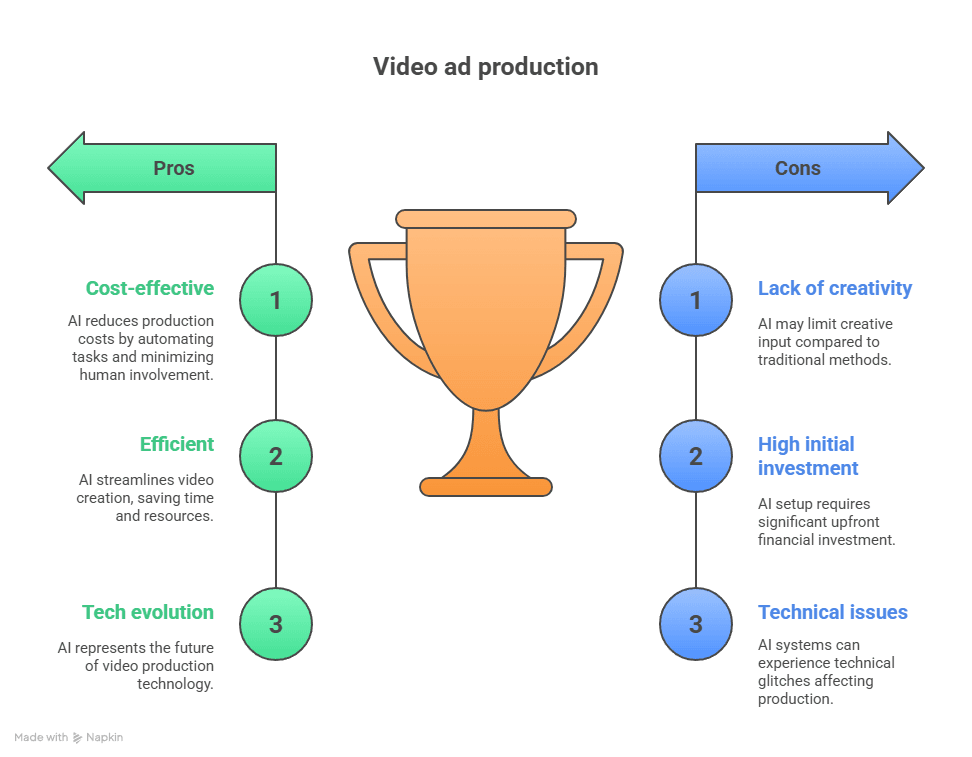
AI video ads offer efficiency and cost savings—but come with trade-offs like creative limits and technical challenges.
No strategy is perfect. Here are a few things to watch as you scale:
Generic messaging: Don’t rely entirely on templates. Always tweak messaging to suit your audience.
Lack of tracking: Make sure you’re using tools like Google Analytics, UTM codes, or built-in tracking features to monitor video performance.
Compliance: If your videos collect or process personal data (especially in the EU), make sure they’re compliant with privacy laws.
💡 Final Thoughts: Gen-AI Is the Future of Advertising
Whether you’re a solo blogger, clothing brand, digital agency, or eCommerce brand—Gen-AI video ads offer an unmatched mix of affordability, personalization, and scale. The sooner you adopt this approach, the faster you can stand out and grow.
And with tools becoming more intuitive and accessible, there’s really no reason not to dive in.
Manage Consent
To provide the best experiences, we use technologies like cookies to store and/or access device information. Consenting to these technologies will allow us to process data such as browsing behavior or unique IDs on this site. Not consenting or withdrawing consent, may adversely affect certain features and functions.
Functional
Always active
The technical storage or access is strictly necessary for the legitimate purpose of enabling the use of a specific service explicitly requested by the subscriber or user, or for the sole purpose of carrying out the transmission of a communication over an electronic communications network.
Preferences
The technical storage or access is necessary for the legitimate purpose of storing preferences that are not requested by the subscriber or user.
Statistics
The technical storage or access that is used exclusively for statistical purposes.The technical storage or access that is used exclusively for anonymous statistical purposes. Without a subpoena, voluntary compliance on the part of your Internet Service Provider, or additional records from a third party, information stored or retrieved for this purpose alone cannot usually be used to identify you.
Marketing
The technical storage or access is required to create user profiles to send advertising, or to track the user on a website or across several websites for similar marketing purposes.