
The AI-Powered Content Playbook for Small Agencies & Solopreneurs
Last Tuesday, I found myself sitting at my desk at 11 PM, staring at a half-written blog post that was due the next morning. My coffee had gone cold hours ago. My eyes were burning. And I still had two client social campaigns to plan before I could even think about sleep.
Sound familiar?
If you’re running a small agency or flying solo, you’ve probably been there too. That moment when you realize the content treadmill never stops, and you’re running faster just to stay in place.
The brutal truth about small business content marketing today is this: you’re expected to produce content like a 20-person team while actually being a team of… well, you. Maybe one or two others if you’re lucky. Blog posts, social media, email campaigns, video content, SEO optimization—it all needs to happen, and it all needs to happen yesterday.
I spent three years burning myself out trying to keep up. I’d wake up at 5 AM to write before client calls. I’d work weekends to stay ahead of my content calendar. I turned down opportunities because I simply didn’t have the bandwidth.
Then something shifted.
I started experimenting with AI—not as a replacement for my work, but as a thinking partner. Someone (or something) that could handle the grunt work while I focused on the parts that actually required my brain, my experience, my voice.
And here’s what surprised me: my content didn’t get worse. It got better. Because I finally had time to think strategically instead of just grinding through tasks.
The agencies and solopreneurs I know who are thriving right now? They figured this out before I did. They’re not working harder—they’re working smarter. They’ve built systems where AI handles what it does well, and humans do what only humans can do.
This isn’t about shortcuts or cheating. It’s about survival. And if we’re being honest, it’s about actually having a life outside of work.
So let me show you what I’ve learned—not from theory or blog posts, but from actually doing this every single day. This is the AI-Powered Content playbook that helped me triple my output while working fewer hours. The same strategies my clients are using to compete with agencies ten times their size.
No fluff. No hype. Just what actually works.
Related topic: how to rank in AI searches
Why AI Matters More Than Ever for Small Teams
Let me paint you a picture of what “normal” looks like now.
Ten years ago, if you published one solid blog post per week and posted to social media a few times, you were keeping up. Maybe you’d send an email newsletter monthly. That was considered consistent.
Today? Your audience expects fresh content every single day across multiple platforms. They want video that actually engages them, not awkward talking head footage. They expect personalized email sequences that speak directly to their problems. They want thought leadership that proves you actually know what you’re doing.
And if you’re in B2B? Add whitepapers, case studies, LinkedIn thought leadership, podcast appearances, and webinars to that list.
For a team of one to five people, this isn’t just hard—it’s physically impossible without help.
I know because I tried. So did hundreds of other small agency owners I’ve talked to. We all hit the same wall eventually.
According to HubSpot’s State of Marketing Report, content creation consistently ranks as one of the most time-consuming activities for marketers. The pressure to produce more, faster, better—it never lets up. And when you’re also juggling client calls, project management, finances, and actually delivering your services? Something breaks.
Usually, it’s you.
I watched a friend who runs a three-person content agency in Mumbai reach her breaking point last year. They were turning away clients—actual money, walking out the door—because they couldn’t handle more work. They were already working 60-hour weeks. Adding more clients meant sacrificing quality or their sanity. Neither was an option.
Then she called me, frustrated and exhausted, asking if I had any advice. I told her about the AI workflows I’d been testing. She was skeptical—she’d tried AI tools before and found them disappointing. They produced generic garbage that needed complete rewrites anyway.
But we talked through a different approach. Not using AI to replace her team’s creativity, but to handle the heavy lifting. Research compilation. First drafts. Content repurposing. The stuff that was eating up hours but didn’t require expert-level thinking.
Six months later, her agency’s producing three times the content they were before. Not because they’re working longer hours—they’re actually leaving the office before 7 PM now. They hired AI to do what it does well, and freed up their team to focus on strategy, client relationships, and the creative touches that make their content stand out.
Their revenue doubled. They’re now selective about which clients they take on. And my friend actually took a vacation for the first time in three years.
That’s not a fairy tale. That’s what happens when you stop fighting AI and start using it strategically.
But here’s what most people get wrong: they think AI is valuable because it produces mediocre content quickly. That’s not the point at all.
AI is valuable because it gives you back your brain space. Instead of spending four hours grinding through a first draft, you spend 90 minutes refining and adding your unique insights. Instead of staring at a blank page trying to come up with content ideas, you spend 10 minutes reviewing AI-generated concepts and picking the ones that resonate.
You stop being a content factory worker and start being a content strategist again.
The agencies still struggling? They’re treating AI like a magic button that solves everything automatically. The ones winning? They’ve built systematic workflows where humans and machines each do what they’re actually good at.
And that makes all the difference.
Building Your AI Content Strategy for Small Businesses
Alright, enough philosophy. Let’s talk about actually building an AI content strategy for small businesses that doesn’t require a computer science degree or a massive budget.
I’m going to walk you through the exact four-phase framework I use with clients. This isn’t theoretical—it’s battle-tested by solopreneurs and small agencies producing hundreds of pieces of content every month.
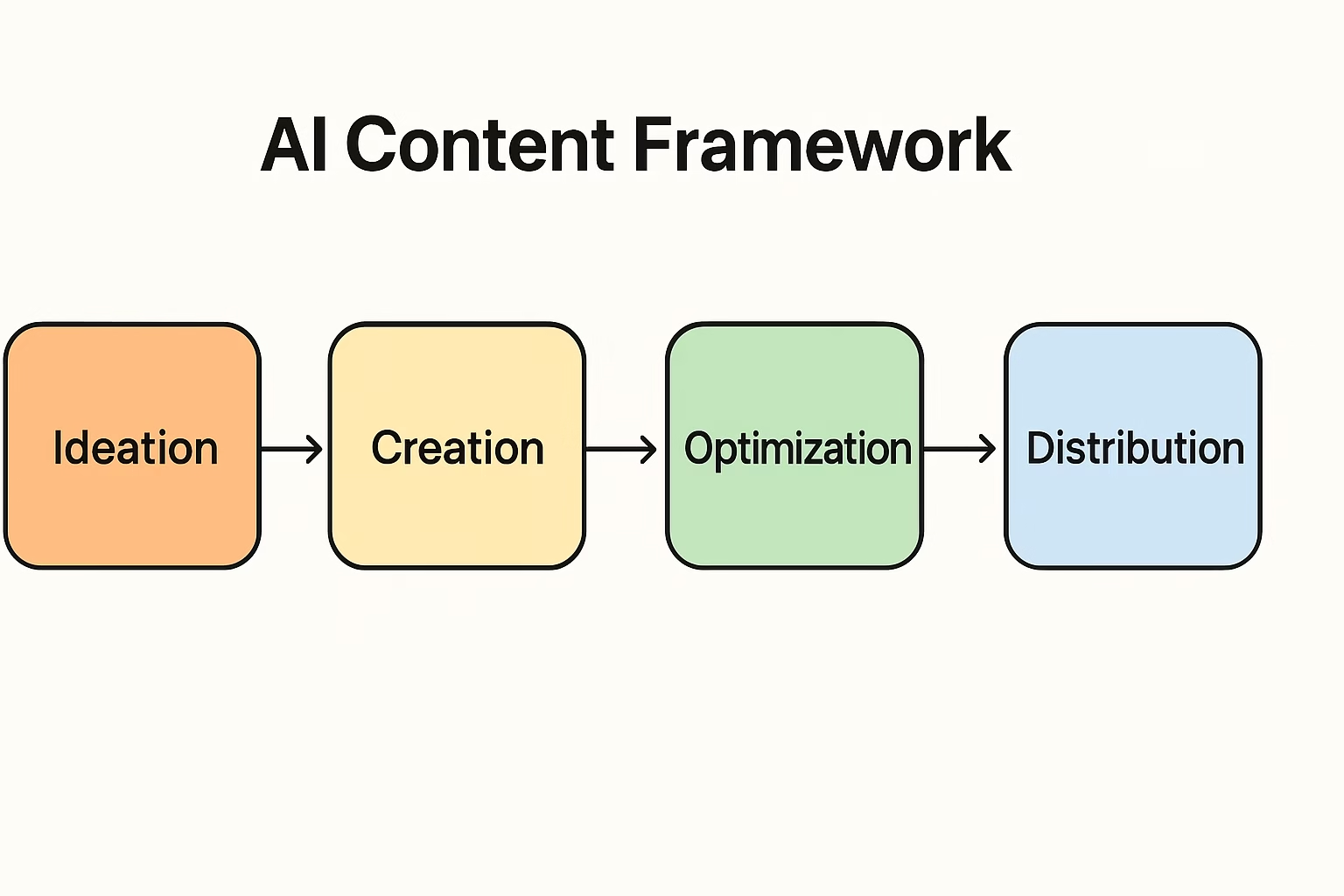
Phase 1: AI-Assisted Ideation (Stop Staring at Blank Pages)
Remember that paralyzing feeling when you sit down to create content and your mind goes completely blank? Where you spend an hour just trying to figure out what to write about?
That used to eat up half my creative time. Not anymore.
Here’s how I approach ideation now: I open up ChatGPT or Claude and have an actual conversation about what my audience needs. Not a robotic prompt—a real discussion.
I’ll say something like: “My audience is small marketing agencies struggling to keep up with content demands. They’re overwhelmed, understaffed, and tired of generic AI advice. What content angles would actually help them right now?”
The AI throws out 15-20 ideas. Most are decent. A few are terrible. But buried in there are usually 2-3 concepts that make me stop and think “oh, that’s interesting.”
Those become my content queue.
The key is I’m not using these ideas verbatim. I’m using them as thought starters. They get my brain moving in directions I wouldn’t have considered on my own.
I keep a simple Notion database where every AI-generated idea gets captured and tagged by topic, audience segment, and content type. Once a week, I review them. The ones that spark something go into production. The rest stay archived for later.
One of my clients—a solo consultant in Toronto—takes this even further. She records her client calls and coaching sessions (with permission, obviously). Then she uses AI to analyze the transcripts and pull out the most common questions and concerns her clients have.
Those become her blog topics. Her email subject lines. Her social media hooks. She’s essentially creating content directly from the problems her real audience is actually facing. And AI does all the extraction work while she focuses on crafting the solutions.
That’s 10X more effective than guessing what your audience wants to read.
Phase 2: Strategic Creation (Where Human Meets Machine)
This is where the magic happens—and where most people screw it up.
Here’s my golden rule: AI writes the first draft. Humans write the final draft.
When I’m creating long-form content—like this very article—I start by outlining the structure myself. The main points I want to make. The stories I want to tell. The controversial opinions that will make people stop and think. The insights that come from my actual experience, not generic advice.
Then I hand that outline to AI and say “flesh out each section based on this structure.”
What comes back is usually 60-70% there. The bones are solid. The information is relevant. The flow makes sense.
But it’s boring. It sounds like a hundred other articles. It has no personality. It’s missing the good stuff—the stories, the opinions, the humor, the humanity.
That’s where I come in.
I rewrite the introduction completely—that’s where you either hook someone or lose them, so it needs to sound like me. I add personal stories from my experience. I inject opinions that might make some people uncomfortable. I cut all the fluffy corporate-speak that AI loves but humans hate. I add specific examples instead of generic platitudes.
According to research from the Content Marketing Institute, creating the right content for your audience—not just more content—is now the biggest challenge marketers face. That “rightness” comes from human insight, not machine generation.
This workflow means I can finish a 2,000-word article in about 90 minutes instead of four hours. And honestly? The quality is better because I’m spending my energy where it matters—on the human touches—rather than grinding through every single sentence from scratch.
For social media, the process is even faster. I ask AI to generate 10 caption variations for a single idea. I pick the two that feel most natural. I merge them. I add my voice. I cut the cringe. Five minutes instead of twenty.
The time I save compounds. That’s an extra hour a day. Five hours a week. Twenty hours a month. That’s half a work week back in your life.
Phase 3: Optimization at Scale (Let AI Handle the Tedious Stuff)
I hate SEO optimization. There, I said it.
Not because it’s not important—it obviously is. But because it’s mind-numbingly tedious. Checking keyword density. Adjusting meta descriptions. Finding internal linking opportunities. Optimizing headers. Making sure your content is readable but also search-engine friendly.
It’s important work that I absolutely hate doing.
This is where AI saves my sanity.
I use AI tools to analyze my content for all those technical details I’d otherwise miss (or skip because I’m tired). It tells me where to naturally include my focus keywords. It checks readability scores. It suggests internal links to related content. It catches when my meta description is too long or too generic.
The AI suggests improvements. I implement the ones that make sense. I ignore the ones that would make my writing sound robotic.
The beautiful thing? I’m not stressed about whether I’ve covered all the technical bases. AI catches them. I can focus on making sure my content is actually valuable to humans, knowing the SEO fundamentals are handled.
Phase 4: Intelligent Distribution (One Piece, Multiple Formats)
Creating great content is only half the battle. Getting it in front of your audience—on the platforms where they actually are—is what actually drives results.
This used to be another massive time sink. You’d write a blog post, then separately create social media posts, then write an email, then maybe record a video. Each format required starting from scratch.
Not anymore.
Here’s what I do now: I take one long-form piece—like a blog post—and use AI to adapt it into multiple formats. It becomes three LinkedIn posts with different angles. Five Twitter threads. Two email newsletters. A script for a short video. An outline for an infographic.
AI handles the initial adaptation. Then I spend 20-30 minutes editing each one to match my voice and add platform-specific touches.
One piece of content now reaches my audience in six different ways, across six different platforms, capturing people wherever they happen to be.
I know a consultant in London who’s absolutely crushing this. She writes one substantial article per week. Then she uses AI to transform it into a week-long social media campaign across LinkedIn, Twitter, and Instagram. She spends maybe 45 minutes editing the AI-generated posts to sound like her, schedules everything, and focuses her time on engaging with comments and building real relationships.
Her content reach increased 300% without creating any additional content. She’s just distributing it smarter.
That’s the power of AI workflow automation—not replacing your creativity, but multiplying its impact.
Choosing the Right AI Tools for Small Agencies & Solopreneurs
Let’s talk tools, because this is where people freeze up.
There are hundreds of AI marketing tools for solopreneurs. New ones launch every week. Each one claims to be revolutionary, game-changing, the only tool you’ll ever need.
It’s overwhelming. I get it. I’ve tried at least 50 different tools over the past two years.
Here’s the truth most people won’t tell you: you don’t need a dozen tools. You need three to five that actually solve problems you have.
More tools don’t make you more productive—they make you more distracted. Tool-hopping is just another form of procrastination.
So let me break down what actually matters, based on what I use and what I see working for other small agencies.
For Content Writing and Ideation
The main players here are ChatGPT, Claude, and Jasper. Each has different strengths, and honestly, you can succeed with any of them.
ChatGPT is incredibly versatile and conversational. It’s great for brainstorming, asking follow-up questions, and generating first drafts. The free version is surprisingly capable. The Plus version ($20/month) removes limits and gives you access to better models.
Claude (what I’m using right now, actually) is better at handling longer context and maintaining consistency across extended documents. If you’re working on in-depth content or need to reference multiple sources, Claude excels there.
Jasper is built specifically for marketing copy and includes templates for different content types. It’s more polished for marketing use cases but also more expensive ($49-125/month).
My honest recommendation? Start with ChatGPT’s free version or Claude. Learn how to prompt effectively—that skill matters more than which tool you use. Only upgrade when you’re consistently hitting usage limits.
Don’t get paralyzed trying to pick the “perfect” tool. Just pick one and learn it deeply.
For Content Planning and Organization
I live in Notion. Their AI features have transformed how I plan and organize content.
Notion AI can help generate content calendars, identify gaps in your strategy, suggest topics based on your existing content, and even draft outlines for entire campaigns.
ClickUp and Airtable also have AI features now. They’re all good options. The key is picking a platform where you already manage your work, so you’re not constantly jumping between tools.
I’ve watched solopreneurs cut their weekly planning time from three hours to 45 minutes just by using Notion AI to generate and organize their content calendar. That’s two hours back in your week, every single week.
That’s 104 hours a year. Two and a half work weeks.
For Visual Content
As someone who can’t design to save my life, AI visual tools have been a game-changer.
Canva’s AI features (Magic Write, Magic Design) make it possible for design-challenged people like me to create professional-looking graphics quickly. Their templates plus AI suggestions mean you can produce solid visuals in 10 minutes instead of an hour.
Midjourney creates custom images when you need something specific that stock photos can’t provide. It requires learning how to prompt effectively, but the results can be stunning.
For video, tools like Descript (with AI editing features) and Synthesia (for AI-generated video) are making video content accessible to non-video people.
But here’s the thing: pick ONE visual tool and actually learn it. A simple, clean graphic created quickly beats a complex design you stressed over for hours. Good enough, shipped today beats perfect, never finished.
For Analytics and Optimization
Clearscope, SurferSEO, and Frase analyze top-ranking content and show you exactly how to optimize your content for search engines without becoming an SEO expert.
These typically cost $50-200 monthly. For small agencies, they often pay for themselves through improved organic traffic within the first month.
But honestly? If budget is tight, start with free tools like Google Search Console and AnswerThePublic. Add premium tools only when you’ve maxed out what free tools can do.
For Social Media Management
Buffer, Hootsuite (with AI features), and newer tools like Predis.ai can analyze your past performance and suggest optimal posting times, content types, and even generate captions based on your brand voice.
The key is finding tools that learn from YOUR data. Generic suggestions aren’t valuable. Personalized insights based on your actual audience behavior—that’s gold.
My Real-World Recommendation
Don’t implement everything at once. You’ll get overwhelmed and quit.
Here’s what I tell clients: Start with one writing tool (ChatGPT or Claude) and one organizational tool (Notion or ClickUp). Master those workflows first.
Use them consistently for 60 days. Build solid habits. Figure out what works for you.
Then add one specialized tool every quarter based on your biggest pain point at that moment.
The agencies that burn out on AI subscribe to twelve tools in month one, get overwhelmed by trying to learn everything simultaneously, and abandon it all within weeks.
The agencies that succeed start small, build expertise gradually, and scale as they go.
Slow and steady wins this race.
Creating a Human + AI Hybrid Workflow
This is where theory becomes practice—building a workflow where AI amplifies your strengths without replacing what makes you, you.
I think about AI like having a really talented assistant who works incredibly fast but needs your guidance and editorial judgment. They can do research, create outlines, generate first drafts, handle repetitive tasks. But they need you to provide direction, ensure quality, and add the strategic thinking that only comes from experience.
That analogy helps me remember what to delegate and what to keep.
The Monday Planning Ritual
Every Monday morning, I block 30 minutes—no meetings, no interruptions—to plan my week’s content with AI.
I review my content calendar. I identify what needs to be created. Then I open Claude or ChatGPT and have a planning conversation.
“Here’s what I’m creating this week. Help me develop detailed outlines for each piece. What angles might work? What objections might my audience have? What examples would make each point clearer?”
The AI’s responses aren’t always brilliant. Sometimes they’re generic or off-base. But they consistently give me perspectives I wouldn’t have considered on my own.
That’s valuable. That’s worth 30 minutes.
By the end of this session, I have solid outlines for my week’s content. I know exactly what I’m creating and why. The hardest part—figuring out what to say—is handled.
The rest of the week, I’m just executing against those outlines. No more staring at blank pages wondering what to write.
The Creation Workflow (The Secret Sauce)
When it’s time to actually write, I follow a specific process:
Step 1: I create a detailed brief for the AI. This includes who I’m writing for, what they’re struggling with, the main message I want to convey, specific points I want to cover, tone and voice guidelines, and any examples or data I want to include.
The more specific my input, the better the output. Always.
Step 2: I let AI generate the first draft while I do something else. Make coffee. Answer emails. Take a walk. Coming back with fresh eyes helps me edit more objectively.
Step 3: Human editing—this is where I earn my money. I read through asking three questions:
- Does this sound like me?
- Are these insights actually valuable, or just generic filler?
- Would I be proud to put my name on this?
Usually, I completely rewrite the introduction. That’s where personality matters most—where you either hook someone or lose them.
I replace generic examples with specific, real-world ones from my experience. I add controversial opinions that make the piece memorable. I cut anything that feels like filler or sounds like it was written by a robot.
I add humor where appropriate. Emotion where it matters. The messy, human stuff that makes content connect.
Step 4: Final optimization using AI to check SEO elements, readability, and structure. Then one last read-aloud to catch anything that sounds unnatural.
This workflow lets me produce high-quality content in a fraction of the time. AI handles the grunt work—research, structure, initial drafting. I handle the creative work—strategy, voice, insight, connection.
The Review and Improve Loop
Here’s what separates good AI workflows from great ones: continuous refinement based on actual results.
Every month, I review which content performed best. I look for patterns:
- What topics resonated most with my audience?
- Which formats got the most engagement?
- What posting times worked best?
- Which headlines drove the most clicks?
Then I feed this data back into my AI prompts:
“Here are five of my highest-performing pieces. Notice the patterns in structure, tone, and topic focus. Generate new ideas that follow these patterns while exploring fresh angles.”
The AI gets smarter about what works for my specific audience. My prompts get more refined. The output gets better.
It’s a flywheel that compounds over time.
The Collaboration Mindset (This Changes Everything)
The biggest mindset shift is this: stop thinking of AI as a replacement for human work. Start thinking of it as a collaboration partner.
When I’m stuck on how to position an idea, I talk it through with AI. When I need to see a concept from different angles, AI helps me explore possibilities quickly. When something in my draft feels off but I can’t pinpoint why, I ask AI to suggest alternatives.
It’s like having a colleague who’s always available, never judges your rough ideas, and processes information faster than any human could.
But—and this is crucial—I never forget that the final decision is mine.
AI suggests, I decide.
AI drafts, I refine.
AI analyzes patterns, I apply strategic thinking.
AI provides options, I choose based on judgment and experience.
That balance is everything. Lose it, and your content becomes generic. Maintain it, and you’ve got a superpower.
Real-World Use Cases: How Small Agencies Are Winning with AI
Let me share stories from agencies crushing it with AI—not because they have massive budgets or technical teams, but because they implemented smart workflows and stuck with them.
These are real businesses run by real people who were exactly where you are now.
Case Study 1: The Content Agency That Nearly Burned Out
Sarah runs a four-person content agency in Austin. By mid-2023, they’d maxed out their production capacity. They were manually creating every piece from scratch—research, outlining, writing, editing, all of it.
They were working 55-hour weeks and still turning away clients. Something had to change, or someone was going to quit.
Sarah implemented an AI-assisted workflow where they used ChatGPT for initial research compilation and first drafts. The team focused their time on strategic editing, adding client-specific insights, and quality control—the high-value activities only humans can do well.
Results after three months:
- Content output increased from 40 to 120 pieces monthly
- Client satisfaction scores improved (quality got better, not worse)
- Took on five new clients without hiring additional staff
- Team burnout decreased significantly—they started leaving work at reasonable hours
- Revenue increased 160%
The key insight? They didn’t eliminate human involvement. They eliminated the repetitive, time-consuming parts of content creation, allowing their team to focus on what actually required human judgment and creativity.
As Sarah told me: “We stopped being typists and started being strategists again.”
Case Study 2: The Solo Consultant Who Broke Six Figures
Marcus is a marketing consultant who was stuck at $75K annual revenue. He couldn’t produce enough content to maintain visibility while also serving clients. It was one or the other—grow his audience or do client work. He couldn’t scale both.
He built a systematic approach using Claude for long-form content, Notion AI for planning, and Canva for visuals.
His workflow: Two hours every Sunday generating outlines for the week’s content using AI. Monday through Friday, 45 minutes daily turning one outline into a finished piece. AI repurposes each piece into social content for the week.
Results after six months:
- Published three blog posts weekly (up from one monthly)
- LinkedIn following grew from 800 to 12,000
- Inbound leads increased 400%
- Crossed six-figure revenue without hiring anyone
- Works fewer hours than before
What made this work? Marcus treated AI as his content production team, allowing him to maintain the content volume needed for growth while focusing his expertise on client work and strategy.
“I finally have the content engine I always needed,” he said. “Except it costs $20 a month instead of a full-time salary.”
Case Study 3: The Agency That Won Enterprise Clients
A five-person boutique agency was competing for enterprise contracts but kept losing to bigger agencies with more resources and deeper portfolios.
They used AI to rapidly develop case studies, white papers, and thought leadership content demonstrating deep expertise in their niche. They created a content library that made them look like a 20-person agency.
They also used AI to customize proposals and presentations for each prospect, tailoring messaging to each potential client’s specific industry and challenges.
Results:
- Won three enterprise contracts in the first quarter using this approach
- Average contract value increased from $15K to $85K
- Closed deals 40% faster because their content library answered most client questions before sales calls even happened
- Team spent less time on proposals and more time on actual client work
The differentiator? They used AI not just for efficiency, but for sophisticated customization at scale. Each prospect felt like they were getting white-glove service because the content was so precisely relevant to their specific needs.
Case Study 4: The Social Media Agency That Found Balance
A social media management agency was spending 60% of their time on content creation and only 40% on strategy and client relationships—exactly backward from where they wanted to be.
They built AI workflows for content ideation, caption writing, and performance analysis. They created detailed brand voice profiles for each client and used AI to generate on-brand content that their team then polished.
Results:
- Reduced content creation time by 65%
- Increased client capacity from eight to 20 accounts
- Improved engagement rates because they had more time to analyze performance and refine strategy
- Team satisfaction increased dramatically—they were doing more meaningful work
Their secret? They didn’t use AI to replace their creative team. They used it to handle repetitive, formulaic content, freeing their creatives to focus on innovative campaigns that actually moved the needle for clients.
“Our team is finally doing the work they were hired to do,” the founder told me. “The creative thinking, not the content production line.”
Pitfalls to Avoid When Implementing AI in Content Marketing
Now let’s talk about where people screw this up, because learning from others’ mistakes is way cheaper than making your own.
I’ve made some of these mistakes myself. I’ve watched clients make others. Here’s what to avoid:
Pitfall 1: Publishing AI Content Without Editing (The Fastest Way to Kill Your Credibility)
This is the cardinal sin. The thing that will destroy your credibility faster than anything else.
AI-generated content has telltale signs. Overly formal language. Repetitive phrasing. Generic examples that could apply to anyone. A complete lack of personality and unique perspective.
If you publish AI content as-is, your audience notices. They might not know it’s AI, but they know something feels off. The content is forgettable. Worse, it sounds exactly like your competitors who are doing the same thing.
I see this constantly: someone discovers AI, gets excited about the speed, and starts pumping out unedited content. Within weeks, their engagement drops. Their audience starts tuning out.
The fix: Treat AI output as a first draft that requires substantial human editing. Never—NEVER—publish without adding your unique perspective, real examples, and brand voice.
If you’re not spending at least 30-40% of your original creation time on editing, you’re probably publishing AI-generated mediocrity.
Pitfall 2: Ignoring Quality Control (AI Makes Confident Mistakes)
AI hallucinates. It invents statistics. It confidently states things that are completely wrong. It misses context and nuance that humans catch immediately.
I’ve seen AI cite studies that don’t exist, attribute quotes to the wrong people, and make up data that sounds plausible but is totally fabricated.
If you’re not fact-checking, reviewing for accuracy, and ensuring every piece meets your standards, you’re going to publish something embarrassing. And fixing your reputation after that is infinitely harder than implementing proper review processes upfront.
The fix: Build a checklist for every piece of content:
- Verify all facts, statistics, and quotes
- Check that examples are accurate and relevant
- Ensure the content actually serves your audience’s needs
- Confirm it matches your brand voice
- Review for bias or problematic framing
Quality control can’t be optional. It has to be part of your workflow.
Pitfall 3: Over-Automation and Losing Your Voice (The Generic Content Trap)
There’s a temptation to automate everything—ideation, creation, optimization, distribution. Just set it and forget it, right?
Wrong.
When you over-automate, you risk becoming a generic content machine that technically does everything right but connects with no one.
Your voice is your competitive advantage. The specific way you explain concepts. Your opinions on industry trends. Your personality. That’s what makes people choose you over competitors with similar services.
Lose that, and you’re just creating noise that adds to the content overload everyone’s already drowning in.
The fix: Identify the parts of content creation that are uniquely yours—your perspective, your examples, your voice—and protect those fiercely. Let AI handle research and structure, but you handle the creative elements that make your content distinctly yours.
If someone could read your content without a byline and not know it was you? You’ve automated too much.
Pitfall 4: Not Training Your Team Properly (Hoping They’ll Figure It Out)
You can’t just subscribe to AI tools and expect your team to magically become productive with them.
Learning to prompt effectively takes practice. Understanding each tool’s strengths and limitations takes time. Developing efficient workflows requires experimentation.
I’ve watched agencies waste thousands of dollars on tools no one uses effectively because they skipped training.
The fix: Invest in proper training:
- Create documentation of your workflows
- Share examples of effective prompts
- Have team members teach each other what’s working
- Build competency systematically rather than expecting everyone to figure it out alone
Set aside two hours for initial training, then 30 minutes weekly for team members to share what they’re learning. That small investment compounds massively.
Pitfall 5: Chasing Every New Tool (Shiny Object Syndrome)
New AI tools launch constantly. Each one claims to revolutionize content marketing. It’s tempting to try everything.
Tool-hopping destroys productivity. Every new tool requires learning time, integration effort, and workflow adjustment. If you’re constantly switching, you never develop deep competency with any platform.
I learned this the hard way. I tried 50+ tools in my first year. Know what I got? Overwhelmed, confused, and no more productive than when I started with just ChatGPT.
The fix: Choose your core tools deliberately based on your specific needs. Commit to using them for at least six months before considering alternatives. Master what you have before adding more to your stack.
Build depth, not breadth.
Pitfall 6: Forgetting About Real Humans (Optimizing for Robots)
Some agencies get so focused on optimizing for AI and search engines that they forget actual humans need to read and engage with their content.
They keyword-stuff. They optimize for every technical metric. They produce content that ranks but doesn’t convert because it’s terrible to actually read.
The fix: Optimize for both search engines AND human readers. Use AI to handle technical SEO elements, but ensure your content is genuinely valuable, readable, and engaging for your target audience.
If you wouldn’t want to read it yourself, don’t publish it.
Pitfall 7: Ignoring Ethical Considerations (The Blind Spot)
AI can perpetuate biases present in its training data. It can generate content that’s technically accurate but ethically questionable. It can create copy that manipulates rather than informs.
As you scale production with AI, it’s easier to accidentally publish problematic content if you’re not actively looking for these issues.
The fix: Develop ethical guidelines for your AI use:
- Review content not just for accuracy but for bias and inclusivity
- Ensure your content serves your audience’s genuine interests, not just your marketing goals
- Be transparent about AI use when appropriate
- Make ethics part of your quality control process, not an afterthought
Your reputation is built over years and can be destroyed in days. Don’t let AI jeopardize that.
Future-Proofing Your Content Strategy in the AI Era
Let’s talk about where this is heading, because the landscape is shifting fast and you need to be ready.
The Rise of AI Agents (Your Future Content Team)
We’re moving beyond AI as a tool you actively use to AI agents that work semi-autonomously on your behalf.
Imagine an AI that monitors your content performance, identifies gaps in your strategy, generates and optimizes content to fill those gaps, and only brings you in for final approval and strategic decisions.
This isn’t science fiction. Early versions exist right now.
For small agencies, this means the administrative overhead of content marketing could shrink dramatically in the next 1-2 years.
The implication: Start building systems and processes now that could eventually be handed off to AI agents. Document your decision-making criteria. Create detailed brand guidelines. Establish clear approval processes.
The agencies ready to integrate autonomous agents will have a massive advantage over those starting from scratch when these tools mature.
Hyper-Personalization at Scale (Every Visitor Gets Custom Content)
AI is getting dramatically better at personalizing content for individual users. We’re moving toward a world where your website, emails, and even blog posts adapt to each visitor based on their behavior, interests, and stage in the buying journey.
For small agencies, this levels the playing field. You’ll be able to deliver personalized experiences that previously required enterprise-level marketing automation and massive teams.
I’m already seeing this with email marketing. Instead of one newsletter for everyone, I’m creating multiple versions that AI customizes based on subscriber behavior. Open rates have increased 45% since implementing this.
The opportunity: Start collecting and organizing data about your audience now. The more you understand different segments—their preferences, behaviors, pain points—the more effectively you’ll leverage AI personalization tools as they mature.
Build your data foundation today. You’ll thank yourself in six months.
Multimodal Content Dominance (One Idea, Every Format)
AI is becoming equally capable across text, images, audio, and video. This means content repurposing is about to become dramatically more sophisticated.
Soon, you’ll take a single written piece and have AI generate video scripts, voiceovers, custom visuals, podcast episodes, and interactive experiences—all maintaining consistent messaging and brand voice.
For resource-strapped small agencies, this is huge. You’ll compete across every content format without hiring specialists in each medium.
The preparation: Develop your core messaging and brand assets now. When these tools mature, you’ll instantly adapt your best content into any format your audience prefers.
Start thinking in terms of content systems, not individual pieces.
The Content Quality Arms Race (Mediocre Dies)
As AI makes content creation easier, the volume of content online will explode. This means standing out requires either exceptionally high quality, highly specific niche positioning, or both.
Mediocre content will get buried. AI-generated content that sounds like everyone else will be ignored. The premium will be on unique insights, strong perspectives, and genuinely valuable information.
The strategy: Focus on developing deep expertise in specific areas. Build authority through consistently delivering insights that AI alone couldn’t generate. Use AI for efficiency, but compete on the uniqueness of your perspective and depth of your knowledge.
Generic thought leadership is dead. Specific, opinionated, deeply informed content wins.
Search Behavior Evolution (Conversational Discovery)
As AI-powered search tools like ChatGPT and Perplexity become more sophisticated, how people discover content is changing. They’re asking conversational questions to AI assistants rather than googling keywords.
This means traditional SEO is evolving. Your content needs to answer specific questions clearly and provide value beyond what an AI assistant could generate from general training data.
The adaptation: Create comprehensive, authoritative content that AI assistants will reference when answering user questions. Position yourself as a cited source rather than competing with AI-generated summaries.
Focus on primary research, unique data, and expert analysis that can’t be replicated by general AI models.
Authenticity as Competitive Advantage (Real Beats Perfect)
As AI-generated content floods the internet, authenticity becomes increasingly valuable. Real stories. Genuine opinions. Personal experiences. These things can’t be faked by AI, and audiences will gravitate toward them.
Small agencies and solopreneurs actually have an advantage here. You’re closer to your work, more connected to your clients, and more able to share authentic experiences than large corporate competitors.
The opportunity: Don’t hide behind AI. Use it as a tool, but let your personality, opinions, and experiences shine through. The more authentic you are, the more you’ll stand out in an AI-saturated content landscape.
Vulnerability and realness beat polished perfection now.
Continuous Learning Requirement (Adapt or Get Left Behind)
The pace of AI development means tools, capabilities, and best practices are evolving rapidly. What works today might be outdated in six months. What seems impossible now might be trivial by next year.
Staying competitive requires committing to continuous learning. You need to experiment with new tools, test emerging strategies, and adapt your workflows regularly.
The mindset: View your AI content strategy as a living system that evolves, not a fixed implementation. Allocate time monthly to explore new tools, test different approaches, and refine your processes based on results.
The agencies that stay curious and adaptable will thrive. The ones that “set it and forget it” will struggle.
Conclusion: Your AI Content Journey Starts Today
Look, I’m not going to sugarcoat this: implementing AI into your content workflow takes effort. There’s a learning curve. You’ll make mistakes. Some experiments won’t work.
But here’s what I know after two years of doing this myself and helping dozens of agencies implement AI workflows:
The agencies and solopreneurs winning right now aren’t the ones with the biggest budgets or the most technical expertise. They’re the ones who started earlier, learned through doing, and built systems that blend human creativity with machine efficiency.
They’re producing more content without burning out. They’re serving more clients without sacrificing quality. They’re competing with agencies ten times their size and holding their own.
And most importantly? They’re enjoying their work again. They’re not grinding through content production like factory workers. They’re thinking strategically. They’re being creative. They’re building businesses that actually scale.
That can be you. But only if you start.
Not next month when you’ve “done more research.” Not when you’ve found the “perfect tool stack.” Not when you feel fully ready.
Today.
Here’s my challenge for you: by this time next week, have one AI-powered workflow running. Just one. It doesn’t have to be perfect. It just has to be better than what you’re doing now.
Maybe it’s using ChatGPT to generate blog post outlines instead of staring at blank pages.
Maybe it’s having AI repurpose your long-form content into social media posts.
Maybe it’s using Notion AI to plan your content calendar instead of doing it manually.
Pick one workflow that’s currently eating your time and energy. Implement an AI-assisted version of it. Test it. Refine it. Make it work for you.
Then, once that’s running smoothly, add another one. Then another.
Six months from now, you’ll look back at this moment and realize it was the turning point. The moment you stopped fighting the content treadmill and started building systems that actually scale.
Your content calendar doesn’t have to feel overwhelming. Your 60-hour work weeks don’t have to be permanent. Your dream of scaling without sacrificing your sanity isn’t unrealistic.
AI gives you the leverage to make it happen.
But only if you actually use it.
The playbook is in your hands. Now it’s time to play.
Ready to build your AI content workflow? Download our free Notion template “AI Content Workflow System” that includes prompt libraries, content planning frameworks, and quality control checklists designed specifically for small agencies and solopreneurs. Subscribe to our newsletter to get the template plus weekly AI strategy insights that actually help you work smarter, not harder.
Visual Decision Tree: “Which AI Tool Should I Use First?”
START HERE: What’s your biggest content bottleneck right now?
↓
BRANCH 1: “I struggle to come up with content ideas” → START WITH: ChatGPT or Claude (Free versions) → Use for: Brainstorming, topic ideation, audience research → Time investment: 30 min setup, 10 min daily → Expected outcome: Never stare at blank pages again → Next step after 30 days: Add Notion AI for organization
BRANCH 2: “Writing takes me forever” → START WITH: ChatGPT Plus or Claude Pro ($20/month) → Use for: First draft generation, outline creation → Time investment: 1 hour learning prompts, then 45 min per article → Expected outcome: Cut writing time by 50-60% → Next step after 30 days: Add SurferSEO for optimization
BRANCH 3: “I can’t keep my content organized” → START WITH: Notion AI or ClickUp → Use for: Content calendar, planning, workflow management → Time investment: 2 hours setup, 30 min weekly maintenance → Expected outcome: Always know what to create next → Next step after 30 days: Add writing AI to execute plans
BRANCH 4: “I need better visuals but can’t design” → START WITH: Canva with AI features (Free or Pro $13/month) → Use for: Graphics, social images, basic designs → Time investment: 1 hour learning templates, 10 min per graphic → Expected outcome: Professional-looking visuals quickly → Next step after 30 days: Add Midjourney for custom images
BRANCH 5: “I create content but get no traffic” → START WITH: SurferSEO or Clearscope ($50+/month) → Use for: SEO optimization, keyword research → Time investment: 1 hour learning tool, 20 min per article → Expected outcome: Better rankings within 60-90 days → Next step after 30 days: Add ChatGPT for content repurposing
BRANCH 6: “I need to multiply my content’s reach” → START WITH: ChatGPT for repurposing + Buffer for scheduling → Use for: Adapting content across platforms → Time investment: 45 min learning repurposing prompts → Expected outcome: 1 article = 10+ pieces of content → Next step after 30 days: Add Canva for visual variations
BRANCH 7: “I’m overwhelmed and don’t know where to start” → START WITH: ChatGPT Free + Notion Free → Use for: Planning AND creation → Time investment: 2 hours total setup → Expected outcome: Clear roadmap + immediate productivity boost → Next step after 30 days: Choose your next biggest bottleneck and branch from there
DECISION TREE FOOTER: Golden Rule: Master ONE tool for 60 days before adding another. Depth beats breadth every time.
Budget Guide:
- $0/month: ChatGPT Free + Notion Free + Canva Free
- $20/month: ChatGPT Plus OR Claude Pro + Free tools
- $50/month: Writing AI + Canva Pro + Buffer
- $100+/month: Full stack (Writing + SEO + Design + Distribution)
Remember: The best tool is the one you’ll actually use consistently. Start small, build habits, scale gradually.