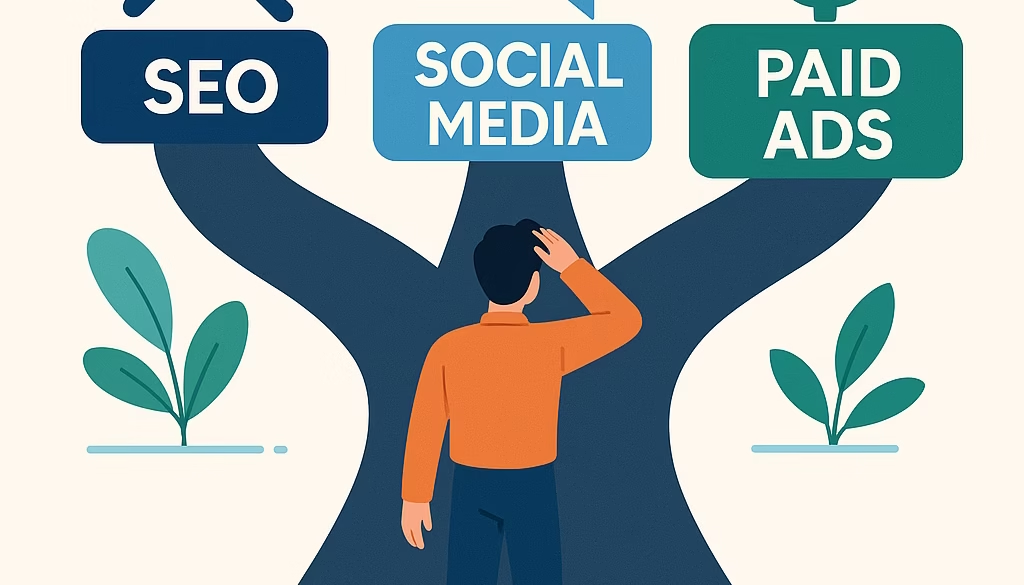
SEO, Social, or Paid Ads? How to Choose the Right Channel for Your Business (Without Losing Your Mind)
Grab a coffee. This one’s personal.
Thank you for reading this post, don't forget to subscribe!
I’m sitting in my favorite corner booth at Murphy’s Diner, watching steam rise from my third cup of coffee this morning. My laptop screen shows another frantic email from Sarah, a bakery owner who’s been jumping between TikTok, Google Ads, and “SEO stuff” for eight months straight. She’s exhausted, broke, and her delicious cupcakes aren’t selling like they should.
Sarah’s story hits close to home because, honestly? I’ve been there too.
Three years ago, I made one of the most expensive mistakes of my consulting career. I convinced a local plumbing company to dump $3,200 into Facebook ads because “everyone’s on social media these days.” I was so confident. So wrong.
Two months later, Tom (the owner) called me, voice cracking slightly: “Hey, we got maybe six calls from those ads, and only one turned into actual work. My wife thinks I should fire you.”
That phone call changed everything for me. Not just because I felt terrible (though I did), but because I realized something crucial: There’s no such thing as the “best” marketing channel. There’s only the right channel for the right business at the right time.
Tom’s customers weren’t scrolling Facebook looking for plumbers. They were frantically Googling “emergency plumber near me” at 2 AM when their basement started flooding. We should’ve focused on local SEO from day one.
The good news? After we pivoted to SEO and local search optimization, Tom’s business tripled within 18 months. But that expensive lesson taught me something I wish someone had told me earlier:
Most businesses fail at marketing not because they pick the wrong tactics, but because they never match their strategy to their actual situation.
Why This Choice Feels Impossible (And Why That’s Actually Normal)
Let me paint a picture that’ll probably sound familiar:
You wake up, grab your phone, and immediately see seventeen different marketing experts telling you seventeen different things. Gary Vee’s screaming about TikTok being the future. Some SEO guru’s promising page-one rankings in 90 days. A Facebook ads expert just posted a screenshot of their client’s $50K month.
Meanwhile, you’re wondering if you should even be spending your Tuesday morning watching marketing videos when you’ve got actual customers to serve.
Here’s what nobody tells you: That overwhelm you’re feeling? It’s not because you’re bad at marketing. It’s because most marketing advice treats every business like it’s the same business.
The “Shiny Object” Trap (And How I Fell Into It Hard)
Remember Tom the plumber? Well, before I learned my lesson, I had another client—Maria, who ran a small graphic design studio. After the Facebook ads disaster with Tom, I overcompensated and put Maria on this intensive SEO program.
Six months later, Maria had beautiful blog posts ranking on page two of Google for “graphic design tips.” But she had zero new clients.
Why? Because Maria’s customers weren’t searching for graphic design tips. They were creative directors at ad agencies who discovered new designers through Instagram portfolios and LinkedIn recommendations.
We were optimizing for the wrong behavior entirely.
The lesson? Every business owner I know (myself included) has chased at least one shiny marketing object that looked amazing but wasn’t right for their specific situation. It’s like trying to fix a leaky faucet with a hammer—the tool isn’t inherently wrong, it’s just wrong for this particular job.
When “Best Practices” Become Worst Practices
Here’s something that kept me up at night for weeks: I once told a client that “content marketing is essential for every business.” This was a guy who ran a 24/7 emergency locksmith service.
Think about it. When’s the last time you read a blog post about “5 Tips for Better Door Security” before calling a locksmith at midnight because you locked yourself out?
Never, right?
But there I was, convincing him to publish weekly blog posts about home security tips while his actual customers were using voice search to find “locksmith open now near me.”
The truth? What works for one business can destroy another business. The strategies that made Glossier famous on Instagram would probably tank a B2B software company. The SEO tactics that work for a law firm would be useless for a food truck.
This isn’t just marketing theory—it’s reality based on watching hundreds of small businesses either thrive or struggle based on whether they picked the right channel for their specific situation.
The Three Channels That Actually Matter (And Why Everyone Gets Them Wrong)
After seven years of helping businesses figure this out, I’ve noticed something: Most people misunderstand what SEO, social media, and paid ads actually do.
Let me break this down the way I wish someone had explained it to me:
SEO: The Marathon Runner Who Always Wins Long-Term
SEO is like that friend who never seems to be in a hurry but somehow always gets where they’re going first.
I’ve got a client, Jennifer, who runs a family law practice. When we started working together two years ago, she was spending $4,000 a month on Google Ads just to stay visible. Her phone rang, sure, but the cost per client was killing her profit margins.
“What if we could get those same calls for free?” I asked her during one of our monthly check-ins.
She laughed. “Nothing’s free in marketing.”
She wasn’t wrong—SEO isn’t free. But here’s what happened: We stopped the ads and invested that $4,000 monthly budget into content creation, website optimization, and building authority in family law topics.
For the first four months, Jennifer’s phone rang less. I won’t lie—there were some tense conversations.
But then something beautiful started happening. Her website began ranking for “divorce attorney near me,” “child custody lawyer,” and dozens of other terms her ideal clients were searching for. By month eight, she was getting more qualified leads than ever before.
The difference? These weren’t expensive clicks—they were organic rankings that sent qualified prospects to her website 24/7, without ongoing ad spend.
Two years later? Jennifer’s practice has grown 340%, she’s hired two associate attorneys, and she hasn’t run a Google Ad since. According to recent data, businesses can see ROI as high as 833% from well-executed SEO campaigns, and Jennifer’s results align perfectly with this trend.
SEO works best when:
- Your customers actively search Google for solutions like yours
- You can commit to 6-12 months of consistent effort before expecting major results
- You’re comfortable with the technical aspects of website optimization
- Your industry has search volume (people are actually Googling your services)
SEO is wrong for you if:
- You need customers this month, not next year
- Your service is so niche that nobody searches for it
- You hate writing or creating content
- Your website is a complete disaster (fix that first)
Social Media: The Networking Event That Never Ends
Social media is like hosting a party where you get to be the most interesting person in the room—but only if you actually show up consistently and bring something valuable to share.
My friend David runs a small coffee roasting business. For two years, he tried everything: newspaper ads, radio sponsorships, even those coupon mailers nobody reads. Nothing moved the needle.
Then he started posting videos on Instagram—not promotional stuff, but behind-the-scenes content of the roasting process. Coffee beans crackling in the roaster. The smell of fresh grounds in the morning. Stories about farmers he sourced beans from.
What started as “I guess I should probably do Instagram” turned into a community of 12,000 local coffee lovers who now drive across town specifically for his beans.
David’s not just selling coffee anymore—he’s selling an experience, a story, a connection to something authentic. Recent studies show that 25% of marketers believe Instagram provides the highest ROI among social channels, and David’s success perfectly illustrates why visual storytelling works so well.
Here’s what makes social media powerful: It’s the only channel where you can build actual relationships with your customers before they’re ready to buy. David’s customers don’t just know his coffee—they know him. They’ve seen his dog wandering around the shop. They know he sources beans ethically. They feel connected to his story.
Social media works when:
- Your product or service has visual appeal or an interesting story behind it
- You genuinely enjoy interacting with people online
- Your customers use social platforms to discover new brands
- You can consistently create content (this is harder than it sounds)
Skip social media if:
- You’re selling something purely functional without emotional appeal
- Your customers are busy executives who live in their email, not Instagram
- You hate being “on camera” or sharing personal aspects of your business
- You can’t commit to posting regularly for months at a time
Paid Ads: The Emergency Room of Marketing
Paid advertising is like calling an ambulance—expensive, but exactly what you need when you need results right now.
Remember Sarah, the bakery owner from the beginning? After months of scattered efforts, we sat down and mapped out her real situation:
- She had a wedding season starting in six weeks
- Her cupcakes were legitimately amazing (I’ve taste-tested them personally)
- She had rent and payroll due in eight weeks
- She needed customers NOW, not six months from now
So we did something radical: We stopped everything else and ran targeted Facebook ads to engaged couples within 25 miles of her bakery.
Within three days, she had five consultation requests. Within two weeks, she’d booked three weddings. By the end of the month, she’d made more revenue than the previous three months combined.
Was it expensive? Yes. Sarah spent $800 on ads that month. Was it worth it? Absolutely. Those ads generated $12,000 in wedding bookings.
Current data shows that search, paid, and email marketing consistently produce the highest ROI, and Sarah’s experience proves why paid ads can be a game-changer when timing matters.
Paid ads are your best choice when:
- You need revenue quickly (within weeks, not months)
- You have a proven offer that converts well
- Your profit margins can handle the ad costs
- You’re launching something new and need initial momentum
Avoid paid ads if:
- You’re still figuring out who your customers are
- Your website doesn’t convert visitors into customers
- You can’t afford to lose the ad money while you learn what works
- You don’t have time to monitor and optimize campaigns
The Real Decision Framework (That Actually Works in the Real World)
Here’s the thing about frameworks—most of them are created by people who’ve never actually run a small business. They look great on paper but fall apart when you’re dealing with real constraints like limited time, tight budgets, and the need to keep existing customers happy while you figure out marketing.
After working with over 200 small businesses, I’ve boiled this down to three questions that actually matter:
Question 1: Where Do Your Customers Go When They Have the Problem You Solve?
This isn’t about where you think they should go. It’s about where they actually go.
Tom’s plumbing customers Googled “plumber near me.” David’s coffee customers browsed Instagram for local experiences. Sarah’s wedding customers researched vendors on Facebook and Pinterest.
Here’s how to figure this out for your business:
Call your five most recent customers and ask them: “Before you found us, where did you go looking for solutions to this problem?”
Their answers will surprise you. I guarantee it.
Jessica runs a dog grooming service. She was convinced her customers found her through Google searches for “dog groomer.” When she actually called and asked, she discovered that 80% of her customers got referrals from their veterinarian.
One conversation changed her entire marketing strategy. Instead of competing for Google rankings, she started building relationships with local vets. Her bookings doubled within four months.
Question 2: What Can You Realistically Execute for the Next Six Months?
I learned this lesson from Michael, who owns a small accounting firm. Michael is brilliant with numbers but admits he “writes like a third-grader with a concussion.”
When we first met, he was convinced he needed to start a blog and “do SEO stuff.” I asked him a simple question: “Do you actually enjoy writing?”
“I’d rather get a root canal,” he replied.
“Then why are we talking about content marketing?”
Instead, we focused on what Michael was naturally good at: talking to people. We set up a simple LinkedIn strategy where he commented thoughtfully on his clients’ posts and shared quick tips about tax planning.
No blog posts. No keyword research. Just Michael being helpful in the spaces where his ideal clients already spent time.
Six months later, his practice had grown by 40% just from LinkedIn referrals.
The lesson? The best marketing channel for you is the one you’ll actually execute consistently. A mediocre strategy you stick with beats a perfect strategy you abandon after six weeks.
Question 3: What’s Your Real Timeline?
Be honest here. Not aspirational, not optimistic—honest.
If you need customers in the next 30 days to make payroll, SEO isn’t going to save you. If you’re building a business you want to run for the next decade, paid ads alone won’t build the foundation you need.
I’ve seen too many business owners pick the wrong channel because they weren’t honest about their timeline.
Mark runs a consulting practice. He came to me saying he wanted to “build a sustainable marketing system” but kept asking about quick wins and immediate results. After an hour of conversation, the truth came out: He had two months of savings left and needed clients ASAP.
We skipped the long-term strategy and focused on outbound sales and networking. Mark landed three clients within six weeks. Six months later, once his revenue was stable, we came back to build that sustainable marketing system.
There’s no shame in needing results quickly. But be honest about it, because it completely changes which channel makes sense.
Real Business Case Studies (The Messy, Honest Truth)
Let me share three detailed case studies from businesses I’ve worked with. I’m including the mistakes, the dead ends, and the breakthroughs—because real business is messier than most case studies admit.
Case Study #1: The Local Service Business That Almost Gave Up
Business: Rodriguez Family HVAC (Tucson, Arizona)
Owner: Carlos Rodriguez
Challenge: Seasonal demand, high competition, shrinking margins
When Carlos first reached out, he was frustrated and considering selling his family’s 20-year-old HVAC business. “These big corporate chains are killing us,” he said during our first call. “They’ve got bigger trucks, bigger budgets, bigger everything.”
The Mistake Phase (Months 1-3): Against my advice, Carlos wanted to try Facebook ads because “everyone’s on Facebook, right?” We spent $2,400 over three months running ads for AC repair services.
Results? Terrible. We got clicks, but they were mostly people looking for DIY tips or bargain hunters who wanted the cheapest possible service—not Carlos’s ideal customers who valued quality and reliability.
The Pivot (Month 4): I convinced Carlos to try a different approach. Instead of chasing everyone on Facebook, we focused on being the best answer when people were actively looking for HVAC services.
We implemented:
- Local SEO optimization for “HVAC repair Tucson,” “AC installation near me”
- Google My Business optimization with photos of actual work
- A simple review collection system for satisfied customers
The Breakthrough (Months 6-18): By month six, Carlos was ranking #2 for “emergency AC repair Tucson.” By month twelve, he was consistently booked out 2-3 weeks during peak season.
But here’s the real kicker: The quality of leads improved dramatically. Instead of price shoppers, he was attracting homeowners who wanted reliable service and were willing to pay for quality work.
18-month results:
- Revenue increased 180%
- Profit margins improved (better customers, less price competition)
- Carlos hired two additional technicians
- Average customer value increased from $280 to $420
Why SEO worked for Carlos:
- His customers were actively searching for HVAC services
- Local intent was high (“near me” searches)
- He could compete on expertise, not just price
- Technical service businesses do well in local search
Case Study #2: The E-commerce Store That Found Its Tribe
Business: Wild & Free Outdoor Gear
Owner: Amanda Chen
Challenge: Launching a new brand in a crowded market with limited budget
Amanda quit her corporate job to start an outdoor gear company focused on women’s hiking and camping equipment. Her products were well-designed and reasonably priced, but she was competing against established brands with huge marketing budgets.
The Research Phase: Before picking any marketing channels, we spent two weeks researching where her target customers spent time online. We discovered something interesting: Women who were passionate about outdoor activities formed tight-knit communities on Instagram and Pinterest, sharing photos of hikes, camping trips, and gear recommendations.
The Strategy (Months 1-6): Instead of trying to compete with big brands on Google or running expensive ads, Amanda focused on building genuine relationships within these communities:
- Posted high-quality photos of her products in real outdoor settings
- Shared stories about designing gear specifically for women’s needs
- Engaged authentically with other outdoor enthusiasts’ content
- Partnered with micro-influencers (women with 2K-10K followers who were genuine outdoor enthusiasts)
The Tipping Point (Month 7): One of Amanda’s posts—a photo of her hiking boots after completing a difficult trail—went viral in hiking groups. The post generated over 100 direct messages from women asking where they could buy the boots.
The Scale Phase (Months 8-24): With proof that social media was working, Amanda doubled down:
- Launched user-generated content campaigns encouraging customers to share their adventures
- Created helpful content about hiking safety and gear selection
- Built an email list of outdoor enthusiasts who wanted gear recommendations
24-month results:
- Built Instagram following from 0 to 45,000 engaged followers
- Generated $380,000 in revenue (first year: $85K, second year: $295K)
- Created a community of loyal customers who regularly refer friends
- Launched successfully on Pinterest, driving additional traffic
Why social media worked for Amanda:
- Her target audience was actively engaged on visual platforms
- The outdoor community values authenticity and real experiences
- Her products were naturally photogenic
- She genuinely enjoyed sharing her outdoor adventures
Case Study #3: The Professional Service That Needed Fast Results
Business: DataSafe Consulting (cybersecurity services)
Owner: Robert Kim
Challenge: New business launch, needed clients immediately, highly competitive market
Robert had 15 years of experience in cybersecurity at Fortune 500 companies but was brand new to running his own consulting practice. He had expertise but zero name recognition, and he needed to start generating revenue within 60 days.
Why traditional approaches wouldn’t work:
- SEO would take 6-12 months in a competitive market
- Social media wouldn’t reach decision-makers quickly enough
- He didn’t have time to build an audience from scratch
The Paid Ads Strategy (Months 1-3): We focused on highly targeted LinkedIn and Google ads aimed at specific decision-makers:
LinkedIn ads targeted:
- IT directors at companies with 50-500 employees
- Companies that had recently experienced data breaches
- Businesses in regulated industries (healthcare, finance)
Google ads targeted:
- “Cybersecurity consultant”
- “Data breach response”
- “Compliance audit services”
The Content Acceleration (Months 2-4): While ads drove immediate visibility, Robert created valuable content to support his expertise claims:
- Published detailed case studies (with client permission)
- Wrote about recent cybersecurity threats in plain English
- Offered free security assessments to qualified prospects
The Results (Months 1-12):
- First client signed within 23 days
- Generated $180,000 in revenue during year one
- Built relationships with 5 strategic partners who refer business
- Transitioned from 80% paid ads to 60% referrals by month 12
12-month results:
- Consistently booked 2-3 months out
- Average project value: $15,000
- Client retention rate: 90% (most clients hired him for ongoing work)
- Built foundation for long-term growth through referrals and partnerships
Why paid ads worked for Robert:
- He needed immediate results to stay in business
- His services had high profit margins that could support ad costs
- Decision-makers were actively searching for cybersecurity help
- He could clearly demonstrate ROI to clients
The Budget Reality Check (What Nobody Tells You About Money)
Let’s talk about something most marketing advice conveniently ignores: actual numbers.
Every week, I get calls from business owners asking variations of the same question: “How much should I spend on marketing?”
The honest answer? It depends on your situation, your goals, and your risk tolerance.
But here are some real-world guidelines based on what I’ve seen work:
Tight Budget ($300-1,500/month)
If this is your reality, embrace it. Some of the most successful businesses I know started with tiny marketing budgets and got creative.
Your best options:
- SEO + Content marketing: Invest time instead of money. Write helpful content, optimize your website, build relationships with other local businesses.
- Organic social media: Pick one platform where your customers spend time and commit to posting consistently.
- Email marketing: Build a list and nurture it religiously.
What to avoid:
- Paid advertising (your budget is too small to generate meaningful data)
- Trying to be on every social platform
- Expensive marketing tools you don’t really need yet
Real example: Maria’s dog walking service started with a $200/month budget. She focused entirely on Google My Business optimization and posting dog photos on Instagram. Within eight months, she was fully booked and had raised her rates twice.
Moderate Budget ($1,500-5,000/month)
This is the sweet spot where you can start testing multiple approaches while building long-term assets.
Strategic approach:
- Foundation: 60% on long-term growth (SEO, content, email marketing)
- Acceleration: 40% on faster results (paid ads, social media advertising)
What this might look like:
- $2,000/month on content creation and SEO
- $1,500/month on targeted ads
- $500/month on tools and email marketing
Real example: Jake’s digital marketing agency allocates $3,200/month: $2,000 for content and SEO, $1,000 for LinkedIn ads targeting decision-makers, and $200 for tools and email software. This combination generates steady organic growth while filling his pipeline with qualified leads.
Healthy Budget ($5,000+/month)
With this budget, you can afford to test multiple channels and scale what works.
Advanced approach:
- Run parallel tests on 2-3 channels
- Scale successful campaigns aggressively
- Build comprehensive attribution tracking
- Invest in professional help where needed
What this investment could include:
- Professional SEO and content strategy
- Multi-platform paid advertising campaigns
- Marketing automation systems
- Professional design and video production
Real example: Sandra’s software company spends $12,000/month across Google Ads ($5,000), content marketing ($3,000), LinkedIn advertising ($2,500), email marketing tools and automation ($500), and marketing analytics ($1,000). This integrated approach generates consistent leads while building long-term brand authority.
The Integration Game-Changer (How Smart Businesses Use Multiple Channels)
Here’s something I’ve learned from working with businesses that consistently grow year after year: The magic happens when you stop thinking about individual channels and start thinking about how they work together.
Let me show you what I mean with a real example:
The Multiplication Effect: How One Piece of Content Becomes Five Marketing Assets
Sarah (the bakery owner) created a simple video showing how she decorates wedding cupcakes. That single piece of content became:
- Blog post: “Behind the Scenes: Creating Custom Wedding Cupcakes” (SEO)
- Instagram Reel: Time-lapse of the decorating process (Social media)
- Facebook ad: Targeted to engaged couples in her area (Paid advertising)
- Email newsletter: Featured in her monthly “Baker’s Secrets” newsletter
- Google My Business post: Added to her business profile with local keywords
Results from this one video:
- Blog post ranks #3 for “custom wedding cupcakes [her city]”
- Instagram reel received 2,400 views and 12 consultation requests
- Facebook ad generated 47 qualified leads at $3.20 each
- Email subscribers increased 18% that month
- Google My Business profile saw 34% more clicks
Total time invested: 3 hours (filming, editing, posting)
Total additional revenue: $8,400 in wedding bookings
This is what smart integration looks like—not more work, but more strategic work.
The Authority Building Flywheel
Another client, James (commercial real estate), built what I call an “authority flywheel”:
- SEO-optimized blog posts establish expertise and capture search traffic
- LinkedIn posts sharing insights from blog content build personal brand
- Email newsletter delivers valuable content to prospects and referral partners
- Speaking engagements (booked because of blog expertise) create new content opportunities
- Case studies from successful deals become content for all channels
Each component feeds the others. Blog expertise leads to speaking opportunities. Speaking content becomes social posts. Social engagement builds email list. Email subscribers refer business.
18-month results:
- Became recognized expert in his market niche
- Average deal size increased from $2.1M to $3.8M
- Referral rate increased from 20% to 60% of new business
- Speaking at 8-10 industry events annually
When to Pivot (And How to Know You’re Not Just Being Impatient)
This might be the most important section of this entire post, because knowing when to stick with a strategy versus when to change course can make or break your business.
I’ve seen businesses fail because they gave up on strategies too early, and I’ve seen others waste months on approaches that were never going to work. Here’s how to tell the difference:
Red Flags: You Should Probably Pivot
For SEO:
- No improvement in rankings after 6 months of consistent effort
- You’re targeting keywords with zero search volume
- Your industry is dominated by major corporations with huge budgets
- You hate creating content and it shows in the quality
For Social Media:
- You’re posting consistently but getting zero engagement after 3 months
- Your ideal customers don’t use the platforms you’re focusing on
- You feel inauthentic or uncomfortable sharing content
- You’re treating social media like a billboard instead of building relationships
For Paid Ads:
- You’re spending money but not tracking conversions properly
- Your cost per acquisition is higher than customer lifetime value
- You’re getting clicks but no actual business
- You don’t have budget to properly test and optimize
Green Lights: Keep Going (You’re Closer Than You Think)
For SEO:
- Your rankings are slowly improving, even if not on page one yet
- You’re getting more organic traffic month over month
- People are finding and sharing your content
- You’re starting to rank for long-tail keywords
For Social Media:
- You’re getting genuine engagement (comments, shares, saves)
- People are reaching out via DM with questions
- Your followers are actually your ideal customers, even if there aren’t many yet
- You enjoy the process and it feels natural
For Paid Ads:
- Your click-through rates are improving with optimization
- You’re getting qualified leads, even if conversion rates need work
- You understand your metrics and can see a path to profitability
- You have budget to continue testing and improving
The Three-Month Rule
Here’s my general guideline: Give any marketing channel at least three months of consistent effort before making major changes. But—and this is crucial—track your leading indicators weekly.
Leading indicators to watch:
SEO: Rankings for target keywords, organic traffic growth, time on site, content shares
Social Media: Engagement rate, follower quality, direct messages, mentions and tags
Paid Ads: Click-through rate, cost per click, conversion rate, quality score
If your leading indicators are trending in the right direction, be patient. If they’re flat or declining after 90 days of consistent effort, it’s time to pivot.
The Decision Tree: Your Personal Marketing GPS
Alright, we’ve covered a lot of ground. Let me boil this down into a simple decision framework you can use right now:
Start Here: The Five-Minute Assessment
Question 1: Where do your customers go when they have the problem you solve?
- Google? → Consider SEO first
- Social platforms? → Consider social media first
- They don’t know they have the problem? → Consider paid ads first
Question 2: How quickly do you need results?
- This month → Paid ads or direct outreach
- 3-6 months → Social media or content marketing
- 6+ months → SEO or long-term content strategy
Question 3: What’s your monthly marketing budget?
- Under $1,500 → Focus on one organic channel
- $1,500-5,000 → Hybrid approach (organic + some paid)
- Over $5,000 → Multi-channel testing
Question 4: What are you naturally good at?
- Writing and research → SEO/content marketing
- Visual content and personality → Social media
- Data and optimization → Paid advertising
- Relationship building → Networking and referrals
Question 5: How much time can you realistically invest?
- 2-5 hours/week → Pick one simple channel
- 5-15 hours/week → Build one channel properly
- 15+ hours/week or team → Multi-channel approach
Your Next 30 Days
Based on your answers above, here’s what to do:
If SEO makes sense for you:
- Week 1: Audit your current website and identify technical issues
- Week 2: Research keywords your customers actually use
- Week 3: Create one piece of helpful, detailed content
- Week 4: Optimize your Google My Business listing and get 5 customer reviews
If social media makes sense:
- Week 1: Pick ONE platform and set up a business profile properly
- Week 2: Research what content performs well in your industry
- Week 3: Create and post 5 pieces of valuable content
- Week 4: Engage authentically with 20 potential customers daily
If paid ads make sense:
- Week 1: Set up proper conversion tracking on your website
- Week 2: Research your competition and identify opportunities
- Week 3: Create one simple campaign with a small budget
- Week 4: Analyze results and optimize based on data
FAQ: The Questions I Get Asked Most
“Should I hire someone or do this myself?”
This depends on your budget, time, and skill level. Here’s my honest take:
Do it yourself if:
- You have more time than money
- You enjoy learning new skills
- You want complete control over your marketing
- Your budget is under $2,000/month
Hire help if:
- You have more money than time
- You’d rather focus on serving customers than learning marketing
- You’ve tried DIY for 6+ months without meaningful results
- Your budget is over $3,000/month
Middle ground option: Hire someone to set up the foundation (strategy, initial setup, training), then manage the day-to-day execution yourself.
“How long before I see results?”
The most honest answer I can give you:
Paid ads: 1-4 weeks for initial data, 2-3 months to optimize properly Social media: 2-6 months to build engaged following, 6-12 months for significant business impact SEO: 3-6 months for initial rankings, 6-18 months for competitive keywords
But here’s what matters more than timeline: Are you seeing progress in the right direction? Small improvements compound over time.
“What if I pick the wrong channel?”
You probably will pick the wrong channel initially. Most successful businesses do.
The key is to pick one channel, commit to it for 90 days, track your results honestly, and adjust based on data. With proper execution, businesses can see returns of $36-$42 for every $1 spent on email marketing, but that doesn’t mean email is right for every business.
It’s better to try one thing properly and pivot if needed than to spread your efforts across multiple channels without clear results.
“Can I really succeed with just one marketing channel?”
Absolutely. Some of the most successful small businesses I know dominate one channel completely rather than doing three channels poorly.
Examples:
- Local restaurant that built entire customer base through Instagram
- B2B consultant who gets all clients through LinkedIn
- E-commerce store that grew to $2M revenue using only Google Ads
The key is picking the right channel for your specific situation and executing it exceptionally well.
The Real Talk: What Success Actually Looks Like
I want to end this with some real talk about what to expect, because most marketing advice sets unrealistic expectations.
Success rarely looks like:
- Overnight transformation from zero to hero
- Hockey stick growth charts
- “Secrets” that nobody else knows about
- One perfect campaign that solves all your problems
Success usually looks like:
- Slow, steady progress with occasional breakthroughs
- Lots of small improvements that compound over time
- Testing, failing, learning, and trying again
- Gradually building systems that work consistently
My Personal Success Story (The Messy Version)
When I started my consulting practice, I made every mistake I’ve warned you about in this post.
I launched with a beautiful website, business cards, and absolutely no idea how to get clients. I tried everything simultaneously: blogging, LinkedIn posting, Facebook ads, Google Ads, networking events, cold emails, and even those awful “business opportunity” seminars.
For six months, I was busy but broke. I was creating content nobody read, running ads nobody clicked, and attending networking events where everyone was selling and nobody was buying.
My breakthrough came when I got brutally honest about three things:
- My ideal clients were business owners who were already successful but struggling with one specific problem: choosing the right marketing approach for their situation.
- These business owners weren’t scrolling social media looking for marketing help—they were Googling things like “best marketing channel for small business” when they hit a wall.
- I was naturally better at writing detailed, helpful content than creating flashy social media posts or optimizing ad campaigns.
So I stopped everything else and focused entirely on SEO and content marketing.
I wrote detailed case studies, in-depth guides, and honest breakdowns of marketing strategies that worked (and didn’t work) for different types of businesses. I optimized every piece of content for search terms my ideal clients were actually using.
Month 1-3: Crickets. My content was getting maybe 50 views per post.
Month 4-6: Slow progress. I started ranking on page 2-3 for some longer keywords.
Month 7: Breakthrough. One of my case studies ranked #1 for “marketing strategy small business” and brought in 847 visitors that month.
Month 8-12: Momentum. Multiple posts were ranking on page 1, my website was getting 2,000+ organic visitors monthly, and I was booking 2-3 new clients per month just from search traffic.
Year 2: My practice was fully booked with a waiting list, I raised my rates 60%, and 80% of my new clients found me through Google search.
The lesson? I succeeded not because I found some secret strategy, but because I finally matched my natural strengths (writing detailed content) with my customers’ actual behavior (searching Google for solutions) and stuck with it long enough to see results.
What I Wish Someone Had Told Me Earlier
If I could go back and give my younger self (and every business owner reading this) three pieces of advice, here’s what I’d say:
1. Your customers don’t care about your marketing strategy—they care about their problems. Stop thinking about channels and start thinking about where your customers go when they need help.
2. Consistency beats perfection every time. A mediocre blog post published every week will outperform a perfect blog post published once a month. A simple Facebook post shared daily will build more relationships than an elaborate campaign you launch once a quarter.
3. Your competition isn’t other businesses—it’s your customer’s status quo. Most people aren’t actively comparing you to your competitors. They’re deciding whether to solve their problem at all. Your job is to make taking action easier than staying stuck.
Your Next Step (And Why Most People Never Take It)
Here’s the part where most blog posts give you a generic call-to-action like “Start implementing these strategies today!”
But here’s the truth: Most people who read this won’t do anything with it.
They’ll bookmark this post, share it with a colleague, maybe even take notes. But they won’t actually pick one channel and commit to it for 90 days.
Why? Because choosing means saying no to other options. And saying no feels risky when you’re not sure if you’re making the right choice.
But here’s what I’ve learned after seven years of helping businesses figure this out: The biggest risk isn’t picking the wrong channel. The biggest risk is not picking any channel at all.
The 5-Minute Action Plan
If you’re serious about making progress, do this right now:
Step 1: Look at your calendar and block out 90 minutes this week for marketing strategy. If you can’t find 90 minutes, you’re not serious about growth.
Step 2: Review the three case studies in this post and identify which business situation most closely matches yours.
Step 3: Based on that comparison, pick ONE channel to focus on for the next 90 days. Write it down. Put it somewhere you’ll see it daily.
Step 4: Set up one simple tracking method so you’ll know if it’s working. This could be as simple as a spreadsheet with weekly numbers.
Step 5: Create your first piece of content or launch your first small campaign within 7 days. Don’t wait until it’s perfect.
The Resources That Actually Help
Throughout this post, I’ve referenced data and trends that support these strategies. Here are three external resources that provide valuable context and current statistics:
- HubSpot’s 2025 State of Marketing Report – This comprehensive report guides you through AI innovation, changing consumer expectations, and smarter marketing strategies. The data shows that businesses using integrated marketing approaches consistently outperform single-channel strategies.
- BrightLocal’s Local SEO Statistics 2025 – Essential reading if you’re considering SEO, especially for local businesses. With 46% of all Google searches having local intent, businesses that optimize for local SEO are positioned to win big, and 78% of mobile local searches lead to an offline purchase, often within 24 hours.
- HubSpot’s Marketing Statistics 2025 – If you need current data on content marketing and channel performance, this resource breaks down the most effective strategies. Blog posts were the fourth most popular content format used by marketers in 2024, following short-form video, images, and interviews.
A quick note about external resources: Don’t fall down the rabbit hole of endless research. These reports are valuable for context, but they can’t make the decision for you. Use them to validate your choice, not to postpone taking action.
The Uncomfortable Truth About Success
I’m going to end with something that might make you uncomfortable, but it needs to be said:
Most businesses that struggle with marketing aren’t struggling because they don’t know what to do. They’re struggling because they won’t commit to doing one thing consistently.
I’ve had clients pay me thousands of dollars for marketing strategies, then implement maybe 30% of what we discussed because they got distracted by the next shiny opportunity.
I’ve watched businesses spend months researching the “perfect” approach instead of spending that time executing a “good enough” approach.
I’ve seen entrepreneurs attend every webinar, read every blog post, and buy every course about marketing—while their competitors quietly dominate one channel through consistent execution.
The harsh reality? Your success won’t come from finding the perfect marketing channel. It’ll come from picking a good channel and executing it better than your competition.
What Happens Next
Six months from now, you’ll be in one of two places:
Option 1: Still researching, still comparing options, still looking for the “perfect” strategy while your business stays exactly where it is today.
Option 2: You’ll have real data about what works for your specific business, a growing pipeline of qualified prospects, and the confidence that comes from knowing your marketing actually works.
The choice is entirely yours.
But if you choose Option 2, if you’re ready to stop researching and start executing, pick your channel right now. Don’t wait until tomorrow, don’t wait until next week, don’t wait until you’ve read three more blog posts about marketing strategy.
Pick one channel. Block time in your calendar. Start this week.
Your future customers are out there right now, looking for someone exactly like you to solve their problems. The question isn’t whether they’ll find someone—they will. The question is whether they’ll find you.
And that depends entirely on what you do next.
Related Topic: Zero-Click Searches & AI Overviews & How to Win Trust and Rankings When Google’s AI Steals Your Clicks
What channel makes the most sense for your business right now? I genuinely want to know. Drop a comment below and tell me about your situation—sometimes an outside perspective can help clarify what feels overwhelming from the inside. I read and respond to every comment personally, and I promise to give you an honest take on your specific situation.
And if this post helped you finally make a decision about your marketing strategy, would you mind sharing it? Not for me, but for that business owner who’s sitting in a coffee shop right now, feeling overwhelmed by all their options and desperately needing someone to just tell them what actually works in the real world.
P.S. Remember Tom, the plumber from the beginning of this story? He sent me a text last week: “Just booked three jobs from one Google search. Thanks for talking me out of those Facebook ads.” Sometimes the best marketing strategy is the one that matches how your customers actually behave—not how we think they should behave.
That simple shift in thinking could be worth thousands of dollars to your business. But only if you actually implement it.