How Machine Learning Works (Without the Technical Overwhelm)
Let’s be honest.
Thank you for reading this post, don't forget to subscribe!
You’ve probably clicked on a dozen “machine learning explained” articles before this one. Started reading. Got hit with words like “neural networks” and “gradient descent” in the first paragraph. Closed the tab.
I get it.
Most explanations assume you already have a computer science degree. They’re written by engineers, for engineers. The rest of us? We’re left feeling like we’re just not smart enough to understand this stuff.
But here’s the truth: understanding how machine learning works has nothing to do with being smart. It’s about finding an explanation that doesn’t assume you’re a programmer.
Last Tuesday, I made pasta without looking at a recipe. My hands just knew what to do. Add salt when water boils. Don’t overcook. Drain at the right moment.
Nobody gave me a manual for this. I learned through practice.
That’s machine learning in a nutshell.
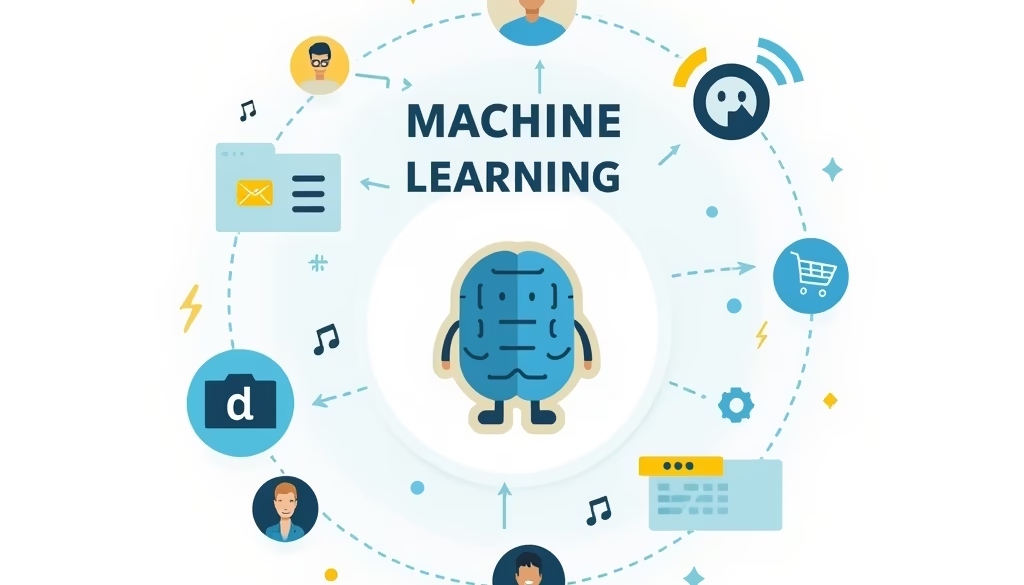
Machine learning is teaching computers to learn from examples instead of following rigid, pre-written instructions. Just like you learned to spot spam emails over time, or cook without recipes, or tell when someone’s upset from their texts—computers can learn to recognize patterns and make predictions.
The difference? Computers can process millions of examples in hours.
That’s why machine learning now powers your email filters, Netflix suggestions, voice assistants, and fraud detection systems. It’s everywhere. And you don’t need a technical background to understand it.
This guide breaks down how machine learning works using plain language and examples from your daily life. No math. No code. No prerequisites.
If you’ve felt intimidated before, you’re in the right place.
Table of Contents
- Introduction
- What You’ll Walk Away With
- Why Most Machine Learning Explanations Overwhelm Beginners
- What Is Machine Learning in Simple Terms?
- How Machine Learning Works Compared to Traditional Programming
- How Machine Learning Works Step by Step
- How Machine Learning Works in Real Life: Spam Filter Example
- Types of Machine Learning (High-Level Only)
- Where Machine Learning Falls Short
- Common Myths About Machine Learning
- Machine Learning Examples in Everyday Life
- Do You Need Coding to Understand Machine Learning?
- FAQ: Your Questions Answered
- Conclusion
What You’ll Walk Away With
After reading this, you’ll:
- Finally understand what machine learning actually is (without the technical fog)
- See the difference between traditional programming and machine learning in a way that clicks
- Know how machine learning systems learn from data, step by simple step
- Recognize where you’re already using ML in your daily life without realizing it
- Feel confident discussing machine learning without needing to code or do math
- Cut through the hype, myths, and fears surrounding AI and ML
Most importantly: you’ll stop feeling like this topic is “over your head.”
It’s not. You’re about to prove that to yourself.
Why Most Machine Learning Explanations Overwhelm Beginners
Here’s what usually happens.
You Google “how machine learning works.” You click an article. Within two paragraphs, you’re drowning in terms like “supervised learning algorithms,” “training epochs,” “hyperparameter tuning,” and “backpropagation.”
You didn’t ask for a PhD crash course. You just wanted to understand the basic idea.
The Real Problem:
Most articles are written by technical people who’ve forgotten what it’s like to not understand this stuff. They assume you know programming. They use academic language. They skip the foundational mental models that make everything click.
What’s Usually Missing:
- Simple analogies from everyday life
- Patient explanations that don’t skip steps
- Clear comparisons to things you already know
- Language that builds confidence instead of intimidation
According to MIT Sloan’s research, one of the biggest barriers to ML literacy isn’t the concepts themselves—it’s how they’re taught.
This Article Is Different:
We start with what you know. We build understanding gradually. We use normal language throughout.
No jargon unless absolutely necessary. And when we use technical terms, we explain them like you’re a friend, not a student.
Sound good? Let’s go.
What Is Machine Learning in Simple Terms?
Here’s the simplest way I can put it.
Machine learning is teaching computers to figure things out from examples, instead of giving them step-by-step instructions for every possible situation.
Think about your spam folder for a second.
How did you get good at spotting junk emails?
Nobody handed you a training manual titled “The Complete Guide to Identifying Spam in 847 Pages.” You didn’t memorize rules. You didn’t take a class.
You just saw spam over time. Lots of it. Your brain naturally noticed patterns.
Weird subject lines. Suspicious links. Messages from strangers promising free money. That “off” feeling about certain emails.
Your brain learned without you consciously trying.
That’s exactly what we’re doing with computers and machine learning.
We show a computer 50,000 spam emails and 50,000 legitimate emails. The computer studies them carefully. It figures out patterns—some obvious, some subtle. Then when your next email arrives, it predicts: “Yeah, this one’s probably spam.”
Here’s the Key Thing:
The computer isn’t “thinking” like a human. It’s not conscious. It doesn’t understand what money is or why scams are bad.
It’s just incredibly good at spotting patterns in data. So good that it looks intelligent from the outside.
That’s the whole magic trick.
How Machine Learning Works Compared to Traditional Programming
Now that you’ve got the basic idea, let’s dig a bit deeper.
For decades—basically since computers were invented—programmers solved problems by writing specific rules. If this happens, do that. If that happens, do something else.
We call this traditional programming. And honestly? It still works great for certain things.
Traditional Programming: The Recipe Method
Imagine you want to program a computer to identify a ripe banana.
With traditional programming, you’d write explicit rules:
IF banana color = yellow
AND no green spots visible
AND small brown speckles present
AND texture feels slightly soft
THEN banana is ripe

IF banana color = completely brown
AND feels mushy
THEN banana is overripe

IF banana color = green
AND feels hard
THEN banana is not ripe yet
See what’s happening? You’re telling the computer every single rule. Every condition. Every possibility you can think of.
It’s like following a recipe exactly. Two cups flour. One teaspoon salt. Bake at 350°F for 25 minutes. Don’t deviate.
This works perfectly for predictable, simple problems.
Your phone calculator? Traditional programming. Your microwave timer? Traditional programming. Your digital alarm clock? Same thing.
These systems follow fixed rules that never need to change.
Machine Learning: The Experience Method
Now imagine teaching a computer about ripe bananas using how machine learning works.
You wouldn’t write rules at all.
Instead, you’d show it 10,000 photos of bananas. Green ones just picked. Yellow ones perfect for eating. Brown ones ready for banana bread. Black ones you should probably throw out.
Each photo is labeled: “not ripe,” “ripe,” “overripe,” “too far gone.”
The computer looks at all these examples. It starts noticing patterns. Relationships between color and ripeness. Texture changes. Size variations. Even patterns you didn’t tell it to look for.
After studying thousands of examples, it builds its own internal “understanding” of what makes a banana ripe.
You never wrote the rules. The computer figured them out from experience.
If this feels familiar, you’re not alone. It’s how you learned most things in life.
Side-by-Side Comparison
| Aspect | Traditional Programming | Machine Learning |
|---|---|---|
| How it works | Programmer writes explicit rules | Computer learns patterns from examples |
| What you need | Detailed instructions for every scenario | Large dataset of labeled examples |
| When rules change | Programmer manually updates code | System adapts automatically from new data |
| Best used for | Fixed, predictable problems | Complex, pattern-based problems |
| Real examples | Calculator, traffic lights, alarm systems | Spam filters, voice recognition, recommendations |
| Flexibility | Limited to programmed scenarios | Handles new situations similar to training |
| Development | Faster for simple, clear-cut problems | Better for messy, complex problems |
When Does This Actually Matter?
Here’s when traditional programming breaks down:
- The rules are too complex to write out
- The rules keep changing
- You don’t even know what all the rules should be
Think about it. How would you write rules to recognize every possible human face? Millions of variations in features, angles, lighting, expressions.
What rules would you create to understand spoken language? Different accents, slang, background noise, speech impediments, context clues.
How do you predict which customers might leave your service next month? There are hundreds of subtle behavioral signals.
You can’t. There are too many variables. Too many edge cases. Too much complexity hidden in the data.
That’s where machine learning shines. It finds patterns in messy, complicated, real-world data that we couldn’t possibly write rules for manually.
Before we move on to the next part, make sure this distinction makes sense. Traditional programming = following recipes. Machine learning = learning from experience.
Got it? Great. Let’s see how the learning actually happens.
How Machine Learning Works Step by Step
Alright, let’s break down exactly how machine learning works without any shortcuts.
Think of it like learning any skill. There are clear stages.
Step 1: Collecting the Examples (Data Collection)
You can’t learn to cook without ingredients, right?
Same deal here. Machine learning needs data to learn from.
And “data” just means examples. That’s it. Nothing fancy.
These examples could be:
- Photos: Pictures of cats, X-rays of lungs, images of handwritten numbers
- Numbers: Past sales figures, temperature readings, stock prices, customer ages
- Text: Product reviews, news articles, emails, social media posts
- Audio: Voice recordings, music tracks, engine sounds
Generally, more examples mean better learning. It’s the difference between learning to cook from five recipes versus five hundred.
But here’s what most people don’t tell beginners: quality matters way more than quantity.
A thousand accurately labeled examples beat a million messy, mislabeled ones every time.
Step 2: Finding the Patterns (Training)
This is where the actual learning happens in machine learning explained simply.
During training, the computer analyzes those examples over and over. It’s searching for patterns. Connections. Relationships.
The computer keeps asking itself questions like:
- What do spam emails have in common that real emails don’t?
- What features show up in pictures of dogs but not cats?
- What usually happened right before sales went up in the past?
It makes guesses. Tests them. Adjusts its internal settings. Makes new guesses. Tests again.
Millions of tiny adjustments over time.
Think of it like learning to season food. You taste it. Add a pinch of salt. Taste again. Add some pepper. Keep tasting and adjusting until it’s just right.
After all these adjustments, you end up with something called a “model.”
The model is basically the computer’s learned knowledge about the problem. It’s like your cooking intuition after years of practice—except captured in mathematical form.
Most people are surprised by this part: the computer is doing all this pattern-finding automatically. You don’t have to tell it which patterns to look for.
Step 3: Testing What It Learned (Evaluation)
You wouldn’t serve a brand new recipe to dinner guests without tasting it first, would you?
Same logic here.
After training, we test the model on completely new examples it’s never seen before. This tells us if it actually learned useful patterns—or if it just memorized the training data without really understanding.
If a spam filter truly learned what makes spam “spammy,” it should catch spam in brand new emails. Not just the ones it trained on.
Fails the test? We go back and adjust how it learns. Try again with different approaches.
Step 4: Using It in the Real World (Deployment)
Once the model performs well on the test, it’s ready for actual work.
Your email provider uses it to filter your inbox every day. Netflix uses it to suggest shows you might like. Your bank uses it to spot potentially fraudulent charges. Your phone uses it to recognize your voice commands.
The model runs quietly in the background. Making predictions. Doing its job without you noticing.
And here’s something cool that most articles don’t mention: many systems continue learning as they work. They improve over time based on real-world feedback.
Getting smarter with experience. Just like you did when you learned to cook.
Now that this idea makes sense, let me show you a real example you use literally every day.
How Machine Learning Works in Real Life: Your Email Spam Filter
Let me walk you through one complete, real-world example.
Your email spam filter. Something you’ve probably used today already.
The Old Way (Traditional Programming)
Back in the day, spam filters were pretty basic. They used simple rules:
- Block any email containing “free money”
- Block emails from certain sketchy domains
- Block emails with way too many exclamation marks!!!
Simple enough, right?
Too simple, actually.
Spammers figured this out fast. They started getting creative with their wording. “Fr.ee M0ney” instead of “free money.” Or “F.r.e.e M.o.n.e.y” with dots separating every letter.
It turned into an endless cat-and-mouse game. Every time email companies updated their rules, spammers found new workarounds. The spammers always stayed one step ahead.
Exhausting for everyone involved.
The Machine Learning Way (How It Actually Works Now)
Modern spam filters work completely differently. They learn from millions of real examples.
Here’s the step-by-step process:
1. Collecting Real Data
Email companies collect millions of emails. Some that real users marked as spam. Some that real users marked as legitimate and important.
These are real examples from real people. Not hypothetical scenarios.
2. Analyzing Features
The system examines hundreds of characteristics in each email:
- Specific words and phrases used
- Patterns in the sender’s email address
- What time the email was sent
- Which links are included (and where they lead)
- The ratio of images to text
- Dozens of other subtle details you’d never consciously notice
3. The Training Phase
The machine learning algorithm studies all these examples carefully. It discovers patterns. Some are obvious:
- Legitimate company emails usually include an unsubscribe link at the bottom
- Spam often intentionally misspells common words
- Real banks never request your password through email
- Spam messages tend to use more images than text
But it also finds thousands of subtle, complex patterns. Patterns way too complicated for humans to spot or describe manually. Combinations of factors that matter in ways we couldn’t predict.
4. Making Predictions on New Emails
When a new email arrives in your inbox, the trained model examines it carefully. It compares the email against all those patterns it learned. Then it calculates a probability score.
“This email is 94% likely to be spam.”
Or “This one looks legitimate.”
5. Continuous Learning and Improvement
Here’s the really cool part: every time you mark an email as spam—or rescue something legitimate from your spam folder—the system learns from your feedback.
It refines its understanding. Adjusts its patterns. Gets more accurate over time.
The beautiful thing about all this? Nobody manually programmed these rules. The system learned them from experience. From data. From real-world examples.
That’s how machine learning works in practice. And it’s happening in your email inbox right now, filtering dozens of messages while you sleep.
Pretty neat, right?
Types of Machine Learning (High-Level Only)
So there are different “learning styles” in machine learning. Kind of like how people learn differently.
You really don’t need to memorize these categories. Just understand they exist and have different use cases.
Supervised Learning: Learning with a Teacher
This is like learning to cook with your grandmother standing next to you, guiding you. She tells you if each dish turned out good or needs work.
The computer gets examples where the correct answers are already labeled:
- This email? Spam.
- That email? Not spam.
- This medical scan? Shows a tumor.
- That scan? All clear.
- This customer? Left the service last month.
- That customer? Still with us.
The computer learns to predict the correct labels for brand new examples.
Most practical, everyday applications use supervised learning. It’s the workhorse of the machine learning world. The bread and butter.
Common uses: Email spam filtering, medical diagnoses, loan approvals, speech recognition, face identification
Unsupervised Learning: Finding Hidden Patterns
This is like browsing through recipes online and naturally noticing categories form. “Oh, all these seem to be Italian dishes.” Or “These are all quick 30-minute meals.”
Nobody told you to group them. You just noticed patterns on your own.
The computer gets examples without any labels. No correct answers provided. Its job? Find natural groupings or interesting patterns in the data all by itself.
For example, a streaming service like Netflix might discover their viewers naturally cluster into groups: action movie enthusiasts, documentary lovers, comedy bingers, true crime fanatics.
Nobody told the system these categories should exist. It found them by analyzing viewing patterns and preferences.
Common uses: Customer segmentation, recommendation engines, finding unusual patterns, market research
Reinforcement Learning: Learning Through Trial and Error
This is like learning to play chess or video games. You try different moves or strategies. See what works. Learn from your mistakes. Get better gradually through practice.
The computer learns by trying different actions in an environment. Good results? It gets rewards. Bad results? It gets penalties.
Over time, it figures out strategies that maximize rewards and minimize penalties.
Common uses: Game-playing AI (like AlphaGo), robotics, self-driving cars, optimizing ad placements
Again, you don’t need to remember these categories. Just know that machine learning can learn with guidance (supervised), without guidance (unsupervised), or through experimentation (reinforcement).
Before we talk about myths, there’s one more thing worth mentioning that most articles skip entirely.
Where Machine Learning Falls Short
Let’s be real for a minute.
Machine learning isn’t magic. It’s not going to solve every problem. And it definitely has limitations worth knowing about.
I think it’s important to talk about this honestly, without hype or fear-mongering.
It Can Only Learn What’s in the Data
If you train a machine learning model only on sunny weather data, it won’t magically predict hurricanes. If you show it thousands of pictures of cats and dogs, it can’t suddenly identify elephants or giraffes.
Machine learning works within the boundaries of what it learned. Nothing more.
It’s like that experienced cook who’s amazing with Italian cuisine but completely lost trying to make authentic Thai food for the first time.
Garbage In, Garbage Out
If your training data is biased, incomplete, or just plain wrong, your model will learn those biases and errors.
There have been real cases where facial recognition systems worked poorly on certain demographics because the training data didn’t represent everyone equally. Where hiring algorithms discriminated because they learned from historically biased hiring decisions.
The machine learning system doesn’t know it’s being biased. It just learns patterns from whatever data you give it.
It Can’t Explain Its Reasoning (Usually)
When a machine learning model makes a prediction, it often can’t tell you exactly why in human terms.
It noticed patterns across millions of data points. It made connections too complex and numerous for simple explanation. This is called the “black box” problem.
For some applications, this is fine. For others—like medical diagnoses or loan decisions—this lack of explainability is a serious concern.
It Needs Lots of Examples (Usually)
Most machine learning approaches need thousands or millions of examples to learn effectively. That’s a lot of data to collect and label accurately.
Humans can often learn from just a few examples. Show a toddler three dogs, and they get the concept of “dog.” Machine learning typically needs way more examples.
It’s Not Common Sense
Machine learning models can be surprisingly stupid in ways that seem obvious to humans.
They might correctly identify cats in thousands of photos but get completely fooled by a picture of a cat with a cucumber photoshopped on its head. Because that specific combination never appeared in training.
They lack human common sense, context understanding, and real-world knowledge about how things actually work.
Why Am I Telling You This?
Because understanding limitations is part of truly understanding how machine learning works. It’s a powerful tool with specific strengths and weaknesses.
Not a magic solution. Not something to fear. Just a tool that’s really good at pattern recognition within the scope of its training.
Now that we’ve covered what it can’t do, let’s clear up some common myths about what people think it can do.
Common Myths About Machine Learning
There’s a lot of confusion and hype around machine learning. Let’s clear some of it up.
Myth 1: “Machine Learning and AI Are the Same Thing”
Not exactly, no.
Artificial Intelligence is the big umbrella term. It means any computer system doing tasks that seem intelligent.
Machine learning is one specific approach to achieving AI. It’s teaching computers through examples and letting them learn patterns from data.
Think of it this way: AI is like saying “transportation.” Machine learning is like saying “driving a car.” Transportation is the broad concept. Driving is one specific method of getting around.
There are other approaches to AI beyond machine learning (like rule-based expert systems), but machine learning has become the most popular and powerful approach in recent years.
Myth 2: “Machines Actually Understand Things Like Humans Do”
They really don’t.
When your spam filter “knows” an email is spam, it doesn’t understand the content the way you do. It has zero idea what money actually is. It doesn’t grasp why scams are harmful or unethical.
It’s recognizing statistical patterns in the data. That’s all.
A machine learning model is more like a very sophisticated pattern-matching calculator than a thinking being. It processes information. It doesn’t comprehend meaning.
This distinction really matters when we think about what these systems can and should do.
Myth 3: “You Need to Be a Math Genius to Understand Machine Learning”
This is probably the biggest myth. The one that scares people away.
Do you need advanced mathematics to build machine learning systems from scratch? Yes, absolutely.
Do you need it to understand what machine learning is, how it works conceptually, and where it’s used? Not even a little bit.
You don’t need to understand internal combustion engines to drive a car. You don’t need to know audio engineering to enjoy music. You don’t need calculus to grasp machine learning concepts.
If you’re still reading this article and understanding it, you’ve already proven this myth wrong.
Myth 4: “Machine Learning Will Replace All Human Jobs”
This one creates a lot of unnecessary anxiety.
Machine learning is a tool that augments human capabilities. It doesn’t replace them entirely.
Yes, some specific tasks that are purely pattern-based and repetitive might get automated. But most jobs involve way more than just pattern recognition.
Doctors use machine learning to help spot patterns in X-rays or MRI scans they might miss. But doctors still make the final diagnosis. They still create treatment plans based on the whole patient context. They still provide emotional support and explain options to worried families.
Customer service teams use AI chatbots to handle simple, repetitive questions. But humans still handle complex issues that require empathy, creative problem-solving, and judgment calls.
Here’s the reality: Machine learning is excellent at pattern recognition. It’s terrible at common sense, creativity, emotional intelligence, ethical reasoning, and adapting to completely new situations.
Those human skills aren’t going anywhere.
Myth 5: “More Data Always Equals Better Results”
Quality beats quantity. Every single time.
Ten thousand accurately labeled, representative examples will teach a model more than a million messy, mislabeled, or biased examples.
It’s like learning to cook. Fifty well-tested recipes from a professional chef teach you way more than five hundred random, unverified recipes scraped from internet comment sections.
The data needs to be good data. Relevant. Accurate. Representative of what you’ll encounter in the real world.
Myth 6: “Machine Learning Can Predict the Future Perfectly”
Nope. It makes educated guesses based on patterns in past data. That’s different from perfectly predicting the future.
If something completely new happens—something that wasn’t in the training data—machine learning models often struggle or fail entirely. They’re extrapolating from past patterns, not actually seeing the future.
Stock market prediction models? They work until market conditions fundamentally change. Weather prediction? Pretty good for a few days out, increasingly uncertain beyond that.
Machine learning excels at finding patterns in historical data and making reasonable predictions when the future resembles the past. It’s not a crystal ball.
Most people are surprised by how normal and practical machine learning actually is once you strip away the myths and hype.
Machine Learning Examples in Everyday Life
You’ve been using machine learning all day without even realizing it.
Let me show you where it’s hiding in your daily routine.
Your Morning
Your phone unlocks with your face. That’s machine learning recognizing your specific face among millions of possible faces. Even when you just woke up with bedhead. Even in different lighting. Even when you’re wearing glasses or a hat.
Your email inbox is already organized. Spam has been filtered automatically. Important messages are flagged. Promotional stuff is sorted into its own folder. All thanks to machine learning working while you slept.
Your news feed shows stories picked specifically for you. Not random articles. The algorithm learned what topics interest you based on what you’ve clicked before, how long you spent reading, and what you shared.
Your Commute
Google Maps predicts traffic jams before you hit them. How does it know? Machine learning analyzing real-time location data from millions of phones, figuring out where traffic is slowing down right now.
Your voice assistant understands what you’re saying. Natural language processing (a type of machine learning) converts your speech to text, figures out what you actually want, and responds appropriately.
Your music app knows what you’ll like next. Those personalized playlists like Spotify’s Discover Weekly? Machine learning studying your listening habits and finding similar songs from millions of options.
At Work or School
Smart email replies appear automatically. Those suggested responses in Gmail? Machine learning analyzing the email content and predicting what you might want to say back.
Your calendar finds good meeting times. Some scheduling tools use machine learning to learn your patterns and preferences, suggesting times that work best for everyone.
Fraud detection protects your money. Your bank or credit card company uses machine learning to spot unusual purchase patterns. That time your card got frozen when traveling? Machine learning noticed the anomaly and protected you.
Shopping Online
“Customers who bought this also bought…” That’s machine learning finding patterns in millions of purchase histories. Amazon practically built their empire on this.
Visual search lets you find products from photos. Upload a picture of shoes you like, and machine learning finds similar products by analyzing visual features and patterns.
According to Coursera’s research on real-world applications, visual search has become one of the most powerful machine learning features in e-commerce, helping people find products they can see but can’t describe in words.
Healthcare
Machine learning helps radiologists spot cancer earlier. It analyzes medical images, recognizing subtle patterns in X-rays and MRIs that human eyes might miss, especially when looking at hundreds of scans per day.
Online symptom checkers suggest possible diagnoses. They’re trained on millions of medical cases, learning relationships between symptoms and conditions. (Though they always tell you to see a real doctor, which you should.)
Drug researchers discover new medicines faster. Machine learning predicts which chemical compounds might work as effective treatments, dramatically speeding up a process that used to take decades.
Tableau’s analysis of machine learning in healthcare shows that ML has helped reduce diagnostic errors by identifying patterns across thousands of medical images—patterns that would take human doctors decades to see enough times to recognize reliably.
Entertainment
Netflix knows what you want to watch next. Machine learning analyzes what you’ve watched, when you watched it, what you abandoned halfway through, and what similar viewers enjoyed. It’s eerily accurate sometimes.
Your social media feed isn’t chronological anymore. Instagram, Facebook, TikTok—they all use machine learning to decide what shows up in your feed based on what you’ve liked, commented on, spent time viewing, and shared.
TikTok’s “For You” page is scary good at knowing your interests. That’s some seriously sophisticated machine learning at work, learning your preferences incredibly quickly from subtle signals in your behavior.
You’re living in a machine learning-powered world. Now that you know what to look for, you’ll start noticing it everywhere.
The question isn’t whether machine learning affects your life. It’s whether you understand how it works well enough to make informed choices about it.
Which, at this point, you do.
Do You Need Coding to Understand Machine Learning?
Here’s the question I get asked most often.
“Do I really need to know how to code to understand this machine learning stuff?”
The answer: Absolutely not.
Look. You just learned the core concepts. Right here in this article. Did you write a single line of code? Did you solve any math equations? Nope.
Understanding how machine learning works conceptually requires zero programming knowledge. Zero mathematical background. Zero technical prerequisites.
Think about it this way:
- You understand how cars work without being a mechanic
- You appreciate music without knowing how to play instruments
- You enjoy movies without studying film production
- You can understand machine learning without knowing how to code
It’s really that simple.
Here’s the Important Distinction
If you want to build machine learning systems yourself—if you want to train models, work with data, and create actual ML applications—then yes, you’ll need to learn coding. Usually Python.
But that’s a completely different goal than understanding what machine learning is and how it works.
Most people don’t need to build these systems. They just need to understand them well enough to make informed decisions in their work and life.
Three Levels of Machine Learning Knowledge
Level 1: User Understanding (No Coding Required)
Understanding what ML is. How it works at a conceptual level. Where it’s used. How to evaluate ML products and make informed decisions about them.
That’s what this article gives you. And honestly, it’s what most people actually need in their lives and careers.
Level 2: Practitioner Skills (Some Coding Required)
Building and training machine learning models yourself. Working with real datasets. Choosing appropriate algorithms for different problems. Using ML tools and frameworks.
This level requires learning programming (typically Python) and getting familiar with ML libraries and platforms.
Level 3: Expert Level (Heavy Coding + Mathematics)
Developing new machine learning algorithms. Optimizing system performance. Conducting research. Publishing papers.
This requires deep programming expertise, advanced mathematics (calculus, linear algebra, statistics), and years of focused study.
Most people only need Level 1 understanding.
If you work in marketing, management, product design, healthcare, finance, education, journalism—pretty much any field where machine learning impacts your work or your company’s decisions—you need conceptual understanding. Not coding skills.
Want to Go Deeper Without Coding?
There are great resources for non-technical people who want to learn more:
- Interactive visualizations that demonstrate concepts visually
- Case studies from real companies showing ML in action
- Podcasts featuring conversations with ML practitioners
- YouTube channels that explain concepts through animations
- Business-focused courses that skip the technical implementation
The barrier to understanding machine learning has never been your coding ability or math skills. It’s been finding explanations that don’t assume you’re already a programmer.
And you just found one. You’re proof that anyone can understand this.
FAQ: Your Questions Answered
Is machine learning the same thing as artificial intelligence?
Not exactly. AI is the broad umbrella term for any computer system that does tasks requiring intelligence. Machine learning is one specific way to achieve AI—by teaching computers through examples and data rather than explicit programming. Think of AI as “transportation” and machine learning as “driving a car.” One’s the general concept, the other’s a specific method.
Does understanding machine learning require coding knowledge?
Nope. Understanding what machine learning is and how it works conceptually requires zero programming knowledge. You only need coding if you want to actually build ML systems yourself. Understanding the concepts, applications, and implications—which is what most people need—doesn’t require any technical skills whatsoever.
Can machine learning systems make mistakes?
Absolutely, yes. ML systems make predictions based on patterns they found in training data. If that training data was biased, incomplete, or unrepresentative of real-world situations, the model will make errors. They also struggle with situations they’ve never encountered before. That’s exactly why human oversight remains so critical for important decisions.
How does machine learning actually learn from data?
Machine learning learns by analyzing thousands or millions of examples, identifying patterns and relationships within that data. During training, the system adjusts its internal parameters millions of times, testing different approaches until it finds patterns that consistently work across the examples. It’s remarkably similar to how you learned to recognize spam emails—through repeated exposure to examples over time.
Is machine learning replacing human jobs?
Machine learning augments human capabilities rather than replacing them entirely. It excels at pattern recognition and processing large amounts of data but lacks common sense, creativity, emotional intelligence, and ethical reasoning. Most industries use ML to help humans make better decisions faster, not to eliminate human judgment entirely.
How long does it take to train a machine learning model?
Training time varies dramatically. Simple models might train in minutes. Complex models analyzing millions of images or vast datasets might take days or weeks on powerful computers. The time depends on the data volume, model complexity, and computing power available.
What’s the difference between machine learning and deep learning?
Deep learning is a subset of machine learning that uses neural networks with many layers (hence “deep”). While all deep learning is machine learning, not all machine learning is deep learning. Deep learning excels at processing images, audio, and unstructured data but requires more data and computing power than traditional ML approaches.
Conclusion
You started this article feeling intimidated by machine learning.
Now you understand it.
Here’s what you know:
Machine learning teaches computers to learn from examples instead of following rigid instructions. It’s the difference between memorizing recipes and learning to cook through experience.
You understand how machine learning works step by step—collecting examples, finding patterns, testing the learning, and deploying it in real-world applications.
You’ve seen it in action through your spam filter, recommendation systems, voice assistants, and countless daily tools.
You know ML doesn’t “think” like humans. It recognizes patterns exceptionally well. It helps humans make better decisions but doesn’t replace human judgment, creativity, or ethics.
Most importantly: You proved you don’t need coding, math, or technical background to understand machine learning fundamentals.
Next time someone mentions machine learning, you won’t feel lost. You’ll understand the concept. You’ll ask informed questions. You’ll be part of the conversation.
Machine learning explained? Check.
Technical overwhelm? Gone.
Welcome to understanding how computers learn. You’re ready for the next step.
Go to Next Lesson:
Understanding AI Models: LLMs, Vision Models, and Predictive Models (Explained Simply)
Now that you understand how machine learning allows computers to learn from data and recognize patterns, the next step is understanding the different types of AI models built using those techniques.
Not all AI works the same way. Some models specialize in understanding and generating text, others analyze images and videos, while some focus on predicting outcomes based on patterns in data.
In the next guide, you’ll learn how large language models, vision models, and predictive models actually work—and when each type is used in the real world.
👉 Read next: Understanding AI Models: LLMs, Vision Models, and Predictive Models (Explained Simply)
Ready to dive deeper? The next lesson explores different types of AI models, how they differ, and when to use each one. You’ll learn about large language models like ChatGPT, computer vision systems, and predictive analytics—all explained in the same beginner-friendly way.