Freelancing 101: A Step-by-Step Blueprint to Land Your First Client and Build Sustainable Income in 2026
You already know what the inside of a 9-to-5 feels like.
Thank you for reading this post, don't forget to subscribe!
Maybe it’s the 6 a.m. alarm for a job that doesn’t start until 9. The salary raise that never quite kept pace with your rent. The Sunday night dread that arrives, reliably, around 7 p.m.
Or maybe you don’t have a job right now and you’re staring at your skills wondering if there’s a way to turn them into real income — without waiting six months for someone to hire you.
That’s the conversation this Freelancing 101 guide is built for.
Here’s the headline: freelancers collectively generated $1.5 trillion in earnings in 2024, according to Upwork’s Future Work Index. Not gig workers scraping together grocery money — actual skilled professionals earning serious income on their own terms, from every corner of the world.
This is your complete Freelancing 101 blueprint. Whether you’re starting from absolute zero or stepping out of a traditional job, you’ll finish this guide with a real system — for choosing a profitable skill, building a portfolio when you have nothing to show yet, landing clients through outreach that doesn’t feel desperate, and pricing your work in a way that doesn’t make you second-guess yourself. Everything here draws from 2025 global market data, platform research, and the unglamorous lessons most “how to freelance” guides skip entirely.
Let’s get into it.
Table of Contents
- What Is Freelancing 101 and Why Is It Exploding Globally?
- Freelancing 101 for Beginners: Step by Step
- How to Find Freelance Clients Online (Even With No Experience)
- The Biggest Freelancing Myth Beginners Still Believe
- Freelancing Skills in Demand 2025 (Global Trends)
- How to Compete in a Saturated Freelance Market
- Common Freelancing 101 Mistakes to Avoid
- Why Freelancing Isn’t for Everyone
- Freelancing 101: Your 30-Day Launch Plan
- Compliance & Disclaimer
- FAQ
- Conclusion
What Is Freelancing 101 and Why Is It Exploding Globally?
Freelancing means you sell your skills directly to clients — without being a permanent employee of any single company. You set your rate, choose your projects, and work on your schedule.
That sounds simple. And at its core, it is.
You might take on a single two-week project for a startup in Austin, then immediately pivot to a three-month retainer with a brand in Berlin. You could be a copywriter in Nairobi, a developer in Bangalore, a designer in São Paulo, or a video editor in Manila. Geography used to determine your income ceiling. Now your skills and positioning do.
When I landed my first freelance client, I underpriced my services and overdelivered — spending nearly twice the hours I quoted because I didn’t want to disappoint someone who had taken a chance on me. That early experience taught me something quickly: freelancing isn’t about working more than everyone else. It’s about positioning yourself better than everyone else. Everything in this guide points back to that lesson.
Freelancing vs. Full-Time Job — What You’re Actually Choosing
This isn’t a “one is better” conversation. It’s about understanding exactly what each path asks of you.
| Factor | Freelancing | Full-Time Employment |
|---|---|---|
| Income ceiling | Unlimited — you raise rates as you grow | Capped by salary bands and annual reviews |
| Schedule | You build it | Employer owns it |
| Job security | Multiple clients spread your risk | One employer concentrates it |
| Benefits | Self-managed (health, pension, paid leave) | Often employer-provided |
| Skill growth | Fast — the market punishes stagnation | Slower; depends on employer priorities |
| Getting started | Skills first, no degree required | Often gatekept by credentials |
| Tax complexity | Higher — you manage it yourself | Simpler — employer withholds |
Neither path is objectively superior. The freelancing vs. full-time job debate is really a question of: what kind of risk can you live with, and what kind of life are you actually trying to build?
Why Is This Happening Now — And Why Does It Matter for You?
When you zoom out for a second, something becomes obvious: this isn’t a trend. It’s a structural shift in how global work gets done.
In 2025, roughly 1.57 billion people globally are engaged in some form of freelancing — nearly half the total working population worldwide. The U.S. freelance workforce grew 90% between 2020 and 2024. India’s grew 160%. The Philippines’ grew over 200%.
Companies stopped hiring full-time employees for every function they needed filled. Nearly 69% of employers who went through layoffs in 2023–2024 replaced those positions with freelancers, according to Fiverr’s research. Even 48% of Fortune 500 companies now use freelance platforms regularly. This isn’t desperation on the employer side — flexibility is the new default, and that’s not reversing.
Technology erased geography. A payment from a client in Germany can land in your account while you’re working from a café in the Philippines, within minutes. Tools like Zoom, Notion, and Slack have made global collaboration feel completely local.
Is freelancing worth it in 2025? For people willing to treat it like a real business — yes. U.S.-based freelancers average roughly $99,230 per year (ZipRecruiter, 2025). Sixty percent of people who left traditional jobs for freelancing reported higher earnings afterward. But it doesn’t happen automatically. That’s what the rest of this guide unpacks.
Freelancing 101 for Beginners: Step by Step
Most Freelancing 101 guides give you a list of tips. This is a system.
There’s a real difference. Tips are things you read and forget before Monday. A system is something you follow in sequence and actually finish. Here’s the sequence.
Step 1: Choose a Profitable Skill — But Ask the Right Question First
The question most beginners ask is: “What can I do?”
Wrong starting point.
The right question is: “What do real clients pay real money for — and do I have a version of that skill?”
Start by listing what you already know. Things you’ve done in past jobs, side projects, school, or even personal hobbies you’ve taken seriously. Then hold each skill up against a market reality check. Are people actively hiring for this on Upwork or Fiverr right now? Are companies posting roles for this on LinkedIn? Are there communities of paying clients looking for exactly this?
If you don’t have an obvious skill yet, that’s completely fine. Pick one foundational skill that takes four to six weeks to reach a beginner-capable level. Copywriting, social media management, basic video editing, virtual assistance, or introductory web design — none require years of formal training, and all have consistent global demand across multiple industries.
One rule you shouldn’t bend on: don’t try to be a generalist at the start. “I’m a writer/designer/marketer” doesn’t land clients. “I write email sequences for e-commerce brands that recover abandoned carts” does. Specificity is your best marketing tool — especially when you don’t have a track record yet.
Step 2: Validate Demand Before You Build Anything
This is the step beginners skip. It’s why most waste their first two weeks building a website and a logo nobody asked for.
Before you write a bio, design a brand, or obsess over your domain name — spend two focused hours doing this instead. Go to Upwork and search your target skill. Count active job listings. Check whether proposals are being submitted (that’s proof real clients are spending money right now). Then look at Fiverr’s top sellers in your category — note what they charge, and more importantly, what client reviews say they were actually hired to solve.
Those reviews are research gold. They tell you exactly what problems clients have, in their own unfiltered words. Write those phrases down. Use them in your profile copy, your proposals, your outreach. Speaking a client’s language before you’ve even spoken to them is a trust signal most beginners miss completely.
Step 3: How to Build a Freelance Portfolio With No Clients
Here’s what nobody tells beginners clearly enough: you don’t need paying clients to build a portfolio. You need proof of concept.
My first “portfolio” was three pieces I made for companies that had never hired me. A redesign concept for a brand I admired. A sample blog post I wrote for a fictional SaaS company. A mock email sequence built around an Etsy store I’d found online. None of it was paid work. All of it got me my first real clients.
A beginner portfolio can include spec work you initiated, volunteer or discounted work for nonprofits or small local businesses, or a personal project framed as a documented case study.
The structure that actually converts: Each piece should answer three questions — What was the problem? What did you do? What was (or realistically would be) the result? Three tight, well-documented pieces will beat a portfolio of fifteen scattered samples every single time. Use Behance for design, Contently or a personal site for writing, or a clean Notion page for almost anything else.
Step 4: Platform vs. Direct Outreach — Pick Your Starting Lane
You don’t have to commit to one forever. You need somewhere to start.
| Platform/Method | Best For | Pros | Cons |
|---|---|---|---|
| Upwork | Tech, writing, marketing, data | Large client pool, built-in contracts | Competitive; up to 20% fees |
| Fiverr | Creative, design, short deliverables | Discoverable, beginner-friendly | Pricing pressure, commoditized feel |
| Toptal | Senior dev, finance, strategy | Premium rates, serious clients | Hard to get accepted as a beginner |
| LinkedIn + Cold Email | B2B consulting, professional services | No platform fees, direct relationships | Slower to start, needs confidence |
| Networking & Referrals | Relationship-driven freelancers, long-term growth | High trust factor, better retention, higher rates possible | Slow at the beginning, depends on relationship building |
| Local outreach | Service businesses, community work | Faster trust, real conversations | Limited geographic scale |
| Freelancer | Entry-level freelancers testing multiple niches | Wide job categories, contest option for beginners, international clients | Heavy competition, bidding system can lower prices, platform fees |
The smartest beginner strategy: use one platform to land your first one to three clients (you need those testimonials and reviews), then gradually shift to direct outreach — where you keep 100% of your fee and own every aspect of the relationship.
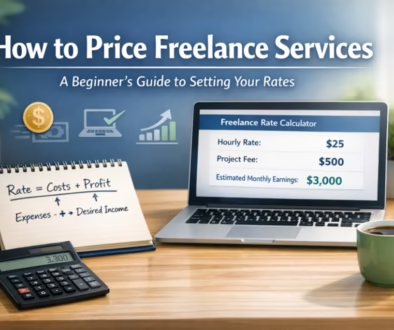
Step 5: How to Price Freelance Services Without Apologizing for Them
My first freelance project paid $40 for six hours of work. I told myself I was “building experience.” What I actually built was quiet resentment — toward the work, the client, and myself for accepting it. That lesson cost me more than money. It cost me several weeks of habitually undervaluing my time.
Here’s the formula that fixes this:
Hourly floor = (Target monthly income ÷ 80 billable hours) × 1.3
The 1.3 multiplier covers taxes, software, non-billable admin time, and the reality that you won’t be fully booked every single week — especially at the start.
Example: You want to earn $3,000/month freelancing. $3,000 ÷ 80 = $37.50 × 1.3 = $48.75/hour minimum
For project-based pricing (which most clients actually prefer), estimate your total hours, multiply by your rate, and add a 20% buffer for the scope creep that almost always materializes. Never quote a project price in real-time. Say: “Let me review the full scope and come back to you within 24 hours.” That pause signals experience, not hesitation.
How to Find Freelance Clients Online (Even With No Experience)
Most beginners wait for clients to come to them.
That is exactly the wrong posture. Successful freelancers go to clients — directly, specifically, with something genuinely useful to offer upfront.
Optimize Your Profile First, Everywhere You Show Up
Whether you’re on Upwork, LinkedIn, or your own website, your profile has three jobs: appear in search, build trust quickly, and push the visitor toward contacting you. Most profiles fail all three because they’re written from the freelancer’s perspective instead of the client’s.
Profile checklist that actually works:
- Headline: Lead with the outcome, not the job title. “Email Copywriter for E-Commerce Brands” beats “Freelance Writer” in every search result.
- Photo: Well-lit, professional, direct eye contact. Clients make trust decisions in under three seconds. This matters more than most people admit.
- Summary/Bio: Open with their problem, not your resume. “Struggling with email open rates below 20%?” before “I have three years of experience writing…”
- Portfolio: Three to five pieces, each with clear context and a documented result.
- Social proof: Even one testimonial from a professor, colleague, or volunteer client is meaningfully better than none. Ask for it — most people will write one if you actually helped them.
The Psychology of Why Clients Actually Hire
Here’s what most Freelancing 101 guides never bother explaining: clients don’t hire skills. They hire confidence in a safe bet.
When a potential client lands on your profile or reads your proposal, their real internal question is: Will this person understand my actual problem before I have to explain it three times? Will they communicate before things go wrong, or only after? Is this going to be worth the money?
Everything you write needs to answer those questions before they’re asked. Specificity is the mechanism. Vague freelancers feel like a gamble. Specific freelancers feel safe.
“I’ve helped e-commerce brands recover 15–20% of abandoned cart revenue through targeted email sequences” hits completely differently than “I’m an experienced email copywriter.” Same skill. Entirely different emotional response from the client reading it.
The three things clients actually care about: clarity (do you understand the problem?), confidence (do you believe you can solve it?), and communication speed (will you tell me what’s happening before I have to ask?). Get those three right and you will win clients even without an extensive portfolio.
Cold Outreach That Doesn’t Feel Desperate
Cold outreach fails when it’s about you. It works when it’s genuinely about them.
Here’s a script that’s generated real responses across different industries and geographies:
Subject: Quick idea for [Company Name]
Hi [Name],
I came across [specific thing — their newsletter, a recent product launch, a post they published] and noticed something that might be worth a quick conversation.
[One sentence naming the exact gap you spotted and how you’d approach fixing it.]
I’ve done similar work for [a relevant reference or “brands in your space”] with results like [specific outcome].
Worth a 15-minute call this week?
[Your name]
Keep it under 100 words. Make it about them. Send 10 of these weekly to researched, targeted prospects — not a mass blast. Track responses in a simple spreadsheet and look for patterns in what gets replies. Adjust. This is how to find freelance clients online when you’re starting from scratch.
Real Beginner Case Study: From Zero to Three Clients in 60 Days
Priya was a 24-year-old marketing graduate from Chennai with no freelance clients, no platform profile, and about $150 saved. She didn’t spend three months “building a brand.” She spent one week creating three spec portfolio pieces — mock social media campaigns for independent fashion brands she found on Instagram.
Then she identified 50 small fashion brands with inconsistent or low-quality social content and sent each of them a short, personalized message with one specific observation about their current content and one small improvement idea.
Within 60 days, she had three paying clients at ₹35,000–50,000/month each. All fashion brand owners. All found through direct outreach. No platform, no paid ads, no followers. Just a clear niche, three pieces of spec work, and 50 messages.
That’s the model.
The Biggest Freelancing Myth Beginners Still Believe
Let’s clear something up — because this one belief is holding back more people than any skill gap ever could.
The myth: You need [thing] before you can start freelancing.
Fill in the blank. A large following. Perfect English. An expensive laptop. A portfolio of paid work. A certification. An LLC. A professional website with custom branding.
None of it is true. None of it is what clients actually buy.
You don’t need thousands of social media followers. Your first 10 clients won’t care how many people follow you on Instagram. They care whether you can solve their specific problem.
You don’t need perfect English. Clarity matters more than fluency. Thousands of successful freelancers around the world work with international clients with English as their second or third language. Communication style and responsiveness matters far more than accent or grammar perfection.
You don’t need expensive tools. A laptop, an internet connection, and free-tier versions of tools like Canva, Google Docs, Notion, and Zoom are enough to start and run a real freelance business. The $2,000 software suite comes later — after you’re earning.
You don’t need a certification. No client has ever hired a copywriter because they passed a Coursera exam. They hired them because their writing was good and their proposal was specific.
What you actually need to start freelancing is simpler and harder than any of these things: one marketable skill, one piece of proof, and the willingness to reach out to someone before you feel completely ready.
That last part — acting before you feel ready — is the real barrier. Not the tools, not the credentials, not the followers.
Freelancing Skills in Demand 2026: Where the Real Money Is
The skills market shifts every year. In 2026, it’s moving faster than it ever has — largely because of AI integrating into almost every industry. Here’s where genuine demand is concentrated right now.
[Image: Freelancing Skills in Demand 2026 — Bar Chart, alt text: “Freelancing skills in demand 2026 showing AI, video editing, UX design and content writing as top growth categories”]
The High-Value Categories Right Now
AI and Machine Learning. Demand for AI-related skills rose 60–70% year-over-year going into 2026, with hourly rates running roughly 44% above platform averages. Prompt engineering, AI model fine-tuning, automation workflow design, and AI content strategy are all commanding real premiums. Most companies adopting AI tools don’t have internal people who actually know how to use them productively.
Content and Copywriting. The flood of mediocre AI-generated content has created more demand for skilled human writers, not less. Brands need content that’s nuanced, brand-consistent, and genuinely useful — and that’s become harder to find, not easier. SEO content writing, email copywriting, thought leadership ghostwriting, and UX writing all remain strong earners.
Short-Form Video and Design. Brands need more content, faster, and in-house teams rarely have the bandwidth. Short-form video editing (Reels, TikTok), UX/UI design, brand identity work, and motion graphics are all growing categories with consistent client demand.
Web and App Development. Full-stack development, React, Python, Node.js, and increasingly, no-code tools like Webflow and Bubble remain in strong demand across every geography. Asia-Pacific is the fastest-growing market for freelance tech work right now.
Performance Marketing. As ad costs rise, companies lean harder on people who can generate actual ROI — not just run campaigns. Performance marketers, email marketers, and conversion rate optimizers are consistently in demand.
Finance and Business Services. Wildly underrated as a freelance category. Bookkeeping, financial modeling, FP&A support, and business analysis have lower competition than creative or tech niches, command high rates, and attract clients who value reliability above almost everything else.
Data and Analytics. Companies have more data than they know what to do with. Freelancers who can build dashboards, run meaningful analyses, or communicate insights using Python, SQL, Tableau, or Power BI have steady, well-compensated work.
Why Skill Stacking Beats Everyone Competing on Rate
A single skill makes you a commodity. A deliberate combination makes you genuinely irreplaceable.
High-earning skill stacks to consider building toward:
- Copywriting + SEO = Content strategist who actually drives measurable traffic
- Design + Social Media Strategy = Brand content creator who understands what performs
- Python + Data Storytelling = Business intelligence freelancer who gets executive buy-in
- Project Management + Deep Industry Knowledge = Fractional operations lead that growing companies actually need
The goal isn’t to be mediocre across many things. It’s to be genuinely strong in one area and add complementary skills that make you more valuable to the exact same clients — without expanding into a different niche entirely.
How to Compete in a Saturated Freelance Market
Yes. There are millions of freelancers. And the majority of them are competing by being cheap generalists.
Which means the bar for actually standing out is lower than it sounds.
Micro-Niche or Get Lost in the Crowd
Most freelancers compete by lowering their rate and hoping volume compensates. The alternative is to become the obvious choice for one specific type of client — making price a secondary consideration.
“I’m a freelance writer” competes with everyone on every platform. “I write long-form technical content for B2B SaaS companies targeting engineering leaders” competes with almost no one — and typically commands three to five times the rate.
The formula: Skill + Industry + Specific Outcome.
“I design Shopify stores for independent fashion brands that want to convert mobile traffic” is a niche. “I’m a web designer” is a commodity. One of those positions generates referrals. The other generates price negotiations.
Build Authority Without a Big Audience
You don’t need 10,000 Instagram followers to be taken seriously as an expert.
Pick one channel: LinkedIn, a niche newsletter, a focused Substack, or a guest post on an industry publication. Publish something useful for your ideal client once a week for 90 days. By month three, you’ll have a body of work that signals credibility to anyone who searches your name. One well-documented case study, shared in the right community at the right time, will generate more real leads than a polished website with nothing substantive on it.
Use Your Location as an Advantage — Not an Excuse
If you’re freelancing from a country with a lower cost of living, you have a structural advantage: you can price below Western market rates and still earn income that’s genuinely strong relative to your local economy. Clients in the U.S., UK, Canada, and Australia actively seek talent in India, the Philippines, Eastern Europe, and Latin America — not just for cost reasons, but because the quality and communication standards have both improved dramatically.
If you’re based in a high-cost market, position around different strengths: timezone overlap, cultural alignment, regulatory simplicity, and zero translation friction. That’s genuinely worth a premium to the right buyers.
Common Freelancing 101 Mistakes to Avoid
Most freelancing horror stories trace back to the same six patterns. Here they are — with the context that usually gets left out.
1. Underpricing as a Strategy
The logic seems sensible: charge less to get your foot in the door, collect reviews, then raise rates. In practice, it builds a client base of people who chose you specifically because you were the cheapest option — which makes raising rates feel like betrayal on both sides.
Charge a rate that’s fair from the very beginning. It might mean fewer early inquiries. The clients who do say yes will value your work, give you better testimonials, and refer others who also value it.
2. Working Without a Contract
A verbal agreement is not a contract. Not legally. Not practically. Not psychologically.
Even a one-page document that defines scope, deliverables, revision rounds, payment terms, and what happens when the project grows — protects you and sets expectations that prevent most conflicts before they start. Clients who resist signing a contract are communicating something important. Pay attention to that signal.
The payment mini-system that protects you: Invoice 50% upfront before work begins. Invoice the remaining 50% upon delivery or at agreed milestones. Include a late payment clause — typically 1.5% per month after 14 days overdue. State the currency. State the payment method. State the timeline. Write all of it down.
3. Scope Creep
It always starts small. One extra revision. “Just a quick change.” A new feature that “shouldn’t take long.” Each individual ask feels minor. The cumulative effect is you working 40% more hours than quoted, for the same fee.
Fix it at the contract level: write deliverables with extreme specificity. “Three rounds of revisions per deliverable” instead of “revisions as needed.” When new work appears, respond every time with: “Happy to add that — here’s what it adds to the timeline and cost.” That consistent response trains clients to respect the scope.
4. Burnout from Taking Everything
When income feels uncertain, the instinct is to accept every project you can get. The result is 70-hour weeks, declining quality, damaged reputation, and a version of yourself that clients quietly stop recommending.
Build reasonable limits into your schedule from week one. Block time for deep work, admin, outreach, and rest. A freelancer who delivers consistently at a sustainable pace is worth significantly more — and lasts significantly longer — than one who burns out every quarter.
5. Running Everything in Your Head
Without systems, every client is a fresh reinvention. Every invoice is created from scratch. Every onboarding feels improvised.
Build templates for client intake, project kick-offs, weekly status updates, invoicing, and contracts. Tools like Notion, HoneyBook, or a well-organized Google Drive can save you several hours a week and make you look considerably more professional than competitors who are still figuring it out one project at a time.
6. Ignoring Global Payment Infrastructure
If you’re working with international clients, payment logistics are real and consequential. Set up cross-border infrastructure before you invoice your first international client — not after they ask how to pay you. Payoneer and Wise are both built specifically for freelancer payment flows across countries and currencies, and both are trusted globally by millions of contractors.
Why Freelancing Isn’t for Everyone
Let’s be honest here — because this is the section that separates real guidance from a highlight reel.
Income volatility is real. Some months will be strong. Others will be unexpectedly quiet in ways that feel genuinely alarming. If you have fixed financial obligations that can’t absorb uncertainty — a mortgage, dependents, significant debt — going all-in on freelancing without a financial runway of at least three to six months of expenses saved is a real risk worth naming.
Discipline is non-negotiable. Without a manager, an office schedule, or a team holding you accountable, your output depends entirely on self-regulation. Many people discover, often through a hard first year, that they need more external structure than freelancing provides.
Client management is its own full-time job. You’re not just doing the work — you’re selling, invoicing, managing relationships, having difficult conversations, and occasionally absorbing disappointment when a project goes sideways despite your best effort. That overhead is real, and some people find it draining in ways that outweigh the income benefits.
Loneliness is underestimated. Especially in year one, before you’ve built communities and rhythms, freelancing can be surprisingly isolating. Coworking spaces, online mastermind groups, and niche communities exist for this reason — and actively using them makes a measurable difference.
None of this means you shouldn’t try freelancing. It means you should go in with accurate expectations instead of a sales pitch.
Freelancing 101: Your 30-Day Launch Plan
Reading a guide is one thing. Here’s what to actually do with it — day by day, over your first four weeks.
Week 1 — Skill Selection + Market Validation
Days 1–2: List every skill you can realistically offer. Pull from past jobs, education, personal projects, and things you do well without thinking. Aim for at least ten items.
Days 3–4: Open Upwork and Fiverr. Search each skill. For each one, note: how many active job postings exist, what top-rated freelancers are charging, and what client reviews say they actually needed. Narrow your list to two or three skills with clear, consistent demand.
Days 5–7: Pick your primary skill and define your micro-niche using the formula: Skill + Industry + Specific Outcome. Write a one-sentence description of who you help and what result you deliver.
Week 2 — Portfolio Creation
Days 8–10: Create your first spec piece. Pick a real brand in your target niche and build something for them without being hired — a sample email sequence, a redesigned landing page concept, a mock content strategy. Document your reasoning and process, not just the output.
Days 11–12: Create a second spec piece for a different type of client within the same niche. Variation shows range without losing the niche focus.
Days 13–14: Set up your portfolio home — a Notion page, Behance profile, Contently portfolio, or simple personal site. Minimum three pieces. Each needs a headline, one paragraph of context, and a clear outcome statement.
Week 3 — Profile Optimization + Platform Setup
Days 15–17: Create or overhaul your Upwork or Fiverr profile. Headline = specific outcome. Summary = their problem first. Portfolio uploaded, organized, and labeled clearly.
Days 18–19: Update your LinkedIn profile. Enable Creator Mode. Connect with 20 people in your target industry or niche.
Days 20–21: Draft your cold outreach template using the script in this guide. Customize it for your specific niche. Identify your first 20 outreach targets — businesses or individuals who match your ideal client description.
Week 4 — First Client Acquisition Push
Days 22–25: Send 10 personalized cold outreach messages. Apply to 5 relevant projects on your chosen platform. Follow up on any unanswered messages from earlier in the week — one follow-up, sent five to seven days after the original, is completely standard practice.
Days 26–28: Post your first piece of value-driven content on LinkedIn. Share a lesson, a breakdown, or an insight your ideal client would actually find useful. Not a pitch. A contribution.
Days 29–30: Review the full month. What got responses? What didn’t? Adjust your messaging, niche framing, or portfolio based on real signals. Set targets for month two.
You are not trying to replace your income in 30 days. You are trying to have your first real conversation with a potential client — or better, land your first actual project. That’s the foundation everything else builds on.
Compliance & Disclaimer
Income variability: Freelance income is not guaranteed and fluctuates significantly based on skill level, niche, geography, market demand, and individual effort. All figures cited in this article are market-level averages and should not be read as income predictions for any individual.
Tax responsibilities: Freelancers are generally classified as self-employed, which means you are responsible for tracking and paying your own taxes — including income tax and, depending on your country, self-employment tax, VAT, or GST. In the U.S., this typically means quarterly estimated tax payments to the IRS. In the UK, you register as self-employed with HMRC. In India, GST registration may apply above certain annual revenue thresholds. Tax law varies significantly by jurisdiction and changes over time — verify current requirements with a local professional.
Legal and financial advice: Nothing in this article constitutes legal, financial, or tax advice. For guidance specific to your situation and country, consult a qualified accountant, solicitor, or financial advisor. Platform terms and conditions also evolve — always verify current rules directly with any platform before relying on them.
FAQ: Freelancing 101
Q: How do I start freelancing with no experience? Identify a skill you can offer or learn to a competent level within four to six weeks. Create two to three portfolio samples as spec work — self-initiated projects for real or imaginary clients. Apply for small projects on Upwork or Fiverr. Your goal in month one is your first real client conversation, not a full-time income replacement.
Q: What are the best freelance platforms for beginners? Upwork and Fiverr are the most accessible entry points. Upwork attracts higher-budget, longer-term projects; Fiverr works better for quick, well-defined creative deliverables. LinkedIn becomes significantly more useful once you have a few portfolio pieces and some confidence with direct outreach.
Q: How much do freelancers earn? It varies considerably. U.S.-based freelancers average around $99,230 annually (ZipRecruiter, 2025). Beginners typically start at $15–30/hour and scale to $50–150+ as they build expertise, reputation, and a track record. Geography, niche, and positioning all matter significantly.
Q: How do I price freelance services? Use this formula: Target monthly income ÷ 80 billable hours × 1.3 = your hourly floor. For project quotes, estimate total hours, multiply by your rate, and add a 20% buffer for scope creep. Never quote a price in real-time — review the full scope first and respond within 24 hours.
Q: Is freelancing worth it in 2026? For the right person, genuinely yes. Sixty percent of people who left traditional jobs for freelancing reported higher earnings afterward. But the Freelancing 101 reality is that it requires self-discipline, consistent marketing effort, financial management, and real tolerance for income variability. Accurate expectations are what separate people who succeed from those who quit in month three.
Q: How do I build a freelance portfolio with no clients? Create spec work — design for brands you admire, write for hypothetical companies, build mock strategies for real businesses. Do one or two pro bono projects for nonprofits or local businesses to earn real testimonials. Document each piece with context, your approach, and the real or projected outcome.
Q: What are the best freelancing skills in demand in 2026? AI tools and automation, prompt engineering, SEO content writing, UX/UI design, short-form video editing, performance marketing, Python and full-stack development, and financial modeling are all seeing strong demand with competitive market rates.
Q: How do I find freelance clients online with no experience? Optimize your platform profile for specificity. Send 10 personalized cold outreach messages weekly — targeted and researched, not mass-blasted. Engage genuinely in communities where your ideal clients spend time. Post value-driven content on LinkedIn weekly. Your first client will most likely come through someone you already know or a warm community connection — not a cold platform search.
Q: Freelancing vs. full-time job — which is actually better? Neither is universally better. Freelancing offers higher income potential, flexibility, and autonomy — but requires self-discipline and tolerance for income swings. Full-time employment provides stability and benefits but limits earning speed and often constrains career growth. Many people run both simultaneously for a period and transition gradually once freelance income becomes reliable.
Q: How do I handle international payments as a freelancer? Use platforms built specifically for cross-border freelance transactions. Payoneer and Wise (formerly TransferWise) are the most widely trusted options globally. Always specify in your contract the payment currency, method, and expected timeline. Invoicing in a client’s local currency when possible reduces friction and avoids exchange rate disputes later.
Conclusion: This Is Your Freelancing 101 Moment
If you’re waiting to feel ready — you’ll wait forever.
Every freelancer who’s now earning consistently started before they felt fully prepared. The portfolio wasn’t complete. The rates weren’t perfectly calculated. The niche wasn’t airtight. They started anyway, with what they had, and built the rest from real experience.
That’s the only way this works.
Who this guide is for: Anyone with a marketable skill — or the ability to learn one — who’s willing to treat freelancing as a real business rather than a casual side activity. People who can tolerate some uncertainty at the start in exchange for genuine autonomy over how they work and what they earn. People who are done waiting for someone else to decide their income ceiling.
Who this probably isn’t for: Anyone who needs guaranteed stable income immediately, who struggles significantly with self-discipline without external structure, or who expects income without consistent and ongoing marketing effort.
This Freelancing 101 guide isn’t about hype — it’s about building a real skill, finding real clients, and creating income you actually control. The framework works. But only if you use it.
The only difference between freelancers earning consistently and those still researching is that one group decided to move.
Your Freelancing 101 action plan for this week:
- List three skills you could offer a paying client right now
- Search Upwork for each one — note what clients are actually paying and what problems they’re describing
- Create one solid portfolio piece, even if it’s spec work you’ve never been paid for
- Send five personalized cold outreach messages using the script in this guide
The global freelance economy is the largest, most accessible, and most geographically distributed it has ever been. Whether you’re in Mumbai, Manchester, Manila, or Minneapolis — the opportunity is genuinely real for people who are willing to niche deliberately, build trust consistently, and stay in long enough for the momentum to compound.
The best time to start Freelancing 101 was months ago. The second best time is before you close this tab.
Ready to move faster? No fluff, just the next action.
External Resources Referenced in This Article:
- Upwork Freelancing Statistics — U.S. and global freelance workforce data and trends
- Payoneer — cross-border payment platform used by millions of freelancers worldwide
- Fiverr Business Research — platform-level freelance hiring data and in-demand skill trends