On-Page vs Off-Page SEO: The Dual-Signal Ranking Framework That Actually Gets You to Page One (2026 Edition)
I once spent 14 hours on a single blog post.
Keywords mapped. Title tag perfect. Meta description tight. Images compressed, alt text written, internal links in place. I hit publish feeling like I’d cracked some secret code.
Three weeks later? Twelve impressions. Zero clicks.
No ranking. No traffic. Just a beautifully optimized page sitting in the dark.
That failure taught me something nobody says clearly enough: on-page SEO tells Google what your page is about. Off-page SEO tells Google whether anyone in the world thinks it’s worth reading.
One without the other is like opening a restaurant in a building nobody knows exists. The food can be incredible. Doesn’t matter.
Here’s what most guides get wrong about on-page vs off-page SEO: they treat them as two separate to-do lists. Tick on-page, then eventually get around to off-page. That’s not how rankings work in 2026. Google evaluates both signals simultaneously — every single crawl cycle.
In this guide I’ll walk you through the exact difference between on-page and off-page SEO, why both matter more than ever in 2026, and the framework I use to combine them into one system — the Dual-Signal Ranking Framework.
In this guide you’ll learn: The real difference between on-page and off-page SEO, a complete on-page SEO checklist for 2026, off-page strategies that generate real links in a post-spam world, a week-by-week case study with messy real-world numbers, the questions most SEO guides are too cautious to answer honestly, and the one original insight that changes how you think about rankings.
Table of Contents
- Why Most Bloggers Are Getting On-Page vs Off-Page SEO Backwards
- The Dual-Signal Ranking Framework: How These Two Systems Actually Work
- The Core Difference Between On-Page vs Off-Page SEO
- SEO Ranking Factors: What Lives On-Page vs Off-Page
- On-Page vs Off-Page SEO Strategy: The Step-by-Step Implementation Plan
- Which Matters More in 2026? The Truth Most Blogs Won’t Tell You
- The Honest Case Study: 90 Days, Real Fluctuations, No Fairy Tale Growth
- Common Mistakes in On-Page vs Off-Page SEO
- What Most SEO Guides Won’t Actually Tell You
- FAQ
- Conclusion
Why Most Bloggers Are Getting On-Page vs Off-Page SEO Backwards
Let me say something that makes some SEO veterans uncomfortable.
The default recommendation — “fix your on-page first, worry about backlinks later” — is half right. But it gets delivered in a way that makes people think off-page can wait indefinitely.
It can’t.
I rarely see pages break into the top three positions on competitive keywords through on-page optimization alone. I’ve seen it happen on low-volume, long-tail queries in genuinely uncompetitive niches. But anything with real traffic behind it? The pages ranking up there almost always have a backlink profile doing serious heavy lifting.
That doesn’t mean you should start link building on day one. That’s the other mistake — chasing backlinks before your on-page foundation is solid enough to convert that authority into actual rankings.
The real problem is sequential thinking. People approach on-page vs off-page SEO like a relay race: finish on-page, hand the baton to off-page. Google isn’t watching a relay race. It’s watching both runners at the same time.
Here’s what competitive search looks like in 2026. Millions of blog posts are published every single day — across English, Spanish, Hindi, Indonesian, Portuguese, and dozens of other languages. The SERPs in every major category are saturated with technically well-optimized content.
Being “well-optimized” is no longer the bar. It’s the floor.
Global note: If you’re outside the US or UK, your competitive landscape looks different. In India, Brazil, and Southeast Asia, local-language content frequently outranks polished English posts — even for English queries. In Germany and France, established regional media dominates SERPs. Your off-page strategy needs to account for country-specific authority signals, not just global domain authority numbers.
The Dual-Signal Ranking Framework: How These Two Systems Actually Work
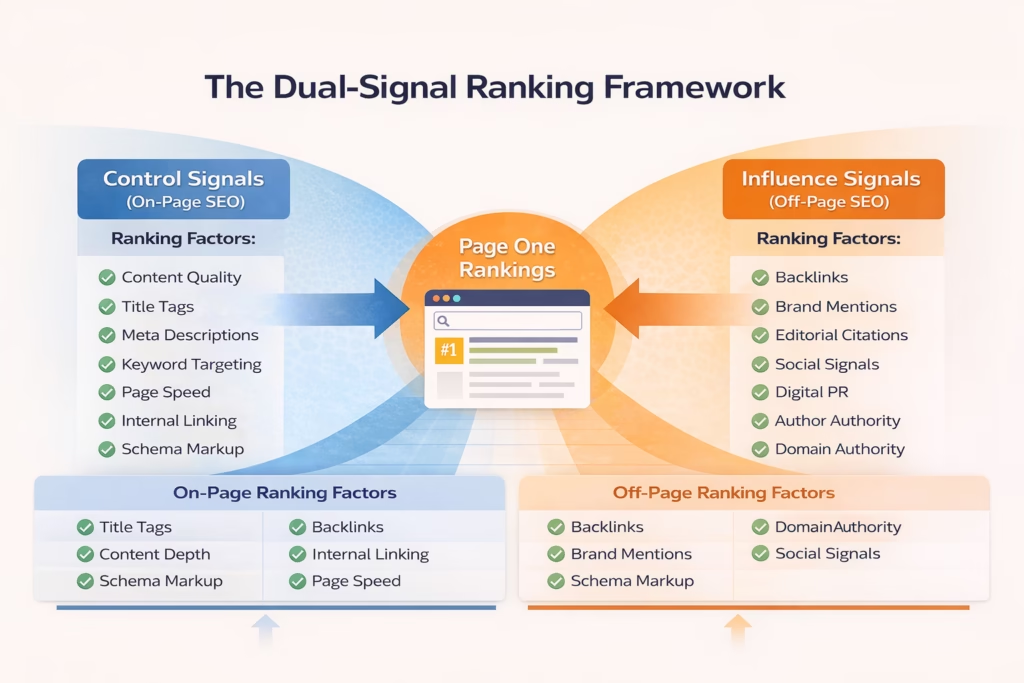
I want to give you a mental model that makes this click permanently. I call it the Dual-Signal Ranking Framework.
Here’s the core idea.
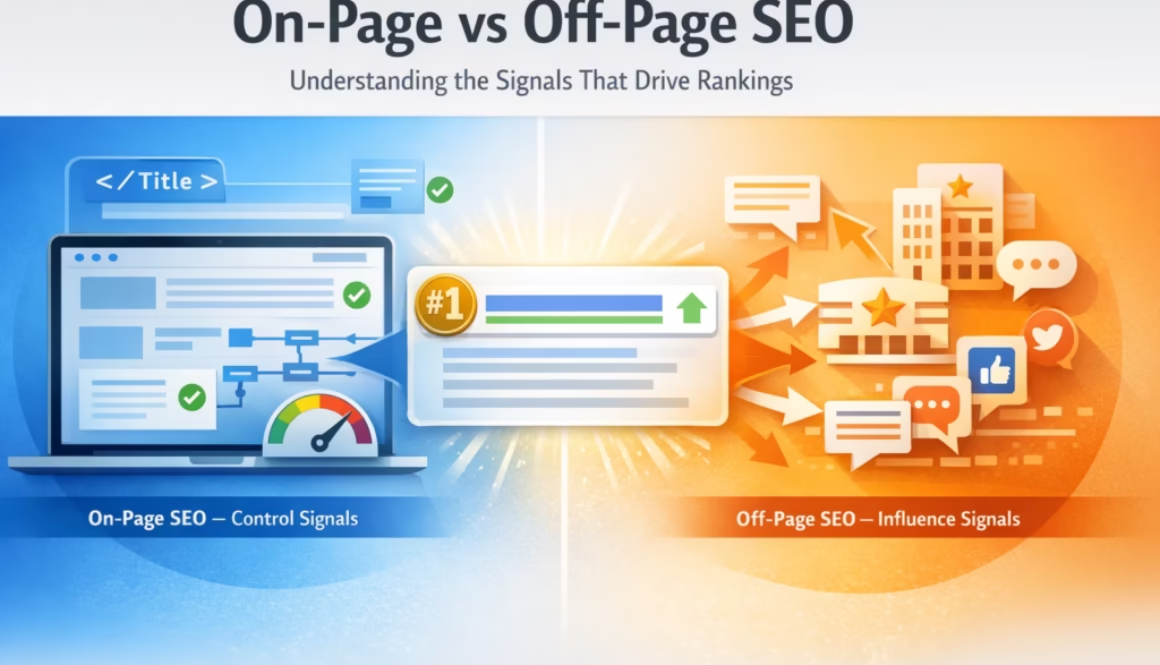
On-page SEO = Control Signals. These are everything you publish, structure, and optimize on your own site. Title tags, content depth, keyword placement, internal links, page speed, schema markup — all of it. You have complete control.
Off-page SEO = Influence Signals. These are signals that come from outside your site. Backlinks, brand mentions, editorial citations, your entity’s presence across the web. You don’t control these directly. You earn them — or you don’t.
Rankings happen when both signals align.
When your Control Signals are strong but your Influence Signals are weak, Google understands your content — but doesn’t trust it enough to put it in front of large audiences.
When your Influence Signals are strong but your Control Signals are weak, you might rank briefly. But your pages won’t convert, users will bounce, and your rankings will eventually erode.
The original insight: On-page SEO determines whether you deserve to rank. Off-page SEO determines whether Google trusts you enough to actually do it.
Keep that line somewhere. It changes how you prioritize every SEO decision you make.
The Core Difference Between On-Page vs Off-Page SEO
Let’s get specific — because vague definitions are exactly what create confusion for beginners.
On-Page SEO — What It Actually Covers
On-page SEO covers every optimization that exists on your own website. Content quality. Keyword targeting. HTML structure. Page speed. Internal linking. User experience. Schema markup. Core Web Vitals.
It’s everything a search crawler and a real human encounter the moment they land on your page.
If your content doesn’t match search intent, your H1 is missing, or your page loads in nine seconds — that’s an on-page problem. You created it. You can fix it.
Off-Page SEO — What It Actually Covers
Off-page SEO covers everything that happens off your website that signals authority and trust to search engines. Backlinks are the most visible piece. But off-page SEO also includes unlinked brand mentions, your author profile across external publications, reviews on third-party platforms, and how Google’s entity system understands who you are.
The distinction that matters: you influence off-page signals, you don’t control them. A backlink happens because someone else decided your content was worth linking to. That’s exactly why off-page signals carry so much weight — they’re harder to fake.
Side-by-Side Comparison
| Factor | On-Page SEO | Off-Page SEO |
|---|---|---|
| Control Level | Full control | You earn it — or you don’t |
| Location | Your own website | External platforms and sites |
| Key Elements | Content, structure, speed, UX, schema | Backlinks, mentions, PR, entity presence |
| Speed of Impact | Faster — days to weeks | Slower — weeks to months |
| Difficulty for Beginners | Moderate | Higher — requires relationships |
| Mistakes | Fixable overnight | Bad links take weeks to clean up |
| Scales With | How much you publish | How much credibility you build |
| Long-Term Value | Stable if maintained | Compounds over years |
Technical SEO vs off-page SEO — worth clarifying: Technical SEO (crawlability, Core Web Vitals, indexing, structured data) sits underneath on-page SEO. It’s the plumbing. Without it, even perfect on-page optimization and strong off-page authority may not register properly. Fix your technical foundation before either of the others.
SEO Ranking Factors: What Lives On-Page vs Off-Page
One of the questions I get most from beginners is: “Which ranking factors am I actually responsible for?”
Here’s a clean breakdown. According to Google Search Central’s documentation on how search works, Google’s systems assess both the relevance of your content and the authority behind it — two entirely different evaluation layers.
| Ranking Factor | On-Page | Off-Page |
|---|---|---|
| Title Tags | ✅ | ❌ |
| Backlinks | ❌ | ✅ |
| Page Speed / Core Web Vitals | ✅ | ❌ |
| Brand Mentions (linked and unlinked) | ❌ | ✅ |
| Content Depth and Search Intent Match | ✅ | ❌ |
| Domain Authority / Trust Signals | ❌ | ✅ |
| Internal Linking Structure | ✅ | ❌ |
| Editorial Citations and PR Coverage | ❌ | ✅ |
| Schema Markup | ✅ | ❌ |
| E-E-A-T (Author Credibility) | ✅ Partially | ✅ Partially |
| Image Alt Text | ✅ | ❌ |
| Social Signals and Brand Presence | ❌ | ✅ |
Notice E-E-A-T appears on both sides. That’s intentional — and it’s one of the most misunderstood aspects of modern SEO. Your expertise and authority get assessed both through what’s on your page and through how your entity appears across the rest of the web.
On-Page vs Off-Page SEO Strategy: The Step-by-Step Implementation Plan
This is where most guides give you 40 tactics and wish you luck. I want to do something more useful — walk you through the Dual-Signal Ranking Framework as a structured workflow you can actually implement.
Step 1 — Search Intent and Keyword Mapping
Before you write anything, you need to understand what someone actually wants when they type your target keyword into Google. This is search intent. Getting it wrong means all the optimization in the world won’t help.
Google’s systems are built to find the meaning behind a query — not just match literal keywords. Your content needs to answer the real question, not just contain the phrase.
There are four intent types worth knowing:
- Informational: User wants to learn something. (“What is the difference between on-page and off-page SEO?”)
- Navigational: User wants to find a specific place. (“Ahrefs login”)
- Commercial: User is weighing options. (“Best SEO tools for bloggers 2026”)
- Transactional: User is ready to act. (“Buy SEMrush annual plan”)
Most beginner content fails because it targets informational intent but the content feels transactional — or vice versa. Google reads the gap and ranks something more aligned instead.
One action before you move on: Find your primary keyword. Then find 5–8 semantic variations. Assign each page one keyword. If two pages on your site are targeting the same keyword, one is cannibalizing the other.
Tools for Keyword Research
| Tool | Best For | Honest Pro | Honest Con |
|---|---|---|---|
| Ahrefs | Competitor gap analysis, keyword difficulty | Best data in the industry | Pricey for solopreneurs |
| Google Search Console | What your own site already ranks for | Free, accurate, straight from Google | Useless for brand new sites |
| SEMrush | Full-funnel research and competitive intel | All-in-one powerhouse | Steep learning curve |
| Ubersuggest | Budget beginners getting started | Cheap and relatively simple | Data is noticeably thin |
| AnswerThePublic | Question-based long-tail keywords | Great for content ideation | Volume data is weak |
Step 2 — On-Page SEO: The 2026 Optimization Framework
Your on-page foundation has to be built before your off-page efforts can do anything meaningful. A great backlink pointing at a poorly optimized page is like pouring water into a cracked jug. Some of it gets through. Most of it doesn’t.
On-Page SEO Checklist 2026
✅ Title tag — Primary keyword within the first 60 characters. Make it click-worthy, not just accurate.
✅ Meta description — 150 to 160 characters. Include your focus keyword naturally and give the reader a reason to click.
✅ H1 tag — One per page. Should include your primary keyword. Should not be word-for-word identical to your title tag.
✅ H2 to H4 structure — Logical hierarchy. Include long-tail keyword variations in at least two H2s naturally.
✅ Keyword in first 100 words — Don’t bury the lead. Google looks for topical signals early in the content.
✅ URL slug — Short, descriptive, keyword-rich. No stop words, no dates. Example: /on-page-vs-off-page-seo
✅ Image alt text — Descriptive and keyword-relevant where appropriate. Not stuffed. Not generic (“image1.jpg”).
✅ Internal linking — Link to 3 to 5 related posts from every article. This is how you distribute authority across your site.
✅ Core Web Vitals — LCP under 2.5 seconds, FID under 100ms, CLS under 0.1. Run PageSpeed Insights if you haven’t recently.
✅ Schema markup — FAQ, Article, or HowTo schema where relevant. This is what generates rich results in SERPs.
✅ Content depth — Cover the topic more thoroughly than whoever is currently ranking. Not longer for the sake of it. Deeper.
✅ E-E-A-T signals — Author bio, cited sources, firsthand experience woven into the writing. Not added as an afterthought.
✅ Mobile experience — Test on a real phone, not just a browser emulator. Google indexes mobile first.
✅ Content freshness — Update important posts at least once a year. Add a visible “Last Updated” date.
Step 3 — Off-Page SEO Strategies That Work in 2026
I want to be direct about something. A lot of what gets labeled “off-page SEO strategy” in 2026 is still recycled advice from 2014 — directory submissions, comment spam, PBN schemes with new names.
None of that works anymore. Some of it actively hurts.
Here’s what actually moves the needle.
White-Hat Link Building — The Real Version
How backlinks affect search rankings is straightforward in principle and genuinely hard in practice. Each contextual, relevant backlink from a credible site tells Google: “someone who knows their subject found this worth citing.” Quality matters enormously more than quantity.
One link from a respected industry publication — even if its domain rating is only 40 — can outperform a dozen links from high-DR sites with no topical connection to your niche. I’ve seen this play out repeatedly. Relevance is the multiplier.
Tactics that are actually producing results right now:
- Digital PR with original data: Commission a survey. Publish proprietary research. Create something that journalists in your space would want to cite. This is the highest-leverage off-page tactic available for content sites.
- Targeted guest posting: Write genuinely useful content for publications your audience already reads. One well-placed piece can drive traffic and a quality backlink. The key word is “targeted” — not mass outreach to irrelevant sites.
- Skyscraper approach: Find content in your niche that has accumulated backlinks. Build something demonstrably better — more current, more detailed, better organized. Then reach out to the sites that linked to the original.
- Broken link recovery: Find dead links on authority sites in your niche. Offer your content as a replacement. It works because you’re solving a real problem for the webmaster.
- Resource page placements: Find pages in your niche that curate “best resources.” Pitch your content genuinely. These links tend to be highly relevant and surprisingly durable.
Brand Mentions — The Underused Off-Page Signal
Google’s official guidance on helpful, reliable, people-first content emphasizes experience, expertise, authority, and trust (E-E-A-T). Beyond backlinks, Google’s systems use entity understanding and natural language processing to evaluate brand signals across the web — even when no hyperlink is present.
This means unlinked brand mentions can still reinforce your authority as a recognized entity in your niche.
Set up a Google Alert for your brand name. When someone mentions you without linking, reach out politely and ask if they’d consider adding a reference link. Because they’ve already mentioned you positively, these outreach emails often convert at a much higher rate than cold backlink requests.
Authority Stacking — Building Your Entity
This isn’t about getting backlinks from LinkedIn or Medium — most of those are nofollow anyway. It’s about establishing your entity as a recognized voice across multiple high-authority platforms.
When Google sees your name consistently appearing in credible, topically relevant contexts — author bylines on respected publications, mentions in industry roundups, citations in research — it updates its understanding of who you are.
That entity recognition feeds directly into how your core site’s content is evaluated. It’s a slow build. It compounds.
How to Build Domain Authority Fast
I’m not going to give you a “30-day domain authority hack.” Those don’t exist. Anyone promising that is either selling you a short-term fix or a future penalty.
What I’ve seen work consistently:
- Publish 2 to 4 genuinely in-depth articles per month — not 20 thin posts
- One targeted link-building campaign per month with real personalized outreach
- One digital PR push per quarter built around original data or a newsworthy angle
- Active presence in 2 to 3 niche communities where your content gets organically shared
Meaningful domain authority movement typically starts showing up in 3 to 6 months with consistent effort. Not 7 days. Not 30. Three to six months — if you’re doing it properly.
Step 4 — Tracking and Optimization
Here’s where most people fall down. They execute steps one through three, wait three months, and judge results by whether traffic doubled. That’s not how you measure this.
You need to track leading indicators — the signals that tell you whether the system is working before traffic confirms it.
| Tool | What It Measures | Pro | Con |
|---|---|---|---|
| Google Search Console | Clicks, impressions, positions, Core Web Vitals | Free, direct from Google | Thin historical data |
| GA4 | User behavior, traffic sources, conversions | Powerful and free | Setup is genuinely annoying |
| Ahrefs / SEMrush | Backlinks, keyword positions, competitor tracking | Comprehensive | Paid — worth it if serious |
| Screaming Frog | Technical issues: broken links, tags, redirects | Best crawl tool available | Free tier limited to 500 URLs |
Monthly review rhythm: Check your target keyword rankings. Review new referring domains. Find your biggest traffic-losing pages and investigate why. Adjust content and outreach from there. That cycle — every single month — is what compounds.
Which Matters More in 2026? The Truth Most Blogs Won’t Tell You
This is the section I rarely see in other on-page vs off-page SEO guides — probably because the answer isn’t clean or universal.
Here it is anyway.
For brand new websites: On-page SEO first. Always. Your domain has zero authority. Backlinks to a site with weak on-page foundations don’t compound effectively. Spend months one and two getting your content, structure, and technical health right. Then and only then does off-page effort start paying dividends.
For websites in competitive niches: Off-page becomes critical — faster than most people expect. If you’re going after keywords where the top results are established sites with years of backlinks and brand authority, on-page optimization alone will get you to positions 8 to 15 at best. Breaking past that ceiling almost always requires external authority signals. Start your off-page strategy by month three, not month twelve.
For personal brands and creator sites: A hybrid strategy works best. Your content is tied to your identity. That means E-E-A-T signals — author credibility, bylines on external publications, editorial mentions, podcast appearances — carry more weight than for anonymous niche sites. Your off-page work should focus as much on building entity recognition as it does on acquiring links.
For local businesses: The equation shifts again. Local SEO adds a third dimension — Google Business Profile optimization, local citations, geo-specific backlinks, and review signals. The difference between on-page and off-page SEO in a local context is slightly different because geographic relevance becomes a ranking factor in itself.
The bottom line: There’s no universal answer to which is more important. What matters is understanding where your site is in its development cycle and which constraint is currently limiting your rankings. New sites are almost always limited by on-page quality. More established sites in competitive niches are almost always limited by off-page authority. Diagnose your actual bottleneck. Then apply effort there.
The Honest Case Study: 90 Days, Real Fluctuations, No Fairy Tale Growth
Let me show you what combining on-page vs off-page SEO actually looks like — week by week, not a smooth upward curve, but the genuine messiness of how rankings actually move.
The site: A personal finance blog targeting millennials in the UK and Australia. Launched early 2024 with zero domain authority and zero backlinks.
The challenge: Competing against aggregators and established comparison sites for commercially valuable keywords. Brutally competitive niche.
A smaller example first: Before the 90-day campaign, a simpler win worth noting. This same blog optimized 10 existing articles — fixing meta descriptions, adding proper internal linking, and aligning content to actual search intent. No new backlinks. No outreach. Traffic to those 10 pages increased 32% in 60 days. That’s what solid on-page work alone can do on a site that already had some crawl history.
Then they went further.
Month 1: Fix Everything That Was Broken
The first 30 days were entirely on-page. No link building at all. The site had title tag issues on 11 of 24 pages, no schema markup anywhere, and three pages targeting the same keyword — a cannibalisation problem nobody had noticed.
Fixed the technical issues. Rewrote the top 8 priority pages for proper search intent alignment. Built an internal linking architecture from scratch.
Month 2: The First Off-Page Campaign — Week by Week
Week 5: Nothing changed. Rankings were flat. The digital PR campaign (a survey on Gen Z money habits) launched but got zero media pickup in the first week. Discouraging.
Week 6: First two editorial mentions came in — both without links. Reached out. One converted to a followed link. One didn’t respond.
Week 7: A mid-tier Google core update rolled out. Traffic dipped 18% for four days. Genuinely alarming. Then it recovered and went slightly above baseline.
Week 8: The survey data got picked up by a fintech newsletter with 40,000 subscribers. Three followed backlinks from that single piece of coverage.
Month 3: Where It Started Compounding
Week 9: One target page jumped from position 38 to position 12 overnight. No obvious cause. This happens sometimes. Google is testing.
Week 10: The backlink cluster from the PR campaign triggered movement on three pages simultaneously. Two broke into top five positions. One stalled at position 9.
Week 11: Guest post went live on a UK finance blog with a domain authority of 51. Primary target keyword moved from position 9 to position 6.
Week 12: Final tally.
| Metric | Month 0 | Month 3 |
|---|---|---|
| Organic sessions (monthly) | 480 | 3,720 (+675%) |
| Keywords on page one | 4 | 31 |
| Domain rating (Ahrefs) | 12 | 24 |
| Referring domains | 6 | 53 |
| Primary keyword position | 34 | 6 |
| Best single-page traffic jump | — | +1,840 sessions (one URL) |
Real talk: That 675% growth sounds spectacular. But it came with an 18% traffic dip in week 7, a full week of flat rankings after the PR launch, and one page that never moved despite everything. Real SEO doesn’t go up in a straight line. Anyone who shows you only the wins is skipping the part where it almost didn’t work.
Common Mistakes in On-Page vs Off-Page SEO
These aren’t abstract warnings. They’re the specific, repeatable errors I see in site after site — often made by people who’ve read plenty of SEO content and still got this wrong.
Mistake 1 — Building Backlinks Before Fixing Internal Linking
This is the one I see most. People hear “get backlinks” and immediately start outreach campaigns — while their internal linking structure is a mess.
Think about it this way: backlinks are water entering your site. Internal links are the pipes that distribute it. If your pipes are broken or poorly connected, most of that water never reaches the pages that need it most.
Before you send a single outreach email, make sure every new piece of content is linked from at least two relevant existing posts. And make sure your highest-authority pages are actively linking to your newest, most important content.
Internal linking vs backlinking is not a competition. It’s a system. One without the other wastes resources.
Mistake 2 — Keyword Stuffing in 2026
Still happening. Constantly. I opened a client’s site last year and found their target keyword used 47 times in a 1,200-word post.
Google’s systems don’t reward density. They reward relevance signals across the full document — the headings, the semantic clusters, the depth of coverage. Writing your keyword 47 times doesn’t make the page more relevant. It makes it look like it’s trying to game a system that stopped working that way around 2012.
Write for humans. Use your keyword where it naturally belongs. Let semantic variations fill in the rest.
Mistake 3 — Chasing Domain Rating Instead of Relevance
This frustrates me more than almost anything else in SEO. People obsess over DR scores like they’re the only metric that matters.
A backlink from a DR 90 entertainment blog does essentially nothing for a B2B software company. Meanwhile, a DR 35 link from a niche-relevant trade publication in your exact industry can move rankings noticeably.
Always target topical relevance first, authority second. The domain rating obsession is one of the most misleading habits in the industry.
Mistake 4 — Ignoring Core Web Vitals
Page experience is a confirmed ranking factor. A page that loads in 8 seconds and jumps around as elements render will eventually lose rankings to a faster, more stable competitor — even if the slower page has better content and more backlinks.
“My content is better” is not a defense against a broken user experience. Fix it.
Mistake 5 — Spam Backlinks
Private Blog Networks. Paid link schemes from link farms. “Guest post” networks where every site is obviously part of the same operation. These still exist and people still buy them.
Google’s Spam Brain system is sophisticated now. It’s not just looking at individual links — it’s looking at link patterns, anchor text distributions, the quality of linking domains, and whether the link profile looks naturally earned over time. Artificial patterns get caught. And when they do, recovery takes months.
Don’t do it.
What Most SEO Guides Won’t Actually Tell You
These are the questions that come up in every SEO community but almost never get an honest answer in published guides. Here are my actual takes.
Can You Rank Without Backlinks?
Yes. But let me be specific about when.
For low-volume long-tail queries in genuinely low-competition niches — yes, strong on-page work can get you onto page one without a single external backlink. I’ve seen it happen.
But in competitive niches? In most cases I’ve watched play out, pages without any external authority signals hit a ceiling. They reach positions 8 to 15 through on-page work alone. Breaking into the top three almost always requires external authority. That conclusion is consistent with research published by Backlinko’s analysis of Google ranking factors, which consistently shows backlink correlation as one of the strongest signals in competitive environments.
My take: optimize on-page fully, then use off-page to break through the ceiling that on-page alone hits.
Does Internal Linking Actually Pass Authority?
Yes — and most people dramatically underestimate how much.
Internal links distribute a form of PageRank between pages on your site. When a high-authority page (one with lots of external backlinks) links internally to a newer, lower-authority page, it passes a portion of that signal. Not identical to an external backlink. But significant.
The most underused SEO tactic I encounter? Building a deliberate hub-and-spoke internal linking architecture where cornerstone content acts as hubs, and supporting content acts as spokes that both receive and pass authority through the system.
If you’re not doing this intentionally, you’re leaving rankings on the table.
How Google Views E-E-A-T in Off-Page SEO
E-E-A-T — Experience, Expertise, Authoritativeness, Trustworthiness — has a significant off-page dimension that most guides treat as purely an on-page concern.
Your E-E-A-T isn’t just determined by your author bio and content quality. It’s also shaped by how your entity appears across the broader web:
- Author bylines on credible external publications
- Editorial mentions in respected industry media
- Positive presence on third-party review platforms
- Your entity appearing in relevant databases, Wikipedia, or Wikidata
- Citations in research or academic contexts
This is why digital PR isn’t just a link-building tactic. Every editorial mention in a credible publication is an E-E-A-T investment — building Google’s confidence in who you are.
Is Off-Page SEO Losing Power Because of AI?
This is a real debate worth engaging with honestly.
AI Overviews and AI-generated summaries in Google are reducing clicks to many informational pages. If someone gets their answer directly in the search results, they don’t click through. That does affect traffic for certain query types.
But here’s what hasn’t changed: Google still uses authority signals to decide which content to pull into those summaries in the first place. The sites that appear in AI Overviews consistently tend to be the ones with the strongest backlink profiles and E-E-A-T signals in their niche.
So off-page authority isn’t losing power. It’s arguably becoming more important — because now it determines not just whether you rank, but whether your content gets selected for the zero-click summary that millions of people see.
Can Topical Authority Replace Backlinks?
Topical authority — covering a subject comprehensively across many well-structured posts — is real and increasingly valued by Google’s systems.
I’ve seen sites with modest backlink profiles rank impressively well in niches where they’ve built genuine topical depth. Topic clusters, semantic coverage, strong internal linking between related posts — all of this contributes.
Can it replace backlinks entirely in competitive niches? In my experience, not usually. But it can reduce the number of backlinks you need. A topically authoritative site needs fewer external signals to rank than a site with scattered, unfocused content.
Build topical depth. It works. Just don’t expect it to substitute for off-page authority on high-competition queries.
The AI Content and Backlink Risk Nobody’s Talking About
The AI content boom has created networks of AI-generated sites that cross-link to each other at scale — effectively trying to simulate legitimate link ecosystems artificially. Google’s systems are actively targeting these patterns.
The risk for legitimate sites: if your backlink profile starts accumulating links from these AI content farm networks — even if you didn’t pursue them — it can create a negative association in Google’s analysis.
What to do: Audit your backlink profile quarterly. Google Search Console shows referring domains. Ahrefs or SEMrush shows detailed link quality data. If you see clusters of obviously spammy, AI-generated linking sites building up, disavow them before they become a pattern Google flags.
Frequently Asked Questions
Which is more important — on-page or off-page SEO?
Neither wins outright — and honestly, this is the wrong question. It leads to bad prioritization decisions. On-page vs off-page SEO aren’t competing priorities. They’re interdependent systems. That said, if your site is new and you had to start somewhere: prioritize on-page. You can’t earn meaningful off-page authority if your content doesn’t deliver on what users need. Once your on-page is solid, off-page becomes the accelerant.
What is the difference between on-page and off-page SEO for beginners?
Simplest version: on-page SEO is what’s on your website — content, keywords, structure, speed, links between your own pages. Off-page SEO is what other websites say about yours — backlinks, citations, brand mentions, your reputation across the internet. You control on-page. You earn off-page.
How do backlinks actually affect search rankings?
Think of backlinks as reputation votes. Not all votes are equal. Some barely matter. Some change everything. A link from a respected, topically relevant publication tells Google: “a credible source in this space thinks this content is worth citing.” The quality, relevance, and contextual placement of the linking page all determine how much that vote counts.
Technical SEO vs off-page SEO — what’s the difference?
Technical SEO is the infrastructure layer: crawlability, site speed, structured data, indexing. It’s the plumbing. Off-page SEO is the reputation layer — completely separate. Technical issues can prevent off-page signals from registering properly, which is why you fix technical problems first.
What off-page SEO strategies actually work right now?
Digital PR using original research. Targeted guest posting on genuinely relevant publications. Converting unlinked brand mentions to linked citations. Broken link building. Strategic resource page placements. Building topical authority through content clusters supported by intentional internal linking. What doesn’t work: directory spam, PBN links, mass outreach to unrelated sites. Focus on earning links through content and relationships — not manufacturing them.
Conclusion: The Last Thing You Need to Read Before You Start
Here’s the honest version of where we’ve arrived.
On-page vs off-page SEO isn’t a debate between two camps. It never was.
On-page SEO determines whether you deserve to rank.
Off-page SEO determines whether Google trusts you enough to actually do it.
That’s the Dual-Signal Ranking Framework in two lines. Control Signals plus Influence Signals equals rankings — but only when both are running together.
If you publish one more article without fixing your on-page structure, or spend another month ignoring the off-page signals that could push your best content past the competition — you’re gambling with your own time.
SEO compounds. But only when both systems are working.
Your 90-day starting point:
- Days 1 to 30: Complete your on-page audit. Fix technical issues, rewrite title tags, build your internal linking structure, update your top 10 pages for search intent alignment.
- Days 31 to 60: Create one linkable asset — original data, a genuinely comprehensive guide, a useful tool. Launch one targeted outreach campaign. Expect slow early results.
- Days 61 to 90: Track everything. Find the pages gaining traction. Build more internal links to them. Pursue more external links for them. Double down on what’s working.
Don’t wait until everything is perfect. Start with the on-page audit. Fix one page. Then another. Then start building the relationships that lead to links.
Before you close this tab, ask yourself honestly: Is your blog not ranking because it’s an authority problem — or an optimization problem?
That one question will tell you exactly where to start.