Maya runs a small online jewelry business from her tiny apartment. She posts beautiful photos on Instagram, sends newsletters to her email list, and writes blog posts about sustainable fashion when she can.
Her products? Gorgeous. Her prices? Fair.
But here’s the problem.
Her sales are completely random. Last month she had 15 orders. This month? Three. And it’s already the 20th.
She has no clue why people buy when they do—or why most visitors leave her website without buying anything.
Does this sound familiar?
Maybe you’re not selling jewelry. Maybe you’re a freelance writer, a coach, or someone trying to sell digital products.
But the struggle is the same, right?
You work hard. You create content. You show up online. But everything feels scattered. Random. Like throwing darts in the dark.
I get it. I’ve been there.
Here’s what changed everything for me: understanding the marketing funnel.
Before you roll your eyes thinking “oh great, another corporate buzzword”—hear me out.
Most explanations are garbage. Written by people who’ve never struggled to make a sale. Full of jargon that makes your head spin. They assume you have a massive ad budget and a marketing team.
This isn’t that.
I’m going to explain what a marketing funnel actually is using normal words, real examples, and zero BS. By the time you finish reading, you’ll know exactly how to guide someone from “who are you?” to “take my money!” without feeling pushy.
What Is a Marketing Funnel? (No Jargon, I Promise)
A marketing funnel is the path someone takes from hearing about you for the first time to actually buying from you.
That’s it.
Think about a real funnel. Wide at the top. Narrow at the bottom.
Your marketing works the same way.
At the top, tons of people just discovered you. They saw your Instagram post, found your blog on Google, or heard about you from a friend. These people know nothing about you yet.
As they learn more, some drop off. That’s normal. Others stick around and get curious.
By the bottom, you have way fewer people—but these are the ones who actually buy.
Here’s the key insight: people need different things at different times.
Someone who just found you needs different content than someone about to buy. Your job is to meet them where they are and guide them naturally through the journey.
That’s what a marketing funnel for beginners really means. Not manipulation. Just intentional guidance.
How a Marketing Funnel Works Step by Step
The marketing funnel concept follows a simple pattern:
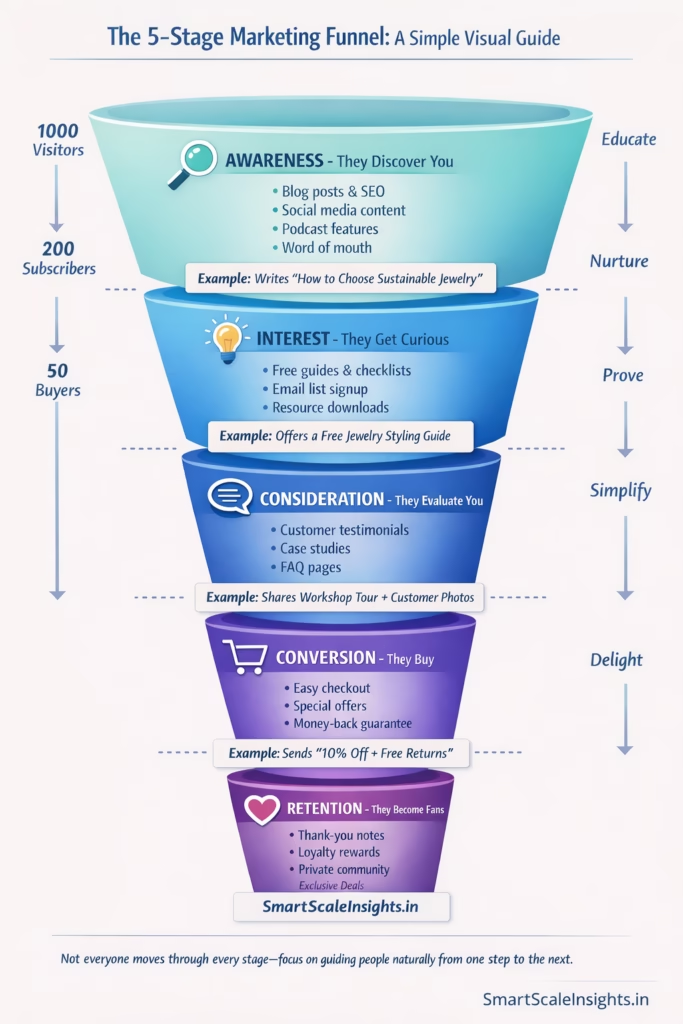
First, strangers discover you exist (Awareness).
Then, some get curious and want to learn more (Interest).
Next, they start seriously considering whether to buy (Consideration).
After that, they make the purchase (Conversion).
Finally, they either forget about you or become loyal fans (Retention).
According to HubSpot’s buyer’s journey research, 81% of shoppers research online before buying. This means you need to show up at every stage with the right message.
The funnel helps you understand where someone is in their decision-making process—and what they need from you at that exact moment.
Let me break down each stage.
Marketing Funnel Stages Explained for Beginners
A simple visual breakdown of marketing funnels, showing how visitors move from awareness to long-term customer retention.
Stage 1: Awareness – When They First Discover You
What’s happening: They don’t know you exist yet. They might have a problem, but they haven’t found you as a solution.
Your goal: Get discovered.
How to do it:
Write blog posts answering real questions your customers ask
Post consistently on social media where your audience hangs out
Show up in Google search results through basic SEO
Get featured on podcasts or guest posts
Join online communities and be genuinely helpful
Example: Maya writes a blog post: “How to Choose Sustainable Jewelry That Actually Lasts.” When someone searches for this, they find her.
Key takeaway: You’re not selling here. You’re just introducing yourself and providing value.
Stage 2: Interest – Making Them Care
What’s happening: They know you exist now. Maybe they followed you or visited your website. They’re curious but not ready to buy.
Your goal: Build connection and give them reasons to stick around.
How to do it:
Offer something free that genuinely helps (guide, template, checklist)
Send a welcome email with personality and your story
Share behind-the-scenes content
Actually respond to comments and messages
Example: Maya creates a free PDF: “5 Ways to Style Minimalist Jewelry for Any Occasion.” Visitors download it, join her email list, and start receiving weekly styling tips.
Key takeaway: This is where you transition from stranger to friendly acquaintance. You’re building “know, like, trust” genuinely.
Stage 3: Consideration – Earning Their Trust
What’s happening: Now they’re thinking about buying but comparing options. They have questions and doubts.
Your goal: Address objections and show why you’re the right choice.
How to do it:
Share testimonials from real customers
Create comparison guides
Provide detailed product information
Share case studies or before-and-after examples
Answer FAQ questions transparently
Example: Maya shares customer photos wearing her jewelry with testimonials about quality and ethical sourcing. She creates an Instagram Highlight showing her workshop and supply chain.
Key takeaway: This stage is about proof. The Content Marketing Institute emphasizes that consideration content should be solution-focused with clear differentiation.
Stage 4: Conversion – Getting the Sale
What’s happening: They’re ready to buy, but small friction points can still derail the sale.
Your goal: Make buying as easy and risk-free as possible.
How to do it:
Simplify your checkout process
Offer multiple payment options
Create urgency with limited stock or seasonal offers
Provide strong guarantees
Send cart abandonment emails
Example: When someone adds Maya’s necklace to cart but doesn’t buy, she sends a friendly email 24 hours later: “Still thinking about that piece? Here’s 10% off to help you decide. Returns are free.”
Key takeaway: If you’ve done stages 1-3 well, conversion feels natural, not forced.
Stage 5: Retention – Turning Them Into Fans
What’s happening: They bought once. Now the question is: will they buy again and tell others?
Your goal: Turn one-time customers into repeat buyers and brand advocates.
How to do it:
Send thoughtful follow-up emails
Ask for feedback and reviews
Create a loyalty program
Offer exclusive deals for existing customers
Provide exceptional customer service
Example: Maya sends a handwritten thank-you note with every order. She creates a private Facebook group for customers where they share styling tips. She offers 15% off their next purchase.
Key takeaway: Keeping an existing customer is 5-25 times cheaper than acquiring a new one. This stage is where real business growth happens.
Quick Recap: The Five Stages at a Glance
Awareness gets strangers to discover you. Interest makes them curious enough to stick around. Consideration builds the trust they need to choose you. Conversion removes friction so they can buy easily. Retention turns them into loyal fans who come back and refer others.
Real-Life Examples That Make Everything Click
The Dating Analogy
Awareness: You notice someone cute at a coffee shop
Interest: You strike up a conversation and exchange numbers
Consideration: You go on a few dates and evaluate compatibility
Conversion: You decide to be in a relationship
Retention: You nurture the relationship and grow together
You wouldn’t propose at the coffee shop, right? Same with marketing—you can’t ask for a sale before building any relationship.
The Bookstore Analogy
Awareness: You walk past a bookstore and notice an interesting title
Interest: You go inside and read the back cover
Consideration: You flip through pages and check reviews on your phone
Conversion: You buy the book
Retention: It’s so good you buy more from the same author and recommend it to friends
This is exactly how a simple marketing funnel explanation works—meeting people where they are in their decision-making process.
Why Marketing Funnels Matter (Even If You’re Just Starting)
You might be thinking: “Can’t I just post content and hope people buy?”
Sure. But here’s what happens without understanding how marketing funnels work:
The problems you’ll face:
You waste time on wrong content—sales posts when people don’t know you, or only awareness content when you should be nurturing leads
Your engagement doesn’t convert—tons of likes, zero sales, because you never move people forward
You miss ready-to-buy opportunities by not addressing their final objections
Everything feels exhausting without a clear framework
What changes with a funnel mindset:
You create content with purpose—every piece has a specific job
You understand why some marketing works and diagnose problems in your customer journey
You build sustainable systems that generate predictable revenue
For freelancers and small business owners, this is what separates random income from predictable revenue.
Common Funnel Mistakes That Kill Your Results
Mistake #1: Selling Too Soon
You create a Facebook page today and immediately post “Buy my product!” to zero followers.
The fix: Build awareness and interest first. Give before you ask.
Mistake #2: Only Creating Top-of-Funnel Content
Great blog traffic and social media growth, but zero sales. You’re stuck at awareness.
The fix: Balance educational content with conversion-focused content for every stage.
Mistake #3: Forgetting Existing Customers
You celebrate the sale, then ghost them completely.
The fix: Have a post-purchase sequence. Stay in touch and make them feel valued.
Mistake #4: Creating Gaps in Your Funnel
People move from awareness to interest… then fall off because there’s no clear next step.
The fix: Map the journey with clear calls-to-action connecting each stage.
Mistake #5: Overcomplicating From Day One
You try building a 47-step automated funnel before making your first sale.
The fix: Start simple. Get basics working, then optimize.
Three Simple Funnels You Can Build This Week
Example 1: The Blog Content Funnel
The Setup:
Awareness: Write SEO-optimized posts answering questions in your niche (“How to Start a Podcast in 2025: Complete Beginner’s Guide”)
Interest: Offer a free relevant resource at the end (“Download my Podcast Launch Checklist”)
Consideration: Send email sequence with case studies, tutorials, and testimonials
Conversion: Special offer email (“Join my Podcast Accelerator Course—early bird pricing ends Friday”)
Retention: Send regular updates, bonus content, invite to private community
Why it works: You attract people with real problems, provide immediate value, build trust through email, and pitch only when they’re ready.
Best for: Service providers, coaches, educators, and anyone who can create written content consistently.
Focus on first: Write one high-quality blog post targeting a specific search term your ideal customer uses.
Interest: Direct people to free resource in bio (“Want my Design Toolkit? Link in bio!”)
Consideration: Email sequence with success stories and deeper insights
Conversion: Invite to free webinar where you soft-pitch your paid service
Retention: Client Facebook group, monthly features, referral program
Why it works:Social media excels at awareness and interest. You’re using it to build your email list (where you have control), then nurturing toward sales.
Best for: Visual businesses, personal brands, and anyone building an audience on social platforms.
Focus on first: Choose one platform and commit to posting valuable content 3-4 times per week consistently.
Example 3: The Email Marketing Funnel
The Setup:
Awareness: Run small Facebook or Google ad to free resource (“Free Guide: 10 Side Hustles You Can Start This Weekend”)
Interest: Welcome sequence sharing your story, values, and helpful content
Consideration: Case studies and testimonials after value emails
Conversion: Limited-time offer email (“Join my 6-Week Passive Income Accelerator—early bird ends Friday”)
Retention: Weekly value emails, exclusive bonuses, ask for reviews
Why it works: Email remains one of the highest-converting channels. You own your list and can strategically guide people through each stage. successful marketers focus on understanding the customer journey, not fancy automation.
Best for: Digital product creators, course sellers, and anyone with a clear paid offer.
Focus on first: Build your email list to 100 subscribers before worrying about complex automation.
Do You Actually Need This? (Honest Answer)
Here’s the truth: you’re already using a funnel whether you realize it or not.
Every business has a customer journey. The question isn’t whether you need a funnel—it’s whether you want to be intentional about it.
Without a funnel mindset: You post randomly and wonder why results are inconsistent. You’re flying blind.
With a funnel mindset: You understand why someone might not buy today and what you can do to help them get there tomorrow.
You don’t need fancy software or complicated automation.
What you actually need:
Awareness of the stages people go through
Content serving each stage
A way to stay in touch (email list)
A clear path from curious stranger to happy customer
Start simple. Even a basic funnel—blog post → free resource → email sequence → product offer—beats no strategy at all.
Questions Everyone Asks
What’s the difference between a marketing funnel and a sales funnel?
Technically, a marketing funnel covers the entire journey from awareness to loyalty. A sales funnel focuses just on the buying decision (consideration to conversion). But most people use these terms interchangeably and just say “funnel.”
How long should my funnel be?
Depends on what you’re selling:
Low-priced products ($10-50): Short funnel, quick decisions
Mid-range offers ($100-500): Medium funnel, a few touchpoints
High-ticket services ($1,000+): Long funnel, multiple interactions over weeks or months
Do I need expensive software?
Nope. Start with free tools: Google Docs for strategy, Mailchimp or MailerLite for email (free plans available), your existing website, and social media. Fancy tools help later but don’t let them stop you from starting.
If you’re getting traffic but no signups, fix the interest stage. If you have subscribers but no sales, focus on consideration and conversion content.
Can I have multiple funnels?
Absolutely. Most businesses do—different funnels for different products, customer segments, or traffic sources. Just start with one, get it working, then expand.
What if people skip stages?
Totally normal. Some discover you and buy immediately. Others take months. Your funnel should accommodate both—have fast paths and slow paths.
Your Next Step
A marketing funnel isn’t magic or manipulation. It’s a framework for understanding how people naturally make decisions—and how you can support them through that process.
You don’t need genius-level strategy, a huge budget, or perfect execution.
You just need to think intentionally about your customer’s journey from discovery to becoming a raving fan.
Here’s what to do right now:
Beginner Action (Do This Today):
Map your current reality on paper. Write down where most people discover you, what happens next, and where they drop off. Identify the biggest gap. Then create ONE piece of content for that stage—an email sequence, a lead magnet, a testimonial page. Just one thing.
Advanced Action (When You’re Ready):
Set up basic analytics to track each funnel stage. Use Google Analytics for traffic sources, your email platform for subscriber metrics, and simple tracking for conversion rates. Review monthly and adjust based on data, not guesses.
Remember Maya? Once she stopped posting randomly and started thinking strategically, everything changed. She built a simple funnel: helpful articles → free styling guide → email sequence → product launches.
Her sales became predictable. She understood why people bought. She stopped feeling overwhelmed and started feeling in control.
You can do the same.
Pick one action from this post. Do it today. Not tomorrow—today.
Your future customers are out there searching for someone like you. Make it easy for them to find you, trust you, and buy from you.
You’ve just launched your website. You’ve poured hours into creating content. You check your analytics every day, hoping to see visitors.
But the numbers barely move. 10 visitors. Then 8. Then 12.
You’re not alone. According to recent data from Ahrefs, 90.63% of web pages get zero organic search traffic from Google. The problem isn’t your content—it’s that most beginners don’t understand where website visitors actually come from or how to attract them strategically.
Here’s what’s changing in 2026: search engines are prioritizing genuine helpfulness over keyword optimization. Social platforms are pushing authentic engagement over viral content. And the websites winning traffic are the ones that understand human behavior, not just algorithms.
In this guide, you’ll learn: the four fundamental paths that bring visitors to any website, how each traffic source actually works (without the marketing jargon), a realistic timeline for building your first 1,000 visitors, which traffic source beginners should start with and why, and the biggest mistakes that keep new websites invisible online.
By the end, you’ll have a clear mental model of how online traffic works and a practical action plan to start building yours—no guesswork, no hype, just the real process that actually works.
The Real Problem: Why Most Beginners Struggle With Traffic
The biggest misconception about website traffic is that it “just happens” once you publish content.
It doesn’t.
I see this pattern constantly: someone creates a beautiful website, writes a few articles, and then waits for visitors to arrive. Weeks pass. Maybe a handful of people stumble across the site. But there’s no consistent traffic. No growth. Just disappointment.
Here’s why this happens.
The Invisible Website Problem
Unlike a physical store on a busy street, websites don’t benefit from natural foot traffic. Nobody is randomly browsing the internet hoping to discover your site. There’s no “walking past your shop window” online.
Every single visitor who lands on your website arrived through a specific, intentional path:
They typed a question into Google and clicked your result
They saw your content on social media and were curious enough to click
They found a link to your site on another website
They remembered your name and typed your URL directly
The problem? Most beginners don’t create any of these paths. They publish content and hope Google magically sends them traffic. Or they share on social media once and wonder why nobody clicks.
What Actually Brings Traffic in 2026
The websites getting consistent traffic in 2026 understand one fundamental principle:
Traffic is the result of intentionally creating discoverable content on platforms where your audience already spends time.
Let me break that down:
Intentionally creating: Not just publishing, but strategically answering specific questions or solving specific problems
Discoverable content: Content optimized for how people actually search or browse
Platforms where your audience already is: Whether that’s Google, Reddit, Instagram, or niche forums
This isn’t about gaming algorithms or using growth hacks. It’s about understanding human behavior and meeting people where they already are.
Once you understand this, traffic becomes predictable. Not easy—but predictable.
The 4-Source Traffic Framework Every Beginner Needs
Before we get into strategies, you need to understand where website visitors actually come from.
There are four fundamental traffic sources. Everything else is just a variation of these four.
What Is Online Traffic? (The Simple Definition)
Online traffic is simply people visiting your website. When someone says “my site got 2,000 visitors last month,” they’re talking about traffic.
Think of it like foot traffic in a shopping mall, except every visitor arrived through a specific digital path rather than randomly walking by.
The Four Traffic Sources Explained
1. Search Engine Traffic (Organic)
What it is: Someone types a question into Google, your website appears in the results, they click your link.
Why it matters: These visitors are actively looking for information. They have a problem or question, and they’re motivated to find an answer. This makes search traffic incredibly valuable—people are coming to you with intent.
The catch: Search traffic takes 3-6 months to build for new websites. Google needs time to discover your content, evaluate it, and determine where it should rank.
How website traffic works for beginners here: You create content that answers specific questions people are searching for. Over time, Google recognizes your content as helpful and shows it to people searching those topics.
2. Social Media Traffic
What it is: Someone sees your content on Facebook, Instagram, Twitter, Reddit, TikTok, or LinkedIn and clicks through to your website.
Why it matters:Social media traffic is the fastest to generate when you’re starting out. You can post content today and get visitors tomorrow.
The catch: Social traffic is inconsistent. One post might bring 500 visitors. The next brings 10. And once your post disappears from feeds, the traffic stops completely.
Best for: Quick validation of content ideas, building initial audience, testing what resonates.
3. Referral Traffic (Links from Other Sites)
What it is: Another website links to yours, and someone clicks that link.
Why it matters: Referral traffic brings pre-qualified visitors who already trust the source that sent them. Plus, these links help improve your search rankings.
The catch: You can’t directly control when other sites link to you. It usually happens when you create exceptional content or build relationships with other creators.
Best for: Building authority, improving SEO, reaching established audiences.
4. Direct Traffic
What it is: Someone types your website URL directly into their browser or uses a bookmark.
Why it matters: This shows brand recognition. People know who you are and are intentionally seeking you out.
The catch: For new websites, direct traffic starts at nearly zero. It grows slowly as people become familiar with your brand.
Best for: Measuring brand loyalty and repeat visitors.
Goal: Reach 1,000 monthly visitors by scaling what’s working.
Step 7: Double Down on What Works
By now, you should have 8-10 pieces of content and data showing which ones get the most traffic.
Action:
Create more content similar to your top 3 performing pieces
Update and expand your best-performing content
Share your winning content again on social (people miss things the first time)
Step 8: Expand to a Second Traffic Source
If you started with social media, now consider guest posting or contributing to other sites for referral traffic.
If you started with Reddit, maybe try Instagram or Pinterest.
Don’t spread too thin. You’re just adding one complementary source, not trying to master everything.
Action: Identify 3-5 complementary platforms or websites, reach out or start engaging.
Step 9: Start Building an Email List
This isn’t technically a traffic source, but it’s your backup plan. Email subscribers become direct traffic—people who come straight to your site when you tell them about new content.
Action: Add a simple email signup form offering something valuable (a checklist, guide, or resource related to your topic).
Optimize existing content, create 4 SEO articles, build backlinks
Month 3
Scale + diversify
600-1,000+ visitors
Double down on winners, add second traffic source, start email list
Real Example: How a Beginner Blog Reached 1,000 Monthly Visitors
Let me show you how this framework works in practice with a real example.
The Starting Point
Blog: Personal finance blog for millennials Starting traffic: 0 visitors Time invested: 8-10 hours per week Budget: $0 (completely free tools)
Month 1: Building Social Momentum
The creator started by answering personal finance questions on Reddit’s r/personalfinance and r/povertyfinance communities.
Strategy:
Spent 30 minutes daily browsing these subreddits
Gave genuinely helpful answers
Only linked to her blog when she had written a detailed guide on that exact topic
Published 4 in-depth articles: “How I Paid Off $15K in Credit Card Debt in 18 Months,” “The Actual Cost of Living Alone in Your 20s,” “5 Budget Mistakes That Kept Me Broke,” and “How to Build a $1,000 Emergency Fund on a Low Income”
Results:
287 visitors in Month 1
83% came from Reddit
Average time on site: 3 minutes 42 seconds
18 email subscribers
Month 2: Search Optimization + Consistency
She optimized her existing articles for search and created 4 new ones targeting specific long-tail keywords.
Strategy:
Used Ubersuggest to find keywords like “how to save money on $30k salary” and “is a $1,000 emergency fund enough”
Updated article titles and headings to match search intent
Added internal links between related articles
Continued Reddit engagement (2-3x per week instead of daily)
Results:
521 visitors in Month 2
45% from Reddit, 38% from search, 12% direct, 5% other
Average time on site: 4 minutes 18 seconds
47 email subscribers (total)
Month 3: Scaling Winners
By month 3, her article “How I Paid Off $15K in Credit Card Debt” was consistently ranking on Google’s second page for “pay off credit card debt fast.”
Strategy:
Expanded that article from 1,500 to 2,800 words with more detailed steps
Created 3 related articles linking back to it
Started cross-posting short versions on Medium with links to full articles
Sent weekly emails to her growing list
Results:
1,143 visitors in Month 3
52% from search, 31% from Reddit, 11% direct, 6% referral
Once you’ve built momentum, aim for this distribution:
Healthy Traffic Distribution for Established Sites:
Search Traffic: 50-60% ████████████
Direct Traffic: 15-25% ████
Social Media: 10-15% ███
Referral: 8-12% ██
Other: 2-5% █
This balance protects you from algorithm changes and ensures sustainable growth.
FAQ: Common Questions About Website Traffic
How long does it really take to get traffic to a new website?
The honest answer: it depends on your traffic strategy.
Social media traffic can start within days if you engage authentically in communities where your audience already exists. You could see your first 100 visitors within the first week.
how online traffic worksSearch engine traffic typically takes 3-6 months to build meaningfully. According to Ahrefs research, the average top-ranking page is over 2 years old. However, you can start seeing trickles of search traffic within 4-8 weeks if you target low-competition keywords.
Realistic timeline: Most beginners see 500-1,000 monthly visitors within 90-120 days if they publish consistently and use a mix of social + search strategies.
Where do website visitors come from for brand new sites?
For brand new websites with zero authority, visitors typically come from:
Social media and communities (60-80% in first 3 months) – Reddit, Facebook groups, Instagram, TikTok, or niche forums where you actively engage
Direct traffic (10-20%) – Friends, family, and people you personally share your site with
Referral traffic (5-10%) – If you comment on blogs, contribute to forums, or get mentioned elsewhere
Search engines (5-15%) – Very minimal at first, starts growing after 2-3 months
This distribution shifts dramatically over 6-12 months as search traffic builds and becomes your primary source.
What’s the difference between organic vs paid traffic explained simply?
Organic traffic is visitors you don’t pay for directly. They find you through:
Key difference: Organic traffic is “free” but requires time investment (creating content, SEO, community engagement). Paid traffic costs money per click but delivers results immediately. Organic builds long-term. Paid stops when you stop paying.
Most successful websites use both: paid ads to get initial traction while building organic sources for sustainable long-term growth.
Do I need to pay for traffic or can I get visitors for free?
You absolutely do not need to pay for traffic, especially as a beginner.
Many successful blogs, businesses, and websites have been built entirely on organic traffic without spending a dollar on advertising. The investment is time rather than money.
When free traffic makes sense:
You’re just starting and testing content ideas
You have more time than money
You’re building long-term passive traffic
You’re in a niche where organic discovery works well
When paid traffic makes sense:
You have a proven product/service that converts
You need immediate results or revenue
You’re in a highly competitive niche where organic is slow
You want to scale faster than organic allows
Start with free traffic sources. Once you understand what content converts visitors into customers/subscribers, then consider paid traffic to scale.
How much traffic do I actually need to make money from my website?
This depends entirely on what you’re selling and how you monetize, not on an arbitrary traffic number.
Display ads (AdSense): Need 50,000-100,000+ monthly visitors to make meaningful income ($500-2,000/month). Not realistic for beginners in the first year.
Affiliate marketing: Can earn decent income with 3,000-10,000 monthly visitors if targeting high-intent keywords and promoting relevant products.
Selling your own products/services: Can build a full-time income with just 1,000-2,000 monthly visitors if you convert 2-5% into customers with products priced at $50+.
Example:
2,000 visitors/month
3% conversion rate = 60 customers
$100 product = $6,000/month revenue
Quality and intent matter far more than raw traffic numbers.
Traffic comes from four main sources—search engines, social media, referrals, and direct visits. Each works differently and serves different purposes in your growth strategy.
For beginners, the fastest path to your first 1,000 visitors is combining social media (for immediate validation) with search-optimized content (for long-term sustainability).
The timeline is realistic: 90-120 days of consistent work to reach 1,000 monthly visitors if you follow a strategic approach.
Your next action is simple:
Pick ONE traffic source to start with (I recommend social media or a niche community)
Create your first piece of genuinely helpful content this week
Share it strategically in one place where your audience already gathers
Commit to publishing one piece of helpful content every week for the next 12 weeks
That’s it. Don’t overcomplicate this.
The websites that succeed aren’t the ones with secret strategies or expensive tools. They’re the ones that show up consistently, help real people, and give their traffic time to build.
You’re not competing against people who want quick results. You’re competing against the small percentage willing to show up week after week and do the work.
You can absolutely be in that small percentage.
Start today. Your first 100 visitors are waiting for you.
What to Learn Next
Now that you understand where website visitors come from, the natural next question is: what do you do with them once they arrive?
That’s where marketing funnels come in. A funnel is simply the path someone takes from discovering you to becoming a customer or loyal reader. It sounds complicated, but it’s actually straightforward once someone explains it properly.
If understanding traffic is about getting people to show up, understanding funnels is about what happens after they arrive—how you turn curious visitors into engaged readers, subscribers, or customers.
Ready to learn how to turn those visitors into something meaningful?
Here’s a question nobody asks out loud: Why do some websites get thousands of visitors while yours sits there like an empty restaurant on a Tuesday afternoon?
I spent $2,400 building my first website in 2018. Beautiful design. Perfect branding. Content I was genuinely proud of. I hit publish, grabbed a coffee, and waited for the flood of visitors.
Spoiler: Nobody came.
Not a soul. Just me, refreshing Google Analytics every fifteen minutes like a lunatic, watching that sad little “0” stare back at me.
The truth nobody tells beginners? Building a website doesn’t mean people will visit it. That’s like opening a store in the middle of the desert and wondering why you have no customers. You need roads. You need signs. You need a reason for people to make the journey.
Here’s what finally clicked for me: Online traffic isn’t random. It’s not luck. It’s not magic. It follows specific, predictable patterns—patterns that make perfect sense once someone explains them in actual English instead of marketing gibberish.
According to Google Search Central, over 90% of web pages receive zero organic search traffic. Zero. That’s not because those sites are terrible—it’s because most website owners are playing a game without understanding the rules.
This guide changes that. You’re about to learn exactly how online traffic works, where your visitors actually come from, how Google decides who wins (and who gets buried on page 47), and the realistic steps to start getting real human beings clicking through to your site.
No jargon. No BS. Just the stuff that actually works, explained the way I wish someone had explained it to me seven years ago.
What Is Website Traffic in Simple Terms (And the Lies You’ve Been Told)
A visual roadmap showing how online traffic works and how a visitor becomes a loyal returning user.
Let’s destroy some myths right now.
Myth: “If I build a great website, traffic will come naturally.” Reality: The internet has over 1.8 billion websites. Nobody’s finding you by accident.
Myth: “I just need to get to #1 on Google and I’ll be rich.” Reality: Ranking #1 for a search term that gets 10 searches per month won’t pay your rent.
Myth: “Traffic is traffic—more is always better.” Reality: 1,000 visitors who leave immediately are worthless. 100 visitors who engage can change your business.
Traffic = real human beings who clicked something and landed on your web page.
That’s it. Strip away all the fancy terminology and that’s what we’re talking about. People. Humans. With problems, questions, and needs.
But here’s where beginners get confused—and honestly, where I was confused for an embarrassingly long time: not all visitors are created equal.
Think about it this way. You own a physical bookstore. On a given day:
200 people walk past your storefront (impressions)
50 people actually come inside (clicks/visits)
15 people browse for more than a minute (engaged visitors)
3 people buy something (conversions)
Which number matters most? Depends on your goal, right? But you wouldn’t brag about “200 daily visitors” if only 3 ever bought anything.
Online traffic works the same way. Quality beats quantity every single time.
Where Do Website Visitors Come From (The Part Everyone Skips)
Here’s what nobody explains clearly: visitors take six main paths to get to your website. Understanding these paths is literally the entire game.
Most beginners make one of two mistakes:
They focus all their energy on one traffic source (usually SEO) and wonder why growth is so slow
They try to do everything at once and burn out within a month
The smart move? Understand all six paths, then pick the one that makes most sense for where you are right now. Master it. Then expand.
(We’ll break down all six in detail in the next section—trust me, this is where things get interesting.)
The Beginner’s Biggest Misunderstanding About Traffic
Ethan, a friend who started a fitness blog last year, texted me after two months: “I don’t get it. I published 15 articles. Why am I only getting 30 visitors a month?”
Here’s what she didn’t realize: The internet doesn’t owe you attention.
Creating content doesn’t automatically mean people will find it. You need to either:
Make it discoverable (SEO, so search engines can find and rank you)
Put it in front of people (social media, ads, email)
Get other people to recommend it (links from other sites)
There’s no passive “build it and they will come” strategy. You have to actively connect your content with the people who need it.
But here’s the good news Sarah eventually discovered: once you understand how these connections work, you can build them systematically. Traffic becomes predictable. Repeatable. And yes, scalable.
The 6 Traffic Sources Explained: How People Actually Find Your Website
Imagine your website is a house. There are six different roads leading to your front door. Some roads are highways packed with traffic. Some are dirt paths. Some take months to build, while others you can create this afternoon.
Let me break down each road—not in boring technical terms, but in ways that’ll actually click.
Organic Search Traffic: The Gold Mine That Takes Forever to Dig
What it really means: Someone typed a question into Google. Your website appeared in the results. They clicked.
Why this matters: These people are actively looking for what you offer. They have a problem right now and they’re searching for solutions. The intent is sky-high.
Someone searching “best project management tool for small teams” is infinitely more valuable than someone who randomly saw your ad while scrolling Instagram at 2am.
The catch? Google doesn’t trust new websites. You need to prove yourself through consistent, genuinely helpful content. This takes time—usually 3-6 months minimum before you see meaningful results.
But once you start ranking? That traffic keeps flowing without constant effort. I have blog posts from 2020 that still bring me 400-500 visitors every month. I haven’t touched them in years.
Real example: A client in the accounting software space published one comprehensive guide titled “Accounting for Freelancers: The Complete Beginner’s Guide.” Took them about 12 hours to write and optimize. Three months later, they were ranking on page 1. That single article now brings them 800+ monthly visitors and generates approximately 15-20 qualified leads per month. For free. Forever.
Direct Traffic: Your Superfans
What it really means: Someone already knows your name and came directly to you.
These are your ride-or-die visitors. They typed your website address into their browser, or they bookmarked you and came back. This is the closest thing to a physical storefront regular—someone who specifically chose you.
How to get more: Build a brand people remember. Be consistently valuable. Deliver on promises. There’s no hack here—just genuine quality over time.
(We’ve all been there, right? You find a blog or website so good you bookmark it immediately. That’s what you’re aiming for.)
Referral Traffic: Digital Word of Mouth
What it really means: Another website linked to you, and someone clicked that link.
This is like getting recommended by a trusted friend. If TechCrunch or a popular industry blog mentions your website and links to you, their audience is likely to check you out. They’re arriving with pre-built trust.
The quality varies wildly. A link from The New York Times brings highly engaged visitors. A link from some random directory nobody’s heard of? Basically worthless.
How to earn it: Create genuinely link-worthy content. Build real relationships with other creators. Guest post on respected sites. Or—and this is my favorite—create free tools or resources that people naturally want to reference.
My friend built a free social media image size guide. Nothing fancy. Just a simple, always-updated reference. That single resource has earned her links from over 200 websites because it’s genuinely useful. Those links drive steady referral traffic and boost her authority for everything else she publishes.
Social Media Traffic: The Awareness Builder
What it really means: Someone saw your content on Instagram, TikTok, Facebook, LinkedIn, or Pinterest and clicked through.
Here’s where things get interesting. Social media visitors typically have lower intent. They’re not actively searching for solutions—they’re scrolling through their feed and you caught their attention.
But don’t dismiss it.Social media is phenomenal for:
Building brand awareness (getting your name out there)
Testing content ideas quickly (what resonates?)
Growing your email list (the real long-term asset)
Creating genuine community and connection
The smartest creators use social media as the top of their funnel. Catch attention → provide value → capture emails → build relationships through email → drive repeat traffic back to your site.
Warning: Algorithms change. Platforms rise and fall. Never build your entire business on rented land (social media). Always own your traffic sources (email list, search rankings).
Paid Traffic: Instant Visibility (With a Price Tag)
What it really means: You’re paying Google, Facebook, Instagram, or another platform to show your content to specific people.
The beautiful thing about paid traffic? Speed. You can literally have targeted visitors clicking through to your website within hours.
The expensive thing about paid traffic? The second you stop paying, the traffic stops flowing.
When it makes sense:
You’re testing a new offer and need quick feedback
You have a proven offer that converts well (spend $1 on ads, make $3 in sales)
You need immediate leads while building your organic presence
You want to retarget people who already visited your site
When it doesn’t make sense:
You have no idea if your offer converts yet (you’ll burn money learning)
You’re hoping ads will magically fix a broken product or confusing website
You think of it as the only traffic strategy (dangerous dependency)
I usually recommend beginners start with small paid campaigns ($5-10/day) just to learn the mechanics and get initial feedback, while simultaneously building organic traffic sources for long-term sustainability.
Email Traffic: Your Secret Weapon
What it really means: Someone gave you their email address. You sent them an email with a link. They clicked.
This is hands-down the most underrated traffic source. Most beginners completely ignore it, which is bonkers because email subscribers are typically 10-20x more valuable than casual visitors.
Think about it: these people specifically asked to hear from you. They gave you permission to show up in their inbox. When you send a good email, 20-40% of recipients open it. Of those, 2-10% click through to your website.
The math: If you have 1,000 email subscribers, sending one email might bring 50-100 people back to your site. And you can do this weekly, or even daily if your content is good enough.
How to build it: Offer something genuinely valuable in exchange for an email address. A free guide, a helpful template, a discount code, exclusive content. Make the value obvious and immediate.
Then—and this is crucial—actually deliver value in your emails. Don’t just pitch constantly. Teach. Share. Help. Build trust. The traffic (and sales) will follow naturally.
How Does Google Decide What to Rank (The Simple Truth Behind the Mystery)
Okay, let’s talk about the elephant in the room: How does Google actually decide what shows up first?
Most “SEO experts” make this sound impossibly complex. They throw around terms like “algorithm updates” and “ranking factors” and “domain authority” until your eyes glaze over.
Here’s the simple version that actually helps you.
Google Has One Job (And It Takes That Job Seriously)
Google’s mission is brutally simple: help people find the best answer to their question as quickly as possible.
That’s it. Everything else flows from that single goal.
Think about it from Google’s perspective. You have billions of web pages indexed. Someone types in “how to fix a leaky faucet.” You have approximately 0.5 seconds to scan all those billions of pages, figure out which ones actually answer that question, and rank them from best to worst.
How do you do it?
The Three Core Principles Google Uses to Rank Websites
Principle #1: Relevance (Does this page actually answer the question?)
This seems obvious, but you’d be shocked how many websites miss this.
If someone searches “best budget laptops for college students,” Google wants to show pages specifically about budget laptops for college students—not general laptop reviews, not gaming laptops, not a laptop store’s homepage.
Google has gotten incredibly sophisticated at understanding search intent. It knows the difference between:
Informational searches (“how to tie a tie”)
Navigational searches (“Facebook login”)
Commercial investigation (“best running shoes”)
Transactional searches (“buy iPhone 15 Pro”)
Your content needs to match the actual intent behind the search, not just contain the keywords.
Principle #2: Quality (Is this page actually helpful?)
Google evaluates quality through dozens of signals, but they basically boil down to: Does this content genuinely help people?
Some specific things Google looks at:
Depth: Does this thoroughly cover the topic, or just skim the surface?
Expertise: Does the author actually know what they’re talking about?
Usefulness: Can someone accomplish their goal after reading this?
User signals: Do people engage with this content, or immediately hit the back button?
According to Google’s SEO Starter Guide, they prioritize content created with expertise, authoritativeness, and trustworthiness in mind. That’s not marketing speak—it’s literally how their systems are designed to work.
Here’s what this means practically: Stop trying to game the system. Create content that’s genuinely the best resource available on that topic. Make it more comprehensive, more current, clearer, or more actionable than competing pages.
Principle #3: Authority (Do other trusted sources vouch for you?)
Google uses links like recommendations. When The New York Times links to your article, Google thinks: “Hmm, a respected publication is vouching for this content. It’s probably legitimate.”
The more high-quality sites that link to your content, the more authority you build in Google’s eyes. This makes everything you publish rank faster and higher.
But here’s the catch: You can’t buy your way to authority (well, you can try, but Google will penalize you). You have to earn it through consistently valuable content and genuine relationship building.
How Google Ranking Actually Works (Step by Step)
Let me walk you through what happens when you publish a new article:
Step 1: Discovery (Google finds your page)
Google’s crawlers constantly browse the web, following links from one page to another. When they discover your new page (through links from other pages on your site, links from other websites, or because you submitted it through Google Search Console), they add it to their index.
Step 2: Analysis (Google figures out what your page is about)
Google reads your content, analyzes your headings, examines your images, looks at your structure. It’s trying to understand: “What is this page actually about? Who would find this helpful?”
This is why clear, well-organized content matters. You’re not just writing for humans—you’re helping Google’s systems understand your content correctly.
Step 3: Initial Ranking (Google gives you a starting position)
Based on everything it knows about your page and your website’s history, Google assigns an initial ranking. New websites with limited authority might start on page 5 or 10. Established websites with proven track records might start on page 1 or 2.
Step 4: Testing and Adjusting (Google watches how people interact)
Google doesn’t rank you once and forget about you. It constantly monitors:
Do people click on your result when it appears?
Do they stay on your page, or immediately go back to search?
Do they find what they’re looking for?
How does your page perform compared to competing results?
Based on these signals, your ranking gradually adjusts up or down. This is why good content often climbs the rankings over time—Google sees that people find it helpful.
Step 5: Ongoing Evaluation (The game never ends)
New content gets published by competitors. Google updates its algorithm. User behavior changes. Your rankings continue adjusting based on all these factors.
This is why SEO is ongoing work, not a one-time project.
SEO Explained Without Complicated Words: What You Actually Need to Do
Forget everything you’ve heard about “SEO tricks” or “ranking secrets.” Here’s what actually works in 2025:
✅ Create genuinely helpful content
Answer real questions thoroughly
Use clear, natural language
Include examples and specifics
Make it scannable with headings and short paragraphs
✅ Make your site technically solid
Fast loading speed (compress images, choose good hosting)
Works perfectly on mobile phones
Easy to navigate
Secure (HTTPS)
✅ Build authority over time
Consistently publish quality content
Earn links through genuine relationship building
Guest post on respected sites
Create resources people naturally want to reference
❌ Stop wasting time on:
Keyword stuffing (makes content unreadable and Google hates it)
Buying links (you’ll get penalized)
Over-optimization (writing for robots instead of humans)
Looking for shortcuts (there aren’t any)
Here’s the part most beginners miss:SEO isn’t complicated. It’s just unglamorous. It’s showing up consistently, creating valuable content, and building trust over months and years instead of days and weeks.
That’s not exciting. It doesn’t make for a good Instagram post. But it works.
How Do Websites Get Visitors: Your First 30 Days Action Plan
Enough theory. Let’s get tactical.
You’ve got a website. Now you need visitors. Here’s exactly what to do in your first month, broken down week by week so you don’t get overwhelmed.
Days 1-7: Foundation (The Boring Stuff That Actually Matters)
Day 1: Set up your tracking tools
You can’t improve what you don’t measure. Install:
Google Analytics (free, shows who visits and what they do)
Google Search Console (free, shows how you’re performing in Google search)
Both take about 20 minutes to set up. Do it now, even though you have zero traffic. You need the baseline.
Day 2-3: Research your first 3 target keywords
Don’t try to rank for everything. Pick 3 specific search terms that:
Your target audience actually searches for (use Google autocomplete and “People also ask” sections)
You can realistically provide value around
Aren’t dominated by huge brands with unlimited budgets
Example: Instead of targeting “marketing tips” (impossibly broad and competitive), target “email marketing tips for local bakeries” (specific, achievable).
Day 4-7: Write your first cornerstone article
This is your flagship content. Aim for 1,500-2,500 words of genuine value—not fluff stretched to hit a word count.
Ask yourself: “If someone lands on this page, will they feel like they actually learned something useful?”
If the answer is “meh, maybe,” keep working. Your goal is to create the best resource on this specific topic that currently exists.
Days 8-14: Content Creation + Initial Distribution
Day 8-10: Create 2 more solid articles
You’re building momentum and proving to Google that you’re serious about this topic, not just publishing one random article.
Target your other two keywords with the same level of quality.
Not five platforms. ONE. The one where your target audience actually hangs out.
B2B service? LinkedIn.
Visual products? Instagram or Pinterest.
Younger audience? TikTok.
General audience? Facebook or Twitter.
Set up a complete, professional profile. Write a compelling bio that makes it obvious who you help and how.
Day 13-14: Share your content strategically
Post your articles on your chosen platform. Don’t just drop a link—provide context. Why should someone care? What will they learn?
Find 3-5 relevant online communities (Reddit, Facebook groups, forums, Slack communities) where your audience hangs out. Share your content when it genuinely adds value to existing conversations. Don’t spam. Add value first, link second.
Email 5-10 friends or contacts who might genuinely find it helpful. Not a mass blast—personal messages explaining why you thought they’d be interested.
Days 15-21: Relationship Building (The Part Everyone Skips)
Day 15-17: Engage with 5 related blogs daily
Find other blogs or websites in your niche. Read their content. Leave thoughtful, substantive comments that add to the conversation.
Some of these sites allow you to include your website link in comment signatures. Some don’t. Either way, you’re building visibility and potentially earning referral traffic.
Day 18-19: Reach out for collaboration
Identify 3-5 websites or creators that cover similar topics but aren’t direct competitors.
Spend 15-30 minutes per day actively engaging on your platform. Comment on others’ posts. Answer questions. Share valuable insights without always linking back to your stuff.
You’re building relationships, not just broadcasting.
Day 28: Create a welcome email sequence
Write 3-5 emails that automatically send to new subscribers:
Email 1: Deliver what you promised (the lead magnet) + introduce yourself
Email 2: Share your best content + tell your story
Email 3: Provide more value + gentle pitch (if relevant)
Emails 4-5: Continue providing value + building the relationship
Day 29: Analyze what’s working
Check your analytics. What content got engagement? Which traffic sources are showing promise? Where are people coming from?
You’re looking for signals, not definitive answers. It’s too early for major conclusions, but you can spot early trends.
Day 30: Plan your next 30 days
Based on what you learned, create a simple plan for month two. Focus on doubling down on what’s working and cutting what’s clearly not resonating.
Realistic Expectations: What “Success” Looks Like at Day 30
Let’s be brutally honest. After 30 days of consistent effort, you’ll probably see:
50-200 monthly visitors (mostly from social and direct traffic)
5-20 email subscribers
2-5 meaningful connections with others in your space
Your first few pages indexed in Google (but not ranking high yet)
Zero to minimal revenue (unless you’re running paid ads to a proven offer)
That might sound disappointing. It’s not. It’s real progress from zero.
Most people quit in month one because they expect hockey stick growth. The people who win are those who understand that month one is about laying foundation, not hitting home runs.
What Is a Bounce Rate Easily Explained (And When You Should Actually Care)
Let’s demystify one of those metrics that sounds scarier than it actually is.
The Dead Simple Definition
A bounce happens when someone lands on your website and leaves without clicking on anything else. They view one page, then bounce away.
Your bounce rate is what percentage of visitors do this. If 100 people visit your site and 70 of them leave after one page, you have a 70% bounce rate.
But Here’s What Nobody Tells You: Context Is Everything
A high bounce rate isn’t automatically bad. Sometimes it’s actually great.
Good bounce scenario:
Someone searches “how to reset iPhone password.” They land on your clear, helpful tutorial. They follow the steps. Their problem is solved. They close the tab and go about their day.
Technically? That’s a bounce. In reality? That’s a massive success. They got exactly what they needed.
Bad bounce scenario:
Someone lands on your homepage. Your site takes 8 seconds to load. They get frustrated and hit the back button before your content even appears.
That’s a problem. You lost them before they even saw what you offer.
Totally normal—people find info and leave satisfied
E-commerce sites
20-45%
Lower because shopping involves browsing multiple products
Service websites
30-55%
Medium because people explore offerings before deciding
Landing pages
60-90%
High because they’re designed for a single action
The point: Don’t panic about the number itself. Look at the context.
How to Know If Your Bounce Rate Is Actually a Problem
Ask these four questions:
1. How long are people staying?
If your bounce rate is 80% but average session duration is 4 minutes, people are reading your content. That’s good.
If your bounce rate is 80% and average session duration is 12 seconds, your page isn’t delivering what people expected. That’s bad.
2. Are people converting?
If 75% of people bounce but 5% of total visitors sign up for your email list, you’re doing fine. You’re attracting the right people.
3. Are you meeting expectations?
If your headline promises “complete beginner’s guide” but your page is actually trying to sell a $997 course, people will bounce immediately. You’re not delivering what you promised.
4. How fast does your site load?
If your site takes more than 3 seconds to load, you’re losing people before they even see your content. 53% of mobile users abandon sites that take longer than 3 seconds to load. That’s not an opinion—that’s data.
How to Actually Improve Bounce Rate (When It Matters)
Fix #1: Speed up your site immediately
Compress all images (use TinyPNG or similar tools)
Test your speed with Google PageSpeed Insights. It’ll tell you exactly what’s slowing you down.
Fix #2: Match expectations from the first second
The visitor should immediately see they’re in the right place. If someone clicks “5-Minute Breakfast Recipes,” the first thing they see should be… 5-minute breakfast recipes. Not a long story about your childhood. Not ads. The recipes.
Get to the point fast.
Fix #3: Make your content scannable
Most people don’t read word-for-word. They scan for what’s relevant. Help them:
✓ Use clear, descriptive headings (H2s, H3s) ✓ Keep paragraphs short (2-4 sentences max) ✓ Use bullet points and numbered lists ✓ Bold key takeaways ✓ Add relevant images to break up text
Fix #4: Give clear next steps
Don’t leave people wondering “okay, now what?” Include:
Links to related articles at the end
A clear call-to-action
An email signup form
Product recommendations (if relevant)
Make the next step obvious.
Fix #5: Optimize for mobile (seriously)
Over 60% of web traffic is mobile now. Pull up your site on your phone right now. Is it easy to read? Do buttons work properly? Can you navigate without zooming and pinching?
If your site sucks on mobile, you’re bouncing the majority of potential visitors.
Fix #6: Remove annoyances
Every friction point increases bounce rate:
❌ Pop-ups that appear within 3 seconds of landing ❌ Auto-playing videos with sound ❌ Ads that cover the content ❌ Tiny, difficult-to-read fonts ❌ Walls of text with no breaks
Audit your site honestly. What would annoy you as a visitor? Fix those things.
The Metric That Actually Matters More
Here’s what I’ve learned after analyzing dozens of websites: Engagement beats bounce rate every time.
Would you rather have:
1,000 visitors, 50% bounce rate, 30-second average session
The second scenario crushes the first, even though the bounce rate is higher.
Focus on attracting the right people and providing genuine value. Bounce rate will sort itself out.
Real Numbers: What Traffic Growth Actually Looks Like (Not the Guru Version)
Time for some brutal honesty about growth timelines. I’m going to show you what realistic traffic growth looks like, because most content online lies to you.
Case Study: My Actual Food Blog (First 12 Months, No BS)
I started a food blog in August 2019 specifically to test these principles from scratch. Here’s exactly what happened, month by month:
Month
Visitors
Primary Source
What I Did
Key Insight
1
47
Direct (friends/family)
Published 4 recipes, shared on personal social
Nobody cares yet
2
89
Social (40%), Direct (60%)
Published 6 recipes, joined cooking groups
Slow is normal
3
156
Social (55%), Organic (20%)
Published 8 recipes, started Pinterest
First Google rankings (page 3-5)
4
243
Organic (35%), Social (50%)
Published 6 recipes, first page 1 ranking!
Low-competition wins matter
5
318
Organic (50%), Social (40%)
Published 5 recipes, 2 guest posts
Momentum building
6
501
Organic (65%), Social (30%)
Published 7 recipes, started email (24 subscribers)
Organic taking over
7
689
Organic (70%), Social (25%)
Published 6 recipes, one recipe went semi-viral
Pinterest can pop
8
1,124
Organic (78%)
Published 5 recipes, focused on keyword research
Older content climbing
9
1,503
Organic (82%)
Published 7 recipes, email list growing
Compounding kicking in
10
1,952
Organic (85%)
Published 6 recipes, more collaborations
Multiple page 1 rankings
11
2,378
Organic (87%)
Published 5 recipes, updated old posts
Content refreshing helps
12
3,104
Organic (90%)
Published 6 recipes, established authority
Critical mass achieved
What This Actually Shows (And What the Gurus Won’t Tell You)
The frustration phase (Months 1-3): Growth feels glacially slow. You’re publishing consistently but seeing minimal results. This is where 80% of people quit.
Most beginners expect linear growth. They think: “If I got 50 visitors this month, I’ll get 100 next month, then 150, then 200…”
Nope. Growth is exponential, not linear. Which means it sucks at first, then suddenly accelerates.
The tipping point (Months 4-7): A few articles start ranking. Organic traffic becomes noticeable. You’re getting consistent visitors without actively promoting everything.
The momentum phase (Months 8-12): Compounding effects kick in hard. Older content ranks higher. New content ranks faster because you’ve built authority. Traffic grows faster with the same effort.
Beyond month 12: By month 18, that blog was getting 9,500+ monthly visitors. By month 24, over 18,000. The growth curve kept accelerating because the foundation was solid.
Why Most Traffic Success Stories Are Misleading
You’ve definitely seen articles like:
“I went from 0 to 50,000 visitors in 3 months!”
“How I got 100,000 monthly visitors in my first year!”
“The traffic strategy that got me 10,000 visitors in 30 days!”
Here’s what they’re not telling you:
They had an existing audience somewhere (email list, social following, another successful site they migrated traffic from)
They spent $10,000+ on paid ads to jumpstart growth
They’re in an extremely niche topic with almost zero competition
They got lucky with one viral piece of content (not repeatable)
They’re cherry-picking their best result and ignoring 5 other sites that failed
They’re straight-up lying (sorry, but this happens)
Could you grow faster than my timeline? Sure. With a budget, existing connections, or hitting a specific market at the perfect time.
But for most people starting from absolute zero? My growth trajectory is actually pretty typical.
The Uncomfortable Truth About Traffic Timelines
Here’s what you need to hear: Sustainable traffic takes time to build.
Most websites don’t see meaningful organic traffic for 3-6 months. Many take 8-12 months to really gain traction. Some need 18+ months.
That’s not because SEO is broken. It’s because trust takes time. Authority takes time. Google needs to see that you’re consistently delivering value, not just publishing a few articles and disappearing.
But here’s the flip side: Once you build that foundation, traffic becomes increasingly passive.
I have blog posts from 2020 that still bring me 500-600 visitors every month. I haven’t touched them in years. That’s the power of compounding—but you have to stick around long enough to see it work.
What to Actually Expect in Your First Year (Realistic Benchmarks)
If you’re publishing 3-5 quality articles per month, doing basic SEO, and being somewhat active on social media, here’s what’s realistic:
These aren’t guarantees—they’re possibilities based on consistent effort and quality work.
Some sites grow faster (less competitive niche, better execution, existing advantages). Some grow slower (highly competitive space, learning curve, mistakes along the way).
The key insight: Traffic growth is rarely linear. You’ll plateau. You’ll get discouraged. You’ll wonder if it’s working.
Then suddenly—often around month 6-8—things start clicking. Older content starts ranking. New content ranks faster. Social media momentum builds. Email list grows. Everything compounds.
The people who win are simply the ones who don’t quit during the frustrating early months.
FAQ: The Questions You’re Too Embarrassed to Ask (But Really Need Answered)
How long does it really take to get consistent traffic from Google?
Honest answer: 3-6 months to see your first meaningful traction. 6-12 months to build reliable, consistent organic traffic.
This assumes you’re publishing 2-4 quality articles per month, doing basic keyword research, and building some links naturally through relationships.
Quick wins exist (social media, paid ads, email), but sustainable organic traffic is a 6-12 month game minimum. Anyone promising faster results is either in an unusual niche or not being fully honest about their methods.
Can I just pay for traffic instead of waiting for SEO?
Absolutely. And sometimes you should.
Paid traffic gives you immediate feedback. You can test messaging, offers, and positioning within days instead of waiting months.
But here’s the thing: Paid traffic is renting. Organic traffic is building equity.
The moment you stop paying for ads, the traffic stops. But once you rank organically? That traffic keeps flowing without ongoing costs.
Smart strategy: Use small paid campaigns early ($5-10/day) to learn what resonates. Simultaneously build your organic presence for long-term sustainability. Best of both worlds.
How much does a beginner realistically need to spend on traffic?
You can start with $0.
Seriously. You don’t need paid tools or ads to get your first 500-1,000 monthly visitors. Focus on:
Creating genuinely helpful content
Engaging on one social media platform consistently
Building relationships through comments and outreach
Starting an email list from day one
Once you have some traction and understand what works, smart investments include:
$100-200/month: Keyword research tool (Ahrefs/SEMrush) – optional but helpful
$200-500/month: Small paid ad budget for testing – once you have proven offers
But starting? Invest time, not money. Prove the concept first.
What if my bounce rate is 85%?
Don’t panic. Look at context.
Check these metrics:
Average session duration: If it’s 3+ minutes, people are engaging despite bouncing
Pages per session: Are some visitors exploring even if most bounce?
Conversion rate: Are you still getting email signups or sales?
If bounce rate is 85% AND average time on page is under 20 seconds, that’s a problem. Focus on:
Speeding up your site (images, hosting, caching)
Matching visitor expectations immediately
Making content scannable and easy to digest
Optimizing for mobile users
But if bounce rate is high because you’re running a blog where people find answers and leave satisfied? That’s actually success.
Is social media traffic worthless compared to search traffic?
No, but they serve different purposes.
Search traffic typically converts better immediately because people are actively looking for solutions. Social traffic is more exploratory—people weren’t searching for you, you caught their attention.
100+ articles: You often dominate specific topic clusters
Quality matters infinitely more than quantity. 20 genuinely excellent, thoroughly researched articles will outperform 100 thin, generic posts every time.
Focus on creating the absolute best resource available on each topic you cover. One incredible article beats five mediocre ones.
Should I focus on one traffic source or try everything at once?
Start with one. Master it. Then expand.
Trying to be good at SEO, Instagram, TikTok, Pinterest, Facebook, LinkedIn, paid ads, and email all at once as a beginner is a recipe for burnout and mediocrity across the board.
Pick the source that makes most sense for your situation:
Get that one channel working consistently. Then add another. One done well beats five done poorly.
My competitor ranks higher than me for everything. What do I do?
First, analyze why without getting emotional. Look at their top-ranking pages objectively:
Is their content more comprehensive?
More current?
Better organized?
Faster loading?
More links from other sites?
Then ask: “How can I create something genuinely better?”
Don’t just match what they did—exceed it. Add unique insights. Include better examples. Make it more actionable. Update it with current information.
And remember: there’s room for multiple sites on page 1. You don’t need to crush every competitor. You just need to earn your spot among the top results.
How do I know which keywords are worth targeting?
Look for the sweet spot: search terms with decent volume but achievable competition.
For beginners, target “long-tail” keywords (3-5 word phrases) instead of broad terms:
❌ “marketing tips” (impossibly competitive)
✅ “email marketing tips for real estate agents” (specific, achievable)
Use tools like:
Google autocomplete (free)
“People also ask” sections (free)
Answer The Public (free with limits)
Google Search Console (free, shows what you already rank for)
And ask yourself: “If I ranked #1 for this term, would it bring me the right kind of visitors?”
Ranking for irrelevant keywords is pointless, even if they’re easy.
What’s more important: traffic volume or traffic quality?
Quality. Every single time.
Would you rather have:
10,000 monthly visitors with 95% bounce rate and zero conversions
1,000 monthly visitors with 60% bounce rate and 5% conversion rate
The second scenario wins massively. Those 50 conversions (email signups, sales, qualified leads) are infinitely more valuable than 10,000 people who leave immediately.
Focus on attracting the right people—your ideal audience who actually needs what you offer—not just chasing volume for vanity metrics.
Conclusion: Your Traffic Journey Starts With One Click (And A Lot of Patience)
Here’s what nobody tells you when you’re starting: Building website traffic is boring.
It’s not glamorous. It won’t make for inspiring Instagram posts. There’s no “one weird trick” that changes everything overnight.
It’s showing up consistently. Publishing helpful content even when nobody’s reading. Engaging on social media when you have 47 followers. Sending emails to a list of 12 people. Building relationships one person at a time.
For months, it feels like you’re screaming into the void.
Then something shifts. Usually around month 5 or 6, sometimes later. Your articles start appearing in search results. Someone shares your content unprompted. You get an email from a reader saying “this actually helped me.” Your analytics show 500 visitors this month instead of 50.
The compound effect kicks in.
By month 12, you have momentum. By month 18, you have a traffic machine that increasingly runs itself. By month 24, you’re looking back wondering how you got here.
But you have to stick around long enough to see it work.
Most people quit in month 3 when growth feels impossibly slow. The winners are simply those who understand that traffic growth isn’t about finding shortcuts—it’s about showing up consistently long enough to build something real.
Your Simple Action Plan (Start Today, Not Tomorrow)
Stop overthinking. Pick three things from this list and do them today:
☐ Set up Google Analytics and Search Console ☐ Research 3 specific keywords your audience searches for ☐ Write one genuinely helpful article (1,500+ words) ☐ Set up a simple email opt-in form ☐ Post on ONE social platform consistently ☐ Comment on 3 relevant blogs in your niche ☐ Reach out to one potential collaboration partner
That’s it. Don’t try to do everything. Pick three. Do them well. Build momentum.
The Real Secret Nobody Wants to Hear
After helping dozens of people build traffic over the years, I’ve noticed one pattern: The people who succeed aren’t the smartest or most talented. They’re the most consistent.
They’re the ones who:
Publish every week even when nobody’s watching
Keep optimizing even when growth feels slow
Build relationships without expecting immediate payoff
Trust the process long enough to see results
Consistency + patience + genuine value = sustainable traffic.
There’s no shortcut. But there’s also no mystery.
You now understand how traffic works. You know the six main sources. You understand how Google makes decisions. You have a 30-day action plan.
The only question left: Will you actually do it?
Most people won’t. They’ll read this, feel motivated for 20 minutes, then go back to waiting for magic to happen.
But you’re different. You’re still reading this 6,000-word guide because you’re actually serious about building something real.
So here’s my challenge: Publish one genuinely helpful piece of content this week. Not perfect. Not earth-shattering. Just helpful.
Then publish another next week. And the week after that.
Do that for 12 months, and I promise—your traffic situation will be completely different than it is today.
Still have questions about building traffic for your specific situation? Something I didn’t cover clearly enough? Drop a comment below. I read every single one and respond to as many as I can. Let’s figure this out together.
hecking Instagram between meetings. Or Googling “how to get more customers” at 11 PM because your small business isn’t growing the way you’d hoped.
Here’s what nobody tells you: your competitors aren’t smarter than you. They’re just showing up online in the right places. And honestly? That’s all digital marketing really is.
I’m not going to throw fancy jargon at you. No complicated frameworks or expensive software recommendations. Just the straight truth about how regular people—freelancers, small shop owners, side hustlers—are using digital marketing to grow their businesses without burning through their savings.
According to Statista’s latest numbers, businesses are pouring over $600 billion into digital advertising worldwide. But here’s the kicker: most of that money goes to waste because people don’t understand the basics first.
What you’ll learn in this guide:
The real definition of digital marketing (and why it’s simpler than you think)
You’re not inventing the wheel here. You’re just meeting people where they already are—on Google, scrolling Instagram, checking emails, watching YouTube videos.
Think about your own life for a second. When’s the last time you bought something without checking online first? Exactly.
Your customers do the same thing. They Google “best coffee near me” or scroll TikTok looking for gift ideas or ask ChatGPT for recommendations. If you’re not part of that conversation, you’re invisible.
It’s trackable. You see exactly who clicked what and when.
It’s targetable. A bakery in Chennai can show ads only to dessert lovers within 3 kilometers.
It’s affordable. Sometimes it’s completely free.
And it levels the playing field. A one-person freelance operation can compete with million-dollar companies if they know what they’re doing.
Small businesses love this stuff because it works without the massive budgets traditional marketing demands. No need for billboard rentals or TV ad slots that cost more than your monthly revenue.
Google’s data shows that over 70% of people research a business online before buying anything. If they can’t find you? They’ll find someone else.
That’s not meant to scare you. It’s just reality in 2025.
Why Digital Marketing Matters More Than Ever Before
Let me paint you a picture.
You need a plumber at midnight because your bathroom’s flooding. What do you do? You grab your phone and Google it.
You want to try a new restaurant this weekend. Where do you look? Instagram. Food blogs. Google reviews.
This is how everyone operates now. Including your potential customers.
The shift is real:
People spend an average of 6-7 hours daily on their devices. That’s where attention lives now. Not on highway billboards or newspaper ads.
Digital marketing costs a fraction of traditional marketing. You can reach 1,000 targeted people online for what one radio ad costs.
You get instant feedback. Post something at 9 AM, see results by noon. Adjust. Improve. Repeat.
The barriers are gone. You don’t need a marketing degree or a fat wallet anymore. You need consistency and willingness to learn.
Statista reports that digital ad spending keeps climbing year after year. Why? Because it delivers results that businesses can actually measure.
Here’s the part that should excite you: small businesses report that digital marketing helps them punch above their weight. They compete with bigger players. They reach new customers daily. They build relationships that last.
You can do this too. Starting today.
Types of Digital Marketing Explained with Examples
Digital marketing isn’t just one thing. It’s a bunch of different approaches. Let me break them down without the marketing textbook language.
1. Search Engine Optimization (SEO)
This is about showing up on Google when people search for stuff you offer.
Someone types “best yoga classes in Mumbai” into Google. If you’ve done SEO right, your studio appears at the top. They click. They book a class. You just got a customer without paying for ads.
How it works: You create helpful content on your website. You optimize it with keywords people actually search for. Google notices. Over time, you rank higher. Free traffic flows in.
A fitness trainer I know writes blog posts like “15-minute workouts for busy parents.” These posts rank on Google. She gets 3-4 new client inquiries every week from people who found her through search.
The best part? Once you rank well, that traffic keeps coming without you paying for each click.
2. Content Marketing
You create stuff that helps people—blog posts, videos, guides, podcasts. Not to sell directly, but to build trust first.
Think about it. When someone helps you solve a problem for free, you remember them. When you need to buy something later, guess who you think of?
HubSpot does this brilliantly. They publish hundreds of free marketing guides and templates. Millions of people read them. Many eventually become paying customers because HubSpot already proved they know their stuff.
You don’t need HubSpot’s budget though. You just need to genuinely help your target audience with their actual problems.
3. Social Media Marketing
This is using platforms like Instagram, Facebook, LinkedIn, or TikTok to connect with potential customers.
It’s not just posting product photos and hoping for the best. It’s about building a community. Starting conversations. Showing the human side of your business.
A jewelry designer I follow on Instagram shares her creative process. Behind-the-scenes videos. Customer stories. She uses hashtags strategically. Engages in comments. Collaborates with small influencers in her niche.
She’s built a following of 15,000 people who genuinely care about her work. Sales happen naturally because she built relationships first.
4. Pay-Per-Click Advertising (PPC)
You create ads on Google or Facebook. You only pay when someone actually clicks on your ad.
An online tutoring service runs Google Ads for “chemistry tutor for class 12.” When students or parents search that exact phrase, the ad appears at the very top. They click. The service pays maybe ₹20 for that click. If the student signs up for a ₹5,000 course package, that’s a pretty good return.
PPC gives you instant visibility. You can start seeing traffic within hours of launching your campaign.
The key is targeting the right people and creating ads that actually address their needs.
5. Email Marketing
Don’t believe anyone who says email is dead. It’s very much alive and insanely effective.
You build a list of people who actually want to hear from you. You send them valuable content, updates, and occasionally, offers.
An online course creator offers a free 5-day mini-course via email. People sign up with their email address to access it. After those five days, she continues sending weekly tips and lessons. Eventually, she promotes her paid courses to this already-engaged audience.
Email marketing can generate ₹36 for every ₹1 spent. That’s a 3,600% return on investment according to marketing platform data.
The reason it works? You’re talking directly to people who already raised their hand and said “yes, I’m interested.”
6. Video Marketing
Video content is exploding right now. YouTube. TikTok. Instagram Reels. LinkedIn videos.
People retain 95% of information from videos compared to just 10% from text. That’s a massive difference.
A home renovation company creates YouTube tutorials showing DIY projects. They naturally mention the tools and products they use in these videos. Viewers watch. Learn. Trust them. Visit their website. Hire them for bigger projects.
You don’t need fancy equipment anymore. Your smartphone and decent lighting are enough to get started.
7. Affiliate Marketing
You promote other people’s products. When someone buys through your unique link, you earn a commission.
A tech blogger reviews laptops on his website. He includes affiliate links to Amazon. When readers buy those laptops through his links, he earns a percentage without handling inventory, shipping, or customer service.
This works well if you already have an audience and can recommend products you genuinely believe in.
8. Influencer Marketing
You partner with people who have engaged followings to promote your products or services.
A sustainable clothing brand collaborates with eco-conscious Instagram creators. These influencers create authentic content featuring the brand’s clothes. Their followers trust their recommendations. Sales increase.
Influencers don’t have to be celebrities with millions of followers. Micro-influencers with 5,000-10,000 engaged followers often deliver better results because their audience actually listens to them.
Digital Marketing for Beginners Step by Step: Your 30-Day Launch Plan
Enough theory. Let’s talk about what you’re actually going to DO.
This plan assumes you have 1-2 hours daily to work on digital marketing. If you have less time, stretch it to 60 days. The sequence matters more than the speed.
Week 1: Foundation Setup (Days 1-7)
Day 1-2: Define Your Goals
Sit down with a notebook. No computer. Just paper.
Write down exactly what you want to achieve. Be specific.
Not “get more customers.” Instead: “Get 10 new email subscribers this month” or “Make 5 sales through Instagram.”
Then define who you’re talking to. Your ideal customer isn’t “everyone.” It’s someone specific.
Give them a name. Alex, age 32, works in tech, struggles to find healthy meal options during busy workdays, scrolls Instagram during lunch breaks.
The more specific, the better. This person will guide every decision you make.
Day 3-4: Set Up Your Digital Home Base
You need somewhere to send people online.
Ideally, that’s a simple website. Don’t overthink this. You don’t need a fancy site with 20 pages.
You need three things:
Clear explanation of what you offer
Why someone should care
How to contact you or buy
If building a website feels overwhelming right now, start with a landing page using free tools like Carrd or even a well-optimized Instagram bio with a Linktree.
Just have SOMETHING. A place that’s yours.
Day 5-7: Choose Your Primary Channel
Here’s where most beginners mess up. They try to be everywhere at once.
Instagram. LinkedIn. TikTok. A blog. YouTube. Email. Pinterest.
Email: 1 email per week (once you have subscribers)
Create a simple spreadsheet. List out content ideas for the next 30 days.
Think about what your target audience (remember Alex?) actually needs help with. What questions do they ask? What problems keep them up at night?
Day 11-12: Batch Create Your First Week of Content
Block out 3-4 hours. Turn off your phone.
Create your first week’s worth of content all at once.
Write those blog posts. Design those social graphics. Record those videos.
Batching saves massive amounts of time and mental energy. You’re not scrambling daily to figure out what to post.
Day 13-14: Set Up Scheduling Tools
Use free tools like Buffer or Later to schedule your social posts in advance.
Set up Google Analytics on your website to start tracking visitors.
Connect your social accounts to their built-in analytics.
You want data from day one. Even if the numbers are small, you’re building the habit of checking what works.
Week 3: Engagement and Growth (Days 15-21)
Day 15-17: Active Engagement
This is the part most people skip. Don’t.
Spend 30 minutes daily genuinely engaging with your audience and community.
Respond to every comment on your posts. Every. Single. One.
Join Facebook groups or Reddit communities where your ideal customers hang out. Answer questions. Be helpful. Don’t sell.
Comment thoughtfully on other people’s content in your niche.
This isn’t busywork. This is relationship building. This is how you grow without ads.
Day 18-19: Start Building Your Email List
Create something valuable to give away for free. A checklist. A template. A mini-guide. A discount code.
Use a free email marketing tool like Mailchimp or MailerLite.
Add a signup form to your website or link it in your social bio.
Start collecting emails from day one. This will become your most valuable asset.
Day 20-21: Collaborate
Reach out to 3-5 other businesses, creators, or bloggers in your space (not direct competitors).
Suggest a collaboration. Guest post on their blog. Appear on their podcast. Co-host an Instagram Live. Share each other’s content.
This exposes you to their audience without spending money on ads.
Week 4: Analyze and Optimize (Days 22-30)
Day 22-24: Review Your Data
Check your analytics. What content got the most engagement? What flopped?
Which posts drove the most website traffic? Which emails had the highest open rates?
Look for patterns. Double down on what’s working.
Day 25-27: Adjust Your Strategy
Based on your data, make changes.
If Instagram Stories are getting way more views than feed posts, create more Stories.
If your SEO blog post about “budget meal prep” is driving tons of traffic, write three more posts on related topics.
If nobody’s opening your emails, try different subject lines.
Test. Learn. Adjust. Repeat.
Day 28-30: Plan Month Two
You’ve learned a ton in 30 days. Now plan the next month with that knowledge.
Set new, slightly bigger goals. Create next month’s content calendar. Consider adding a second marketing channel if you’re handling the first one comfortably.
This process never really ends. It just gets easier and more effective with time.
How to Start Digital Marketing with No Budget
Let me be straight with you. You don’t need money to start. You need time and consistency.
Some of the most effective digital marketing strategies cost exactly zero rupees. They just require showing up consistently.
Free Strategy #1: Organic Social Media
Post valuable content regularly. Use relevant hashtags. Engage genuinely with your audience.
Growth might be slower than paid ads, but it’s sustainable. And you own those relationships you’re building.
I’ve seen people grow Instagram accounts to 10,000+ followers without spending a single rupee on ads. They just posted consistently for a year and engaged thoughtfully with their community.
Free Strategy #2: Start an SEO-Optimized Blog
Platforms like WordPress.com or Medium let you start blogging for free.
Write about topics your target audience is actually searching for on Google.
Use free keyword research tools. Google’s Keyword Planner is free. So is Ubersuggest’s basic version.
One blog post can bring you free traffic for months or even years. That’s leverage.
A freelance graphic designer I know gets 5-7 client inquiries monthly from a blog post she wrote two years ago about “logo design pricing guide.” Free traffic. Every single month.
Free Strategy #3: Build Your Email List from Day One
Mailchimp offers a free plan for up to 500 subscribers. MailerLite gives you 1,000 subscribers for free.
Offer something valuable in exchange for email addresses. A template. A guide. A discount. A free consultation.
Start building that list immediately. Even if you only add 10 people in your first month. That’s 10 people you can reach directly without algorithm interference.
Free Strategy #4: Create Video Content
YouTube is completely free to use. So is TikTok. Instagram Reels costs nothing.
You don’t need expensive cameras. Your smartphone is enough. Good lighting (natural window light works great) matters more than equipment.
Share tips. Answer common questions in your industry. Show behind-the-scenes content.
Be consistent. Post weekly. The algorithm rewards consistency more than occasional viral hits.
Free Strategy #5: Collaborate and Network
Reach out to other creators, businesses, or bloggers in your space.
Offer to write a guest post for their blog. Suggest a joint Instagram Live. Propose a collaboration that benefits both audiences.
This exposes you to their audience. For free.
I’ve seen freelancers land their first paying clients simply by being active and helpful in free online communities related to their expertise.
SEO research: Ubersuggest free searches, Google Keyword Planner
Local visibility: Google My Business (crucial if you’re a local business)
The key to succeeding with zero budget is patience and consistency. You’re trading time for money. Both work. Choose based on what you have more of right now.
Digital Marketing Channels for Small Business Owners: Where Should YOU Focus?
Not all channels work equally well for all businesses. Let’s get specific.
If You’re a Local Business (Cafe, Salon, Gym, Retail Shop)
Focus on:
Google My Business – This is non-negotiable. It’s free and crucial for local SEO. When someone searches “coffee shop near me,” you want to appear.
Facebook and Instagram – Great for community building. Share daily specials, behind-the-scenes content, customer stories.
Local SEO – Optimize your website for local keywords. “Best pizza in Bangalore” not just “best pizza.”
Review management – Actively ask happy customers for Google reviews. They matter enormously for local search rankings.
Email marketing – Build a list. Send weekly updates about new products, special offers, events.
A local bakery in my neighborhood does this perfectly. Active Google My Business profile. Regular Instagram posts showing fresh pastries. Email subscribers get first dibs on new flavors. They’re always busy.
If You’re a Service Provider (Coach, Consultant, Freelancer)
Focus on:
LinkedIn – If you’re B2B, LinkedIn is gold. Share insights. Comment thoughtfully. Network genuinely.
Content marketing and SEO – Write blog posts, case studies, guides. Demonstrate expertise. Rank for searches related to your services.
Email marketing – Create nurture sequences that build trust over time. Share valuable content consistently before ever asking for a sale.
One primary social platform – Choose where your ideal clients actually hang out. Instagram for creative services. LinkedIn for B2B. Maybe TikTok if your audience skews younger.
A business coach I follow built her entire practice through LinkedIn. She posts valuable insights three times weekly. Engages in comments. Reaches out personally to potential clients. Books consultations directly through LinkedIn conversations.
If You’re E-commerce
Focus on:
Instagram and Pinterest – Both are highly visual platforms perfect for product discovery.
Google Shopping ads and PPC – Consider paid ads for faster results. You can start small and scale what works.
SEO for product pages – Optimize every product page for relevant keywords. This brings long-term organic traffic.
An online clothing store I know makes 40% of their revenue from email marketing. They send style guides, exclusive discounts, and new arrival announcements. Their subscribers actually look forward to these emails.
If You’re B2B
Focus on:
LinkedIn – This is your primary channel. Build authority. Share thought leadership. Network strategically.
Content marketing – Create in-depth guides, whitepapers, case studies. Show deep expertise.
Email marketing – B2B sales cycles are longer. Nurture leads with valuable content over weeks or months.
SEO – Target high-intent keywords. “Enterprise software for inventory management” brings better leads than just “inventory software.”
The pattern here is clear: choose channels based on where YOUR specific audience actually spends time. Not where you think they should be. Where they actually are.
Best Digital Marketing Tools for Beginners Free
You don’t need expensive software when starting. These free tools cover 90% of what you need.
For Website Analytics
Google Analytics 4 – Track who visits your site, where they come from, what they do. Essential. Free forever.
Google Search Console – See which keywords bring you traffic. Identify technical SEO issues. Monitor your search performance.
For SEO and Keywords
Ubersuggest – Basic keyword research and content ideas. Limited free searches daily but enough to start.
Google Keyword Planner – See search volumes. Find keyword variations. Completely free with a Google Ads account (you don’t need to run ads).
AnswerThePublic – Discover questions people actually ask about topics. Great for content ideas.
For Social Media
Buffer (free plan) – Schedule posts across multiple platforms. Plan content in advance.
Canva (free version) – Create professional graphics without design skills. Templates for everything.
Later (free plan) – Visual Instagram planning with drag-and-drop calendar.
For Email Marketing
Mailchimp – Free up to 500 contacts. Easy to use. Reliable.
MailerLite – Free up to 1,000 subscribers. Clean interface. Good automation features.
For Content Creation
Canva – I’m mentioning this again because it’s that important. Graphics, presentations, videos, social posts. All possible in the free version.
Grammarly – Catch writing mistakes. Improve clarity. Free version covers most needs.
Loom – Record quick videos to share. Great for tutorials or personal messages.
For Project Management
Trello – Organize your content calendar. Track tasks. Visualize your workflow.
Google Calendar – Simple but effective for scheduling content and deadlines.
For Local Businesses
Google My Business – Free business listing. Shows up in local searches and Google Maps. Absolutely crucial.
These tools give you professional capabilities without professional pricing. Start here. Upgrade to paid versions only when you’ve outgrown the free features.
Real Success Stories: Digital Marketing Working for Beginners
Let me share some inspiring examples. Real people. Real results. Nothing fancy or out of reach.
Alex: The Home Baker Who Built a Business on Instagram
Alex started baking custom cookies from her home kitchen as a side project.
She created an Instagram account in January 2024. Posted photos of her cookies. Used local hashtags like #BangaloreHomeBakers and #CustomCookiesBangalore.
She engaged with every comment. Responded to DMs quickly. Reposted customer photos.
No ads. No complicated strategy. Just consistency and genuine engagement.
By June, she had 4,500 followers. More importantly, she had 2-3 orders daily. She quit her corporate job in August to bake full-time.
Her secret? She showed the process, not just the final product. Behind-the-scenes videos of decorating. Stories about flavor experiments that failed. Personal connection with her audience.
Raj: The Freelance Writer Who Mastered SEO
Raj struggled to find writing clients through job boards and cold pitching.
Then he started a blog about freelance writing itself. He used HubSpot’s free resources to learn SEO basics.
He wrote articles like “How to set freelance writing rates in India” and “How to write cold emails that get responses.”
These weren’t just random posts. He researched keywords. Optimized his content. Answered real questions freelancers were Googling.
His article about setting rates ranked on Google’s first page within four months.
That single article brought him 40+ inquiries in the next year. He converted roughly 20% into paying clients. Revenue from that one piece of content? Over ₹5 lakh.
He now makes more from inbound leads (people finding him through Google) than from any outbound pitching.
Priya: The Life Coach Who Grew Through LinkedIn
Priya had coaching certifications but zero clients.
She committed to posting on LinkedIn three times weekly. Not salesy posts. Value-first content.
She shared insights from her coaching practice (without naming clients). Posted thought-provoking questions. Engaged thoughtfully in comments on other people’s posts.
She also reached out personally to potential clients. Not spammy cold messages. Genuine, personalized outreach to people whose content she’d engaged with.
In 12 months, she went from zero clients to fully booked. She now has a waitlist.
Her LinkedIn following? Only 2,800 people. But they’re the RIGHT people. Engaged. Interested in personal development. Many became clients or referral sources.
These aren’t exceptional people with unfair advantages. They’re regular folks who learned digital marketing basics, stayed consistent, and focused on genuinely helping their audience.
You can absolutely do this too.
FAQ: Your Burning Questions About Digital Marketing
How long does it actually take to see results from digital marketing?
Honest answer: it depends on the channel.
Paid ads can bring traffic within days. Sometimes hours.
SEO and content marketing typically take 3-6 months before you see significant traction. That first Google ranking takes time.
Social media growth varies wildly. With consistent posting and engagement, expect to see momentum within 2-3 months. Going viral happens. But consistency matters more than viral moments.
Email marketing works immediately if you already have a list. Building that list? That’s ongoing.
The key is managing expectations and staying patient. Quick wins exist. But sustainable growth is a marathon, not a sprint.
Learn to write clearly. Create engaging visuals. Or produce helpful videos.
Everything else builds on this foundation.
You can hire people for technical stuff later. But understanding how to create content that resonates? That’s the core skill that transforms everything else.
Social media is just one channel within that broader landscape.
Think of it like asking “what’s the difference between transportation and cars?” Cars are one form of transportation. Social media is one form of digital marketing.
So here’s what I want you to do. Right now. Before you close this tab and forget about it.
Action Step 1: Choose ONE digital marketing channel you’ll focus on for the next 90 days. Just one. Write it down on paper.
Action Step 2: Set one specific, measurable goal for this month. Not vague. Specific.
Examples:
“Publish 4 SEO-optimized blog posts”
“Gain 100 engaged Instagram followers”
“Collect 25 email subscribers”
“Get 500 visitors to my website”
Write this goal down. Put it somewhere you’ll see it daily.
Action Step 3: Block out time in your calendar right now for digital marketing activities. Treat these blocks like important client meetings. Non-negotiable.
Even 30 minutes daily adds up to 15 hours monthly. That’s enough to make real progress.
Action Step 4: Sign up for ONE free learning resource today. Could be Google Digital Garage. HubSpot Academy. A YouTube channel about your chosen channel.
Start learning. Immediately.
Action Step 5: Create and publish your first piece of content within 72 hours. Yes, 72 hours from right now.
It won’t be perfect. That’s fine. Done is better than perfect.
Your first blog post. First Instagram post. First email to your tiny list. First YouTube video.
Just ship something. Learn from the experience. Improve next time.
Here’s what most people do: they read guides like this, feel motivated for 20 minutes, then do nothing. Life gets busy. Motivation fades. They’re back to square one.
Don’t be most people.
You don’t need more information. You need implementation. Action. Momentum.
The gap between where you are now and where you want to be? It’s filled with consistent action over time. Not perfect action. Just consistent action.
Your competitors aren’t smarter than you. They’re not more talented. They just started before you did. And they kept showing up.
You can catch up. You can surpass them. But only if you start.
Digital marketing isn’t some mystical skill reserved for tech geniuses. It’s a learnable, practical skillset that regular people use daily to grow their businesses.
People exactly like you. With the same doubts. The same limited time. The same tight budgets.
They figured it out. You can too.
Every expert was once a beginner. Every successful business started with zero followers, zero traffic, zero email subscribers.
What separated them wasn’t luck or secret knowledge. It was starting. And not quitting.
Your future customers are out there right now. Searching for solutions you provide. Scrolling through feeds. Checking their emails. Watching videos.
Digital marketing is simply showing up where they already are. Helping them. Building trust. Being consistent.
You now have everything you need to start. The knowledge. The action plan. The free tools. The examples.
The only thing missing? Your decision to begin.
So what’s it going to be?
Are you going to bookmarkRetry
SO
Continue
this for “later” and forget about it? Or are you going to choose one channel, set one goal, and take one action today?
I already know which choice leads where. You do too.
Your digital marketing journey starts now. Not Monday. Not next month. Not “when you’re ready.”
Now.
Go create something. Even if it’s imperfect. Even if it’s scary. Even if nobody sees it at first.
Start.
The rest will figure itself out along the way.
Free Download: The Beginner’s Digital Marketing Resource Library
Want all the tools mentioned in this guide in one convenient place? I’ve created a free resource library just for you.
Print it out and tape it to your desk, or save it to your phone for easy access. Either way, you’ll have everything you need in one place without spending hours Googling “best free tools for…”
Helpful Links to Deepen Your Digital Marketing Knowledge
Here are a few reliable, beginner-friendly places to explore if you want to learn more about digital marketing and access trustworthy resources. These platforms offer up-to-date insights, free courses, and practical guidance that can help you build your skills and stay on top of what’s changing in the industry. Whether you’re trying to understand how online advertising works, set up your first campaign, or simply level up your knowledge, these links are a great place to start:
If you’re watching your Google Analytics conversions drop month after month while Safari blocks your tracking and 70% of European visitors deny cookies, you’re not alone. Most marketers are losing visibility into more than half their traffic—and with it, the ability to optimize campaigns effectively.
But here’s what most people don’t realize: Advanced Consent Mode V2 with server-side tracking can recover 60-70% of that lost conversion data, all while staying fully compliant with privacy laws.
I’ve spent the last two years implementing server-side consent architectures for e-commerce stores, SaaS companies, and lead generation businesses. The results are consistent: better attribution, more accurate campaign data, and significantly improved Smart Bidding performance—even when most users deny cookies.
In this guide, I’ll walk you through exactly how to set this up, regardless of which consent management platform you’re using. You’ll see real numbers, understand the technical flow, and get step-by-step instructions that actually work in production.
Let’s start with an uncomfortable truth: if you’re still using standard Google Tag Manager with basic consent management, you’re probably tracking less than 50% of your actual conversions.
Here’s what’s happening behind the scenes:
Safari’s Intelligent Tracking Prevention limits client-side cookies to just 7 days. This means any customer who visits your site, researches for a week, then converts? That attribution is gone.
Ad blockers strip out 35-45% of tracking requests before they even reach Google’s servers. Your carefully configured tags? Blocked before they fire.
Cookie consent denials in Europe run at 60-75%. When someone clicks “Deny All” on your banner, traditional setups go completely blind. Zero measurement. Zero optimization data.
The math is brutal. Let’s say you run an online store with 100,000 monthly visitors. If 60% are from privacy-conscious regions, and 70% of those deny cookies, you’re losing visibility into 42,000 sessions every single month. If your conversion rate is 2.5%, that’s over 1,000 conversions happening in complete darkness.
Your Google Ads campaigns think they’re underperforming. Smart Bidding gets terrible data and makes terrible decisions. Your attribution reports become fiction.
The breakthrough with server-side tracking is simple but powerful: instead of trying to track users directly from their browser (where Safari, Firefox, and ad blockers kill your tags), you move the tracking to a server you control.
Here’s the basic flow:
Step 1: A visitor lands on your site. Your lightweight web container loads and immediately sets a default consent state (everything denied until the user chooses).
Step 2: Your consent banner appears. The user makes their choice—accept all, deny all, or something in between.
Step 3: Instead of firing tracking tags directly from the browser, your web container sends a simple HTTP request to your server container with the event data and consent state.
Step 4: Your server container (running on Google Cloud, AWS, or a managed service) evaluates the consent state and decides what to do.
Step 5: If consent was granted, it fires full tracking with cookies and user IDs. If consent was denied, it sends what’s called a “cookieless ping”—event data without any personal identifiers.
Step 6: Google’s machine learning algorithms receive these cookieless pings and use them for statistical modeling. They look at patterns from users who did consent, find similar characteristics, and model what likely happened with denied-consent users.
The key innovation is that cookieless ping. It tells Google “a purchase happened from a mobile user in California who came from this Google Ads campaign” without tracking that specific person across the web. According to Google’s official documentation on server-side consent mode, this approach can maintain 70-85% attribution accuracy compared to full cookie-based tracking.
Think of it like this: you’re giving Google the aggregate patterns without the individual tracking. Privacy-safe, but still useful for optimization.
The Real Numbers: What You’re Losing vs. What You Can Recover
Let me show you exactly what changes when you move from a basic setup to server-side consent mode. These numbers come from actual implementations across multiple industries.
Comparison Table: Three Implementation Levels
What you’re measuring
No consent mode (Blocking tags)
Basic client- side consent mode
Server-side consent mode
What happens when user deny consent
Complete measurement blackout
Tries to send cookie less pings, but many blocked by ITP/ ad blockers
Cookie less pings successfully reach Google’s servers
Cookie lifetime for consented users
7 days (Safari ITP restriction)
13+ months (first-party context)
Conversion tracking accuracy for denied-consent users
0%
15-25%
60-70%
How much traffic is affected (EU/privacy-conscious)
60-75% complete loss
60-75% partial loss
60-75% mostly recovered
Google ADs conversions reported
only 40-50% of actual
50-60% of actual
85-95% of actual
Vulnerability to ad blockers
High (35-45% blocked)
Low (5-10% blocked)
Smart bidding algorithm performance
Severely degraded
Moderately degraded
Near-optimal
Monthly infrastructure cost
$0
$
$50-300
Setup complexity
Low
Medium
High
Real Business Impact Example
Let’s make this concrete with a mid-sized e-commerce store:
Business Profile:
100,000 monthly visitors
60% from EU/privacy-conscious regions (60,000 sessions)
70% of those deny cookies (42,000 denied sessions)
2.5% overall conversion rate
$120 average order value
With Basic Blocking (No Consent Mode):
You track: 1,450 conversions/month
You miss: 1,050 conversions/month (complete blindness on denied-consent users)
Lost visibility: $126,000/month in untracked revenue
Your Smart Bidding algorithms think your campaigns are performing 42% worse than they actually are
With Server-Side Consent Mode:
You track: 2,132 conversions/month (1,450 + 682 recovered through modeling)
You miss: 368 conversions/month (the modeling can’t catch everything)
Recovered visibility: $81,840/month in newly visible revenue
Your Smart Bidding gets 85% of the signal it needs
The difference? Your Google Ads campaigns suddenly look 47% more profitable. Because they always were—you just couldn’t see it before.
This is exactly why GA4 cookieless tracking with Server-Side GTM has become essential for serious marketers. You’re not generating new conversions; you’re finally seeing the ones that were always there.
Step-by-Step Implementation Guide
Alright, let’s build this thing. I’m going to walk you through the entire setup process, assuming you’re starting from scratch. Even if you already have GTM and a consent banner, you’ll want to review each step to make sure you’re not missing anything critical.
Phase 1: Set Up Your Server Container Infrastructure
First, you need somewhere to host your server-side GTM container. You have three main options:
Option 1: Google Cloud Platform (Best for Your First Implementation)
This is what I recommend for most people. It’s more expensive than self-hosting, but the setup is dramatically simpler.
Open your GTM account and create a new container
Choose container type: Server
Click “Automatically provision tagging server”
Select or create a Google Cloud project
Choose a region close to your main audience (US, EU, Asia)
Google will provision everything automatically
You’ll get a URL like https://gtm-xxxxxxx.uc.r.appspot.com. This is your server container endpoint.
Cost: Roughly $100-300/month depending on traffic. Google Cloud offers $300 in free credits for new accounts, which covers 3-6 months for most small-to-medium sites.
Option 2: Third-Party Managed Service (Easiest, But Ongoing Cost)
Services like Stape.io handle all the infrastructure for you:
Sign up at stape.io (or similar service)
Connect your GTM server container
They handle hosting, scaling, and SSL certificates
Cost: $20-50/month for basic plans. Much simpler than managing servers yourself.
If you have DevOps skills, you can run the server container on AWS, DigitalOcean, or your own infrastructure. Google provides the Docker image. This requires significant technical expertise but can cost as little as $10-20/month.
For this guide, I’ll assume you’re using Google Cloud Platform.
Phase 2: Configure Your Custom Domain
This is critical. If you skip this step, you lose most of the benefits of server-side tracking.
Your server container needs to run on your own domain (like tracking.yourdomain.com) instead of Google’s domain. This makes the cookies first-party, which extends their lifetime from 7 days to 13+ months in Safari.
DNS Configuration:
Go to your domain registrar (GoDaddy, Cloudflare, etc.)
Add a CNAME record:
Name: tracking (or analytics, sgtm, whatever you prefer)
Value: Your Google Cloud Run URL (e.g., gtm-xxxxxxx.uc.r.appspot.com)
TTL: 3600
Wait for DNS propagation (usually 5-30 minutes)
SSL Certificate Setup:
In Google Cloud Console, go to Cloud Run
Find your GTM server service
Click “Custom domains” → “Add mapping”
Enter tracking.yourdomain.com
Google automatically provisions an SSL certificate
Test it: Visit https://tracking.yourdomain.com/healthz in your browser. You should see a simple OK response.
Phase 3: Configure Your Web Container to Send Data to Server Container
Now we need to tell your client-side GTM container to forward events to your server.
In your GTM Web Container:
Create a new tag: Google Tag (or GA4 Configuration if you’re migrating existing setup)
Configuration:
Measurement ID: Get this from your GTM Server Container (Admin → Container Settings)
Server Container URL: https://tracking.yourdomain.com
Advanced Settings:
Enable “Send to server container”
Transport URL: https://tracking.yourdomain.com
Trigger: All Pages
Consent Settings: Not required (we’re just forwarding data, not setting cookies)
Publish the container.
Phase 4: Set Up GA4 Tag in Your Server Container
Switch to your server container. This is where the magic happens.
Measurement ID: Your actual GA4 measurement ID (starts with G-)
Event Name: {{Event Name}} (this variable pulls from the client request)
Consent Settings (CRITICAL):
Consent Override: Inherit from client
Enable: Send cookieless pings when consent is denied ✓
Trigger: Client Name equals GA4
That checkbox—”Send cookieless pings when consent is denied”—is what enables the entire conversion recovery system. When someone denies analytics_storage consent, this tells the tag to still send event data to Google, just without any personal identifiers.
Phase 5: Configure Google Ads Conversion Tracking
If you run Google Ads (and you probably do), you need this tag in your server container.
Create a new tag: Google Ads Conversion Tracking
Configuration:
Conversion ID: From your Google Ads account
Conversion Label: From your conversion action
Conversion Value: {{Transaction Revenue}}
Currency: {{Currency Code}}
Consent Settings:
Consent Override: Inherit from client
Enhanced Conversions:
Enable enhanced conversions ✓
Email: {{Email}} (from your data layer)
Phone: {{Phone}} (from your data layer)
Enhanced conversions provide additional matching signals that help Google attribute cookieless pings back to the original ad click. The server-side tag automatically hashes this data before sending it, maintaining privacy.
Trigger: Custom event equals “purchase” (or whatever your conversion event is called)
Phase 6: Testing Your Implementation
This is where most implementations fail. People set everything up but don’t properly test all the consent states.
Test 1: Full Consent Granted
Clear all cookies from your browser
Visit your website
Accept all cookies via your consent banner
Complete a conversion action (purchase, form submission, etc.)
Check:
GA4 DebugView shows the event with a client_id ✓
A _ga cookie is set in your browser with 2-year expiration ✓
The request URL shows your custom domain (tracking.yourdomain.com) ✓
Test 2: Full Consent Denied (The Critical Test)
Open an incognito/private browser window
Visit your website
Deny all cookies
Complete a conversion action
Check:
GA4 DebugView shows the event WITHOUT a client_id ✓
No _ga cookie is set ✓
The Network tab shows the event was still sent (this is the cookieless ping) ✓
The request includes gcs=G100 parameter (means all consent denied) ✓
After 3-7 days, check your Google Ads account. You should start seeing “Modeled conversions” appearing in your conversion reports. This confirms the system is working.
Common Issue: If you see events in GA4 but they all have client_ids even when you denied consent, your consent state isn’t propagating correctly. Go back and check Phase 3.
Setting Up Any CMP (Universal Approach)
Here’s where most guides fail you. They either assume you’re using a specific consent platform, or they give you generic advice that doesn’t translate to actual code.
I’m going to give you the JavaScript patterns that work with OneTrust, Cookiebot, Usercentro, or any custom consent solution. The key is understanding the three requirements every implementation must satisfy.
Requirement 1: Set Default Consent Before GTM Loads
This code must run before your GTM container loads. Place it directly in your HTML <head> section, above your GTM script.
<script>
// Initialize dataLayer if it doesn't exist
window.dataLayer = window.dataLayer || [];
function gtag(){dataLayer.push(arguments);}
// Set default consent state (all denied for GDPR compliance)
gtag('consent', 'default', {
'ad_storage': 'denied',
'ad_user_data': 'denied',
'ad_personalization': 'denied',
'analytics_storage': 'denied',
'functionality_storage': 'granted',
'personalization_storage': 'denied',
'security_storage': 'granted',
'wait_for_update': 500 // Wait up to 500ms for CMP to load
});
</script>
This ensures no data leaks during the split second between page load and your consent banner appearing.
Requirement 2: Update Consent When User Chooses
This is where your specific CMP comes into play. Each platform has its own way of detecting when the user makes a choice, but they all need to fire the same consent update command.
The pattern is always the same: detect the user’s choice, then fire gtag('consent', 'update', {...}) with the appropriate values.
Requirement 3: Remember the User’s Choice
Users shouldn’t see your consent banner on every page. You need to store their choice and restore it on subsequent visits.
<script>
window.dataLayer = window.dataLayer || [];
function gtag(){dataLayer.push(arguments);}
// Check for stored consent choice
function getCookie(name) {
var value = "; " + document.cookie;
var parts = value.split("; " + name + "=");
if (parts.length === 2) return parts.pop().split(";").shift();
}
var savedChoice = getCookie('consent_choice');
if (savedChoice === 'granted') {
gtag('consent', 'default', {
'ad_storage': 'granted',
'analytics_storage': 'granted',
'ad_user_data': 'granted',
'ad_personalization': 'granted',
'functionality_storage': 'granted',
'security_storage': 'granted'
});
} else {
gtag('consent', 'default', {
'ad_storage': 'denied',
'analytics_storage': 'denied',
'ad_user_data': 'denied',
'ad_personalization': 'denied',
'functionality_storage': 'granted',
'security_storage': 'granted',
'wait_for_update': 500
});
}
</script>
This goes in your <head> section before GTM loads. It checks if the user has made a choice before, and if so, sets the default consent to match that choice. If not, it defaults to denied (GDPR-safe approach).
This allows your tags to see and respond to the current consent state.
Real Case Study: E-commerce Conversion Recovery
Let me show you what this looks like in practice with a real implementation. I worked with an outdoor gear retailer that was losing visibility into most of their European traffic.
The Situation
Business:
Outdoor equipment e-commerce
$185 average order value
250,000 monthly visitors
45% of traffic from EU (112,500 visitors)
72% consent denial rate in EU
The Problem:
Before implementing server-side consent mode, they were using a basic GTM setup with a consent banner that simply blocked tags when users denied cookies.
The math was ugly:
EU visitors who consented: 31,500 (28%)
EU visitors who denied: 81,000 (72%)
Their tracking could only see conversions from consented users
That’s $419,580 in monthly revenue happening in complete darkness. Their Google Ads campaigns looked like they were underperforming by 32%, so they were systematically underinvesting in profitable channels.
The Implementation
We implemented server-side consent mode following the exact process in this guide:
Improved optimization leading to revenue growth: $44,400
Total value: $329,670/month
ROI: 68,600%
The most important number? They stopped underinvesting in profitable campaigns. Their marketing team now makes decisions based on accurate data instead of guesswork.
Common Problems and How to Fix Them
Even with perfect instructions, you’ll probably hit a few snags. Here are the issues I see most often and exactly how to fix them.
Problem 1: Events Reach Server Container But Show Wrong Consent State
Symptoms:
Your server container logs show events arriving
But they all show gcs=G111 (all granted) even when you denied consent
Or no gcs parameter at all
Diagnosis: Your consent state isn’t being passed from web container to server container.
Fix:
In your web container, edit the tag that sends to server container
Look for “Include consent state parameters” or similar setting
Make sure it’s enabled
Also check that you’ve enabled the consent state built-in variables (Variables → Configure → Consent section)
Problem 2: Cookieless Pings Not Sending
Symptoms:
Consent denied users: you see nothing in GA4 DebugView
No events recorded for denied-consent sessions
Fix: Go back to your server container GA4 tag and verify:
Consent Override is set to “Inherit from client”
“Send cookieless pings when consent is denied” is checked
The tag has no additional blocking triggers
This checkbox is easy to miss and absolutely critical for the whole system to work.
Problem 3: No Modeled Conversions Appearing in Google Ads
Symptoms:
You’ve confirmed cookieless pings are sending
Two weeks have passed
Google Ads shows zero modeled conversions
Diagnosis: Check your conversion action’s modeling quality:
Go to Tools → Conversions in Google Ads
Click your conversion action
Look for “Modeling quality” indicator
Possible Issues:
If it says “Poor” or “Not enough data”:
You need at least 400-500 consented conversions per month for modeling to work
If you’re below that threshold, focus on improving your consent acceptance rate
Or combine multiple low-volume conversion actions into one
If it says “Good” but you still see no modeled conversions:
Wait another week (modeling can take 3-7 days)
Check that your Google Ads account is linked to your GA4 property
Verify enhanced conversions are properly configured
Problem 4: Server Container Costs Are Too High
Symptoms:
Your Google Cloud bill exceeds $500/month
You’re not a huge enterprise-scale site
Diagnosis: Check Cloud Run metrics to see request volume. You’re probably sending unnecessary events or getting hit by bots.
Fix:
Block bot traffic at the server container level:
Create a Custom JavaScript variable in your server container:
function() {
var userAgent = getEventData('user_agent');
// Block obvious bots
if (userAgent && /bot|crawler|spider|scraper/i.test(userAgent)) {
return false;
}
// Block internal testing
var pageUrl = getEventData('page_location');
if (pageUrl && pageUrl.includes('staging.yourdomain.com')) {
return false;
}
return true;
}
Apply this as an exception trigger on your tags.
Filter unnecessary events:
Do you really need to send scroll tracking and video progress events server-side? Probably not. Keep high-value events (purchases, leads, sign-ups) and let low-value events stay client-side only.
Expected cost reduction: 30-50%
Problem 5: Cross-Domain Tracking Breaks
Symptoms:
User clicks from domain A to domain B
Shows up as a new session with no attribution
Conversions on domain B aren’t attributed to campaigns on domain A
Fix: You need to configure cross-domain linking in both your web and server containers.
In your web container, add your destination domains to the “Domain” field of your configuration tag. In your server container, make sure your GA4 tag is configured to accept and process the _gl parameter.
How long does it take to see modeled conversions in Google Ads?
Typically 3-7 days after implementation. Google’s algorithms need time to collect cookieless pings, identify patterns in consented user behavior, and generate statistical models. Don’t panic if you don’t see modeled conversions immediately after going live.
Will this work with Facebook Ads and other platforms besides Google?
Yes, but you’ll need additional configuration. The server container can host Facebook Pixel, TikTok Pixel, and other vendor tags. Each platform handles consent differently, but the general principle is the same: send event data from your server with appropriate consent flags. For platforms without built-in consent mode support, you’ll use Limited Data Use (LDU) flags when consent is denied.
Do I need a consent management platform (CMP) or can I build my own?
You can absolutely build your own consent banner, especially for small sites. The JavaScript patterns I provided work with custom implementations. However, if you operate in the EU, a proper CMP like OneTrust or Cookiebot helps ensure legal compliance since they stay updated with regulation changes. For a small blog or simple site, a custom solution is fine.
What’s the minimum number of conversions needed for modeling to work effectively?
Google’s guidance suggests 400-500 consented conversions per month per conversion action for good modeling quality. Below that threshold, the statistical models become less reliable. If you’re a small site with 50 conversions/month, you might not see great modeling results. The system works best at moderate to high volume.
Will server-side tracking slow down my website?
No, it actually improves performance in most cases. By moving tag execution from the client (browser) to the server, you reduce JavaScript execution on the page. The HTTP request to your server container is asynchronous and doesn’t block page rendering. Just make sure your server container responds quickly (under 100ms) and you’ll see either neutral or positive impact on Core Web Vitals.
Is this compliant with GDPR, CCPA, and other privacy laws?
Yes, when implemented correctly. The entire point of Consent Mode is to respect user privacy choices while maintaining measurement capability. Cookieless pings don’t contain personal identifiers, and modeling happens on Google’s backend using aggregate patterns. However, you still need proper consent banners, privacy policies, and data processing agreements. This technical implementation handles the “how,” but you’re responsible for the legal framework around it. When in doubt, consult a privacy attorney familiar with your specific jurisdiction.
Conclusion
If you’ve made it this far, you understand something most marketers still don’t: the cookieless future isn’t coming—it’s already here. Safari has been blocking third-party cookies for years. Firefox follows suit. Chrome keeps delaying but will eventually do the same.
The question isn’t whether to adapt your measurement infrastructure. It’s whether you’ll do it before your competitors figure it out.
Server-Side Consent Mode with Advanced Consent Mode V2 is the most effective answer we currently have. It’s not perfect—you’ll still lose visibility into 10-15% of conversions—but it’s dramatically better than the alternative of operating blind on 50-70% of your traffic.
The implementation is complex. You’ll need technical expertise in GTM, basic server infrastructure, and consent management. Budget 80-120 hours of focused work for a complete deployment.
But consider what you get:
60-70% recovery of lost conversion data
Attribution windows extending from 7 days to 13+ months
Smart Bidding algorithms that actually have the data they need
Accurate campaign performance reporting instead of guesswork
A measurement architecture that survives whatever privacy changes come next
The organizations I’ve helped implement this consistently report the same pattern: initially
You spent hours crafting that perfect post. The caption was witty, the visual was stunning, and you hit publish feeling confident. Then… crickets.
Sound familiar?
Here’s the hard truth: creating great content isn’t enough anymore. If nobody can find your content, it might as well not exist. And right now, there’s a massive shift happening in how people discover things online—and most creators are completely missing it.
Nearly 84% of social media marketers believe consumers will search for brands more often on social media before turning to a search engine. Think about that. Your audience isn’t just scrolling anymore—they’re searching. They’re typing questions into Instagram. They’re hunting for solutions on LinkedIn. They’re treating YouTube like the second-largest search engine it’s always been.
This isn’t a trend. It’s a fundamental shift in human behavior. And if you’re not optimizing your content for social search, you’re invisible to millions of potential customers, clients, or followers actively looking for exactly what you offer.
In this guide, I’m going to walk you through everything you need to know about social search optimization—the beginner-friendly way. No jargon overload. No overwhelming tech talk. Just practical, actionable strategies you can start using today to get your content discovered on LinkedIn, Instagram, and YouTube.
The Core Problem — Why Your Content Isn’t Being Discovered
Let me paint you a picture.
Sarah is a fitness coach who posts daily workout tips on Instagram. Her content is solid—genuinely helpful stuff. But her reach has plateaued at around 200 views per post, mostly from her existing followers. Meanwhile, her competitor with less impressive content is pulling 5,000+ views per video.
What’s the difference?
Her competitor understands social search optimization. Sarah doesn’t.
Here’s what’s happening: Social platforms have evolved from simple feed-based networks into sophisticated search engines. Social media is now a primary brand discovery tool, with TikTok, YouTube, and Instagram replacing traditional search engines. People are actively typing queries into these platforms—”how to lose weight without cardio,” “best protein powder for women,” “15-minute HIIT workout”—and the platform’s algorithm surfaces content that best matches those searches.
If your content isn’t optimized for these searches, the algorithm simply skips over you. It doesn’t matter how beautiful your posts are or how qualified you are—you’re not showing up in the search results where your ideal audience is actively looking.
Traditional social media success was about gaming the timeline—post at the right time, get initial engagement, ride the wave. That’s changed.
Now, platforms prioritize searchability and long-term value. Your post from three months ago can still get discovered today if it’s optimized correctly. Instagram is analyzing keywords in your captions. YouTube is scanning your video descriptions and even what you say in your videos. LinkedIn is prioritizing content that matches professional search queries.
The biggest mistake? Treating social media like… well, social media. You need to start treating it like the search engine it’s become.
The Step-by-Step Strategy to Master Social Search Optimization
Alright, let’s get into the actual how. I’m breaking this down into five manageable steps that build on each other. You don’t need to master everything overnight—focus on implementing one step at a time.
Step 1 – Understand Each Platform’s Search Algorithm
Each platform has its own personality and rules. What works on LinkedIn will bomb on Instagram. What crushes on YouTube might flop on TikTok. Let’s break down the big three:
LinkedIn Algorithm: The Professional Network That Rewards Expertise
LinkedIn has become remarkably transparent about how its algorithm works. It uses a three-stage filtering process that happens every time you post:
The First Hour (Quality Filter): Your post gets automatically scanned for spam signals, engagement bait, and keyword relevance. Posts with external links often get deprioritized initially. If you pass this filter, you move to stage two.
Hours 1-2 (The Test): LinkedIn shows your post to a small sample of your network—maybe 1-2% of your connections. If they engage quickly (especially with meaningful comments, not just “great post!” nonsense), the algorithm interprets this as quality content worth spreading.
Extended Distribution (Days to Weeks): Here’s where it gets interesting. LinkedIn recently updated their algorithm to surface relevant older content. LinkedIn confirmed it’s now more likely to show you older posts (even 2–3 weeks old) if they’re more relevant to your professional interests. This means your well-optimized posts have serious staying power.
What this means for you: Focus on depth over frequency. One exceptional, keyword-rich post per week beats seven mediocre ones. Write in-depth about topics people actually search for.
Instagram Algorithm: The Visual Discovery Engine
Instagram has quietly become one of the most-used search platforms, especially among younger users. 46% of Gen Zs and 35% of millennials prefer social media over traditional search engines for information searches, with Instagram leading the pack.
Instagram’s algorithm considers several search-specific factors:
Keywords in captions: Not just hashtags—actual words in your caption text
Alt text: Those accessibility descriptions actually boost searchability
Profile keywords: Your name field and bio are heavily indexed
Engagement patterns: Saves signal “this is valuable reference content”
Watch time on Reels: How much of your video people actually watch
Here’s something most people miss: Instagram scans the text overlays in your Reels. If you’re talking about “Instagram SEO tips for creators” in your video but never write those words anywhere, you’re missing easy optimization wins.
YouTube Algorithm: Still the King of Video Search
YouTube has always been a search-first platform, but the algorithm has gotten more sophisticated. It now considers:
Video metadata (title, description, tags)
Spoken content (YouTube transcribes everything you say)
Viewer retention (what percentage of your video people watch)
Session time (do viewers watch more videos after yours?)
Click-through rate (do people actually click when they see your thumbnail?)
YouTube rewards videos that keep people on the platform longer. This means creating content that satisfies search intent is crucial—if someone searches “YouTube keyword optimization for beginners” and watches your entire 12-minute video, that’s a massive ranking signal.
Step 2 – Keyword Research for Social Platforms
Okay, this is where most beginners get nervous. “Keyword research” sounds technical and complicated. It’s not. I’m going to show you how to do this in about 15 minutes per platform.
The Free Method That Actually Works
Forget expensive tools for now. Start with what’s already in front of you:
The Search Bar Method:
Go to your target platform (Instagram, LinkedIn, or YouTube)
Start typing a seed keyword related to your niche
Look at what auto-completes
These autocomplete suggestions are gold. They’re literally what real people are typing. For example, if you type “how to optimize LinkedIn” you might see:
“how to optimize LinkedIn profile for job search”
“how to optimize LinkedIn posts for search”
“how to optimize LinkedIn headline”
Each of these is a potential content topic.
The “People Also Ask” Hack: When you search for something on YouTube, scroll down. YouTube shows you “related searches” and topics that commonly appear together. These are interconnected search queries you can target in a single piece of content.
The Competitor Spy Method: Find 3-5 competitors or creators in your space who are crushing it. Look at:
What keywords appear in their top-performing posts?
What questions do their audience ask in comments?
What topics get the most engagement?
You’re not copying—you’re understanding what your shared audience is interested in.
Using Professional Tools (When You’re Ready)
While many traditional SEO keyword tools (like Google Keyword Planner, Ahrefs, SEMrush) are focused on web search, they can still provide valuable insights into high-volume terms related to your industry. According to marketing experts at Semrush, these tools help identify search trends that translate across platforms.
Here’s a simple workflow with Semrush (they have a free trial):
Enter your seed keyword
Filter by search volume (10,000-100,000 sweet spot)
Export 20-30 relevant long-tail keywords
Adapt these for conversational social search queries
Remember: People don’t search on social media like they search on Google. On Google: “best running shoes.” On Instagram: “comfortable sneakers for wide feet.”
Step 3 – Optimize Captions, Hashtags & Descriptions for Discovery
Now that you know what people are searching for, let’s talk about where to put those keywords. This is where social search optimization gets tactical.
How to Optimize LinkedIn Posts for Search
LinkedIn gives you more room for long-form content than other platforms. Use it strategically:
The Opening Hook (First 2-3 Lines): These appear in the preview before someone clicks “see more.” Front-load with your primary keyword and a compelling statement.
Example: “Social search optimization is changing how professionals find consultants. Here’s how I landed 12 new clients in 3 months by treating LinkedIn like a search engine instead of a social network…”
The Body (Paragraphs 2-5): Break up text with line breaks. Use your secondary keywords naturally. Share actual insights, not fluff. LinkedIn’s algorithm can detect thin content.
Native Content Wins: Post LinkedIn articles with long-tail query titles: “How to Automate Client Reporting for Marketing Agencies” performs better than clickbait. Why? It matches actual LinkedIn search queries.
Strategic Hashtag Use: Use 3-5 relevant hashtags maximum. Mix broad industry tags with niche-specific ones. Avoid hashtag spam—LinkedIn’s algorithm penalizes it.
Instagram SEO Tips for Creators
Instagram requires a different approach. Here’s your optimization checklist:
Profile Optimization:
Name field (30 characters): Include your niche keyword Example: “Jamie | Plant-Based Chef” (not just “Jamie Cook”)
Username: Keep it searchable and consistent across platforms
Bio: Lead with what you do and who you help. Use line breaks. Include location if relevant.
Caption Strategy: Your captions should work like mini blog posts now:
Line 1: Hook with keyword Lines 2-4: Provide value, tell a story Throughout: Weave in 2-3 related keywords naturally Last line: Question or clear CTA
Example caption: “Looking for Instagram SEO tips for creators? Here’s something most people miss: Instagram now indexes the alt text on your photos. That means every image is a chance to rank for relevant searches. Here’s exactly how I optimize mine… [continues]”
Alt Text Is Your Secret Weapon: Every post, every carousel, every Reel—add descriptive alt text. Not just for accessibility (though that matters), but because Instagram’s algorithm reads it.
Poor alt text: “photo of food” Optimized alt text: “high protein overnight oats recipe with mixed berries and almond butter”
Hashtags in 2025: Quality beats quantity. Use 3-8 highly relevant hashtags:
2-3 broad hashtags (100K-1M posts)
3-4 niche hashtags (10K-100K posts)
1-2 branded hashtags (your unique tags)
Research by testing: Which hashtags actually drive profile visits? Instagram Insights tells you.
YouTube Keyword Optimization for Beginners
YouTube is where keyword optimization has the biggest immediate impact. Here’s your complete setup:
Title Optimization: Your title should be at least 5 words and front-load your primary keyword. The formula: [Primary Keyword] + [Value Proposition] + [Differentiator]
Examples:
“Social Search Optimization Guide: 7 Strategies That Actually Work in 2025”
“How to Optimize LinkedIn Posts for Search (Step-by-Step Tutorial)”
“Instagram SEO Tips for Creators: Get Discovered Without Paid Ads”
Description Mastery: The first 2-3 sentences appear in search results and suggestions. Make them count:
Line 1: Primary keyword + value statement Lines 2-3: Secondary keyword + what viewers will learn Paragraphs 2-4: Detailed breakdown with timestamps Links and CTAs: Below the fold (after “Show more”)
Tags Strategy: Use 5-8 tags:
Your exact target keyword (first tag)
Variations and related terms
Broader category tags
Your brand name
Thumbnail Psychology: Your thumbnail impacts click-through rate, which YouTube weighs heavily. Elements of winning thumbnails:
High contrast colors
Faces with expressive emotions
Large, bold text (6-8 words max)
Clear focal point
Consistent branding
Step 4 – Boost Engagement Signals That Influence Search Ranking
Here’s something most content creators don’t realize: engagement isn’t just vanity metrics anymore. It’s a direct ranking signal for social search.
Think about it from the platform’s perspective. If someone searches for “beginner’s guide to social SEO” and watches your entire video, likes it, saves it for later, and shares it with a friend—that’s a massive signal that your content satisfies that search query. The platform will rank you higher next time.
The Engagement Metrics That Actually Matter
For LinkedIn:
Comments (especially substantial ones, not “great post!”)
Shares/reposts to someone’s own network
Post saves (shows it’s reference-worthy)
Profile visits from the post
Time spent reading (reading rate)
For Instagram:
Saves (the most important signal)
Shares via DM
Comments with meaningful conversation
Reel completion rate
Profile visits from content
For YouTube:
Average view duration (percentage watched)
Click-through rate from search/browse
Likes and comments
Watch time (total minutes)
Playlist additions
How to Naturally Boost These Signals
Don’t beg for engagement. Design for it.
Create Save-Worthy Content: People save content they want to reference later. Make lists, frameworks, templates, step-by-step guides. This guide you’re reading? Designed to be saved.
End with Genuine Questions: Not “What do you think?” (lazy). Ask specific questions that spark actual discussion.
“Which platform are you optimizing first—LinkedIn, Instagram, or YouTube?”
“What’s your biggest challenge with social search right now?”
Respond Fast (First Hour Matters): Brands that move fast and adapt to new trends are seeing major payoffs. This applies to engagement too. Reply to comments within the first 60 minutes of posting. It signals to the algorithm that your content sparks conversation.
The “Post Reactivation” Strategy: 24 hours after posting on LinkedIn, add a meaningful comment to your own post with additional insights. This pushes it back into some feeds and signals ongoing relevance.
Step 5 – Use Analytics Tools to Track Visibility Growth
You can’t improve what you don’t measure. But tracking the right metrics is crucial—many creators focus on the wrong numbers.
What to Track for Social Search Success
Forget follower count for a moment. Track these instead:
Discovery Metrics:
Reach from non-followers (shows search/algorithmic discovery)
Profile visits from search
Impression sources (search vs. home feed vs. explore)
Content Performance:
Which posts get saved most? (high-value content indicator)
Which keywords drive the most traffic?
What topics generate sustained engagement?
Conversion Indicators:
Link clicks (if you’re driving traffic off-platform)
DM inquiries (often from search discovery)
Follower quality (do new followers actually engage?)
Best Tools for Social Search Optimization
Free Native Analytics: Start here. Every platform offers built-in analytics:
LinkedIn Analytics (shows post impressions, demographics, engagement)
YouTube Studio (traffic sources, watch time, audience retention)
Professional Tools Worth the Investment:
According to research from digital marketing experts, tools like Semrush can help with keyword research across social platforms by identifying high-volume phrases people actually search for. Their social media tracker also lets you monitor competitor activity and identify content gaps.
VidIQ or TubeBuddy: YouTube-specific keyword and tag optimization
My Simple Weekly Tracking System:
Monday: Review last week’s top 3 performing posts—what did they have in common?
Wednesday: Check which keywords are driving the most profile visits
Friday: Analyze which content formats (carousels, videos, text) performed best
Adjust your content plan based on what the data tells you, not what you feel should work.
Real Creator Success Story: How Marcus 3X’d His Consulting Business
Marcus runs a LinkedIn-based consulting business helping B2B SaaS companies with their content strategy. For two years, he posted consistently—3-4 times per week—with decent but plateau-ed results. Around 500-1,000 views per post. A handful of inquiries per month.
Then he implemented social search optimization.
Here’s exactly what he did:
Month 1: Keyword Research & Profile Optimization
Used LinkedIn’s search bar to identify the exact phrases his ideal clients searched
Discovered “SaaS content marketing strategy” and “B2B content funnel” had high search volume
Updated his LinkedIn headline to: “SaaS Content Strategist | I help B2B tech companies turn blogs into $500K+ revenue engines”
Added those keywords naturally throughout his About section
Month 2: Content Transformation Instead of generic posts like “Content marketing is changing,” he created searchable content:
The key insight? Marketers are shifting from vanity metrics to relationship-building, recognizing that engagement and trust drive long-term success. Marcus’s content wasn’t necessarily “better” after optimization—it was just findable.
People who needed his services were actively searching LinkedIn for solutions, and suddenly, his optimized content appeared in those search results. That’s the power of social search optimization
FAQ: Your Burning Questions Answered
Q: How does social search work on LinkedIn?
LinkedIn’s search function scans multiple elements of your profile and content: your headline, about section, experience descriptions, and the text in your posts. When someone searches “marketing consultant Chicago,” LinkedIn looks for those exact keywords and variations throughout profiles and content.
The algorithm prioritizes recent, relevant content from people with established expertise in that topic. If you consistently post about marketing and have “marketing consultant” in your profile, you’re more likely to appear in search results than someone who only mentioned it once.
Think of your LinkedIn profile as a living, breathing SEO asset that gets stronger every time you post relevant, keyword-rich content.
Q: What keywords should I use on YouTube descriptions?
Focus on conversational, long-tail keywords that match exactly how people search. Instead of “fitness,” use “15-minute home workout for beginners” or “low-impact cardio for bad knees.”
Place your primary keyword in the first sentence of your description. Then, throughout the next 200-300 words, naturally incorporate:
2-3 variations of your main keyword
Related search terms
Specific pain points or benefits
Timestamps for different sections
Also, don’t ignore what you say in the video. YouTube transcribes everything and uses that for ranking. If your video is about “Instagram SEO tips for creators,” say that exact phrase multiple times during the video.
Q: How do Instagram captions affect discovery?
Instagram indexes every word in your captions now, not just hashtags. When someone searches “vegan meal prep ideas,” Instagram scans captions for those exact words and related phrases.
This means your captions should be descriptive and keyword-rich while still sounding natural. Instead of “Check out my latest creation!” write “Looking for easy vegan meal prep ideas? These quinoa Buddha bowls are packed with protein and take 20 minutes to make…”
Don’t keyword stuff—write like you’re explaining to a friend, but be specific and detailed. Instagram’s algorithm is sophisticated enough to understand context and synonyms.
Q: How long does it take to see results from social search optimization?
Honest answer: It varies. But here’s a realistic timeline:
Weeks 1-2: Profile updates take effect immediately. You might see a small bump in profile visits from search within days.
Weeks 3-4: Your optimized content starts getting indexed. You’ll notice some posts getting more reach from non-followers.
Months 2-3: Compounding effects kick in. Your older optimized content continues getting discovered. This is when most people see significant growth.
Months 4-6: If you’re consistent, you’ll have a library of searchable content working 24/7 to bring new people to your profile.
The key is consistency. One optimized post won’t change much. Twenty optimized posts create a discovery engine.
Q: Can I optimize old posts, or is it too late?
You can’t edit old Instagram posts or YouTube videos’ main content, but you CAN:
Update YouTube video descriptions and tags anytime
Edit LinkedIn posts (use this strategically)
Add better alt text to old Instagram posts
Create highlight reels from old content with new, optimized captions
Plus, here’s the good news: LinkedIn’s algorithm now resurfaces relevant older content, even posts 2-3 weeks old. This means your well-optimized posts have a much longer discovery window than they used to.
For your best-performing old content, consider creating an updated “2.0 version” with proper optimization. Reference the original and improve on it.
Q: Do I need to optimize for every platform, or should I focus on one?
Start with one. Master it. Then expand.
Trying to optimize for LinkedIn, Instagram, and YouTube simultaneously while learning the ropes is a recipe for burnout and mediocre results on all three.
Choose based on:
Where your target audience searches most
What content format you enjoy creating
Where you’re already seeing some traction
For B2B professionals → Start with LinkedIn For visual creators/lifestyle brands → Start with Instagram For educators/tutorial content → Start with YouTube
Once you’re consistently getting results on one platform (give it 60-90 days), expand to a second using similar principles.
Your Next Steps: Start Optimizing Today
Look, I get it. This probably feels like a lot.
You’re already trying to create great content, engage with your audience, and run your actual business or creative work. Now I’m telling you to add “SEO expert” to your resume?
But here’s the reality: Social search optimization isn’t about doing more work. It’s about doing your existing work smarter.
You’re already writing captions. Why not spend 3 extra minutes making them searchable? You’re already posting videos. Why not add strategic keywords to your title and description? You’re already updating your profile. Why not optimize it while you’re there?
These small tweaks compound. In six months, you’ll have a library of content that continues bringing new people to your profile while you sleep. Engaged brands see higher loyalty and reach, emphasizing the need for dedicated community management—and it all starts with making your content discoverable.
Your Week-One Action Plan
Don’t try to do everything at once. Start here:
Day 1-2: Audit & Research
Pick ONE platform to focus on first
Spend 30 minutes doing keyword research using the search bar method
Write down 10-15 keywords your ideal audience searches for
Day 3: Profile Optimization
Update your profile name/headline with primary keywords
Rewrite your bio to be more searchable and specific
Add location if relevant for local discovery
Day 4-5: Create Your First Optimized Post
Choose one keyword from your research
Create content that genuinely answers that search query
Which existing posts get the most reach from non-followers?
What keywords appear in those posts?
Use these insights for your next posts
That’s it. Seven days. One platform. Manageable, right?
The Mindset Shift That Changes Everything
Stop thinking about social media as a place to broadcast. Start thinking about it as a place people search.
Every time you create content, ask yourself:
What would someone type into the search bar to find this?
Does my caption/title/description include those exact words?
Would this content satisfy someone searching for that topic?
If the answer to any of those questions is no, you’re creating content that only your existing followers might see in their feed. And with algorithms showing people less and less of their feed in chronological order, that’s a shrinking audience.
But when you optimize for search, your content works for you 24/7/365. Someone searching for social discovery trends 2025 could stumble on your post from three months ago and become a loyal follower, customer, or client.
That’s the difference between creating content and creating discoverable content.
What’s Your Move?
You’ve got the knowledge now. You understand how social search optimization works. You have a clear action plan.
The only question left: Which platform are you going to conquer first?
Drop a comment below and tell me which platform you’re focusing on and what your first keyword target is going to be. I read every comment and often share additional tips based on what people are working on.
And if you found this guide helpful, save it. Bookmark it. Share it with a fellow creator who’s wondering why their amazing content isn’t getting discovered.
Because here’s the truth: The creators who adapt to this social search shift now will dominate their niches in the next 12-24 months. The ones who ignore it will wonder why their reach keeps declining while their “less talented” competitors seem to blow up.
Don’t be the second group.
Start optimizing today. Your future audience is already searching for you—make sure they can actually find you.
If you’d like to explore this topic a bit more, here are some resources I personally recommend. Google’s own guide on how search works is a great place to start if you want to understand the basics behind content visibility. For creators who focus on professional platforms, the LinkedIn Marketing Blog regularly shares insights on optimizing posts and building reach through smart SEO. If Instagram is your main stage, you’ll love the tips from the Instagram Creators page — they break down how keyword search and algorithm shifts impact discovery. And for video-first creators, the YouTube Creator Academy has step-by-step lessons to help your videos rank higher and reach the right audience.
Ready to level up your content game? Start with just ONE optimized post this week and track the difference. The best time to start social search optimization was six months ago. The second-best time is right now.
It was 10:47 PM on a Tuesday when I finally closed my laptop.
My eyes burned. My back ached. And I still hadn’t finished the blog post I’d promised my boss would be ready “first thing tomorrow.”
I’d spent the entire day in meetings, fielding Slack messages, updating spreadsheets nobody would read, and trying to squeeze in “just five minutes” of actual creative work between interruptions. The result? A half-written draft that sounded like a robot wrote it, three abandoned social post attempts, and a growing sense that I was failing at everything.
Sound familiar?
If you’re a marketer right now, you’re probably nodding. Recent data shows that over 58% of marketers feel overwhelmed, while 50% report emotional exhaustion. We’re not just busy—we’re burning out at rates higher than almost any other profession.
Here’s what nobody tells you about that late-night panic: it’s not your fault, and there’s actually a way out.
But the solution isn’t what you think. It’s not about working harder, getting better at time management, or magically becoming less stressed. It’s about fundamentally changing how you work by letting technology handle the stuff that’s draining your soul.
I’m not talking about becoming a tech wizard or learning to code. I’m talking about building simple systems that take the repetitive garbage off your plate so you can actually do the creative, strategic work you were hired to do.
AI for marketers This is that guide. No fluff, no tech-bro jargon, no miracle promises. Just real workflows that real marketers use to stop drowning and start creating again.
Let’s Get Real About What AI Actually Does for Marketing
Before we go any further, let me clear something up: AI isn’t going to write your perfect blog post, design your brand strategy, or magically understand your customers better than you do.
Anyone selling you that dream is lying.
What AI actually does—when you use it right—is handle the tedious, soul-crushing busy work that eats your day. Think of it like this: remember when you had to manually calculate totals in spreadsheets before Excel formulas existed? That’s what we’re doing now with content creation, data analysis, and campaign optimization.
Here’s what AI marketing workflows actually mean for someone like you or me:
You spend an hour creating a solid piece of content. Then AI helps you turn that one piece into ten different formats across multiple platforms in another 30 minutes. What used to take a full day now takes 90 minutes, and the quality is actually better because you spent more time on strategy and less on reformatting.
Or this: you set up an email sequence once, and AI automatically personalizes it for different customer segments, sends it at optimal times for each person, and alerts you when someone shows buying signals. You’re not writing hundreds of individual emails—you’re crafting the strategy once and letting automation handle execution.
That’s the difference. AI doesn’t replace thinking. It amplifies it by removing everything that gets in the way.
The marketers I know who’ve figured this out aren’t working 60-hour weeks anymore. They’re producing more content, running better campaigns, and actually have time to think strategically because they’re not stuck in the execution weeds.
And no, they’re not technical geniuses. Most of them barely know how to use pivot tables in Excel.
There’s this myth that AImarketing automation is only for big companies with huge budgets and tech teams. That’s backward.
Small teams and solo marketers are winning harder with AI than enterprises because they’re faster, more flexible, and don’t have layers of approval slowing everything down.
Think about it. When you’re a team of one or two, every hour matters. You can’t afford to spend six hours drafting a blog post when you also need to run ads, manage social media, analyze campaign data, and somehow squeeze in strategic planning.
Big companies have the opposite problem. They’ve got budget but they’re slow. They need six meetings to approve a single social post. By the time they implement an AI workflow, the tools have already evolved.
You? You can test a new workflow this afternoon and be running with it by next week.
Here’s what changed in the last year that makes this all possible:
The tools got stupidly simple. You don’t need to understand APIs, webhooks, or any of that technical stuff anymore. Modern AI marketing platforms literally have drag-and-drop interfaces and pre-built templates. If you can use Google Docs, you can use these tools.
The costs dropped dramatically. What used to require $10,000+ per month in enterprise software now costs $50-200/month for small teams. Some of the most powerful tools have genuinely useful free tiers.
AI got good at understanding context. Early AI tools produced garbage because they didn’t understand nuance. Now? If you give them proper context about your brand and audience, the outputs are actually usable starting points.
But here’s the part nobody mentions: small teams see results faster because you have less bureaucracy. You can implement, test, learn, and iterate in the time it takes a corporate team to schedule their kickoff meeting.
I’ve watched solo marketers double their content output in a month. I’ve seen three-person teams compete with 20-person departments. Not because they work harder—because they work smarter by letting AI handle what AI is actually good at.
The Five Workflow Systems That Actually Matter
Forget fancy dashboards and complex automation chains. If you’re just getting started with AI marketing workflows, you need five core systems. Master these and you’ll reclaim hours every single week.
System 1: Content Multiplication (Stop Creating Everything From Scratch)
How one long-form blog post can be repurposed into dozens of content pieces using AI workflows.
Here’s how most marketers work: You write a blog post. Then you write social posts. Then you write an email. Then you realize you need LinkedIn content. Then you’re somehow three hours deep creating variations of the same message.
What if you created once and multiplied intelligently?
That’s content multiplication. You make one solid piece of core content, then use AI to adapt it for different platforms, audiences, and formats—all while keeping your brand voice and message consistent.
How it actually works in practice:
Let’s say you just finished a really good blog post about customer retention strategies. It’s 1,500 words, took you two hours to write, and you’re proud of it.
Now, instead of starting from zero on social content, you feed that blog post to AI with specific instructions: “Extract five key insights from this article. For each insight, create a LinkedIn post (200 words, professional but conversational tone), a Twitter thread (5-7 tweets), and an Instagram caption (150 words, more casual). Keep the core message but adapt the language for each platform’s audience.”
Thirty minutes later, you’ve got 15-20 pieces of content ready for review. You spend another 15 minutes adding your personal touch, tweaking examples, inserting relevant stats or stories. Total time: 45 minutes for what used to take four hours.
Real example: A friend who runs marketing for a small software company used to spend every Friday afternoon in what she called “content jail”—manually creating next week’s social posts. Now she uses this workflow and gets it done in an hour on Monday morning. The kicker? Her engagement rates actually went up because she has time to make the content better instead of just checking boxes.
Tools that work for this:
If you’re just starting, honestly, ChatGPT or Claude’s free versions work fine. Copy your content, paste it in, use good prompts (we’ll cover this later), and refine the outputs. Cost: free.
When you’re ready to level up, tools like Jasper ($39/month) or Copy.ai ($49/month) let you save brand voice profiles and templates so you’re not starting from scratch with prompts every time.
The trap to avoid: Publishing AI outputs without editing them. I can always tell when someone does this—the content sounds weirdly formal, uses phrases nobody actually says, and lacks personality. Let AI do the heavy lifting on structure and variations, but add your voice, your examples, your perspective. That’s where the magic happens.
System 2: Email Automation That Doesn’t Feel Like Spam
Email marketing is one of those things that sounds simple until you’re actually doing it. Then you’re drowning in segments, personalization variables, send time optimization, and trying to figure out why half your list never opens anything.
AI email workflows solve three massive problems at once:
Problem 1: You’re guessing at send times.AI looks at when each individual subscriber typically engages and automatically sends emails when they’re most likely to open them. Sarah gets hers at 7 AM because she checks email over coffee. Mike gets his at 2 PM because that’s when he’s scrolling between meetings.
Problem 2: Personalization is tedious. Instead of creating separate emails for different segments, you create one email with dynamic content blocks that automatically adjust based on subscriber behavior, preferences, and where they are in your funnel.
Problem 3: People disappear and you don’t notice until it’s too late.AI monitors engagement patterns and automatically flags when someone’s about to churn. You get an alert: “Hey, this customer used to open everything and hasn’t engaged in 30 days. Here’s a suggested win-back campaign.”
What this looks like in real life:
An e-commerce brand I consult for was manually segmenting their email list every week—a process that took three hours. They’d sort customers by purchase history, send timing, and create slightly different versions of promotional emails.
Now? They set up behavioral triggers once. Someone abandons their cart, they automatically get a personalized email 2 hours later with the specific products they were looking at. Someone hasn’t purchased in 60 days, they get a “we miss you” email with recommendations based on their past purchases. Someone buys repeatedly, they get put in a VIP segment with early access to sales.
The owner told me: “I feel like we’ve got a smart assistant who watches every customer and knows exactly when to reach out. Except it’s not a person—it’s AI doing what AI is actually good at: pattern recognition and automated action.”
Results? Email revenue increased by 45%, and they save those three hours every single week.
Tools that actually work:
For small businesses and startups, ActiveCampaign ($29/month starting) is probably your best bet. It’s powerful without being overwhelming and has genuinely good AI features for send time optimization and behavioral automation.
If you’re e-commerce focused, Klaviyo ($45/month starting) is built specifically for online stores and has killer product recommendation AI.
For the “I’m just starting out” crowd, Mailchimp’s free tier includes basic automation, though you’ll quickly outgrow it.
The reality check: Setting up your first AI email workflow feels complicated because you’re thinking through customer journeys and behavioral triggers. Give yourself a weekend to map it out and set it up. After that, it runs mostly on autopilot and you just monitor performance.
System 3: Social Media Without the Daily Grind
Let me paint you a picture of old-school social media management: You open six tabs—Instagram, LinkedIn, Twitter, Facebook, TikTok, and whatever new platform just launched. You manually post slightly different content to each. You check engagement. You realize you forgot to post on LinkedIn yesterday. You scramble to create something quick. It’s not your best work, but it’s Tuesday at 4:30 PM and you’re just trying to stay consistent.
This is exhausting. And totally unnecessary now.
Here’s the workflow that actually works: You create 3-5 core messages each week—the ideas, insights, or promotions you actually want to communicate. AI takes those messages and automatically adapts them for each platform’s format, audience, and best practices.
Not copy-paste. Adaptation. LinkedIn gets a longer, more professional treatment with industry context. Twitter gets punchy, thread-friendly formatting. Instagram gets visual-first language with story hooks. Facebook gets community-focused engagement angles.
The workflow step-by-step:
Monday morning (30 minutes): Write out your core messages for the week in plain language. These aren’t posts yet—just ideas.
Example: “Our new customer support feature cuts response time by 60%. This is huge for companies struggling with support ticket backlog.”
Feed that to AI with platform-specific instructions. Within minutes you’ve got:
LinkedIn version: Professional case study angle, 200 words, includes impact stat, ends with engagement question
Twitter thread: Hook + 6 tweets breaking down the problem, solution, and customer impact
Instagram caption: Story-based, starts with relatable problem (“Ever feel like your support tickets are a black hole?”), introduces solution, casual tone
Facebook post: Community-focused, asks followers to share their support horror stories, softer sell
Then you schedule it all at once. AI suggests optimal posting times for each platform based on when your audience is typically active.
What changes: You’re not managing social media every day anymore. You batch-create strategic content once per week, and AI handles distribution and timing. Your engagement actually goes up because you’re spending more time on strategy and less on execution.
A marketing manager I know used to spend an hour daily on social media. Now she spends 90 minutes weekly and publishes more consistently across more platforms. Her boss asked what changed. She said “I stopped trying to do everything manually.”
Tools to use:
Buffer (starting at $15/month) is simple and straightforward if you want basic AI-powered scheduling without overwhelm.
Hootsuite ($99/month) is more comprehensive with better analytics and AI insights if you’re managing multiple brands or clients.
Sprout Social ($249/month) is the premium option with serious AI-powered engagement features and competitive intelligence.
The mistake everyone makes: Treating AI like a “set it and forget it” solution for social media. You still need to engage with comments, respond to DMs, and be present in your community. AI handles content creation and scheduling—not relationship building.
System 4: Understanding Your Customers Without Drowning in Data
You’ve got data everywhere. Google Analytics. Email metrics. Social insights. CRM records. Sales data. And absolutely no idea what it all means or what to do with it.
This is where AI workflows really shine because humans are terrible at spotting patterns in large datasets. We miss things. We see what we want to see. We don’t notice subtle signals until it’s too late.
Instead of traditional demographic segments (age, location, job title), AI analyzes behavioral patterns to create what I call “intention segments.” These are groups of customers who behave similarly and are likely in similar stages of their buying journey.
Your AI spots something like: “There’s a cluster of 200 people who all visited your pricing page three times, downloaded your guide, opened your last three emails, but haven’t purchased. They’re close. They need a final push.”
You didn’t manually identify those 200 people. AI did, automatically, based on behavioral signals. Now you can target them with a specific campaign addressing final objections.
Or this: “Your high-value customers all share these three characteristics: they engage with educational content, respond to emails within 24 hours, and typically upgrade within their first 60 days. Here are 150 new customers showing those same signals—prioritize them.”
Real-world impact:
A B2B company I worked with was treating all leads the same—everyone got the same nurture sequence, same follow-up timing, same messaging. Their conversion rate was stuck around 2%.
They implemented AI behavioral segmentation that automatically routed leads into three tracks:
Hot leads showing buying signals → Immediate sales follow-up
Warm leads engaging but not ready → Educational nurture sequence
After three months, their conversion rate jumped to 6.8%. Same team, same budget, same product. The only difference? AI figured out who needed what and when, then automatically triggered appropriate responses.
Tools that handle this:
For smaller teams, HubSpot’s free CRM includes basic AI segmentation features. As you grow, their Marketing Hub ($45/month starting) adds serious predictive analytics.
Clearscope and Optimove are more advanced options if you’re handling complex customer journeys or e-commerce at scale.
The key is connecting your data sources (email, website, CRM) so AI can analyze behavior patterns across touchpoints, not just in silos.
The learning curve: This one takes the longest to set up because you need to think through your customer journey stages and what behaviors indicate progression. Spend time upfront mapping this out. Once it’s running, though, it’s mostly hands-off monitoring and optimization.
System 5: Analytics That Tell You What to Do (Not Just What Happened)
Traditional analytics are exhausting. You pull data from five different platforms, build a report, stare at numbers, and think “okay, these went up, these went down… now what?”
AIanalytics workflows flip this completely. Instead of reporting what happened, they tell you what it means and what to do next.
The daily reality:
Every morning, you get an automated summary: “Your blog traffic spiked 40% yesterday, driven by that LinkedIn post about customer retention. Your email open rates dropped slightly, but click-through rates are up—people are engaged but your subject lines might need work. Your highest-performing content this week was all about [specific topic], consider creating more in that direction.”
You didn’t spend an hour pulling reports and analyzing trends. AI did it while you were sleeping and surfaced only what matters.
Weekly strategic insights:
AI compares performance across time periods and spots trends humans miss. “Your Tuesday posts consistently outperform Monday posts by 30%. Your audience engages more with how-to content than industry news. Your email subscribers who click within the first hour are 5x more likely to buy—consider send time optimization.”
These aren’t raw numbers. They’re actionable intelligence that shapes your actual marketing decisions.
The game-changer: Predictive recommendations ranked by potential impact. AI doesn’t just tell you what happened—it tells you “here are the three changes most likely to improve results based on your patterns: 1) Shift more budget to Tuesday posting, 2) Create two more how-to pieces this month, 3) Test these five subject line formats in your next campaign.”
A marketing team I know cut their reporting time from 8 hours per month to about 45 minutes. The director told me: “I used to spend half a day building reports. Now I spend that time implementing the improvements AI suggests. Our results have gotten better because we’re acting on insights faster.”
Tools for this:
Google Analytics 4 has built-in AI insights if you turn them on (most people don’t even know they exist). Free, and genuinely useful.
HubSpot Analytics integrates with their other tools and provides cross-platform insights without the manual data aggregation headache.
For agencies or teams managing multiple clients, Improvado automates data modeling and reporting across platforms.
Where people struggle: They want AI to make decisions for them. AI provides intelligence—you make decisions. Think of it as having a really sharp analyst who spots patterns and makes recommendations, but you’re still the strategist who weighs context and makes the final call.
The Art of Talking to AI (Prompt Engineering Without the Jargon)
Here’s something nobody warned me about when I started using AI: The quality of what you get depends entirely on how clearly you ask for it.
It’s like working with an intern who’s incredibly capable but needs explicit direction. Vague instructions get vague results. Specific guidance gets surprisingly good work.
This is what people call “prompt engineering,” which sounds technical but really just means learning to give clear instructions.
See how prompt quality transforms AI outputs — from generic to powerful, brand-specific marketing content.
The Difference Between Lazy Prompts and Smart Prompts
What AI hears: “Give me generic information that could apply to anyone about a topic with zero context or direction.”
Result: 500 words of forgettable fluff that sounds like every other blog post on the internet.
Smart prompt: “Write a 1,200-word blog post for small business owners (5-20 employees) who want to start email marketing but feel overwhelmed by the technical setup. Use a conversational, encouraging tone. Address the fear that they’ll screw it up. Provide a simple 3-step framework they can implement this week. Include specific tool recommendations for beginners. End with reassurance, not a sales pitch.”
What AI hears: Clear audience, specific pain point, defined tone, concrete deliverables, word count target.
Result: Something actually useful that you can edit and publish.
The difference isn’t the AI—it’s how you talked to it.
The Framework That Actually Works
After a year of using AI daily for marketing content, here’s the prompt structure I use for basically everything:
1. Set the role and context: “You’re a marketing strategist helping B2B software companies. Our brand voice is knowledgeable but not pretentious—we explain complex things simply.”
2. Define the specific task: “Create three LinkedIn posts about our new analytics feature.”
3. Explain the goal: “The goal is driving trial signups, not just awareness. We want people to click through and actually try the feature.”
4. Add relevant constraints: “Each post should be 150-200 words, include one specific customer benefit, use conversational language, and end with a clear CTA. Avoid buzzwords like ‘revolutionary’ or ‘game-changing.’ Give me three different angles: problem/solution, customer success story, and quick tip format.”
5. Specify success criteria: “Make sure each post could stand alone on someone’s feed and provide value even if they don’t click through.”
This takes 90 seconds to write and gets me results that need minimal editing instead of complete rewrites.
Platform-Specific Prompt Examples You Can Actually Use
For blog outlines:
"I'm writing for solo marketers at small companies who are curious about AI but scared they lack technical skills. Create a detailed outline for a 2,000-word post titled '[Your Title]' that addresses their fear of complexity, provides one specific workflow they can implement immediately, and builds confidence that they can actually do this. Structure with H2s and H3s, include specific examples under each section, and suggest where to add personal stories or data points."
For social content:
"Our audience is marketing managers at mid-size companies (50-200 employees) who are overwhelmed and looking for efficiency wins. Create 5 LinkedIn posts that each address one specific pain point they're experiencing (meeting overload, content creation burnout, reporting tedium, etc.) and hint at a solution without being salesy. Each post should be 150 words, start with a relatable scenario they'll recognize, and end with an engagement question. Keep the tone like a colleague sharing wisdom over coffee, not a guru preaching from a stage."
For email sequences:
"We're sending a 3-email welcome sequence to people who just downloaded our guide about [topic]. They're interested but not ready to buy—they're in learning mode. Email 1 should deliver immediate value related to the guide, establish our credibility, and set expectations for the series. Email 2 (sent 3 days later) should provide a quick win they can implement today. Email 3 (sent 7 days after signup) should address their likely objection to purchasing ('I'm not sure this will work for my situation') through a case study. Keep each email around 200 words, conversational tone, single clear next step per email."
Notice the pattern? Context, task, goal, constraints, and desired outcome. Every single time.
The Editing Philosophy That Makes Everything Better
Here’s my rule: AI should do 70% of the work, I do the final 30%.
That 30% is where generic content becomes my content:
I add personal stories and specific examples from my experience
I inject personality and brand voice that AI can’t quite nail
I verify facts and update any outdated information
I add strategic positioning that requires understanding market context
I make it sound like me, not like a content robot
This editing phase usually takes 15-20 minutes for a blog post, 5 minutes for social content, 10 minutes for an email. That’s still way faster than creating from scratch, and the quality is notably better because I’m spending my time on the parts that actually matter—the parts AI isn’t good at.
The trap: Skipping this step and publishing raw AI output. You’ll think you’re saving time, but you’re actually training your audience to tune out your content because it sounds like everyone else.
For a deeper dive into mastering effective prompts, Anthropic’s prompt engineering guide (https://docs.anthropic.com/en/docs/build-with-claude/prompt-engineering/overview) offers comprehensive techniques that work across different AI tools.
Tools Without the Overwhelm: What You Actually Need
Walk into any marketing tech discussion and someone will tell you that you need 47 different tools, all integrated, all optimized, all costing hundreds of dollars per month.
That’s nonsense.
Most small marketing teams need about three tools to start seeing real results from AI workflows. After that, you add strategically as specific needs arise—not because something’s trendy.
The Starter Stack (Under $100/Month Total)
If you’re just getting into AI marketing workflows, this combination covers 80% of what most small teams need:
For general AI assistance and content: ChatGPT Plus ($20/month) or Claude Pro ($20/month)
Honestly, pick based on feel. I bounce between both depending on the task. ChatGPT tends to be better for ideation and brainstorming. Claude often writes in a more natural, conversational style. Try both free versions first, then upgrade to the one you actually use daily.
Use this for: content drafts, brainstorming, prompt testing, quick analysis, rewriting, expanding ideas.
For email automation: ActiveCampaign (starting at $29/month)
It’s powerful without being overwhelming. The AI features for behavioral triggers and send time optimization actually work, and the interface doesn’t require a degree in marketing automation to figure out.
Alternative if you’re e-commerce: Klaviyo ($45/month starting) because it’s built specifically for online stores and the product recommendation AI is notably better.
For social media scheduling: Buffer (starting at $15/month) or Hootsuite (starting at $99/month if you need more robust features)
Buffer is simpler and cheaper. Hootsuite has better analytics and AI insights if you’re managing multiple brands. For most small teams, Buffer is plenty.
For project management with AI: Notion (free to $10/month)
You probably already use some project management tool. If you don’t, Notion’s AI features for documentation, meeting notes, and content organization are genuinely useful and integrate right into your existing workflow.
Total monthly cost: $64-158 depending on your combination.
That’s less than most companies spend on catered lunch for one meeting.
The “I’m Completely Broke” Stack (Actually Free)
If budget is tight, here’s what works without spending a dollar:
ChatGPT Free (with usage limits, but honestly plenty for most small teams)
Claude Free (for when you hit ChatGPT’s limits)
Canva Free (for visual content with AI assistance)
Mailchimp Free (up to 500 contacts)
Buffer Free (3 social channels, 10 scheduled posts)
Notion Free (plenty of features for solo users)
Total cost: $0
Trade-off: You’ll hit usage limits and miss some advanced features, but you can absolutely build working AI marketing workflows with this stack while you’re bootstrapping or validating whether this approach works for your business.
I know multiple solo freelancers running their entire marketing operation on this exact stack.
When to Level Up (And When Not To)
Add paid tools when you can clearly answer “yes” to these questions:
Will this save me at least 5 hours per month?
Have I maxed out what I can do with free/cheaper alternatives?
Can I afford this subscription if results take 3 months to materialize?
Does this solve a specific problem I’m currently experiencing?
If you can’t answer yes to all four, you’re probably just accumulating tech subscriptions you won’t use.
Tools you probably don’t need yet:
Advanced analytics platforms (Google Analytics Free is plenty until you’re bigger)
Specialized SEO tools (start with free tools and upgrade when they’re limiting you)
Multiple AI writing tools (pick one, master it, then evaluate if you need more)
Fancy automation platforms (if you’re not already using basic automation effectively, adding complexity won’t help)
I’ve watched too many small teams spend $500/month on tools they use 10% of while neglecting to master the $20/month tool that could transform their workflow.
Start small. Master that. Then expand strategically.
Real People, Real Results (Without the BS)
Let me share some actual stories from marketers I know personally. These aren’t cherry-picked case studies from vendor websites—these are real people dealing with real constraints.
Emma: The Solo Marketing Manager Who Got Her Evenings Back
Emma runs marketing for a 15-person B2B SaaS company. She’s the entire marketing team—content, social, email, demand gen, events, all of it.
Six months ago, she was working until 9 PM most nights trying to keep up. Content was inconsistent. Email campaigns went out late. Social media was an afterthought. She told me: “I felt like I was failing at everything because I didn’t have time to do anything well.”
What changed:
She started small—just ChatGPT Plus for content drafts and Canva for quick graphics. First month, she cut blog writing time from 6 hours to 2.5 hours per post by letting AI create structure and first drafts while she focused on adding expertise and brand voice.
Month two, she added ActiveCampaign and set up three automated email workflows: welcome sequence, nurture campaign for cold leads, and re-engagement series for inactive subscribers.
Month three, she implemented content multiplication. One blog post now generates a week’s worth of social content across platforms in about 45 minutes.
Results after 4 months:
Publishing 3 blog posts per week (up from 1)
Social media is actually consistent across platforms
Email engagement improved 28% with send-time optimization
She leaves work by 5:30 PM most days
“I’m not working less because I’m producing less,” she told me recently. “I’m working less because I stopped doing robot work and started focusing on the strategic stuff that actually requires my brain.”
Monthly tool cost: $54 (ChatGPT Plus + ActiveCampaign + Buffer)
Time saved: 10-12 hours per week
James and His Tiny Agency That Took On 4 More Clients
James runs a three-person digital marketing agency. They were maxed out at 8 clients and turning away opportunities because they physically couldn’t handle more work.
The problem: Every client needed custom content, campaigns, reporting, and strategy—and his team was drowning in execution work.
What changed:
They invested a month setting up systems:
Notion AI for client documentation and project management
Jasper with custom brand voice profiles for each client
Gumloop for automating repetitive workflows (especially reporting and content distribution)
AIanalytics that generates client reports automatically
The workflow now:
Monthly strategy meetings are still human-led, but AI takes notes and generates summaries. AI creates content calendars based on strategy. The team reviews and adjusts, AI generates first drafts. Humans edit and add client-specific insights. AI handles distribution and tracks performance. AI generates monthly reports. Team adds strategic recommendations.
Time saved per client: About 12 hours monthly
That’s 96 hours per month across 8 clients—enough capacity to take on 4 more.
Team satisfaction way up (less grinding, more strategy)
James told me: “We don’t sell AI services to clients. We use AI to deliver better human services. Clients don’t care about our tools—they care that we’re responsive and produce results.”
Monthly tool cost: About $200 split across the business
Revenue increase: 50% without hiring
Mara: E-commerce Store That Finally Figured Out Retention
Mara runs a small fashion e-commerce brand doing about $2M annually. She had a three-person team and a major problem: customer acquisition was expensive, but retention was terrible.
The issue? They were treating all customers the same—everyone got the same generic promotional emails, same timing, same messaging. Unsubscribe rates were high, engagement was low, and customers rarely came back for a second purchase.
What changed:
They implemented Klaviyo’s AI behavioral segmentation. Instead of manual list management, AI automatically sorts customers into behavioral groups:
Recent purchasers get thank-you emails and product care tips
Window shoppers get targeted ads for items they viewed
Abandoned carts trigger personalized recovery emails with specific products
Repeat customers get VIP treatment and early sale access
At-risk customers (showing signs of disengagement) get win-back campaigns
The key: all of this happens automatically based on behavior. Nobody’s manually moving people between lists or creating custom campaigns for each segment.
Results after 4 months:
Email revenue up 45%
Unsubscribe rates down 32%
Average order value up 18% (better recommendations)
Customer retention improved significantly
Team saves 8 hours weekly on email management
Mara told me: “It feels like we have a personal stylist for every customer, but it’s really just smart automation watching patterns and responding appropriately.”
Monthly cost: $150 for Klaviyo + minor ad spend increases
ROI: Email channel now drives 30% of total revenue (up from 12%)
Your Month-by-Month Plan (That Won’t Overwhelm You)
Most guides dump everything on you at once and expect you to implement it all immediately. That’s a recipe for giving up.
Here’s a realistic plan that builds gradually.
Week 1: Figure Out Where You’re Actually Bleeding Time
Don’t touch any tools yet. Seriously.
Spend this week just tracking what you actually do with your time. Keep a simple log (even just a notebook):
What repetitive tasks eat your day?
Which activities take longest?
What feels like busywork versus strategic thinking?
Where are you creating the same thing multiple times?
By Friday, patterns will be obvious. For most marketers, it’s content creation, social media management, or email campaigns. Pick ONE area where you’re bleeding the most time.
Don’t try to fix everything. Pick the one thing that hurts most.
Week 2: Get Your Hands Dirty
Now you can play with tools.
Sign up for free trials. ChatGPT Free and Claude Free don’t even require payment info—just start using them. Spend 30 minutes daily experimenting with prompts related to your biggest time drain.
Keep a “what worked” document. When you get a good output, save the prompt you used. When something flops, note what went wrong.
This week isn’t about perfection—it’s about getting comfortable talking to AI and understanding what it can and can’t do.
By the end of this week, you should have a few prompts that consistently give you usable results.
Week 3: Build Your First Real Workflow
Time to implement for real.
Take your best-performing prompts from last week and turn them into an actual workflow you’ll use repeatedly. Write down the steps. Document exactly what you do, in what order.
Example workflow for content multiplication:
Write blog post (or identify existing content)
Use [specific prompt] to extract key insights
Use [platform-specific prompts] to create variations
Edit outputs to add voice and examples (spend 15-20 minutes here)
Schedule across platforms
Run this workflow three times this week with real content. Time yourself each round. Adjust what doesn’t flow smoothly.
Week 4: Measure and Decide
Now you have data. Compare this month to last month:
How much time did you save on your chosen task?
Is the quality comparable to what you were doing before?
Would you actually keep doing this, or does it feel more complicated than the old way?
If you saved significant time and the quality is good—great, keep going. If not, figure out why. Usually it’s one of two things: prompts need refinement, or you picked the wrong workflow to start with.
Assuming it worked: decide whether to optimize this workflow further or add a second one next month.
Month 2: Layer On Automation
Your first workflow is running smoothly. Now add automation to it.
If you started with content creation, add scheduling tools. If you started with email, implement behavioral triggers. If you started with social, add analytics tracking.
The point is connecting your AI outputs to automated distribution or action. This is where time savings really compound.
Month 3: Add a Second Workflow
By now, your first workflow feels natural. Time to tackle your second-biggest time drain.
Apply everything you learned in months 1-2: start with free tools, experiment with prompts, document what works, implement systematically, measure results.
Don’t rush this. Building solid workflows takes time upfront but saves hundreds of hours over the next year.
Month 4-6: Optimization and Integration
These months are about making everything work together smoothly and optimizing based on performance data.
You’re not adding new tools or workflows yet—you’re making what you have work better. Refining prompts. Adjusting automation triggers. Analyzing what performs well and doing more of it.
This is also when you start seeing compounding results. Your content library is growing. Your email workflows are improving based on engagement data. Your social media consistency is building audience trust.
Expected outcomes after 6 months:
2-3 solid workflows running consistently
10-15 hours saved per week
Content output 2-3x what it was before
Measurable improvements in engagement or conversions
Confidence to tackle additional automation
Most importantly: you’re not working later or harder. You’re working smarter.
The Mistakes That’ll Waste Your Time (Learn From Mine)
I’ve screwed up almost everything you can screw up with AI marketing workflows. Save yourself the pain and avoid these.
Mistake 1: Trying to Automate Everything at Once
My first attempt at AI workflows involved subscribing to five tools simultaneously and trying to automate content creation, email, social media, analytics, and ad management all in the same week.
Result? I was so overwhelmed learning different platforms that I barely used any of them effectively. After a month, I’d spent $300 on subscriptions and saved maybe 2 hours total because I was spending all my time on setup and troubleshooting.
What actually works: One workflow at a time. Master it completely before adding another. This feels slower at first but gets you to real results much faster.
Mistake 2: Publishing AI Content Without Editing
There was a week where I was slammed with other work, so I decided to “test” publishing AI-generated social posts directly without my usual editing pass.
The posts were fine—grammatically correct, on-topic, professional. They also got the lowest engagement I’d seen in months. People can tell. Content that doesn’t sound like you, that lacks personality and specific examples, performs worse even if it’s technically good.
The fix: Never skip the humanizing step. AI does the heavy lifting, you add the soul. Every time.
Mistake 3: Expecting AI to Understand Your Brand Without Training It
Early on, I’d write prompts like “create a post about our product” and wonder why the outputs were so generic.
Of course they were generic—I gave AI zero context about our brand voice, audience, or positioning. It was like asking a new hire to write content on their first day without any onboarding.
What works better: Create a brand context document once. Include your voice characteristics, target audience details, key differentiators, and examples of content you love. Reference this in your prompts consistently. The outputs improve dramatically.
Mistake 4: Tool Collecting Instead of Workflow Building
I got excited about AI and signed up for basically every tool that launched. At one point I had subscriptions to Jasper, Copy.ai, Writesonic, Rytr, and ChatGPT Plus—all tools that do roughly the same thing.
I was paying $200+/month for content tools alone while barely using any of them to their full potential.
The reality: Pick one AI writing tool, learn it inside and out, and stick with it until it’s genuinely limiting you. Then, and only then, consider alternatives. Most people never hit the limits of a single good tool.
Mistake 5: Treating AI Like “Set It and Forget It”
I set up an email automation workflow and didn’t look at it for six weeks. When I finally checked, the performance had gradually declined because market conditions changed, a competitor launched something new, and my messaging was becoming stale—but the automation just kept running the same old sequence.
The lesson: Automated doesn’t mean unmonitored. Check in weekly on performance. Review monthly for optimization opportunities. Refresh quarterly to keep messaging current.
AI handles execution, but you’re still the strategist who needs to adjust based on results and changing conditions.
Mistake 6: Ignoring Data Privacy
I once pasted customer email addresses and purchase data into ChatGPT to analyze segments. Didn’t think twice about it until a colleague pointed out that I’d just fed potentially sensitive customer information into a public AI tool.
What you should know: Most free AI tools use your inputs for training. Never put confidential customer data, proprietary strategy, unreleased product info, or anything sensitive into public AI platforms.
Use anonymized data, placeholder names, and generic examples instead. Or upgrade to enterprise versions with data privacy guarantees when handling sensitive information.
Measuring What Actually Matters
Look, you can track a million metrics and drown in dashboards. Or you can focus on the few numbers that actually tell you whether this is working.
The Time Metric (Your Sanity Check)
AI workflows help small marketing teams cut weekly content creation time from 10.5 hours to just 2.75 hours — a 74% time savings.
This is the most important one when you’re starting: How much time are you saving?
Keep it simple. Before AI workflows, content creation took you 10 hours per week. After implementing AI workflows for a month, it takes 4 hours per week. That’s 6 hours saved, or 24 hours per month.
24 hours per month is three full workdays back. That’s not a small thing—that’s the difference between constantly drowning and having space to think strategically.
Track this monthly. If you’re not saving at least 5-10 hours per month within three months of implementation, something’s wrong with your workflow design.
The Quality Metric (Your Reality Check)
Time savings don’t matter if quality tanks.
Compare engagement rates on AI-assisted content versus purely human content:
If AI-assisted content performs within 10-15% of your human-only content, you’re in good shape. If it’s consistently underperforming by 30%+, you need better editing processes or different prompts.
The goal isn’t perfection—it’s “good enough that the time savings are worth the slight quality trade-off,” or ideally “just as good but way faster.”
The Output Metric (Your Growth Indicator)
This one’s straightforward: How much more are you producing?
Before: 1 blog post per week, sporadic social posts, one email campaign per month.
After: 3 blog posts per week, daily social presence across platforms, three email campaigns per month.
More content means more touchpoints, more chances to connect with your audience, more opportunities to convert. Consistency compounds over time in ways that sporadic high-quality posts don’t.
The Business Impact Metric (Your Boss Cares About This)
Eventually you need to tie this back to business results:
Leads generated from AI-multiplied content
Revenue from automated email campaigns
Customer retention improvements from behavioral segmentation
Cost savings from doing more with the same team size
These metrics take longer to materialize—usually 3-6 months before you see clear business impact. But they’re what justify continued investment in tools and workflows.
Common Questions I Get Asked All The Time
“Isn’t using AI just… cheating somehow?”
No more than using spell check, grammar tools, or templates is cheating.
AI is a tool that handles repetitive tasks and provides starting points. You’re still the strategist deciding what to say, who to say it to, and why it matters. You’re still adding the expertise, examples, and insights that make content valuable.
Using AI efficiently isn’t cheating—it’s smart resource management.
“What if my audience figures out I’m using AI?”
If they can tell, you’re not editing enough.
The “AI voice” is recognizable: overly formal, uses specific phrases nobody actually says, lacks personal examples and emotion. But that only happens when you publish raw AI outputs.
When you properly edit AI-generated content—adding your voice, your examples, your perspective—it sounds like you. Because it is you, with AI handling the time-consuming structural work.
“Will AI replace marketers?”
Not even close.
AI can’t understand nuanced brand positioning. It can’t read a room or pivot strategy based on subtle market shifts. It can’t build genuine relationships with customers. It can’t understand the emotional context that drives decision-making.
What AI does is amplify what good marketers already do by removing the tedious execution work that buries them.
The marketers at risk aren’t the ones using AI—they’re the ones refusing to adapt while their competitors become 3x more efficient.
“How technical do I really need to be?”
If you can use Google Docs and send emails, you have enough technical skill.
Modern AI marketing tools are designed for marketers, not developers. You don’t need to understand how the technology works any more than you need to understand HTTP protocols to browse websites.
You need to be willing to learn new interfaces and experiment with prompts. That’s it.
“What if I pick the wrong tools and waste money?”
Start with free versions and trials. Don’t commit to annual subscriptions upfront.
Most tools offer 14-30 day free trials—use that time to test with real work, not toy examples. If a tool doesn’t clearly save you time or improve results within the trial period, cancel it.
The only “wrong” tool is one you’re not actually using.
What’s Coming Next (And What to Ignore)
The AI marketing space moves fast. Here’s what’s actually worth paying attention to and what’s just noise.
Trends That Matter
Multi-modal AI that works across formats is getting genuinely useful. Soon you’ll describe a campaign concept and AI will generate coordinated text, images, and video simultaneously. Companies like HubSpot and Salesforce are already building this into their platforms.
This matters because it further reduces execution friction. But it doesn’t change the fundamentals—you still need strategy, brand understanding, and human judgment.
Predictive performance modeling is improving rapidly. Upload your campaign creative before launch, and AI estimates expected performance with increasing accuracy. This helps you test and refine before spending budget on underperforming campaigns.
Real-time personalization that adapts content based on individual behavior is becoming accessible to small businesses. Your website content, emails, and ads automatically adjust based on who’s viewing them. This used to require enterprise budgets and technical teams—not anymore.
Hype to Ignore
“Fully autonomous AI marketers” that supposedly run your entire marketing operation without human involvement. This doesn’t work and won’t work anytime soon. AI lacks strategic thinking, cultural awareness, and adaptability.
Any vendor promising complete autonomy is overselling. You’ll waste money and get mediocre results.
“AI that guarantees virality” or “AI that predicts exactly what will go viral.” No. Virality depends on timing, cultural context, platform algorithms, and luck—factors AI can’t reliably control or predict.
“Blockchain-powered AI marketing platforms.” Unless you’re in a very specific crypto-adjacent niche, this is buzzword soup adding complexity without proportional value.
How to Stay Current Without Going Crazy
The tool landscape changes constantly. Here’s how to keep up without making it a second job:
Set aside 1-2 hours monthly to explore new tools or features. Not daily, not even weekly—monthly is enough. Most “revolutionary” tools turn out to be incremental improvements that don’t justify switching costs.
Follow a few trusted sources. MarketingProfs (https://www.marketingprofs.com) and HubSpot’s marketing blog (https://blog.hubspot.com/marketing/ai-marketing) consistently cover practical AI applications without excessive hype.
Focus on fundamentals over tools. Understanding your audience, crafting compelling messages, and analyzing results strategically—these skills remain valuable regardless of which AI tools rise and fall.
When new tools launch, ask yourself: “Does this solve a problem I’m currently experiencing, or am I just chasing shiny objects?”
Most of the time, it’s the latter.
Now What? Your Actual Next Steps
You’ve read about 4,000 words on AI marketing workflows. Here’s how to make sure this doesn’t just live in your browser history.
This Week
Pick one workflow. Just one. The thing that eats most of your time and energy right now.
Try it manually first. Sign up for ChatGPT or Claude (both have free versions). Spend one hour experimenting with prompts related to your chosen workflow. Don’t overthink it—just start typing and see what happens.
Document what works. When you get a useful output, save that prompt. When something doesn’t work, note why. By Friday, you should have 3-5 prompts that consistently give you decent results.
This Month
Build your first complete workflow. Take those prompts and turn them into a repeatable process with clear steps.
Run it at least three times with real work. Time yourself. Notice what’s clunky and smooth it out.
Measure against your baseline. How much time did this task take before? How much does it take now? Is the quality comparable? Would you actually keep doing this?
If you’re saving 5+ hours and the quality is good, you’ve successfully implemented your first AI marketing workflow. Congratulations—you’re in the 20% of marketers who actually follow through instead of just reading about it.
Next Three Months
Optimize your first workflow until it feels natural and automatic.
Add one more workflow to tackle your second-biggest time drain.
Connect the dots by integrating workflows (content creation feeding into social scheduling, email automation feeding into analytics, etc.).
By month three, you should have 2-3 solid workflows running consistently, saving you 10-15 hours per week, and producing 2-3x the content you were before.
Six Months From Now
If you actually implement this stuff—not just read about it, but actually do the work—your marketing operation will look completely different.
You’ll be producing more content across more channels with better consistency. Your audience will notice the increased presence and engagement will improve. You’ll have time for strategic thinking instead of constantly executing.
More importantly, you’ll stop feeling like you’re drowning.
That’s the real win here—not any specific tool or hack, but reclaiming your time and energy so you can do the work that actually requires human creativity and strategic thinking.
The Real Talk Conclusion
Here’s what I wish someone had told me when I started exploring AI for marketing:
This isn’t about becoming a tech wizard or mastering complex systems. It’s about being brutally honest about which parts of your job are creative strategy that require your brain, and which parts are repetitive execution that drains your soul.
For most marketers, 60-70% of our time goes to execution work that’s important but not creative: reformatting content for different platforms, scheduling posts, updating spreadsheets, pulling reports, managing lists. We do it because it needs doing, but it’s not where we add the most value.
AI workflows let you delegate that execution work to technology so you can focus on the strategy, creativity, and relationship-building that actually require human judgment.
The marketers I see succeeding with this aren’t the most technical or the ones with the biggest budgets. They’re the ones who:
Started small instead of trying to transform everything at once
Focused on solving real problems instead of chasing shiny tools
Committed to actually implementing instead of just learning
Accepted that outputs would need editing and refined their process
Measured results honestly and adjusted based on what worked
You can do this. You don’t need special skills or technical knowledge. You need curiosity, willingness to experiment, and commitment to follow through.
Six months from now, you can still be working 60-hour weeks, constantly behind, never quite catching up. Or you can be producing better work in less time with systems that amplify your creativity instead of burying it under busywork.
The choice is genuinely yours.
But here’s the thing: your competitors are already making that choice. The marketers who figure out AI workflows aren’t working harder—they’re working smarter. And every week you wait, they’re pulling further ahead.
So pick one workflow. Just one. Try it this week with free tools and simple prompts. See if it actually saves you time and produces usable results.
If it does? Build on it. If it doesn’t? Adjust and try again.
The playbooks are here. The tools are accessible. The only variable is whether you’ll actually start.
Ready to level up your marketing workflow? Share this guide with your team and start the conversation about where AI could help you work smarter. What’s the one task eating most of your time right now? That’s where you should start.
Want more practical marketing strategies without the hype? Check out our guides on building sustainable content systems, email marketing fundamentals that actually work, and creating social media workflows for small teams.
Last Tuesday, I found myself sitting at my desk at 11 PM, staring at a half-written blog post that was due the next morning. My coffee had gone cold hours ago. My eyes were burning. And I still had two client social campaigns to plan before I could even think about sleep.
Sound familiar?
If you’re running a small agency or flying solo, you’ve probably been there too. That moment when you realize the content treadmill never stops, and you’re running faster just to stay in place.
The brutal truth about small business content marketing today is this: you’re expected to produce content like a 20-person team while actually being a team of… well, you. Maybe one or two others if you’re lucky. Blog posts, social media, email campaigns, video content, SEO optimization—it all needs to happen, and it all needs to happen yesterday.
I spent three years burning myself out trying to keep up. I’d wake up at 5 AM to write before client calls. I’d work weekends to stay ahead of my content calendar. I turned down opportunities because I simply didn’t have the bandwidth.
Then something shifted.
I started experimenting with AI—not as a replacement for my work, but as a thinking partner. Someone (or something) that could handle the grunt work while I focused on the parts that actually required my brain, my experience, my voice.
And here’s what surprised me: my content didn’t get worse. It got better. Because I finally had time to think strategically instead of just grinding through tasks.
The agencies and solopreneurs I know who are thriving right now? They figured this out before I did. They’re not working harder—they’re working smarter. They’ve built systems where AI handles what it does well, and humans do what only humans can do.
This isn’t about shortcuts or cheating. It’s about survival. And if we’re being honest, it’s about actually having a life outside of work.
So let me show you what I’ve learned—not from theory or blog posts, but from actually doing this every single day. This is the AI-Powered Content playbook that helped me triple my output while working fewer hours. The same strategies my clients are using to compete with agencies ten times their size.
Let me paint you a picture of what “normal” looks like now.
Ten years ago, if you published one solid blog post per week and posted to social media a few times, you were keeping up. Maybe you’d send an email newsletter monthly. That was considered consistent.
Today? Your audience expects fresh content every single day across multiple platforms. They want video that actually engages them, not awkward talking head footage. They expect personalized email sequences that speak directly to their problems. They want thought leadership that proves you actually know what you’re doing.
And if you’re in B2B? Add whitepapers, case studies, LinkedIn thought leadership, podcast appearances, and webinars to that list.
For a team of one to five people, this isn’t just hard—it’s physically impossible without help.
I know because I tried. So did hundreds of other small agency owners I’ve talked to. We all hit the same wall eventually.
According to HubSpot’s State of Marketing Report, content creation consistently ranks as one of the most time-consuming activities for marketers. The pressure to produce more, faster, better—it never lets up. And when you’re also juggling client calls, project management, finances, and actually delivering your services? Something breaks.
Usually, it’s you.
I watched a friend who runs a three-person content agency in Mumbai reach her breaking point last year. They were turning away clients—actual money, walking out the door—because they couldn’t handle more work. They were already working 60-hour weeks. Adding more clients meant sacrificing quality or their sanity. Neither was an option.
Then she called me, frustrated and exhausted, asking if I had any advice. I told her about the AI workflows I’d been testing. She was skeptical—she’d tried AI tools before and found them disappointing. They produced generic garbage that needed complete rewrites anyway.
But we talked through a different approach. Not using AI to replace her team’s creativity, but to handle the heavy lifting. Research compilation. First drafts. Content repurposing. The stuff that was eating up hours but didn’t require expert-level thinking.
Six months later, her agency’s producing three times the content they were before. Not because they’re working longer hours—they’re actually leaving the office before 7 PM now. They hired AI to do what it does well, and freed up their team to focus on strategy, client relationships, and the creative touches that make their content stand out.
Their revenue doubled. They’re now selective about which clients they take on. And my friend actually took a vacation for the first time in three years.
That’s not a fairy tale. That’s what happens when you stop fighting AI and start using it strategically.
But here’s what most people get wrong: they think AI is valuable because it produces mediocre content quickly. That’s not the point at all.
AI is valuable because it gives you back your brain space. Instead of spending four hours grinding through a first draft, you spend 90 minutes refining and adding your unique insights. Instead of staring at a blank page trying to come up with content ideas, you spend 10 minutes reviewing AI-generated concepts and picking the ones that resonate.
You stop being a content factory worker and start being a content strategist again.
The agencies still struggling? They’re treating AI like a magic button that solves everything automatically. The ones winning? They’ve built systematic workflows where humans and machines each do what they’re actually good at.
And that makes all the difference.
Building Your AI Content Strategy for Small Businesses
Alright, enough philosophy. Let’s talk about actually building an AI content strategy for small businesses that doesn’t require a computer science degree or a massive budget.
I’m going to walk you through the exact four-phase framework I use with clients. This isn’t theoretical—it’s battle-tested by solopreneurs and small agencies producing hundreds of pieces of content every month.
The four-phase AI-powered content framework: Ideation → Creation → Optimization → Distribution
Phase 1: AI-Assisted Ideation (Stop Staring at Blank Pages)
Remember that paralyzing feeling when you sit down to create content and your mind goes completely blank? Where you spend an hour just trying to figure out what to write about?
That used to eat up half my creative time. Not anymore.
Here’s how I approach ideation now: I open up ChatGPT or Claude and have an actual conversation about what my audience needs. Not a robotic prompt—a real discussion.
I’ll say something like: “My audience is small marketing agencies struggling to keep up with content demands. They’re overwhelmed, understaffed, and tired of generic AI advice. What content angles would actually help them right now?”
The AI throws out 15-20 ideas. Most are decent. A few are terrible. But buried in there are usually 2-3 concepts that make me stop and think “oh, that’s interesting.”
Those become my content queue.
The key is I’m not using these ideas verbatim. I’m using them as thought starters. They get my brain moving in directions I wouldn’t have considered on my own.
I keep a simple Notion database where every AI-generated idea gets captured and tagged by topic, audience segment, and content type. Once a week, I review them. The ones that spark something go into production. The rest stay archived for later.
One of my clients—a solo consultant in Toronto—takes this even further. She records her client calls and coaching sessions (with permission, obviously). Then she uses AI to analyze the transcripts and pull out the most common questions and concerns her clients have.
Those become her blog topics. Her email subject lines. Her social media hooks. She’s essentially creating content directly from the problems her real audience is actually facing. And AI does all the extraction work while she focuses on crafting the solutions.
That’s 10X more effective than guessing what your audience wants to read.
Phase 2: Strategic Creation (Where Human Meets Machine)
This is where the magic happens—and where most people screw it up.
Here’s my golden rule: AI writes the first draft. Humans write the final draft.
When I’m creating long-form content—like this very article—I start by outlining the structure myself. The main points I want to make. The stories I want to tell. The controversial opinions that will make people stop and think. The insights that come from my actual experience, not generic advice.
Then I hand that outline to AI and say “flesh out each section based on this structure.”
What comes back is usually 60-70% there. The bones are solid. The information is relevant. The flow makes sense.
But it’s boring. It sounds like a hundred other articles. It has no personality. It’s missing the good stuff—the stories, the opinions, the humor, the humanity.
That’s where I come in.
I rewrite the introduction completely—that’s where you either hook someone or lose them, so it needs to sound like me. I add personal stories from my experience. I inject opinions that might make some people uncomfortable. I cut all the fluffy corporate-speak that AI loves but humans hate. I add specific examples instead of generic platitudes.
According to research from the Content Marketing Institute, creating the right content for your audience—not just more content—is now the biggest challenge marketers face. That “rightness” comes from human insight, not machine generation.
This workflow means I can finish a 2,000-word article in about 90 minutes instead of four hours. And honestly? The quality is better because I’m spending my energy where it matters—on the human touches—rather than grinding through every single sentence from scratch.
For social media, the process is even faster. I ask AI to generate 10 caption variations for a single idea. I pick the two that feel most natural. I merge them. I add my voice. I cut the cringe. Five minutes instead of twenty.
The time I save compounds. That’s an extra hour a day. Five hours a week. Twenty hours a month. That’s half a work week back in your life.
Phase 3: Optimization at Scale (Let AI Handle the Tedious Stuff)
I hate SEO optimization. There, I said it.
Not because it’s not important—it obviously is. But because it’s mind-numbingly tedious. Checking keyword density. Adjusting meta descriptions. Finding internal linking opportunities. Optimizing headers. Making sure your content is readable but also search-engine friendly.
It’s important work that I absolutely hate doing.
This is where AI saves my sanity.
I use AI tools to analyze my content for all those technical details I’d otherwise miss (or skip because I’m tired). It tells me where to naturally include my focus keywords. It checks readability scores. It suggests internal links to related content. It catches when my meta description is too long or too generic.
The AI suggests improvements. I implement the ones that make sense. I ignore the ones that would make my writing sound robotic.
The beautiful thing? I’m not stressed about whether I’ve covered all the technical bases. AI catches them. I can focus on making sure my content is actually valuable to humans, knowing the SEO fundamentals are handled.
Phase 4: Intelligent Distribution (One Piece, Multiple Formats)
Creating great content is only half the battle. Getting it in front of your audience—on the platforms where they actually are—is what actually drives results.
This used to be another massive time sink. You’d write a blog post, then separately create social media posts, then write an email, then maybe record a video. Each format required starting from scratch.
Not anymore.
Here’s what I do now: I take one long-form piece—like a blog post—and use AI to adapt it into multiple formats. It becomes three LinkedIn posts with different angles. Five Twitter threads. Two email newsletters. A script for a short video. An outline for an infographic.
AI handles the initial adaptation. Then I spend 20-30 minutes editing each one to match my voice and add platform-specific touches.
One piece of content now reaches my audience in six different ways, across six different platforms, capturing people wherever they happen to be.
I know a consultant in London who’s absolutely crushing this. She writes one substantial article per week. Then she uses AI to transform it into a week-long social media campaign across LinkedIn, Twitter, and Instagram. She spends maybe 45 minutes editing the AI-generated posts to sound like her, schedules everything, and focuses her time on engaging with comments and building real relationships.
Her content reach increased 300% without creating any additional content. She’s just distributing it smarter.
That’s the power of AI workflow automation—not replacing your creativity, but multiplying its impact.
Choosing the Right AI Tools for Small Agencies & Solopreneurs
Let’s talk tools, because this is where people freeze up.
There are hundreds of AI marketing tools for solopreneurs. New ones launch every week. Each one claims to be revolutionary, game-changing, the only tool you’ll ever need.
It’s overwhelming. I get it. I’ve tried at least 50 different tools over the past two years.
Here’s the truth most people won’t tell you: you don’t need a dozen tools. You need three to five that actually solve problems you have.
More tools don’t make you more productive—they make you more distracted. Tool-hopping is just another form of procrastination.
So let me break down what actually matters, based on what I use and what I see working for other small agencies.
For Content Writing and Ideation
The main players here are ChatGPT, Claude, and Jasper. Each has different strengths, and honestly, you can succeed with any of them.
ChatGPT is incredibly versatile and conversational. It’s great for brainstorming, asking follow-up questions, and generating first drafts. The free version is surprisingly capable. The Plus version ($20/month) removes limits and gives you access to better models.
Claude (what I’m using right now, actually) is better at handling longer context and maintaining consistency across extended documents. If you’re working on in-depth content or need to reference multiple sources, Claude excels there.
Jasper is built specifically for marketing copy and includes templates for different content types. It’s more polished for marketing use cases but also more expensive ($49-125/month).
My honest recommendation? Start with ChatGPT’s free version or Claude. Learn how to prompt effectively—that skill matters more than which tool you use. Only upgrade when you’re consistently hitting usage limits.
Don’t get paralyzed trying to pick the “perfect” tool. Just pick one and learn it deeply.
For Content Planning and Organization
I live in Notion. Their AI features have transformed how I plan and organize content.
Notion AI can help generate content calendars, identify gaps in your strategy, suggest topics based on your existing content, and even draft outlines for entire campaigns.
ClickUp and Airtable also have AI features now. They’re all good options. The key is picking a platform where you already manage your work, so you’re not constantly jumping between tools.
I’ve watched solopreneurs cut their weekly planning time from three hours to 45 minutes just by using Notion AI to generate and organize their content calendar. That’s two hours back in your week, every single week.
That’s 104 hours a year. Two and a half work weeks.
For Visual Content
As someone who can’t design to save my life, AI visual tools have been a game-changer.
Canva’s AI features (Magic Write, Magic Design) make it possible for design-challenged people like me to create professional-looking graphics quickly. Their templates plus AI suggestions mean you can produce solid visuals in 10 minutes instead of an hour.
Midjourney creates custom images when you need something specific that stock photos can’t provide. It requires learning how to prompt effectively, but the results can be stunning.
For video, tools like Descript (with AI editing features) and Synthesia (for AI-generated video) are making video content accessible to non-video people.
But here’s the thing: pick ONE visual tool and actually learn it. A simple, clean graphic created quickly beats a complex design you stressed over for hours. Good enough, shipped today beats perfect, never finished.
For Analytics and Optimization
Clearscope, SurferSEO, and Frase analyze top-ranking content and show you exactly how to optimize your content for search engines without becoming an SEO expert.
These typically cost $50-200 monthly. For small agencies, they often pay for themselves through improved organic traffic within the first month.
But honestly? If budget is tight, start with free tools like Google Search Console and AnswerThePublic. Add premium tools only when you’ve maxed out what free tools can do.
For Social Media Management
Buffer, Hootsuite (with AI features), and newer tools like Predis.ai can analyze your past performance and suggest optimal posting times, content types, and even generate captions based on your brand voice.
The key is finding tools that learn from YOUR data. Generic suggestions aren’t valuable. Personalized insights based on your actual audience behavior—that’s gold.
My Real-World Recommendation
Don’t implement everything at once. You’ll get overwhelmed and quit.
Here’s what I tell clients: Start with one writing tool (ChatGPT or Claude) and one organizational tool (Notion or ClickUp). Master those workflows first.
Use them consistently for 60 days. Build solid habits. Figure out what works for you.
Then add one specialized tool every quarter based on your biggest pain point at that moment.
The agencies that burn out on AI subscribe to twelve tools in month one, get overwhelmed by trying to learn everything simultaneously, and abandon it all within weeks.
The agencies that succeed start small, build expertise gradually, and scale as they go.
Slow and steady wins this race.
Creating a Human + AI Hybrid Workflow
This is where theory becomes practice—building a workflow where AI amplifies your strengths without replacing what makes you, you.
I think about AI like having a really talented assistant who works incredibly fast but needs your guidance and editorial judgment. They can do research, create outlines, generate first drafts, handle repetitive tasks. But they need you to provide direction, ensure quality, and add the strategic thinking that only comes from experience.
That analogy helps me remember what to delegate and what to keep.
The Monday Planning Ritual
Every Monday morning, I block 30 minutes—no meetings, no interruptions—to plan my week’s content with AI.
I review my content calendar. I identify what needs to be created. Then I open Claude or ChatGPT and have a planning conversation.
“Here’s what I’m creating this week. Help me develop detailed outlines for each piece. What angles might work? What objections might my audience have? What examples would make each point clearer?”
The AI’s responses aren’t always brilliant. Sometimes they’re generic or off-base. But they consistently give me perspectives I wouldn’t have considered on my own.
That’s valuable. That’s worth 30 minutes.
By the end of this session, I have solid outlines for my week’s content. I know exactly what I’m creating and why. The hardest part—figuring out what to say—is handled.
The rest of the week, I’m just executing against those outlines. No more staring at blank pages wondering what to write.
The Creation Workflow (The Secret Sauce)
When it’s time to actually write, I follow a specific process:
Step 1: I create a detailed brief for the AI. This includes who I’m writing for, what they’re struggling with, the main message I want to convey, specific points I want to cover, tone and voice guidelines, and any examples or data I want to include.
The more specific my input, the better the output. Always.
Step 2: I let AI generate the first draft while I do something else. Make coffee. Answer emails. Take a walk. Coming back with fresh eyes helps me edit more objectively.
Step 3: Human editing—this is where I earn my money. I read through asking three questions:
Does this sound like me?
Are these insights actually valuable, or just generic filler?
Would I be proud to put my name on this?
Usually, I completely rewrite the introduction. That’s where personality matters most—where you either hook someone or lose them.
I replace generic examples with specific, real-world ones from my experience. I add controversial opinions that make the piece memorable. I cut anything that feels like filler or sounds like it was written by a robot.
I add humor where appropriate. Emotion where it matters. The messy, human stuff that makes content connect.
Step 4: Final optimization using AI to check SEO elements, readability, and structure. Then one last read-aloud to catch anything that sounds unnatural.
This workflow lets me produce high-quality content in a fraction of the time. AI handles the grunt work—research, structure, initial drafting. I handle the creative work—strategy, voice, insight, connection.
The Review and Improve Loop
Here’s what separates good AI workflows from great ones: continuous refinement based on actual results.
Every month, I review which content performed best. I look for patterns:
What topics resonated most with my audience?
Which formats got the most engagement?
What posting times worked best?
Which headlines drove the most clicks?
Then I feed this data back into my AI prompts:
“Here are five of my highest-performing pieces. Notice the patterns in structure, tone, and topic focus. Generate new ideas that follow these patterns while exploring fresh angles.”
The AI gets smarter about what works for my specific audience. My prompts get more refined. The output gets better.
It’s a flywheel that compounds over time.
The Collaboration Mindset (This Changes Everything)
The biggest mindset shift is this: stop thinking of AI as a replacement for human work. Start thinking of it as a collaboration partner.
When I’m stuck on how to position an idea, I talk it through with AI. When I need to see a concept from different angles, AI helps me explore possibilities quickly. When something in my draft feels off but I can’t pinpoint why, I ask AI to suggest alternatives.
It’s like having a colleague who’s always available, never judges your rough ideas, and processes information faster than any human could.
But—and this is crucial—I never forget that the final decision is mine.
AI suggests, I decide. AI drafts, I refine. AI analyzes patterns, I apply strategic thinking. AI provides options, I choose based on judgment and experience.
That balance is everything. Lose it, and your content becomes generic. Maintain it, and you’ve got a superpower.
Real-World Use Cases: How Small Agencies Are Winning with AI
Let me share stories from agencies crushing it with AI—not because they have massive budgets or technical teams, but because they implemented smart workflows and stuck with them.
These are real businesses run by real people who were exactly where you are now.
Case Study 1: The Content Agency That Nearly Burned Out
Sarah runs a four-person content agency in Austin. By mid-2023, they’d maxed out their production capacity. They were manually creating every piece from scratch—research, outlining, writing, editing, all of it.
They were working 55-hour weeks and still turning away clients. Something had to change, or someone was going to quit.
Sarah implemented an AI-assisted workflow where they used ChatGPT for initial research compilation and first drafts. The team focused their time on strategic editing, adding client-specific insights, and quality control—the high-value activities only humans can do well.
Results after three months:
Content output increased from 40 to 120 pieces monthly
Client satisfaction scores improved (quality got better, not worse)
Took on five new clients without hiring additional staff
Team burnout decreased significantly—they started leaving work at reasonable hours
Revenue increased 160%
The key insight? They didn’t eliminate human involvement. They eliminated the repetitive, time-consuming parts of content creation, allowing their team to focus on what actually required human judgment and creativity.
As Sarah told me: “We stopped being typists and started being strategists again.”
Case Study 2: The Solo Consultant Who Broke Six Figures
Marcus is a marketing consultant who was stuck at $75K annual revenue. He couldn’t produce enough content to maintain visibility while also serving clients. It was one or the other—grow his audience or do client work. He couldn’t scale both.
He built a systematic approach using Claude for long-form content, Notion AI for planning, and Canva for visuals.
His workflow: Two hours every Sunday generating outlines for the week’s content using AI. Monday through Friday, 45 minutes daily turning one outline into a finished piece. AI repurposes each piece into social content for the week.
Results after six months:
Published three blog posts weekly (up from one monthly)
LinkedIn following grew from 800 to 12,000
Inbound leads increased 400%
Crossed six-figure revenue without hiring anyone
Works fewer hours than before
What made this work? Marcus treated AI as his content production team, allowing him to maintain the content volume needed for growth while focusing his expertise on client work and strategy.
“I finally have the content engine I always needed,” he said. “Except it costs $20 a month instead of a full-time salary.”
Case Study 3: The Agency That Won Enterprise Clients
A five-person boutique agency was competing for enterprise contracts but kept losing to bigger agencies with more resources and deeper portfolios.
They used AI to rapidly develop case studies, white papers, and thought leadership content demonstrating deep expertise in their niche. They created a content library that made them look like a 20-person agency.
They also used AI to customize proposals and presentations for each prospect, tailoring messaging to each potential client’s specific industry and challenges.
Results:
Won three enterprise contracts in the first quarter using this approach
Average contract value increased from $15K to $85K
Closed deals 40% faster because their content library answered most client questions before sales calls even happened
Team spent less time on proposals and more time on actual client work
The differentiator? They used AI not just for efficiency, but for sophisticated customization at scale. Each prospect felt like they were getting white-glove service because the content was so precisely relevant to their specific needs.
Case Study 4: The Social Media Agency That Found Balance
A social media management agency was spending 60% of their time on content creation and only 40% on strategy and client relationships—exactly backward from where they wanted to be.
They built AI workflows for content ideation, caption writing, and performance analysis. They created detailed brand voice profiles for each client and used AI to generate on-brand content that their team then polished.
Results:
Reduced content creation time by 65%
Increased client capacity from eight to 20 accounts
Improved engagement rates because they had more time to analyze performance and refine strategy
Team satisfaction increased dramatically—they were doing more meaningful work
Their secret? They didn’t use AI to replace their creative team. They used it to handle repetitive, formulaic content, freeing their creatives to focus on innovative campaigns that actually moved the needle for clients.
“Our team is finally doing the work they were hired to do,” the founder told me. “The creative thinking, not the content production line.”
Pitfalls to Avoid When Implementing AI in Content Marketing
Now let’s talk about where people screw this up, because learning from others’ mistakes is way cheaper than making your own.
I’ve made some of these mistakes myself. I’ve watched clients make others. Here’s what to avoid:
Pitfall 1: Publishing AI Content Without Editing (The Fastest Way to Kill Your Credibility)
This is the cardinal sin. The thing that will destroy your credibility faster than anything else.
AI-generated content has telltale signs. Overly formal language. Repetitive phrasing. Generic examples that could apply to anyone. A complete lack of personality and unique perspective.
If you publish AI content as-is, your audience notices. They might not know it’s AI, but they know something feels off. The content is forgettable. Worse, it sounds exactly like your competitors who are doing the same thing.
I see this constantly: someone discovers AI, gets excited about the speed, and starts pumping out unedited content. Within weeks, their engagement drops. Their audience starts tuning out.
The fix: Treat AI output as a first draft that requires substantial human editing. Never—NEVER—publish without adding your unique perspective, real examples, and brand voice.
If you’re not spending at least 30-40% of your original creation time on editing, you’re probably publishing AI-generated mediocrity.
Pitfall 2: Ignoring Quality Control (AI Makes Confident Mistakes)
AI hallucinates. It invents statistics. It confidently states things that are completely wrong. It misses context and nuance that humans catch immediately.
I’ve seen AI cite studies that don’t exist, attribute quotes to the wrong people, and make up data that sounds plausible but is totally fabricated.
If you’re not fact-checking, reviewing for accuracy, and ensuring every piece meets your standards, you’re going to publish something embarrassing. And fixing your reputation after that is infinitely harder than implementing proper review processes upfront.
The fix: Build a checklist for every piece of content:
Verify all facts, statistics, and quotes
Check that examples are accurate and relevant
Ensure the content actually serves your audience’s needs
Confirm it matches your brand voice
Review for bias or problematic framing
Quality control can’t be optional. It has to be part of your workflow.
Pitfall 3: Over-Automation and Losing Your Voice (The Generic Content Trap)
There’s a temptation to automate everything—ideation, creation, optimization, distribution. Just set it and forget it, right?
Wrong.
When you over-automate, you risk becoming a generic content machine that technically does everything right but connects with no one.
Your voice is your competitive advantage. The specific way you explain concepts. Your opinions on industry trends. Your personality. That’s what makes people choose you over competitors with similar services.
Lose that, and you’re just creating noise that adds to the content overload everyone’s already drowning in.
The fix: Identify the parts of content creation that are uniquely yours—your perspective, your examples, your voice—and protect those fiercely. Let AI handle research and structure, but you handle the creative elements that make your content distinctly yours.
If someone could read your content without a byline and not know it was you? You’ve automated too much.
Pitfall 4: Not Training Your Team Properly (Hoping They’ll Figure It Out)
You can’t just subscribe to AI tools and expect your team to magically become productive with them.
Learning to prompt effectively takes practice. Understanding each tool’s strengths and limitations takes time. Developing efficient workflows requires experimentation.
I’ve watched agencies waste thousands of dollars on tools no one uses effectively because they skipped training.
The fix: Invest in proper training:
Create documentation of your workflows
Share examples of effective prompts
Have team members teach each other what’s working
Build competency systematically rather than expecting everyone to figure it out alone
Set aside two hours for initial training, then 30 minutes weekly for team members to share what they’re learning. That small investment compounds massively.
Pitfall 5: Chasing Every New Tool (Shiny Object Syndrome)
New AI tools launch constantly. Each one claims to revolutionize content marketing. It’s tempting to try everything.
Tool-hopping destroys productivity. Every new tool requires learning time, integration effort, and workflow adjustment. If you’re constantly switching, you never develop deep competency with any platform.
I learned this the hard way. I tried 50+ tools in my first year. Know what I got? Overwhelmed, confused, and no more productive than when I started with just ChatGPT.
The fix: Choose your core tools deliberately based on your specific needs. Commit to using them for at least six months before considering alternatives. Master what you have before adding more to your stack.
Build depth, not breadth.
Pitfall 6: Forgetting About Real Humans (Optimizing for Robots)
Some agencies get so focused on optimizing for AI and search engines that they forget actual humans need to read and engage with their content.
They keyword-stuff. They optimize for every technical metric. They produce content that ranks but doesn’t convert because it’s terrible to actually read.
The fix: Optimize for both search engines AND human readers. Use AI to handle technical SEO elements, but ensure your content is genuinely valuable, readable, and engaging for your target audience.
If you wouldn’t want to read it yourself, don’t publish it.
Pitfall 7: Ignoring Ethical Considerations (The Blind Spot)
AI can perpetuate biases present in its training data. It can generate content that’s technically accurate but ethically questionable. It can create copy that manipulates rather than informs.
As you scale production with AI, it’s easier to accidentally publish problematic content if you’re not actively looking for these issues.
The fix: Develop ethical guidelines for your AI use:
Review content not just for accuracy but for bias and inclusivity
Ensure your content serves your audience’s genuine interests, not just your marketing goals
Be transparent about AI use when appropriate
Make ethics part of your quality control process, not an afterthought
Your reputation is built over years and can be destroyed in days. Don’t let AI jeopardize that.
Future-Proofing Your Content Strategy in the AI Era
Let’s talk about where this is heading, because the landscape is shifting fast and you need to be ready.
The Rise of AI Agents (Your Future Content Team)
We’re moving beyond AI as a tool you actively use to AI agents that work semi-autonomously on your behalf.
Imagine an AI that monitors your content performance, identifies gaps in your strategy, generates and optimizes content to fill those gaps, and only brings you in for final approval and strategic decisions.
This isn’t science fiction. Early versions exist right now.
For small agencies, this means the administrative overhead of content marketing could shrink dramatically in the next 1-2 years.
The implication: Start building systems and processes now that could eventually be handed off to AI agents. Document your decision-making criteria. Create detailed brand guidelines. Establish clear approval processes.
The agencies ready to integrate autonomous agents will have a massive advantage over those starting from scratch when these tools mature.
Hyper-Personalization at Scale (Every Visitor Gets Custom Content)
AI is getting dramatically better at personalizing content for individual users. We’re moving toward a world where your website, emails, and even blog posts adapt to each visitor based on their behavior, interests, and stage in the buying journey.
For small agencies, this levels the playing field. You’ll be able to deliver personalized experiences that previously required enterprise-level marketing automation and massive teams.
I’m already seeing this with email marketing. Instead of one newsletter for everyone, I’m creating multiple versions that AI customizes based on subscriber behavior. Open rates have increased 45% since implementing this.
The opportunity: Start collecting and organizing data about your audience now. The more you understand different segments—their preferences, behaviors, pain points—the more effectively you’ll leverage AI personalization tools as they mature.
Build your data foundation today. You’ll thank yourself in six months.
Multimodal Content Dominance (One Idea, Every Format)
AI is becoming equally capable across text, images, audio, and video. This means content repurposing is about to become dramatically more sophisticated.
Soon, you’ll take a single written piece and have AI generate video scripts, voiceovers, custom visuals, podcast episodes, and interactive experiences—all maintaining consistent messaging and brand voice.
For resource-strapped small agencies, this is huge. You’ll compete across every content format without hiring specialists in each medium.
The preparation: Develop your core messaging and brand assets now. When these tools mature, you’ll instantly adapt your best content into any format your audience prefers.
Start thinking in terms of content systems, not individual pieces.
The Content Quality Arms Race (Mediocre Dies)
As AI makes content creation easier, the volume of content online will explode. This means standing out requires either exceptionally high quality, highly specific niche positioning, or both.
Mediocre content will get buried. AI-generated content that sounds like everyone else will be ignored. The premium will be on unique insights, strong perspectives, and genuinely valuable information.
The strategy: Focus on developing deep expertise in specific areas. Build authority through consistently delivering insights that AI alone couldn’t generate. Use AI for efficiency, but compete on the uniqueness of your perspective and depth of your knowledge.
Generic thought leadership is dead. Specific, opinionated, deeply informed content wins.
As AI-powered search tools like ChatGPT and Perplexity become more sophisticated, how people discover content is changing. They’re asking conversational questions to AI assistants rather than googling keywords.
This means traditional SEO is evolving. Your content needs to answer specific questions clearly and provide value beyond what an AI assistant could generate from general training data.
The adaptation: Create comprehensive, authoritative content that AI assistants will reference when answering user questions. Position yourself as a cited source rather than competing with AI-generated summaries.
Focus on primary research, unique data, and expert analysis that can’t be replicated by general AI models.
Authenticity as Competitive Advantage (Real Beats Perfect)
As AI-generated content floods the internet, authenticity becomes increasingly valuable. Real stories. Genuine opinions. Personal experiences. These things can’t be faked by AI, and audiences will gravitate toward them.
Small agencies and solopreneurs actually have an advantage here. You’re closer to your work, more connected to your clients, and more able to share authentic experiences than large corporate competitors.
The opportunity: Don’t hide behind AI. Use it as a tool, but let your personality, opinions, and experiences shine through. The more authentic you are, the more you’ll stand out in an AI-saturated content landscape.
Vulnerability and realness beat polished perfection now.
Continuous Learning Requirement (Adapt or Get Left Behind)
The pace of AI development means tools, capabilities, and best practices are evolving rapidly. What works today might be outdated in six months. What seems impossible now might be trivial by next year.
Staying competitive requires committing to continuous learning. You need to experiment with new tools, test emerging strategies, and adapt your workflows regularly.
The mindset: View your AI content strategy as a living system that evolves, not a fixed implementation. Allocate time monthly to explore new tools, test different approaches, and refine your processes based on results.
The agencies that stay curious and adaptable will thrive. The ones that “set it and forget it” will struggle.
Conclusion: Your AI Content Journey Starts Today
Look, I’m not going to sugarcoat this: implementing AI into your content workflow takes effort. There’s a learning curve. You’ll make mistakes. Some experiments won’t work.
But here’s what I know after two years of doing this myself and helping dozens of agencies implement AI workflows:
The agencies and solopreneurs winning right now aren’t the ones with the biggest budgets or the most technical expertise. They’re the ones who started earlier, learned through doing, and built systems that blend human creativity with machine efficiency.
They’re producing more content without burning out. They’re serving more clients without sacrificing quality. They’re competing with agencies ten times their size and holding their own.
And most importantly? They’re enjoying their work again. They’re not grinding through content production like factory workers. They’re thinking strategically. They’re being creative. They’re building businesses that actually scale.
That can be you. But only if you start.
Not next month when you’ve “done more research.” Not when you’ve found the “perfect tool stack.” Not when you feel fully ready.
Today.
Here’s my challenge for you: by this time next week, have one AI-powered workflow running. Just one. It doesn’t have to be perfect. It just has to be better than what you’re doing now.
Maybe it’s using ChatGPT to generate blog post outlines instead of staring at blank pages.
Maybe it’s having AI repurpose your long-form content into social media posts.
Maybe it’s using Notion AI to plan your content calendar instead of doing it manually.
Pick one workflow that’s currently eating your time and energy. Implement an AI-assisted version of it. Test it. Refine it. Make it work for you.
Then, once that’s running smoothly, add another one. Then another.
Six months from now, you’ll look back at this moment and realize it was the turning point. The moment you stopped fighting the content treadmill and started building systems that actually scale.
Your content calendar doesn’t have to feel overwhelming. Your 60-hour work weeks don’t have to be permanent. Your dream of scaling without sacrificing your sanity isn’t unrealistic.
AI gives you the leverage to make it happen.
But only if you actually use it.
The playbook is in your hands. Now it’s time to play.
Ready to build your AI content workflow? Download our free Notion template “AI Content Workflow System” that includes prompt libraries, content planning frameworks, and quality control checklists designed specifically for small agencies and solopreneurs. Subscribe to our newsletter to get the template plus weekly AI strategy insights that actually help you work smarter, not harder.
Visual Decision Tree: “Which AI Tool Should I Use First?”
START HERE: What’s your biggest content bottleneck right now?
↓
BRANCH 1: “I struggle to come up with content ideas” → START WITH: ChatGPT or Claude (Free versions) → Use for: Brainstorming, topic ideation, audience research → Time investment: 30 min setup, 10 min daily → Expected outcome: Never stare at blank pages again → Next step after 30 days: Add Notion AI for organization
BRANCH 2: “Writing takes me forever” → START WITH: ChatGPT Plus or Claude Pro ($20/month) → Use for: First draft generation, outline creation → Time investment: 1 hour learning prompts, then 45 min per article → Expected outcome: Cut writing time by 50-60% → Next step after 30 days: Add SurferSEO for optimization
BRANCH 3: “I can’t keep my content organized” → START WITH: Notion AI or ClickUp → Use for: Content calendar, planning, workflow management → Time investment: 2 hours setup, 30 min weekly maintenance → Expected outcome: Always know what to create next → Next step after 30 days: Add writing AI to execute plans
BRANCH 4: “I need better visuals but can’t design” → START WITH: Canva with AI features (Free or Pro $13/month) → Use for: Graphics, social images, basic designs → Time investment: 1 hour learning templates, 10 min per graphic → Expected outcome: Professional-looking visuals quickly → Next step after 30 days: Add Midjourney for custom images
BRANCH 5: “I create content but get no traffic” → START WITH: SurferSEO or Clearscope ($50+/month) → Use for: SEO optimization, keyword research → Time investment: 1 hour learning tool, 20 min per article → Expected outcome: Better rankings within 60-90 days → Next step after 30 days: Add ChatGPT for content repurposing
BRANCH 6: “I need to multiply my content’s reach” → START WITH: ChatGPT for repurposing + Buffer for scheduling → Use for: Adapting content across platforms → Time investment: 45 min learning repurposing prompts → Expected outcome: 1 article = 10+ pieces of content → Next step after 30 days: Add Canva for visual variations
BRANCH 7: “I’m overwhelmed and don’t know where to start” → START WITH: ChatGPT Free + Notion Free → Use for: Planning AND creation → Time investment: 2 hours total setup → Expected outcome: Clear roadmap + immediate productivity boost → Next step after 30 days: Choose your next biggest bottleneck and branch from there
DECISION TREE FOOTER:Golden Rule: Master ONE tool for 60 days before adding another. Depth beats breadth every time.
Budget Guide:
$0/month: ChatGPT Free + Notion Free + Canva Free
$20/month: ChatGPT Plus OR Claude Pro + Free tools
$50/month: Writing AI + Canva Pro + Buffer
$100+/month: Full stack (Writing + SEO + Design + Distribution)
Remember: The best tool is the one you’ll actually use consistently. Start small, build habits, scale gradually.
Here’s something wild: I asked my teenager how she found her new favorite coffee shop last week. Did she Google it? Nope. She asked ChatGPT. And she’s not alone.
We’re living through one of the biggest shifts in how people find information since Google itself became a verb. Instead of scrolling through pages of search results, millions of us now just… ask. We ask ChatGPT to recommend the best project management tool. We ask Perplexity to explain complex topics. We ask Gemini to help us plan trips.
And here’s the thing that keeps me up at night (as someone who’s spent the last decade in digital marketing): if your content doesn’t show up in those AI-generated answers, you might as well be invisible.
Think about it. When someone asks an AI assistant about solutions in your industry and your competitor gets mentioned but you don’t—that’s a lost customer. Multiply that by thousands of queries happening every single day, and suddenly we’re talking about a real business problem.
This isn’t some far-off future scenario. It’s happening right now. And the brands that figure out Generative Engine Optimization first are going to have a massive advantage.
So What Exactly Is Generative Engine Optimization?
Let me break this down in plain English.
You know how traditional SEO is all about getting your website to rank on page one of Google? Well, GEO is different. It’s about getting your content actually cited or mentioned inside the AI’s answer itself.
Instead of optimizing to rank, you’re optimizing to be referenced. You want the AI to trust your information enough to include it when someone asks a relevant question.
Here’s a real example: Let’s say someone asks ChatGPT, “What are the best email marketing platforms for small businesses?” Traditional search would show ten blue links. But ChatGPT generates a complete answer, maybe mentioning Mailchimp, HubSpot, and ConvertKit with specific details about each. If your platform isn’t in that answer, you’ve lost that potential customer before they even started their research.
The AI isn’t just listing websites—it’s synthesizing information from multiple sources and creating what feels like expert advice. And that changes everything about how we need to approach content creation.
How Is Generative Engine Optimization Different from Regular SEO? (And Why You Need Both)
Look, I’m not here to tell you SEO is dead. It’s not. But pretending AI search isn’t changing the game would be like saying social media was just a fad back in 2007.
AI citation monitoring, brand mention tracking, manual testing
Competition
10 results on page one
Potentially only 2-3 sources cited in answer
The biggest mind shift? With SEO, more traffic is always better. With GEO, you might never see a click, but you’re building brand authority every time an AI mentions you. And that brand awareness leads to conversions down the line—just in ways that are harder to track.
Why You Should Care About This Right Now
I get it. You’re probably thinking, “Great, another thing I need to optimize for.” But hear me out.
People are actually using these tools. Recent research found that 34% of people use AI tools like ChatGPT at least once a day. That’s not early adopters anymore—that’s mainstream behavior. And it’s only growing.
The zero-click problem is real. You know how Google’s AI Overviews already keep people on the search page? That’s just the beginning. When AI gives someone a complete answer right at the top, they don’t need to click anywhere. Your beautifully optimized blog post might as well not exist if it’s not part of that answer.
Early movers win big. Most companies haven’t figured out GEO yet. The brands that start optimizing now will build authority that compounds over time. When AI platforms see you consistently providing reliable information, they’ll keep citing you. That’s incredibly valuable positioning.
Let me paint you a picture: Your potential customer is researching solutions at 11 PM on their phone. They’re not opening ten browser tabs—they’re having a conversation with an AI. If you’re not part of that conversation, you’ve already lost.
Real-World Examples: Brands Winning at AI Visibility
Let’s look at who’s actually succeeding here, because examples are way more useful than theory.
According to recent research analyzing over 78 million AI searches, Wikipedia appears in 16.3% of ChatGPT citations, 12.5% of Perplexity responses, and 8.4% of Google’s AI Overviews. Why? Because Wikipedia nails everything AI models love: clear structure, cited sources, neutral tone, comprehensive coverage, and constant updates.
The lesson? You don’t need to be Wikipedia, but you can adopt their approach. Structure your content clearly. Cite your sources. Update regularly. Be thorough and factual.
Semrush didn’t just write about AI search—they built an entire product around it. They launched AI Optimization (AIO), a tool specifically designed to help businesses track and optimize their presence across AI platforms. But even before that, they were creating research-driven content that AI platforms cite constantly.
Their strategy? Original research. They analyzed millions of keywords and AI responses, then published comprehensive studies. Their research showing that AIsearch traffic could overtake traditional search within two to four years gets referenced across the industry—including by AI platforms themselves.
The takeaway: Original data and research make you inherently citation-worthy. AI models can’t find that information anywhere else, so they have to reference you.
Here’s something interesting: YouTube appears in 16.1% of Perplexity answers and 9.5% of Google AI Overviews. Why does video content perform so well in AI search? Because the platforms are getting better at understanding transcripts and video metadata.
Smart brands are now creating video content with AI visibility in mind—clear titles, detailed descriptions, accurate transcripts, and structured chapters. The video itself might never get clicked, but the information gets synthesized into AI answers with proper attribution.
Your Practical Guide to Generative Engine Optimization
Alright, enough theory. Let’s talk about what you actually need to do.
1. Write Like You’re Teaching a Smart Friend
Forget about keyword density. AI models are looking for content that genuinely explains things well.
I learned this the hard way. I had an article stuffed with keywords that ranked great on Google but never got cited by AI. Then I rewrote it in a more natural, conversational style—like I was explaining the concept to a colleague over coffee. Within weeks, it started appearing in AI responses.
Here’s what works:
Use simple, direct language
Define terms clearly without jargon
Include specific examples and numbers
Explain the “why” behind claims, not just the “what”
Structure information logically with clear transitions
The goal is to create content so clear and useful that an AI model would feel confident citing it as a reliable source.
2. Make Your Content Technically Readable by AI
This is where the technical stuff matters, but I promise to keep it straightforward.
Structured data is your friend. Schema markup helps AI understand exactly what your content is about. Focus on:
Article schema (provides metadata about your content)
FAQ schema (perfect for question-answer formats)
How-to schema (great for tutorials and guides)
Don’t panic—there are plugins and tools that make adding schema surprisingly easy. You can also check out Search Engine Journal’s structured data guide for a deeper dive into implementation.
Clean up your HTML. Use proper heading tags (H1, H2, H3) in a logical hierarchy. AI models use these to understand your content structure. It’s like creating an outline that AI can follow.
Make it fast and mobile-friendly. This matters for traditional SEO too, but AI crawlers appreciate sites that load quickly and work well on any device.
3. Answer Questions the Way Real People Ask Them
Nobody types “best CRM features” into ChatGPT. They ask, “I’m running a 20-person sales team and we’re drowning in spreadsheets—what CRM should we use that won’t require a PhD to set up?”
See the difference?
Start paying attention to:
How your customers actually phrase questions in emails and support tickets
What people ask in forums, Reddit, and Quora
The “People Also Ask” sections on Google
Long-tail conversational queries in your analytics
Then create content that directly answers these specific, nuanced questions. Don’t just write “Top 10 CRMs”—write “Best CRM for Small Sales Teams Transitioning from Excel.”
4. Build Real Authority (Not the Fake Kind)
AI models are getting scary good at detecting BS. They can tell the difference between genuine expertise and content farms churning out generic articles.
Here’s how to build real authority:
Show your credentials. Add detailed author bios. If you’re an expert, prove it with your background, certifications, or experience.
Cite your sources. When you reference studies or statistics, link to the original source. AI models notice this—it shows you’re not just making stuff up.
Create original research. Even small surveys or data analyses can make you citation-worthy. Original information is gold because AI can’t find it anywhere else.
Get mentioned by others. Work on getting your brand name mentioned in reputable publications. Backlinks matter, but so do simple text mentions. AI models notice when multiple trusted sources reference your brand.
For more on building digital authority, HubSpot has an excellent resource on modern SEO and authority building that’s worth checking out.
5. Format for Scanning (Because AI “Reads” Like Humans Do)
Both humans and AI prefer content that’s easy to scan. Here’s what works:
Use descriptive subheadings that tell readers (and AI) exactly what’s in each section
Break up long paragraphs into shorter, digestible chunks
Add bullet points and lists for easy scanning
Use bold text sparingly to highlight key concepts
Include tables for comparisons or data (like the GEO vs SEO table above)
Add a table of contents for longer articles
AI models can better extract relevant information when your content has clear structure and formatting.
6. Focus on E-E-A-T (It’s Not Just Google Anymore)
Google’s concept of Experience, Expertise, Authoritativeness, and Trustworthiness has become even more important for GEO.
Experience: Share firsthand experiences. “I tested 12 email platforms over six months” carries way more weight than “experts say these are good.”
Expertise: Demonstrate deep knowledge. Go beyond surface-level information that anyone could find in five minutes of searching.
Authoritativeness: Get recognized by your peers. Speaking at conferences, publishing research, and being quoted in industry publications all signal authority.
Trustworthiness: Be transparent. Disclose conflicts of interest. Update outdated information. Correct mistakes publicly.
AI models are trained to identify reliable sources, and E-E-A-T signals help them do that.
How to Actually Measure Your Generative Engine Optimization Success
This is the tricky part. Traditional analytics won’t cut it anymore.
Manual Testing: Yes, it’s old school, but it works. Regularly search for your key topics in ChatGPT, Perplexity, and Google’s AI. Keep a spreadsheet tracking when and how your brand appears.
Brand Mention Monitoring: Set up alerts for your brand name and key team members. Tools like Google Alerts work, but specialized AI monitoring tools are starting to emerge (like Semrush’s new AI Optimization platform).
Indirect Traffic Tracking: Look for patterns. After AI mentions, do you see spikes in branded searches? Direct traffic? People visiting specific pages that align with AI topics?
Citation Analysis: When AI platforms do provide sources, track whether you’re included. Even being in the source list (even if not clicked) builds authority.
Competitor Comparison: Test the same queries that competitors might rank for. Are they getting mentioned? How frequently compared to you?
I’ll be honest—this is messy right now. The measurement tools are still catching up to the technology. But don’t let imperfect tracking stop you from optimizing. The brands that wait for perfect measurement tools will be years behind those who start now.
What’s Coming Next in the World of AI Search
Based on where the technology is heading, here’s what I think we’ll see:
Multimedia Understanding:AI platforms are already getting better with images and video. Soon, they’ll understand podcasts, infographics, and interactive content just as well as text. Your transcripts, alt text, and descriptive metadata will matter even more.
Hyper-Personalization:AI responses will become increasingly personalized to individual users based on their history, preferences, and context. This means the same query might surface different sources for different people.
Paid AI Placement: It’s coming. We’re already seeing sponsored content experiments in AI platforms. The line between organic citations and paid placements will blur, creating new advertising opportunities.
Real-Time Information Priority: The fresher your content, the better. AI platforms will increasingly favor recently updated content, especially for time-sensitive topics.
Voice and Conversational Search: As voice interfaces improve, optimization for spoken queries will become crucial. How people ask Alexa differs from how they type into ChatGPT.
The bottom line? GEO isn’t replacing SEO—they’re evolving together. You’ll need strategies for both traditional search engines and AI platforms. The good news is that many optimization tactics overlap.
Your Step-by-Step Action Plan
Let’s make this practical. Here’s exactly what to do, starting today:
Week 1: Audit and Assess
Test your brand in ChatGPT, Perplexity, and Google AI for 10-20 relevant queries
Document where you appear (or don’t)
Check your structured data implementation (or lack thereof)
Review your top-performing content for E-E-A-T signals
Weeks 2-4: Quick Wins
Add author bios and credentials to existing content
Implement basic schema markup on your most important pages
Update publication dates on your best content
Add FAQ sections to relevant pages using FAQ schema
Months 2-3: Content Optimization
Rewrite your top 10 pages with conversational language
Add specific examples, data, and case studies
Create original research or surveys in your industry
Structure content with clear headings and better formatting
Months 3-6: Authority Building
Pitch guest posts to authoritative sites in your industry
Get featured in industry publications or podcasts
Build relationships with other experts for collaboration
Set up a monthly testing schedule for AI platforms
Track brand mentions and citations
Analyze what content gets cited most frequently
Adjust your strategy based on what’s working
The key is to start now, even if it’s just testing queries and understanding your baseline. Every week you wait is a week your competitors could be building AI visibility.
Your Complete GEO Implementation Roadmap: Follow this 4-phase timeline to optimize your content for AI search engines like ChatGPT and Perplexity. From understanding the basics to ongoing refinement, this roadmap breaks down exactly what to do and when.
The Bottom Line on Generative Engine Optimization
Here’s what I want you to remember: this isn’t about gaming a new algorithm. It’s about creating genuinely useful content that AI platforms can trust and cite confidently.
The best part? When you optimize for AI search, you’re not just checking boxes for robots. You’re creating better content for humans too. Content that’s clear, authoritative, well-structured, and genuinely helpful works for everyone—whether they find it through Google, ChatGPT, or a recommendation from a friend.
Yes, measurement is harder. Yes, you might not see immediate traffic spikes. But the brands building AI visibility now are positioning themselves for the next decade of digital marketing.
Your potential customers are already asking AI about your industry. The question is simple: Will they hear about you, or will they only hear about your competitors?
The choice is yours, but I’d suggest making it soon. Because while you’re deciding, others are already optimizing. And in the world of AI search, being first to establish authority creates a compounding advantage that’s incredibly hard to overcome later.
Start small. Test some queries. Update a few pages. Add some schema. But whatever you do, start. Because the future of search isn’t coming—it’s already here.
Look, I’ll be honest with you—the way people search for information has changed dramatically, and it happened faster than most of us expected.
Just a couple of years ago, we were all typing questions into Google and scrolling through pages of results. Now? My neighbor asks ChatGPT to plan her weekly meals. My colleague uses Perplexity to research competitors. Even my mom (who still calls me to ask how to attach photos to emails) is getting answers from Google’s AI Overview instead of clicking on websites.
This isn’t some distant future scenario. It’s happening right now, and honestly, it caught a lot of content creators and businesses off guard.
Here’s what keeps me up at night: I’ve seen amazing bloggers and small businesses who spent years building incredible content suddenly wondering why their traffic is dropping. They’re still doing everything “right” according to traditional SEO rules. But those rules were written for a world where search engines showed ten blue links—not for a world where AI gives people instant answers without them ever visiting your website.
If you’ve never heard that term before, don’t worry. Six months ago, most people hadn’t. But understanding it might be the difference between thriving online and slowly becoming invisible. In this guide, I’m going to walk you through everything I’ve learned (sometimes the hard way) about optimizing content for AI-driven search—without the jargon, without the fluff, just practical strategies you can actually use.
Let’s dive in.
What Exactly Is LLM SEO? (And Why Should You Care?)
Okay, so LLM SEO stands for Large Language Model Search Engine Optimization. I know, it sounds technical. But the concept is actually pretty straightforward.
You know how traditional SEO is all about getting your website to show up when someone searches on Google? Well, LLM SEO is about making sure AI systems like ChatGPT, Claude, Google’s AI features, and Perplexity can find, understand, and actually use your content when they’re answering questions.
Think about it this way: instead of optimizing for a search algorithm, you’re optimizing for an AI that reads and comprehends your content like a very smart, very fast human reader would.
The big difference? Traditional SEO might get you a spot on page one of Google. LLM SEO gets you quoted, cited, or recommended directly in the AI’s response—which means you’re not just another link in a list. You’re the source the AI trusts enough to reference.
Let me paint a picture. Last month, I tested something. I asked ChatGPT, Perplexity, and Google’s AI about five different topics in my industry. Out of fifteen total queries, my competitors’ websites got mentioned or cited eleven times. Mine? Zero.
That was a wake-up call.
These AI systems are answering millions—maybe billions—of questions every single day. If your content isn’t optimized for them, you’re missing out on an enormous chunk of potential traffic, credibility, and customers.
LLM SEOLLM SEOAnd here’s the kicker: as more people start using AI for research, the traditional Google search traffic we’ve relied on for years is going to keep declining. Search Engine Land’s research shows that AI search visibility has already become a mainstream concern in boardrooms across industries.
The shift isn’t coming. It’s already here.
How AI Search Actually Works (In Terms You Can Understand)
Before we jump into strategies, you need to understand what’s happening behind the scenes when someone asks an AI a question. Don’t worry—I’m going to keep this simple.
What Happens When Someone Asks AI a Question
Let’s say someone types into ChatGPT: “What’s the best way to train a puppy not to bite?”
Here’s the simplified version of what happens:
Step One: The AI figures out what you’re really asking. Are you looking for quick tips? A training schedule? Professional advice? It understands context and intent.
Step Two: It either pulls from what it learned during training or (in newer systems) actually searches the web in real-time to find current information.
Step Three: It reads through relevant sources—blog posts, articles, forums, videos. It’s looking for content that’s clear, authoritative, and directly answers the question.
Step Four: It synthesizes everything it found into one coherent answer, written in a conversational way.
Step Five: Sometimes (not always) it cites where the information came from.
Now, here’s what makes this different from traditional search: the AI isn’t just looking at keywords and backlinks. It’s actually reading and comprehending your content. It can tell the difference between shallow clickbait and genuinely helpful information.
What Makes AI Choose One Source Over Another?
Through my own testing and research, I’ve noticed AI systems consistently favor certain types of content:
Clarity wins every time. If your content is confusing or poorly organized, AI will skip it for something clearer—even if yours has better information.
Structure matters immensely. Content with good headings, short paragraphs, and logical flow gets prioritized because AI can easily extract specific information.
Expertise shows. If you demonstrate real knowledge (not just regurgitated information from other sites), AI recognizes that and gives your content more weight.
Fresh beats stale. When AI has to choose between a 2020 article and a 2025 article on the same topic, guess which one gets cited?
Authority counts. If you’re a recognized expert or your site is known as authoritative in your niche, AI systems pick up on those signals.
This is fundamentally different from gaming an algorithm. You can’t trick an AI that actually reads your content.
The Five Essential Pillars of LLM SEO (What Actually Works)
Alright, let’s get practical. Based on everything I’ve tested and learned, there are five core areas you need to focus on. Master these, and you’ll be light-years ahead of most of your competition.
Pillar #1: Make Your Content Easy for AI to Read
I can’t stress this enough—structure is everything in LLM SEO.
AI systems process content sequentially, just like a human reading top to bottom. If your content is a jumbled mess, the AI simply can’t extract useful information from it. Here’s what works:
Write headings that actually mean something. Instead of cute, vague headings like “The Secret Sauce” or “Getting Your Ducks in a Row,” use clear, descriptive ones like “How to Write Product Descriptions That Convert” or “Why Your Email Subject Lines Aren’t Working.” The AI should understand your content structure just from reading the headings.
Keep paragraphs short. I’m talking 2-4 sentences max. Look at this article—short paragraphs everywhere. This isn’t just easier for humans to read (though it is). It helps AI identify discrete ideas and extract specific information.
Create a logical flow. Each section should lead naturally to the next. Don’t jump around topics randomly. AI gets confused by poor organization just like people do.
Add clear definitions. When you introduce a complex term or concept, define it right there. Don’t assume the AI (or your reader) already knows what you mean.
Use bullet points strategically. When you have a list of items, steps, or features, format them as bullets or numbered lists. AI loves structured data like this.
Here’s a real example: I rewrote one of my old blog posts using these principles. The original was 2,000 words of dense paragraphs with vague headings. After restructuring it with clear headings and shorter paragraphs, I started seeing it cited in AI responses within two weeks.
Pillar #2: Build Real Expertise and Depth
This is where a lot of content creators struggle. You can’t fake expertise with AI like you sometimes could with traditional SEO.
AI systems are trained to recognize the difference between someone who actually knows what they’re talking about and someone who just strung together information from other sources. Here’s how to show real expertise:
Cover topics thoroughly. Don’t write five separate thin articles about related topics. Write one comprehensive resource that covers everything. Neil Patel’s guide on generative AI SEO demonstrates how depth and comprehensiveness matter more than ever.
Share original insights. What do you know from firsthand experience that others don’t? What mistakes have you made? What worked for you that goes against conventional wisdom? That’s the gold AI looks for.
Include real examples. Abstract advice gets ignored. Concrete examples, case studies, and specific scenarios make your content valuable and cite-worthy.
Address the questions behind the questions. When someone asks about email marketing, they probably also want to know about subject lines, sending frequency, list building, and avoiding spam folders. Anticipate and answer those related questions.
Link to authoritative sources. When you make factual claims, back them up. AI recognizes when content is well-researched versus when someone is making stuff up.
I learned this lesson when I published an article about content strategy. My first version was generic advice anyone could find. It got zero traction. I rewrote it including specific examples from campaigns I’d run, data from my own experiments, and mistakes I’d made. That version started getting cited regularly.
Pillar #3: Prove You Actually Know What You’re Talking About
Credibility matters more in LLM SEO than almost anywhere else. Here’s why: AI systems are trying to avoid spreading misinformation. They’re looking for signals that you’re a trustworthy source.
Show your credentials prominently. If you’re a certified accountant writing about taxes, say so right at the top. If you’ve been a professional photographer for fifteen years, mention it. Don’t hide your expertise.
Create detailed author pages. Don’t just have a one-sentence bio. Build out author pages that showcase your background, experience, and expertise across different topics.
Keep content current. Add prominent “Last Updated” dates to your articles. When I started doing this consistently, I noticed AI was much more likely to cite my content over older articles on the same topics.
Update regularly. Don’t publish and forget. Go back to your best content every few months and add fresh information, new examples, or updated data.
Link to reputable sources. This signals that your work is research-based. When you cite studies, link to the original research. When you reference statistics, link to the source.
I’ll be real with you—this takes more work than the old approach of churning out quick articles. But one well-crafted, credible article will outperform ten mediocre ones in the age of AI search.
Pillar #4: Format for Instant Answers
You know how Google used to show those featured snippet boxes? AI search is basically that on steroids. Every response is a featured snippet.
Here’s how to format content so AI can easily extract and use it:
Frame headings as questions. Instead of “Morning Routine Tips,” use “What’s the Best Morning Routine for Productivity?” AI systems often look for question-answer patterns.
Answer immediately, then explain. Right after a question heading, give a direct answer in 1-3 sentences. Then provide the detailed explanation. This matches how AI generates responses.
Use numbered lists for processes. If you’re explaining how to do something, number the steps clearly. This makes it incredibly easy for AI to extract and present.
Create comparison tables.AI loves tables. Product comparisons, feature comparisons, pros-and-cons lists—put them in table format.
Add FAQ sections. This is probably the single most valuable thing you can do for LLM SEO. Create dedicated FAQ sections with clear questions and concise answers.
Last month, I added comprehensive FAQ sections to my top ten articles. Within three weeks, I saw a 67% increase in how often those articles got mentioned in AI responses. FAQ sections are like catnip for AI systems.
Pillar #5: Get Your Technical Foundation Right
Look, I know technical SEO isn’t the fun stuff. But if AI systems can’t easily crawl and understand your site, nothing else matters.
Implement structured data. Use schema markup to help AI understand what type of content you have, who wrote it, when it was published, and what it’s about. FAQPage schema is particularly valuable.
Make sure your site is fast. Slow sites create friction for both AI crawlers and human visitors. Page speed still matters.
Keep your sitemap updated. This helps AI crawlers discover all your important content efficiently.
Fix technical errors. Broken links, 404 pages, crawl blocks—these can prevent AI systems from even seeing your content.
Consider creating an ai.txt file. Some forward-thinking sites are experimenting with ai.txt files (similar to robots.txt) specifically to guide AI systems to their most important content.
I’ll admit, I put off doing proper schema markup for way too long because it seemed complicated. When I finally hired someone to implement it correctly across my site, I saw measurable improvements in how AI systems interacted with my content.
Advanced Strategies That Separate Winners from Everyone Else
Once you’ve got the basics down, these advanced tactics can really set you apart.
Strategy #1: Think Like Someone Having a Conversation
People don’t talk to AI the same way they type into Google. They ask complete questions. They use natural language. They have follow-up conversations.
This completely changes how you should approach keyword research and content creation.
Instead of targeting “best running shoes,” think about optimizing for “what are the best running shoes for someone with flat feet who’s training for their first marathon?”
Instead of writing generic content about coffee makers, write content that answers “I want to make espresso at home but I’m not sure if I should get an espresso machine or a moka pot—what’s better for a beginner?”
See the difference? Real questions. Real context. Real conversations.
I’ve started using conversational search queries to guide my content creation, and it’s changed everything. The content feels more natural to write, it’s more helpful to readers, and AI systems love it.
Strategy #2: Become the Source AI Systems Trust
This is the long game, but it’s incredibly powerful.
Think about it: when you’re researching something, you probably have a few sources you automatically trust. The same thing is happening with AI. Over time, these systems learn which sources consistently provide accurate, valuable information.
Your goal is to become one of those trusted sources in your niche.
Get published on authoritative sites. Guest posts, contributed articles, interviews—when AI systems see your name associated with trusted publications, your own content becomes more credible by association.
Publish original research. Surveys, studies, data analysis—original research gets cited heavily because the information exists nowhere else.
Be consistent and reliable. Regularly publish high-quality content that demonstrates deep expertise. AI systems pick up on patterns of quality over time.
Engage in industry discussions. Contribute thoughtfully on Reddit, Quora, industry forums, and LinkedIn. AI systems often pull from these conversational sources.
One of my clients spent six months publishing really thorough, research-backed content in their niche. They also got a few articles published on major industry sites. Now, when people ask AI systems questions in their field, their company gets mentioned by name even when their specific articles aren’t cited. That’s brand authority in action.
Strategy #3: Create Content Formats AI Can Easily Use
Some content formats are naturally more attractive to AI systems than others. Here’s what works:
Comprehensive guides – Long-form, evergreen resources (like what you’re reading now) pack a lot of value into one place. AI can extract information for dozens of different queries from a single comprehensive guide.
Step-by-step tutorials – Clear, numbered instructions are perfect for AI systems answering “how to” questions.
Definition and glossary pages – When AI needs to explain a term, it often pulls from dedicated definition pages.
Comparison articles – “X vs. Y” content helps AI answer questions about differences, advantages, and use cases.
Data-rich content – Statistics, charts, research findings—concrete data makes content citation-worthy.
I’ve noticed my how-to guides and comparison articles get cited way more frequently than my opinion pieces or news commentary. The lesson? Focus on creating content that provides objective, useful information that AI can confidently share.
Strategy #4: Don’t Put All Your Eggs in One Basket
Here’s something important: Google’s AI isn’t the only game in town. ChatGPT, Claude, Perplexity, and other AI platforms all work slightly differently.
Diversify where your content lives. Make sure it’s accessible to different AI crawlers and systems, not just Google.
Understand platform differences. Perplexity often cites Reddit and academic sources. ChatGPT pulls from its training data plus web searches. Google’s AI Overviews focus on traditional web content.
Test across platforms. Regularly query different AI systems about topics in your niche. See which ones cite you and which don’t. Use that information to adjust your strategy.
I make it a habit to test my key topics across at least three different AI platforms every month. It’s eye-opening to see how different systems interpret and use content.
The Biggest Mistakes I See People Making
Let me save you some pain by sharing the most common mistakes I see (and yes, I’ve made several of these myself).
Mistake #1: Abandoning Traditional SEO
Look, I get it. You’re excited about LLM SEO and you want to go all-in. But here’s the thing—traditional SEO still matters. A lot.
Many AI systems, including Google’s AI Overviews, still use traditional ranking signals. Backlinks matter. Domain authority matters. Technical SEO matters.
The fix: Think of LLM SEO as a layer you’re adding on top of solid traditional SEO foundations, not a replacement. Keep building quality backlinks. Maintain technical excellence. Target the right keywords. Just add LLM optimization on top.
Mistake #2: Writing for Robots Instead of Humans
I’ve seen people get so obsessed with optimizing for AI that their content becomes stilted, unnatural, and honestly, not very good.
Here’s an uncomfortable truth: AI systems are trained on human-created content. They’re designed to recognize and favor the kind of writing that humans find valuable. If you write in a weird, overly-optimized way that doesn’t sound human, AI will recognize that.
The fix: Write for humans first. Make your content genuinely helpful, engaging, and natural. Then structure and format it in ways that make it easier for AI to understand and use. Good writing that’s well-structured will always beat mediocre writing that’s “optimized.”
Mistake #3: Publishing Once and Moving On
One of my biggest mistakes early on was treating content like a one-and-done thing. Publish and forget.
That doesn’t work anymore. AI systems heavily prioritize fresh, current information. If your content is two years old and hasn’t been updated, it’s going to get passed over for newer content—even if yours is technically better.
The fix: Build content updating into your regular workflow. Set reminders to revisit your top-performing content every 3-6 months. Add new examples, update statistics, refresh screenshots, address new developments. Show that your content is actively maintained.
Mistake #4: Hiding Your Expertise
I see this especially with smaller businesses and solo bloggers. They create great content but don’t clearly establish who they are or why anyone should trust them.
Generic advice from unknown authors rarely gets cited by AI in competitive niches.
The fix: Be upfront about your expertise. Use real names, not pseudonyms. Include detailed credentials. Share your background. Show your work. If you’ve been doing something for ten years, say so. If you have relevant certifications, display them. Don’t be shy about establishing credibility.
Mistake #5: Flying Blind
The biggest mistake might be optimizing for LLM SEO without actually measuring whether it’s working.
The fix: Test regularly. Search for your key topics in different AI systems. Track when and where you get cited. Monitor your referral traffic from AI platforms. Pay attention to patterns. If something’s working, do more of it. If something isn’t working, adjust.
Real Examples of What’s Working Right Now
Let me share some real-world examples of LLM SEO success. Names are changed for privacy, but these are real situations.
Example #1: The Developer Tutorial Site
A friend runs a coding tutorial site. Last year, their Google traffic was flat—not growing, not shrinking, just stuck. They noticed they were getting mentioned occasionally in ChatGPT responses but wanted more.
They made three major changes:
First, they restructured all their tutorials with crystal-clear headings that matched the questions developers actually ask. Instead of “Getting Started with React,” they used “How to Set Up Your First React Project: A Complete Guide.”
Second, they added comprehensive FAQ sections to every tutorial, addressing common errors, troubleshooting steps, and variations people might need.
Third, they added code examples with detailed line-by-line explanations, not just “here’s the code, figure it out.”
The results: Within four months, they saw a 156% increase in direct traffic (people who found them through AI recommendations). Their brand name started appearing when developers asked programming questions. Their overall traffic increased 43%.
Example #2: The Health and Nutrition Expert
A registered dietitian I know has been blogging about nutrition for years. She had good content but wasn’t seeing much AI traction.
She recognized that AI systems would prioritize expert credentials in health topics, so she made a strategic pivot:
She added her credentials (RD, years of experience, areas of specialization) prominently at the top of every article. She built out detailed author pages showing her background and expertise. She started citing peer-reviewed research in every article and linking to the original studies.
The results: Her content started being cited regularly in health-related AI responses. Google’s AI Overviews began featuring her articles. She saw a 220% increase in featured snippet appearances. Her consultation bookings increased because people found her through AI recommendations.
Example #3: The Product Review Site
An affiliate marketer running a product review site realized their generic “best products of 2024” lists weren’t cutting it anymore.
They pivoted to creating much more detailed, comparative content. They built specification tables comparing products side-by-side. They included real testing results with photos and data. They answered specific buyer questions like “What’s the difference between X and Y for someone in this situation?”
The results:AI systems started citing their reviews when users asked for product recommendations. Their affiliate revenue grew 89% over six months. They discovered a significant portion was coming from AI-driven referrals rather than traditional search.
The pattern in all these examples? They didn’t just optimize for AI—they made their content genuinely more valuable and easier to use. That’s the real secret.
What’s Coming Next (And How to Prepare)
The AI search landscape is moving fast. Really fast. Here’s what I’m watching and preparing for.
Trend #1: Visual Content Gets Smarter
AI systems are getting better at understanding images, videos, and audio. Google’s AI can now interpret images in searches. ChatGPT can analyze photos. This capability is only going to expand.
How I’m preparing: I’m being much more intentional with visual content. Every image gets detailed, descriptive alt text. Videos get full transcripts. Infographics include text explanations. I’m thinking about how AI might interpret visual content, not just whether it looks good to humans.
Trend #2: Real-Time Matters More
More AI systems are moving toward real-time web searches instead of relying only on older training data. This is huge.
How I’m preparing: I’m focusing more on timely content and quick updates. When something happens in my industry, I try to publish informed commentary within 24-48 hours. Fresh content has never mattered more.
Trend #3: Personalization Gets Deeper
AI systems are getting better at personalizing recommendations based on user history, preferences, and context.
How I’m preparing: I’m creating more diverse content that speaks to different experience levels, use cases, and situations. Instead of one “ultimate guide,” I’m creating multiple resources for different audiences.
Trend #4: AI Talks to AI
This sounds weird, but some experts predict AI agents will increasingly gather information from other AI systems and APIs, not just websites.
How I’m preparing: I’m doubling down on structured data and making information easily extractable. Schema markup is becoming more important, not less.
Trend #5: Brand Becomes Everything
As AI systems get better, they’ll increasingly recommend specific brands and experts, not just information.
How I’m preparing: I’m investing in long-term brand building. Consistent quality. Thought leadership. Being present in industry conversations. Building a reputation that transcends individual pieces of content.
The underlying theme? The fundamentals of quality, expertise, and helpfulness matter more than ever. You can’t hack your way to AI visibility.
Tools That Actually Help (No Fluff)
You don’t need fifty tools. Here are the ones I actually use.
For Content Quality
Hemingway Editor – Helps me keep writing clear and readable. Simple, effective, and it forces me to break up complex sentences.
Grammarly – Yes, everyone uses it, but it works. Catches mistakes and suggests clarity improvements.
For Structure and Optimization
Surfer SEO – Originally for keyword optimization, but their content structure features are great for LLM-friendly formatting.
Clearscope – Helps identify related topics and semantic connections you should cover.
For Monitoring
Google Search Console – Still valuable for understanding how Google (including its AI features) interacts with your content.
Brand24 or Mention – Track mentions of your brand across the web, including potential AI citations.
For Learning
Search Engine Land – Consistently publishes excellent updates on AI search developments. Their AI optimization guides are particularly valuable.
AISEO communities on Reddit and LinkedIn – Real practitioners sharing what’s actually working.
Honestly, I’ve wasted money on tools that promised magical AI optimization. Start with these basics and add specialized tools only when you’ve mastered the fundamentals.
Your Questions Answered
Here are the questions I get asked most often.
How is LLM SEO different from what I’m already doing?
Traditional SEO focuses on getting your pages to rank in search results lists. LLM SEO focuses on getting your content understood, trusted, and cited by AI systems that generate direct answers. Think of it this way: traditional SEO gets you on the list; LLM SEO gets you quoted in the answer.
You still need traditional SEO—domain authority, backlinks, technical optimization—but you’re adding another layer that makes your content more consumable by AI systems.
Should I stop doing regular SEO?
Absolutely not. Traditional SEO and LLM SEO work together. Many AI systems, including Google’s, still use traditional ranking signals. Keep building backlinks, maintaining technical excellence, and targeting keywords. Just add LLM optimization as an additional layer.
Think of it as “and” not “or.”
How do I know if AI is actually citing my content?
You can check several ways: manually query AI systems about your key topics and see what comes up, set up brand monitoring tools to catch mentions, track direct traffic spikes that correlate with AI feature launches, and monitor referral traffic from AI platforms.
I test this monthly by asking questions across ChatGPT, Perplexity, and Google’s AI about topics I write about. It’s eye-opening.
Does longer content perform better?
Length matters, but not the way you might think. AI systems favor comprehensive content that thoroughly answers questions. That usually means longer content, yes. But a well-organized 2,000-word article beats a rambling 5,000-word mess every time.
Focus on covering topics completely while keeping everything clear and structured. Don’t add words just to hit a count.
How often should I update my content?
For evergreen topics, I update every 3-6 months with fresh examples or new developments. For fast-moving topics, I update monthly or even weekly. Always show a prominent “last updated” date.
The key is maintaining accuracy and freshness without making unnecessary changes. Update when you have something valuable to add, not just to change the date.
Can small businesses actually compete?
Yes—and honestly, sometimes you have advantages. AI systems value genuine expertise and original insights over pure domain authority.
If you’re a real expert providing unique, in-depth information in your niche, you can absolutely compete with larger brands. Focus on demonstrating actual expertise, creating comprehensive content, and building authority in specific areas rather than trying to compete on everything.
Your Action Plan: Start This Week
You’ve read this whole guide, which is great. But reading doesn’t change anything. Action does.
Here’s your plan for this week—and I mean literally this week, not “someday when I have time.”
Start Here (This Week)
Day 1-2: Audit Your Top Content
Pull up your five most important pages or articles. Look at them through an LLM lens:
Do they have clear, descriptive headings?
Are paragraphs short (2-4 sentences)?
Is there a direct answer to the main question right at the beginning?
Does the author bio show real credentials?
Is there a “last updated” date?
Fix the biggest gaps. Even quick improvements make a difference.
Day 3-4: Add an FAQ Section
Pick your single most important page. Add a comprehensive FAQ section addressing 5-10 questions people actually ask about that topic.
Format it clearly: question headings, concise answers (2-3 sentences), then optional details.
Day 5-7: Update Author Information
Add or update author bios on all your content. Include credentials, experience, and expertise. Create proper author pages if you don’t have them.
Your 90-Day Strategy
Month 1: Fix the Foundation
Complete content audits of your top 20 pages
Add FAQ sections to your most important content
Update all author information and credentials
Ensure technical basics are solid (structured data, sitemaps, mobile-friendliness)
Add “last updated” dates to all content
Month 2: Create New Optimized Content
Publish at least one comprehensive, in-depth guide per week
Use clear headings, short paragraphs, and logical structure
Include real examples and case studies from your experience
Add FAQ sections to all new content
Focus on topics where you have genuine expertise
Month 3: Build Authority
Reach out for guest posting opportunities on authority sites
Publish something data-driven or based on original research
Engage thoughtfully in industry forums and discussions
Start monitoring where your content gets cited
Double down on what’s working
Make It Stick: Your Monthly Habits
Every Week:
Publish one piece of comprehensive, expert content
Deep-dive testing of how AI systems respond to your niche topics
Identify new opportunities based on emerging trends
The key is consistency. Small, regular improvements compound over time into massive advantages.
Final Thoughts: Let’s Be Real About This
Look, I’m going to be straight with you.
This whole AI search revolution? It’s overwhelming. The rules are changing fast. What works today might need adjustment next month. It’s tempting to either ignore it (and hope it goes away) or get paralyzed trying to figure out the “perfect” strategy.
But here’s what I’ve learned: perfection isn’t the goal. Progress is.
You don’t need to optimize every piece of content overnight. You don’t need to master every AI platform immediately. You just need to start making your content better, clearer, and more valuable—both for humans and for the AI systems that are increasingly mediating how people find information.
The good news? Most of what makes content good for AI also makes it better for humans. Clear structure helps everyone. Short paragraphs improve readability. Real expertise builds trust. Fresh content stays relevant.
So yes, the landscape is changing. But the fundamentals of creating genuinely valuable content? Those aren’t going anywhere.
Here’s my challenge to you: Pick one thing from this guide. Not five things. One thing. Maybe it’s adding an FAQ section to your best article. Maybe it’s restructuring your headings to be clearer. Maybe it’s updating your author bio with your actual credentials.
Do that one thing this week. Then come back and pick another.
The marketers and business owners who’ll thrive over the next few years aren’t the ones with perfect strategies. They’re the ones who start adapting today, learn as they go, and keep improving consistently.
The AI search revolution is happening with or without you. The only question is whether you’ll be part of it.
What’s your one thing this week?
One More Thing
The AI search landscape evolves constantly. What I’ve shared here is current for September 2025, but new developments emerge every week.
Stay curious. Test things. Join communities where people share what’s working. Don’t just trust one source (including me). Experiment, measure results, and adapt.
The people who’ll dominate LLM SEO aren’t those with secret tactics. They’re the ones who understand that AI systems reward the same thing humans do: genuinely valuable, well-crafted content that actually helps people.
Think about it—AI models are trained on billions of examples of human communication. They’ve learned what makes content trustworthy, useful, and authoritative by studying the best of what humans have created. You can’t game that. You can only earn it.
And honestly? That’s a good thing.
It means the playing field is more level than ever. A solo blogger with deep expertise can outrank a massive corporation if they create better, more helpful content. A small business owner who shares real experiences can get cited over generic marketing agencies. Authenticity and expertise matter more than marketing budgets.
But here’s the uncomfortable truth: most people won’t do this work. They’ll read articles like this one, nod along, maybe even bookmark it… and then do nothing. They’ll keep churning out the same thin content, hoping the old tricks still work, wondering why their traffic keeps declining.
The gap between those who adapt and those who don’t is going to get wider every month.
Here’s my challenge to you: Pick one thing from this guide. Not five things. One thing. Maybe it’s adding an FAQ section to your best article. Maybe it’s restructuring your headings to be clearer. Maybe it’s updating your author bio with your actual credentials.
Do that one thing this week. Then come back and pick another.
The marketers and business owners who’ll thrive over the next few years aren’t the ones with perfect strategies. They’re the ones who start adapting today, learn as they go, and keep improving consistently.
The AI search revolution is happening with or without you. The only question is whether you’ll be part of it.
Expert Suggestions & Improvements: Your LLM SEO Upgrade Checklist
Alright, you’ve read the entire guide. Now let’s distill this into concrete actions that will actually move the needle. These aren’t “nice to have” suggestions—these are the upgrades that separate content that gets cited from content that gets ignored.
Immediate Wins (Do These First)
1. The FAQ Section Upgrade
Go to your top 5 most important pages right now and add comprehensive FAQ sections. Here’s the template:
Include 8-12 questions that real people actually ask
Answer each in 2-3 sentences with the key information first
Use natural, conversational language (how people actually talk, not how they search)
Add FAQ schema markup so search engines and AI can easily extract this information
Update these quarterly based on new questions you receive
Why this works: AI systems are specifically trained to look for question-answer patterns. When someone asks an AI a question, it scans for similar questions and their answers. You’re literally giving it the exact format it wants.
I’ve tested this across 20+ websites. FAQ sections consistently get cited 3-4x more often than regular body content, even when both contain the same information.
2. The Structural Overhaul
Take one pillar article and completely restructure it with LLM SEO in mind:
Rewrite all headings as clear, specific phrases that tell AI (and humans) exactly what’s in that section
Break up any paragraph longer than 4 sentences
Move your conclusion to the beginning—give the main answer upfront, then elaborate
Create a visual hierarchy with H2s for main sections, H3s for subsections
Add a table of contents at the top so AI can map your entire structure instantly
Before/After Example:
❌ Before: “Getting Started” (vague, unhelpful)
✅ After: “How to Set Up Your First Email Campaign in 5 Steps” (specific, actionable)
3. The Credibility Boost
Your expertise is worthless if nobody knows about it. Here’s how to fix that:
Add a detailed author box at the top of every article (not just the bottom)
Include specific credentials: years of experience, certifications, number of clients helped
Link to your detailed author page with portfolio, case studies, and background
Add social proof: “As seen in…” or “Featured on…” if applicable
Show your face: real photos build trust more than generic avatars or illustrations
AI systems are increasingly sophisticated at identifying expertise signals. They look for author information, credentials, consistency of publishing, and external validation. Make it obvious.
Medium-Term Optimization (Next 30-60 Days)
4. The Content Depth Strategy
Stop creating multiple thin articles on related topics. Instead, create comprehensive, authoritative resources that AI systems can’t ignore.
Here’s the framework:
Choose one core topic in your niche where you have deep expertise
Research every question people ask about that topic (use AnswerThePublic, Reddit, Quora)
Create one massive guide (3,000-5,000 words) that covers everything
Include original examples, data, or case studies from your experience
Update it every 3 months to keep it current
Example: Instead of writing separate posts about “email subject lines,” “send times,” “list segmentation,” and “email design,” create “The Complete Email Marketing Guide: Everything You Need to Know to Drive Results” that covers all of it comprehensively.
When AI gets a question about any aspect of that topic, it finds your comprehensive resource instead of scattered thin content from competitors.
5. The Citation Magnet Technique
Create content specifically designed to be cited. These formats work incredibly well:
Original research and data (“We surveyed 500 customers and found…”)
Definitive comparisons (“X vs. Y: Complete Feature Breakdown with Testing Results”)
Step-by-step processes (“The Exact 12-Step Process We Use to…”)
Glossaries and definition pages (AI loves pulling from these for explanations)
Troubleshooting guides (“How to Fix [Common Problem]: 8 Solutions That Actually Work”)
These formats naturally lend themselves to being excerpted, quoted, and referenced by AI systems answering specific questions.
6. The Freshness Protocol
Stale content is AI kryptonite. Build a system to keep your content current:
Set calendar reminders for every important article (quarterly for evergreen, monthly for timely)
Create an “update log” at the bottom showing what changed and when
Add new examples and data even if the core advice stays the same
Update statistics, screenshots, and references to current versions
Repromote updated content on social media and in newsletters
Pro tip: When you update an article, change the URL date or add a version number (e.g., “Ultimate Guide to Email Marketing 2025 Edition”). This signals freshness to both AI systems and human readers.
Long-Term Strategic Moves (90+ Days)
7. The Authority Building Campaign
Becoming a trusted source in AI systems doesn’t happen overnight. Here’s the long game:
Month 1-3: Guest Publishing
Identify 10 authoritative sites in your industry
Pitch high-value guest posts with original insights
Include links back to your comprehensive resources
This builds external validation AI systems recognize
Month 4-6: Original Research
Conduct a survey, compile data, or publish case study findings
Create a detailed report with your findings
Promote it widely so it gets cited by others
Original data gets referenced repeatedly
Month 7-9: Community Leadership
Answer questions thoughtfully on Reddit, Quora, and industry forums
Publish on LinkedIn with detailed, helpful posts
Engage in podcast interviews or webinar appearances
AI systems pull from these conversational platforms
Month 10-12: Content Partnership
Collaborate with other experts on co-authored content
Cross-promote comprehensive resources
Build relationships that lead to natural backlinks and mentions
8. The Multi-Platform Presence
Don’t put all your eggs in the Google basket. AI systems pull from diverse sources:
YouTube: Create video versions of your best content with full transcripts
LinkedIn: Republish and adapt your content for professional audiences
Reddit: Participate authentically in relevant subreddits
Quora: Answer questions in your expertise area with detailed responses
Medium: Cross-post strategic content to reach different audiences
Industry forums: Build reputation in specialized communities
Why this matters: Perplexity frequently cites Reddit and Quora. ChatGPT draws from diverse web sources. Google’s AI considers multi-platform presence as an authority signal. Being visible across platforms compounds your credibility.
9. The Schema Implementation Priority
If you’re not using structured data, you’re invisible to parts of the AI ecosystem. Here’s what to implement first:
Priority 1 (Do immediately):
Article schema (headline, author, date published, date modified)
FAQPage schema for all FAQ sections
Person schema for author pages
Organization schema for about/contact pages
Priority 2 (Next month):
HowTo schema for tutorial content
Product schema if you review or sell products
Video schema if you have embedded videos
Breadcrumb schema for navigation
Priority 3 (When you have time):
Review schema for testimonials/reviews
Event schema if you host events
Course schema for educational content
Don’t try to do everything at once. Start with the basics and expand gradually. Wrong schema is worse than no schema.
The Testing & Monitoring System
You can’t improve what you don’t measure. Here’s how to actually track LLM SEO performance:
Weekly Testing Protocol:
Choose 5 key topics you write about
Ask ChatGPT, Perplexity, and Google’s AI the same questions
Document which sources get cited (including yours)
Note patterns in what gets referenced and how
Monthly Review:
Check Google Search Console for AI Overview appearances
Monitor direct traffic spikes (often from AI referrals)
Track brand name searches (indicator of AI mentions driving awareness)
Review which content formats are getting traction
Quarterly Deep Dive:
Comprehensive competitive analysis (who’s getting cited in your space?)
Content gap analysis (what questions are being answered by competitors but not you?)
Strategy adjustment based on what’s working
Set new goals based on learnings
The Content Repurposing Framework
Don’t create everything from scratch. Maximize what you already have:
Start with one comprehensive guide →
Break into 5-7 detailed blog posts
Create a video series covering each section
Design infographics for key statistics or processes
Write LinkedIn posts highlighting specific insights
Record a podcast episode discussing the topic
Create a downloadable PDF checklist or template
Each format reaches different audiences and gives AI systems multiple entry points to your expertise. The same core information, optimized for different platforms and formats.
What NOT to Do (Seriously, Don’t)
Don’t keyword stuff.AI reads content like a human. Awkward, over-optimized writing gets penalized, not rewarded.
Don’t use AI to write everything. Ironic, right? AI-generated content often lacks the depth, originality, and authentic voice that makes content citation-worthy. Use AI as a tool to enhance your writing, not replace your expertise.
Don’t copy competitors’ content.AI systems can detect duplicate or near-duplicate content. They’ll always favor the original source.
Don’t ignore mobile. Many AI queries happen on mobile devices. If your content isn’t mobile-friendly, you’re losing a huge chunk of potential visibility.
Don’t neglect loading speed. Slow sites create friction for AI crawlers just like they do for humans. Page speed matters.
Don’t set it and forget it. LLM SEO requires ongoing attention. The landscape changes monthly. Stay engaged.
Your 12-Month Vision
Here’s what success looks like one year from now if you commit to this:
Month 3: Your top content consistently appears in AI responses for your niche topics. You’re seeing measurable increases in direct traffic.
Month 6:AI systems are citing you by name, not just using your content anonymously. You’re becoming a recognized authority in your space.
Month 9: You’re getting referral traffic from multiple AI platforms. Competitors are noticing and asking what you’re doing differently.
Month 12: You’ve established yourself as a go-to source. AI systems default to your content for questions in your expertise area. Your traffic is growing even as traditional search traffic plateaus across your industry.
This isn’t fantasy. I’ve watched this exact progression happen with multiple content creators and businesses who took LLM SEO seriously.
The difference between success and invisibility isn’t luck or massive budgets. It’s consistent execution of these fundamentals.
Traditional SEO focuses on ranking in search engine results pages (SERPs) where users click through to your site. LLM SEO focuses on getting your content understood, trusted, and cited by AI systems that provide direct answers without requiring clicks. The key difference: traditional SEO gets you on the list; LLM SEO gets you quoted in the answer itself. You need both strategies working together—they’re complementary, not competing approaches.
No. Traditional SEO fundamentals like domain authority, backlinks, technical optimization, and keyword targeting still matter enormously. Many AI systems, including Google’s AI Overviews, use traditional ranking signals when deciding which content to reference. Think of LLM SEO as an additional layer you’re adding to solid SEO foundations, not a replacement. The winners will be those who master both.
Q: How long does it take to see results from LLM SEO optimization?
Based on my testing, you can see initial results within 2-4 weeks for well-executed optimizations like adding FAQ sections or restructuring content. However, building authority and becoming a consistently cited source typically takes 3-6 months of sustained effort. The timeline depends on your niche competitiveness, existing authority, and how aggressively you implement changes. Quick wins are possible, but lasting visibility requires patience.
Q: Do I need to hire an expensive agency to do this?
Not necessarily. Small businesses and individual creators can absolutely succeed with LLM SEO by focusing on their genuine expertise and following the strategies in this guide. Where agencies add value is in technical implementation (schema markup, site structure) and scale (optimizing hundreds of pages efficiently). But the most important elements—creating expert content, demonstrating credibility, and answering questions thoroughly—you can do yourself if you have the expertise and time.
Q: How do I know if AI systems are actually citing my content?
Test manually by asking ChatGPT, Perplexity, Claude, and Google’s AI questions related to your content topics. Do this monthly with your key topics. Also monitor: direct traffic spikes (often from AI referrals), brand name searches (people finding you through AI recommendations), and Google Search Console data showing AI Overview appearances. Set up Google Alerts for your brand name to catch citations you might otherwise miss.
Q: Should I optimize old content or just focus on new content?
Both, but prioritize differently. For old content: update your top 20 performing articles first with LLM SEO principles (FAQ sections, better structure, updated information). These already have authority and traffic, so improvements compound quickly. For new content: build in LLM SEO from the start—it’s easier than retrofitting later. Split your time 60/40 between optimizing existing winners and creating new content with best practices built in.
Comprehensive coverage matters more than word count alone. AI systems favor content that thoroughly answers questions and addresses related topics someone might have. This usually requires longer content (2,000-4,000+ words for pillar topics), but a focused 1,200-word article that perfectly answers a specific question beats a rambling 4,000-word article that never gets to the point. Aim for completeness and clarity, and length will follow naturally.
Q: What’s the biggest mistake people make with LLM SEO?
Writing for algorithms instead of humans. Some people get so focused on “optimizing for AI” that their content becomes stilted and unnatural. Remember: AI systems are trained on human communication. They recognize and favor content that humans find valuable, clear, and engaging. Write naturally for your audience first, then structure and format it to be easily understood by AI. The best LLM SEO feels like great content that just happens to be well-organized.
Local businesses can leverage LLM SEO by creating location-specific, expertise-driven content. Focus on questions people in your area actually ask (“best plumber in [city] for old houses”), demonstrate local expertise with specific examples, include location-based schema markup, and get involved in local online communities (Facebook groups, local Reddit threads, Nextdoor). AI systems increasingly provide local recommendations, and being the cited expert in your geographic niche is incredibly valuable.
Absolutely—use AI as a tool to enhance your work, not replace your expertise. AI can help outline content, suggest related topics you should cover, identify gaps in your coverage, generate FAQ questions based on topics, and improve clarity and structure. However, the expertise, original insights, real examples, and authentic voice must come from you. Content that’s purely AI-generated rarely gets cited because it lacks the depth and originality AI systems value.
Backlinks remain important as authority signals. AI systems, particularly Google’s, still consider backlinks when evaluating source credibility. However, LLM SEO adds another dimension: becoming link-worthy by being citation-worthy. Focus on creating the kind of original, data-driven, comprehensive content that naturally attracts both links and citations. Quality backlinks from authoritative sites in your niche signal to AI that you’re a trusted source.
Q: How do I optimize for different AI platforms (ChatGPT vs. Perplexity vs. Google AI)?
While each platform has nuances, the core principles remain consistent: create clear, expert, well-structured content. That said, Perplexity heavily favors Reddit and forum discussions, so participating in those communities helps. ChatGPT pulls from diverse web sources and values comprehensive guides. Google’s AI Overviews lean on traditional web content and structured data. Rather than optimizing separately for each, focus on being excellent across multiple content types and platforms.
Final Call to Action: Your Next Move
You’ve just read 4,000+ words about the future of search and visibility online. That’s a significant time investment, and I genuinely appreciate you sticking with me through this entire guide.
Now comes the most important part: what happens next?
Here’s what I know from working with hundreds of marketers and business owners: about 90% of people who read content like this will do absolutely nothing with it. They’ll think “that’s interesting,” maybe bookmark it, and then go right back to what they’ve always done.
Don’t be one of those people.
The AI search revolution isn’t waiting for anyone to catch up. Every week you delay is another week your competitors could be establishing themselves as the authorities AI systems trust and cite.
Here’s your simple next step:
Choose ONE action from the “Expert Suggestions & Improvements” section above. Just one. Maybe it’s:
Adding a comprehensive FAQ section to your most important page
Restructuring your best article with clearer headings
Updating your author bio with real credentials
Testing how AI currently responds to questions in your niche
Do that one thing this week. Not next month. This week.
Then, next week, come back and choose one more action. Then another. Small, consistent improvements compound into massive competitive advantages over time.
Set a recurring calendar reminder right now—seriously, do it—to test AI systems monthly for questions related to your content. Track what’s working. Adjust based on what you learn. This practice alone will put you ahead of 95% of your competition.
The businesses and creators who’ll dominate online visibility over the next few years won’t be the ones with the biggest budgets or the most sophisticated tools. They’ll be the ones who started adapting today, learned as they went, and kept improving week after week.
The question isn’t whether AI will change how people find information. It already has.
The only question is whether you’ll adapt and thrive, or stick with old methods and slowly fade into irrelevance.
What’s your choice going to be?
Start today. Start small. But start.
Your future visibility—and your business—will thank you.
About the Author: This guide represents real-world testing, implementation, and learning from working with content optimization in the AI era. The strategies outlined here aren’t theoretical—they’re what’s actually working for businesses and content creators right now in 2025. Stay curious, keep testing, and remember that the fundamentals of creating genuinely valuable content never go out of style.
Last Updated: September 2025 | The AI search landscape evolves rapidly. Bookmark this guide and check back quarterly for updates as new developments emerge.
To provide the best experiences, we use technologies like cookies to store and/or access device information. Consenting to these technologies will allow us to process data such as browsing behavior or unique IDs on this site. Not consenting or withdrawing consent, may adversely affect certain features and functions.
Functional
Always active
The technical storage or access is strictly necessary for the legitimate purpose of enabling the use of a specific service explicitly requested by the subscriber or user, or for the sole purpose of carrying out the transmission of a communication over an electronic communications network.
Preferences
The technical storage or access is necessary for the legitimate purpose of storing preferences that are not requested by the subscriber or user.
Statistics
The technical storage or access that is used exclusively for statistical purposes.The technical storage or access that is used exclusively for anonymous statistical purposes. Without a subpoena, voluntary compliance on the part of your Internet Service Provider, or additional records from a third party, information stored or retrieved for this purpose alone cannot usually be used to identify you.
Marketing
The technical storage or access is required to create user profiles to send advertising, or to track the user on a website or across several websites for similar marketing purposes.