What Is Artificial Intelligence? A Beginner-Friendly Guide
My mom called me last Tuesday with a question that made me smile.
Thank you for reading this post, don't forget to subscribe!
“How does my phone finish my sentences before I do?”
She wasn’t complaining. Just curious.
And honestly? That’s the perfect question to start understanding AI.
Because here’s the truth—you’re already using artificial intelligence for beginners without even knowing it. When your email blocks spam before you see it, that’s AI. When Spotify creates a playlist that feels like it knows your soul, that’s AI too.
Even when your bank catches a fraudulent charge before you notice? Yep. AI again.
This guide will help you understand what is artificial intelligence for beginners in plain English. No tech degree needed. No complicated jargon. Just real talk about what AI actually is, how it works behind the scenes, and why it’s changing everything about how we live and work.
Think of me as your friendly guide who’s going to explain this stuff the way I’d explain it over coffee.
Ready? Let’s go.
Quick Summary: Artificial intelligence is software that learns patterns from data to make smart decisions. It powers everything from voice assistants to fraud detection. This guide breaks down AI basics, types, real applications, and why understanding it matters—even if you’re not a programmer.
Table of Contents
- Understanding AI: The Real Definition (No Fluff)
- How AI Actually Works: The Simple Breakdown
- Types of Artificial Intelligence Explained
- Real-World AI Examples You Use Every Day
- What Is Generative AI? (The Newest Game-Changer)
- Why Understanding AI Matters to Everyone
- Common Questions About AI (Answered Simply)
- Your Next Steps with AI
- AI Glossary for Beginners
Understanding AI: The Real Definition (No Fluff)
Let me give you an artificial intelligence simple explanation that actually sticks:
AI is software that recognizes patterns and learns from them.
That’s it. No mystery. No magic.
Think about teaching a kid to spot dogs at the park. You point out different breeds—poodles, labs, German shepherds. Eventually, the kid gets it. They understand what makes a dog a dog, even if they’ve never seen that specific breed before.
AI does the exact same thing.
Except instead of a kid, it’s a computer program. And instead of five dogs, it’s analyzing millions of photos, conversations, or data points.
According to Britannica’s comprehensive guide on artificial intelligence, AI represents the ability of digital computers to perform tasks typically associated with intelligent beings.
But let’s keep it real.
AI isn’t “thinking” like you and me. It’s not conscious. It’s not sentient.
It’s incredibly good at finding patterns.
When Siri understands “Hey Siri, set a timer for 10 minutes,” she’s not comprehending what you need on a human level. She’s matching sound patterns to probable actions based on millions of similar requests she’s processed.
When Netflix recommends that show you end up binging, it’s not reading your mind. It’s comparing your viewing habits to millions of other users and predicting what you’ll enjoy.
This is what makes AI both powerful and limited.
Powerful because it can process more data in seconds than humans could in lifetimes.
Limited because it only works within the patterns it’s learned.
The AI Definition That Started Everything
Back in 1950, a mathematician named Alan Turing asked a wild question:
“Can machines think?”
At the time, most people thought he was crazy.
But Turing believed computers could learn by observing their environment. He thought they could improve at tasks without humans writing instructions for every single scenario.
Turns out? He nailed it.
Modern AI does exactly what Turing imagined seven decades ago.
Quick Takeaway:
AI = Pattern recognition software that learns from data to make predictions and decisions. It’s not magic—it’s math and massive amounts of information.
How AI Actually Works: The Simple Breakdown
Alright, let’s talk about how does AI work for dummies.
No shame in that question. I’m going to explain it so clearly, you could teach it to someone else by the end of this section.
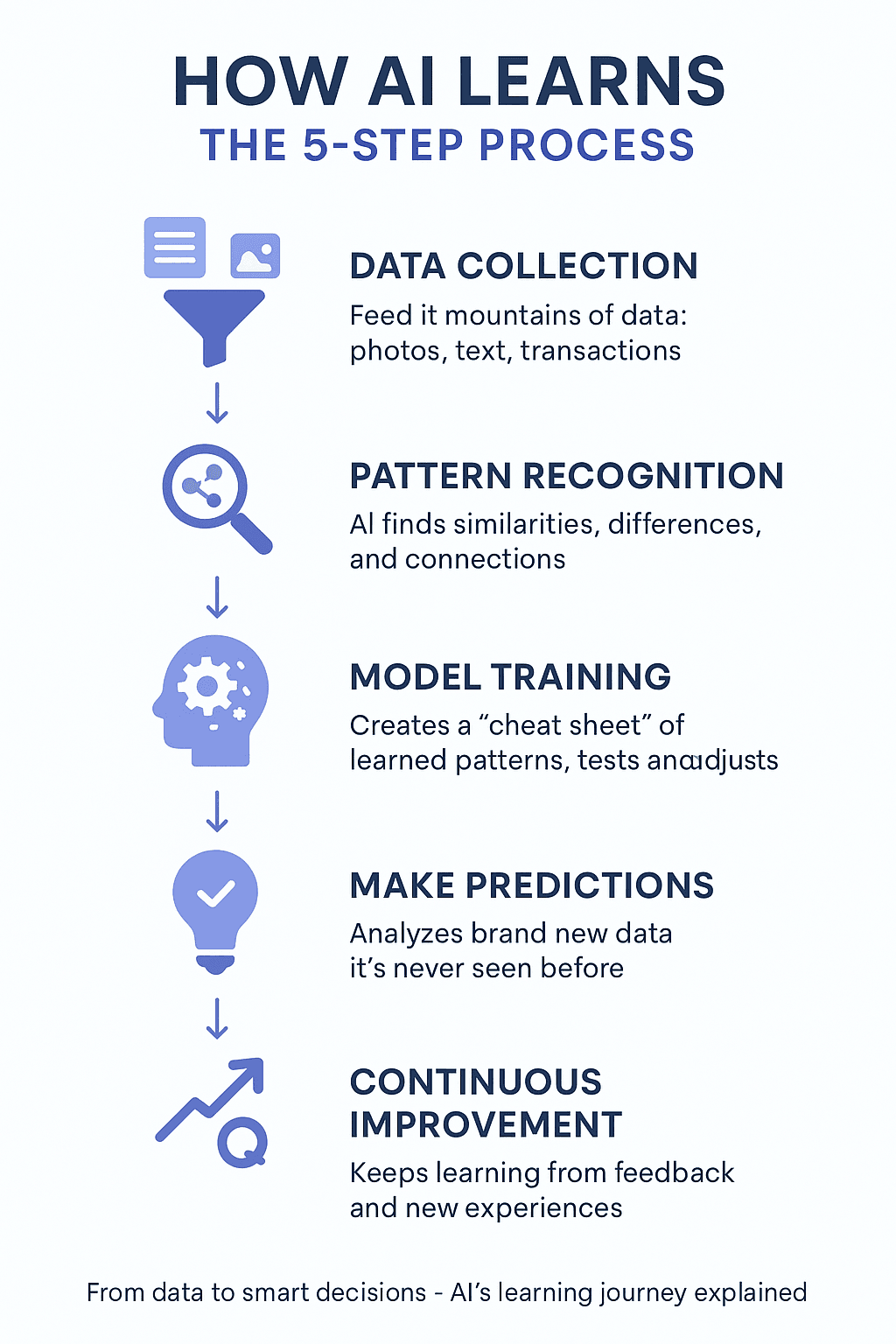
The Five Steps AI Takes to Get Smart
Step 1: Feed It Mountains of Data
Everything starts with data. Tons of it.
Want AI to recognize cats? Show it 100,000 labeled cat photos.
Want it to detect fraud? Feed it millions of transaction records.
Want it to translate languages? Give it billions of translated sentences.
More data = smarter AI. It’s that simple.
Step 2: Let It Hunt for Patterns
Here’s where the real work happens.
AI uses algorithms—think of them as mathematical recipes—to crunch through all that information. It looks for similarities, differences, connections.
With those cat photos, it starts noticing: “Things with pointy ears, whiskers, and four legs are usually cats.”
Step 3: Train the Model (Like Teaching a Student)
Once AI finds patterns, it creates what’s called a “model.”
Think of a model as a cheat sheet of everything it learned.
Mozilla researcher Becca Ricks puts it perfectly: “The algorithm is the program that works with the dataset. The model is the output that makes predictions.”
The model gets tested repeatedly. Makes mistakes? It adjusts. Gets something right? It remembers that approach.
Step 4: Make Predictions on Brand New Stuff
This is where AI becomes actually useful.
Show it a cat photo it’s never seen? It recognizes it.
Send it a new email? It knows if it’s spam.
Give it a chess position? It suggests the best move.
Step 5: Keep Getting Better
The best AI systems never stop learning.
Your Netflix recommendations improve the more you watch. Your phone’s autocorrect learns your weird vocabulary. Gmail’s spam filter adapts to new scam techniques.
That’s continuous learning in action.
Here’s a quick visual summary of how AI learns – save this for easy reference.
The Key Technologies Powering AI
Let me break down the most important concepts in the beginner guide to artificial intelligence:
Machine Learning
- AI’s foundation
- Computers learn from examples instead of following rigid rules
- Like showing a computer 10,000 spam emails so it recognizes future spam
Neural Networks
- Inspired by how your brain works
- Layers of digital “neurons” passing information
- Each layer finds increasingly complex patterns
Natural Language Processing (NLP)
- Helps AI understand human language
- Powers voice assistants and chatbots
- Why you can talk to Alexa like a person
Deep Learning
- Machine learning on steroids
- Uses multiple neural network layers
- Powers facial recognition and self-driving cars
A Simple Analogy
Think of AI like teaching someone to make pizza.
Traditional programming: Write detailed instructions for every possible pizza situation. “If customer wants pepperoni, add 15 slices. If they want mushrooms, add exactly 8…”
Machine learning: Show them 10,000 pizzas and let them figure out the patterns. They learn what makes a good pizza without you writing endless rules.
That’s the revolution.
Types of Artificial Intelligence Explained
When learning what is artificial intelligence for beginners, you need to understand there are different levels.
Some exist today. Some are science fiction. Some are theoretical dreams.
Let’s break them down.
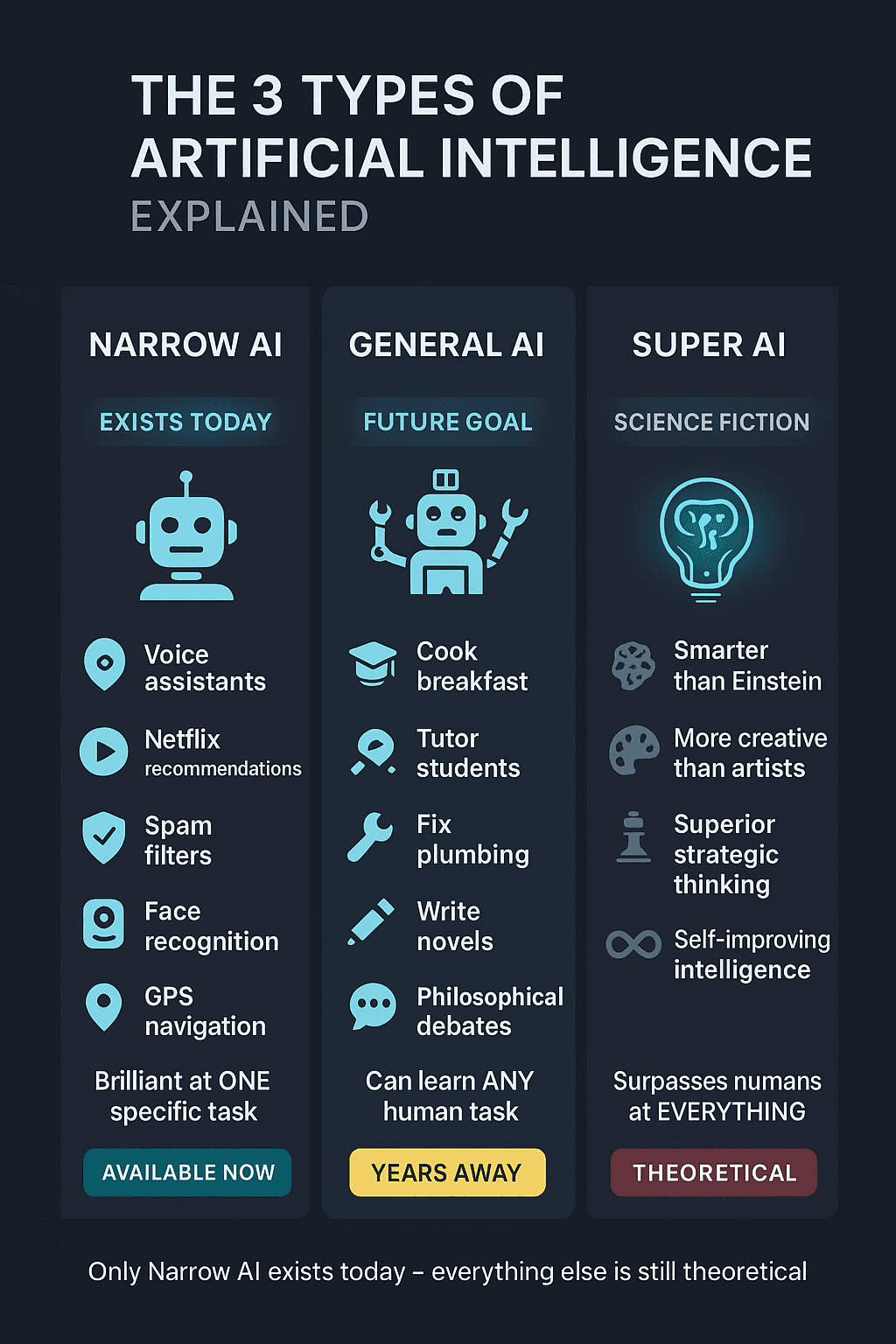
Narrow AI: What We Actually Have Right Now
This is every AI you’ve ever used.
Narrow AI (also called Weak AI) is brilliant at one specific job. But only that job.
Chess AI? Amazing at chess. Useless at everything else.
Spam filter? Excellent at catching junk mail. Can’t help with your taxes.
Face ID? Great at recognizing your face. Won’t drive your car.
According to NASA’s explanation of artificial intelligence, these narrow AI systems excel at singular tasks like facial recognition or speech processing, but they operate within strict boundaries.
Narrow AI You Interact With Daily:
- Voice assistants (Siri, Alexa, Google Assistant)
- Recommendation systems (Netflix, Spotify, YouTube)
- Email spam filters
- Face recognition on your phone
- GPS navigation apps
- Online shopping suggestions
- Credit card fraud detection
- Social media content filtering
This is the only type of AI that exists today.
Everything else? Still theoretical.
General AI: The Future Everyone’s Chasing
This is the AI from movies.
General AI (also called Strong AI or AGI) would think like a human. It could learn any task, understand context, transfer knowledge between completely different areas.
One AI system that could:
- Cook breakfast
- Tutor your kids in calculus
- Fix your plumbing
- Write a novel
- Have philosophical debates
All without specific programming for each task.
Sounds incredible, right?
Here’s the reality check: it doesn’t exist yet.
Not even close.
Despite flashy headlines, we’re still years—maybe decades—away from true General AI. We don’t fully understand human intelligence yet, so replicating it in machines is incredibly difficult.
Super AI: Pure Science Fiction
This is AI that surpasses human intelligence in every way imaginable.
Smarter than Einstein at physics. More creative than Picasso. Better strategic thinking than any general who ever lived.
All in one system.
Super AI is purely hypothetical. Scientists debate whether it’s even possible.
For now, let’s focus on Narrow AI—because that’s what’s actually changing your world right now.
Quick Comparison Table
| Types | Status | Example |
|---|---|---|
| Narrow AI | Exists today | Siri, Netflix recommendations, Spam filters |
| General AI | Doesn’t exist yet | AI that can do any human tasks |
| Super AI | Theoretical concept | AI smarter than humans at everything |
Let’s visualize these three types of AI so you can see exactly what’s real and what’s still theoretical:
Now that you know Narrow AI is the only type that exists today, let’s explore the real-world examples you’re already using…
Real-World AI Examples You Use Every Day
Let’s talk about AI applications for everyday life that surround you constantly.
These real-world examples of AI technology prove AI isn’t futuristic. It’s here. Working quietly in the background of your daily routine.
Your Virtual Assistant (More Helpful Than You Think)
“Alexa, what’s the weather?”
Simple question. Complex AI.
Virtual assistants use natural language processing to understand your voice. They figure out your intent, search for information, and respond conversationally.
They also learn your patterns.
Ask about traffic every morning at 7:15? Eventually, they’ll tell you proactively.
Entertainment That Knows Your Taste
Ever wonder how Netflix picks shows you actually want to watch?
It’s not lucky guessing.
The AI analyzes what you watch, pause, finish, skip, and rewatch. Then it compares your behavior to millions of other users with similar patterns.
Spotify does this with music. YouTube with videos. TikTok’s “For You” page? Powered by AI learning what keeps you scrolling.
Open Google Maps during rush hour.
It doesn’t just show the shortest route. It analyzes live traffic data from millions of users, predicts where slowdowns will happen, and reroutes you before you hit the backup.
That’s AI processing insane amounts of real-time data to make split-second decisions.
Online Shopping That Predicts What You Want
“Customers who bought this also bought…”
Amazon pioneered this. Now everyone uses it.
The AI tracks:
- What you browse
- What you buy
- What you return
- How long you look at items
- What similar shoppers purchased
Then it predicts what you might want next.
Sometimes it’s almost creepy how accurate it is.
Banking Protection You Never See
Your bank’s fraud detection works 24/7 in the background.
It knows your normal spending patterns. Where you shop. How much you typically spend. What time of day you make purchases.
When something breaks that pattern—like a $2,000 charge in another state—the AI flags it instantly.
You get a text: “Was this you?”
This system saves millions from fraud every day.
Healthcare Diagnostics Getting Smarter
Doctors now use AI to analyze medical images like X-rays, MRIs, and CT scans.
The AI has studied millions of scans. It learned to spot patterns indicating cancer, heart disease, or neurological problems.
According to IBM’s detailed analysis of AI in healthcare, these systems can process images faster than human radiologists and catch diseases in earlier stages.
It doesn’t replace doctors. It gives them a powerful second opinion.
Language Translation in Your Pocket
Traveling somewhere you don’t speak the language?
Google Translate, DeepL, and other apps use AI to convert text, speech, and even images instantly.
Point your phone at a restaurant menu in Japanese? It translates it in real-time.
These systems analyzed millions of translated documents to understand how languages relate to each other.
Social Media Content Filtering
The posts appearing first in your Facebook or Instagram feed? AI decides that.
It predicts which content you’ll engage with based on what you’ve liked, shared, and commented on before.
AI also identifies and removes spam, scams, and harmful content continuously.
Did You Know? The average person interacts with AI at least 10-15 times per day without realizing it.
What Is Generative AI? (The Newest Game-Changer)
Let’s talk about the AI everyone’s buzzing about.
Generative AI.
What Is Generative AI Simple Definition
Here’s the clearest way to understand it:
Traditional AI recognizes things. Generative AI creates things.
Old AI: “That’s a cat.” Generative AI: “Here’s a picture of a cat wearing a top hat at a coffee shop.”
It generates entirely new content—text, images, music, code, videos—that never existed before.
Think of it like this:
A librarian helps you find books. An author writes new books.
Traditional AI is the librarian. Generative AI is the author.
How Does Generative AI Actually Work?
Generative AI learns by consuming massive amounts of existing content.
ChatGPT analyzed billions of web pages, books, articles, and conversations. It learned patterns in how humans write, structure arguments, tell stories, and explain concepts.
When you ask it a question, it doesn’t search for an answer like Google.
It generates a new response based on patterns it learned.
It’s predicting the most likely next word, then the next, then the next—creating coherent, original responses in real-time.
Popular Generative AI Tools Changing Everything
ChatGPT (The One That Started the Craze)
This conversational AI can:
- Answer questions
- Write essays
- Debug code
- Brainstorm ideas
- Create stories
- Explain complex topics simply
It remembers context throughout your conversation, making interactions feel surprisingly natural.
DALL-E, Midjourney, and Stable Diffusion (AI Artists)
These systems create images from text descriptions.
Type: “A sunset over purple mountains with flying whales”
It generates exactly that. An image that never existed until you described it.
Artists, designers, and marketers use these to visualize concepts instantly.
GitHub Copilot (The Programmer’s Assistant)
This AI helps developers write code.
As you type, it suggests entire functions, complex algorithms, or debugging solutions.
It learned from millions of code repositories, understanding patterns in how programmers solve problems.
Gemini, Claude, and Others
Google’s Gemini and Anthropic’s Claude compete with ChatGPT.
Each has unique strengths. Gemini integrates with Google’s ecosystem. Claude excels at longer, more nuanced conversations.
Real Ways People Use Generative AI Daily
- Drafting and editing professional emails
- Generating social media content
- Creating artwork and design mockups
- Writing and debugging code faster
- Brainstorming solutions to problems
- Answering customer service questions
- Learning new topics through conversation
- Creating presentations and summaries
- Translating and adapting content
Generative AI went from experimental to essential incredibly fast.
It’s changing how people work across almost every industry.
Did You Know? ChatGPT reached 100 million users faster than any app in history—just 2 months after launch.
Why Understanding AI Matters to Everyone
You might be thinking: “I’m not in tech. Why should I care about what is artificial intelligence for beginners?”
Fair question.
Here’s why it matters to absolutely everyone.
Your Career Depends On It (Whether You Like It Or Not)
AI is reshaping every industry.
Not just tech.
Healthcare workers use AI for diagnostics. Marketers use it for content and targeting. Teachers use it for personalized learning. Lawyers use it for document analysis. Artists use it for inspiration and creation.
The people who understand how to work with AI have massive advantages over those who don’t.
You don’t need to become a programmer.
You need to understand what AI can do and how to leverage it.
It’s Already Making Decisions About Your Life
AI systems are deciding:
- Whether you get that loan
- If your job application gets seen
- What news appears in your feeds
- Whether your insurance claim gets approved
- If your resume passes initial screening
Understanding how AI works helps you understand these decisions.
And sometimes, spot when they’re wrong or biased.
You Can Use It to Boost Your Productivity
People who understand AI tools get more done in less time.
They use:
- ChatGPT to draft documents
- DALL-E to create visuals
- AI coding assistants to build websites
- Voice transcription AI to turn meetings into notes
This isn’t about replacing human skills.
It’s about amplifying them.
Privacy and Data Matter More Than Ever
AI learns from data.
Often, that data includes information about you.
Understanding how AI works helps you make informed decisions about:
- Which apps to trust with your data
- What information to share online
- Which AI-powered features to enable
- When to opt out of data collection
Knowledge equals power, especially with your digital privacy.
The Technology Isn’t Slowing Down
AI advances faster than most people realize.
What seemed impossible five years ago is normal now.
What seems cutting-edge today will be basic tomorrow.
Starting to understand AI fundamentals now—even at a beginner level—positions you to adapt as things evolve.
The earlier you learn the basics, the easier it becomes to keep up.
Quick Takeaway: Understanding AI basics isn’t optional anymore—it’s essential for career growth, informed decision-making, and staying relevant in 2025 and beyond.
Common Questions About AI (Answered Simply)
Is AI going to take my job?
Let’s be honest about this.
AI will change most jobs. But “change” doesn’t always mean “eliminate.”
Think of AI as a powerful assistant, not a replacement.
It handles repetitive, time-consuming tasks. Humans focus on creativity, strategy, emotional intelligence, and complex problem-solving.
Programmers use ChatGPT to optimize code—they’re not being replaced, they’re becoming more efficient.
Writers use AI to draft outlines—but humans still edit, refine, and add unique perspectives.
The jobs at highest risk involve pure repetition with no creative judgment.
But even there, new jobs emerge—someone needs to train, monitor, and improve these AI systems.
Can AI make mistakes?
Absolutely.
AI can be confidently wrong.
It can show bias based on flawed training data.
It sometimes “hallucinates”—generates plausible-sounding but completely incorrect information.
This is why human oversight remains crucial.
Always verify important information from AI systems. Use critical thinking. Don’t blindly trust AI outputs just because they sound confident.
Do I need to be good at math to understand AI?
Not at all.
Creating AI systems requires serious mathematical knowledge—statistics, calculus, linear algebra.
But using and understanding AI concepts?
That just requires curiosity and willingness to learn.
You’re reading this guide right now without needing a single equation.
That proves the point.
Is AI conscious or self-aware?
No.
Zero. Not even close.
Current AI, including advanced systems like ChatGPT, doesn’t possess consciousness, emotions, or self-awareness.
It processes patterns in data extremely well.
But it doesn’t “think” or “feel.”
When ChatGPT says “I think” or “I understand,” that’s just trained language patterns. It’s mimicking how humans communicate, not experiencing thoughts or feelings.
Can I start using AI tools without technical skills?
Yes! That’s the beautiful part.
Modern AI tools are designed for normal people.
ChatGPT, Grammarly, Canva’s AI features—they all work through simple conversations or clicks.
No coding required. No technical background needed.
Just start experimenting.
What’s the difference between AI, machine learning, and deep learning?
Simple explanation:
- AI = The big umbrella term for making computers intelligent
- Machine Learning = A specific method where systems learn from data
- Deep Learning = An advanced version using neural networks
Think of it as: AI is the category. Machine learning is the technique. Deep learning is the advanced version of that technique.
Are there ethical concerns with AI?
Definitely.
Privacy issues. Bias in decision-making. Job displacement. Potential for manipulation. Deepfakes and misinformation. Environmental impact of training massive models.
These are real concerns.
Researchers, companies, and governments are actively addressing them.
Being an informed AI user means understanding both opportunities and risks.
Question how AI is being used. Advocate for transparency. Support ethical AI development.
Your Next Steps with AI
Now you understand what is artificial intelligence for beginners.
You know how it works. The types that exist. Real applications you’re already using. Why it matters.
So what’s next?
Start Experimenting Today
The best way to understand AI is to use it.
Try free tools:
- ChatGPT for conversations and questions
- Google Gemini for research and planning
- Canva’s AI for creating visuals
- Grammarly for writing improvement
Ask questions. Request help with tasks. See what these systems can and can’t do.
Hands-on experience teaches you more than any guide ever could.
Stay Curious But Critical
Approach AI with open-minded skepticism.
Appreciate its capabilities.
Recognize its limitations.
Don’t believe everything an AI generates. Verify important information. Think critically about how AI might be biased or wrong.
Keep Learning (Without Getting Overwhelmed)
AI evolves rapidly.
You don’t need to understand every new development.
Follow a couple of trusted sources. Join online communities. Read articles when topics interest you.
You don’t need to become an expert.
You just need to stay reasonably informed.
Think About the Bigger Picture
As you use AI, consider the implications.
How does this affect privacy?
Could this system be biased?
What data is it collecting?
How might this technology impact society?
Being an informed user means thinking beyond just “does this work?”
Explore Related Topics
Want to dive deeper? Consider learning about:
- Prompt engineering (how to write better AI instructions)
- AI ethics and responsible use
- Specific AI tools for your industry
- Future trends in AI development
Recommended Next Read: “Prompt Engineering for Non Coders”
AI Glossary for Beginners
Algorithm: A set of mathematical rules that tells AI how to solve problems or find patterns.
Artificial Intelligence (AI): Software that learns from data to make intelligent decisions without explicit programming.
Bias: When AI makes unfair decisions based on flawed or unrepresentative training data.
Chatbot: An AI program designed to have text conversations with humans.
Deep Learning: Advanced machine learning using neural networks with multiple layers.
Generative AI: AI that creates new content (text, images, music) rather than just analyzing existing data.
Hallucination: When AI confidently generates incorrect or made-up information.
Machine Learning: A subset of AI where systems improve through experience without being explicitly programmed.
Model: The output of AI training—essentially what the AI has learned from data.
Natural Language Processing (NLP): Technology that helps AI understand and respond to human language.
Neural Network: AI architecture inspired by how human brains work, with interconnected digital “neurons.”
Training Data: The information used to teach AI systems how to recognize patterns and make decisions.
Wrapping It All Up: Your AI Journey Starts Right Here
Remember that question my mom asked about her phone finishing her sentences?
Now you understand the answer.
AI isn’t magic. It’s pattern recognition on a massive scale.
It’s software that learned how millions of people type, what words commonly follow other words, and what you personally tend to say.
And here’s what I want you to remember most:
Artificial intelligence isn’t some mysterious technology locked away in research labs.
It’s already woven into your daily life. From your morning alarm analyzing your sleep patterns to Netflix’s evening recommendations.
Understanding what is artificial intelligence for beginners empowers you.
It helps you leverage these tools effectively. Make informed decisions. Prepare for an increasingly AI-driven future.
Whether you’re asking Alexa about the weather, using AI to improve your writing, or simply understanding how your spam filter works—you’re interacting with one of humanity’s most transformative technologies.
The key takeaway?
AI isn’t something to fear. It’s not something to feel intimidated by.
It’s a powerful tool that, when understood and used responsibly, can enhance human capabilities, solve complex problems, and create opportunities we’re only beginning to imagine.
Your AI education doesn’t stop here.
It’s just beginning.
Keep asking questions. Stay curious. Experiment with tools. Think critically.
Every expert in artificial intelligence started exactly where you are right now—curious, eager to learn, and taking those first important steps toward understanding this remarkable technology.
Now go try something.
Ask ChatGPT a question. Use an AI image generator. See what these tools can do.
The future isn’t coming.
It’s already here.
And now you understand how it works.
If this topic sparked your curiosity, the next lesson will make things even clearer. Machine learning sounds intimidating at first, but once you see how it actually works behind the scenes, it becomes surprisingly relatable. In the next guide, I break it all down using everyday examples—no code, no math, no tech overwhelm.
Go to Next Lesson:
How Machine Learning Works (Without the Technical Overwhelm)
Now that you understand what artificial intelligence is and how it’s used in everyday technology, the next step is exploring the engine that powers most modern AI systems: machine learning.
Machine learning is the reason AI can improve over time instead of simply following fixed rules. Instead of being programmed for every possible situation, machine learning systems analyze data, recognize patterns, and gradually get better at making predictions.
In the next guide, you’ll learn how machine learning actually works using simple, real-world examples—without complicated math or technical jargon.
👉 Read next: How Machine Learning Works (Without the Technical Overwhelm)